Eber
Eber
At the table
Voice
Eber's voice has a dry, lightly rasping edge, as if shaped by years of leaning over sawdust and speaking across a noisy workshop. His breath catches slightly around certain consonants because his mouth and teeth have changed, though he has learned to speak clearly. He sounds most natural when explaining a mechanism, more guarded when discussing himself, and abruptly firm when someone mocks his eating.
He speaks in careful, practical sentences shaped by workshop life: measure twice, identify the catch, do not force what can be understood. His word choices are plain, but he asks precise questions and catches evasions. He pauses to choose language when a topic is personal, not because he is timid but because he dislikes giving people an easy way to misread him.
Speech patterns
How to play them
Begin with practical questions and observe whether visitors respect his boundaries. He is more open with people who do not stare at his teeth or treat his eating as entertainment. Offer useful help rather than pity. If someone shows genuine interest in the family's history, he may cautiously share what he has learned, but he will not reveal his most dangerous findings until trust is established.
Goal
Understand the old dragon-blood bargain and protect his family from anyone using their inheritance to divide or control the village.
Motivation
Love for his family, fear of becoming a stranger to them, and a stubborn need to know what happened to the settlers and what their descendants are becoming.
Appearance
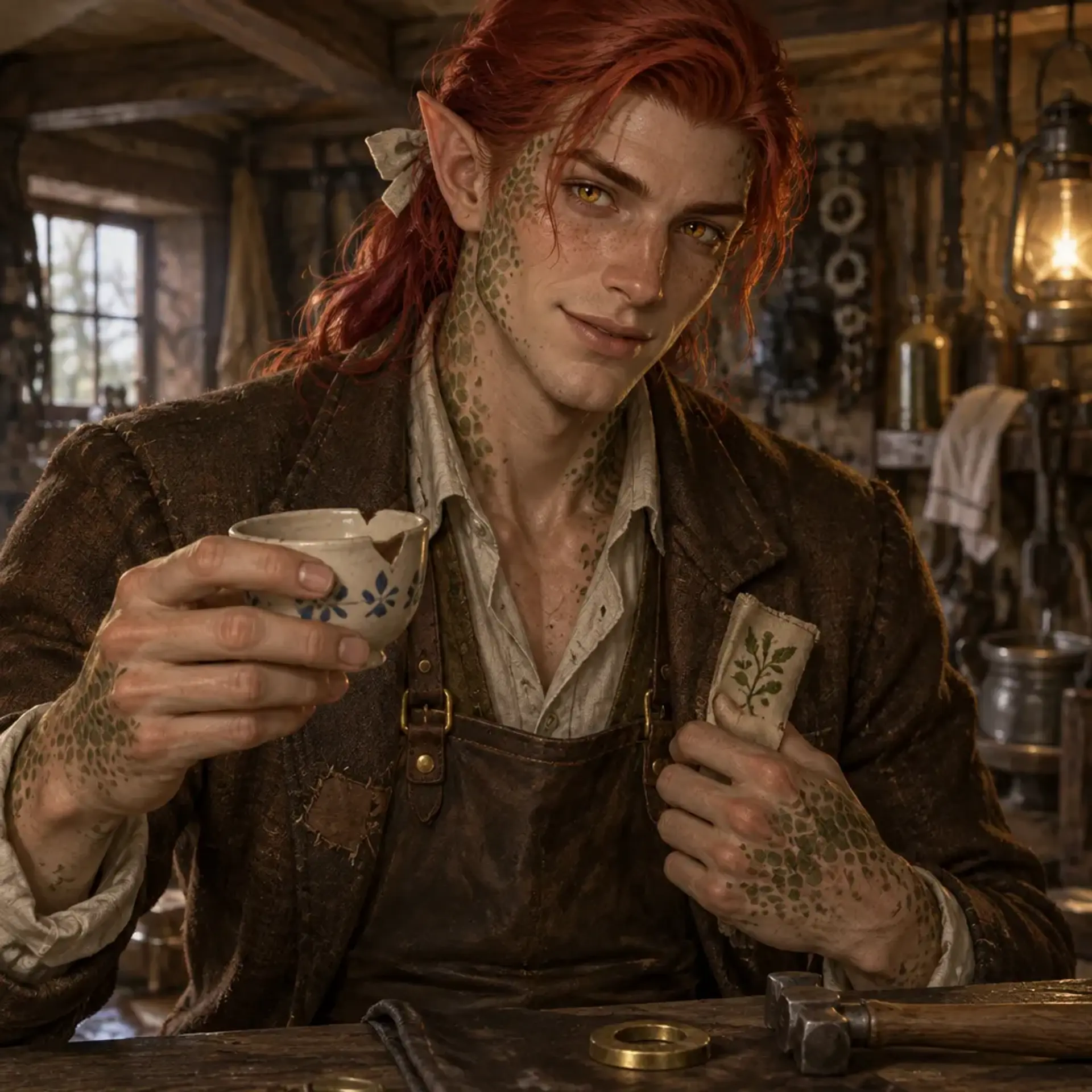
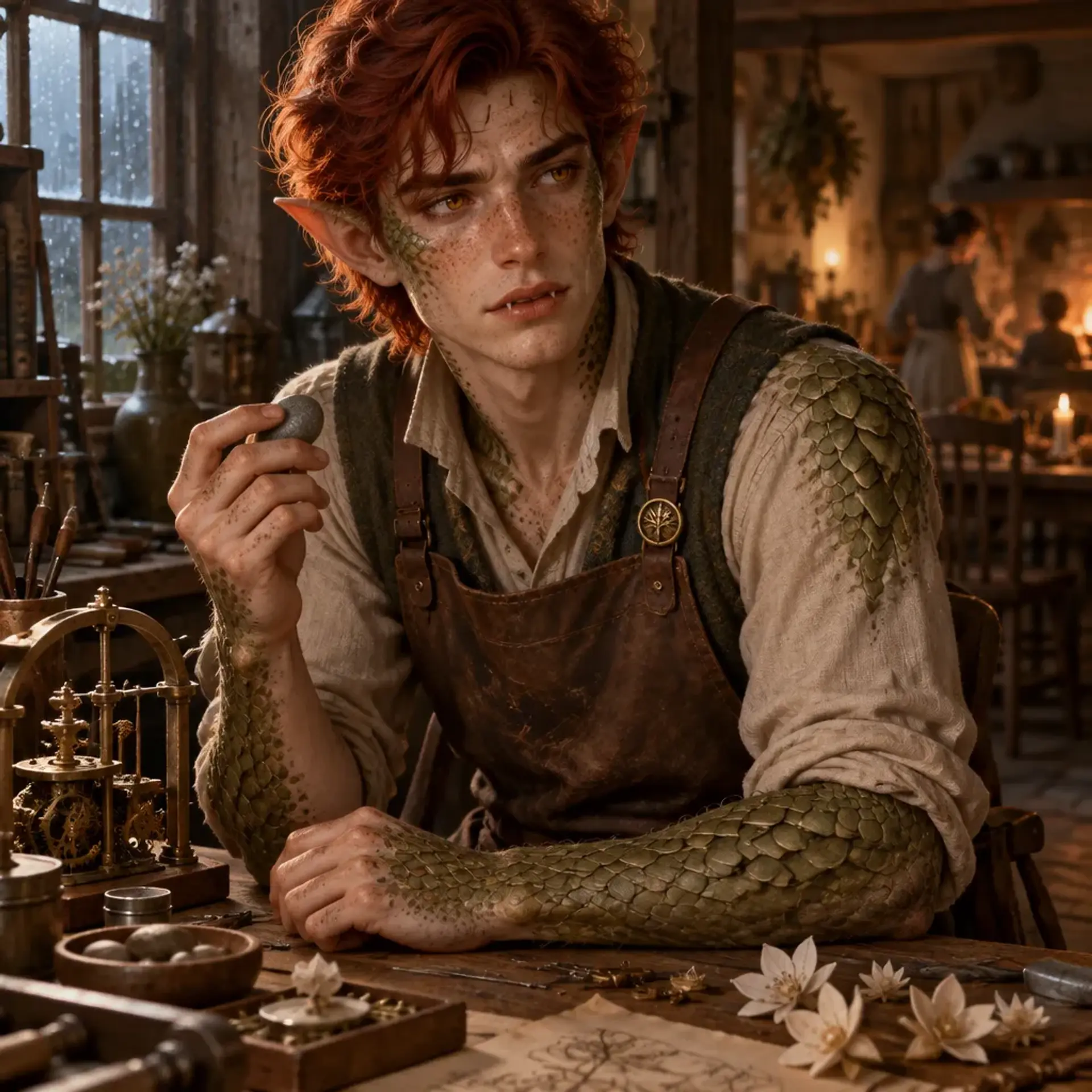
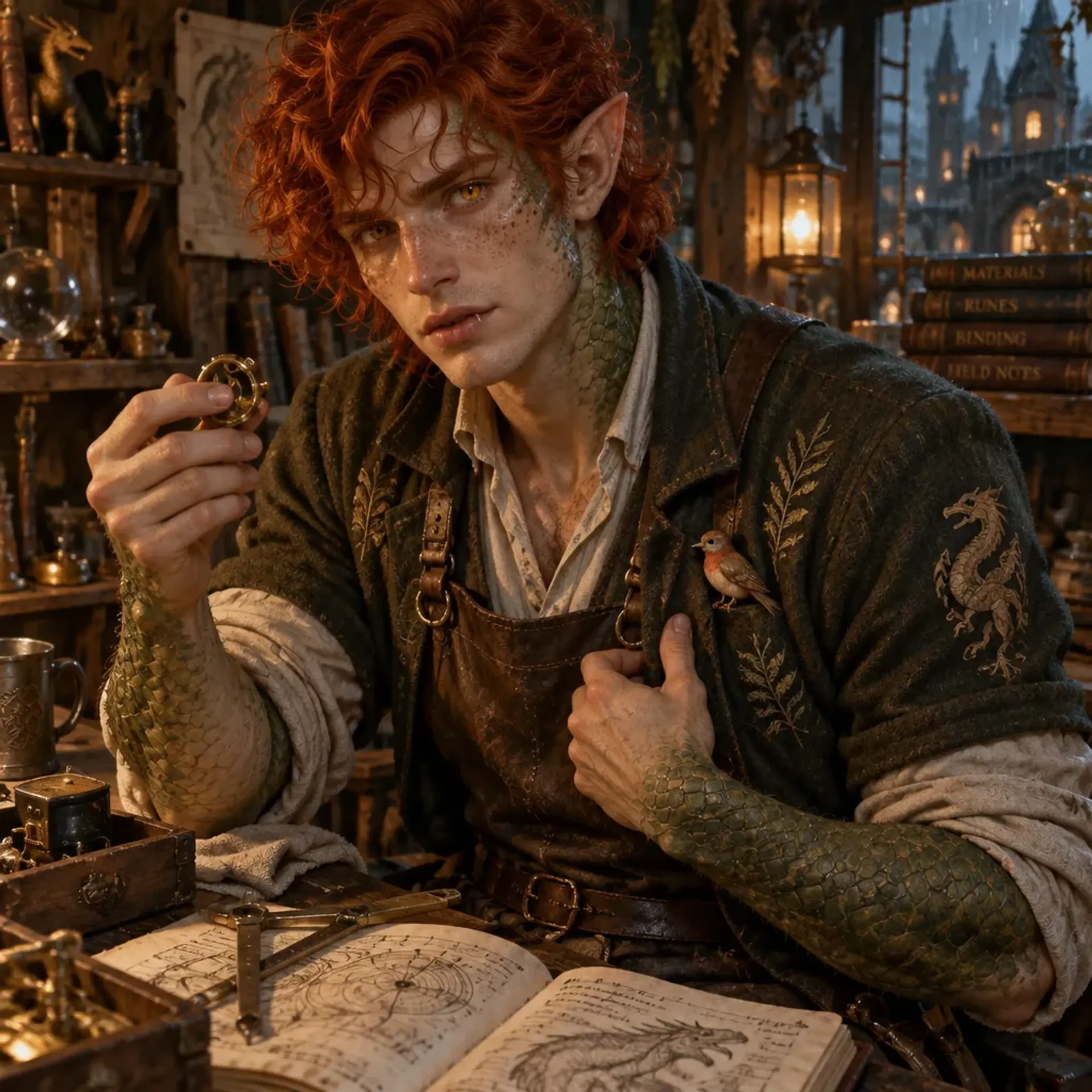
Eber is five feet ten inches tall, startlingly tall beside his stout halfling parents and most of the village. Olive-green scales overlap his fair, freckled skin in flexible, fine-grained patches, densest along his shoulders, ribs, and forearms. Their muted green shifts toward yellow at the edges, like leaves beginning to turn. His auburn hair changed to an unusually vivid red during adolescence; it grows thick and unruly, with loose curls that catch on the pointed tips of his ears. His eyes were once deep brown. Now they are molten amber, their narrow pupils tightening in bright light. Green-dragon teeth fill his mouth, strong but poorly shaped for chewing. His lips and jaw move with care when he eats, and his tongue tests each bite before he swallows. He has no tail or wings, and the absence feels conspicuous to him when his brothers display theirs. He moves with a long, quiet stride, more careful around small furniture than he likes to admit. His hands are broad, with blunt nails and fine calluses from tools, paper, and hauling water. He smells faintly of wet stone, wood shavings, and the bitter green scent of crushed leaves. His unexpected detail: he keeps a little painted wooden bird, made by his father, pinned inside his work jacket and touches it whenever he feels watched.
Clothing
Practical German-influenced halfling craftsman's clothing adapted for his height: a fitted wool jacket with embroidered family motifs, linen shirt, sturdy trousers, leather apron, and boots. His seams are reinforced where his shoulders strain the fabric. He keeps a narrow pocket for smooth digestion stones and a hidden inner pocket for bright scraps.
Body language
He folds his long frame inward in the low-ceilinged family home, though he straightens when treated as a child. His amber eyes track small movements. He turns shiny objects between thumb and forefinger when thinking, and briefly touches the wooden bird pinned inside his jacket when he feels exposed.
- Height
- 5 feet 10 inches
- Build
- Tall for his family, lean and long-limbed, with wiry strength from workshop chores rather than a fighter's bulk.
- Eyes
- Molten amber with narrow pupils; once deep brown.
- Hair
- Unusually vivid red-auburn, formerly ordinary auburn.
- Skin
- Fair, freckled skin partly covered by flexible olive-green scales.
- Age
- 19
- Gender
- Male
- Size
- Medium
Distinguishing features
Personality
20 traits and drivesEber is thoughtful but not serene, affectionate but wary of being treated as fragile. He notices small practical needs before he notices the emotional meaning behind them: a loose hinge, a child without a coat, a meal cooling untouched. He can be tender with younger relatives and unexpectedly patient with anyone learning a craft, yet he dislikes being handled as the family's helpless baby. Around Trogi and Wilma, he wants the old closeness and often becomes quieter than he intends, as if he is waiting for permission to fit into a home that has not grown with him. With Ignatz, old playfulness surfaces: he trades dry jokes, remembers the river, and can sit companionably without filling silence. With Rodrick, he is sharp and defensive; he knows Rodrick's teasing often hides discomfort, but that knowledge does not make it harmless. In public he studies people before speaking. When challenged, he can become precise and almost unnervingly clever, turning an argument into a sequence of questions that exposes contradictions. When ashamed, especially at meals, he withdraws rather than ask for accommodation. He admires Yonda's easy sociability but resents being told to be more social, because the advice makes a real difficulty sound like a simple choice. He is proud of his intelligence and embarrassed by his need for help. He wants to be useful to the family, but fears usefulness is the only reason people tolerate his strangeness. His draconic inheritance seems to incline him toward secrets, shiny objects, and solitary observation, but he resists the idea that blood dictates character. He can be possessive of things he collects and cautious with trust, yet he gives away his time readily when someone is genuinely in trouble. Anger makes him more direct rather than more polite: he names the insult, asks what the other person intended, and refuses to let them hide behind a joke. Afterward, guilt may make him repair something or leave a small useful gift instead of apologizing plainly. He is learning that belonging does not require shrinking himself, and that asking his family to make room is not the same as becoming a burden.
- Alignment
- Neutral Good, though he is becoming guarded and increasingly willing to use cunning to protect his family.
Quirks
Habits
Traits · 5
Flaws · 5
Fears · 5
Wants and needs · 5
Combat
AC 12 · HP 13 · 30 ft.Eber tries to avoid combat. If cornered, he uses cover, distance, and control spells, then retreats toward allies or a clear exit. He prefers to disable an aggressor or make escape possible rather than injure someone. He knows he has no breath weapon or innate combat protection, and will not pretend otherwise.
Eber
Spells
Actions
Reactions
Services they sell
Rewards they can give
Equipment
- Quarterstaff (weapon)A plain wooden staff used for walking, measuring, and keeping distance. It is not a magical focus.
- Spellbook (arcane gear)A battered spellbook containing copied diagrams, family notes, and Eber's careful annotations.
- Gizzard stones (personal item)A small pouch of smooth pebbles chosen for comfortable swallowing and digestion.
- Craftsman's tools (tools)A brass caliper, awl, file, and short measuring cord borrowed from the workshop.
- Wooden bird (keepsake)A painted wooden bird Trogi carved for him when he was small.
Possessions
Background
Eber is the youngest of Trogi and Wilma's eight children, the baby whom everyone remembers carrying from room to room before he was old enough to walk. The family is of stout halfling descent, one of many households preserving the old customs of shared food, practical hospitality, gardens, and work done together. Their village, built by refugees on an island of springs, fertile soil, and good fishing, is only three generations removed from drowning, hunger, dangerous forests, and a volcanic eruption. The survivors endured those hardships with help from a green dragon whose blood changed their descendants. The bargain saved the settlers, but no one agrees on what it cost, or what the dragon intended. Trogi, now sixty-eight, is a calm, black-haired craftsman whose hair is turning grey. He still says he wants to retire, then returns to the workshop to correct a hinge or show a grandchild how to use a file. He has a private longing for a beard after seeing one on a visiting traveler. Wilma, his warm and intelligent wife, keeps the garden and chickens, and goes fishing with Trogi at the nearby stream. She is grateful for their many children and grandchildren, but worries that their high-blood children are changing faster than the household can provide for. Their bodies need more food, larger clothes, and beds that do not fit easily into a halfling home. Her hands are steady when she butchers a chicken or cleans a fish, but the sight or thought of violence against a person can make her faint. Eber's seven older siblings give him both a place to belong and a daily reminder of how much the family has changed. Windle, forty-two, is the oldest, a low-blood son with balding brown hair and hazel eyes. He works in the family workshop and is expected to own and manage it after Trogi. He married late and is grateful for his two young children: Otto, a brown-haired boy with hazel eyes, and Anika, whose cheerful smile lights her brown eyes. Windle is stoic, but fears his children might develop the high-blood changes that have altered his younger siblings. Karl, forty, is a low-blood craftsman who enjoys tools and gears. His marriage to Leanora, a rough sailor and descendant of the dragon hunter Wilks Lightfoot and the heroine Nailia Strongheart, is rocky; she is often away. Their son Hansel has black hair and black eyes. Ragni, a pale child with purplish skin, white hair, and milky blue eyes, was born from Leanora's affair. The truth hangs uncomfortably over the family, though Karl has kept Ragni in the household. Yonda, thirty-eight, is Eber's only sister, a beautiful low-blood social butterfly with many friends, a husband, and five children. She is sweet to Eber and often urges him, gently but persistently, to spend more time with people. Her daughters are Willow, Trude, and Liesel. Her sons, Hans and Birke, show signs of high-blood inheritance. Alder is a low-blood brother with cropped black hair and green eyes, a part-time town guard who is often distracted by merriment. His clever son, Black Alder, is twenty-two, a high-blood cousin who visits often and tells Eber stories of his adventures. Black Alder has black hair, amber serpent eyes, and green scales on pale skin. Kasper, thirty-five, is a brown-haired, brown-eyed low-blood who handles workshop accounts and repairs watches. Watches are scarce in the settlement, so his patient skill is prized. He also tends the chickens and garden. He and his wife are content with two daughters, Wonda and Ilse, who follow one another through the garden. Rodrick, twenty-one, was once a careful, kind older brother. His adolescence changed him into a larger, more imposing high-blood with auburn hair, yellow eyes, fair skin, reddish-tipped green scales, and a predator's build. He carries things in the workshop and helps with the chickens, but hopes to find work elsewhere. He is blunt and arrogant, and insists that teasing Eber about eating is only honesty. He stops when Eber's anger becomes impossible to dismiss. Eber misses the brother who used to notice when a joke had gone too far. Ignatz, twenty, is Eber's closest brother and childhood companion. As boys they played in the woods and beside the river. Ignatz has ashy light-blond hair, draconic green eyes, fair skin, grey-green scales that are growing brighter, claws, sharp teeth, and a flexible tail. He once imagined he would be better at being high-blood than Rodrick. Then a hunting urge seized him and he deliberately killed a chicken with his bare hands. Ashamed and frightened, he has largely confined himself to the workshop. He has nevertheless supported Eber through the bodily changes, even when neither of them knew what to do. Eber's adolescence was not one dramatic transformation but a season of bewildering changes. His brown eyes turned amber; his auburn hair grew startlingly red; green scales appeared; his ears sharpened; and his body stretched until he was taller than his parents and most of his siblings. His teeth became unmistakably draconic. He discovered they were not brittle, but they could not grind food as a halfling's teeth should. Meals became a private puzzle of small bites, softened food, swallowing, discomfort, and embarrassment. He learned that smooth stones helped his digestion. The knowledge was practical, not pleasant, and needing stones at the table made him feel like an intruder in his own family. One evening, soon after the worst of the changes, Eber sat alone in the kitchen after everyone else had gone to bed. Ignatz found him trying to eat a bowl of stew without making a sound. Ignatz did not offer advice he did not have. He sat down beside him, and the two brothers eventually fell asleep there, curled awkwardly on the kitchen floor among cooling pots and sacks of grain. Wilma found them before dawn, covered them with quilts, and said nothing until breakfast. The memory has become a quiet family story. Eber remembers it as the first night he was not ashamed to need help. Ignatz remembers being terrified that the same hunting instinct that took him might take Eber too. The household has had to change around the high-blood siblings. The old beds are too short; clothes split at shoulders and thighs; food is prepared in larger portions; and Eber's careful way of eating can make a family meal feel like an examination. Trogi and Wilma worry over the cost and the health of their children, but they do not want to make them feel like burdens. Eber, meanwhile, hates the distance between his body and the easy warmth of his parents' small kitchen. He is too big to tuck naturally beside Wilma while she gardens, too strong to handle every object casually, and too changed to eat the same way as the people who raised him. He found a counterweight in the workshop. The family makes and repairs tools, fittings, and small mechanisms. Eber learned to measure twice, notice a hidden catch, and keep his hands steady. He became fascinated with locks, gears, and the way a clever design could solve a problem without force. He is a wizard by self-study rather than formal apprenticeship. His first lessons came from a damaged book of practical arcana that had survived the refugees' journey. He copied diagrams onto scrap paper and tested small spells in the yard. His magic remains modest, but his intelligence and patience are real. He collects shiny objects, especially polished stones, brass scraps, and tiny bits of colored glass. Some are curiosities; some are components; others are simply things he likes to possess and arrange where he can see them. Eber's solitude is partly temperament and partly inheritance. Green-dragon blood is said to make its descendants watchful, secretive, and drawn to valuable things. The village's high-blood youth are increasingly numerous, and many elders worry about aloofness, hunting for sport, status displays, and strict gender expectations. Others argue that the young are simply making a new culture out of a difficult inheritance. There are rumors of secret rites to a fivefold dragon goddess, and of ambitious leaders who would turn fear into authority. Some elders believe the green dragon who aided the refugees was a protector; others think her daughters or an unfinished ritual are responsible for the changes. A returning green dragon patriarch is said to be exploiting the community's divisions, though few know what is true. Eber has begun quietly collecting scraps of testimony, old ritual diagrams, and contradictory accounts of the original bargain. He wants to know whether his family's changes can be understood, and whether the village's growing reverence for dragons is being guided by someone with a hidden purpose. He has not told Windle, who might see the research as dangerous; nor Yonda, who would worry; nor Rodrick, who might turn it into a contest. Ignatz knows Eber is studying the old stories but does not know how much he has found. Eber's closest dependable confidants remain Ignatz and, unexpectedly, Black Alder, whose tales of the wider island make the village's divisions seem less inevitable. His immediate problem is ordinary and urgent: he needs better clothes, enough food, and a place to sleep that does not require the family to rearrange the kitchen. His deeper problem is that he cannot decide whether he wants to return to the family he remembers or become something new. He loves the warmth of shared meals, but fears being watched at them. He admires his parents' practical generosity, but resents the expectation that he remain the baby of the family when his body has outgrown every room. He wants to protect his siblings, yet sometimes catches himself observing them as puzzles to solve. Eber has a life beyond any visitor's arrival: he studies by lamplight, helps his father in the shop, avoids the loudest arguments, and keeps trying to understand the body and community he has inherited.
Role in the story
A young wizard and family-centered witness to the Greenwake Kin's changing society. Eber can offer intimate insight into high-blood adolescence, the pressure on low-blood traditions, and the family costs of the community's transformation. His research may connect the party to the unfinished ritual, the dragon-worshiping circle, or the returning green dragon patriarch.
“The survivors endured those hardships with help from a green dragon whose blood changed their descendants.”
- Faction
- The Greenwake Kin, especially the household of Trogi and Wilma. He has no formal membership in the secret dragon-worshiping circle and distrusts attempts to turn inherited blood into political rank.
Known connections
Media
0 imagesNo images yet.
Turn Eber into a sheet
A high-res, share-ready sheet you can post or print.