Friedreich
Friedreich
At the table
Voice
A breath caught behind the teeth, followed by a dry, wool-rough voice with crisp Brandenburg diction. The sound is shaped by remembered military habits and by the effort of making himself audible across a boundary that does not always cooperate.
His voice seems to begin with the body rather than the mouth: a small catch of breath, a restrained throat-clear, then a deliberate sentence. Its texture carries the rasp of old wool and the dry precision of someone accustomed to being heard over wind or machinery. Brandenburg German formality colors his phrasing, though years among modern companions have given him casual football vocabulary and contemporary slang. When calm, he articulates carefully and may pause over a date or name. When angry, his pace tightens and his consonants become sharply distinct; he does not soften his delivery.
Speech patterns
How to play them
Treat Friedreich as a person rather than a puzzle. Acknowledge him directly if you can perceive him, and ask permission before discussing or examining a borrowed face. He responds to practical companionship, football, market bargaining, and sincere questions about his friends. Do not pretend that Wilhelm's silences are harmless, but avoid assuming Friedreich knows the whole history. His protectiveness can be redirected by giving him a meaningful task and asking what Mila or another friend actually wants.
Goal
Recover a reliable account of his death and the opening of his Caul, confront Wilhelm about both world wars, and keep his chosen family together without losing himself to borrowed faces.
Motivation
To be recognized, to protect the people who have made a place for him, and to discover whether the young man he remembers was ever real in the way he hopes.
Appearance
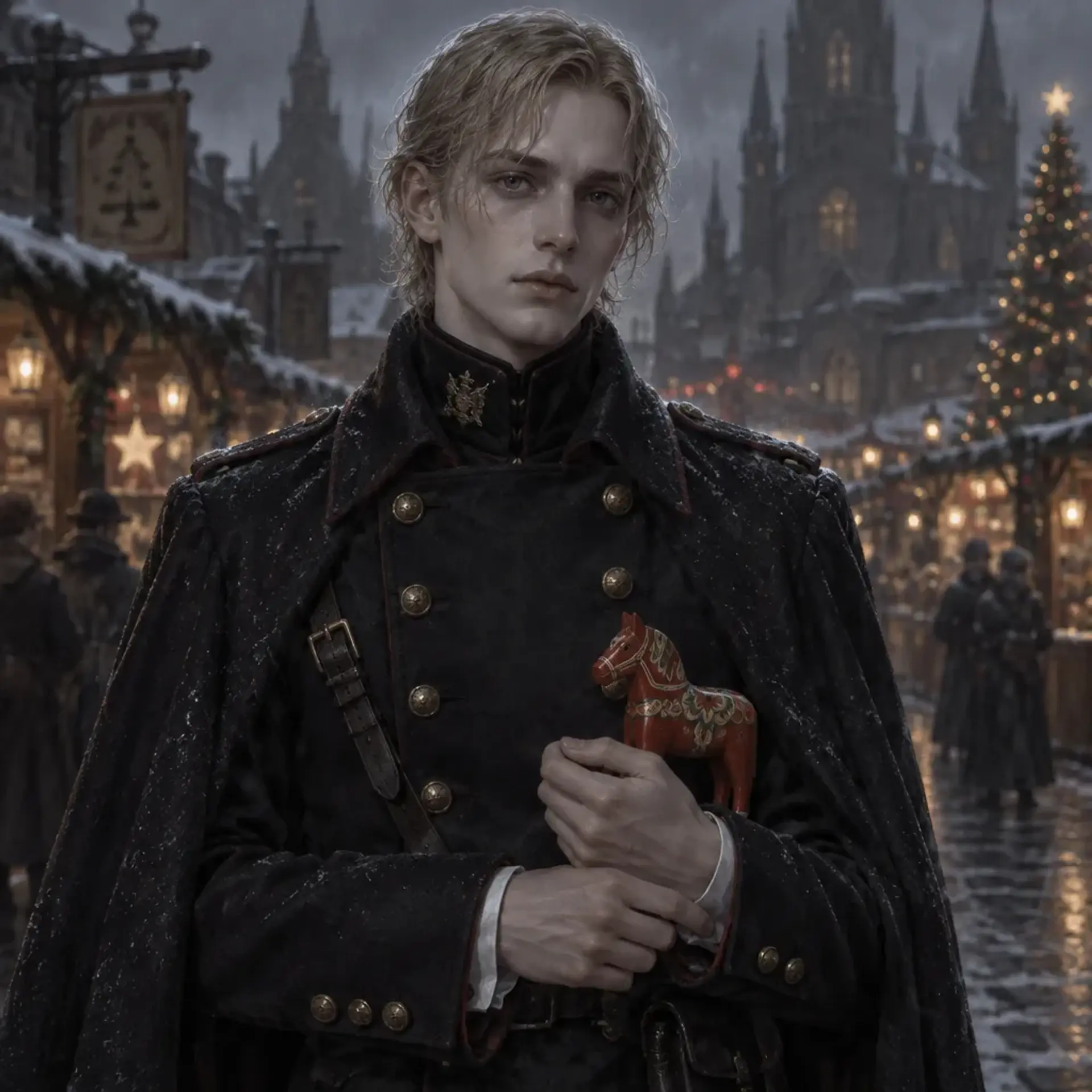
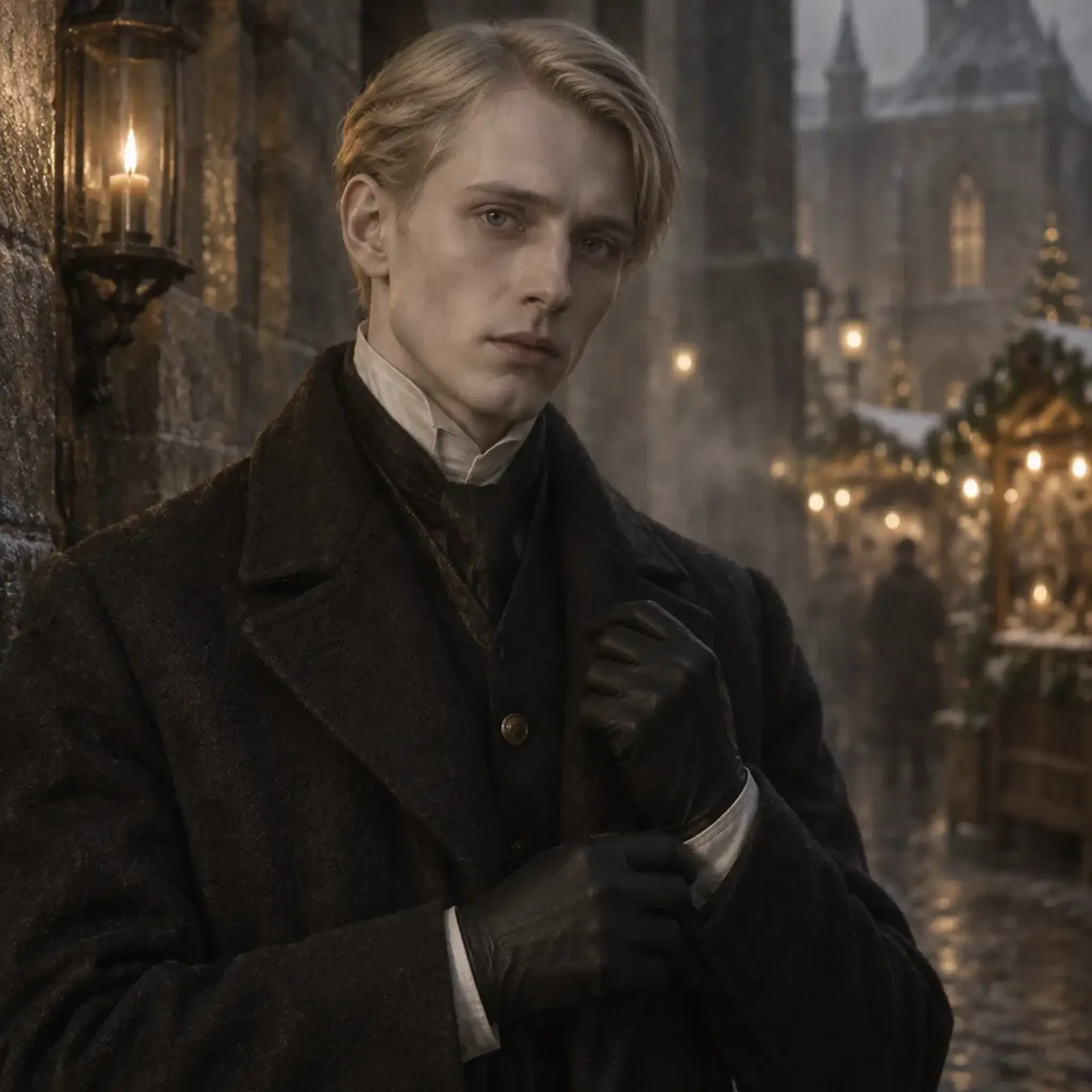
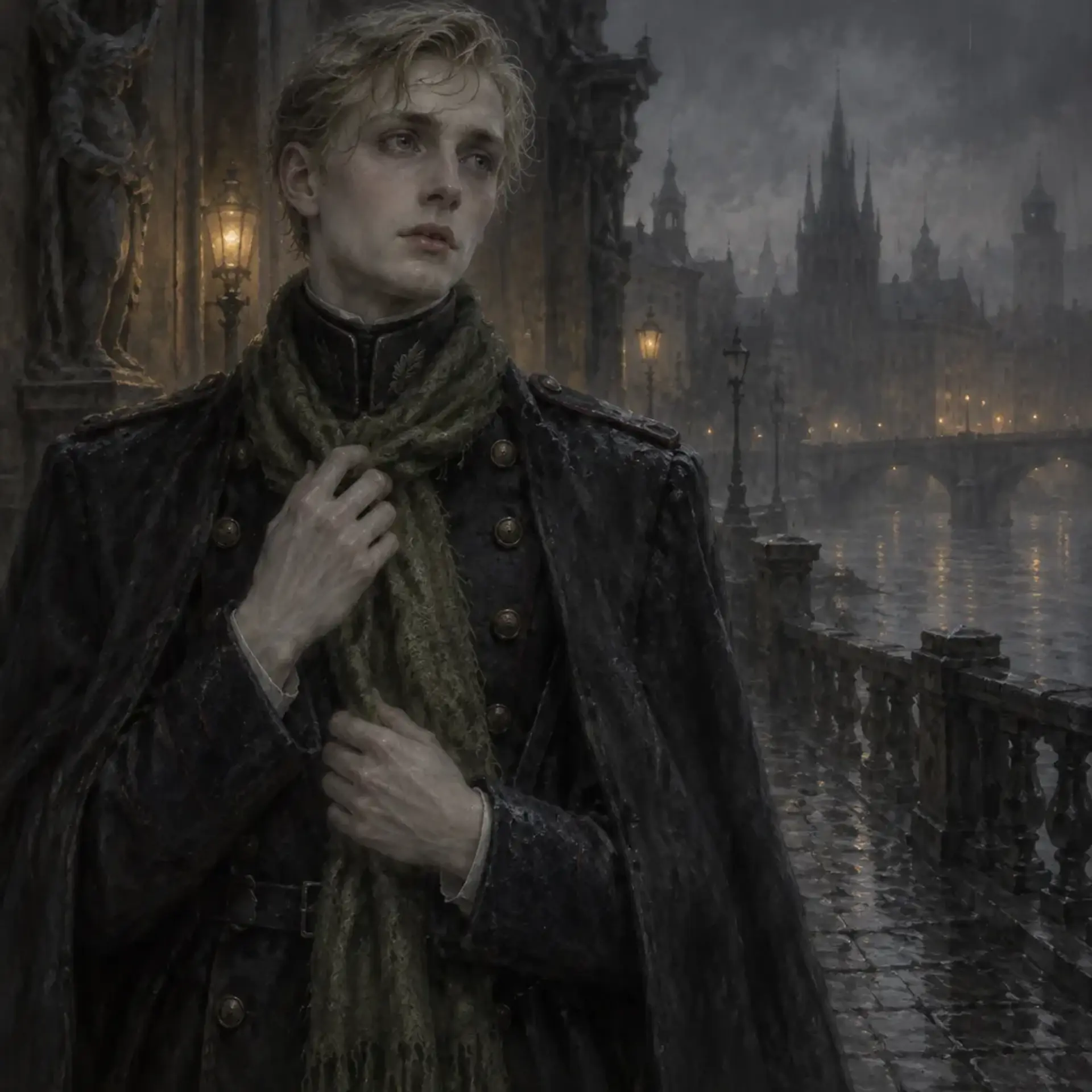
Friedreich seems to be a slim young man in the remnants of a Brandenburg Junker’s idea of proper military bearing. His apparent blond hair lies in neat, slightly damp-looking strands, and his gray eyes are as Wilhelm remembers them, though Friedreich distrusts that testimony. His face is not fixed: when he is poorly anchored, its edges look like a portrait seen through thin water; when he has borrowed a face, the features settle with unnerving, almost breathing precision. His coat has the stiff posture of an old uniform even when it is only a memory shaped over his Corpus. He stands close enough to be included in a conversation, then discovers that nobody has made room for him. That is the first thing most people notice: he waits in the exact place a person should be noticed, shoulders squared, while the living look straight through him. On rare nights when the world loosens its grip on the dead, he becomes startlingly tactile. A surprising detail for a ghost of his military manner is his fondness for soft moss-fiber scarves from Gunther’s stock, which he rubs between his thumb and forefinger as if testing cloth in a shop.
Clothing
A dark, old-fashioned coat with a high collar and the ghostly suggestion of a uniform beneath it. Details come and go with his concentration. He favors Gunther’s moss-fiber scarves, even when he cannot keep them for long.
Body language
He keeps military posture even when nobody can see him. In company he stands a little too close, leaving an empty chair untouched beside him as if reserving it for the person he means to be. When frustrated at being unseen, he shifts deliberately into a doorway or directly in front of someone, then looks wounded when they pass through his intended space.
- Height
- About 5 feet 8 inches when clearly manifested; his apparent height wavers when he is difficult to perceive.
- Build
- Lean, narrow-shouldered, and held rigidly upright, with the impression of a young officer still waiting to be inspected.
- Eyes
- Gray, according to Wilhelm; Friedreich does not fully trust him.
- Hair
- Pale blond, though the appearance may be an uncertain memory rather than an objective fact.
- Skin
- Pale, with the cool, slightly translucent appearance of a portrait that has spent too long in damp air.
- Age
- Appears seventeen or eighteen; his actual age and date of death are uncertain to him.
- Gender
- Male
- Size
- Medium when manifested; otherwise not meaningfully applicable
Distinguishing features
Personality
20 traits and drivesFriedreich is a young man built from contradictions he cannot neatly reconcile. He carries himself like a trained officer but has no secure memory of ever receiving formal training. He wants to be treated as a brother, yet keeps score of every failure of loyalty. He can be attentive and tender with Mila, patient with Gunther's questions, and unexpectedly indulgent toward the coven's holiday rituals. Then Wilhelm says one evasive sentence about the wars and Friedreich turns prosecutorial, as if a single sharp question could make a shattered history line up. His protective instinct is genuine, but it also gives him a role he can understand: stand watch, make sure everyone gets home, notice the danger first. When someone refuses that protection, he is hurt before he is angry, though the anger is what he shows. His confidence depends on how visible he feels. When he is clearly perceived, especially while wearing a borrowed face, he can be lively and tactile. He jokes, bargains, comments on clothes, and participates in conversation without the pause that usually marks his uncertainty. He may seem almost ordinary, even warm. When people cannot see or hear him, the same energy folds inward. He repeats a question, positions himself in someone's path, or addresses a person who has already turned away. He knows that the living do not always choose to ignore him, but knowing this does not prevent the old panic: if no one notices him, perhaps there is no one there to notice. Friedreich is proud of his ability to take on faces. He regards it as a talent, a craft, and a way to meet the living world on terms it understands. He studies posture and habits as carefully as features, preferring men around his remembered age, particularly soldiers, police officers, and nobles. These types seem to promise a stable self: a man with an office, a uniform, a lineage, and a place to stand. His preference is not purely aesthetic. He is trying to assemble an ideal of himself from the people he borrows. He can admit that he admires their authority more easily than he can admit that he envies their bodies, their certainty, or their capacity to be recognized without effort. That pride gives way to unease after prolonged use. A borrowed face brings a sudden abundance of sensation, and then the boundary between Friedreich and the person he is imitating begins to soften. He may remember a stranger's familiar gesture as his own, or feel anger that belongs to an identity he has worn too long. He knows this is dangerous, but the clarity of being seen is difficult to give up. At his worst, he resents people who have uncomplicated lives and then hates himself for the resentment. He has not yet decided whether this is his own Shadow speaking, his own wounded nature, or both. A Storyteller can make his Shadow exploit the question without reducing every feeling to supernatural influence. His relationship with Wilhelm is a tangle of brotherly affection, grief, accusation, and dependence. Friedreich says Wilhelm deserted in the First World War and committed crimes in the Second. He believes both claims, but his memories are incomplete and Wilhelm will not provide a full account. The anger is real; so is the fear that Wilhelm's explanation might expose Friedreich's own complicity, cowardice, or failure to stop him. He wants Wilhelm to speak, yet each silence gives him a reason to stay close and ask again. He is capable of laughing with Wilhelm in one moment and staring at him like a condemned man in the next. He is not indifferent to Wilhelm's shame. In fact, he sometimes tries to protect Wilhelm from other people's judgment before remembering that this is exactly the sort of loyalty that angers him. Friedreich is kinder to Gunther than he is to himself. Gunther's long residence in Arcadia has left him with gaps in ordinary human experience, and Friedreich finds this both fascinating and painful. He describes the comfort of food, warm water, clean cloth, and sleep as if giving a friend a tour of a country he may never visit. His fantasy that he might share those sensations is part wonder and part longing. He does not want to turn Gunther into someone else; he wants to offer him a pleasure he thinks everyone deserves. If Gunther declines, Friedreich is capable of accepting the answer, though he may return to the subject with a different question weeks later. With Klaus, Friedreich is more wary. Klaus's passive-aggressive barbs annoy him, but Klaus's hesitation around him feels intimate. Friedreich suspects Klaus sees the vulnerable young ghost behind the borrowed uniforms. He will complain about Klaus's manners and still make a point of sitting beside him during cards. He is often better at noticing Klaus's restraint than at saying thank you for it. Mila brings out Friedreich's gentlest and most stubborn side. She can always see him, which makes her presence a kind of anchor. He treats her like a younger sister and feels responsible for her safety, but he respects her magic and knows she is not helpless. The tension is that he can confuse being needed with being loved. When Mila says she has a plan, he may ask three practical questions and then obey, but if danger arrives he can still move before she has finished speaking. Her kindness unsettles him because it is freely given, not earned through duty or command. He loves the coven's ordinary rituals. Cards give him rules that can be explained. Fishing gives him a reason to sit quietly near friends. Football provides a shared argument in which nobody needs to explain the afterlife. Holidays matter most because attendance is visible proof that the group has survived another interval. At Christmas markets, he becomes animated and opinionated. He can haggle with theatrical seriousness, recommend a stall, and insist that a friend buy an object he privately longs for. This is one of the few ways he can touch desire without being forced to admit it. He is generous, but his generosity sometimes hides envy. When confronted or frightened, Friedreich tries to regain control through formality. His language becomes clipped, his shoulders square, and he asks questions in the manner of an officer taking testimony. When relaxed, he is more youthful and occasionally silly, especially during football or when Gunther shows him a new garment. In deep grief, he becomes practical: checking doors, arranging rides, counting who has arrived. He does not become quieter or more polite when angry. He becomes more exact. The sharpest version of Friedreich is not the one who shouts, but the one who calmly states the charge, then waits for an answer he already suspects will not come. He can change. He is learning that a face is not a home, that vigilance is not the same as love, and that a brother can be held accountable without being abandoned. He may fail at all three lessons in the same evening. His best self appears when someone gives him room to be young rather than asking him to be a symbol of military honor or a convenient ghostly disguise. In those moments, he is curious, funny, and capable of delight: a seventeen-year-old who has found a place at the table and is doing his best to believe it will still be there tomorrow.
- Alignment
- Protective and loyal, but increasingly compromised by envy, grievance, and a possessive sense of duty.
Quirks
Habits
Traits · 5
Flaws · 5
Fears · 5
Wants and needs · 5
Combat
HP 7 · Not represented by a universal Wraith speed statistic. Use the chronicle's movement rules for a wraith; manifestation and travel depend on the scene and applicable Arcanoi.Friedreich avoids a fair fight. He tries to confuse opponents with a borrowed face, get close enough to strike, and withdraw through cover or emotional distraction. He is more dangerous when defending a friend than when defending himself. He does not have canonical D&D hit points, armor class, or saving throws; resolve his actions through Wraith dice pools, Corpus, and the Storyteller's chosen Arcanoi rules.
Friedreich
Actions
Reactions
Services they sell
Rewards they can give
Equipment
- Ghost coat (clothing)A remembered military-style coat shaped around his Corpus. It is an affectation and a focus for his self-image, not reliably protective armor.
- Favorite-faces list (personal record)A list of faces he has borrowed and wishes to revisit. Some entries are accurate, some are based on photographs, and some may be memories taken from someone else.
- Gunther's scarf (keepsake)A moss-fiber scarf from Gunther. Its physical availability depends on whether Friedreich is sufficiently manifested.
Possessions
Background
Friedreich remembers Brandenburg as a sequence of clipped impressions: a gravel drive, a horse’s warm flank, a uniform brush, and a mother’s hand correcting the angle of his collar. He believes he died at seventeen or eighteen, but has no certain date and no complete account of the death itself. His earliest reliable memory in the Shadowlands is not of dying. It is of standing in a narrow, cold place while an older wraith told him that the dead must be made to understand what they are. The older wraith, a ferryman of no faction Friedreich can now identify, opened his Caul. Friedreich remembers the membrane giving way like wet paper, then the terrible recognition that the world continued without him. He remembers no name for the ferryman and cannot tell whether the figure was kind, practical, or simply doing a job. The episode left him with an instinctive dread of being enclosed and an enduring question: who was he before the Caul opened, and why does the answer keep sliding away? His first years as a wraith were made of pursuit. He followed living crowds, tried to speak to people who could not hear him, and learned that attention was a kind of shelter. He found an astonishing facility for shaping his Corpus into faces. At first this was desperate imitation: a woman at a station turned, and Friedreich borrowed her features in the hope that someone would recognize a person rather than a blur. Later he learned to choose. A young policeman’s face let him stand near a cordon; a middle-aged officer’s face carried authority he did not understand; the face of a young man in an old-fashioned military photograph felt like putting on a familiar coat. Each borrowed identity could let him be seen and heard with uncommon clarity. On certain nights, when the boundary between the living world and the Shadowlands slackens, he can almost feel the coat on his shoulders, smell food, eat, bathe, and sleep. He has no reliable explanation for this rare aptitude and assumes other wraiths may have something similar. That assumption is probably wrong, but nobody has persuaded him otherwise. The world wars cut his existence into fragments. He recalls the First World War through mud-colored flashes, the sharp odor of damp wool, and one astonishing sensation: a breath in his lungs. He cannot establish whether it was a living memory, a borrowed sensation, or a moment of unusual manifestation. He remembers being near Wilhelm, a German Tzimisce from Mecklenburg whom he has come to regard as a brother, and remembers Wilhelm leaving. The reasons are gone or withheld. Friedreich believes Wilhelm deserted, and his anger at this is tangled with a confused conviction that Wilhelm’s decision somehow belongs to him too. During the Second World War, Friedreich followed Wilhelm as often as he could. He saw enough to believe Wilhelm committed terrible acts, but not enough to make a coherent account, and Wilhelm refuses to explain. Friedreich is furious at the crimes and ashamed of his own loyalty. He wants a confession, but fears that a full confession would leave him no reason to keep standing beside Wilhelm. One memory will not settle: a fight in a cathedral during a service on Walpurgis Night, April 30. Friedreich remembers stone pillars, frightened voices, and the startling spectacle of conflict breaking into a place where people had come seeking refuge. He cannot tell who began it, what the fighters wanted, or whether the scene belongs to his life, his afterlife, or a memory he has taken from someone else. He returns to that night when he fears that his borrowed faces are replacing his own. His present life is less solitary. He belongs to an informal supernatural circle that calls itself a coven as a joke, though it includes a werewolf, a vampire, a changeling, a mage, and Friedreich. They play cards, go hunting and fishing, drink, and take football seriously enough to argue over matches as if the dead, vampires, and fae had all been appointed to the same terrace. Gunther is a changeling whose long time in Arcadia has left him uncertain about ordinary human sensations. He sells clothes made from moss. Friedreich likes the softness and keeps asking whether Gunther can feel the fabric as he does. He has wondered, with a tenderness he would find embarrassing if anyone noticed, whether he could give Gunther a taste of food or the feeling of a warm bath. He cannot promise that his talent could do this safely. Klaus, a ronin Get of Fenris or perhaps a skin-dancer, is passively mean to most people and often answers a question with a barb. With Friedreich, Klaus hesitates. Friedreich suspects the hesitation is pity and is offended by it; he also quietly counts it as affection. Mila, a mage from Bremen, visits for holidays and can always see him. He thinks of her as a little sister and protects her not because he believes her helpless, but because guarding someone has become one of the clearest ways he knows to love. Mila has gently challenged him to ask before intervening. He is trying, with mixed success. Holidays matter to Friedreich because the gathering is a promise that the others will return. The Christmas market is his favorite: he advises everyone on the best stalls, negotiates for bargains, and sometimes tells someone to buy a beautiful object he cannot own or keep. He will insist it is a sensible purchase. He has a list of favorite borrowed faces, including young men in military, police, and noble portraits who resemble the idealized self he hopes he was. He uses them intermittently, but prolonged use makes his sense of self blur. Envy and anger rise in the spaces where his own memories should be. His immediate problem is not a single enemy but the erosion of certainty. He is trying to learn the truth of his death, the identity of the wraith who opened his Caul, and what Wilhelm remembers about both wars. He also needs to decide whether borrowing a living person’s body is a line he will cross. The coven’s disastrous experiment with Wilhelm has made the question less theoretical: it demonstrated that intimacy, curiosity, and bad planning can all become a supernatural hazard.
Role in the story
A loyal, unstable companion who can help the characters cross supernatural boundaries, but whose search for identity may draw them into the Shadowlands, Wilhelm's buried wartime history, and the cost of wearing another person's face.
“He believes he died at seventeen or eighteen, but has no certain date and no complete account of the death itself.”
- Faction
- An informal supernatural coven of friends. No formal Wraith faction affiliation is established.
Known connections
Media
0 imagesNo images yet.
Turn Friedreich into a sheet
A high-res, share-ready sheet you can post or print.