Wilhelm
Wilhelm
At the table
Voice
A dry, slightly rasped speaking voice with clipped consonants and a Mecklenburg German accent. Its texture suggests cold air, wet wool, and a man used to being heard in noisy places. He sounds matter-of-fact when describing disturbing things, then unexpectedly animated when someone engages his theories or asks about the machines he cannot operate.
He speaks German with a Mecklenburg regional accent, using plain, practical sentences and a workmanlike military vocabulary. His voice has a dry rasp, as if shaped by cold air, old tobacco smoke, and years of speaking across gunfire, though he does not sound theatrically hoarse. He stresses consonants and tends to end statements firmly. When relaxed, he talks too long and lets odd theories spill out in precise, earnest detail. When angry, he becomes more direct and forceful, not quieter or more polite. His pronunciation of “local” carries a stubborn, faintly defensive emphasis.
Speech patterns
How to play them
Begin with practical conversation and let him inspect the other person’s competence before asking for trust. Treat his ideas seriously without endorsing unsupported claims. Do not demand an account of his wartime service or his birth unless the scene has earned that intimacy. Showing him how a piece of technology works, patiently and without mockery, can open a door faster than flattery. If his feeding habits are exposed, he is likely to become defensive rather than immediately violent.
Goal
Find a trustworthy teacher who can explain his salvaged computer and game station, while uncovering whether his burial-shroud memory is a true origin or a planted story.
Motivation
To make a coherent account of himself from a life with no remembered beginning, and to prove that a person can choose what they become even when their blood, history, and ideology pull them elsewhere.
Appearance
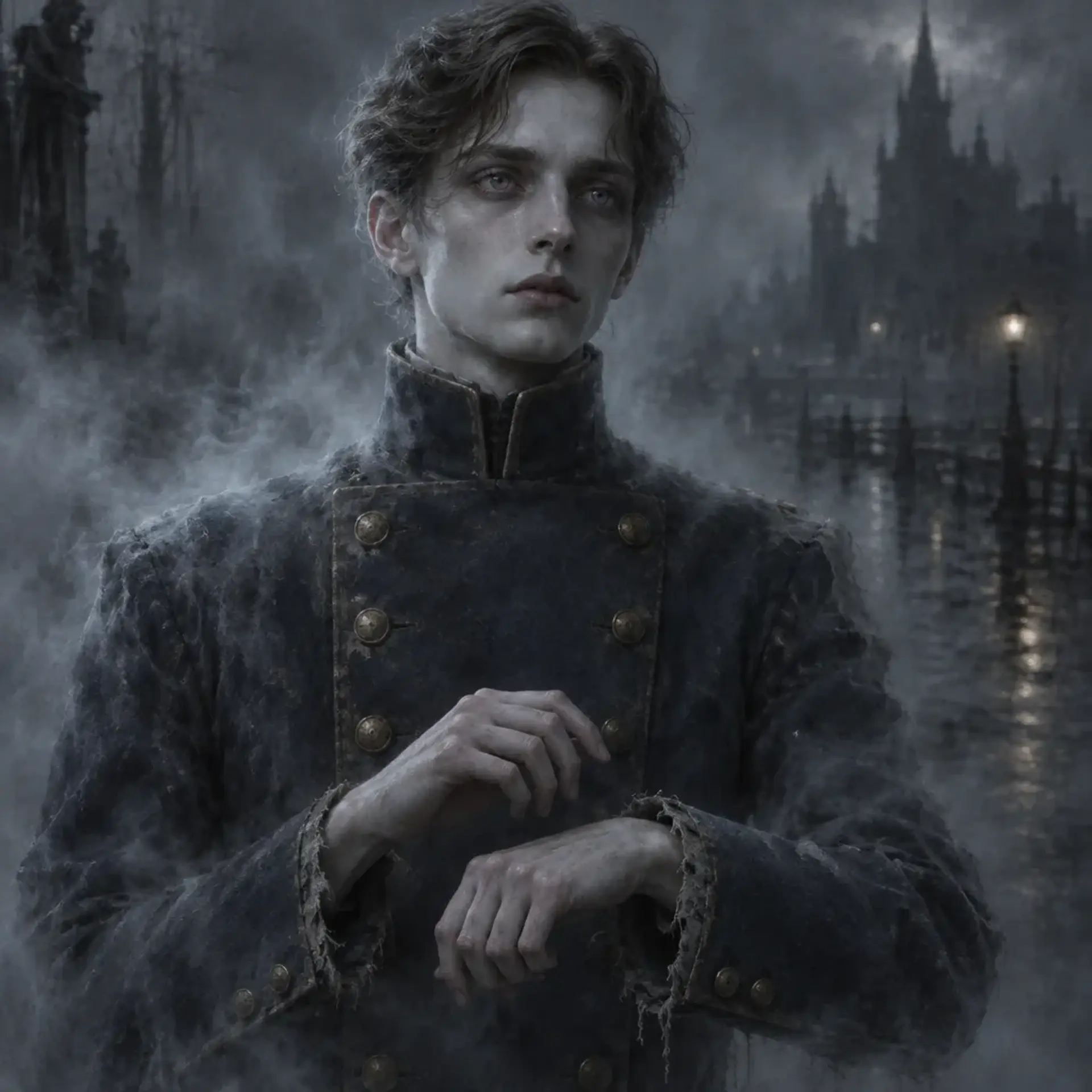
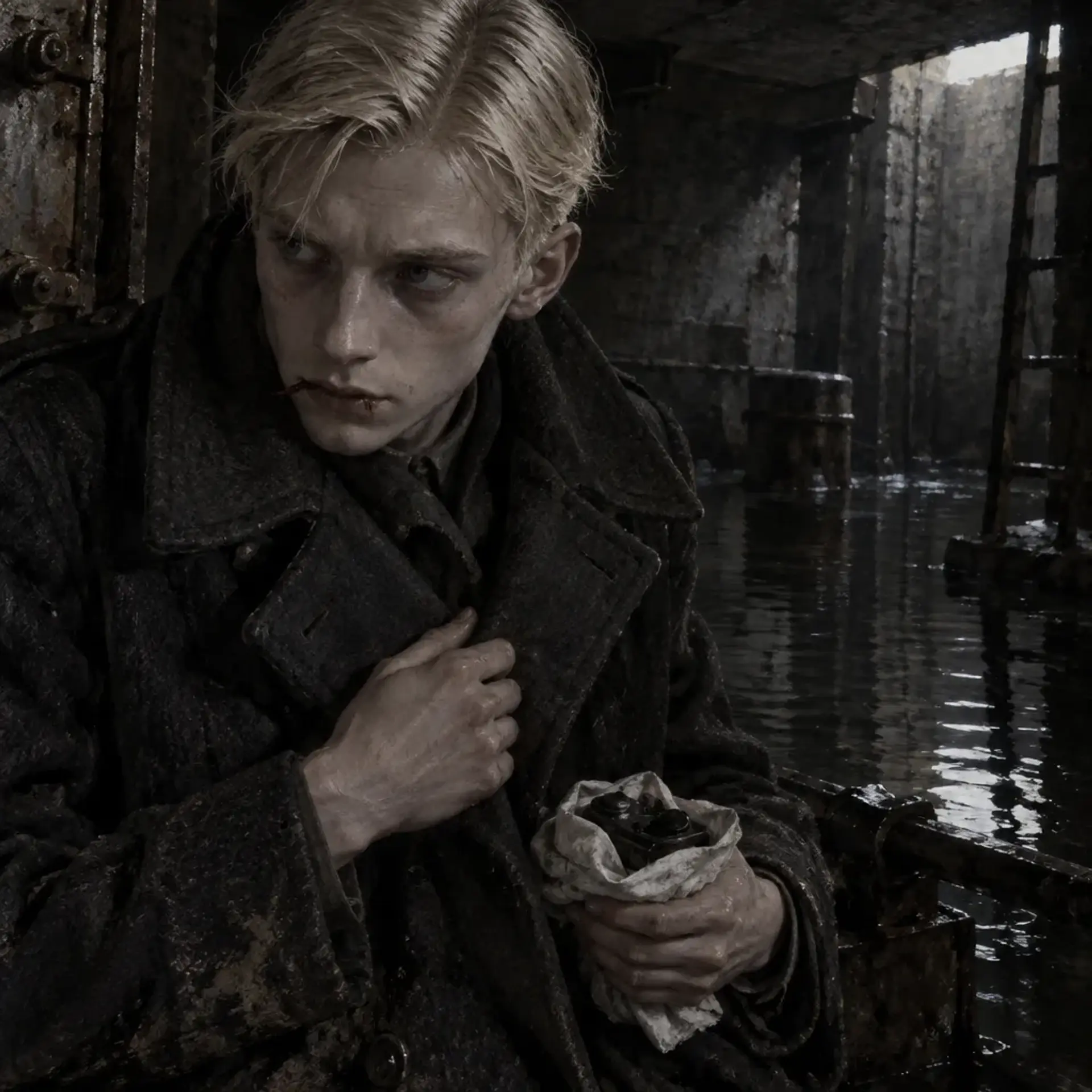
Wilhelm looks like a pale, underfed German youth who has learned to arrange himself as a serious young adult. His short, pale-blond hair is combed into a neat 1920s part, with a few stubborn tufts that rise after he has been underground. His skin has the chalky, faintly damp look of a body kept too long in a cellar. Before feeding, his eyes are yellow and dull; after feeding, they clear to a steely, washed-out blue. He moves with the careful, forward-leaning balance of someone accustomed to tunnels, rubble, and the possibility of a sudden attack. His clothes are clean in the fussy way of a man maintaining one small patch of order against a collapsing world: cuffs brushed, buttons checked, coat hem carefully mended. They smell of wet earth, old wool, and a trace of blood. The unexpected detail is that he keeps a modern game controller wrapped in a square of immaculate linen, as tenderly protected as a relic, though he cannot operate it.
Clothing
A carefully brushed, dark German military greatcoat with all insignia removed, worn over practical interwar-style clothes. His shirt and trousers are mended neatly, while his boots are muddy from the bunker. One pocket is reserved for a linen-wrapped game controller.
Body language
He angles his shoulders toward exits and keeps his chin tucked, like a soldier entering a room under fire. When interested, he leans forward with almost embarrassing intensity. When ashamed, he smooths his coat front or checks a button that is already secure. He tends to hold still for too long, then moves with abrupt, efficient speed.
- Height
- About 165 cm (5 ft 5 in).
- Build
- Short-looking and wiry, with a narrow chest and compact, economical movements; he appears more like a hungry adolescent than a hardened soldier.
- Eyes
- Dull yellow before feeding; steely, washed-out pale blue after feeding.
- Hair
- Pale blond, short and practically styled with a neat 1920s part.
- Skin
- Deathly chalk-pale, with a faint damp, corpse-like cast; his pallor becomes less stark after feeding but does not become healthy.
- Age
- Appears about 16; actual age unknown, likely Embraced during or shortly after the First World War.
- Gender
- Male
- Size
- Small-framed adult; use ordinary human scale.
Distinguishing features
Personality
18 traits and drivesWilhelm is not simply dour, patriotic, or strange. He is disciplined about small tasks and evasive about the large ones. He will spend an hour brushing mud from his coat, then sleep in a half-flooded bunker without complaint. His neatness is not vanity so much as a private refusal to let the world decide that he has become nothing but a corpse. He makes himself stand like an older young adult, setting his shoulders and arranging his expression, because his face looks too young to carry the authority he wants. The pose is convincing until he is startled, when the posture vanishes and a watchful, hungry creature looks out through it. He values endurance, but distrusts the stories people build around endurance. He can speak admiringly of a hard march or a person who keeps their word, then turn viciously skeptical when someone calls sacrifice noble. His own desertion at the end of the First World War sits at the center of this contradiction. He calls it dishonorable, yet cannot bring himself to say that he should have stayed. He resents officers who demanded obedience and resents himself for having obeyed them as long as he did. When a conversation touches the war, he may make a dry, almost practical observation that sounds like acceptance. A moment later he may accuse his listener of confusing survival with virtue. He does not want absolution, though he is always measuring whether he has been judged. Wilhelm is argumentative because he wants ideas to be sturdy enough to survive contact with reality. He rejects the Cainite origin story as too neat and offers alternatives, some thoughtful and some ridiculous. His theories have the urgency of someone building a shelter while the rain is already coming through the roof. If he believes a person is friendly, he will explain his conclusions at exhausting length, invite challenges, and be genuinely pleased when someone catches an inconsistency. If he senses mockery, he retreats into clipped military phrasing and treats the conversation as a hostile interrogation. He does not easily distinguish disagreement from contempt, especially when the subject is his lineage or the legitimacy of his memories. Around strangers he is guarded, formal, and attentive to exits. He tries to make himself seem older and more settled than he is. Around Friedrich, the performance frays into familiar bickering: he can be tender in the form of an argument about duty, or protective in the form of insisting that Friedrich is making a foolish choice. With Gunther, he deliberately provokes and then acts surprised when the changeling is angry. With Klaus, he is more careful. He understands that the warning to stay out of Bavaria may be a real boundary, not a game, and that Klaus’s occasional kindness does not cancel the threat. Around Johan he becomes awkwardly patient. He wants to be a mentor, a protector, and an equal friend all at once, without understanding how those roles can conflict. He asks the boy questions about ordinary life and then conceals how little he knows. His curiosity is one of his most humane qualities and one of his most dangerous. He is fascinated by the computer and game station because they represent a world he cannot make answer to instinct. He can track a scent through mud and recognize a soldier’s fear from the set of his jaw, yet he cannot make a console start. This humiliates him more than he admits. He wants instruction, but only from someone he has decided is worthy. That standard protects him from exploitation while ensuring he often rejects the help he needs. Wilhelm is capable of brutality without being casually cruel. In a fight, he uses the cramped, wet environment and his opponent’s hesitation. He will bite, grapple, or shoot if necessary, and the sight of him chewing at the dead can make even experienced Kindred reassess what they thought they understood. After violence, he may become meticulous: cleaning his pistol, checking his coat, hiding the shroud. He does not celebrate victory. He wants the danger resolved and the evidence put away. He believes the living and undead are closer than either side admits. This is not a comforting idea. To Wilhelm, both are creatures organized around appetites, loyalties, and inherited stories. He finds that frightening, but also useful: if people are shaped by what they do, then perhaps a person without a remembered past can still choose what comes next. He is a loner by habit, not preference. He complains about his strange little family and keeps returning to it. He rejects sentimental language, yet notices who is absent at holidays, saves a place for Friedrich, and keeps watch over Johan’s route home. He acts as though attachment is an argument he has already won, even when he is terrified it can be taken from him.
- Alignment
- Not a D&D alignment category. Principled in his own terms, but capable of frightening cruelty; loyal to chosen companions and contemptuous of institutions he sees as dishonest.
Quirks
Habits
Traits · 5
Flaws · 5
Fears · 4
Wants and needs · 4
Combat
HP 6Avoids a fair fight. Uses cover, darkness, and the bunker’s narrow passages to break line of sight, then retreats or attacks an isolated opponent. He prefers grappling and biting at close range, where his unsettling feeding style can unsettle enemies. He uses the pistol to cover escape, not to posture. Root-Weather is an unreliable custom practice, best used to conceal movement rather than win a direct contest.
Wilhelm
Actions
Reactions
Services they sell
Rewards they can give
Equipment
- Stripped Military Coat (clothing)Old German military coat with all insignia removed; carefully maintained and emotionally difficult for him to discard.
- Service Pistol (weapon)A battered service pistol. Use the relevant VTM firearm rules and the weapon’s damage rating for the chronicle.
- Shroud Fragment (personal relic)Small, soil-stained fragment of burial shroud, hidden in his mouth; he chews it when distressed and sometimes wets it with blood.
- Computer and Game Station (salvage)A salvaged old computer and game station, both nonfunctional to him. He is searching for a trustworthy teacher.
Possessions
Background
Wilhelm remembers no mortal childhood, no mother, no house, and no name. His earliest memory is pressure: a burial shroud against his teeth, cold soil packed over his face, and the discovery that his hands could claw upward. He remembers chewing through the cloth and dirt until he reached night air. He has since called this his birth. The name Wilhelm came later, adopted because it sounded ordinary enough to use among German people. “Gunther” is a borrowed name he uses to irritate the changeling who already owns it. He was born, he insists, in Mecklenburg. Whether this means he was buried there, was mortal there, or merely woke there is unknown. He began as a solitary, uncanny thing moving through the Prussian countryside: avoiding towns when he could, feeding on the dead when he could not, and learning the habits of the living by watching them from tree lines and broken buildings. Other Tzimisce encountered him over the years. Some called him a runt, some a mistake, and some claimed he was the last childe of Byelobog, the ancient White God. Wilhelm has met supposed siblings of that lineage, but no one has proved the connection. He has neither a reliable sire’s account nor a coherent memory of an Embrace. The claim that Byelobog’s skin lives within him is a rumor, not a fact he can demonstrate. The Great War gave his scattered existence a uniform and a purpose. He served as a German shock trooper, moving through trenches and shattered positions with a bodily calm that frightened the men around him. He learned the smell of wet wool, cordite, blood, and crowded fear. Near the war’s end, as defeats accumulated and the army’s promises became hollow, he deserted. He calls this the worst dishonor of his existence. He also knows that staying might have meant dying for officers and causes he had begun to distrust. He cannot settle the contradiction. His shame is less that he survived than that he cannot prove what, exactly, he should have done. He served again during the Second World War, but refuses to name his post. Asked, he says, “You wouldn’t understand,” and changes the subject. The answer may hide a military role, an atrocity, or simply a part of his history he cannot bear to make comprehensible. He kept a German military coat, stripping away every insignia, and a pistol. He will not wear the coat in public if he thinks it might draw attention, but he cannot bring himself to discard it. Wilhelm’s oddest inheritance is a private body of practices he calls Root-Weather. He rejects the Tzimisce label “Koldunic” for his work, arguing that his rites come from Germanic folk beliefs, battlefield observation, and experiments he has conducted in mud and water. He is a dabbler in Norse paganism, not a reliable scholar. He thinks severe ideologies sometimes reveal how little separates the living from the undead: both organize themselves around hunger, fear, and stories they call necessity. He argues that the Cainite account of vampiric origins is too simple, proposing instead that vampirism is an old condition with several causes. His theories range from perceptive to absurd, and he shares the absurd ones most readily with people he considers friends. For years he has lived in a partly flooded wartime bunker. Its dry shelf holds his most precious object: a small cut piece of the burial shroud that he keeps hidden in his mouth, chewing it and soaking it in blood. The remainder is concealed in a separate safe place. He also salvaged an old computer and a game station from victims. He cannot make either work. He wants a mentor who will explain the machines without treating him as stupid, but he is so suspicious of eager helpers that he has made little progress finding one. His closest companion is Friedrich, a Brandenburg wraith who resembles the sort of Junker and Prussian officer Wilhelm has spent a lifetime arguing against. Friedrich has his own memory loss and often must steal a living person’s face, in the folkloric doppelganger sense, to be seen. They quarrel about history, duty, and whether a person can be responsible for a past they cannot recall. Their friendship survives because neither demands a simple answer. Wilhelm belongs to a loose, uncomfortable family of supernatural outsiders: a changeling called Gunther, Friedrich, Klaus, a Get of Fenris ronin or possibly a skin-dancer, and other occasional companions. They reject the phrase “found family” as sentimental, while gathering for holidays and, rarely, football. Klaus warns Wilhelm to stay out of Bavarian territory indefinitely, yet has shown him hospitality when circumstances left no alternative. Wilhelm is also cultivating a friendship with Johan, a relaxed mortal teenager from Berlin. Wilhelm calls it cultivating; Johan would probably call it hanging out. Their bond risks exposing both of them. Now the bunker leaks more quickly than he can keep it dry, and someone has begun moving through the drainage channels at night. His friends are tired of his lectures; the local Kindred are curious about his rumored bloodline; and Johan keeps asking how Wilhelm knows so much about war but so little about ordinary life. Wilhelm wants someone to teach him the machines, to tell him what he was before his burial, and to explain whether his memories are missing or were never his. He hopes these are separate questions. He fears they are not.
Role in the story
A suspicious, potentially valuable ally whose disputed origin and missing memories draw attention from Tzimisce, while his ties to a mortal teenager and a fractious outsider family create immediate stakes. He can offer refuge, folklore, and a disturbing example of how little a vampire may know about their own creation.
“He remembers chewing through the cloth and dirt until he reached night air.”
- Faction
- Tzimisce by clan, though poorly integrated into Kindred society. Associated with an informal gathering of supernatural outsiders who call themselves a family and reject formal coven labels. Byelobog’s paternity is an unconfirmed lineage claim.
Known connections
Media
0 imagesNo images yet.
Turn Wilhelm into a sheet
A high-res, share-ready sheet you can post or print.