Pieter Goldwater
Pieter Goldwater
At the table
Voice
Pieter speaks from the chest and throat with the rough, slightly unstable resonance of a voice changing during the Turning. Workshop noise has trained him to carry his words, while years of listening for tiny changes in metal have made him attentive to pauses and evasions. The result is a voice that sounds practical and direct, but can turn unexpectedly raw when a conversation reaches his siblings or the stockades.
His voice has recently dropped and still catches at the edges when he is tired. Years around a noisy workshop taught him to project clearly over hammering, so his ordinary speech carries farther than he intends. He uses plain, practical phrases and a craftsperson's vocabulary. When angry, he does not become soothing or quiet; he speaks more directly, with clipped sentences and a hard emphasis on names and facts.
Speech patterns
How to play them
Treat Pieter as a young person with agency, not as a spectacle. He responds well to concrete help, direct questions, and people who address him rather than his wings. Avoid promising a cure or demanding that he conceal himself. Earn his trust by respecting his siblings' privacy and asking before touching his wings or tail.
Goal
Keep his siblings safe through their Turnings, reclaim his right to live openly in town, and prevent his family's inheritance from being stripped away.
Motivation
Pieter wants to make room for his changed body without forcing his family to pay for his visibility. His determination is partly principle and partly fear: if he lets the town decide that he is shameful, he believes it will decide the same thing about Nils.
Appearance
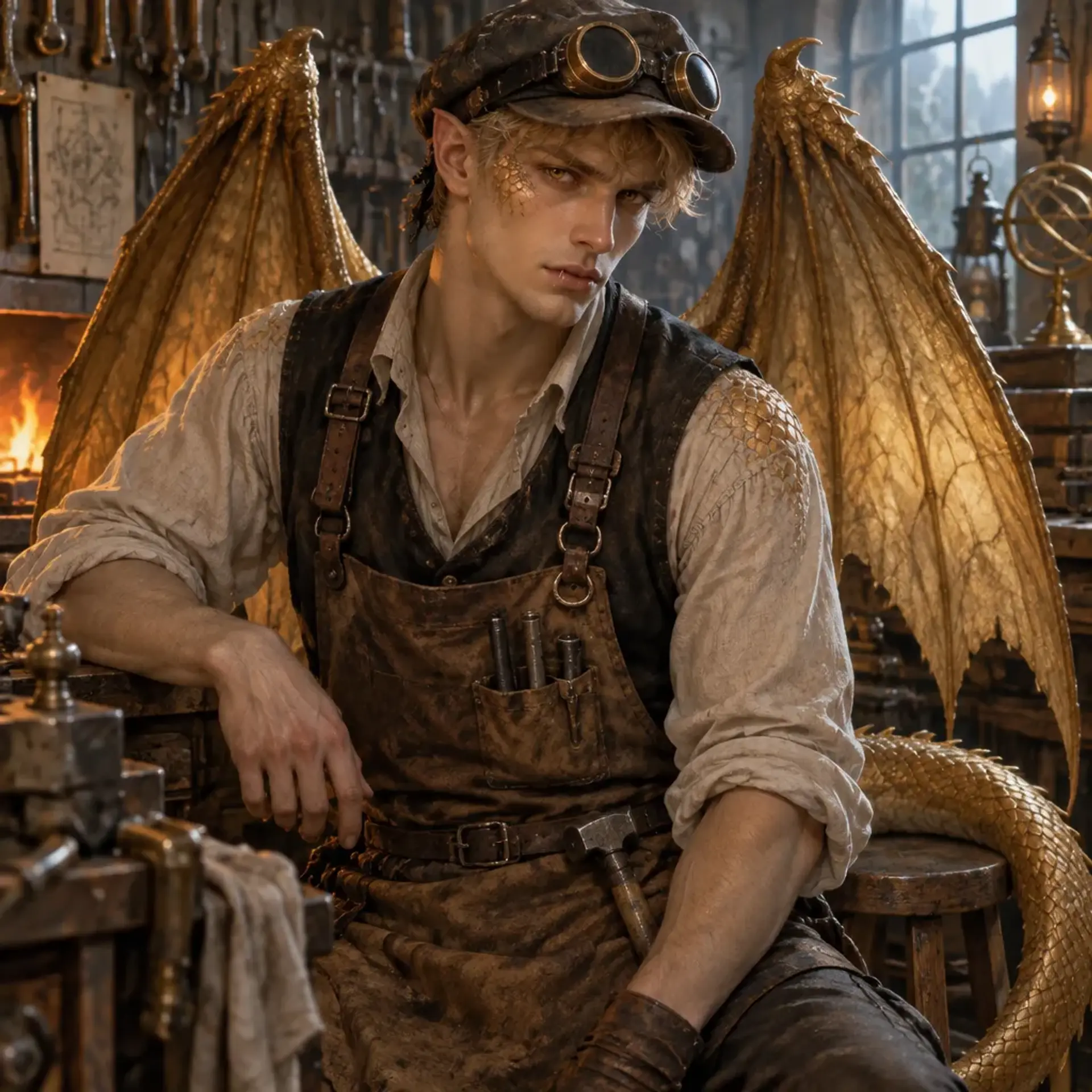
Pieter looks like a young craftsman whose body has begun insisting on a different ancestry. He is tall and lean, with a long, flexible trunk, narrow waist, and a poised, forward-set carriage that can seem almost predatory when he stands still. Fine gold scales lie close against his pale, warm-toned skin, most visible along his temples, shoulders, and ribs. His broad, sail-like wings rise from his shoulder blades, their gold-brown membranes patterned with fine veins; they fold upright when he rests and trail close behind when he walks. A long, muscular tail balances him through turns and curls around a chair leg when he is distracted. His face keeps only faint gnomish traces: a short, neat nose, strong cheekbones, sharp teeth, and eyes with narrow pupils. He moves through his family's workshop with unnerving ease, turning his torso to reach tools without shifting his feet. In sleep, he lies belly-down or loosely coiled, wings tucked around him like a tent. Unexpectedly for a young heir in a celebrated craft family, Pieter is a terrible judge of expensive clothes and will happily mend a fine coat with a conspicuous patch of sailcloth.
Clothing
Practical Dutch-inspired workshop clothes: a sturdy dark waistcoat over a linen shirt, reinforced trousers, thick-soled boots, and a work apron with pockets adapted around his tail. His broad-brimmed cap has leather goggles pushed up on it, useful for sparks but increasingly awkward around his wings. He mends his own garments with visible, mismatched patches.
Body language
Pieter's shoulders remain slightly forward to protect the bases of his wings. His tail reveals his mood before his face does, tapping when impatient and curling around a stool when he feels safe. In unfamiliar rooms, his eyes go first to doors, overhead beams, and the people standing nearest his siblings. When he is ashamed, he folds his wings too tightly; when he is determined, he lets their full outline show.
- Height
- 6 ft. 4 in. (193 cm)
- Build
- Tall, lean, long-limbed, and newly muscular, with an unusually flexible torso and a serpentine balance.
- Eyes
- Amber-gold with narrow pupils that catch light like polished metal.
- Hair
- Short, practical, bright wheat-gold hair, usually flattened beneath his cap.
- Skin
- Pale ivory with a warm golden cast; fine scales blend almost seamlessly into the skin.
- Age
- 18
- Gender
- Male
- Size
- Medium
Distinguishing features
Personality
16 traits and drivesPieter Goldwater wants to be treated as a person before anyone decides what his wings, tail, or blood mean. He does not expect every stranger to understand him, but he has little patience for those who speak about his body as though he were absent from the conversation. When someone calls him dangerous, unnatural, or a problem to be solved, he answers plainly and often too quickly. He has learned that silence can be mistaken for agreement, and that a crowd may settle on its story about him before he gets the chance to speak. Still, he is not eager to fight. He would rather be left to work, eat, and walk through town without turning into a public lesson. His protectiveness is sincere, practical, and often inconvenient. With Nils and Anji, Pieter tries to make the changes in their bodies feel ordinary. He shares food, offers a joke when one of them looks self-conscious, and speaks of soreness or sudden hunger as if they were no more alarming than a rough night’s sleep. He has a habit of asking questions sideways, disguising concern as casual conversation. He notices when Nils is tired, when Anji’s cheeks grow warm, and when either sibling falls quiet under someone’s scrutiny. He wants them to know he is there without making them feel watched. Yet the instant he thinks they are in danger, that restraint can vanish. Pieter starts deciding what they should do, where they should go, and who is allowed near them. He may insist that Nils stay home or tell Anji to leave a room before she has decided whether she wants to. He means to keep them from being hurt, but he can mistake protection for authority. If they object, he first hears the risk in their choice rather than the frustration in their voices. Later, once the danger has passed, he is capable of admitting that he overstepped, though the apology may arrive stiffly and after a long silence. He is still learning that being frightened for someone does not give him the right to speak for them. Pieter’s humor is warmer than his public manner suggests. In private, especially with Anji, he can be playful and dry, quick to tease and just as quick to accept a joke at his own expense. He likes the familiar rituals of family life: food passed across a bench, a tool returned to its proper place, an argument about who left crumbs near the drawings. These small things reassure him. He makes room for his wings at the table and treats the awkwardness as a practical nuisance rather than a tragedy. If someone looks at him too long, he may make a remark about charging admission, then go back to eating as though he has not noticed the stare. In the workshop, Pieter is patient in a way he is not always elsewhere. A difficult fitting does not insult him, and a stubborn hinge cannot make him feel judged. He knows the value of testing a part, checking a measurement, and beginning again when the first attempt fails. If a tool is wrong for the task, he says so without embarrassment. He is careful with delicate work, sometimes excessively so. The memory of crushing a wooden jig has made him conscious of his hands even when the more obvious challenge is keeping his wings clear of the shelves. He will pause before touching a fine piece, settle his grip, and then proceed with a concentration that can look like solemnity. He is proud of his skill, but not so proud that he cannot learn from a mistake. That patience has limits when people turn his body into a problem while denying him a say in how it is handled. He can endure awkward questions if they are asked in good faith. What angers him is the false gentleness of someone who calls an order advice, or a demand for concealment a kindness. He dislikes being told that he must prove he is decent by obeying whoever has the most respectable coat or official title. He is capable of courtesy, and in public he is often formally polite, particularly around magistrates and other officials. His speech may become precise, his posture rigid, and every answer carefully chosen. This is not submission. It is an effort to prevent his anger from becoming the only thing the crowd remembers. The stockade changed how he moves through public spaces. Pieter watches the edges of a crowd now, notices who is whispering and who is waiting for an excuse to provoke him. He is quicker to answer a slight than he used to be, partly because he fears that letting it pass will make the next one easier. He can misjudge this. A look or a muttered nickname may earn a sharp reply before he has decided whether answering will help. He resents the vigilance because it makes ordinary errands feel like tests, but he has not found a way to put it aside. When he believes a confrontation is coming, he tries to sound certain, even commanding. Fear, for him, often arrives dressed as confidence. That certainty falters when he is tired. Then he can become abruptly honest, saying that he is scared, that he does not know what will happen to Nils, or that he hates being watched. He may regret the bluntness moments later, especially if his words have made his family worry. But he is less practiced at hiding the truth than at controlling how it is heard. Pieter’s pride is real, though it is not invulnerable. He believes his wings and tail belong to him and will not hide them simply to make a stranger comfortable. He also sometimes treats visibility as a duty, as if accepting a compromise would betray everyone who has ever been forced to conceal themselves. He may refuse a sensible adjustment because he fears it will be mistaken for shame. He is slowly discovering that choosing where and when to stand openly can be as deliberate as refusing to disappear. Pieter is compassionate toward anyone being stared at, singled out, or made to perform for other people’s reassurance. He knows the difference between curiosity and entitlement, and he tries to offer the kind of ordinary company he wishes more people offered him. Yet his attention is not limitless. When he is busy watching for the larger danger, he can miss a smaller hurt close at hand. He may fail to notice that Anji is tired of being questioned, or that Nils wants to be treated as himself rather than as a preview of Pieter’s life. His instinct is to guard them from the town’s judgment, but sometimes what they need is for him to listen and let them choose their own response. At heart, Pieter wants a modest thing that has become difficult to ask for: the chance to be a decent young man without being made into a symbol. He does not want praise for enduring humiliation, nor does he want his family’s fear mistaken for lack of love. He loves Mara and Joost, even when their wish to conceal him feels like a rejection of the person he is becoming. He can understand why they are frightened without agreeing to make himself smaller for their comfort. His loyalty is stubborn, sometimes exasperating, and rarely quiet. He is trying to protect his siblings without owning their choices, to stand his ground without turning every slight into a battle, and to believe that compromise need not mean surrender. He has not mastered any of this. He keeps trying anyway.
- Alignment
- Neutral Good, with an increasingly stubborn belief that decency without justice is only good manners.
Quirks
Habits
Traits · 4
Flaws · 4
Fears · 4
Wants and needs · 4
Combat
AC 12 · HP 13 · 30 ft.Pieter is a commoner, not a trained combatant. He tries to create space, protect bystanders, and get away rather than win a fight. He uses a workshop hammer only when cornered, and his wings can hinder him in cramped rooms. If he uses his unstable breath, it is a last resort and may endanger people or property.
Pieter Goldwater
Actions
Reactions
Services they sell
Rewards they can give
Equipment
- Workshop hammer (tool)A compact iron hammer used for fitting and riveting. It is a tool, not a weapon he has trained with.
- Leather goggles (gear)Sturdy protective eyewear, worn on his cap more often than over his eyes. The left hinge has been rubbed almost smooth.
- Work apron (clothing)A patched apron with pockets adapted to avoid catching on his tail and wing joints.
- Weather book (personal)A small notebook recording Nils's symptoms and Pieter's own changes. He keeps it hidden from his parents.
Possessions
Background
Pieter Goldwater was born first, and for years the Goldwaters spoke of him as if his future were a finely made object already laid out on the bench. His parents, Mara and Joost Goldwater, are respected Low-blooded Aureate Gnomes who built their standing by making precise hinges, fittings, and brass instruments for ships and townhouses. They had hoped for a High-blooded child, and when Pieter's first signs appeared they were proud. They did not understand how much dragon blood could ask of a body, or how quickly pride could turn to fear when the inheritance became unmistakable. Until adolescence, Pieter looked much like a sturdy gnome boy. The Turning began with aches that kept him awake and an appetite that emptied the pantry. His bones lengthened; his voice roughened; his skin warmed toward gold. His parents took this for a difficult but ordinary family passage. Then the wings budded through his shirts, and his tail grew long enough to knock tools off a workbench. The family's High-blooded clients reassured his parents that strength and scales were familiar. One, an older shipwright, warned them to note every strange behavior and every new growth. Mara wrote the warning in a household book, then hid the book because she hated seeing her son reduced to symptoms. Pieter adapted by working. The shop's narrow aisles taught him how to fold his wings and use his tail as a counterweight. His new strength made lifting castings easy, but he once crushed a wooden jig simply by gripping it while startled. He remembers the sound more clearly than the broken wood. Since then, he checks his hands before touching delicate work, even though the wings and tail draw far more attention. His younger sister Anji, seventeen, has begun to show the first signs of her own Turning: bouts of heat, deep tiredness, and a brightness in her eyes that vanishes when she catches someone watching. His brother Nils, fifteen, has similar aches and sudden hunger, and Pieter sees too much of his own early changes in him. Pieter is quietly frightened that Nils will inherit the same conspicuous traits. He asks questions without making them sound like questions and has started keeping a small notebook of Nils's symptoms. He has not told his parents about the notebook. Anji knows anyway and calls it his 'weather book.' The town's response shifted after Pieter's first public trouble. A lawman warned him that sudden flight, unfamiliar movements, and public alarm could be treated as disorderly conduct. Pieter answered that he could not simply remove his wings to make the street comfortable. Their argument drew a crowd. After a later confrontation, Pieter spent two days in the stockades, where passersby could stare at the wings and tail through the bars. His family could not keep the event private. The town learned the nickname Wyrmling, first as a joke, then as an excuse to treat him like an unruly animal. A High-blooded lordling named Bastien Arvelo used the incident to press a complaint of antisocial behavior and public indecency. The lordling's own party had baited Pieter, but the complaint described only Pieter's anger and the space his wings occupied. A local magistrate and judges imposed public service in place of a harsher sentence: carrying civic water casks, hauling market refuse, and standing as a living demonstration of 'safe wing folding' during a public works day. The work could have been useful. Instead, officials staged it for amusement, ordering him to bow, spread his wings, and let onlookers inspect him. Pieter complied enough to protect his parents from a fine, and hated himself for every moment. His former friends have mostly withdrawn. Some avoid his eyes; others tell him to leave town. The old ease of being a Goldwater heir has vanished, and his family's right to pass the workshop to him is now discussed as a question of civic fitness. His parents want a discreet healer to find a cure or at least a way to conceal the wings. Pieter refuses to be hidden. He believes the changes are his inheritance, not a disease, though he is not certain what that belief will cost his family. Now Pieter divides his time between the workshop, his siblings, and the public duties imposed by the magistrate. He keeps looking for a way to make the humiliation useful: perhaps a public record of how the law treats a person who cannot disguise his body, perhaps a safer place for Nils to undergo the Turning. He also keeps a small supply of spare cloth and leather, repairing damaged wing seams before his parents can see them. He loves them too much to mistake their fear for rejection, but not enough to obey their wish that he disappear.
Role in the story
A young heir caught between family protection and public shame. Pieter can lead characters into the town's dispute over Aureate inheritance, reveal how local law treats unusual bodies, and make the stakes personal through Nils's approaching Turning.
“They had hoped for a High-blooded child, and when Pieter's first signs appeared they were proud.”
- Faction
- The Goldwater family's respected craft business; currently under pressure from the town magistrate and local judges.
Known connections
Media
0 imagesNo images yet.
Turn Pieter Goldwater into a sheet
A high-res, share-ready sheet you can post or print.