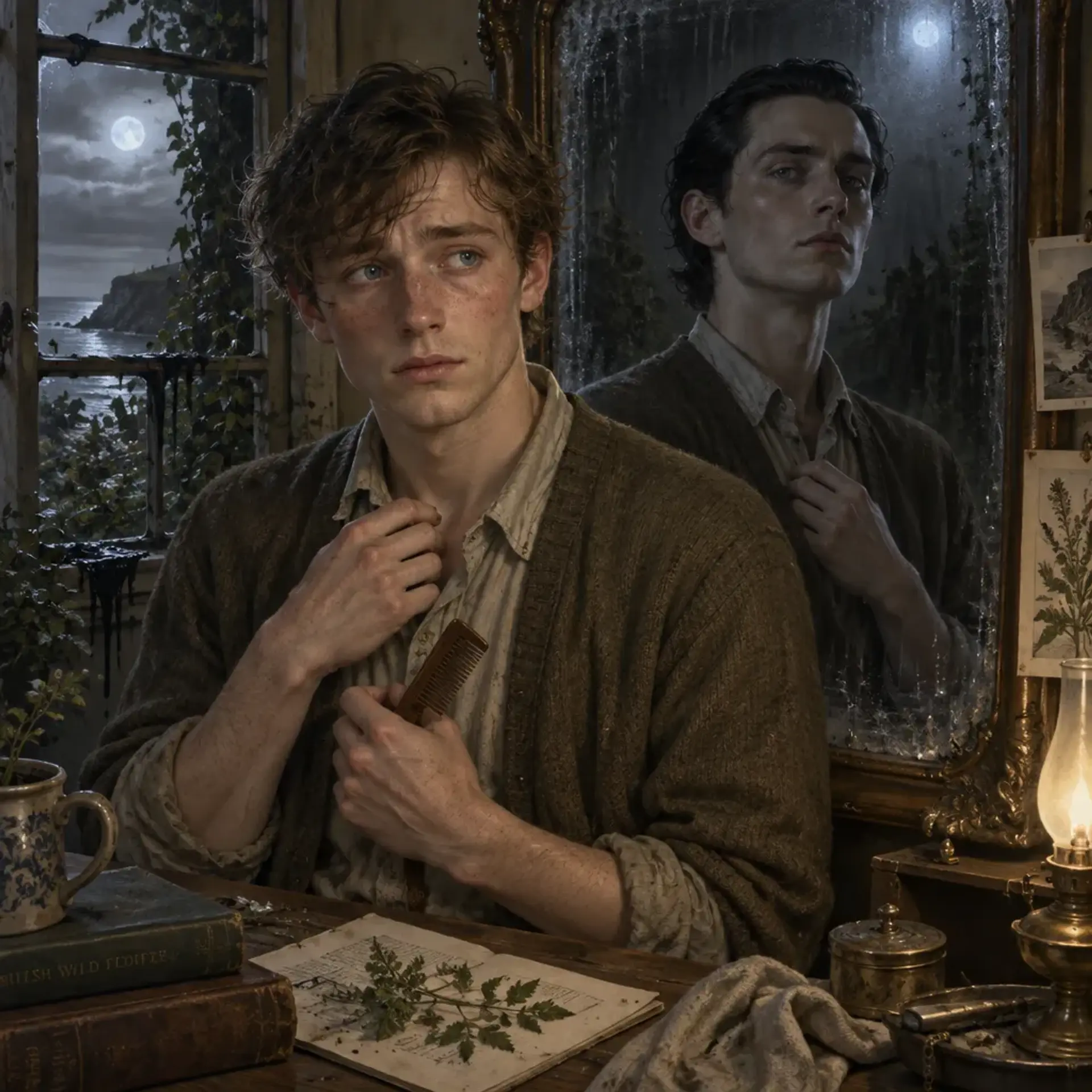
William Windon
William Windon
At the table
Voice
William's voice is youthful and clear, with a little breathiness after illness and the familiar cadence of someone raised in Wiltshire. It carries the practical vocabulary of garden work and the careful warmth of a son used to smoothing over arguments. Wilt uses the same body but changes its weight: a deeper, older-sounding placement, a thick Wiltshire accent, and crisp, formal articulation. At moments the shift is so complete that William's mother recognizes the words but not the speaker. Wilt's laughter, especially after alcohol, is startlingly open and boyish; his anger is not a whisper but a sharp, unvarnished interruption.
William speaks in a contemporary, ordinary Wiltshire manner, with a warm, slightly hesitant rhythm that becomes firm when he is frightened for someone else. Gardening has given his speech a practical vocabulary of growth, soil, weather, and seasons. Wilt's voice comes through the same mouth but sounds older: a thicker Wiltshire accent, deeper in its placement without relying on a singing-range label, and shaped by careful consonants and formal turns of phrase. Its texture can feel dry and close, like breath against cold glass. Wilt's words suggest a history of coast, forge, and old custom, but he describes memories as sensations instead of dates. His voice does not simply become quieter or more polite when angry; anger makes him blunt, cutting, and willing to speak over William.
Speech patterns
How to play them
Meet William with patience and concrete help rather than pressing him to explain the impossible. He responds to gardening, practical tasks, and honest concern. Do not assume Wilt is simply an evil possessing spirit: he is strange, sometimes harmful, sometimes protective, and not fully understood. If Wilt takes the lead, maintain calm boundaries and address him by the name he has chosen. Elizabeth is a valuable but frightened ally.
Goal
Keep the coastal siblings out of the Windon home, learn what the chalk heart did, and preserve a future in which William and Wilt can coexist without one erasing the other.
Motivation
William wants a safe, ordinary life among plants and the people he loves. Wilt wants to understand his siblings, retain his place in the world, and experience its customs and sensations. Their shared needs overlap in safety but conflict over control, privacy, and the future.
Appearance
William is an average-height young English man, soft-faced and approachable, with a faintly freckled, brown-spotted complexion and a habit of standing as if ready to apologize for occupying space. His dark-blond hair is brushed carefully for work, though it springs out at the crown after a night of poor sleep. His blue eyes are direct when he is with his mother and evasive when someone asks about his health. His hands carry the dry green stain of crushed stems and soil beneath the nails. His clothes are practical and often a little too carefully mended: work trousers, plain shirts, and one repeatedly brushed jacket. He smells faintly of damp earth, tea, and, lately, brine that he cannot wash out. Wilt appears in the same clothes but is taller, longer in the face, handsome in a severe, old-fashioned way, with black hair, blue eyes like moonlight on a still pond, and an aloofness that makes familiar rooms feel borrowed. He does not look like William, though the clothes match exactly. Wilt moves with a measured economy, as if every room has rules he remembers and everyone else has forgotten. The unexpected detail: for all his unsettling antiquity, Wilt is fascinated by television and cars, and his attention to a new machine is as openly delighted as a child's.
Clothing
Practical estate-gardening clothes, plain shirts, work trousers, and a repeatedly brushed jacket with careful repairs. Wilt wears exactly what William is wearing, though he carries the garments with a more formal, composed air.
Body language
William's ordinary posture is slightly rounded and receptive, his hands occupied with a sleeve, a cup, or a plant stem. When anxious, he checks his pulse and presses his palm against his chest. Wilt's posture lengthens the same body: chin level, shoulders arranged with a formal stillness, movements economical and proprietorial. When Wilt is listening for his sister, William's body may go unnaturally still, as if the whole house has become an ear.
- Height
- Average height for a young man in Cold War-era England as William; Wilt appears taller, though the shared body is not a separate permanently taller person.
- Build
- Average, lightly built, and more suited to long hours of gardening than a fight. Wilt's apparent height and bearing make their shared body seem taller and more imposing while he is foremost.
- Eyes
- Blue; in Wilt's face, blue like moonlight on a still freshwater pond.
- Hair
- Dark blond for William; black for Wilt's reflected and manifested appearance.
- Skin
- Fair, with brown freckles and spots; often reddened by cold or outdoor work.
- Age
- 18; a young adult in a Cold War-era English setting.
- Gender
- Male
- Size
- Medium
Distinguishing features
Personality
20 traits and drivesWilliam is affectionate yet guarded, gentle without being helpless, and eager to please until someone threatens the people he loves. He is more sensitive than his father thinks, but not simply timid: once he has decided that a door must stay shut or a sibling must be kept outside, he can hold his ground through fear. In familiar company he is warm, awkwardly funny, and easily flustered, especially around Adaline or when Elizabeth teases him. Under pressure he becomes practical, counting doors, checking his pulse, and looking for a task he can complete. He dislikes lying, but now lies by omission every day because the truth could frighten his mother or invite Hector's scrutiny. Wilt pulls against nearly everything William expects from himself. He is composed but not calm, formal but capable of vulgarity, stern yet curious about television, cars, and small comforts. He can be exquisitely particular about manners and then hide tinned fish beneath the bed. He finds modern devices fascinating, but war films can drive him into an involuntary terror. He is not merely a cruel voice: he apologizes, offers memories as consolation, and tries to keep the siblings from reaching the house. His care is possessive and old-fashioned. He may prevent William from speaking, make an unwanted remark, or seize the body to flee. He is intrigued by Adaline and Elizabeth in ways he calls “interesting,” and is still learning that attention does not confer a claim. At home, William becomes quieter when Hector questions him. Wilt may answer instead, with formal contempt or an exacting observation that makes the argument worse. With Clare, Wilt is noticeably less insulting and sometimes responds to Bible passages with passages of his own, though he cannot always say where he learned them. With Elizabeth, both sides are unsettled: she has found ways of asking questions that make William flustered and Wilt answer, but her teasing now gives way to watchfulness when she senses a real change. In the garden, William is most himself and Wilt most willing to coexist. Alone at bedtime, their conversations can become candid, irritable, and almost companionable. When the sister is near, the familiar bickering stops; Wilt listens, William fights to remain present, and every creak in the house becomes a warning. Neither is entirely honest with the other. William fears that accepting Wilt will mean disappearing. Wilt fears that giving William more control will leave him alone and unmoored. They can share a joke, a film, a drink, and the same breath, then quarrel over whose face the mirror ought to show. Their tenderness is real, but so is the danger of a shared body whose rules neither has mastered.
- Alignment
- Not applicable as a Secret Histories rule. In ordinary terms, William is compassionate but increasingly secretive; Wilt is governed by old customs, possessiveness, and unfamiliar loyalties.
Quirks
Habits
Traits · 5
Flaws · 5
Fears · 5
Wants and needs · 5
Combat
HP 10William avoids a fight and tries to get family or bystanders to safety. He is still recovering from a heart stoppage and is not a trained combatant. If cornered, Wilt may take control long enough to shove free or wield a nearby tool, but this risks injury, lost time, and frightening witnesses. In a Secret Histories-focused game, treat Scale, Nectar, Forge, and Moon as affinities and clues rather than automatic combat powers; use custom effects only when the table agrees.
William Windon
Actions
Reactions
Services they sell
Rewards they can give
Equipment
- Estate gardening tools (tool)Ordinary gardening implement, useful for work and potentially an improvised weapon; not magical.
- Work jacket (clothing)A worn, carefully brushed jacket with mended seams; William takes more care over it than its value warrants.
- Pocket torch (equipment)A small torch used during nighttime checks of doors, windows, and the study.
- The chalk heart (missing object)The heart is missing. William believes it was hidden in a hollow log, but it has vanished.
Possessions
Background
William Windon was born in Wiltshire to a family that had lived in the county for generations. At eighteen he is still recognizably a young man: warm, sensitive, and inclined to study plants rather than argue about politics or impress his father's intellectual friends. He works as a gardener on an estate and hopes to train as a botanist. The work suits him. It gives him names for living things, patient tasks, and reasons to be outside when the house feels close around him. His father, Hector, is a historian with an interest in occult matters that he keeps from the rest of the family. Hector is a modern-minded man who distrusts rigid class customs and prefers contemporary art and social debate. His own father, remembered by the family as Bobby, was a fierce veteran of the Second World War. Hector is dismissive of the older man's wartime experience and wary of inherited authority, but his rejection of Bobby has not freed him from the old man's shadow. He wants William to become an intellectual, someone who can meet him in argument and share his interests. He was proud of his son's studiousness until William's interests became plants, practical work, and what Hector regards as country silliness. Their love is real, but often arrives as disappointment or a correction. William's mother, Clare, has been his steadier refuge. During his recovery she set aside time to go outside with him, read from a book or the Bible while he gardened, and bring him snacks and tea. She is warm without being easily shaken. His sister Elizabeth, younger and sharper than William would like to admit, has long enjoyed teasing him about manners, clothes, and his awkwardness around girls. She has a boyfriend, Romy Brock, an artistic young man who plays rock and roll on his guitar. Elizabeth's playfulness has begun to mix with real concern: she has noticed that William sometimes answers questions in a voice that is not quite his own. The trouble began with a stone that was not really a stone. Bartholomew Golden, an amateur alchemist, once left a strange object at Hush House as payment for entry. Wrapped in newspaper, it resembled a human heart carved from Dover chalk, crusted with barnacles and sea grass. Golden called it the Heart of England and claimed it could bring forth nonhuman laborers from the hearts of chalk cliffs and borderlands. After that gift, he was never allowed near Brancrug again. No one living knows the object's true name or purpose; Golden is long dead. The heart was thrown into the sea and returned to shore, weeping saltwater and black ooze. Beneath its crust it had turned a reddish pink, as if lit by blood. Abraham Groff, a young Londoner visiting the coast, found it and carried it home to Wiltshire. It beat beneath his coat after the train journey. Groff's neighbors saw it go inert, but it stirred again near the Hampshire shore when dipped in seawater. It seemed to dislike an audience as much as its owner disliked sharing it. As strange sounds, moving doors, and unseen footsteps accumulated around Groff's house, he sold the heart to William, one of the people who had once seen it die. William prized the queer object until its pulse began to answer his own. He tasted salt, blood, and earth. Terrified, he struck it with a hammer. Pain tore through his chest as if the blow had landed on his heart, and he collapsed, groaning in a voice he did not recognize. He woke with Clare's hands on his face and learned his heart had stopped. The hammer had left no mark on the stone. William hid it in a hollow log, where it looked cold and pristine, and tried to go on as before. The reflection came gradually. First it was an unfamiliar young man in the mirror: long-faced, black-haired, blue-eyed, stern, and more handsome than William. It copied his clothes but not his movements. It began to jerk toward things William had not chosen to look at, and it watched him groom himself with a critical expression. Then, one night, it spoke through his moving mouth: “Well, it's not often you use that one.” Its voice carried an older Wiltshire accent and an air of dry, uninvited familiarity. William tried to ignore it. The reflection spread to windows and still water; it commented on his hair, his clothes, his neighbors, and eventually his family. It had old-fashioned rules about manners, tea, grooming, and what was proper to say. Its cutting remark about Hector earned William a reprimand. When it insulted a Welsh neighbor's child with a slur, William had to muck out the neighbor's stables; the word is not repeated. It was interested in William's girlfriend, Adaline, whose auburn hair and soft brown eyes it found compelling. William discovered that his most unnerving romantic rival was himself. It sometimes prevented him from saying something it considered improper, and sometimes made the remark itself. The presence had an appetite for ordinary life. It enjoyed books and films, sneaked into places, and watched television with absorbed fascination. It hid cigarettes, cigars, food, tinned fish, sweets, and once a bottle of alcoholic apple juice beneath William's bed. It adored alcohol. When Hector left scotch and bourbon for William's health, Wilt got drunk through their shared body, teasing and arguing with William as if they were drinking in a pub. He smiled, sang, yelled, and tried to take off his shirt in defiance. They agreed that taking off the trousers would go too far. Clare found the empty bottle the next morning. Hector first yelled, then fell quiet and offered William jobs around the house, a change of tone William found more frightening than the anger. The television brought a worse revelation. During a war film, William lost control of his body. Wilt reacted as if caught in a terror he had not chosen: fighting, screaming, and cursing while Hector tried to hold him down and Elizabeth changed the channel, wide-eyed. His family thought William was having another heart attack. When William regained control, Hector looked at him differently. Wilt later offered a muddled apology and an image from memory: a sensory recollection of fear and violence, explained not as a story but as weather, metal, and pressure. Wilt avoids films and situations that seem likely to trigger this state, but he cannot always predict what will do it. William recovered enough to return to estate work. Five months have passed since the heart stoppage. The garden and the town have steadied the shared life; Wilt is fascinated by cars, electrical devices, and the way modern machines make noise and movement obey a hidden arrangement. Clare remains kind. Hector has grown increasingly suspicious, searching William's face for a reason that will fit his private occult knowledge. He has not told the family about his circle, and William has begun quietly searching Hector's study for clues. He has found occult papers and hints that his father recognizes more than he admits, but cannot tell whether Hector's work caused this or merely gave him the language to fear it. The clearest name the reflection has given William is Wilt. Even this answer came reluctantly. Wilt says he has siblings and a father, but describes them as if they were weather, coastline, or a feeling in the ground. He is not a human ghost in any ordinary sense. The heart has anchored something more like a glimmering of Wiltshire itself, a county-presence acquiring a human soul with which to mingle. William and Wilt do not understand the full truth. Wilt's nature is unwieldy beyond its own sphere; his face may, over time, replace William's, while the distinction between the two may soften into a single person called William Windon, as Wiltshire. No one, including Wilt, can yet say what that would mean. The episodes are no longer confined to mirrors. At night, something outside the house has begun calling for Wilt. Wilt calls the presences his siblings and insists that one sister is trying to draw him out. They seem able to wake him, and perhaps to find routes into the house. He has made William lock doors and windows, including the second-floor bedroom window. The house has vulnerable places: a damaged study window hidden behind a bookcase, which Hector once sealed, and a cellar entrance bricked up before Hector bought the home. Salt, blood, black ooze, or the scent of a meadow sometimes rides the draft from those places. On one cold night William woke unable to move. Wilt held his mouth shut and whispered that his sister was outside looking for him. Through the walls came a faint voice, almost William's name. His body rolled from the bed and crawled beneath it. William fought for control, heard himself ask what the bloody hell “your siblings” meant, and heard Wilt answer in a thick Wiltshire accent: “She is trying to draw me out.” They waited in the dark. Moonlight moved across the bedroom as branches passed before it; shadows lengthened and withdrew. William could smell saltwater, wet grass, and the black ooze. He realized Wilt had stopped fighting him, not because the danger had passed but because Wilt was listening. William tried to hold his ground inside their shared body. Eventually, exhausted, he fell asleep beneath his own bed. At morning he pushed himself out and went straight to the bathroom mirror. Wilt's face was still there. William pressed his own hand to his cheek and felt, for a moment, the stranger's features beneath it. Wilt said, “See, you're fine now,” with an oddly plaintive gesture. Then William's face returned, and his skin felt like his own again. The relief did not last. Outside, the ground smelled of salt, damp grass, and black ooze. Wilt wanted to hide. William made himself look around instead. He now understands that the house is not just a refuge; it may be a boundary the siblings are testing. William has begun to haunt his own home. When the sister comes, Wilt can take physical form through their body, wearing his own face and the clothes William wore before the change. William, still present but displaced, experiences the house through the body that has become Wilt's. He avoids his family, moves through halls with unfamiliar composure, and tries to keep the presence away from the windows and doors. This is not a trick he enjoys. It is a means to an end: if the family sees Wilt plainly, their fear may give the sister another opening, and if William is found in Wilt's skin, Hector may decide the occult answer is to restrain, study, or expel him. Elizabeth discovered him one evening in Wilt's face. She had followed the odd silences and the way William spoke to mirrors, but the sight of her brother's clothes on a taller, black-haired stranger stopped her in the doorway. She did not scream. Her eyes went first to the clothes, then to the face, then to the familiar way the stranger held a hand against the doorframe. She said, carefully, “William?” Wilt answered with William's mouth and an old-fashioned “Miss Elizabeth,” which made her go pale. She asked whether he had hurt William. Wilt said no, and then, with unexpected restraint, let William force a small movement of his fingers. Elizabeth understood enough to step aside and let him pass. Later she told William she had been afraid of him, but more afraid that he was trapped somewhere inside. She now watches to understand, not merely to tease. She has not told Clare or Hector what she saw. Hector's suspicion is worsening. He notices locked windows, missing food, unexplained mud, and the way William's answers sometimes sound like quotations from a history he has not read. He sees his son's increasingly careful avoidance of the study and takes it for resentment or a secret illness. His own guilt complicates the suspicion: he fears he may have brought something home through his occult circle, and he also fears William hates him as Hector once hated Bobby. He has begun asking William to sit with him, not as a father seeking comfort but as a historian testing a witness. William wants to tell him the truth, but cannot tell whether Hector would protect him or classify him as a problem to be solved. William's present life is divided between work, family, and the night-watch at home. He gardens with Clare when he can, returns to the estate when his health permits, and searches Hector's papers in silence. Wilt wants to know what his sister is, what the heart made of him, and whether the house can keep the siblings outside. William wants his body, his family, and his future back. Neither knows whether those wants can all be satisfied.
Role in the story
A sympathetic, unstable ally at the center of a domestic folk-horror mystery. William can offer access to the Windon family, the estate gardens, and Hector's occult research. The party may help him protect the house and investigate the heart, while deciding how much agency Wilt deserves. Elizabeth is an important witness. Hector can be an ally, an obstacle, or both.
“He works as a gardener on an estate and hopes to train as a botanist.”
- Faction
- No known formal faction. Hector belongs to a secret occult circle whose identity William has not established. Wilt has a relationship to Wiltshire's landscape and to unnamed coastal siblings, but not a confirmed organization.
Known connections
Media
0 imagesNo images yet.
Turn William Windon into a sheet
A high-res, share-ready sheet you can post or print.