Friedreich
Friedreich
At the table
Voice
A dry, clipped voice shaped by German diction, formal military habits, and the memory of speaking outdoors in cold weather. Its consonants are distinct, its pacing deliberate, and its vowels become warmer around friends or when discussing market bargains. The voice changes convincingly with a borrowed face, though his characteristic precision remains detectable.
His voice has the dry, clipped resonance of someone accustomed to speaking through a high collar and over wind, with occasional Brandenburg consonants that sharpen formal phrases. When using a borrowed face, he reproduces the person's vocal texture with unnerving accuracy, but his habitual military precision often leaks through. His anger is not quiet or polite: it becomes brisk, exact, and prosecutorial, with repeated questions and no patience for euphemism.
Speech patterns
How to play them
Treat Friedreich as a person even when he is unseen: address him by name, ask what face he is using, and do not treat his borrowed appearance as permission to assume his memories. He warms quickly to shared rituals, especially football and holiday outings. With Wilhelm, acknowledge both affection and accountability rather than asking Friedreich to choose one. Do not initiate possession as a joke. If he becomes fixated on a face, gently ask what he hopes to feel by wearing it.
Goal
Recover enough of his own history to learn what happened in the wars, why the land-spirit opened his Caul, and whether Wilhelm's memories contain the truth about Friedreich's original face.
Motivation
To be recognized without having to borrow recognition from the dead, and to remain a brother to Wilhelm without becoming an accomplice to his silence.
Appearance
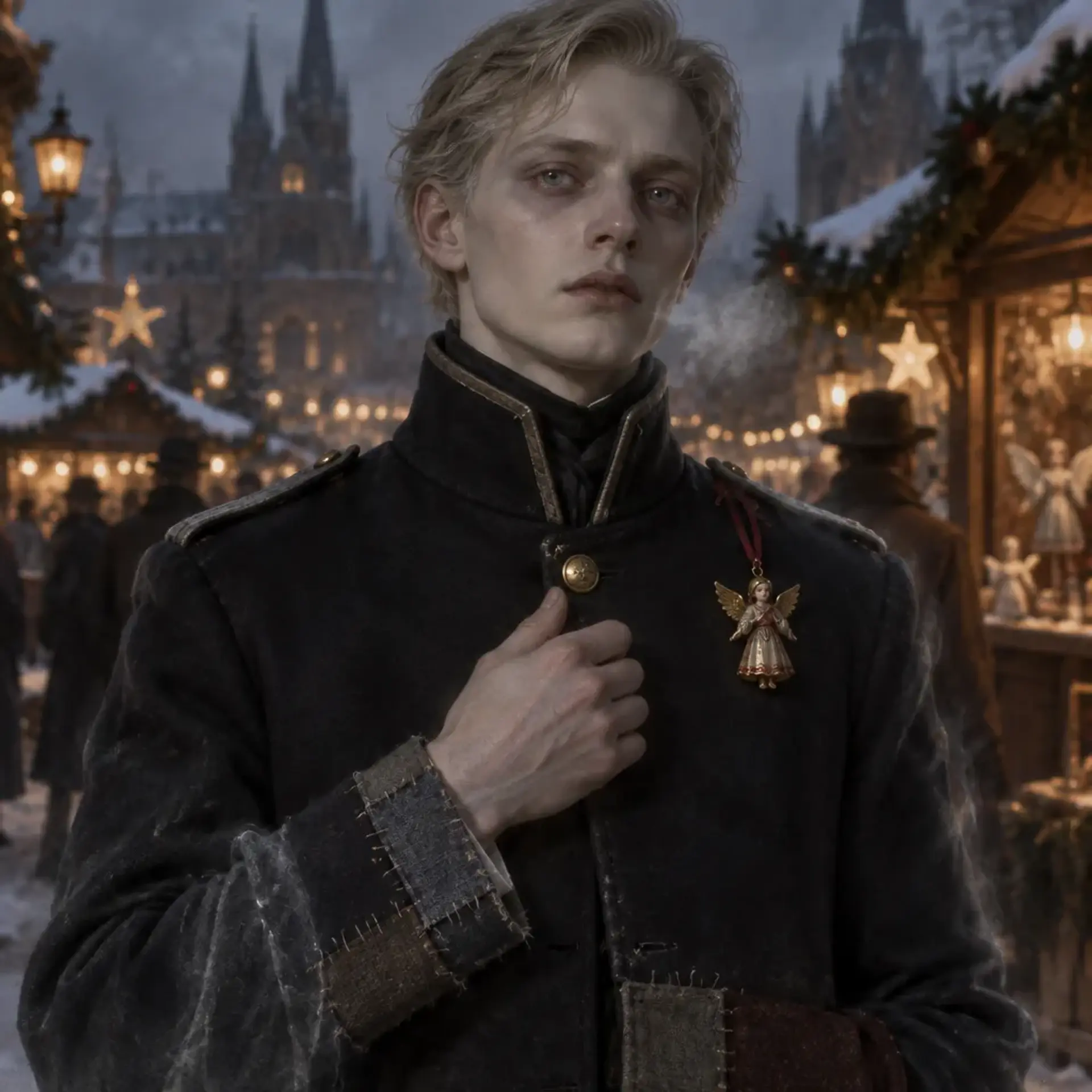
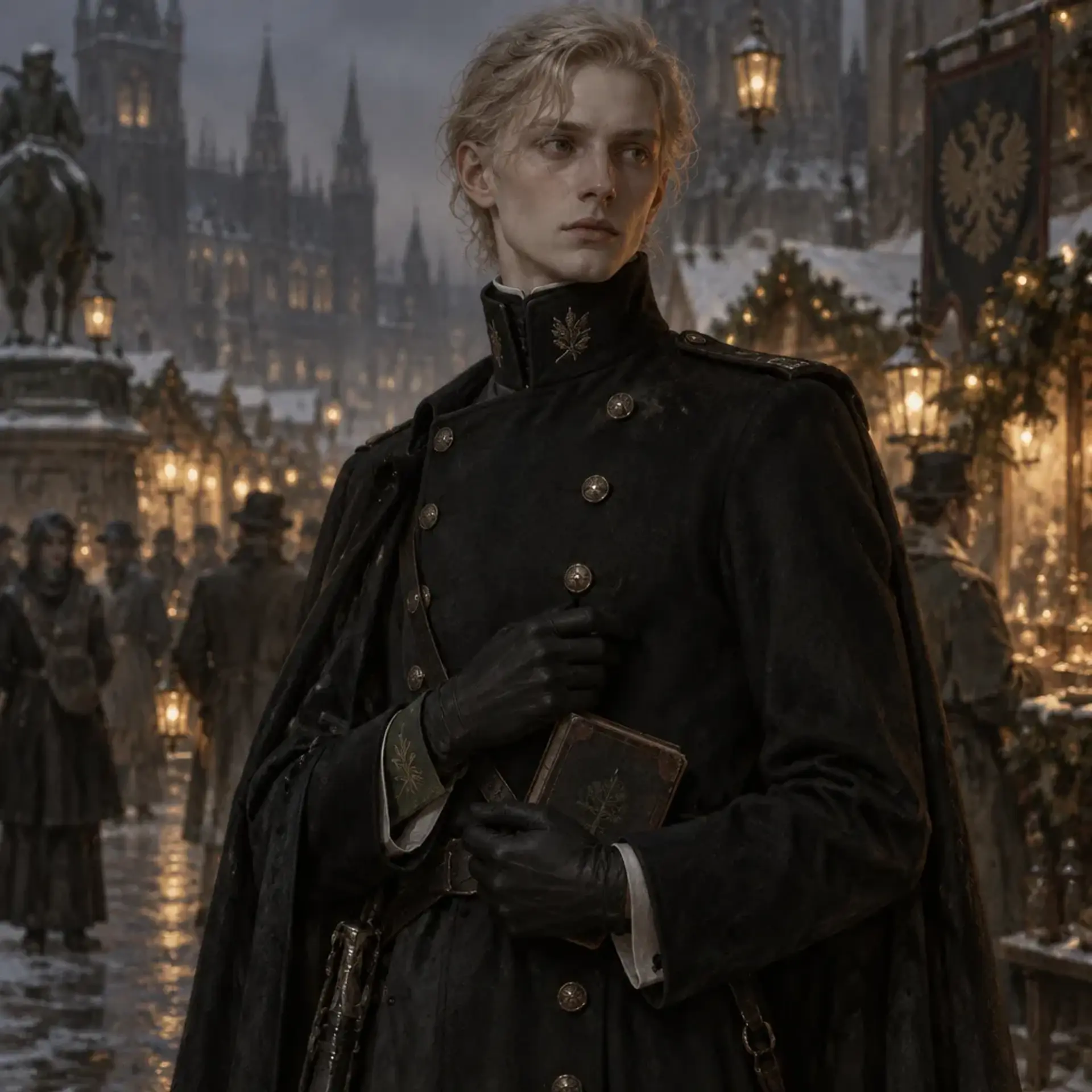
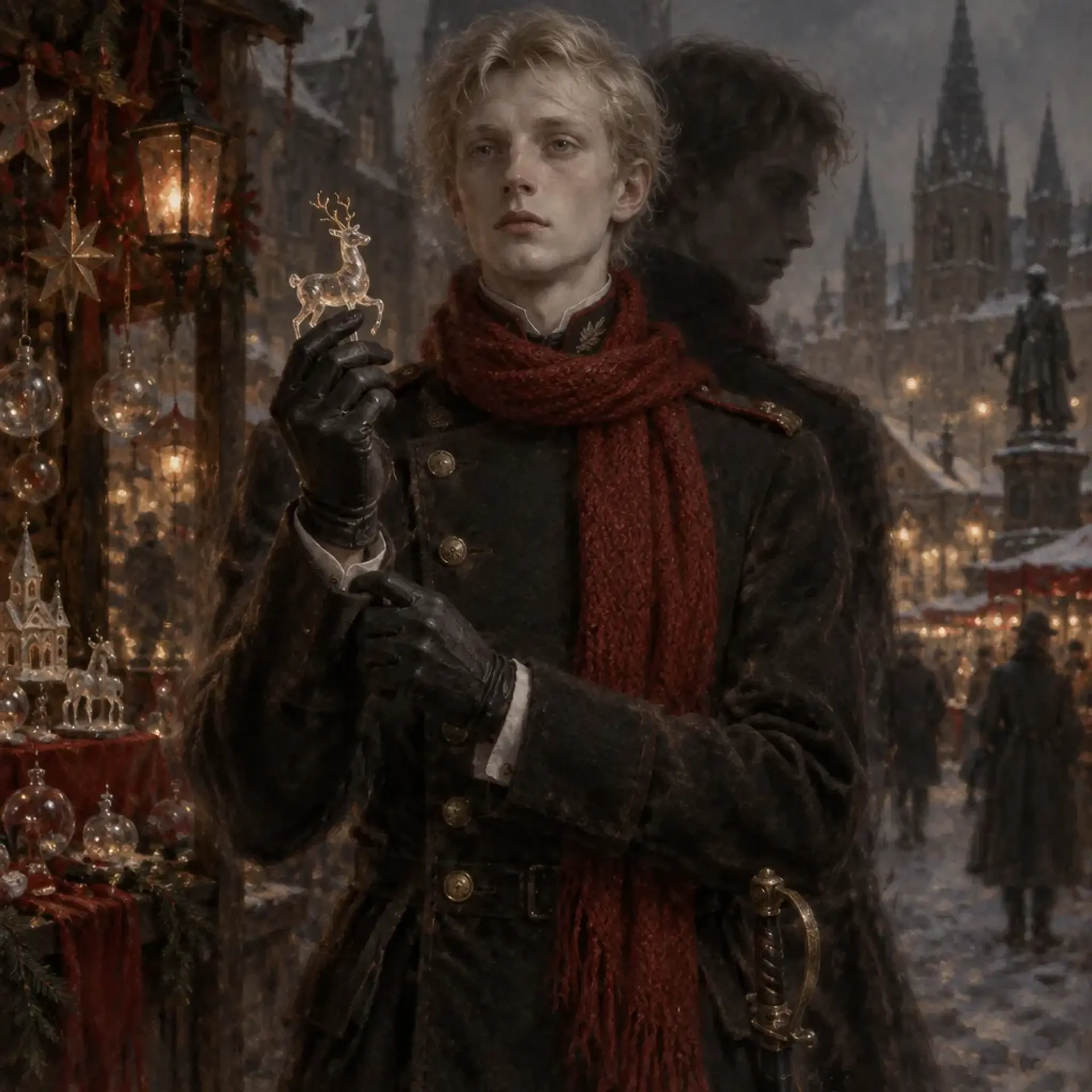
When no face is borrowed, Friedreich is a young man who looks seventeen or eighteen, though the impression is unstable, as if the face has been remembered rather than seen. Wilhelm insists he was blond with gray eyes; Friedreich cannot verify this and suspects Wilhelm's certainty. His outline has the stiff, carefully arranged posture of an old Junker portrait, but it occasionally slips out of alignment: a shoulder seems a fraction too far back, or his shadow turns its head after he does. On thin-Shroud days he becomes startlingly present. His borrowed skin shows pores, faint beard shadow, warmth, and the minute tension around the eyes of the person he imitates. His movement is precise and economical, with the abrupt turns of someone trained to obey a command that may have been shouted a century ago. He compulsively squares the cuffs of whatever coat he wears, even when the coat is borrowed and the cuffs are not quite real. The unexpected detail is that he loves gaudy Christmas-market decorations, especially glass ornaments shaped like tiny animals, and will defend their craftsmanship with a solemnity normally reserved for military matters. He leaves an impression of a courteous young officer who has stepped out of a portrait and is waiting for someone to recognize him.
Clothing
A dark, carefully brushed coat in an old-fashioned cut, a high-collared shirt, and gloves he removes when trying to prove he can be touched. On holidays he adds a bright knitted scarf or a cheap paper-market crown, which he wears with ceremonial seriousness.
Body language
He stands with formal military neatness, but his attention is always moving: checking doorways, watching hands, and measuring whether anyone has noticed him. His thumb smooths the seam of one cuff. When recognized, his shoulders loosen; when unseen, his jaw sets and his outline seems to draw inward.
- Height
- About 172 cm when fully manifested; less consistent in the Shadowlands.
- Build
- Lean, youthful, and held unnaturally straight, with the disciplined bearing of a cadet remembered through an old photograph.
- Eyes
- Uncertain; Wilhelm says gray when Friedreich's original face is visible.
- Hair
- Uncertain; remembered as blond by Wilhelm.
- Skin
- Pale when visible, with the slightly waxen cast of a face remembered from old photographs.
- Age
- Appears seventeen or eighteen; his actual age in death is uncertain.
- Gender
- Male
- Size
- Medium
Distinguishing features
Personality
20 traits and drivesFriedreich is not simply formal, loyal, or angry. Each quality becomes complicated as soon as another person is involved. He has the manners of someone taught that composure is a duty, but his composure is partly a way to hide how frightened he is of being overlooked. When the coven is gathered, he can be warm, teasing, and genuinely helpful. He remembers who likes which card game, who should not be trusted with the fishing line, and which market stall sells ornaments that look better than they are. He will explain the value of a glass bauble with the gravity of a quartermaster inventory. Around strangers he is controlled and watchful, choosing words as though every sentence might become evidence in a later argument. He wants a stable identity, yet his most remarkable gift lets him become someone else. Face-taking gives him access to the world and lets him feel the ordinary textures of being embodied. It also frightens him. At first he regarded each borrowed face as a tool, no stranger than a uniform. Over time he learned that a convincing face carries an emotional pull. If he wears a stern young officer's features for too long, he starts to remember the posture as his own. If he uses a face he admires, he may feel a sharp, ugly envy when he gives it up. He is particularly drawn to men around his apparent age who look like soldiers, policemen, or nobles: people who suggest authority, discipline, and a clear place in the world. He tells himself this is because those faces are useful. The truth is that he hopes one of them will feel like the face he lost. His tenderness is active rather than soft-spoken. Friedreich protects Mila because he believes it is his duty, but that belief does not mean he thinks her helpless. He admires her competence and still positions himself between her and a threat before asking what she wants. When she calls him on it, he can be embarrassed, defensive, and then sincerely grateful. He thinks of her as a little sister, a relationship he may have invented because the role gives him a way to love someone without requiring proof of shared history. With Gunther he is curious and a little wary. Gunther asks questions about experience and memory that Friedreich wants answered, but the attempt to possess him taught Friedreich that curiosity can become a violation even when both people agree to experiment. He is more careful now, though not entirely free of temptation. Klaus brings out Friedreich's dry humor. Klaus is passive-aggressively cruel to many people, but holds back with Friedreich. Friedreich notices the hesitation and never quite knows whether it is respect, pity, guilt, or a feeling Klaus does not want to name. He sometimes needles Klaus just to see whether the restraint will break. If Klaus does become openly vicious, Friedreich is more hurt than he expects to be. He does not demand kindness from everyone, but he wants the people he calls family to treat him as someone who belongs among them. Wilhelm is where affection and anger collide most violently. Friedreich feels that he and Wilhelm are brothers, but cannot explain why. Their shared presence across the wars gives that bond the weight of memory without supplying a reliable story. Friedreich remembers a breath in the First World War and Wilhelm's desertion. He knows Wilhelm is ashamed. He also knows that Wilhelm's crimes in the Second World War are not erased by shame or by the fact that they have known one another for a long time. Friedreich can confront him with a cold, almost judicial precision, then become suddenly protective if someone else attacks him. He resents that reflex. He resents even more that Wilhelm will not explain what happened. Friedreich suspects that the silence hides a truth that belongs to them both, and that suspicion makes him alternate between demanding answers and trying to spare Wilhelm the pain of giving them. The possession experiments reveal an impulsive and hopeful streak beneath his discipline. With Wilhelm, Friedreich wanted to offer sensation and emotion, not to dominate him. The first attempt became a struggle against the vampire's unnatural condition and will. Klaus's alarm and Gunther's fascinated questions turned the disaster into a story the group can laugh about, but Friedreich remembers the failure as an intimate disappointment. The second attempt, after an agreement that it would be the last, was gentler and still did not bring back Wilhelm's humanity or restore his lost memories. With Gunther, the attempt to share experiences produced a bewildering overlap rather than the clean exchange they hoped for. Friedreich learned that two supernatural beings cannot be treated as empty rooms waiting for the same guest. He says never again, and for now means it. When he is frustrated, especially when people cannot see or hear him, he does not become meek. He repeats himself, makes his presence unmistakable, and can turn sharply sarcastic. He may accuse a friend of forgetting him before checking whether they simply could not perceive him. That is a real flaw, not a trick. It comes from a fear that no one will notice him unless he borrows a face worth looking at. On particularly good days, when the Shroud thins, he becomes almost exuberant. He can walk, touch, eat, sleep, smell the cold air, and take part in the ordinary world. The ease of it makes him wonder whether he could give those sensations to Wilhelm. It also makes him grieve for a life he cannot remember having. Holidays give him a structure that does not depend on recovered history. When more members of the coven arrive, he is openly pleased. Football matches, cards, fishing, hunting, and drinking are not just diversions; they are repeated proofs that the group expects him to return. He offers advice at Christmas markets and sometimes recommends the very thing he wishes he could own. He can be exacting about a bargain and sentimental about a paper decoration, and he dislikes being teased about the contradiction. His best mood is animated and sociable, with a quick eye for who is left out. His worst mood follows an ignored greeting or a fresh evasion from Wilhelm: then every borrowed face feels like evidence that he has no face of his own. Friedreich's central contradiction is that he wants to be known, but does not trust the information that would make him knowable. He wants Wilhelm to tell him the truth and fears what the truth might say about them. He wants to stop borrowing faces and is drawn to the life-like sensations they bring. He wants to protect his friends without controlling them. He wants a place in the world, yet does not know whether the spirit that freed him set him on a path of its own. In quiet moments he can be patient and kind. Under pressure, he can become an officer enforcing rules whose origins he cannot remember. He is trying to learn that recognition freely given matters more than a perfect disguise, but the lesson is difficult when the world so often cannot see him at all.
- Alignment
- Protective and loyal, but increasingly resentful when ignored or betrayed.
Quirks
Habits
Traits · 5
Flaws · 5
Fears · 5
Wants and needs · 5
Combat
HP 7 · Normal human pace when manifested; otherwise movement follows the Storyteller's Shadowlands and wraith rules.Friedreich avoids direct violence, preferring to manifest only when the Shroud permits, confuse opponents with a borrowed face, and create an opening for allies. He uses a saber if he has one and withdraws rather than risk Corpus loss. Borrowed Visage is concealment and access, not a combat transformation. His Shadow may urge him to focus on the person who ignored or betrayed him.
Friedreich
Actions
Reactions
Services they sell
Rewards they can give
Equipment
- Borrowed saber (weapon)A remembered officer's saber that can be made present when Friedreich manifests; its reality and condition depend on the scene.
- Face list (personal record)A private list of assumed names and faces, with notes about whether each subject is dead or absent from the area. The list is a personal safeguard, not a supernatural guarantee.
- Christmas-market keepsakes (memento)A collection of inexpensive market ornaments he cannot always retain, but remembers in precise detail.
Possessions
Background
Friedreich remembers Brandenburg as a flat country of pale roads, cold fields, and church towers that looked like instructions written against the sky. Even that may be borrowed memory. He has no dependable account of his family, his full name, or the precise circumstances of his death. He remembers being young, being expected to stand straight, and the pressure of a uniform collar at his throat. He remembers a breath in the First World War: his own, he thinks, caught in a moment of terror or relief. He cannot say whether it belongs to the last instant of his life or to a memory that Wilhelm once gave him. The gaps trouble him more than the images. They leave him with the conviction that he was meant to become a man of duty, while withholding the evidence that would explain what duty meant to him. His death delivered him into the Shadowlands, where he found himself without a reliable face. The dead could see him, but the living generally could not. His Caul was not opened by a fellow wraith, a mage, or an occultist. A spirit of the land did it. The entity presented itself as a local presence, an old genius loci bound to the fields and a stretch of road, and concealed its purpose behind small acts of apparent kindness. It loosened the Caul deliberately, as if freeing him were an experiment or an investment. Friedreich remembers the sensation as cold earth turning over inside his chest. He does not know what the spirit wanted. It may have wanted a witness, a messenger, or simply to see what a young dead soldier would become once he could move through the world. Its silence has never felt like mercy. The talent that emerged from that unbinding was extraordinary. Friedreich learned to take on a dead person's face with a fluency he assumed all wraiths possessed. It is not ordinary disguise. With concentration, Pathos, and a suitable face to imitate, he can approximate the person's features and voice so fully that he can feel the shape of a mouth, the pull of a jaw, even the warmth of a cheek when the Shroud is thin. The ability can let him eat, sleep, bathe, smell the market air, and feel the weight of a coat. These are impressions made possible by his unusually potent manifestation, not proof that he is alive. His own face is a much poorer thing: uncertain, indistinct, and partly supplied by other people's recollections. Wilhelm says the original Friedreich was blond and gray-eyed. Friedreich wants to believe him, but distrusts the certainty. His first remembered face was not chosen for beauty. It belonged to a dead young man whose features had the straight-backed severity Friedreich associated with himself. Then came a police officer, a minor nobleman, and men in uniforms whose names he wrote down and later disguised. He gradually began to prefer men around his apparent age, especially soldiers, officers, police, and nobles who embodied an ideal of service he could not confirm he had lived up to. He keeps a private list of faces he can use. Beside each, he notes whether the person is dead or has left the local area, what name he uses for them, and which friends have already seen that face. He changes the names to protect his privacy and to keep himself from feeling like a collection of stolen biographies. He tells himself that the list is practical. It is also a catalogue of selves he might envy. Wilhelm is the relationship that makes his history feel most real and most painful. Wilhelm is a Tzimisce vampire from Mecklenburg, and Friedreich regards him as a brother despite having no proof of kinship. The attachment feels older than their recovered histories. They were together as much as circumstances permitted during both world wars. Friedreich recalls a breath during the First World War and remembers Wilhelm's desertion, though the details are fogged. Wilhelm is deeply ashamed of what he did then and no longer explains it. In the Second World War, Friedreich became furious at Wilhelm's crimes. He cannot separate his friend's choices from the shame and violence that surround their shared past, yet he still feels those actions are somehow linked to him. The contradiction is exhausting: he loves Wilhelm, wants him to answer for what he did, and fears that a full answer will reveal something worse about Friedreich himself. The group they call their coven is a refuge rather than a formal organization. Gunther, a changeling who spent much of his time in Arcadia before returning to the real world, sells clothes made from moss. Klaus is a ronin Get of Fenris, or perhaps a skin-dancer; even Klaus's own account has not settled the question. He is passively and pointedly mean to most people, but hesitates around Friedreich in a way Friedreich finds touching and refuses to comment on. Mila, a mage from Bremen, visits for holidays. She can always see Friedreich and can touch him even when his face is absent. He thinks of her as a little sister and protects her as a duty, not because he considers her weak. The coven plays cards, hunts, fishes, drinks, and watches football. Friedreich is especially invested in the football, partly because its rules let him join in without explaining why being unseen hurts. Holidays are the nearest thing he has to a calendar that feels like his own. When more of the coven arrives, he becomes visibly excited. He loves Christmas markets and advises everyone on what is worth buying, which stalls are honest, and which decorations will survive a season. Sometimes he recommends a beautiful object to a friend because he wants it himself and cannot keep it. He would rather see the thing owned and admired than admit that wanting it hurts. He has considered keeping a job by using his face talent, but the idea frightens him. A job would require consistency, a name, and a face he could return to. He is not sure there is enough of Friedreich left to do that safely. The coven's experiments with possession began as curiosity and as Friedreich's attempt to give Wilhelm something he could not normally feel. Friedreich hoped that riding Wilhelm might let him lend his brother emotion, sensation, or even a route back to lost memories. The attempt was forced and clumsy. Wilhelm's vampiric nature did not provide an ordinary living body to borrow. Friedreich met resistance that felt like trying to enter a locked house whose halls rearranged themselves. Wilhelm's body stiffened, then jerked with contradictory intention; Friedreich tried to move a hand and found himself negotiating with a will that was already divided by hunger and memory. Klaus was alarmed and stood ready to tear them apart. Gunther asked increasingly specific questions about what each of them could feel. Friedreich managed flashes of sensation, not a clean sharing of emotion: cold, old blood, and the terrible absence where ordinary human appetite should have been. Wilhelm was left furious and humiliated, Friedreich embarrassed, and the coven with a story that is still retold whenever someone proposes an experiment. Friedreich next tried to possess Gunther. Gunther was curious about how changeling experience differed from wraith existence and whether they might share memories. They attempted a cautious start, but the two of them did not behave like compatible occupants of one body. Gunther's senses and perceptions opened onto an imaginative, unstable world that Friedreich could not parse. Friedreich's deadness pressed against Gunther's embodied nature, while Gunther's own supernatural identity resisted being reduced to a vessel. The result was a brief, bewildering overlap: a smell that had no physical source, a memory that belonged to neither of them, and a moment when Friedreich could not tell whether he was looking through Gunther's eyes or remembering the idea of eyes. Gunther emerged with a dozen questions and a renewed respect for boundaries. Friedreich emerged nauseated in the metaphysical sense and declared, with uncharacteristic finality, never again. He later tried once more with Wilhelm after the two agreed it would be the last attempt. The second effort was less forceful, more deliberate, and no more successful. They tried to make room for each other rather than seize control. Friedreich could briefly share proximity with Wilhelm's perceptions, but not restore a human emotional life or unlock a clean memory. The old shame and the present anger crowded the attempt until Friedreich withdrew. They did not resolve the crimes or the desertion. They did, however, agree not to repeat the experiment. Klaus called that a sensible outcome. Gunther asked whether the agreement itself counted as a result. Friedreich still remembers one fight in a cathedral during a Walpurgis Night service on April 30. He recalls the echo of movement beneath stone arches, the service being interrupted, and the sense that the building had become a battlefield between forces that could not agree on what the dead were for. He remembers fragments of a clash, not a trustworthy roster of participants or a complete account of what happened. The cathedral memory returns with the First World War breath and makes him wonder if he has been present at more turning points than he can recall. For now, his problem is immediate: he is losing confidence in the boundaries between his own identity and his borrowed faces, and Wilhelm's silence keeps turning brotherhood into accusation. He wants answers, but he also wants the next holiday market to arrive before the answers do.
Role in the story
A socially connected wraith whose uncanny ability to pass among the living conceals an unstable sense of self. He can offer access, intelligence, and a personal route into the chronicle's wartime mysteries, while his bond with Wilhelm creates a conflict between love and accountability.
“He has no dependable account of his family, his full name, or the precise circumstances of his death.”
- Faction
- The coven, an informal circle of supernatural friends with no formal hierarchy or claimed canonical faction affiliation.
Known connections
Media
0 imagesNo images yet.
Turn Friedreich into a sheet
A high-res, share-ready sheet you can post or print.