
DND Character Generator: How to Build a Complete Hero in 2026
Use a dnd character generator to build stats, story, portrait art, tokens, and table-ready heroes without losing rules clarity.
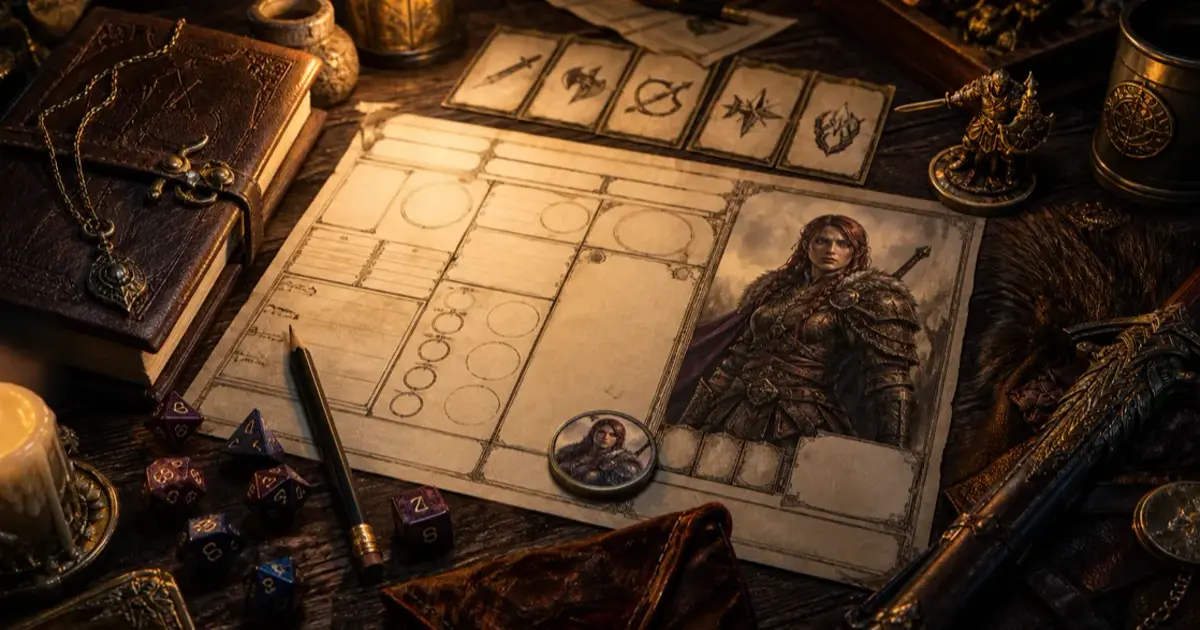
A dnd character generator has to do more than spit out a name, six numbers, and a class label. I can roll a dwarf fighter by hand. What I want, especially before a one-shot or a late campaign replacement, is a playable hero with a rules spine, a reason to exist, a portrait I can show the table, and enough export options that I am not rebuilding the same character in four places.
The search results for character tools are odd right now. Some tools are excellent rules builders. Some are art generators wearing a character-creator hat. Some are randomisers that produce a fun starting point but leave you doing the actual table work. The newer pressure comes from D&D Beyond's Quickbuilder, which got attention in March 2026 because it makes a legal starter hero very fast. PC Gamer called out the obvious benefit: new players can choose class, species, background, and portrait, then start from an automated sheet rather than a blank page.
That is useful. I still think there is a bigger question for 2026: which tool gets you from idea to table without creating a second prep job?
CharGen's D&D character generator is my pick when I need a complete D&D hero package: build choices, backstory, portrait art, shareable presentation, a token route, and links into the rest of campaign prep. D&D Beyond still wins for official sourcebook depth. FastCharacter still wins when you want speed with almost no friction. The right answer depends on the job.
Why a dnd character generator is not one job
Character creation used to be easy to describe and slow to finish. Pick a class, pick a species, choose scores, add equipment, write a name, then discover three sessions later that the character is mechanically fine and emotionally made of wet cardboard.
The 2024 Player's Handbook changed some of the order and emphasis. D&D Beyond's official guide notes that character creation now starts with class, then origin, ability scores, alignment, and personal details. It also points out that D&D Beyond labels the 2024 rules as 5.5e for clarity while still supporting both rules versions. That matters because many tables are now half in 2014, half in 2024, and quietly pretending the word "compatible" solves every argument.
For a tool to be useful in that mess, it needs to handle several jobs cleanly.
| Job | What the generator needs to provide | What usually goes wrong |
|---|---|---|
| rules base | class, species, background, ability scores, proficiencies, hit points, equipment | missing choices, wrong assumptions, locked paid content |
| story hook | backstory, motive, bond, flaw, table-ready personality | long lore paragraphs nobody reads |
| visual identity | portrait, gear cues, token crop, party style | nice art that does not match the sheet |
| play handoff | printable sheet, share link, export, notes | the character is trapped in one tool |
| campaign use | NPC links, recap links, token, future edits | the hero disappears after session one |
That is why I split this roundup by table purpose rather than pretending there is one universal winner. A first-time player at a store game needs a different tool from a DM creating six backup pregens, and both differ from a player who already knows the rules but wants art, backstory, and a Roll20 token by Thursday.
Best D&D character generators in 2026: quick comparison
Here is the version I would give someone who just wants the short list.
| Tool | Best for | What I like | Main limit |
|---|---|---|---|
| CharGen Character Generator | full hero package with stats, story, portrait, exports, and campaign handoff | connects character creation to art, tokens, NPCs, session notes, and other RPG tools | not trying to replace every paid official rules option |
| D&D Beyond Character Builder and Quickbuilder | official D&D rules onboarding | strongest official rules ecosystem, automated sheet, beginner-friendly Quickbuilder | character presentation and art workflow are not the focus |
| FastCharacter | instant random 5e sheets | extremely fast, no fuss, useful for emergency pregens | light on art, personality, and campaign memory |
| dndcharactercreator.art | AI stats, backstory, and portrait in one page | clear AI character pitch, 90-second promise after signup, PDF and JSON claims | pricing and export features need checking before relying on it |
| DND AI | character creation inside AI adventure play | useful if you want the character to live inside an AI campaign loop | more of a play platform than a dedicated tabletop prep tool |
| Hotpot AI Character Generator | character portraits and visual ideas | quick no-login art creation, many style routes | not a D&D rules builder |
| Hero Forge | custom miniatures and pose control | best when the final object is a miniature or VTT-style figure | slower for full sheets and written character work |
| Perchance and random table tools | quick weird sparks | free, chaotic, good for NPC ideas and one-shot prompts | needs human clean-up before play |
My actual recommendation is simple. Use D&D Beyond if official mechanics are the main concern. Use FastCharacter if you need a legal-ish sheet right now and the personality can wait. Use CharGen if you want a playable hero that also has story, art, token prep, and a campaign-facing presentation.
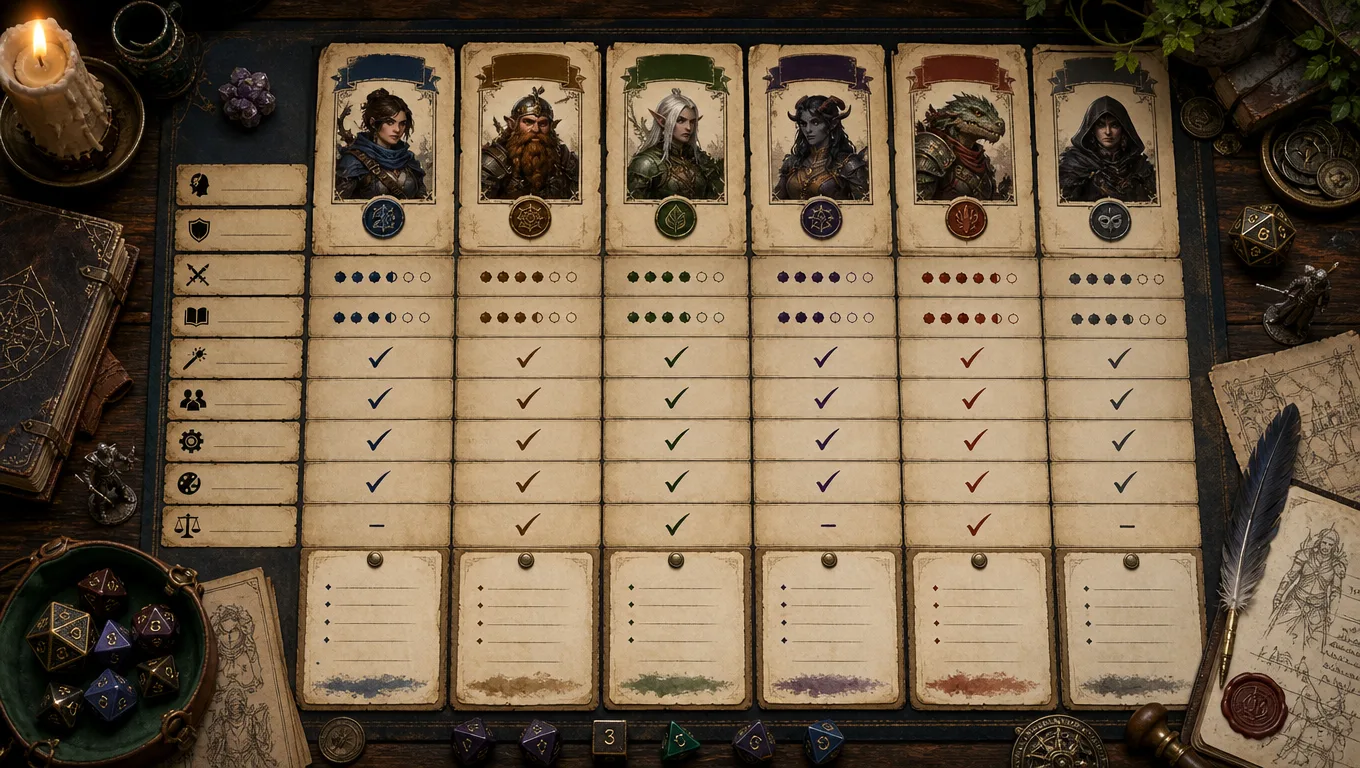
Where CharGen fits best
CharGen is strongest when the sheet is not the finish line. That is usually how I play. The numbers need to work, but the table remembers the chipped tusk, the failed vow, the weird voice, the portrait in Discord, and the moment the character's old debt walks into the tavern.
The D&D character generator has two useful modes: Character Builder and Quick Generate. I use Character Builder when I care about decisions, and Quick Generate when I have a concept sentence and need the tool to help fill the gaps. The builder walks through system, species, class, abilities, background, and details. Ability options include familiar routes like point buy, standard array, rolling, and manual entry. The details step is where the character stops being a rules object and starts being a person.
Here is a prompt I would actually type:
Human warlock, former barrister, bound to a tide spirit, immaculate coat, terrible sleep, level 4, wants to prove one miracle was fraud.
That gives the generator role, class, old life, pact flavour, visual clue, level, and a playable motive. It is much better than cool warlock with tragic past, which is how you get a velvet coat, purple smoke, and no useful table hook.
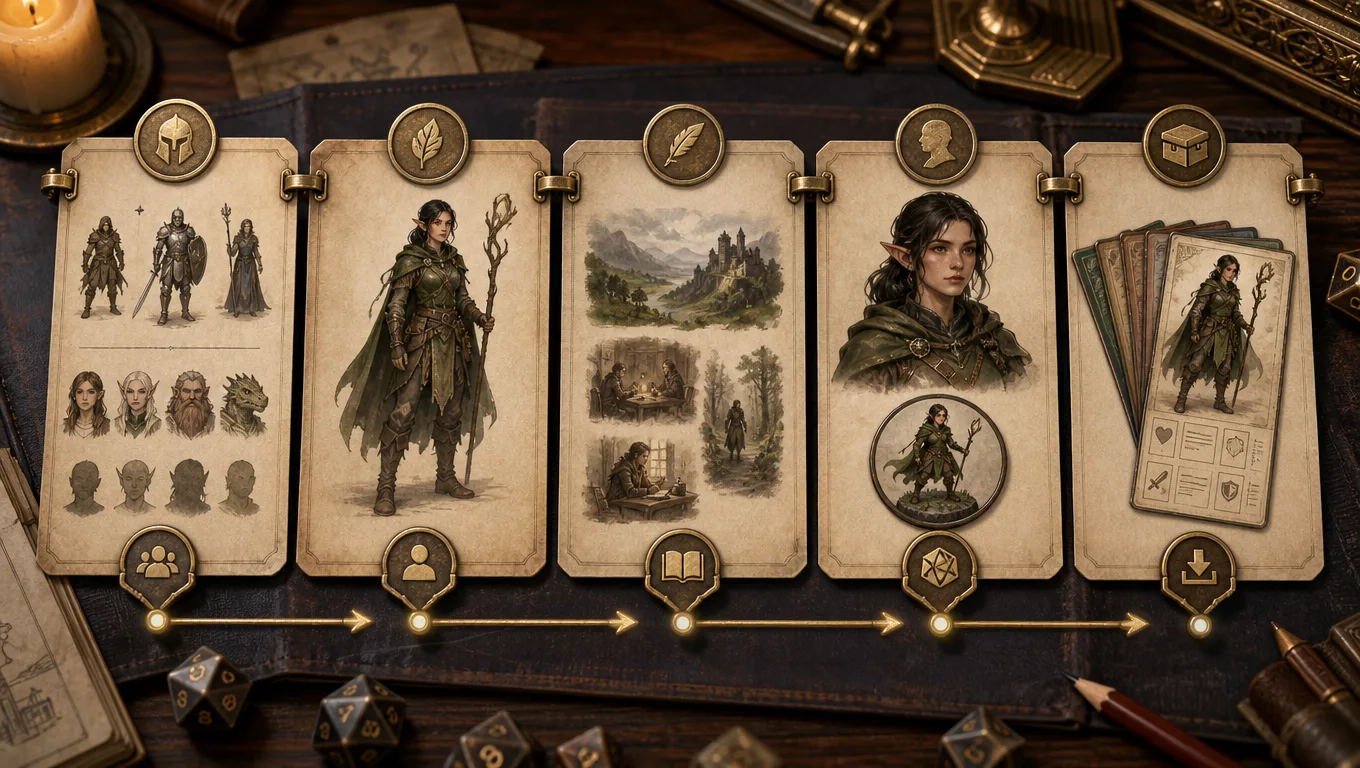
The thing I like most is the handoff. A generated character can connect to portrait art, share cards, exports, voice and ambience work, and the rest of the CharGen ecosystem. If the character later becomes an NPC, I can build out contacts through the NPC Generator. If the portrait needs VTT use, I can send it through the Token Maker. If the character survives a session, RPG Session Notes can preserve what changed.
That connected workflow is the point. I do not want six disconnected files called newcharacter_final_v3_reallyfinal.png.
Where D&D Beyond still wins
D&D Beyond is still the safest pick when you need official rules gravity. The support article for Quickbuilder is clear that Quickbuilder is not replacing the full Character Builder. It is one way to create a character, while the full builder continues to exist and grow. That split makes sense. Quickbuilder is for speed. The full builder is for control.
PC Gamer's March 2026 write-up caught why it matters for new players. A blank sheet can feel like maths homework. Quickbuilder turns creation into a few visual choices, then fills in attributes, equipment, spells, and proficiencies with defaults you can tweak later. For a nervous first player, that is a real benefit.
Where D&D Beyond is better than CharGen:
| Need | Why D&D Beyond wins |
|---|---|
| official content ownership | purchased books, rules, and digital sheets live together |
| strict rules automation | the sheet handles many calculations and level-up details |
| new player onboarding | Quickbuilder reduces blank-page fear |
| table groups already using DDB | less tool switching for the whole party |
| official errata and updates | changes arrive inside the official platform |
Where it is weaker for my use:
| Need | Why I look elsewhere |
|---|---|
| original character art | art is not the core workflow |
| campaign presentation | the sheet is practical, not theatrical |
| token creation | still needs a separate visual workflow |
| AI story iteration | not the main point of the builder |
| cross-tool creative prep | character, art, recap, NPCs, and media are separate jobs |
That is not a criticism so much as a boundary. D&D Beyond is excellent at being D&D Beyond. I just do not expect it to be my portrait studio, token bench, and backstory editor at the same time.
What I test before trusting an AI character builder
AI character tools are getting better, but I do not trust them blindly. The funniest error is when the story is good and the mechanics are wrong. A dramatic paladin with illegal proficiencies is still a problem. So is a wizard with the wrong hit points, a rogue with gear that does not fit the rules, or a cleric whose backstory says they worship a sea saint while the sheet says nothing about that faith.
My test is small:
| Check | What I look for |
|---|---|
| rules sanity | class, species, background, ability scores, hit points, proficiencies |
| play role | what the character does in combat, exploration, and social scenes |
| story pressure | one motive, one debt, one fear, one useful relationship |
| visual match | portrait shows class, species, age, gear, and mood |
| export | I can move the result into the place I actually play |
| edit path | I can correct the parts that are almost right |
For example, I generated a half-orc barbarian with ritual scarring, a chipped tusk, a red wolf pelt, and a battered bronze greataxe. If the sheet says barbarian but the portrait gives me a clean-shaven human gladiator in gold plate, the tool has failed the handoff. If the backstory says he is gentle with children but gives no reason he joined the party, I still have work to do.
Another useful test is the backup character problem. Say your level 9 cleric dies at the end of a session and you need a replacement before next week. A good ai character builder dnd tool should produce a legal enough base, a reason the new character enters the story, a portrait for the group chat, and a token for the VTT. If it only gives one of those, it may still be useful, but it is not the whole answer.
Free D&D character creator options: what "free" usually means
People search for dnd character creator free because they do not want to buy three books and subscribe to a platform before they know whether the game will stick. That is fair. The tricky bit is that free can mean very different things.
| Free model | What you get | What to watch |
|---|---|---|
| official free rules | basic rules and limited character options | full sourcebook options may require purchases |
| random sheet generator | fast pregens and simple exports | fewer custom choices |
| AI trial credits | a few story or art generations | recurring costs after the trial |
| art-only free tool | portraits or style tests | no rules sheet |
| community generator | homebrew or SRD-friendly builds | accuracy and maintenance vary |
dndcharactercreator.art, for example, advertises complete heroes with backstory, stats, and artwork in 90 seconds after signup, plus five free story generations. It also says it handles 5e rules and maths, and mentions PDF or JSON exports. That is an appealing pitch, but I would still test the export before using it at a live table.
Hotpot is a different category. Its AI Character Generator is aimed at portraits and character visuals for RPGs, writers, game developers, and creators. It says no login is required. Useful for art sparks, yes. Full D&D character sheet, no.
DND AI is different again. It is framed around AI adventure play, character progression, generated images, video, and narration. That may be brilliant if you want an AI story platform. It is not the same job as making a printable hero for a normal Friday night table.
My practical CharGen workflow for a table-ready hero
This is the routine I would use if a player sent me "I want a dwarf ranger who maps monster migration routes and hates heroic speeches" at 8 pm.
| Minute | Action | Result |
|---|---|---|
| 0-2 | open Character Builder or Quick Generate | concept becomes a rules-shaped draft |
| 2-5 | choose system, species, class, level, and ability method | the character has a stable base |
| 5-8 | add a tight prompt with motive and visual clues | story and art have direction |
| 8-12 | review stats, features, story, and equipment | obvious mistakes get fixed |
| 12-16 | generate or refine the portrait | the character has a face |
| 16-18 | create a VTT token if needed | Roll20 or Foundry handoff is ready |
| 18-20 | export or share | the group can actually use the result |
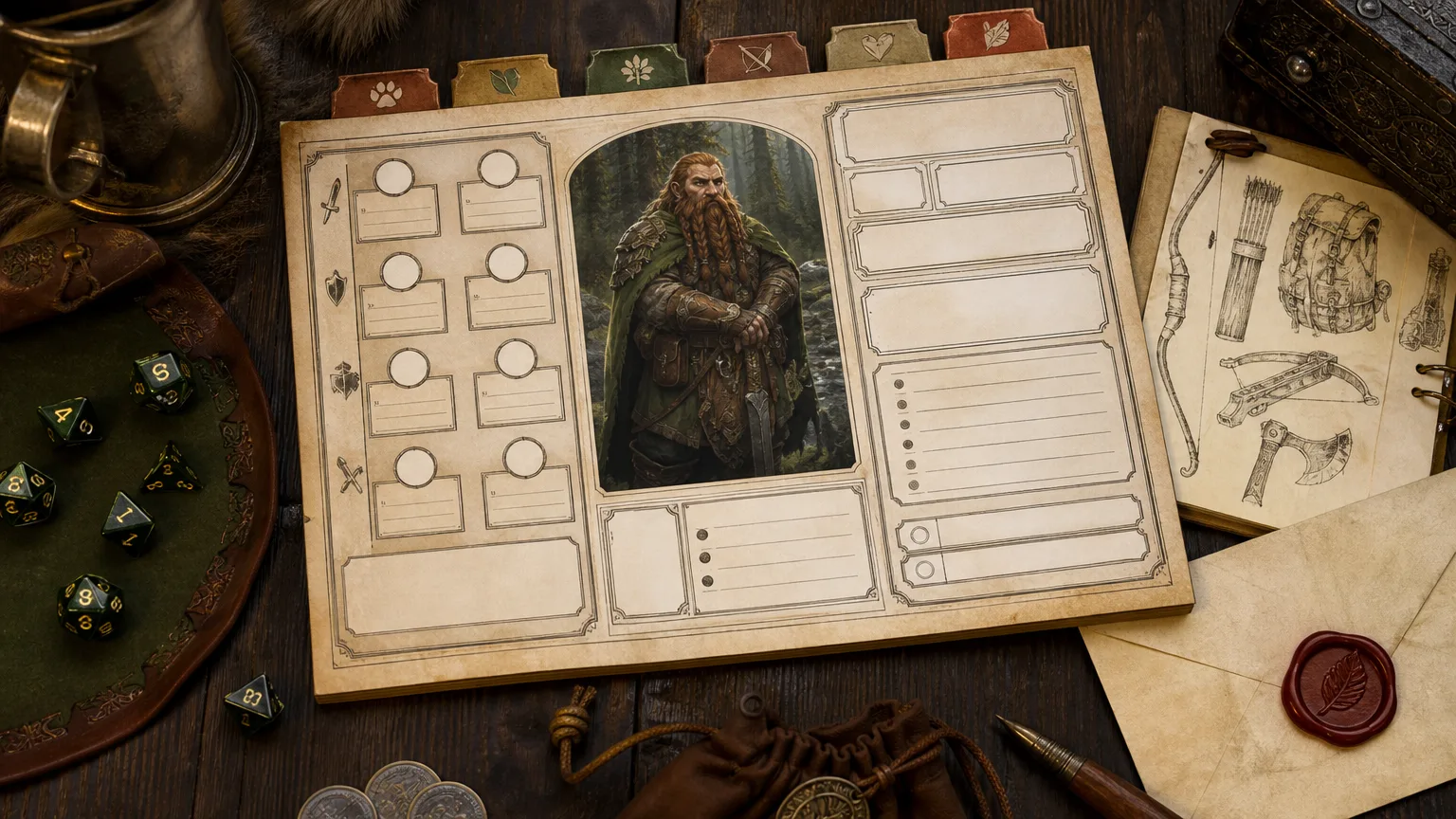
My prompt pattern is:
[species] [class], [old life], [current problem], [visual clue], [party role], [tone].
Examples:
| Character idea | Prompt I would use |
|---|---|
| cautious ranger | Dwarf ranger, maps monster migration routes, owes money to a cartographers' guild, mud-stained green cloak, party scout, dry humour |
| strange cleric | Halfling cleric, raised in a lighthouse monastery, hears bells before storms, salt-white robes, party healer, calm until lied to |
| social rogue | Half-elf rogue, former court tailor, knows every noble sleeve button in the capital, silver scissors, party infiltrator, polite menace |
| loud fighter | Dragonborn fighter, retired arena champion, keeps letters from disappointed fans, cracked brass shield, party defender, theatrical but lonely |
The prompt does not need to be long. It needs a role, a contradiction, and one visual thing the art can hold onto.
Turning a generated character into a VTT token
The best character builder still needs a token plan if you play online. A beautiful full-body portrait can become useless when it gets crushed into a small circle.
Token-friendly character art needs boring discipline:
| Prompt rule | Example |
|---|---|
| centre the face | centred bust portrait |
| simplify the background | plain dark background |
| avoid wide props | weapon lowered, not crossing the frame |
| keep the eyes visible | face fully visible, no hood shadow |
| mention the final use | token-ready crop |
After that, CharGen's Token Maker is the quick route. Upload or pick the portrait, choose a frame, adjust the crop, then export the PNG. The full portrait can stay with the sheet or share card. The token can go into Roll20, Foundry VTT, Fantasy Grounds, or whatever folder your group uses.
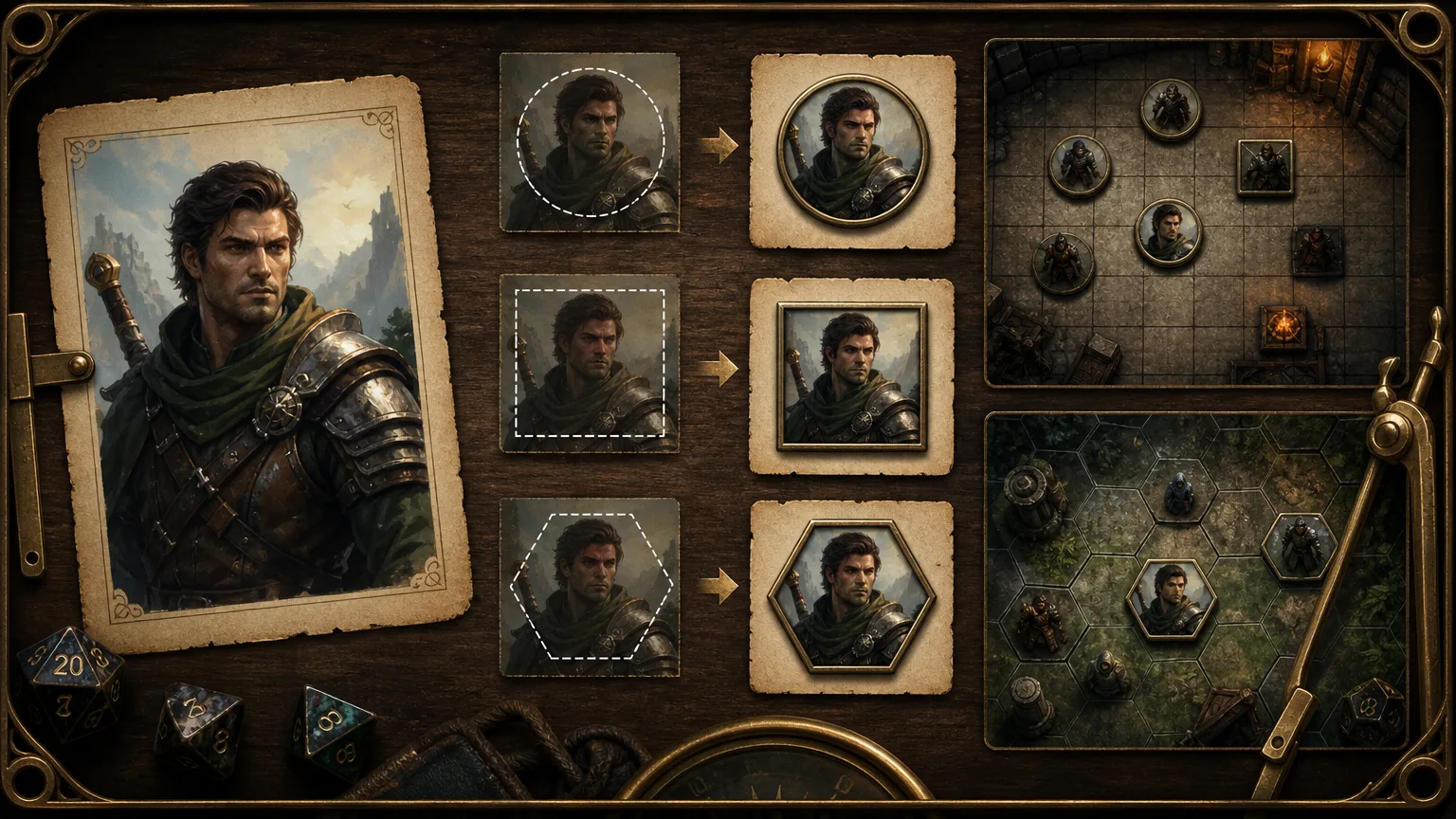
I also save the prompt beside the character. If the player later gains a cursed axe, loses an eye, joins a faction, or changes armour, that old prompt gives the next image a better chance of still looking like the same person.
Choosing the best character generator for your table
Here is my honest split.
| Table situation | Best starting point |
|---|---|
| brand-new player needs legal official character fast | D&D Beyond Quickbuilder |
| experienced player wants full official control | D&D Beyond Character Builder |
| DM needs six emergency pregens | FastCharacter, then human clean-up |
| player wants stats, story, portrait, and token | CharGen |
| group wants AI adventure play, not just a sheet | DND AI |
| artistically picky player wants portrait only | CharGen Image Generator, Hotpot, or a dedicated art tool |
| miniature-focused player | Hero Forge |
| one-shot needs weird prompts | Perchance or random tables, then tidy by hand |
My own default is CharGen for any character I expect people to remember. I still check the rules. I still cut overwrought backstory. I still fix the occasional too-smooth AI sentence. But I get the whole table package faster: sheet, story, portrait, token path, and campaign continuity.
Build a D&D CharacterFAQ
What is the best dnd character generator in 2026?
For a full table-ready hero, I would start with CharGen because it combines character building, story, portrait art, exports, and token handoff. If you need official sourcebook rules above everything else, D&D Beyond is still the safer pick.
Is there a free D&D character generator?
Yes. You can use free official rules, FastCharacter-style random generators, community tools, and AI trial tools. The catch is usually content depth, export control, art limits, or paid upgrades after the free allowance.
Can AI make a legal D&D character sheet?
Sometimes, but you should check the result. AI can write a good backstory while making small rules mistakes. Before play, verify class features, hit points, ability scores, proficiencies, equipment, spells, and any 2024 versus 2014 rules assumptions.
What is the fastest way to create a D&D character?
For official D&D, D&D Beyond Quickbuilder is one of the fastest beginner routes. For a full CharGen workflow, use Quick Generate with a tight concept prompt, then review the sheet and create a portrait or token if the character needs to be shared.
Should I use one tool for rules and another for art?
You can. Many players use D&D Beyond for rules and a separate art tool for portraits. I prefer CharGen when I want those pieces closer together, because the portrait, token, story, and campaign notes are easier to keep connected.
My final recommendation
Pick the generator by what will happen after the character exists. If the character is for a rules-heavy official campaign, start in D&D Beyond and add art later. If the character is for a one-shot tonight, use the fastest sheet tool and spend your remaining time on one memorable motive. If the character needs to arrive with a face, a story, a token, and a shareable handoff, start in CharGen's Character Generator and keep the prompt tight.
The best test is simple: can you put the result in front of players and start play without apologising for missing pieces? If yes, the generator did its job.
Image credits
Images in this post were generated with WaveSpeed GPT Image 2 at medium quality, then cropped, resized, and converted to WebP for web use.