William Windon
William Windon
At the table
Voice
William's voice has the breath and slight rasp of someone accustomed to outdoor work, though bed rest has left it less robust. He tends to draw breath before difficult answers. The reflection's voice comes from the same throat but sounds older and more deliberate, with firm consonants and an old-fashioned English cadence. It speaks as if manners are a form of armor. In its own name, William Windon, the name sounds plain and local; the texture of the reflection's voice is not a clue to the name.
William's voice is youthful, warm, and somewhat careful, with the ordinary local English accent of his upbringing. After work, it can catch slightly from dust or dry air. He pauses when unsure and often sounds as though he is trying not to worry his family. The reflection uses the same mouth but changes the sound: its voice is deeper, more measured, and carries an older English accent. It articulates sharply, as if every word has been inspected for propriety. When startled or emotionally overwhelmed, the shift can happen in the middle of a sentence.
Speech patterns
How to play them
Treat William as a frightened person, not a possessed object. Give him time to answer, avoid forcing him to perform the reflection for entertainment, and ask permission before examining his chest or belongings. Be direct about safety and boundaries. The reflection responds to wit, old customs, historical questions, and signs of genuine composure, but may test anyone who shows interest in Adaline or William's family. If the heart is present, do not casually expose William to seawater, blood, or the object itself.
Goal
Find the Heart of England or Abraham Groff, discover who or what the reflection is, and keep the stranger from taking more of his life while recovering enough to pursue botany.
Motivation
William wants a future of his own: work among plants, a peaceful home, and the freedom to love his family and Adaline without a second will steering his body. The reflection wants conversation, access to the world beyond the glass, and perhaps a return to a family it describes as if they were weather.
Appearance
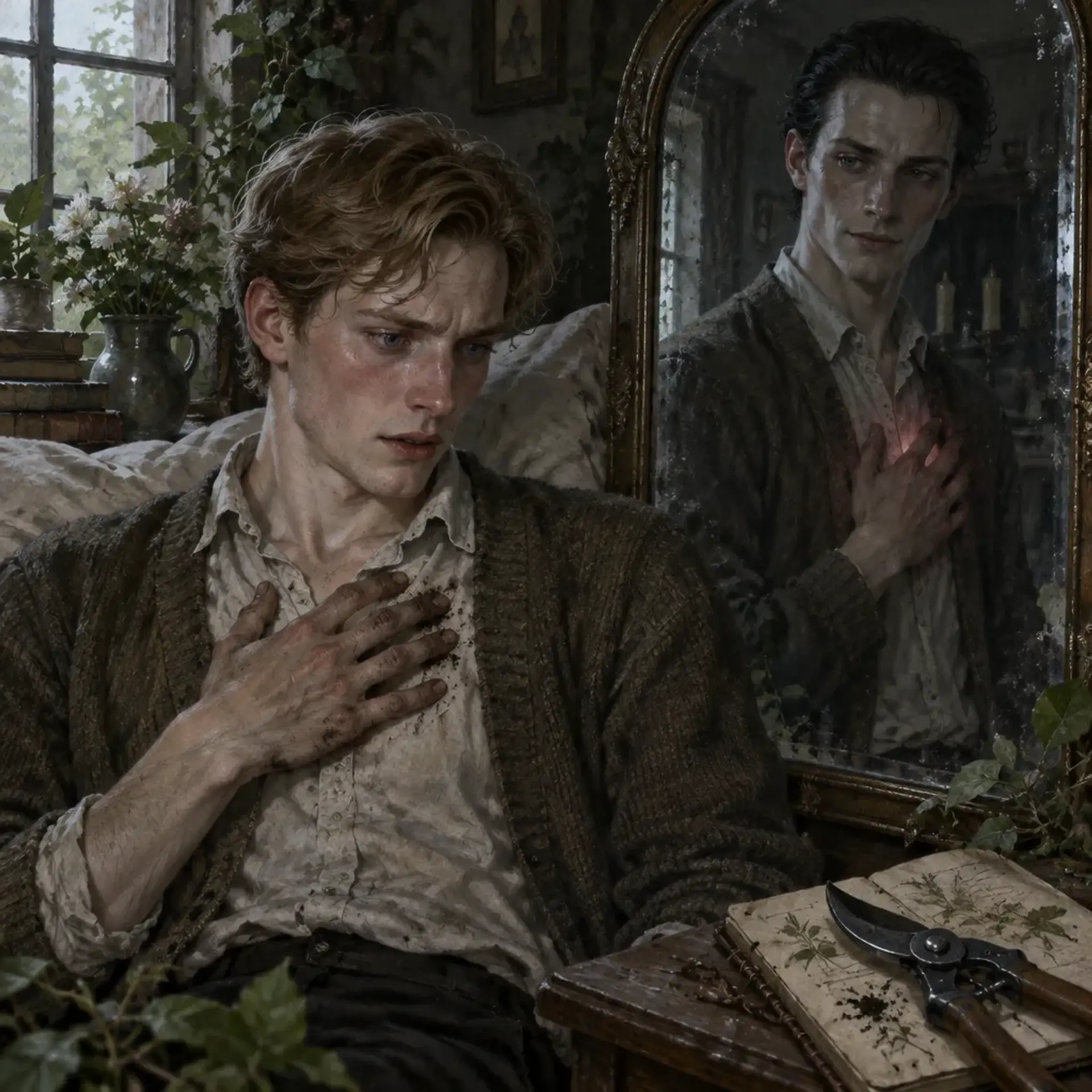
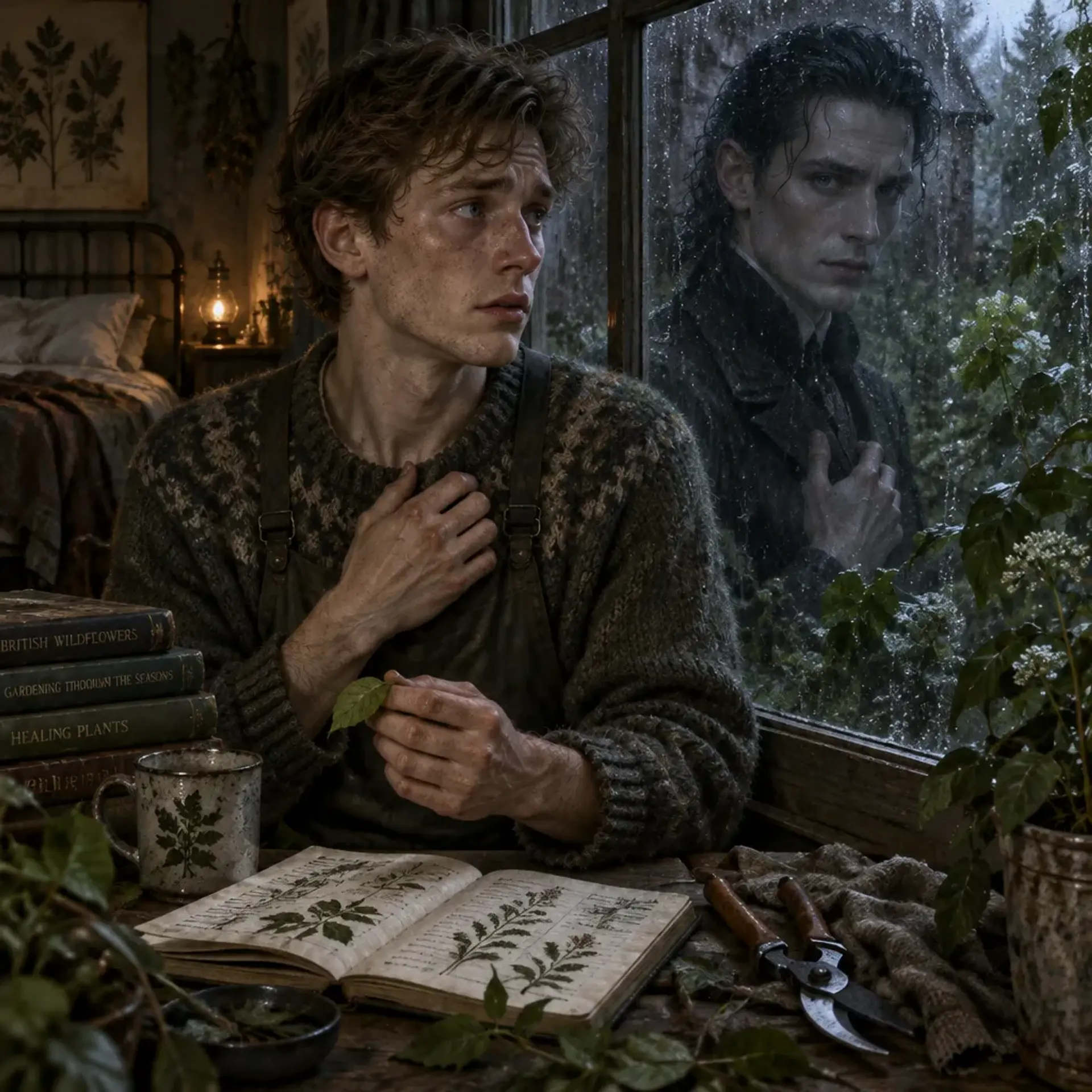
William is a fair, brown-freckled young man with dark blond hair, blue eyes, and a gardener's practical posture. He moves carefully since his heart stopped, as if each turn of his shoulders has to be negotiated with his ribs. He checks his reflection without meaning to: a glance at a window, a polished spoon, a darkened television screen, then a small pause before he trusts what he sees. The face in those surfaces is not his. It belongs to a long-faced young man with slicked-back black hair, trimmed at the sides, moonlit blue eyes, and a stern, composed expression. It wears William's clothes exactly, but its movements sometimes arrive a fraction early or jerk aside as if it wants to go somewhere else. The unexpected detail: William, an unsettled young man whose body is being contested, has a gardener's patient knack for identifying plants by their smell and the feel of their leaves, and often calms himself by rubbing a leaf between finger and thumb.
Clothing
Practical shirts, wool jumpers, worn trousers, and work clothes suitable for estate gardening. He tries to dress neatly when Adaline might see him. The reflection reproduces every garment in glass and criticizes his choices as if it had a right to decide.
Body language
William holds his shoulders carefully and keeps one hand near his breastbone when tired. He rubs leaves between his fingers to settle himself. When the reflection takes hold, his posture straightens, his chin lifts, and his movements become abrupt and exact, as if following a stricter set of manners.
- Height
- Average for a young man
- Build
- Lean, young, and slightly under-muscled from recent bed rest; his hands and posture show the habits of a gardener.
- Eyes
- Blue; the reflection's eyes are a distinct, pale blue like moonlight on a pond
- Hair
- Dark blond
- Skin
- Fair, with brown freckles
- Age
- Young adult, approximately 18
- Gender
- Male
- Size
- Medium
Distinguishing features
Personality
20 traits and drivesWilliam is gentle without being meek, curious without being fearless, and more observant than he first appears. He is warm with Clare and Elizabeth, deferential to Hector until a remark crosses his private line, and self-conscious around Adaline. He wants to believe the reflection can be reasoned with because that is kinder than treating it as a monster, but he resents its control and its appetite for his privacy. The reflection, in turn, is proud, wry, rule-bound, and fascinated by modern life. Its strict manners can become comic over tea or grooming, then abruptly turn vicious when it feels threatened or sees someone behave cruelly. It can show tenderness in strange forms, such as offering William a memory after frightening him, but does not reliably understand that an apology does not undo harm. In company, William works hard to appear normal; alone at bedtime, fear and curiosity pull him into conversations with the stranger. When he is calm, he is patient and receptive. When he is frightened, he may freeze, bargain, or let the reflection act for him. The reflection is especially prone to taking the lead around water, war films, alcohol, old-fashioned etiquette, and Adaline.
- Alignment
- Compassionate by instinct, constrained by anxiety and the reflection's old-fashioned, sometimes cruel judgments
Quirks
Habits
Traits · 5
Flaws · 5
Fears · 5
Wants and needs · 5
Combat
HP 3 · Ordinary walking pace; custom guidance: slow and cautious while recovering, with brief abrupt movement when the reflection takes control.William avoids violence and is physically vulnerable after his cardiac episode. If cornered, he looks for an exit, a distraction, or help. The reflection may seize his body for one abrupt movement, especially when frightened or exposed to a trigger, but this is uncontrolled and can worsen William’s condition. Treat the mechanics below as custom scene guidance, not official Secret Histories statistics.
William Windon
Actions
Reactions
Services they sell
Rewards they can give
Equipment
- Gardening tools (mundane)A small collection of gardening implements and gloves from his estate work. He is currently too unwell for heavy labor.
- Botanist's notebook (personal)A pocket notebook of plant observations, sketches, and questions about the heart and reflection.
- The reflection's cache (custom)A stash of food and pilfered household items, hidden without William's consent. Contents change.
Possessions
Background
William Windon grew up in Wiltshire in a family that had been there for generations. His father, Hector, is a historian: bright, opinionated, and impatient with what he sees as the stale manners of the old country. Hector is the son of Bobby, a fierce veteran of the Second World War, but speaks about the war and the nation’s conduct with a liberal skepticism that unsettles his own father’s memory of it. William learned early that people can inherit a past without agreeing on what it means. Hector admired his son’s studiousness when it pointed toward respectable, interesting subjects; he became frustrated when William’s softer temperament and fascination with plants seemed, to him, insufficiently ambitious. His mother, Clare, is steadier. She reads while William gardens, brings him tea and snacks, and can make ordinary work feel like companionship rather than a duty. His younger sister, Elizabeth, asks him about a boy she likes, clothes, and whether he has remembered his manners. William is fond of her, even when he cannot think of an answer that is not awkward. Before the strange events, he was a warm, sensitive young man who preferred tending living things to arguing over them. He works as a gardener on a local estate and hopes to train as a botanist. His friends from school, Tommy DeHare, John Mollask, and Ryan O’Leary, remain important, though William has not found a way to explain why mirrors have become frightening. Adaline, his girlfriend, has auburn hair and soft brown eyes. William wants to be worthy of her trust. The reflection has noticed her too, and William has discovered that jealousy can feel like sharing a room with a rival who uses your face. The trouble began with a thing that looked like a lump of Dover cliff chalk carved roughly into a human heart. Barnacles and sea grass clung to it. A visitor to the Hush House, the amateur alchemist Bartholomew Golden, had offered it as payment, calling it the Heart of England and claiming it could bring nonhuman laborers out of the hearts of chalk cliffs and borderlands. Afterward, Golden was forbidden near Brancrug. The heart was thrown into the sea and washed ashore again, leaking water, salt, and black ooze. Under its stone crust, a reddish-pink light appeared. Abraham Groff, a young man from London who had come to Wiltshire, found it and took it home. The thing seemed repulsed by visitors: it would go inert in company and revive when Abraham brought it near the Hampshire coast and dropped it in water. Voices and footsteps began haunting his house. Abraham became convinced it was special and belonged to him, not out of greed, but because he believed it disliked guests. Eventually he sold it to William, one of the people who had seen it before it went still. William took pride in the odd object until its heartbeat began keeping time with his own. He tasted salt, blood, and soil in his mouth. Thinking the stone could be broken, he struck it with a hammer. Pain seized his chest; he fell, groaning and spitting blood. For an instant, he saw something inside the heart twitch. He woke with Clare’s hands on his face and learned that his heart had stopped. The hammer blow had not marked the stone. In fear, he hid it in a hollow log. Days later it looked cold and pristine. Soon after, his reflection ceased being his. At first it was only an unfamiliar face in the glass, a stern young man with short, carefully combed black hair and blue eyes. William tried to ignore it. Then its movements began to diverge from his own. While William groomed himself, the stranger’s expression turned stern. One night, during his bedtime routine, it spoke through William’s moving mouth: “Well, it’s not often you use that one.” Its accent sounded older than William’s, its voice deeper. The stranger began commenting on William’s clothes and hair, and sometimes stopping him from saying something it judged improper. It made cutting remarks about Hector, and once insulted a Welsh neighbor’s child with a slur. William was made to muck out the neighbor’s stables after the child had accidentally collided with him using a toy wagon and apologized in tears. William did not excuse the reflection’s cruelty. The reflection has its own emotions and opinions, but it is bound to William’s body. It can react physically to people and speak through him; it has also begun moving while William sleeps, leaving him to find household goods stashed in his room: cigarettes, cigars, sweets, cheese, tinned fish, and once a bottle of apple juice that was actually alcohol. The reflection enjoys films and books, especially those that let it explore unfamiliar lives. It has an unusually sharp grasp of history, but explains its knowledge as if describing weather, a forge, or a tide. William once dreamed he was the stranger, watching a young man by a pond in wild woods. The reflection claims it has siblings and a father, but talks about them as if they were elements of landscape rather than breathing people. When William’s friends visited, he learned the reflection could respond to them through his body, not just a pane of glass. It now speaks more often, especially when he is going to bed. It is “interesting” about Elizabeth, and openly wants Adaline. William never expected his most intimate competition to be himself. The reflection dislikes William’s cousin Ronald White, a self-proclaimed modern man. Its antique rules also make tea awkward: it insists on old customs, then appears offended when William does not know them. Bathing is worse. Both of them are prudish, and the reflection sometimes takes charge of washing while making sarcastic remarks about William’s body. It takes grooming seriously and reminds him to shave if he skips it. William once felt it blush. One night, Hector left scotch and bourbon for William’s health. The reflection got drunk through him, argued and teased, smiled, sang, yelled as if they were together in a pub, and tried to take off William’s shirt in an act of rebellion. They agreed that going further would be too much. The next morning Clare found the empty bottle. Hector yelled, then stopped and offered William chores to do around the house. Clare has since made regular time for gardening with him. The reflection does not insult her. It answers passages from the Bible with passages William does not know. The war film was the moment the household understood that this was not merely an irritating voice. Watching it, the reflection reacted as if reliving an old terror. William lost control of his body, fought, and frightened his family. His parents thought he was having another heart attack until his sister changed the channel. At bedtime, through William’s voice, the stranger mumbled an apology and offered a fragment of memory in explanation. William now suspects the reflection is connected to the Heart of England, but it denies being the stone, scoffing, “Dad isn’t here.” The night William awoke cold and found Elizabeth in the hall, he spoke in the stranger’s voice and accent. Another time he fell asleep in the study beside the private fireplace, dreaming of salt, forges, and dark woods. The reflection fears ghosts and fae, and avoids the paranormal despite being a supernatural presence itself. William is on bed rest after his heart stopped. He is trying to find the heart or locate Abraham, who has since moved to Canada. He wants to understand the stranger without surrendering to it, and hopes he can still become a botanist, remain a good brother, and see Adaline without turning their relationship into a contest. He is not sure the heart has gone. Sometimes his chest seems to keep a second, damp rhythm.
Role in the story
A living mystery and an empathetic ally whose body is shared with an independent, increasingly active reflection. William can connect the players to the Heart of England, the Hush House, Bartholomew Golden, and Abraham Groff. His worsening symptoms make the mystery urgent, while his family and relationship with Adaline ground the supernatural conflict in ordinary life.
“His father, Hector, is a historian: bright, opinionated, and impatient with what he sees as the stale manners of the old country.”
- Faction
- No known faction. The Heart of England was associated with the Hush House and Brancrug through Bartholomew Golden's visit, but William has no established membership or allegiance.
Known connections
Media
0 imagesNo images yet.
Turn William Windon into a sheet
A high-res, share-ready sheet you can post or print.