Aftara Kesh
Aftara Kesh
At the table
Voice
Their voice has a dry rasp from years of projecting through cold, dusty corridors, with crisp consonants shaped by shouted commands and repeated legal formulas. When addressing a superior, they sound almost ceremonially exact. With Hessa, a rough catch sometimes interrupts their prepared phrases.
Aftara speaks in clipped, procedural phrases learned from years of calling orders down stone corridors. They favor exact verbs and avoid contractions when on duty. Their sentences come out with the same measured cadence whether offering directions or threatening an arrest; the strain shows instead in how quickly they repeat a command.
Speech patterns
How to play them
Aftara begins with firm questions about visitors' purpose, weapons, and business in the prison. They respect calm competence and lawful procedure, but react badly to magic, nonhuman ancestry, or attempts to bypass authority. Players who bring credible evidence of misconduct may see their certainty falter. Hessa's name or the prison riot can draw out a more personal response.
Goal
Expose the prison officials selling confiscated spell components without admitting that their own obedience helped the institution become corrupt.
Motivation
Aftara wants to believe that a system of rules can keep everyone safe, because admitting that authority failed would mean facing their part in its failures.
Appearance
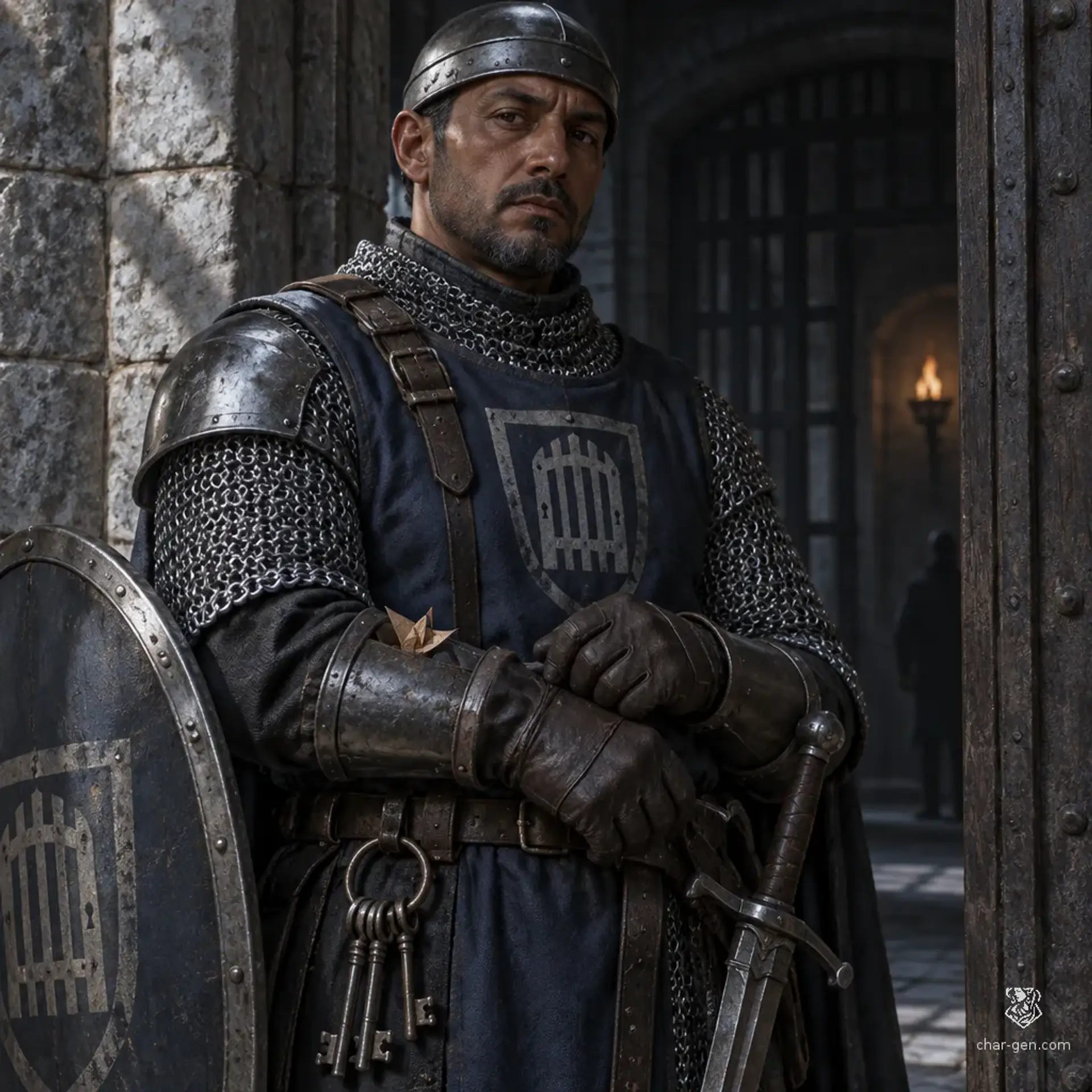
Aftara is a human with an iron-straight posture and a compact, work-hardened frame. Their chain mail has been polished until its rings gleam like wet scales, and the leather straps are rubbed smooth where a shield rests against them. They walk with a clipped, heel-first stride, always favoring the same side of a corridor so no one can pass behind them unnoticed. In a role built around iron discipline, the unexpected detail is a tiny, meticulously folded paper bird tucked into the cuff of their gauntlet. It is made from an old prison ration wrapper.
Clothing
Polished chain mail over a dark blue padded coat, steel-rimmed shield, heavy gloves, and a plain surcoat bearing the prison wardens' barred-door emblem. Their boots are scrupulously cleaned, though the hems of their coat are stained with stone dust.
Body language
Aftara stands with their chin slightly tucked and shoulders squared, occupying doorways as if they were assigned posts. Their gaze checks hands, exits, and belts before faces. When unsettled, they press a thumb to the seam of their gauntlet, where the folded paper bird is hidden.
- Height
- 5 feet 8 inches
- Build
- Compact, dense-muscled, and sturdy from years of wearing armor and controlling crowded corridors.
- Eyes
- Dark hazel, with a steady, appraising gaze.
- Hair
- Black, clipped close at the sides and combed flat beneath a plain steel cap.
- Skin
- Olive-brown, with a dry, wind-chapped texture at the knuckles and temples.
- Age
- 38
- Gender
- Non-binary
- Size
- Medium
Distinguishing features
Personality
13 traits and drivesAftara is disciplined enough to notice a missing key at a glance, yet privately tender toward small, helpless things. In front of other guards they are rigid and openly contemptuous of magic and nonhumans; alone, they can show patience to a frightened prisoner. When secure, they are brisk and almost dryly funny. When afraid, they become more formal, more controlling, and much less fair.
- Alignment
- Lawful evil; Aftara prizes hierarchy and order, and considers those who challenge it dangerous, even when they are right.
Quirks
Habits
Traits · 3
Flaws · 3
Fears · 3
Wants and needs · 4
Combat
AC 19 · HP 20 · 30 ft.Aftara uses the shield and longsword to block routes, keep prisoners away from keys and doors, and force opponents into narrow approaches. They call for help rather than pursue into unfamiliar terrain. They use Action Surge to end a dangerous struggle quickly, and Second Wind when an opponent has worn them down. They prefer to capture living foes, but their prejudice can make them reckless against nonhuman or visibly magical opponents.
Aftara Kesh
Actions
Reactions
Services they sell
Rewards they can give
Equipment
- Longsword (martial melee weapon)A straight, serviceable blade maintained to a regulation shine.
- Shield (armor)A steel-rimmed shield marked with the prison's barred-door device.
- Chain mail (armor)Interlocking rings worn over a padded coat; their exceptionally careful upkeep reflects Aftara's fixation on order.
- Light crossbow and 20 bolts (martial ranged weapon)A compact crossbow for distant threats, carried with a small case of bolts.
- Prison key ring (tool)A heavy iron ring carrying several cell and corridor keys.
- Folded paper bird (personal keepsake)A paper bird folded from a ration wrapper, hidden inside the gauntlet cuff.
Possessions
Background
Aftara was raised in a household that treated obedience as a virtue and difference as a threat. Their parent served as a court bailiff, and Aftara learned early that a clean uniform and a steady voice could make a harsh order seem inevitable. They joined the city watch, then accepted a post at the prison called the Day of Three Doors, named for an infamous escape attempt outsiders insist involved only one door. Years ago, during a riot, Aftara obeyed an order to seal a cell block despite hearing prisoners pleading inside. The fire killed several people, including a human guard Aftara had mentored. Since then, they have become more exacting about procedures, partly because they believe rules prevent chaos and partly because rules give them somewhere to hide their guilt. Their current problem is that Hessa, a human infirmary keeper who was once their closest friend, has found evidence that prison officials are secretly selling confiscated spell components. Aftara despises magic and nonhumans, but the evidence points toward human administrators, and Hessa expects them to act. Aftara has also begun to suspect that the paper birds left in their gauntlet are being folded by a prisoner they once refused to hear out.
Role in the story
A morally compromised prison guard who can obstruct the party, become a reluctant source of help, or serve as a confrontation about complicity and prejudice. Their choices may help expose corruption in the prison, but trust must be earned through evidence and difficult honesty.
“Their parent served as a court bailiff, and Aftara learned early that a clean uniform and a steady voice could make a harsh order seem inevitable.”
- Faction
- A senior guard in the wardens' staff at the prison called the Day of Three Doors. They serve its human administrators but have begun to suspect that some of them are corrupt.
Known connections
Media
0 imagesNo images yet.
Turn Aftara Kesh into a sheet
A high-res, share-ready sheet you can post or print.