William Windon
William Windon
At the table
Voice
William's voice is youthful, clear, and slightly breathy when his heart condition or nerves make him cautious. It carries the easy familiarity of someone raised in Wiltshire, with a gardener's habit of naming practical things precisely. The stranger's voice is deeper and more weathered, with dry consonants and an older cadence, as if the words were formed by someone accustomed to command and correction. When it speaks through William, the mismatch is obvious even to people who know him well. On the whisky night the stranger's voice became raucous and pub-loud, laughing, arguing, and attempting a song with shameless confidence.
William's speech is plain and gently paced, with the familiar cadence of a young man raised in Wiltshire. He often pauses before answering, partly from caution and partly to make sure the next words are his. His gardener's vocabulary is concrete: soil, roots, weather, and what a plant needs. The stranger uses William's mouth but sounds older, with a deeper, drier voice and an accent suggesting another generation. It favors clipped judgments, formal corrections, and metaphors drawn from tides, weather, and forge work. When the reflection is frightened, William's words may come out unevenly, as though someone is trying to speak through a memory rather than a throat.
Speech patterns
How to play them
Treat William as a frightened but thoughtful young man, not as a vessel to be interrogated. Give him space to answer in his own time. He trusts people who take his heart condition seriously without reducing him to it, and who do not mock his fear of mirrors. The reflection may speak through him if it feels ignored, insulted, or curious. William is more likely to discuss the stranger if someone asks what it wants rather than insisting that it is imaginary.
Goal
Find the missing heart or Abraham Gorff, learn what the reflection is, and establish a way to live with it without surrendering his body, family, or relationship with Adaline.
Motivation
William wants his ordinary future back: gardening, study, family, and a relationship that belongs to him. He also wants to know whether the stranger can be treated as a person without letting it take his life over.
Appearance
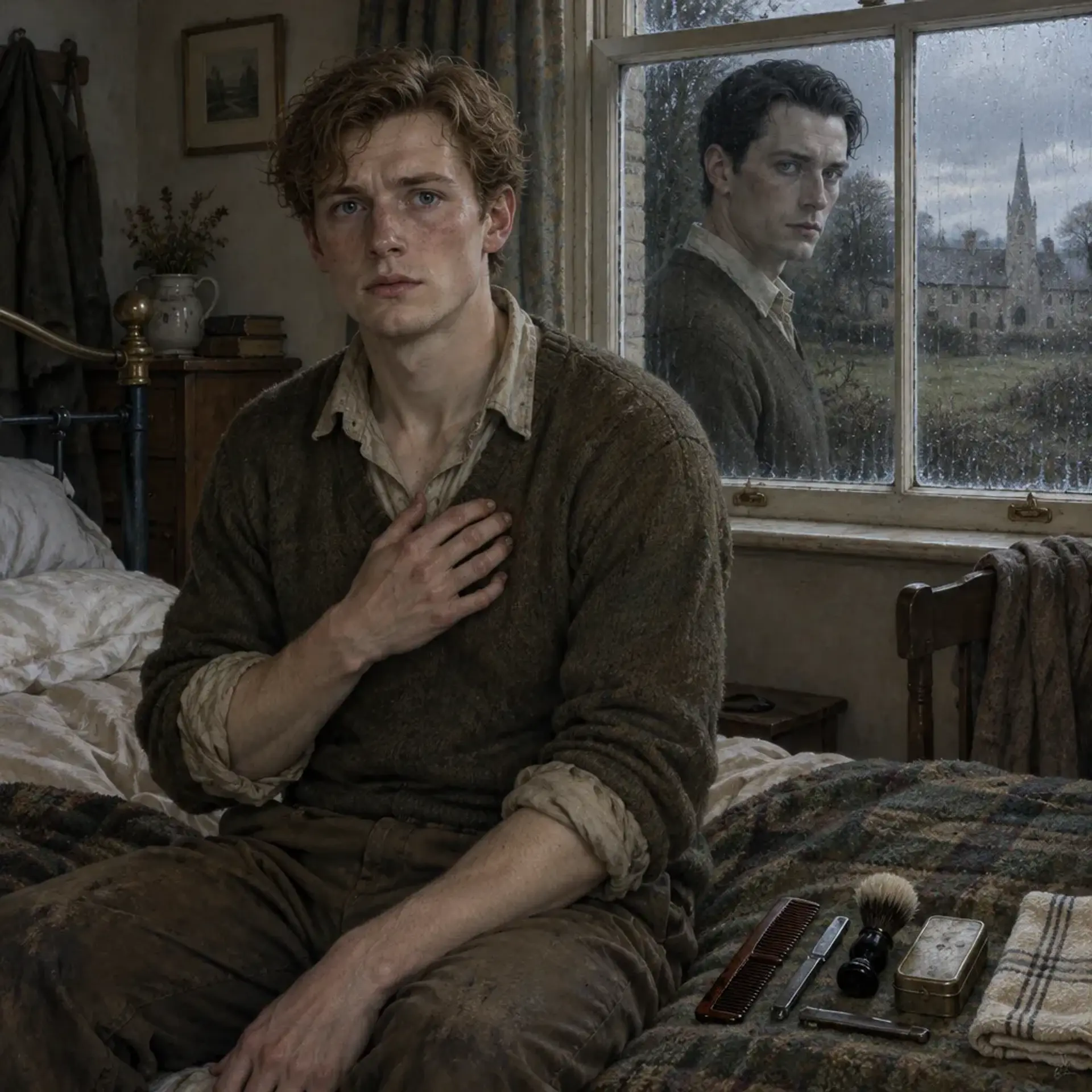
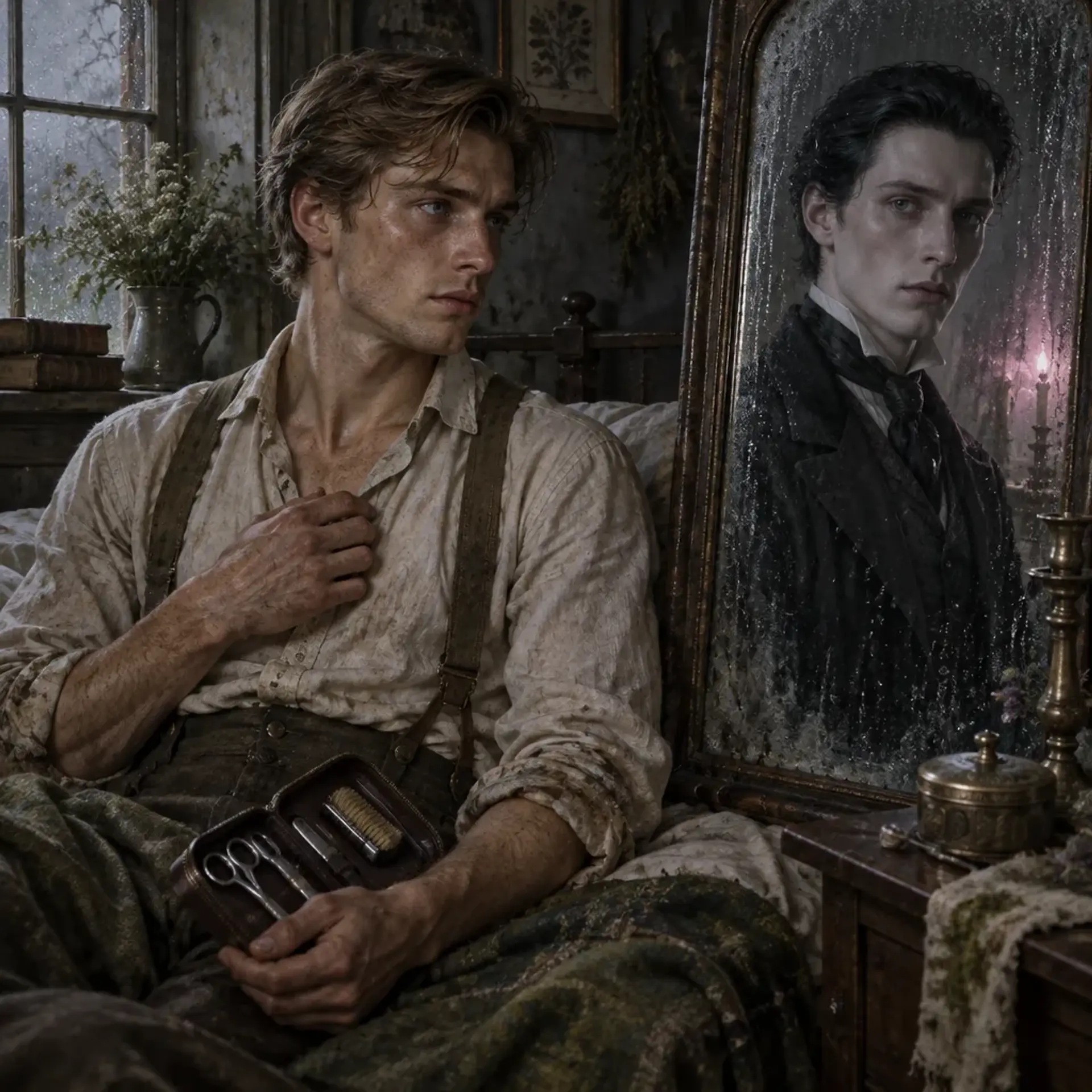
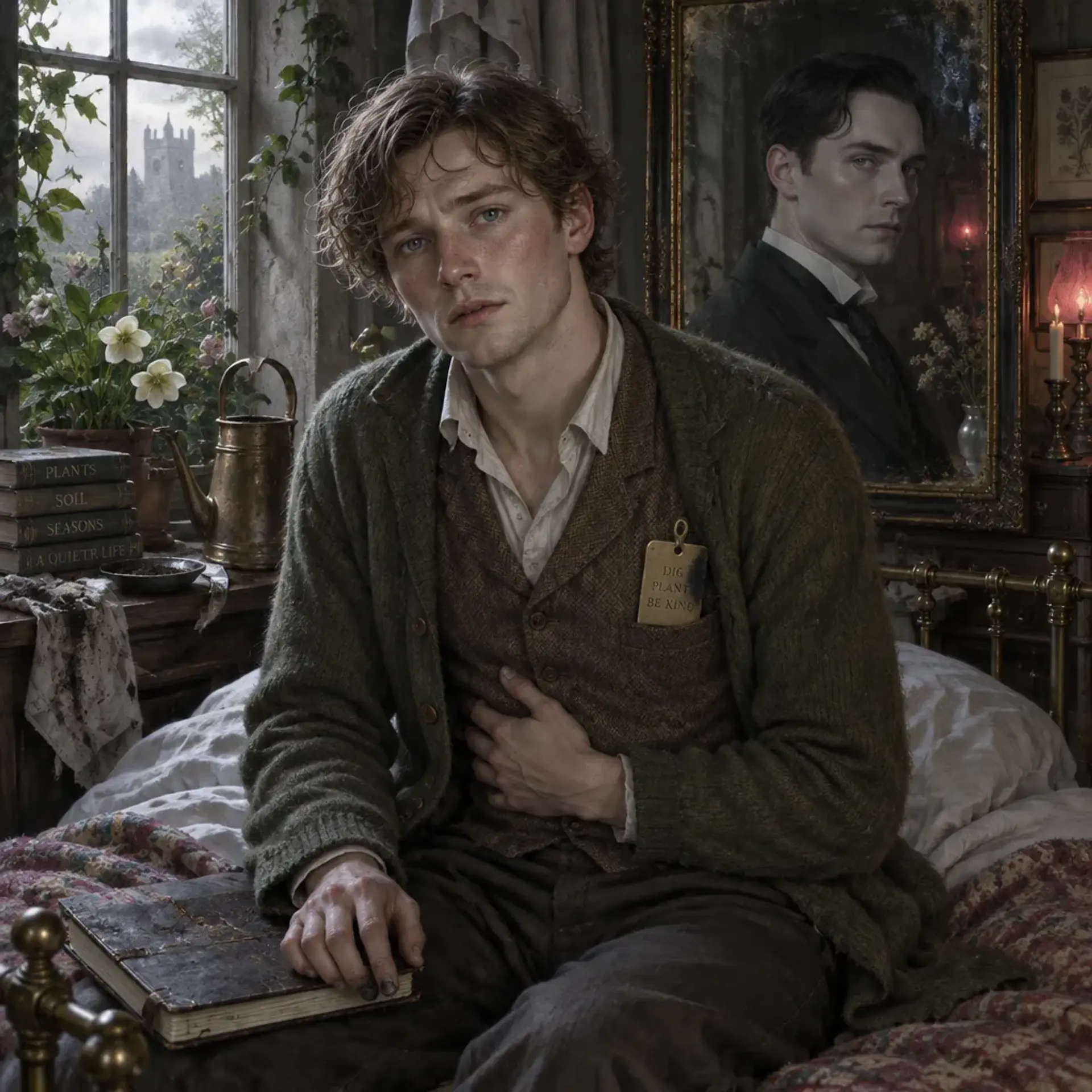
William Windon is a young Wiltshire man with dark blond hair that refuses to lie flat for long, blue eyes, and light skin freckled with small brown spots. His face is open and still a little soft with youth, though bed rest has left him paler and more watchful than he used to be. His hands carry the faint greenish stains of a gardener: crushed leaf, soil worked into the creases, and the dry roughness of pruning and digging. He smells faintly of damp earth, bruised stems, soap, and the cold mineral smell of a room that has been shut up. He walks carefully since his heart stopped, testing his strength and trying not to show how quickly a flight of stairs can tire him. When he is distracted, his head turns toward windows and polished surfaces before the rest of him follows. The unexpected detail is his habit of keeping a small, carefully folded scrap of patterned paper tucked into his pocket, a childish-looking bit of prettiness he says he uses to press leaves, though he has never pressed a leaf in it. In a mirror or dark window, the young man looking back has a longer face, neatly combed short black hair trimmed at the sides, moonlit blue eyes, and a stern, handsome composure quite unlike William's. The stranger wears William's clothes exactly as William is wearing them, but carries them as though they were a uniform borrowed for an evening.
Clothing
Ordinary country clothes suited to estate gardening: work trousers, sturdy boots, shirts with sleeves rolled or buttoned, and a cardigan or jacket when the weather turns cold. While resting he wears comfortable clothes chosen by his family. He tries to dress neatly when Adaline visits. The reflection duplicates the clothes precisely, though it wears them with a more formal, almost inherited composure.
Body language
William tries to keep his shoulders relaxed and his movements economical, partly because he is recovering and partly because he fears his body may act without permission. He watches other people's faces for signs they have noticed the reflection. When the stranger is close to the surface, his jaw sets, his head turns toward glass, and his hands may make a gesture he did not intend. Afterward he rubs his fingers together as if checking that they belong to him.
- Height
- Average height for a young adult man
- Build
- Slender, with the slight, underfed look of someone kept on bed rest and the practical strength of a young gardener not yet fully recovered.
- Eyes
- Blue
- Hair
- Dark blond
- Skin
- Light skin with brown freckles and a faint, garden-weathered flush when he has been outdoors.
- Age
- Young adult; exact age unspecified
- Gender
- Male
- Size
- Medium
Distinguishing features
Personality
20 traits and drivesWilliam is warm without being unguarded. Before the heart, he was the sort of young man who would listen patiently while someone else talked themselves into feeling better. He still wants to be kind, but he has become more private, not from coldness but because every disclosure seems to invite another person to decide what is happening to him. He can laugh easily with friends when his body feels steady, then abruptly retreat into silence if a reflection catches his attention. He dislikes being pitied and also hates being left alone with his fear. His instinct is to soften a disagreement, though his anger can become startlingly direct when someone dismisses his experience or humiliates another person. He is studious and observant, yet not naturally clinical: plants matter to him as living things, not as specimens to be conquered. He wants to believe that patient attention can solve problems, even as the heart offers no clear answer to observation. The stranger's presence pulls against William's better instincts. It is more cutting, more confident, and often much less concerned with whether a remark is welcome. William feels embarrassed when it says something cruel, especially when a child or family member is involved. He has punished himself for remarks that were not entirely his own, partly because he fears that blaming the reflection would become an excuse. When the Welsh neighbor's child accidentally ran into him with a toy wagon and then cried while apologizing, the stranger made a slur about the child. William will not repeat the word. The child's parent heard enough to be offended, and William was made to muck out the neighbor's stables. He accepted the punishment because the child did not deserve to be frightened, though he privately resented being held responsible for a voice he had not chosen. William is careful with Adaline, sometimes to the point of awkwardness. He wants her to see him as a boyfriend, not a patient or a mystery. He tries to be funny and attentive, remembering small things she says, but he becomes self-conscious when a window is behind her. The reflection can make him feel like a rival in his own body: it notices her auburn hair, her soft brown eyes, and the way she smiles before William has decided what to say. Its attention seems sincere, which is more disturbing than a crude joke would be. It can be polite to her in a way William finds difficult to match, offering an old-fashioned compliment or holding his posture with a confidence that makes Adaline look twice. William then feels jealous of a voice that has no right to court anyone. He hates that jealousy, because the reflection is bound to him and may not understand the boundary in the same way he does. He has not told Adaline everything, fearing she will leave, fearing she will stay out of pity, and fearing the stranger will treat her trust as permission. With Elizabeth, William is protective and easily exasperated in the familiar way of an older brother. He likes being the person she asks about the boy she likes, whether a dress or object looks nice, and whether she has been improper. He tries to answer honestly without making her feel foolish. The stranger's responses complicate this. It watches Elizabeth with a quiet interest that William cannot read. Its repeated description of her as “interesting” can sound like affection, appraisal, or an old memory pressing through. Sometimes it offers stern advice in the voice of its own father or siblings. Sometimes it ridicules the social ritual of gossip, then asks a question about Elizabeth's expression that shows it has paid close attention. William does not like the way the stranger seems to learn her habits. Yet he has also seen it look pleased when she laughs. He cannot decide whether that pleasure is its own, William's, or something shared. Hector brings out William's unresolved need for approval. William respects his father's curiosity and his resistance to rigid class rules, but he has absorbed Hector's impatience with inherited superstition. He worries that taking the reflection seriously will sound like foolishness, especially to a historian who prefers explanations that can be catalogued. When Hector calls country people silly, William wants to defend the county and the lives rooted in it. The reflection's cutting comment gave voice to that anger more sharply than William would have dared. He was scolded, but he was also relieved. The relief made him uneasy: it felt good to have someone else say what he had been holding back. He has to remind himself that the stranger's boldness is not automatically courage. The whisky night exposed a softer and more dangerous side of the reflection. William had thought of it as stern, watchful, and easily offended. Alcohol loosened it into noisy amusement. It argued over the bottle, teased William about his habits, sang badly, and laughed at its own jokes. It seemed delighted by the ordinary possibility of being drunk, as if drink gave it a sensation it had been denied. William found himself laughing with it before remembering that he was sharing his body with a stranger. The moment was joyful, almost companionable, and afterward he felt guilty for enjoying it. The stranger's remark about its father, “Dad isn't here,” turned the joke into a glimpse of loneliness. William now suspects that the reflection's discipline may be a kind of inherited armor, and that its desire for alcohol, films, books, and forbidden exploration is not simply mischief. It wants experiences. It wants to taste the world through William, and it may not understand that William cannot give everything without losing himself. Under stress, William becomes practical. He looks for a chair, a glass of water, someone nearby, or a way to reach a place with a phone. He has learned to notice the first signs of exhaustion. Under loneliness, he becomes more willing to listen to the stranger. When he is angry, he can use humor as a shield, then regret it later. When frightened, he clings to concrete facts: the date, the room, the sound of the clock, the names of his family. His care for plants is a counterweight to the uncanny. A seed does not need him to believe in it; it simply responds to water, soil, and time. William hopes that the same patience will work on the heart, though he is beginning to accept that patience alone cannot answer every question. William has a stubborn streak that becomes clearer the more people tell him what he should do. He will listen to advice from Clare and his friends, but he resists being ordered to stop thinking about the reflection or to hand over every private object. He is not reckless, but he does test boundaries: looking into dark windows, asking questions at bedtime, and trying to provoke the stranger into giving a straight answer. He sometimes convinces himself that a dangerous experiment is reasonable because it might produce knowledge. The stranger encourages that impulse when it wants to explore, and warns him away from danger when it fears what waits there. Their disagreements reveal that neither of them is consistently sensible. He is ashamed of how much he wants the reflection to like him. The stranger's approval matters because it is always present, always watching, and capable of turning William's own face into a judgment. If it praises his careful grooming or calls his gardening work “well done,” William feels warmed and resentful at once. He dislikes being corrected, yet he has begun to anticipate the stranger's comments. He can tell when it is amused by the slight pull at his mouth, even when he cannot see glass. This dependence frightens him. William wants separation, but he also wants conversation. He wants the stranger to leave him alone, then lies awake hoping it will explain itself. The private conflict that defines William is not simply whether he will survive the heart. It is whether he can remain a person who acts from care while sharing a body with a presence that has its own appetites, memories, and fears. He does not want to become cruel because the reflection is cruel, nor to erase the stranger because it frightens him. He wants a boundary that can hold both people without making either one disappear. That hope may be naive. It is also the reason he is still asking questions instead of reaching for a hammer.
- Alignment
- Not applicable as a formal Secret Histories statistic; personally compassionate, stubbornly private, and increasingly divided between his own wishes and the reflection's.
Quirks
Habits
Traits · 5
Flaws · 5
Fears · 5
Wants and needs · 5
Combat
HP 1William is not a trained fighter and is medically vulnerable. He avoids violence, looks for a way to leave, and may use a garden tool or household object only if cornered. The reflection can distract or briefly interfere with William's speech and posture, but it is not a reliable combatant. Treat any physical outcome using the table's chosen Secret Histories procedures; the listed actions are custom narrative prompts, not official combat rules.
William Windon
Actions
Reactions
Services they sell
Equipment
- Gardening tool (tool)A small hand tool from his gardening work, currently kept nearby more as a familiar object than as a weapon.
- Botany notebook (personal item)A pocket notebook with plant observations and hurried notes about the heart, the reflection, and the dates of strange episodes.
- Hand torch (household item)A small light used when he wakes in the night and is afraid to cross the dark hall.
- Patterned paper (keepsake)A folded scrap of patterned paper kept in his pocket; William claims it is for pressing leaves.
Possessions
Background
The heart arrived at Hush House wrapped in newspaper, offered as payment for entry by the amateur arcanist Bartholomew Golden. He called it the Heart of England. It looked like a piece of Dover cliff chalk carved into the shape of a human heart, though it was not chalk alone. Barnacles clung to its rough surface; sea grass had taken root in cracks; and its shape seemed less sculpted than worn into being. Hush House rejected the gift in the only way it could: the object was thrown back into the sea. It returned to shore without ceremony, wet with salt, black ooze, and the limp strands of weeds. Beneath its stone-colored crust, a dim reddish-pink hue had appeared, like a flush under pale skin. Abraham Gorff found it after leaving London and taking the train toward Wiltshire. He was young, curious, and just proud enough of his powers of observation to believe he could study the strange thing without being changed by it. He picked it up and put it in his coat pocket. On the journey home, it beat against him. Not a sharp impact, but the deep, patient thud of something alive insisting it was not alone. Abraham was frightened, but fear and fascination were so tightly braided that he could not tell one from the other. He took it home and watched it as a naturalist might watch a rare specimen. The heart repulsed him: it looked wet even when dry, and its shape made him think of an animal pulled from a body. At the same time, he felt that it had chosen him. He showed the heart to neighbors. In company it seemed to die. The reddish color dulled, the pulse stopped, and it became a curious, ugly rock. Abraham discovered that carrying it to a shore and dropping it into water brought the color back. The object did not simply respond to the sea; it seemed to remember it. He stopped inviting people to see it. He told himself that this was caution, not possessiveness, because the heart seemed to dislike visitors as much as he did. He began to think of it as his, not because he wanted to own a wonder, but because he believed it would be harmed by being handled or displayed. Then the house began to behave as if it had acquired another resident. Voices rose from empty rooms. Doors moved on their own. Footsteps crossed landings and paused on the stairs. Abraham heard the heart weep, though he could not tell whether the sound came from the stone, the walls, or somewhere inside his own hearing. The weeping was salt water and blackness, grief without a human face. He endured it for a time, trying to reason with the object and then with himself. In the end he sold it to William Windon, a local lad of seventeen, one of the people who had seen it when it appeared dead. Abraham may have thought he was transferring a curiosity rather than a burden. He never went near Brancrug afterward, and William would learn that Abraham had since moved to Canada. William had been born and raised in Wiltshire, in a family that had lived in the county for generations. Before the heart, he was warm, patient, and softer in manner than his father thought a young man needed to be. He was proud of the strange stone, showing it off as a treasure he had discovered, until he noticed that its pulse seemed to match his own. After time spent tasting the sea, blood, and soil in his mouth, he decided that the rock must be broken. He took a hammer to it. The blow never landed as he expected. Pain flashed through his chest and knocked him to the ground. He groaned and wept, hearing a voice come out of his throat that did not sound like his own. Blood rose in his mouth. For an instant he saw the stone's surface twitch like muscle. Then his own heart seemed to give out. He woke with his mother, Clare, holding his face and telling him that his heart had stopped. William was alive, but the fear of dying had become a fact lodged in the family's daily life. He left the rock in a hollow log days later. When he checked it, the stone looked cold and pristine, as if the hammer had never touched it. He thought he had left the danger behind. That was the first mistake. The stranger appeared in reflections. At first William assumed a trick of light: a young man of roughly his age, long-faced, handsome by a tidy English ideal, with short black hair combed back and trimmed at the sides, and blue eyes like moonlight on a freshwater pond. The stranger's expression was stern. He did not look like William. He did, however, wear whatever William wore, down to a crooked collar or a shirt buttoned wrong. The first few times William saw him, the figure stood still. Then its movements began to jerk out of step. It seemed to want to move elsewhere, to look at something William was ignoring, or to turn away while William was still staring. Its face would tighten into disapproval while William himself was relaxed. William grew used to checking mirrors before grooming. He tried not to make a fuss, because the stranger did not seem able to do much beyond annoy him. Then, during his bedtime routine, the figure moved its lips with William's and said, “Well, it's not often you use that one.” William had not spoken. The voice sounded as if it came from his own mouth, but it belonged to an older generation: deeper, drier, and shaped by an accent that did not fit the young man William saw in the glass. The stranger paused afterward, as if surprised that it had spoken too. After that, William heard comments during the morning shave and while getting dressed. The stranger took grooming seriously. If William failed to shave, it might say, “You'll remember tomorrow, then,” in the tone of a father noting a neglected chore. If he combed his hair badly, it would offer directions as if correcting a recruit. It commented on shirts, manners, and what it considered a proper way to sit at table. It had strict opinions about tea time, sometimes citing its father or siblings as authorities. Its rules were not consistent with William's household, and its explanations were often as odd as its manners: “You don't pass that way. Father would have called it inviting weather into the room.” William's family had to live with the difference between a son who was recovering from a frightening cardiac event and a son who sometimes looked at a window and answered someone no one else could see. His mother, Clare, tried to care for him without making every conversation a medical examination. His father, Hector, worked as a historian. Hector was the son of a fierce veteran known as Bobby, who had served in the Second World War. Hector was more liberal than his father and dismissive of the rigid old culture of the upper classes. He liked new art, argued about social change, and disliked what he called inherited nonsense. He had once been proud of William's studious nature. As William's life narrowed around the heart and its reflection, Hector began calling the situation silly, or treating William's caution as country superstition. William loved him, but the dismissal hurt. The stranger noticed. When Hector remarked on how silly country people were in the county, the reflection cut in with a scathing comment about Hector's certainty and his habit of treating other people's lives as historical curiosities. William said it aloud without meaning to. He was reprimanded at home, and the stranger offered no apology. It seemed to have enjoyed getting the point across. It also disliked William's cousin Ronald White, who called himself a modern man. The reflection's dislike is immediate and theatrical: it finds Ronald's certainty more offensive than Hector's, perhaps because it recognizes in him a kind of self-satisfied posture it has seen before. William has a younger sister, Elizabeth, whose questions and small confidences have become a strange test of the reflection's manners. Elizabeth pesters him about the boy she likes, about which things look nice, and about whether William is being improper. The stranger calls her “interesting,” often with a pause that makes the word sound like a diagnosis or a warning. It watches her more intently than William likes. When she asks for advice, the reflection may supply a dry, archaic rule, then retreat into a cryptic observation about its own siblings. It can sound protective one moment and unnervingly detached the next. William has caught it smiling at her reflection when Elizabeth is laughing, though it insists it was only observing. It has also made cutting comments about the way she tries to draw William into family gossip, but it does not mock her as it mocks Ronald. William suspects that the stranger recognizes something familiar in her curiosity, or perhaps in the way she trusts him enough to speak freely. The most important test came when William's schoolmates Tommy DeHare, John Mollask, and Ryan O'Leary visited the house. Until then, William had been able to treat the reflection as an intimate disturbance, a private voice in glass. The boys made it social. They sat together in William's room, trading ordinary jokes and trying to make their friend feel less like a patient. A window caught the light. The stranger moved before William did. Its mouth formed an expression of amusement while William was listening to Tommy. It looked directly at John when John spoke, although William's own eyes were turned toward Ryan. Then, without any glass between them, William's mouth answered one of the boys in the stranger's older voice. The remark was dry and uncomfortably specific. It sounded like a person joining the conversation, not like William quoting something. The boys fell silent. William tried to explain that he had not meant to say it. The reflection made a small, impatient motion with his hands, and William's fingers followed just enough to make him feel that his body was being demonstrated. Ryan asked William if he was all right. Tommy tried to laugh it off. John watched the window instead of William. The visit ended politely, but it left William with the knowledge that the stranger could reach outside the mirror. His friends had seen it, or at least enough of it to know that something was wrong. They have not stopped caring about him, but each has developed a different way of showing it: Tommy jokes too loudly, John watches him for signs of faintness, and Ryan keeps asking if he should fetch an adult. William fears that their concern will become another form of surveillance. William works as a gardener on an estate and hopes to train as a botanist. For now he is on bed rest, and the work he misses has become a map of everything he cannot do. He tries to identify plants from books and pressed samples, and he worries that every day away from the garden will make him less capable. The heart has made ordinary tasks uncertain: carrying a pot, walking uphill, or standing too long can turn into an argument with his own body. At night he lies awake, listening for a beat that may be his, the stranger's, or both. The stranger's moods have become more visible. It enjoys films and books, especially stories with old battles, journeys, and people who have to decide what they owe the dead. William has felt his body make excited, involuntary movements while the reflection watches a film. The stranger is curious about forbidden rooms and places it should not enter. It seems to enjoy exploring through William's eyes, then leaving him to explain why something has been moved. Cigarettes, cigars, food, sweets, cheese, and tins of fish have disappeared from the house and reappeared in William's room. He once found a bottle beneath his bed that looked like apple juice but turned out to contain alcohol. The stranger behaves as if storing these things is a practical preparation, though it rarely explains what it is preparing for. It describes knowledge in ways that make sense only after the fact. History is weather. A political change is a shift in pressure. A forge is a way to understand a family argument. It speaks of siblings and a father as though describing the sea or a feeling, not living people. William has learned that asking direct questions often earns a metaphor instead of an answer. The stranger seems afraid of ghosts and fae. Its fear is not the ordinary caution of someone who dislikes stories; it tightens William's body and turns his attention away from places where the paranormal is strongest. For a presence that can speak from a mirror and influence a living body, this fear is unexpectedly human. One night William awoke cold and shivering. He carried a small light into the hall, where Elizabeth saw him and asked what was wrong. When he answered, the words came in a different accent and a voice that was not his. Elizabeth stared at him. William could feel the stranger's presence in the shape of his mouth and the set of his jaw. He could not remember choosing the words. The stranger spoke as though it had woken from a dream and found Elizabeth standing there. Later it would not explain why it had taken over, only saying that the cold had been “familiar.” Another night William felt better than he had in weeks, though cold still clung to him. He went to the study, where a smaller fireplace offered warmth, and fell asleep on the lounge. He dreamed of salt, forges, and dark woods. Hector found him there and looked at him with a strange expression, as if William had been speaking in his sleep or carrying some other person's grief. William woke without knowing what he had said. He remembered only the sense of a vast, wet distance and the certainty that someone else had once been cold in the same way. The most frightening episode followed a war film on television. When the film reached a scene of violence, William lost control of his body. His muscles locked and then fought against the room, as if he were trying to escape an attack no one else could see. The family thought he had suffered another heart attack. Elizabeth changed the channel, wide-eyed and worried. William was not simply frightened by the images; the stranger was reliving something. William felt panic, noise, and a pressure to fight, all tangled with memories that were not his. Afterward, the stranger spoke through him in a mumble and apologized. It offered an unfamiliar memory as consolation and an explanation, though the images were broken: heat, shouting, a smell like metal, a body braced against a terrible sound. William does not know whether these are memories of the stranger, of the heart, or of something that happened to someone the heart once knew. Bathing has become another negotiated boundary. The bathwater reflects the stranger's face, not William's. Both appear to possess a severe English prudishness about the situation, which makes the practical business of washing more awkward than it should be. Sometimes the stranger takes the lead in washing or dressing William when embarrassment makes him freeze, all the while making dry comments about his body and his lack of discipline. Once William felt the reflection blush. He has not decided whether this means it has a body somewhere, or whether it simply understands embarrassment. The whisky night was, against all expectation, the funniest evening William had experienced since the heart stopped. Hector had left scotch and bourbon for William's health, intending them as an adult remedy or comfort, not an invitation. William drank some, and the stranger responded as if it had been waiting for the chance. It smiled through William's mouth, argued with him, teased him, and sang in a rough, pub-like way. It shouted as though William and the stranger were in a crowded room together. It was giddy, warm, and unguarded. The stranger took off William's shirt in a burst of rebellion and appeared ready to go further, but William managed to persuade it that taking off his trousers would be a step too far. The conversation became ridiculous: the stranger insisted it was entitled to a drink, William protested that the alcohol belonged to him, and the stranger replied that it had been waiting much longer. When William asked whether it was the stone, the stranger scoffed and said, “Dad isn't here.” It was a joke, but it landed like a clue. William laughed until his chest hurt, then panicked that laughter might be dangerous. The stranger's amusement faded at once. In the morning, the bottle was not where William had left it. William has a girlfriend, Adaline, with auburn hair and soft brown eyes. The stranger noticed her immediately. It watched her in windows and darkened screens with a focus William found intolerable. The competition is not simply that the reflection finds her attractive; it appears to want her attention and treats William's relationship as a contest it has joined without permission. When Adaline visits, the reflection makes itself present in small ways: a look held too long in the glass, a remark delivered in William's voice, or an observation about the color of her hair that sounds less like William's own thought than a claim of interest. It can be unexpectedly charming, with old-fashioned courtesy and an attentiveness William struggles to imitate when anxious. That makes the situation worse. Adaline has noticed that William sometimes seems to answer an unasked question, and she is perceptive enough to realize that his silences are not always his own. William wants to find the heart, or Abraham Gorff, or any explanation that might give him back a boundary between himself and the stranger. The heart has vanished from the hollow log. He does not know whether it is still near, whether it returned to the sea, or whether it has become something that can travel without stone. Abraham's move to Canada seems to close off the simplest lead. William is frightened of dying again, frightened of losing control, and frightened that the stranger may be more than a passenger. Yet he has begun to care about it. The war-film apology, the odd stories about siblings, and the whisky-night laughter have made it impossible to think of the reflection as merely a parasite. William is looking for a way to survive that does not require him to destroy the only other person who knows what it feels like to be inside his life.
Role in the story
A vulnerable young gardener caught between an impossible relic and an increasingly person-like reflection. William can lead investigators toward Hush House, Abraham Gorff, and the history of the heart, while the stranger offers unreliable memories and a second perspective. His family and friends make the consequences intimate rather than abstract.
“It looked like a piece of Dover cliff chalk carved into the shape of a human heart, though it was not chalk alone.”
- Faction
- No known faction affiliation. His connection to Hush House is indirect, through the heart Bartholomew Golden left there and Abraham Gorff later sold.
Known connections
Media
0 imagesNo images yet.
Turn William Windon into a sheet
A high-res, share-ready sheet you can post or print.