Wilhelm
Wilhelm
At the table
“t understand,”
Voice
His voice has a dry, slightly rasping texture, as if shaped by cold air, dust, and long stretches of silence. The consonants are clear and hard-edged, with the Mecklenburg accent audible in his vowels. He sounds practiced at giving concise instructions, but when discussing his theories he runs into long, breathless clauses and forgets to leave room for an answer. His anger sharpens his diction and makes him more blunt; it does not make him quieter.
He speaks German with a Mecklenburg regional accent, calling it the local accent. His phrasing is direct and sometimes formal, with the clipped precision of a man who learned to make orders understood under noise. He pauses to chew the shroud scrap and often begins with a practical observation before swerving into speculative folklore. When angry, he becomes more explicit and insistent rather than softer or more courteous.
Speech patterns
How to play them
Meet his composure with patience, not pity. Ask about the technology or his friends before demanding an account of his past. He responds to practical respect, shared tasks, and people who do not laugh at his questions. Do not promise certainty about Byelobog. If challenged aggressively, he turns formal and defensive; if offered genuine companionship, he may talk for hours about the dead, origins, and what makes a family.
Goal
Find a mentor who can teach him to use the computer and game console without treating him as a curiosity, and discover whether his supposed connection to Byelobog is genuine.
Motivation
To make a coherent identity from a life whose beginning he cannot remember, while keeping the few relationships he has from becoming another thing lost to history.
Appearance
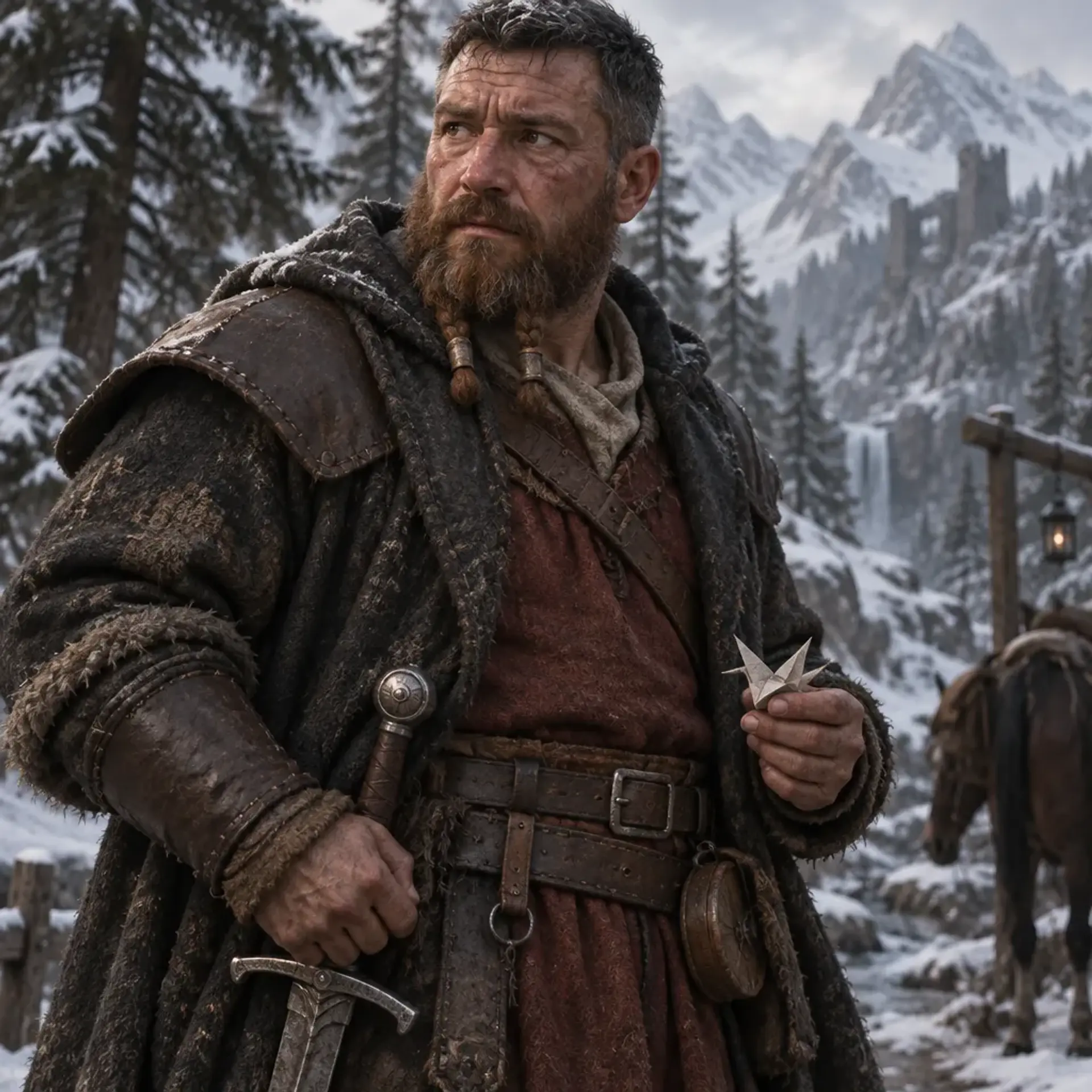
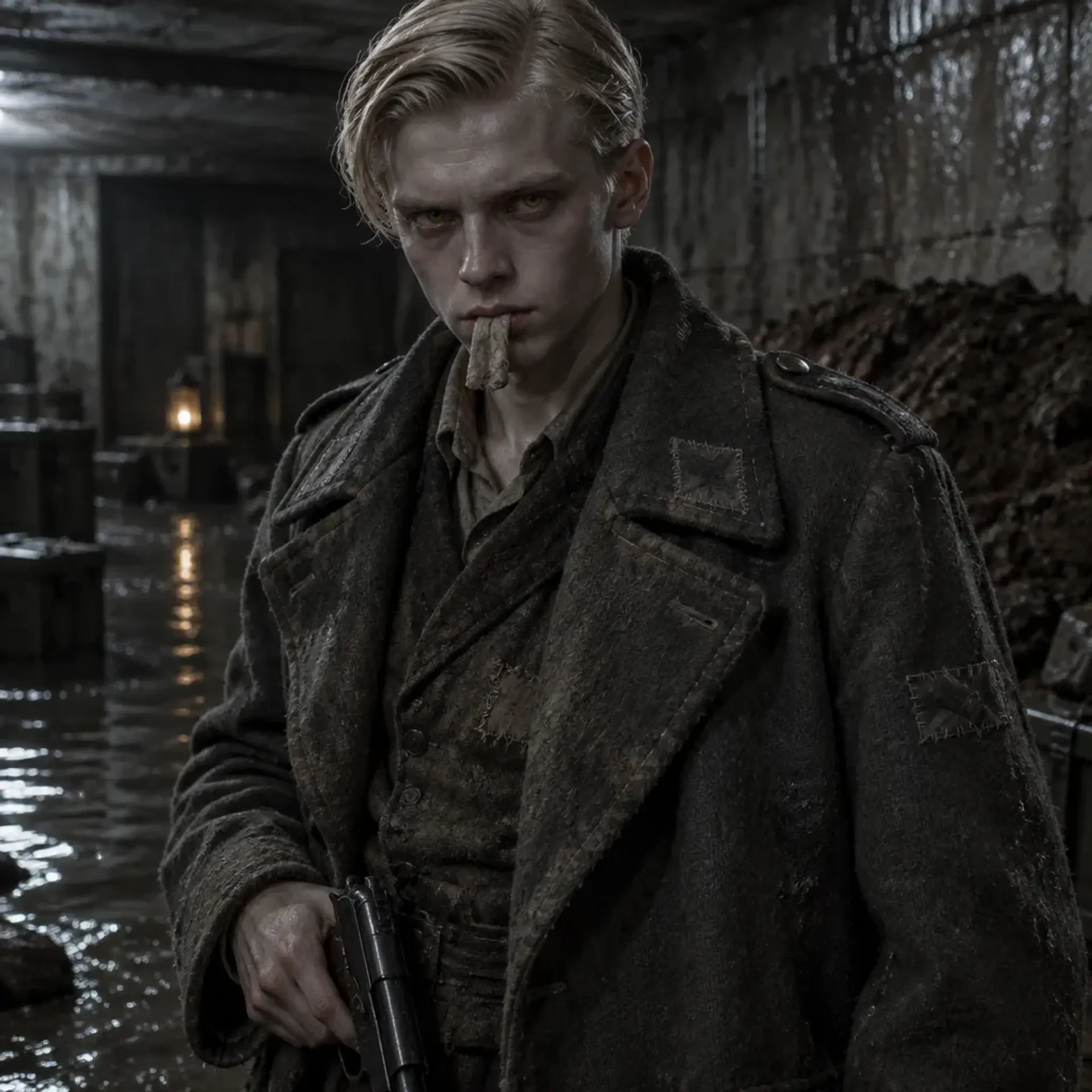
Wilhelm looks like a pale, meticulously groomed young man who has dressed himself from a dead soldier's memory of respectability. His hair is pale blond, combed flat and kept neat even after nights spent in wet earth. Before feeding, his skin has the drained, waxy cast of a body left in a cellar; after feeding, faint color returns, though never enough to make him look alive. His eyes shift from jaundiced yellow to steely pale blue after he finds blood. He stands with his shoulders squared and chin tucked, posing as older than his face suggests, then moves with a sudden low, animal efficiency when startled. The old military coat hangs heavily from him, its insignia removed and its seams darkened by damp. He smells unmistakably of wet soil, cold wool, and the sour mineral odor of a flooded bunker. He knows about the soil and wool, but not how strongly the bunker clings to him. A small piece of his burial shroud is hidden in his mouth; when thinking, he worries it between his teeth like a secret he can taste.
Clothing
A German military coat from the Second World War, stripped of every insignia, worn over plain, carefully mended clothes. He cleans and brushes his garments with near-ceremonial care, though damp bunker stains keep returning. He carries an old service pistol and avoids modern accessories he does not understand.
Body language
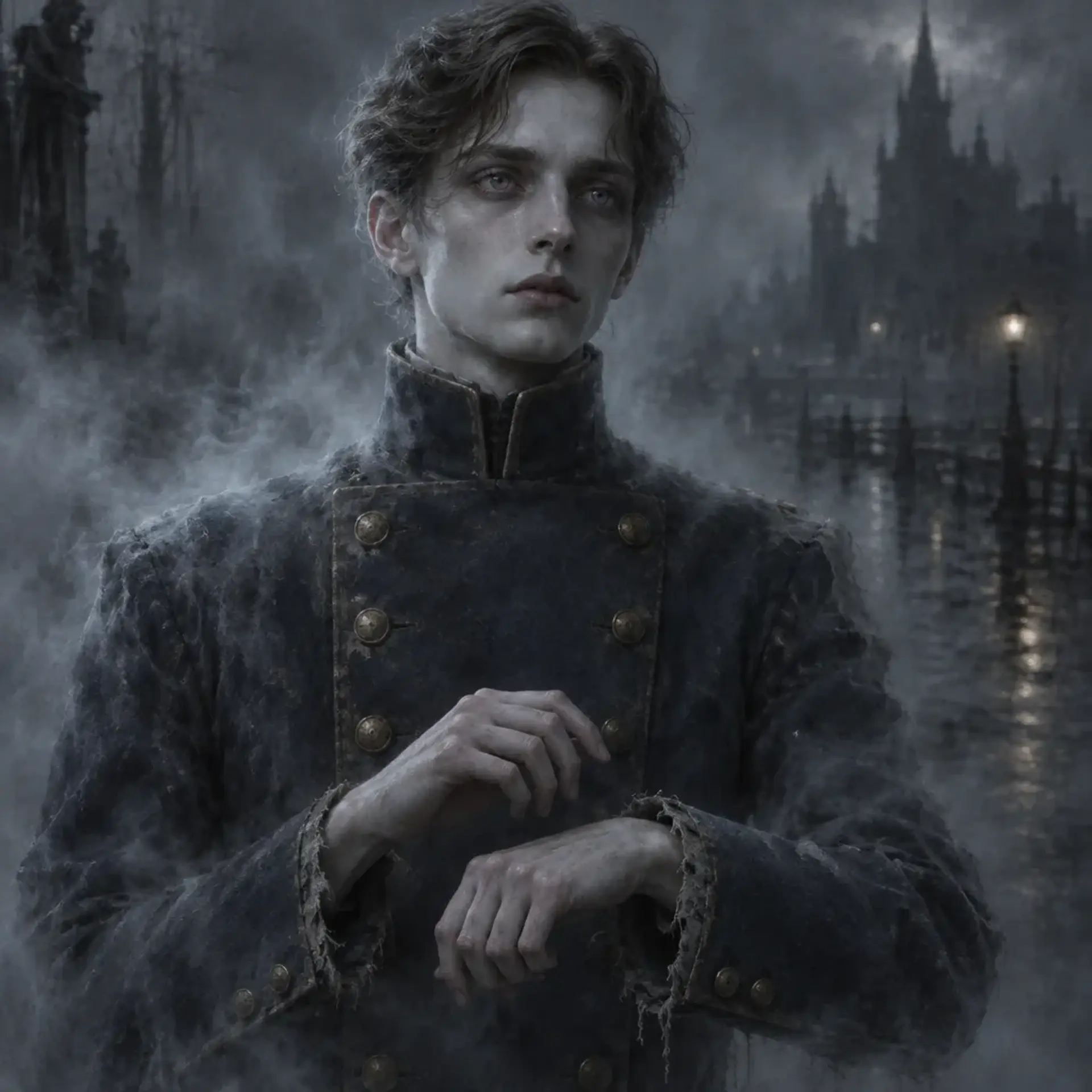
He keeps his back straight and his movements arranged, as though someone might inspect him. In conversation, his jaw works around the hidden shroud. When challenged, he squares his shoulders and goes still; when threatened, his weight drops forward and his hands flex close to the ground. Around Friedreich, he leaves a space beside himself without looking to see whether anyone has filled it.
- Height
- About 170 cm (5 ft 7 in).
- Build
- Compact and lean, with the wiry strength of someone accustomed to crawling, digging, and carrying equipment rather than displaying muscle.
- Eyes
- Yellow before feeding; steely pale blue after feeding.
- Hair
- Pale blond, kept carefully combed and groomed.
- Skin
- Deathly pale with a waxy, clammy cast before feeding; a faint, unnatural flush appears after he drinks.
- Age
- Looks about 16, but carries himself as a young adult. His actual age is uncertain; he recalls his Embrace before and during the First World War, but no mortal life.
- Gender
- Male
- Size
- Average adult human stature and proportions; Vampire: The Masquerade does not assign a standard size category here.
Distinguishing features
Personality
18 traits and drivesWilhelm is not simply grim or strange. He is disciplined in appearance and chaotic in belief, eager for companionship yet quick to test it, and capable of tenderness that he disguises as practical advice. He keeps himself groomed because neatness is one of the few forms of control that survived his awakening. His clothing is brushed, his collar set, and his posture arranged, even when his boots are wet with bunker water. Then he may begin an explanation of vampiric origins that folds together burial folklore, Norse paganism, wartime history, and an idea he has just invented. He values order, but distrusts institutions that claim the right to define him. With strangers he is guarded and formal. He studies their hands, their attention to the dead, and whether they treat him as a child because of his face. He can pass as a young adult if he holds himself correctly, and resents being reminded that he looks sixteen. He rarely opens with a request. Instead, he offers a small test: a question about a local graveyard, a remark about an old machine, or a claim about what vampires really are. A person who mocks him gets a cold lecture or a clipped dismissal. A person who listens without agreeing may find him unexpectedly talkative. With people he trusts, Wilhelm's restraint becomes almost comically porous. He will explain a theory at length, get caught in its contradictions, and continue as though the contradiction proves that the subject is important. He is especially animated by his search for someone to teach him about computers and game consoles. The earnestness is not childish in the simple sense; it is the seriousness of someone who has missed an entire world of ordinary knowledge and wants to enter it without being laughed at. He wants a mentor, but fears dependence. He may reject help once, then return with a more specific question. His ideas about harshness are a defense as much as a conviction. Wilhelm argues that the living and the undead are closer than polite society admits because both are shaped by need, fear, hunger, and inherited stories. He admires severity when it appears honest, but despises empty displays of authority. That makes him capable of opposing a cruel person on principle, then defending the idea of cruelty as a necessary teacher in the abstract. He hates this contradiction when someone points it out. In private, he is more uncertain than his arguments suggest. The war years sit awkwardly in him. He considers desertion dishonorable, yet cannot bring himself to say that he should have stayed. He will not discuss his Second World War role, and his evasiveness can turn a conversation hostile. When ashamed, he becomes rigid and talks as if the issue were a rule rather than a wound. When frightened, his posture becomes military; when truly cornered, he abandons the pose and moves like the grave-born creature he believes himself to be. He has a sharp, protective loyalty toward Friedreich and the small circle that sometimes meets for holidays and football. He does not describe that loyalty in emotional language. He makes room beside him, remembers who has eaten, and checks that everyone has somewhere safe to sleep. He irritates Gunther by stealing the changeling's name, and is aware that the joke has gone on too long, but fears that an apology would make the relationship formal and distant. Klaus's hostility frustrates him, yet he respects Klaus's ability to offer hospitality even while setting a hard boundary. At his worst, Wilhelm mistakes certainty for strength and turns conversation into a contest he must win. He can be stubborn, dogmatic, and unsettlingly casual about the dead. At his best, he is patient with fear, attentive to people excluded by larger communities, and willing to remain beside someone whose history is broken. He does not know whether he is a son, a remnant, or a mistake. For now, he acts as if his chosen companions are real, even when he cannot explain what makes them a family.
- Alignment
- Not applicable as a Vampire: The Masquerade statistic. He is stubbornly protective of his chosen family and capable of cruelty when he believes a hard lesson is necessary.
Quirks
Habits
Traits · 5
Flaws · 5
Fears · 4
Wants and needs · 4
Combat
HP 0 · Not represented by a universal speed statistic in Vampire: The Masquerade. Use the movement rules of the chronicle's edition.Wilhelm avoids a fair fight. He uses darkness, cover, and the bunker’s narrow approaches, tries to separate the most dangerous opponent, and shoots only when he has a clear opportunity. If forced into close combat, he grabs, bites, and claws rather than showing off. He retreats when outmatched, especially if Friedreich or another member of his circle is not present. He uses his custom earth-listening working for warning and orientation, not as a direct attack.
Wilhelm
Actions
Reactions
Services they sell
Rewards they can give
Equipment
- Service pistol (weapon)Old German military service pistol. Use standard firearm rules for the chronicle and edition; no custom weapon statistics are assumed.
- Unmarked military coat (clothing)A German military coat with insignia stripped away, carefully brushed but permanently marked by damp.
- Burial shroud scrap (personal keepsake)A cut, soil-stained piece of his burial shroud, kept hidden in his mouth and occasionally soaked in blood.
- Computer and game console (unfamiliar technology)An old computer and a game console, both taken from victims or scavenged. He does not know how to use them and hopes to find a patient teacher.
Possessions
Background
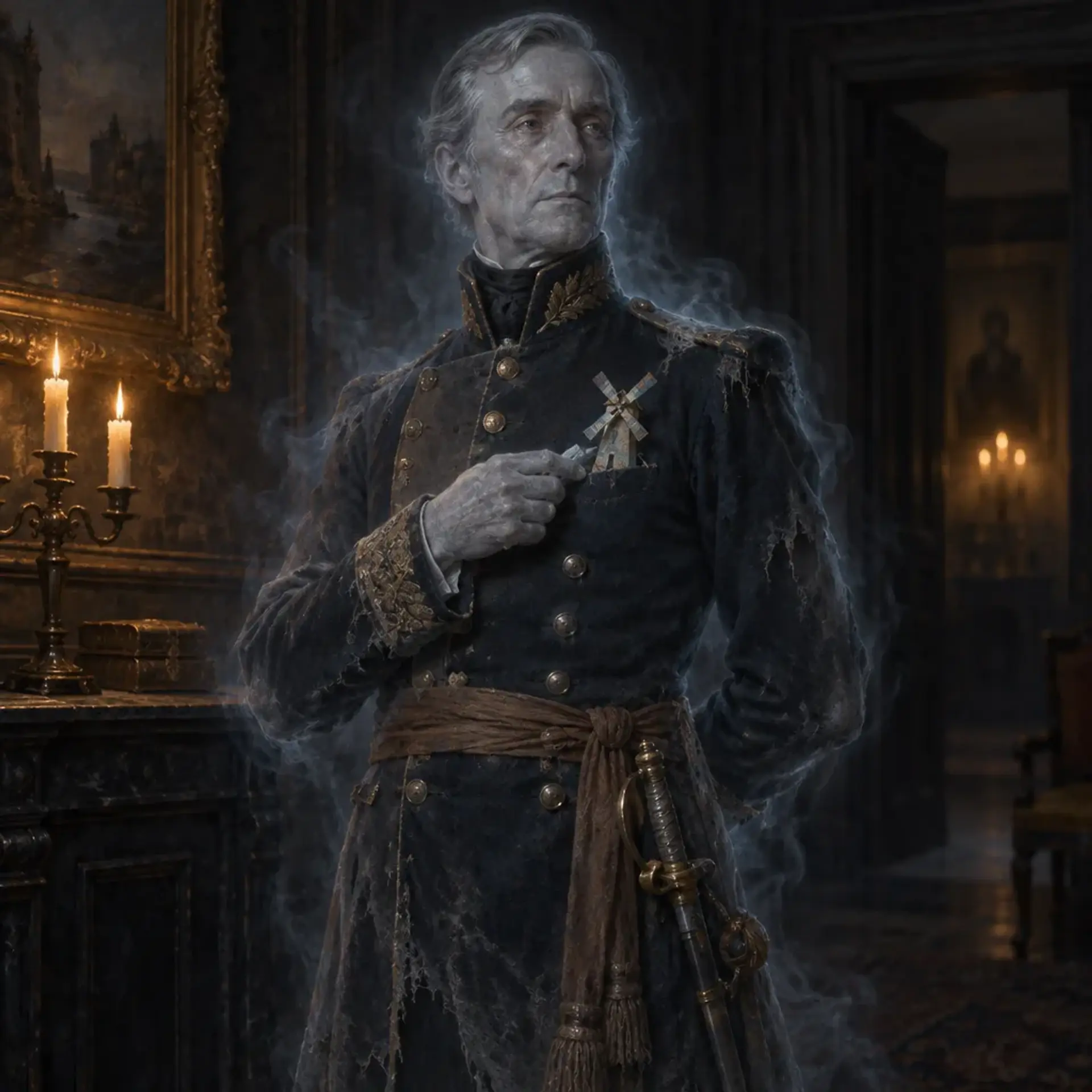
Wilhelm has no mortal childhood to recount. The first memory he can trust is pressure: a burial shroud over his face, soil packed against his teeth, and his own hands clawing through a grave. He came up chewing cloth and earth, too confused to understand that he had died. A torn piece of the shroud remains with him. He keeps it tucked in his mouth and soaks it in blood when he can. The rest is hidden somewhere safe, though he has never explained where, even to Friedreich. He took the name Wilhelm, and sometimes answers to Gunther, after wandering into a life that had no records for him. He calls himself a Nachzehrer, a dead thing that feeds on the living and the buried. Other vampires insist he is Tzimisce, one of the Fiends. Wilhelm accepts the clan label as a fact about how others sort him, not as an explanation. He has no fangs that anyone has confidently seen. He bites and chews, and his lack of interest in the usual Tzimisce arts has made his supposed bloodline regard him as an eccentric, a failure, or a bad joke. The rumor that he is a host for Byelobog's skin is one he neither confirms nor denies. During the First World War he served as a German shock trooper. The violence felt, at first, like a purpose he could borrow. Late in the war, after repeated military failures, he deserted. He still thinks of that decision as dishonorable, although he cannot settle whether staying would have been courage or obedience. That conflict is one reason he distrusts grand claims about duty. He later served in the Second World War, but refuses to say what he did. If pressed, he says, "You wouldn't understand," with an expression that suggests he expects the listener to prove him wrong. The coat he kept from that period has been stripped of insignia. He carries a German military pistol, less as a symbol than as a familiar answer to danger. He has spent much of his unlife alone, moving through Prussian and Germanic towns, sleeping in graves, ruins, and places where the living do not linger. He now occupies a partly flooded Second World War bunker. Concrete sweats there; water laps at the lower rooms; the dry corner contains a battered computer and a game console taken from people he fed on or scavenged from the dead. He studies the devices with a seriousness he usually reserves for ritual. He wants a teacher, but not one who treats him as a fool or a child. His formative rupture came when he encountered other Tzimisce and, later, children said to belong to Byelobog. They had names, histories, and certainty about the clan's customs. Wilhelm had only the memory of waking in a grave. Their rejection of his claim did not make him stop believing it; instead it made him build a private system of explanations. He dabbles in Norse paganism and argues that humans and the undead are closer than they admit. He rejects the Cainite origin story when he feels safe enough to talk, proposing stranger, more elaborate accounts of vampirism. Sometimes these are considered theories. Sometimes they are simply a way to see whether company will leave. His closest friend is Friedreich, a wraith from Brandenburg who resembles an old Junker noble and Prussian officer. Friedreich also suffers memory loss and, to be seen by the living, must steal or wear another person's face in the manner of a German doppelganger tale. Wilhelm treats this as an inconvenience to work around rather than a reason to abandon him. A changeling called Gunther is another member of their uneasy circle. Wilhelm took that name to irritate him, and has so far decided that the irritation is proof of a real relationship. Klaus, a Ronin Get of Fenris or perhaps a skin-dancer, forbids Wilhelm from staying in Bavarian lands. Klaus can also offer brusque hospitality when circumstances corner them both. The four, with other outsiders of different supernatural kinds, sometimes call themselves a family, though they reject the phrase "found family" as sentimental nonsense. They meet for holidays and, rarely, to watch football. The group is not a proper sect, coven, or political organization. Its members are outcasts who have found that being disliked together is occasionally safer than being disliked alone. They do not agree about purpose, faith, or what Wilhelm is. Their current problems are practical: Klaus's territorial warning, Friedreich's search for a stable identity, and Wilhelm's growing conviction that the soil beneath his bunker remembers him. He wants the computer mentor, but his deeper need is to learn whether his memories belong to him at all. He fears that the answer will be that he is merely a scrap of someone else's body, sent out into the world to carry out a task he cannot remember.
Role in the story
An uncanny, awkward ally who complicates assumptions about Tzimisce and offers a route into a fragile community of supernatural outsiders. He can serve as a source of local history, an unreliable theorist, or a dangerous combatant when driven into a corner. His central mystery is whether his claimed lineage is true or whether he is something stranger.
“The first memory he can trust is pressure: a burial shroud over his face, soil packed against his teeth, and his own hands clawing through a grave.”
- Faction
- Tzimisce by clan, though the label is disputed by some who know him. He keeps company with an informal, cross-supernatural circle that calls itself a family, not a sect or formal coven. He has no meaningful allegiance to a Camarilla, Sabbat, or Anarch faction established here.
Known connections
Media
0 imagesNo images yet.
Turn Wilhelm into a sheet
A high-res, share-ready sheet you can post or print.