Friedreich
Friedreich
At the table
“I remember the shape of it”
Voice
His voice seems to come from behind the borrowed face and slightly to its left, as if the sound has taken a longer route than the words. It has the dry rasp of a man accustomed to cold air, wool collars, and issuing instructions outdoors. Tobacco roughness persists even through a borrowed throat. When memory fails him, a sentence ends abruptly, followed by a brief, mechanical tap of his watch.
His diction is formal, clipped, and shaped by the habits of an officer who once had to make instructions carry through wind and confusion. He favors complete sentences and careful distinctions, but fragments and misplaced dates intrude when he reaches for a lost memory. He does not soften when angry; he becomes more exact, as if every word were being entered into a report.
Speech patterns
How to play them
Approach him with patience, direct questions, and small acts of reliability. He responds poorly to demands for a full account of his past, but will share one precise fragment at a time if the question is specific. Treating the borrowed face as a person rather than a disguise earns his respect. Threats against Wilhelm “Gunther” make him decisive and difficult to negotiate with.
Goal
Recover the shared missing memories that connect his death to Wilhelm “Gunther”'s past, without making his friend pay for the answer.
Motivation
Loyalty to Wilhelm “Gunther,” a need to know whether his last act in life was truly an act of courage, and the hope that a recovered memory might finally let him stop borrowing the faces of the living.
Appearance
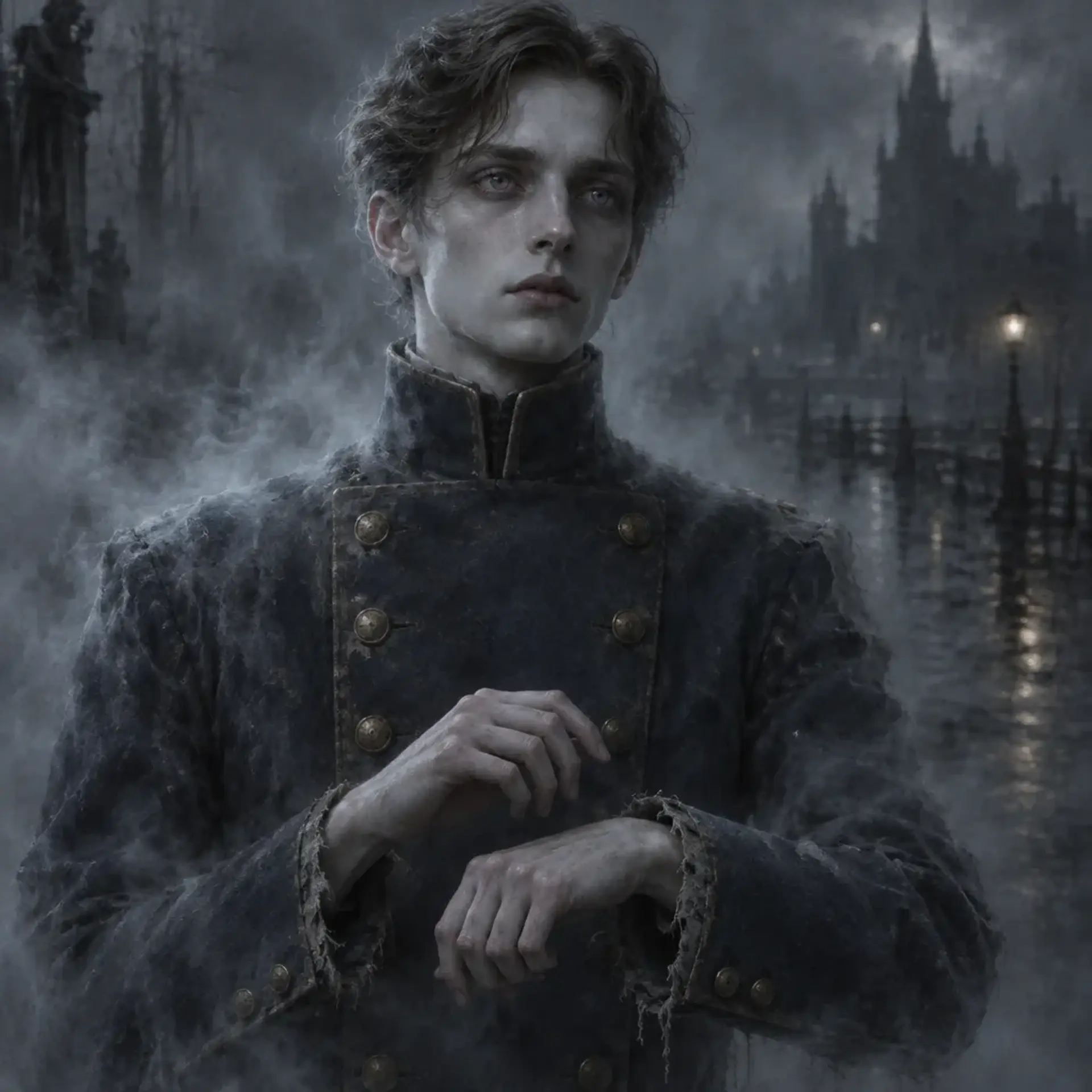
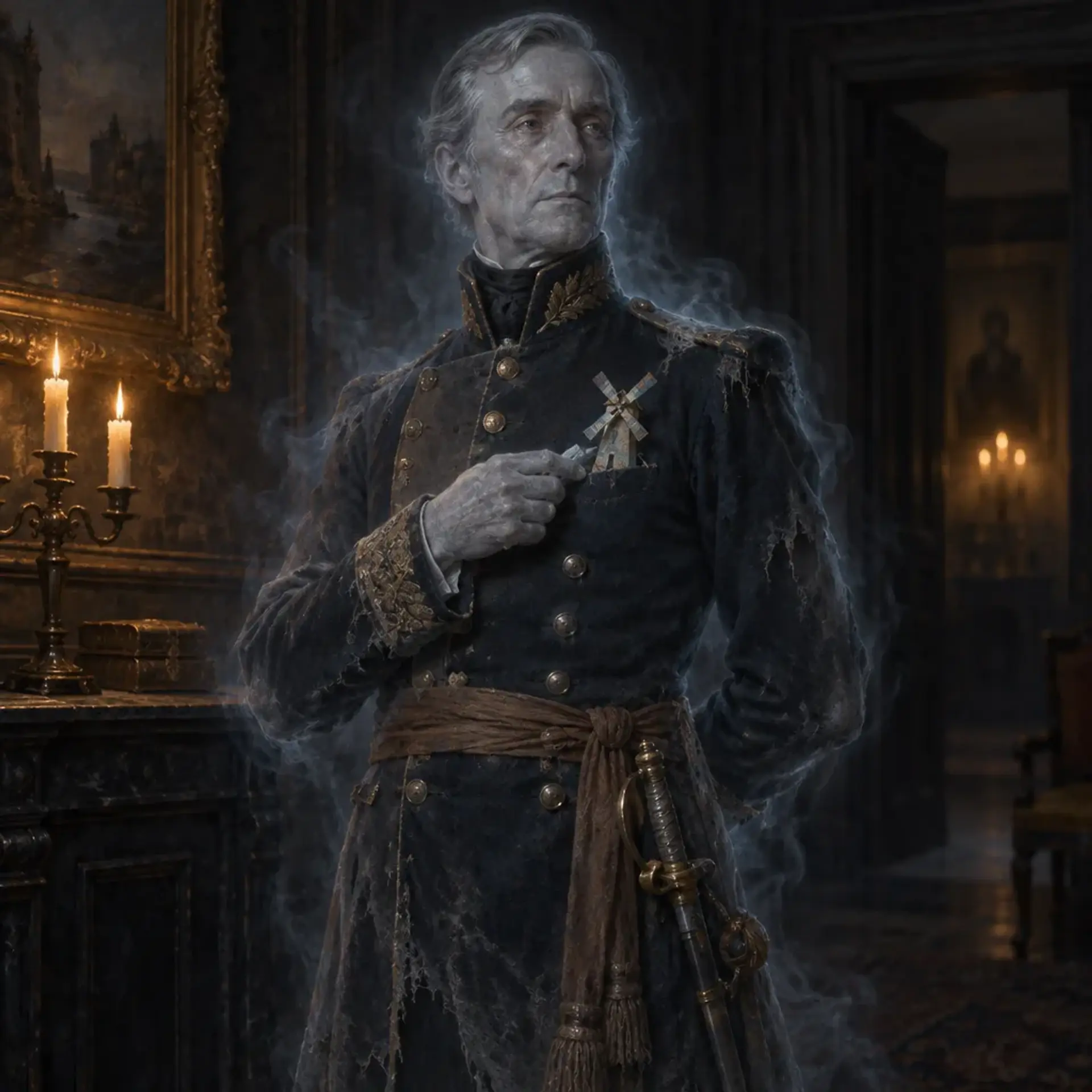
Friedreich resembles a retired Brandenburg Junker officer whose uniform has been carefully maintained by someone who no longer understands that it is out of fashion. He cannot be seen by the living without a borrowed face. When visible, the face sits on him with a faintly waxed, too-smooth stillness, while the rest of him seems made of smoke pressed into the shape of a man. His posture is rigidly upright, but his steps slide a fraction above the ground, as if he expects a polished parade floor beneath him. He smells strongly of wet wool, old pipe tobacco, and the sharp medicinal scent of camphor; he knows about the tobacco and insists it is an improvement over the alternatives. In any room, his eyes go first to the doors, then to the empty chairs, as though counting people who should have arrived. The unexpected detail: he keeps a tiny, hand-painted paper windmill tucked into his breast pocket and turns it whenever a conversation becomes too solemn.
Clothing
A faded dark-blue officer's coat with dulled brass buttons, a high collar, and immaculate but threadbare cuffs; gray trousers, polished boots that make no sound, and a narrow sash faded nearly to brown. The garments look tangible at a distance and mist-frayed at the seams up close.
Body language
He stands as if awaiting inspection, hands clasped behind his back, and pivots from the heels with precise economy. His gaze counts doorways before faces. When someone mentions the past, his shoulders settle as though a greatcoat has grown heavier. He touches the paper windmill through his breast pocket when he wants to reassure someone but cannot find the words.
- Height
- About 5 feet 10 inches when wearing a face.
- Build
- Lean and erect, with the economical bearing of a man trained to stand for long inspections.
- Eyes
- Pale gray beneath the borrowed face, visible only as a faint suggestion through its surface.
- Hair
- Steel-gray, brushed flat and neatly parted, though it is an impression formed by the borrowed face rather than his own visible body.
- Skin
- Normally unseen, a smoke-gray translucence; the borrowed face retains its living owner's complexion but appears cold and faintly waxen.
- Age
- His age in life is uncertain, perhaps in his late sixties; he has been dead long enough to forget the year of his death.
- Gender
- Male
- Size
- Medium
Distinguishing features
Personality
14 traits and drivesFriedreich is courteous and dutiful, yet privately suspicious of every neat explanation. In danger he becomes clipped and commanding; among friends he allows dry humor to surface, then seems faintly embarrassed by it. He wants to be useful but resents being treated as a tool. He prizes honesty, though he withholds the truth when he believes a confession would burden someone else.
- Alignment
- Neutral, bound more by personal loyalty than law or ideology.
Quirks
Habits
Traits · 4
Flaws · 4
Fears · 3
Wants and needs · 3
Combat
AC 13 · HP 22 · 30 ft.; can move through creatures and objects as difficult terrain, taking 5 force damage if he ends his turn inside one.Avoids a fair fight. He uses barriers, darkness, and the faces of willing or already hostile creatures to move unseen, then targets a pursuer's ability to move with Grave-Cold Grasp. He uses The Missing Minute to break a crowd's coordination or create an opening for escape. He will not take Wilhelm “Gunther”'s face, even if doing so would save them both.
Friedreich
Actions
Reactions
Services they sell
Rewards they can give
Equipment
- Ceremonial saber (weapon)A tarnished Brandenburg-style officer's saber, more useful as a sign of rank than as a weapon.
- Paper windmill (personal keepsake)A small hand-painted paper windmill, carefully mended at one blade.
- Unfinished route map (evidence)A damp, incomplete marching map with a drainage cut marked in pencil; the map's date and place names have blurred away.
- Stopped watch (keepsake)A worn pocket watch that stopped at an hour Friedreich cannot connect to any remembered event.
Possessions
Background
Friedreich learned early that a map could be honest and still lead a person into disaster. Ink recorded roads, rivers, and borders with admirable precision, but it rarely showed where a bridge had rotted, which village would open its doors after dark, or how much fear could change the meaning of an order. He trusted maps more than speeches, though he never mistook one for the whole country. He was born in Brandenburg to a family of modest means and modest expectations. His father kept accounts for a grain merchant, and his mother had a talent for remembering who had lent whom a winter coat three years earlier. From them, Friedreich acquired a careful manner and a dislike of promises made for show. He was not a brilliant student, nor did he possess the sort of ambition that makes a young man speak as if the future already belongs to him. He was patient, observant, and useful with a pen. When he entered military service, those qualities made him a competent officer of the kind who kept supply lists legible, noticed when a road had been mislabeled, and remembered that a frightened recruit might need an instruction repeated without an audience. His rank remained minor. He did not command armies or decide the fate of kingdoms. He led small groups, carried orders, checked the condition of roads, and tried to ensure that the men under him were not sent toward trouble on the strength of a careless assumption. He could be courteous even when tired, and he believed that discipline worked best when a person understood what was expected of him. He also learned that an officer's politeness could be mistaken for weakness. When danger arrived, he discovered he could give an order sharply and without apology. The voice that came out of him in those moments sounded like someone else, but the men usually obeyed it. The winter retreat began with a chain of explanations. The enemy was closer than expected. The roads were failing. The stores could not support the company and the hamlet's inhabitants both. A withdrawal was necessary, the order said, and necessity left no room for sentiment. Friedreich had heard enough tidy accounts to know that they often concealed the person who would pay the price. He checked the route himself, questioned a courier whose account did not match the map, and asked whether there was time to warn the villagers. Each answer was reasonable on its own. Taken together, they were too neat. The company had been sheltered in the hamlet for several nights. Its people had shared what little they had, though the soldiers could not repay them in anything but guarded thanks and promises that the military would not forget their aid. When the order came to move out, Friedreich saw the civilians gathering their belongings in the snow. Some were old. Some were children. A few could barely walk. The main road was exposed, and a stream cut through the low ground beyond the houses. In better weather, the drainage cut might have been a miserable but passable route. In the storm, it was a dark trench beneath hardening snow, with water moving under a skin of ice. He asked for time to lead the villagers through it. He was told that the company could not wait. He asked whether anyone had sent a guide ahead. No one had. He asked for a lantern, a rope, and two steady soldiers. The officer giving the orders reminded him that his duty was to the company. Friedreich answered that he understood. He did not say that the villagers had also trusted the company, or that he had helped make them trust it. He did not argue again. He simply watched the column depart, then turned back toward the hamlet. He later tried to remember exactly why he stayed. Sometimes he thought he had acted from compassion. Sometimes he suspected that he could not bear to be the man who left after making a promise. On other nights, he wondered whether shame had driven him more than kindness. The memory always stopped before it could settle the question. He gathered the civilians and explained the route as plainly as he could. He did not claim it was safe. He told them where the ground was firm, where the cut narrowed, and where the ice might give way. They moved slowly, tied together with rope, and followed his lantern into the storm. Friedreich walked near the rear, counting heads and listening for anyone who slipped. He kept the numbers in his mind as if he were checking a supply list. One, two, three. Again. The wind erased tracks behind them. Snow filled the lantern's glass. At some point, a child began to cry, and Friedreich spoke to him in a low voice about the absurdity of marching in a ditch when there were perfectly good roads above it. He could not remember whether the child laughed. There was a moment when someone called him by a name. He thought it was his own, but the sound did not fit. He turned, and a face appeared in the snowlight, familiar in a way he could not explain. It might have belonged to a soldier, a villager, or someone he had once been. He had the sudden conviction that he had borrowed that face from another man, though he could not say when or why. Then the memory broke apart. Friedreich's last clear recollection is not of dying. It is of counting heads and failing to reach the end of the count. Afterward there are fragments: ice cracking beneath a boot, a hand closing around a rope, a voice issuing an order that might have been his, and a terrible silence in which he could no longer remember his own name. Whether he died of exposure, violence, or something less visible, he cannot tell. He only knows that when his memory returned in pieces, the pieces contained no proper account of the storm and no answer to the question of who had survived. He spent a long time as a man without a reliable past. He kept the habits of an officer because habits were easier to carry than memories. He made careful promises. He watched the road before trusting the person who described it. He was polite, even when he was afraid, and exacting when someone tried to pass a convenient explanation off as the whole truth. He did not like being treated as a tool, though he rarely complained when there was work to do. He wanted to be useful because usefulness gave him a place in the world. He resented it when people decided that was all he was good for. Decades later, Friedreich met Wilhelm, the man he came to know as “Gunther.” Their first conversations were cautious, almost formal. Wilhelm had gaps in his memory too. He would lose a detail, then cover the absence with a confident answer that did not quite survive a second question. Friedreich recognized the maneuver because he used it himself. Neither man asked the other to explain what he could not remember. Neither demanded a confession that might prove impossible to give. Their trust grew by ordinary degrees. Wilhelm remembered a road Friedreich had forgotten, and Friedreich insisted that Wilhelm had once told him the same story in different words. Wilhelm denied it, then later admitted that the details sounded familiar. Friedreich stood witness when Wilhelm doubted whether an event had happened at all. In return, Wilhelm allowed Friedreich to be silent without filling the space with guesses. Their friendship took on the shape of an old military courtesy, though neither could have said where it began. They shared what they knew, marked what they did not, and tried not to mistake a blank for a lie. Friedreich became Wilhelm's closest friend, and at times the only person willing to say, calmly and firmly, that a forgotten event had truly occurred. He has never considered that a small service. A person can be made to doubt himself by a missing memory just as surely as by a false accusation. Still, Friedreich does not always tell Wilhelm everything he suspects. He withholds some thoughts because he believes the truth, if it is only a theory, might burden his friend without helping him. He knows the danger in that reasoning. It resembles the excuses men use when they decide someone else cannot bear the truth. He has not yet found a better rule. Now he is looking for the connection between their missing memories. The gaps do not always match, but some seem to have the same edges, as if two accounts were torn from the same page. Friedreich has noticed the pattern and does not trust coincidence merely because it offers comfort. He has begun to keep records of small details: names that recur, places that feel familiar, and the exact words each of them uses when a question comes too close. He marks speculation as speculation. He refuses to call a pattern proof until he can test it. The face he once borrowed troubles him most. He cannot remember whose it was, or whether the thought came from a genuine memory rather than a fragment shaped by guilt. He suspects that the owner of that face was connected to the winter storm and to the moment his own name disappeared. He also suspects that Wilhelm may have encountered the same person, or the same hidden event, somewhere in the missing portions of his life. Friedreich has not told him the full shape of that suspicion. For now, he continues to search carefully, to ask questions that allow honest answers, and to stand beside his friend when memory fails. He would rather be wrong in good company than certain alone.
Role in the story
Wilhelm “Gunther”'s closest friend, a supernatural companion and a living link to a shared mystery. Friedreich can offer practical counsel, testimony about old events, and a personal stake in uncovering the memories both friends lack.
“He trusted maps more than speeches, though he never mistook one for the whole country.”
- Faction
- No living faction. He retains the habits, rather than the authority, of a minor Brandenburg officer.
Known connections
Media
0 imagesNo images yet.
Turn Friedreich into a sheet
A high-res, share-ready sheet you can post or print.