Oswin Hirst
Oswin Hirst
At the table
Voice
Warm and weathered, with a dry rasp from cold mornings and long hours outdoors. The sound is supported by a relaxed chest and a breath that stays steady when others become nervous. His name, Oswin, carries an unexpectedly firm stress on the first syllable when spoken by him. He does not sing his words; he gives them the plain, useful weight of a man accustomed to being heard over wind and sheep.
A grounded Yorkshire cadence shaped by farm work and centuries of adapting to whoever is listening. He places weight on practical nouns and lets the end of a sentence fall plainly. His voice catches slightly after a night without sleep, as if cold air has roughened it. He speaks in short, useful phrases when working, but becomes vivid and winding when telling a road story. Under strain, an older rhythm slips into his words, unfamiliar even to him.
Speech patterns
How to play them
Meet fear with practical kindness before discussing the supernatural. He offers help with farmwork, listening, and local knowledge. If pressed about his age, iron, or the hound, he answers with partial truths and watches whether the questioner is protecting someone or seeking leverage. Threats to his family end his patience quickly.
Goal
Keep Mary and William safe, help William grow without shame, and build a household where the dark is no longer treated as proof of evil.
Motivation
To make a real home without surrendering the old self that kept him alive, and to give William the choice and tenderness he never had as a child.
Appearance
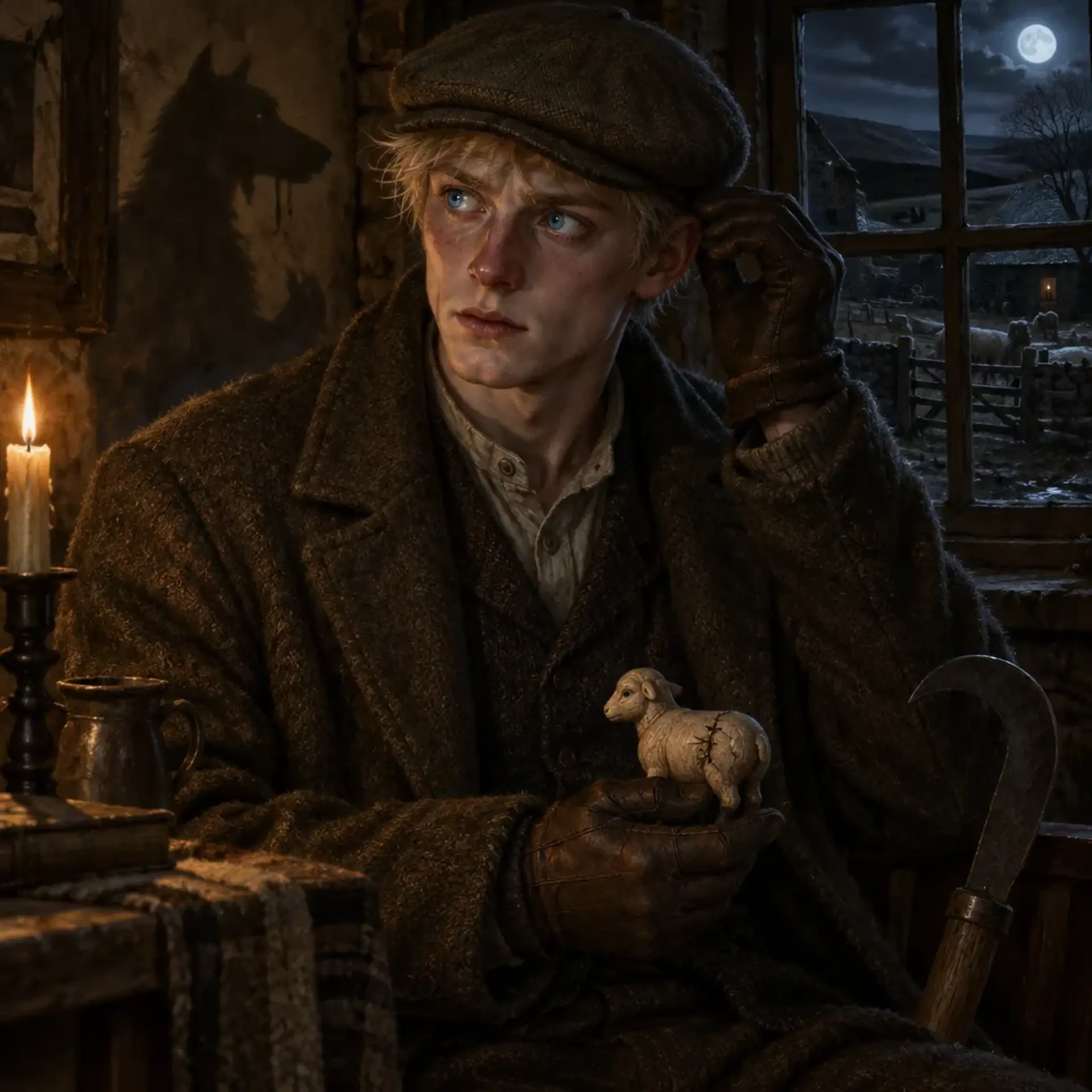
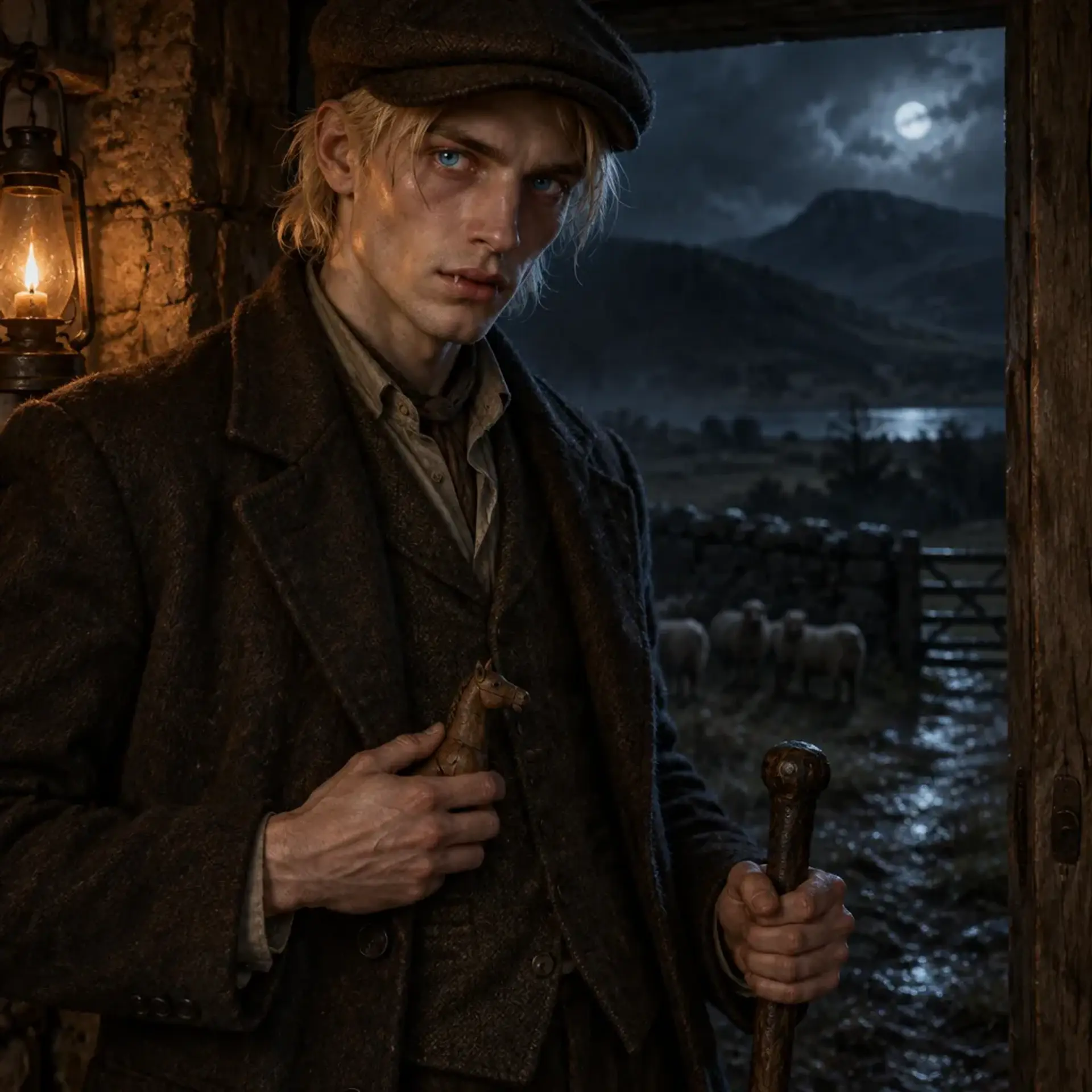
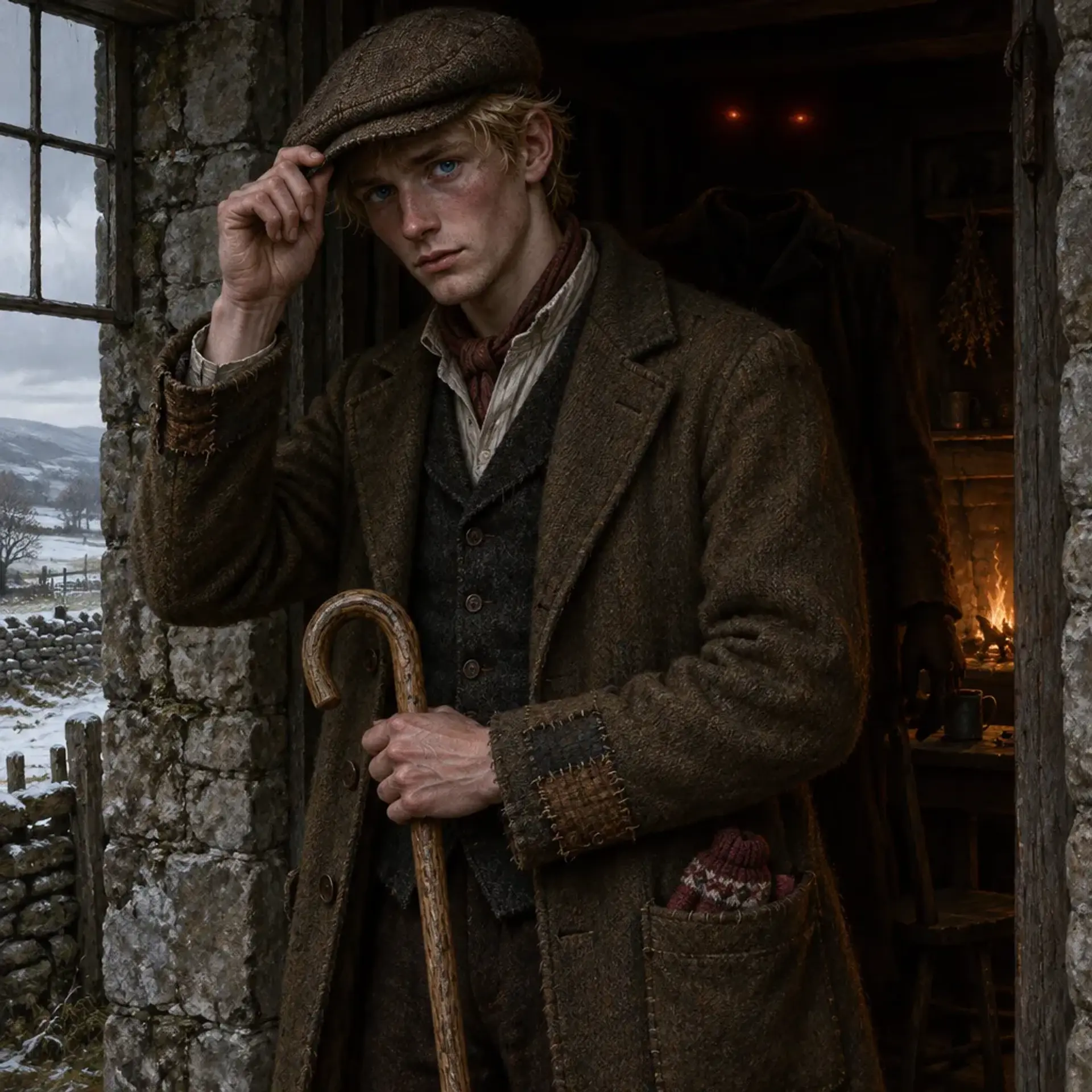
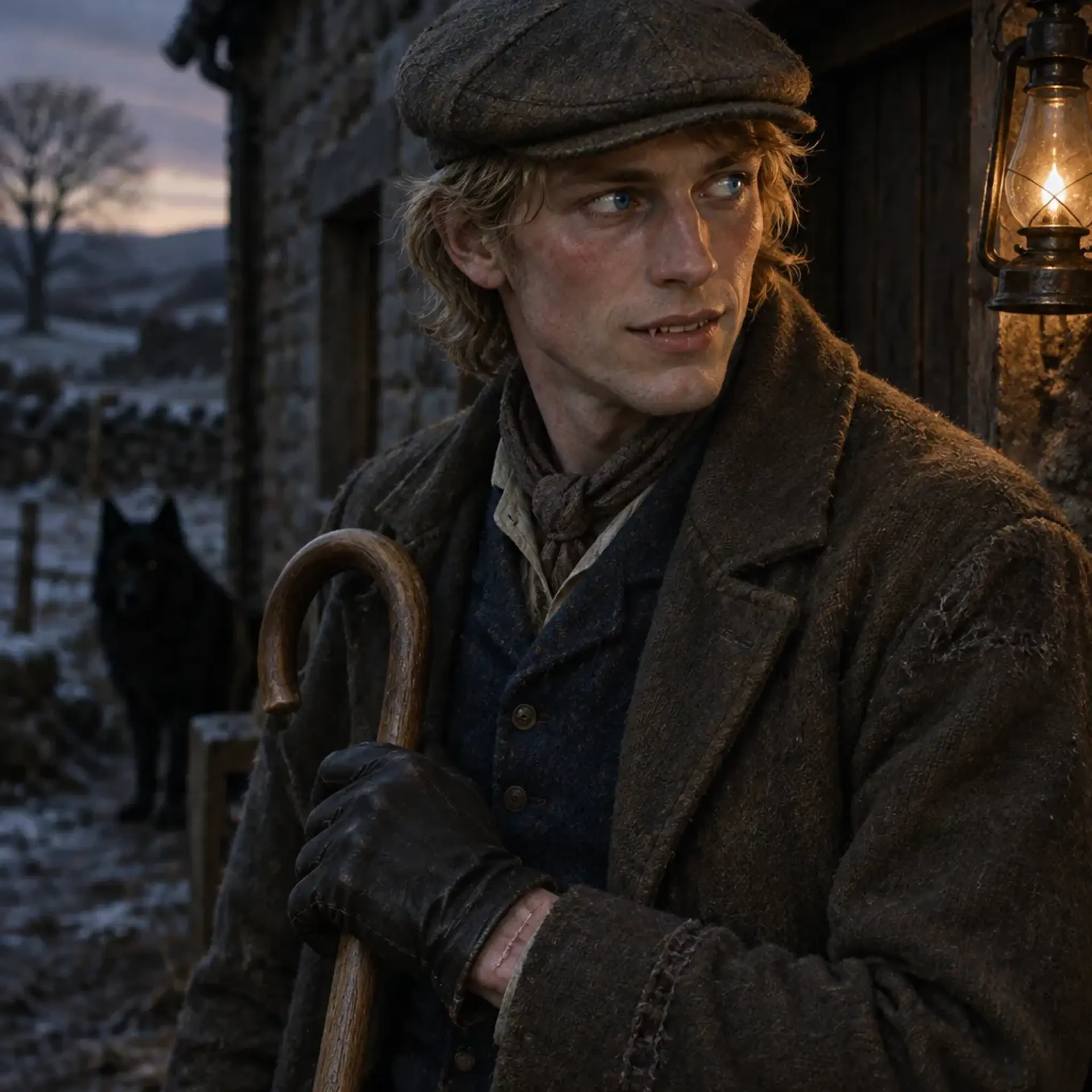
Oswin stands six feet tall, with the long, slightly forward-leaning posture of someone accustomed to walking hills into a headwind. He has pale skin with a wind-roughened texture across the nose and cheeks, straight flaxen-blond hair that brushes his collar, and brilliant blue eyes that seem to catch light even in a dim room. His handsome face has kept the unlined youthfulness Mary remembers, an effect he disguises with a flat cap, a weathered expression, and a careful choice of lamplight. His smile is unexpectedly canine: the upper canines are a little too long, and when he laughs his jaw opens wider than seems comfortable. He eats neatly in company but tears bread into small, exact pieces when alone. His working clothes are sound, mended, and well fitted, except for one over-cared-for blue waistcoat he brushes free of lint as if it were a uniform. He moves with economical farmhand patience until a sound or scent catches him; then his head turns first, too quickly, and his body follows with a silent, predatory smoothness. People remember the contrast between his mild manners and the sense that he has already measured the door, the dog, and every heartbeat in the room.
Clothing
A common flat cap, carefully brushed wool waistcoat, practical coat, work trousers, and sturdy boots. His clothes are mended cleanly; he favors buttons and fastenings that are not iron and wears gloves when work might bring him near iron.
Body language
He keeps his hands visible and away from iron, often turning a tool in his fingers before accepting it. His head reacts to noises a fraction before his shoulders do. With Mary he angles himself toward her but leaves her room to withdraw; with William he crouches to meet his eyes. When frightened, he becomes motionless rather than agitated, and his jaw sets until the long canines show.
- Height
- 6 feet (about 183 cm).
- Build
- Tall, lean, and long-limbed, with the rope-hard strength of a working shepherd rather than a soldier.
- Eyes
- Clear, intense blue, bright enough to seem aflame in low light.
- Hair
- Straight flaxen blond.
- Skin
- Very pale, with weather-reddened cheeks and a wind-roughened nose.
- Age
- Appears about seventeen; claims to be a young adult. In truth, he was born during the Danelaw, centuries ago.
- Gender
- Male
- Size
- Medium in human form; large hound in Barguest form, as a custom descriptive rule.
Distinguishing features
Personality
20 traits and drivesOswin is gentle in the deliberate, practiced way of someone who knows that gentleness is a choice he must keep making. He does not confuse kindness with softness. He will sit through William's long silences, mend a gate in bad weather, or give a frightened stranger his best blanket; he will also make a shrewd bargain, conceal a danger, and leave a room by the door no one else has noticed. He likes useful work because it has honest rules. A sheep is lost, a fence is broken, a storm is coming: each problem can be met with hands, attention, and time. People are harder. He reads their pauses and glances well, but often treats that knowledge as a tool for managing them rather than an invitation to be known. His nature pulls in two directions. The settled farmer in him wants routine, family meals, and a future measured in lambing seasons. The roving creature remembers open roads, night air, and the strange company of the dales. When home feels safe, he is affectionate and quietly funny. When home feels like a trap, he dreams of walking until the hills swallow the house behind him. He is ashamed of that impulse, because he chose Mary and William and means the choice. He sometimes mistakes wanting distance for wanting freedom, and then has to remind himself that the road is not a person who can forgive him for leaving. Oswin is practical and deeply superstitious at once. He will tell Mary that a sound outside is only a fox, then check the yard three times because the season makes him uneasy. He can explain a child's fever with the language of new sciences and still leave a dish of food where an old spirit was said to pass. These beliefs do not feel contradictory to him. The world has ordinary causes and older hungers, and a sensible person prepares for both. He is not a preacher, though he invokes church teaching when it gives Mary comfort. He wants her to believe that darkness is not proof of the devil, but he knows that his own existence makes that reassurance difficult to defend. With Mary, Oswin is solicitous and attentive, sometimes to the point of anticipating needs she has not voiced. He remembers how she takes her tea, which floorboard wakes the child, and which subject makes her father turn cold. He loves the domestic details because they prove he is present. But he has built their marriage on an essential omission: his age, his nature, and the meaning of his aversion to iron. When Mary asks a direct question, he may answer a smaller one honestly and hope the larger question falls away. His affection is real; so is his fear that honesty will end it. He does not see how the evasion itself can make Mary feel watched rather than trusted. With William, he is patient in a way he has had to learn. He does not rush the boy through a task or mock him for crying. He offers simple work that can be finished and praised: carrying a small pail, folding a blanket, sorting a handful of pebbles by shape. He recognizes the distant look in William because he has spent centuries looking past people at something they cannot see. That recognition makes him tender, but it also makes him fearful. When William's anger rises, Oswin may become too alert, watching for signs of the hound in the child rather than responding to the child who is there. The memory of gripping William too hard has made him cautious, yet the shame sometimes makes him avoid the subject instead of repairing it openly. In company, he is mild, observant, and more sociable than his secrets would suggest. He can make a room comfortable by listening well and asking people about their work. He rarely boasts, but he tells excellent stories about his travels, shaping them as entertaining adventures with harmless endings. A question about dates or names makes his manner more careful. If a listener presses, he may smile, change the subject, or offer a practical service that redirects the conversation. He is not a natural liar in the sense of enjoying deception; he simply believes that truth is dangerous when delivered without shelter. That belief has kept him alive and is now endangering the intimacy he wants. His mood changes with the year. As the evenings grow dim and cold, his patience becomes effortful. He wakes at hours when the house is still, listens to the yard, and feels the old routes tugging at him. He can be affectionate during the day and distant after nightfall, not from lack of love but from a growing inward vigilance. He is reluctant to sleep because dreams return him to places he cannot name. When he has slept badly, he becomes brisk and overfocused on chores, as though work can keep his attention from straying beyond the lamplight. All Saints' Eve and Halloween stir him. His blood seems to recognize a season his mind cannot explain. He becomes quick, watchful, and uncomfortably exhilarated by the dark. He may pace the property, inspect the flock, and offer no convincing reason for doing so. He dislikes that the fear around him can feel like a kind of welcome. He does not want to feed on fear, but part of him remembers being treated as a terrible thing and finds the old recognition almost comforting. This is one of the truths he refuses to examine for long. The Maypole brings a stranger response: delight. On that day he can seem more openly young than at any other time, laughing at ribbons, movement, and the bright turning of people in the green. The pleasure is not entirely his, and that frightens him. He tries to remain with Mary and William and to enjoy the celebration as a husband and father rather than as something answering an ancient call. He does not always succeed. Christmas, by contrast, calms him. The hearth, shared food, familiar prayers, and repeated customs make him feel held in the present. He works willingly, makes room for guests, and rarely feels the urge to wander. He regards this calm as precious but does not tell Mary how much he depends on it. Oswin's anger is contained until it is not. He does not usually shout or threaten. He becomes still, studies the other person, and chooses the most effective words. If someone endangers his family, something colder may take over: his eyes fix, his jaw opens, and his movements lose their human hesitation. He can be frighteningly direct and may cross a room faster than a person expects. Afterwards, the gentleness returns, accompanied by guilt, but guilt does not undo what another person has seen. The incident with William is the proof he cannot dismiss. He is capable of courage, but it is not always noble. He will face danger for Mary and William because he cannot bear to lose them, and he will flee a battle that serves no purpose. He avoids iron not because he is cowardly but because it hurts him and can undo his control. If cornered by it, he may panic, lash out, or run. He can be generous with help and stingy with the truth. He can be tender with a frightened stranger and impatient with a person who insists that every fear is foolish. His contradictions are not disguises around a simple center. They are the shape of a man trying to make a home while carrying a life that keeps calling him elsewhere.
- Alignment
- Protective and compassionate, but not reliably human in his instincts; his morality is personal rather than doctrinal.
Quirks
Habits
Traits · 5
Flaws · 5
Fears · 5
Wants and needs · 5
Combat
HP 12 · Human pace: ordinary walking or running for a fit adult. Hound form: fast over open ground; custom narrative advantage, not a canonical movement statistic.Avoids a fair fight. He uses fences, darkness, livestock, and knowledge of the ground to separate opponents. If Mary or William is threatened, he may shift into the black hound and end the danger quickly, but tries to flee rather than kill. Iron makes him abandon a plan at once. He does not treat a clear hound-form sighting as a tactical trick; it is a frightening omen with consequences for trust.
Oswin Hirst
Actions
Reactions
Services they sell
Rewards they can give
Equipment
- Flat cap (clothing)A familiar everyday cap that helps him look like a local farmer rather than an ageless stranger.
- Work gloves (protection)Worn for gate repairs, handling tools, and any task where iron might touch his skin.
- Prayer book (personal)A small household prayer book, used sincerely as comfort and sometimes as a way to reassure Mary.
- Shepherd's crook (tool)A plain shepherd's crook used for farm work and keeping animals at a distance, not as a weapon of choice.
Possessions
Background
Oswin Hirst was born in the Yorkshire dales during the years of the Danelaw, to a mother whose life had been broken by Viking violence. His mother gave him the name Oswin and little else that could keep him safe. They lived among other poor folk on the edges of settled land, where a child could be fed one week and forgotten the next. He remembers her hands more clearly than her face: cracked knuckles, a thumb that smelled of sheep grease, and the way she used to press his head beneath her chin when dogs barked in the dark. She died while he was still a child. He has never been sure whether it was fever, hunger, or something that came to the door after sunset. He has carried the uncertainty so long that it feels like a memory. After her death, Oswin drifted between households and small settlements. He was a useful boy, but strange enough that people found reasons to send him away. He could sleep in a byre without waking when the animals panicked. Dogs sometimes followed him without barking. He learned to avoid certain hollows and old tracks because the air there seemed crowded. He did not understand that he was becoming a Barguest changeling, or that the black dog glimpsed at the edge of the fields was sometimes his own shape. No single bargain or deliberate enchantment made him what he is. His nature grew into him as unwittingly as a second shadow. In youth, he began to roam. He worked as a drover, guide, messenger, and occasional guard, taking the routes that ordinary folk avoided. The dales taught him how to bargain for a meal, judge a man's temper, and keep moving when a village had decided a traveler was ill-omened. He met wraiths, fae, and devils, though he had no firm names for them at first. Some were cruel, some merely alien, and a few seemed almost companionable. He learned to trade favors and stories, but never to trust a gift without finding out what it cost. His memories of those years are now eroding. A face will become a smell; a promise will survive after the person to whom it was made has vanished from his mind. He does not know why he is a changeling. He knows only that he is one, and that the black hound is not a costume. The most formative change came when he saw a funeral procession pass through a dale in a winter storm. The dead person was important to the valley, and dogs came from every nearby farm to howl behind the bier. Oswin remembered walking at the procession's edge in a shape he could not name. People fled from him. He later learned that those who had seen him clearly feared they were marked for death. That night convinced him that being useful and being loved were different things. He resolved to make himself useful enough that people might keep him near, while hiding the nature that made them afraid. In later centuries, he passed through different lives under different circumstances, never staying long enough to be asked why his face did not change. He became practiced at small explanations: an old portrait was of a cousin; the family had always been youthful; he was not the same man Mary had met. He learned a few scraps of church teaching and newer natural philosophy, not because either could explain him, but because a calm explanation could steady a frightened listener. He came at last to a settled sheep-farming life in Yorkshire. The farm is prosperous by local standards, with a fine house for a man of his station. He has worked hard for it and is proud of the ordinary things it contains: a dry roof, a good flock, a table that can seat family, and a door Mary can close against the night. Mary Pickles became Mary Hirst after their marriage. Oswin loves her with a tenderness that makes him more frightened than any supernatural enemy. He tells her stories of roving days as though they were adventures from a distant youth, and he tries to persuade her that darkness need not be feared. He uses Christian teaching when it comforts her and the evolving language of natural science when it gives a fear another name. He means well, but these explanations conceal as much as they soothe. Mary has noticed that he has not aged since she met him, and that he avoids iron. She keeps iron scissors close and an iron thimble near their son. She believes William may be the Barguest's spawn, and she watches Oswin especially when the year turns toward the old seasons. Their son, William, is called Black William or Blackby by locals because his hair is black, although both parents are blond. William has Oswin's burning blue eyes. He is slower to meet expectations for his age, cries easily, and can be seized by sudden anger; sometimes he gazes past the people around him as if listening to a far-off road. Oswin makes a point of spending time with Mary and William even when he is tired or the season is stirring his old nature. He reads aloud, tends the boy's small tasks, and stays beside him through fits. Yet once, in a moment of fear, Oswin's face changed and his hands closed around William's shoulders with inhuman strength. His eyes fixed on the boy as if he had scented a threat rather than recognized his child. William screamed, struck him, and called for Mary. Oswin released him at once, horrified by himself. He has never explained the moment fully, and William remembers it. Mary's father, Thomas Pickles, is suspicious of Oswin and would like to turn what he suspects into an advantage for his family. He lives in a cottage a good distance away and has begun asking pointed questions about Oswin's age, his travels, and the iron avoidance. Mary has told Thomas about the night she saw Oswin behave strangely; Oswin does not know she has done so. Her brothers Hugh and Edward are tied to the same family tension. The Pickles family still grieves Alice, Mary's elder sister, who died of a winter fever after Thomas failed to get help in time. The loss has left Thomas protective, controlling, and capable of dressing self-interest as family duty. Mary's pregnancies have often failed, and one small son was born sickly and died soon after birth. Oswin carries grief and guilt for each loss, though he does not know whether his nature has anything to do with them. He fears that William may be the first child to inherit a visible trace of it. The thought that his son might be condemned as a monster makes Oswin more determined to teach him gentleness, patience, and the comfort of a household. It also makes him vigilant, sometimes to the point of being frightening. The seasons are a private conflict. As nights grow dimmer and colder, Oswin sleeps poorly. He checks doors, listens for dogs, and wakes with the taste of wet earth in his mouth. Certain hours between midnight and dawn pull him toward the lanes; he must consciously choose the house over the road. Around All Saints' Eve and Halloween, his blood rises with an excitement that is not quite pleasure and not quite hunger. He becomes restless, alert to every sound, and ashamed of how alive he feels. The terrible day of the Maypole has the opposite effect: it brings him an unnatural delight, bright and immediate, as if the green boughs and dancing have called an older self to the surface. He works to remain present with his family rather than surrender to it. Christmas is calm. Its hearth, shared food, and familiar prayers make him feel anchored, and he is usually at his gentlest then. A recent accident tested his precautions. While mending a gate, he reached for a rusted iron staple without thinking. It bit his palm. The contact raised a pale blistering welt and dropped him to his knees, while a smell like a struck match and wet fur filled his nose. He hid the hand under a rag and told Mary he had caught it on a nail. The wound closed slowly and left a tender, silvery mark. Since then he has worn gloves for repairs and keeps iron tools at arm's length, but Thomas noticed the way Oswin recoiled when a horseshoe was set down beside him. Now Oswin is trying to keep a normal life intact while the past presses closer. Thomas is gathering suspicions; Mary is afraid for William; and the boy's odd moods seem to answer something in Oswin's blood. Oswin's dream is not escape but an ordinary future: a grown William who can choose his own life, a Mary who does not watch the dark, and a farm where no one has to learn the shape of a hound from a glimpse at the window. He knows, though he will not say it, that a life built on concealment may already be costing his family the trust he wants most.
Role in the story
A seemingly ordinary farmer who can become a guide, ally, source of local lore, or tragic obstacle. His family drama can expose the costs of secrecy and the difference between folklore and the people trapped inside it.
“His mother gave him the name Oswin and little else that could keep him safe.”
- Faction
- No formal faction. He belongs to his household and the local farming community, though both ties are strained by suspicion.
Known connections
Media
0 imagesNo images yet.
Turn Oswin Hirst into a sheet
A high-res, share-ready sheet you can post or print.