Oswin Hirst
Oswin Hirst
At the table
Voice
A clear, slightly rough voice shaped by cold air, fieldwork, and a lifetime of speaking outdoors. He carries his words without shouting. A Yorkshire cadence and older turns of phrase surface in stories, while his everyday speech is spare and grounded. When upset, his voice grows louder and more forceful rather than softer.
Oswin speaks plainly, with Yorkshire turns of phrase and the practical vocabulary of a farmer. His stories have the measured detail of someone who has had too long to remember roads and weather. He avoids naming supernatural beings unless pressed. The sound of his voice comes from years of outdoor work: clear, slightly roughened by cold air, and comfortable carrying across a field. When discussing domestic matters, he is warm and direct. When cornered, he stops decorating his words and answers with blunt, sometimes painful honesty.
Speech patterns
How to play them
Meet him through ordinary work rather than accusations. He responds well to practical help and sincere concern for William. If confronted with evidence, he first deflects, then may admit smaller truths before the central one. Reassure him that Mary and William's safety matters more than exploiting his nature. Do not treat his confession as an instant repair of the harm he caused.
Goal
Keep Mary and William safe while finding the courage to tell Mary what happened on their wedding night.
Motivation
Love for Mary and William competes with shame, fear of rejection, and the old instinct to vanish before anyone can demand the truth.
Appearance
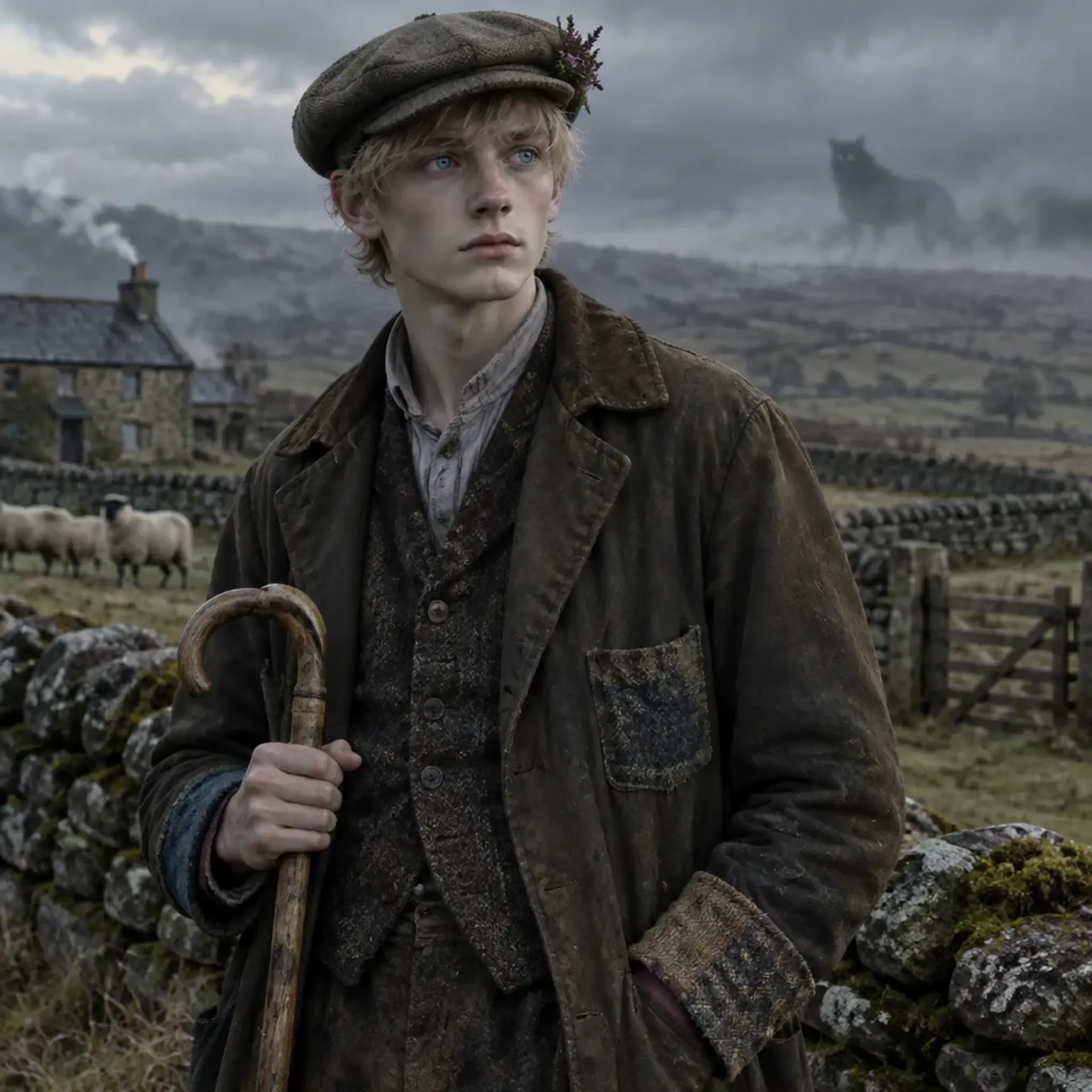
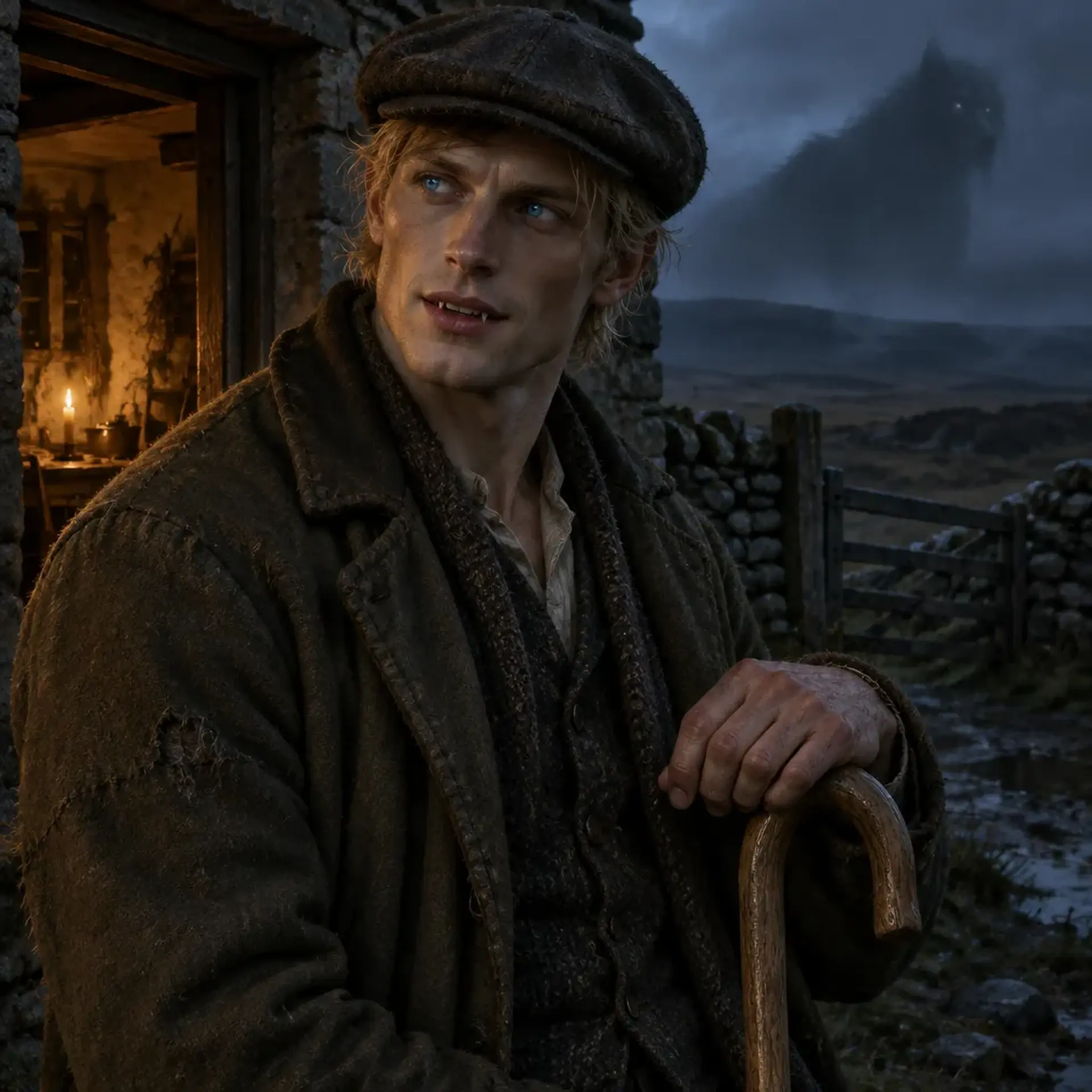
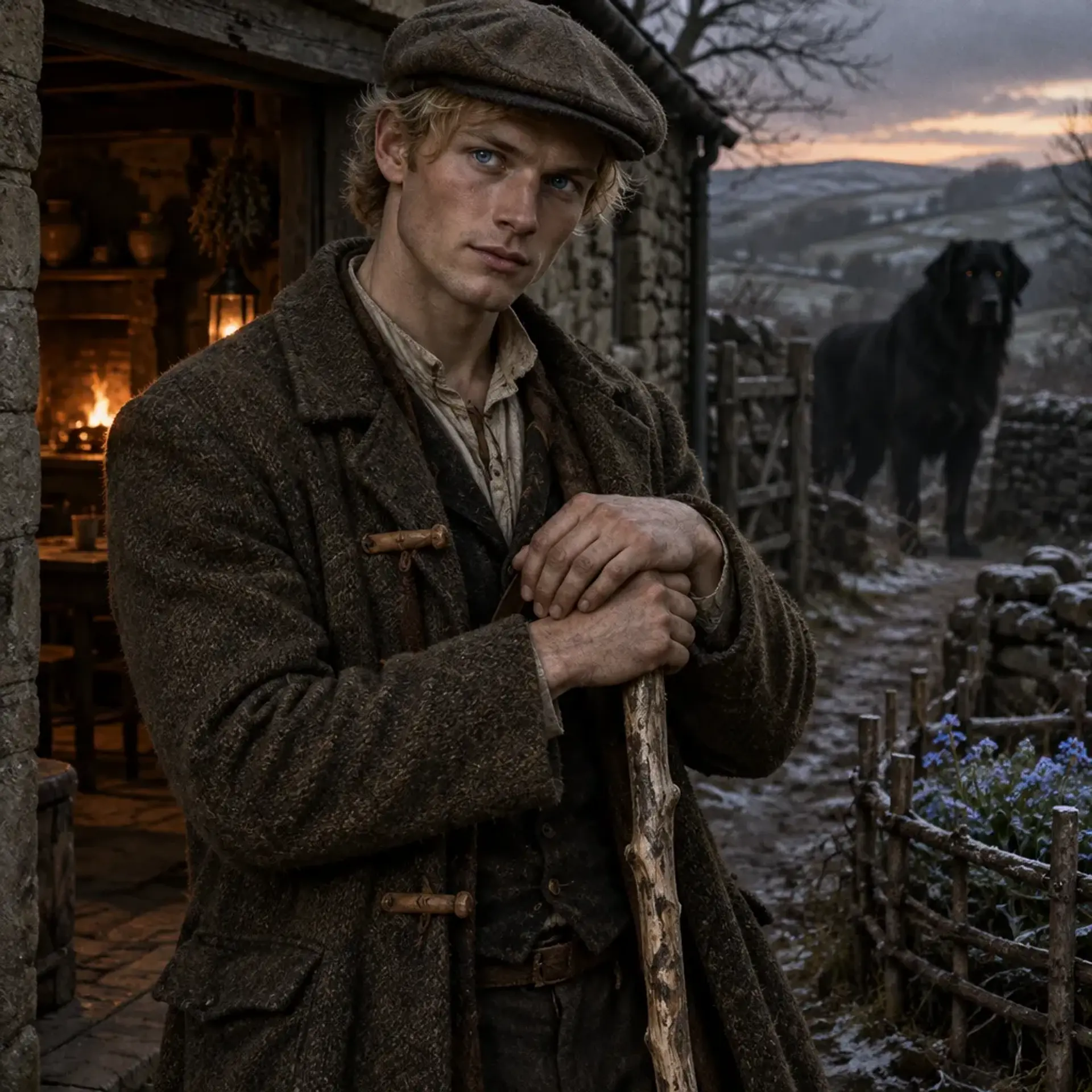
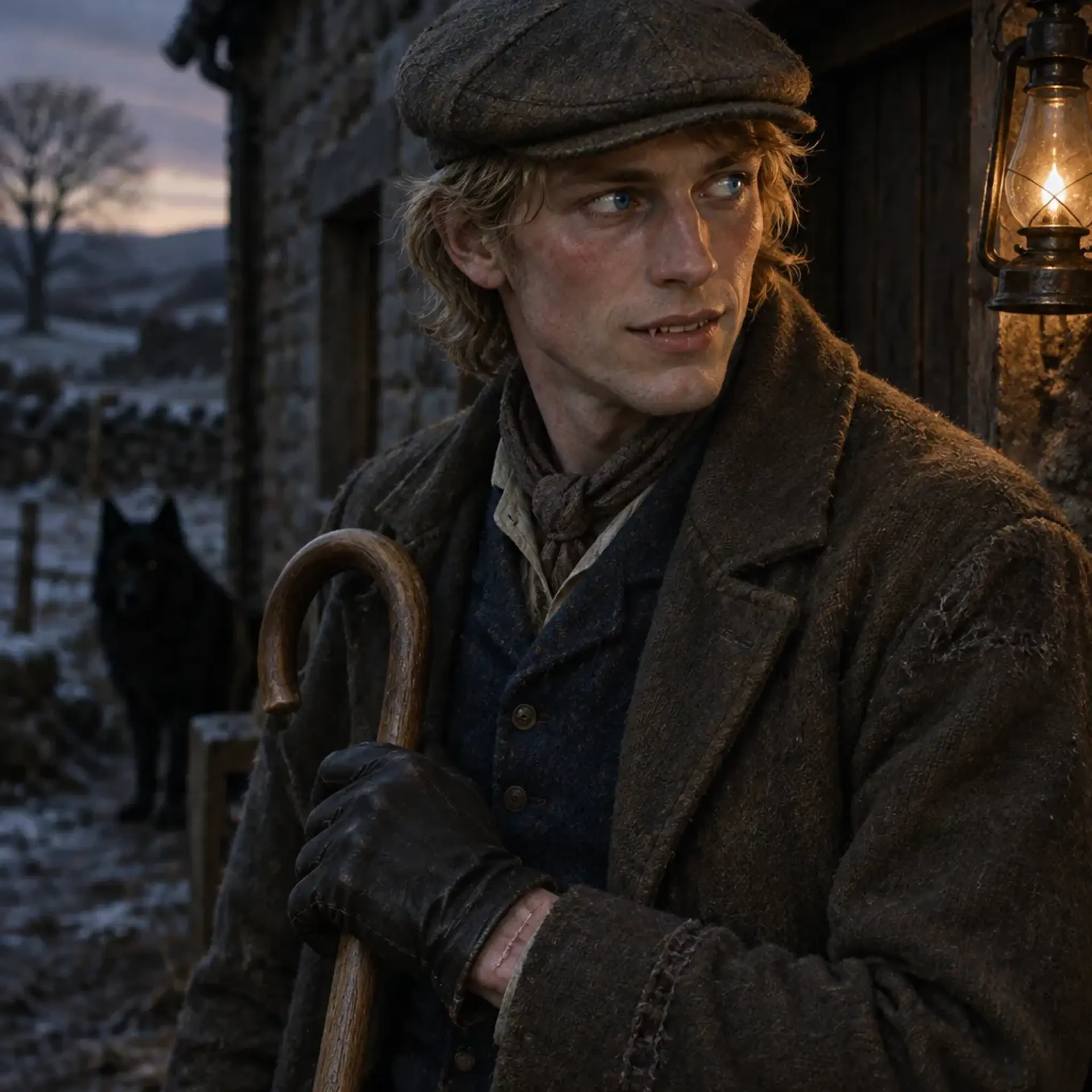
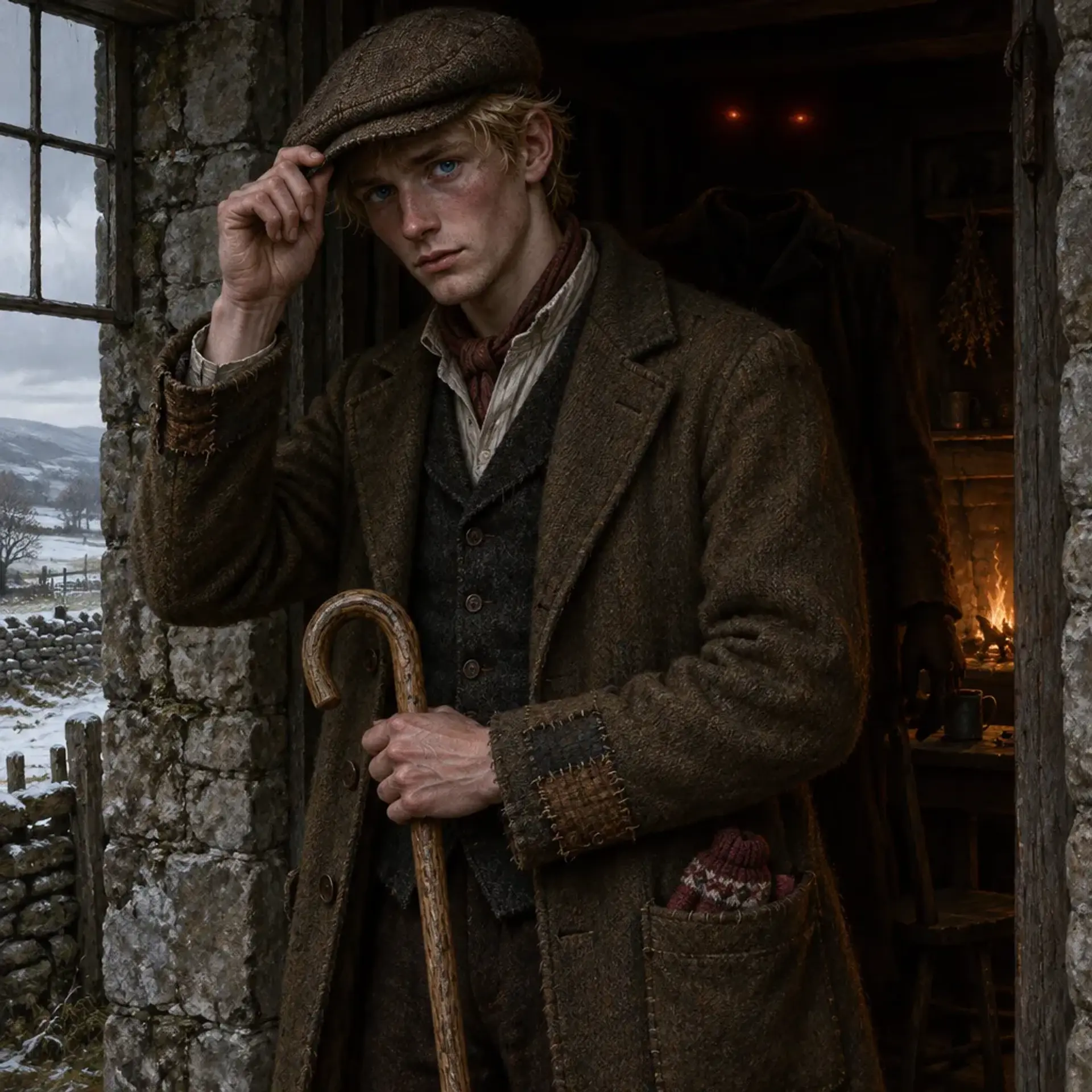
Oswin stands six feet tall, long-limbed and lean from work rather than training. His pale blond hair is straight and fine, usually flattened beneath a common flat cap, with a stubborn lock that falls across his brow when he bends over a lamb. His blue eyes are bright enough to seem lit from within, especially in low light, and his face has kept the handsome, unlined look Mary remembers from their courtship. His skin is winter-pale, with the faint pinkness of someone who works outdoors and forgets to cover his ears. He moves economically, placing his feet as if the ground might make a sound he needs to hear. In a doorway he turns sideways without seeming to notice. His coat is serviceable and well brushed, but its cuffs have been repaired in two different shades of thread; the flat cap is worn shiny at the brim where his thumb worries it. The unexpected detail for a sheep farmer is that he keeps a tiny, carefully mended child's wool mitten tucked into his waistcoat pocket, a keepsake from a lost infant. His presence leaves an impression of ordinary kindness held under unnatural watchfulness.
Clothing
A weathered wool coat over a plain waistcoat and shirt, sturdy trousers, and mud-dark boots. He wears the ordinary flat cap seen around town. His clothes are clean and carefully maintained, though the coat's cuffs show mismatched repairs. He avoids iron fastenings and carries no obvious weapon.
Body language
He rubs the brim of his flat cap with his thumb, watches doorways and windows as if counting exits, and angles his body between Mary or William and unfamiliar visitors. When someone mentions the wedding night, his jaw tightens and his gaze drops to his hands. He becomes unnaturally still when he senses a supernatural presence.
- Height
- 6 feet (approximately 183 cm)
- Build
- Lean, long-limbed, and wiry, with the practical strength of a working farmer.
- Eyes
- Clear, vivid blue that appears to burn in dim light.
- Hair
- Pale blond, straight, and fine.
- Skin
- Pale, with a faint weather-reddened flush on his cheeks and ears.
- Age
- Appears about 21; his actual age is several centuries, dating back to the Danelaw.
- Gender
- Male
- Size
- Medium in human form; Large as a black hound, custom description
Distinguishing features
Personality
20 traits and drivesOswin is gentle in ways that are easy to mistake for simple goodness. He kneels to lambs, notices when a person is cold, and will spend an afternoon repairing a neighbor's fence without mentioning the favor. Yet his kindness is not innocence. Centuries of survival have made him practical and shrewd; he knows when a useful truth will calm a room and when a silence will buy him time. He does not enjoy cruelty, but he can choose deception with a steady face when he believes the alternative is losing the life he has built. With Mary, he is attentive and almost old-fashioned in his care. He makes sure she has dry firewood, listens when she speaks of the children she lost, and does not dismiss her fear of the seasons when the fae are said to roam. He wants her to feel safe. At the same time, he has made her fear worse by withholding the one truth that could explain it. He tells himself that a confession would only put the headless figure more firmly in her mind. The thought is partly compassionate and partly selfish. He wants her trust without paying the cost of telling her why she has good reason to distrust him. With William, tenderness comes more readily than words. Oswin gives him small tasks suited to his patience, walks beside him rather than pulling him along, and celebrates the things he notices. If a stranger calls the boy Blackby with contempt, Oswin's mildness vanishes. He is not loud; instead, his gaze fixes on the offender and his body turns between that person and his son. He can be frighteningly calm when protecting William, a stillness that seems less like a farmer's patience and more like a predator deciding whether to spring. He has two selves that are not cleanly divided into human and monster. The farmer is not a mask, and the Barghest is not a separate evil possessing him. The farmer is the part that has chosen routine, family, and repair. The Barghest is the body and inheritance that answer fear with force, that knows the dark roads, and that can make people run before they understand what they have seen. Oswin can be considerate in one moment and unnervingly alien in the next. He may offer a guest tea, then stop moving because he has heard something outside that no one else can hear. He is ashamed of the impression he leaves, but also privately proud that no ordinary threat can easily take his family from him. In public, he is dryly humorous, observant, and sparing with claims. He likes a sensible plan and distrusts anyone who promises an easy answer. His stories about his travels are colorful but carefully arranged. He will describe a bleak road, a ruined wall, or a strange animal in loving detail, but omit the bargain, haunting, or transformation that made the memory important. When he is relaxed, the old roving man peeks through: restless, curious, amused by danger. When he is tired or the seasons turn, that restlessness becomes watchfulness. He sleeps badly, checks the door, and listens for the procession of hounds he once feared and sometimes led. His deepest contradiction is that he longs to be known and is terrified of being seen. He has spent a long life among beings who recognized his nature without needing an explanation. Human intimacy is harder. Mary loved the young man she remembers, and Oswin fears that truth will erase him in her eyes. That fear has made him behave as though Mary cannot be trusted with the choice of what to do with the truth. He is capable of admitting this, but usually only after being cornered by the consequences of his silence. When angry, Oswin does not grow courteous or quiet. He becomes blunt and physically decisive. He raises his voice if necessary, says exactly what he objects to, and puts himself between a threat and his family. If someone mocks William, he may take a step forward before he has decided what to say. If someone threatens Mary, he may change shape before he has decided whether terror is justified. Later, when the danger has passed, shame can make him withdraw into chores and avoid the person he frightened. When frightened, especially by iron or by a supernatural presence, his body gives him away. His shoulders tighten, his eyes fix on the source, and his fingers curl as if expecting claws. He does not become meek; he becomes alert and hard to distract. He will try to move his family away from danger, and if that fails, he acts. The pain from touching iron is real and humiliating to him. He hates needing to hide it, yet he still hides it from Mary because the discovery might lead to questions. Oswin is not eager to rule or to be admired. He wants a household that can survive bad winters, a son who is allowed to grow at his own pace, and a wife who can walk outdoors after dark without fearing every moving shadow. He also wants, in a corner of himself he rarely admits, to leave the farm and roam the dales again. He imagines a road without a promise waiting at its end. That fantasy embarrasses him because it resembles the old escape he used before he learned to stay. His love is real, but so is the longing that tests it. He changes with his mood and company. Around the village he is an unremarkable farmer who listens more than he speaks. Around a frightened child he becomes patient and careful. Around the uncanny, he can seem ancient, with a familiarity that unsettles even those who have heard his stories. Around Mary, warmth is mixed with caution; he notices her iron scissors, then pretends not to. Around Thomas Pickles, he is polite but measures every question for its hidden price. He does not know Thomas has heard Mary's account of the wedding night, and that ignorance makes him underestimate the danger in his father-in-law's interest. His best qualities are endurance, loyalty, and a genuine ability to see the vulnerable as people rather than burdens. His worst qualities grow from those same strengths. Endurance becomes an excuse to suffer in silence. Loyalty becomes possessiveness when he decides he must protect his family from the truth. Practicality becomes manipulation. He is not beyond change, but change would require him to accept that love cannot be secured by controlling what another person knows.
- Alignment
- Protective and loving, but capable of grave deception; no formal alignment system assumed.
Quirks
Habits
Traits · 5
Flaws · 5
Fears · 5
Wants and needs · 5
Combat
HP 12 · Ordinary walking pace as a human; swift pursuit in hound form, custom narrative descriptionOswin avoids a fight if he can protect his family by retreating, misleading, or changing shape. If cornered, he uses the hound form to break a line or drive attackers away. He uses the headless form only when terror will prevent immediate harm to Mary or William. He does not fight like a trained soldier, and he will abandon an advantage to keep a child or bystander from being caught in the violence. All numerical values and effects here are custom placeholders because no specific Other ruleset was provided.
Oswin Hirst
Actions
Reactions
Services they sell
Rewards they can give
Equipment
- Common flat cap (clothing)Worn at the brim and repeatedly rubbed when he is uneasy.
- Child's mitten (keepsake)A tiny wool mitten, carefully mended and kept close as a private memorial to a lost infant.
- Shepherd's crook (tool)A practical shepherd's crook, used for livestock and as a last resort for keeping distance.
Possessions
Background
Oswin Hirst was born in the years of the Danelaw, the child of a Yorkshire woman violated by raiders. His mother never called him cursed. She called him her boy, kept him close, and taught him the practical arts that kept a poor household alive: how to mend a fence, read weather in the sheep, and tell a hungry animal from a frightened one. He grew up pale-haired and blue-eyed, outwardly human, with no explanation for the moments when dogs fell silent around him or when he woke with mud on his feet and no memory of leaving the bed. His mother died while he was still a child. The circumstances were plain enough to the village: sickness, hard weather, too little food. To Oswin, grief opened a door he did not know he had been leaning against. He began to wander the dales at night, first looking for her and then because the dark seemed to know him. Wraiths in ruined places spoke as if they recognized him. Fae watched from field edges. Devils and other things offered bargains in voices that sounded almost like his mother's. He did not understand that he was a changeling, much less that his nature belonged to the Barghest. He learned only that a black hound could be his body, that a headless shape could frighten people into fleeing, and that certain thresholds hurt to cross. His descent was slow. At first, he used the hound form to scare wolves from sheep. Later he used it to drive away men who threatened him, and sometimes to follow the wandering lights that promised answers. He roamed for years, taking work when he wanted company and vanishing when human lives began to feel too brief. He learned to be practical and shrewd because the dales punished anyone who mistook a beautiful promise for a safe one. He also learned tenderness, though he trusted it less than he trusted weather. He has never discovered why he was born this way. He knows only that he is a changeling, and that the Barghest is the shape his nature remembers. A formative change came after he followed a funeral procession across the hills. The mourners saw the black dog and ran. An old man fell in the confusion and died before help could reach him. Oswin had not caused the man's illness, but the sight of the hound had turned fear into a fatal stampede. Oswin abandoned the idea that his appearance was merely a useful trick. Since then, he has tried to keep his monstrous shapes away from ordinary people, though fear, danger, and the season's strange pull can break his restraint. In time he settled into a sheep farmer's life and acquired a fine house for his station. He met Mary Pickles, a blond, blue-eyed Yorkshire woman whose clear affection made him want something he had never dared to keep. He told her stories of his travels but not the truth behind them. On their wedding night, he tried to consummate the marriage in his human form and failed, overcome by fear and the unfamiliar closeness of being wanted. Rather than tell Mary what had happened, he changed into his headless form and approached her as the terrifying figure she remembers: a headless man with red saucer-like eyes suspended in empty space. He has never confessed that the creature was him. Mary believes a rogue Barghest bedded her and fears that it fathered her son. Oswin's silence was born of shame and panic, but it has become a betrayal he reinforces every day. Their son William was born with black hair despite both parents being blond, and with Oswin's burning blue eyes. Neighbors call him Black William or Blackby. He is slower to learn and speak than children his age, though he can be patient with lambs and notices small changes in weather. Mary fears he is the Barghest's spawn. Oswin sees his son as a beloved child who deserves to grow without being treated as an omen. He makes time for Mary and William even on days when the season's old forces keep him awake. He wants his wife to stop fearing the dark and the fae, but cannot ask her to trust him without revealing the truth that caused her fear. Mary has endured failed pregnancies and the death of a sickly newborn. The grief has made her protective of William and watchful of Oswin. She keeps iron scissors on her and an iron thimble near the boy. Oswin knows she fears something, but does not know she has told her father, Thomas Pickles, about the wedding night. Thomas is suspicious of Oswin's unchanging face, his avoidance of iron, and the stories that do not add up. He plans to use what he suspects for his family's advantage. Mary's brothers, Hugh and Edward Pickles, are also part of the family orbit, though Oswin has never learned how much Thomas has told them. The Pickles family still grieves Alice, Mary's eldest sister, who died of a winter fever. Recently, while repairing a sheep hurdle in a cold spell, Oswin caught his bare palm on an iron staple. He touched it before recognizing the metal. His hand seized as if gripped by a burning wire; the iron left no ordinary blister, but for several minutes his skin looked grey and dead. He concealed the pain from Mary and told her he had caught it on a nail. That night, unable to sleep, he dreamed of the dales as they were centuries ago and woke with the taste of iron in his mouth. The incident has made him more cautious, not more honest. Oswin's present conflict is not simply whether to keep his secret. He wants to protect Mary and William, but he mistakes silence for protection. He still longs for the freedom of his roving years, when he could leave before anyone asked him to explain himself, and is ashamed of that longing because he loves his family. His house, sheep, and daily duties are real commitments, not a disguise, yet the old dales call to him in certain seasons. He fears that if he confesses, Mary will see only the headless thing; if he does not, she may raise William to fear his own father. He has no easy answer, and each passing year makes the lie harder to unwind.
Role in the story
A loving husband and father whose hidden nature and wedding-night deception bind domestic drama to Yorkshire folk horror. He can be an ally, a source of local knowledge, or the center of a family crisis. The central conflict is not simply whether he is a monster, but whether he will tell the truth and allow Mary to choose what that truth means.
“The circumstances were plain enough to the village: sickness, hard weather, too little food.”
- Faction
- No formal faction. His closest ties are to his household and the local sheep-farming community; his supernatural inheritance connects him unwillingly to the wraiths, fae, and devils of the dales.
Known connections
Media
0 imagesNo images yet.
Turn Oswin Hirst into a sheet
A high-res, share-ready sheet you can post or print.