Oswin Hirst
Oswin Hirst
At the table
Voice
A clear, slightly rasped speaking voice with the dry catch of someone accustomed to cold air and night work. His breath sometimes carries a faint canine huff when he is tense. He speaks plainly and does not raise his voice to dominate a room; when angered, he becomes clipped and intensely direct rather than soft or theatrically loud.
His speech is measured and locally grounded, shaped by farm work and long travel. He favors concrete words, short explanations, and dry humor. When telling a road story, he becomes vivid and quick, but carefully leaves out dates and names. Under strain his sentences shorten, and a rough, breath-catching rasp sometimes pushes through as though he has been running.
Speech patterns
How to play them
Approach him through practical concerns: livestock, weather, family safety, or a task that needs doing. He is courteous and helpful until questions turn toward his age, iron, or the night Mary fears. Do not press him with threats to William; that can bring the hound close. A sincere offer to help Mary or the child may persuade him to disclose one small truth, though he will resist a full confession.
Goal
Keep Mary and William safe, remain a present husband and father through the dangerous seasons, and discover whether his changeling nature can be understood without surrendering his family to it.
Motivation
Love, guilt, and the desperate hope that ordinary kindness can make a home stronger than the supernatural inheritance he carries.
Appearance
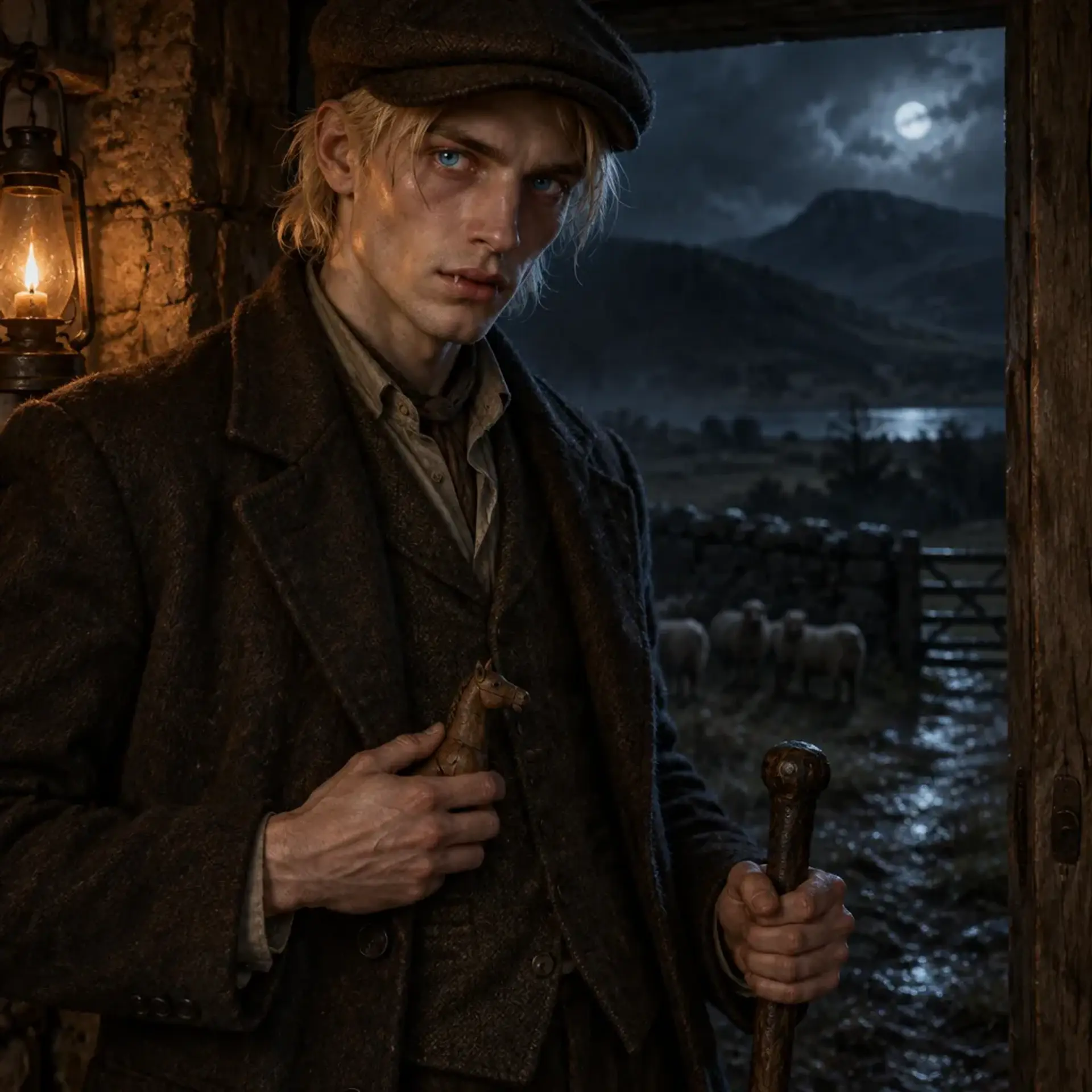
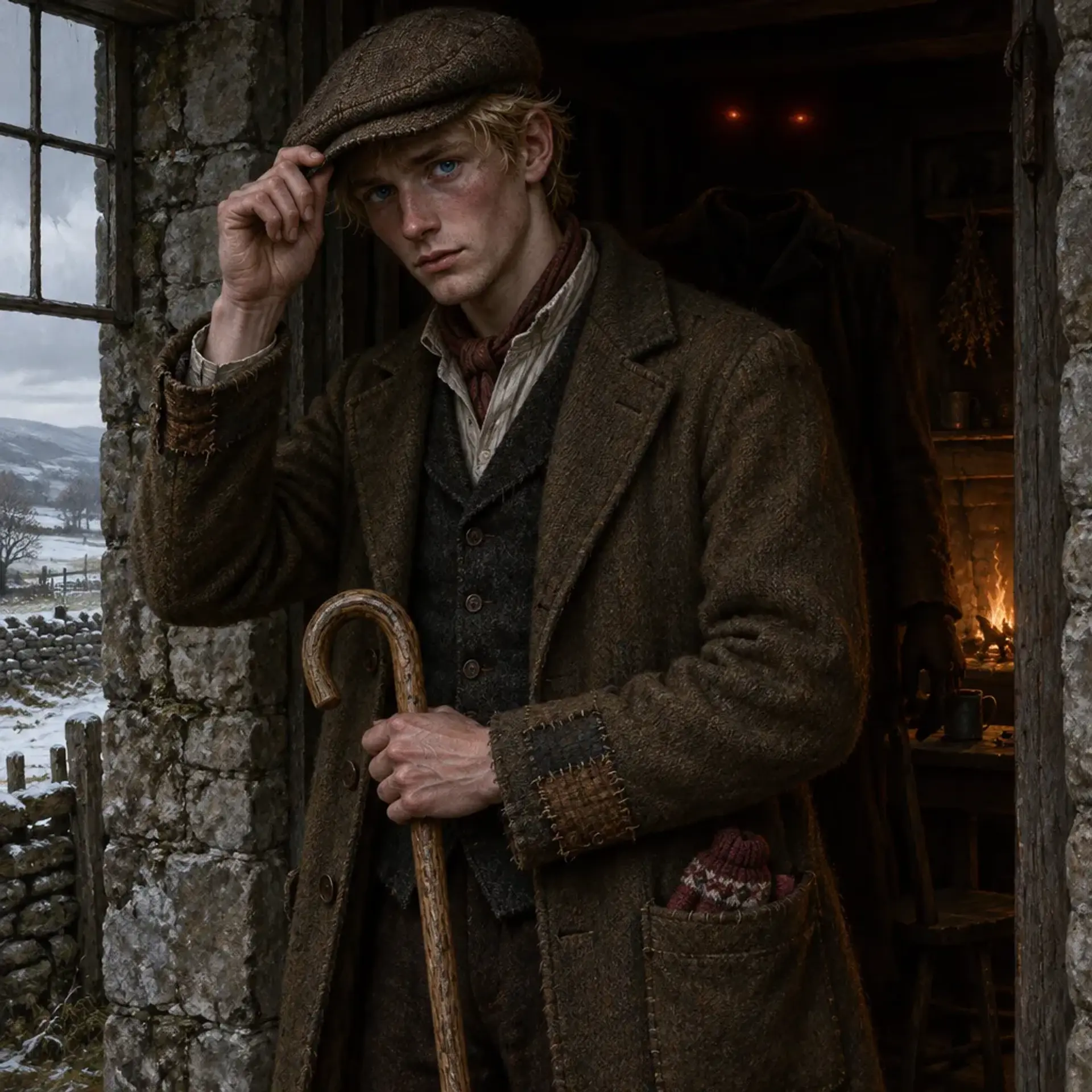
A tall, pale young man of six feet, with straight flax-blond hair that falls neatly beneath a common flat cap and bright, burning blue eyes. He looks so persistently seventeen that Mary remembers his face as unchanged from the day they met. His skin has the translucent pallor of someone who spends long nights awake and works outdoors only when he must; wind has roughened the bridge of his nose and reddened his ears. He smells faintly of lanolin, damp earth, and cold dog, a scent he tries to cover with soap and rosemary. His movements are economical and watchful, with a stillness that can turn abruptly into a loping, animal speed. He dresses as a respectable sheep farmer, but never lets his cuffs or boots brush the iron fittings around the house. The unexpected detail is that he keeps a tiny, carefully mended wooden toy lamb in his pocket and worries its ears between his fingers when nobody is looking.
Clothing
A well-kept wool coat, waistcoat, plain shirt, sturdy trousers, leather boots, and the flat cap common in the district. His clothes are respectable for his class without being showy. He favors wooden fastenings and avoids iron buckles where he can.
Body language
He plants himself between danger and his family without appearing to decide to do so. When uneasy, he stills his shoulders, angles his head as if scenting the air, and rubs his thumb over the seam of his cap. Around iron, he keeps his hands tucked in or uses cloth as a barrier. When the hound presses close, his jaw works and his gaze tracks movement too quickly.
- Height
- 6 ft (183 cm)
- Build
- Long-limbed and lean, with a farmer's functional strength rather than a soldier's bulk.
- Eyes
- Bright, burning blue, conspicuously like William's.
- Hair
- Straight, pale blond hair.
- Skin
- Very pale, with wind-reddened ears and nose and a faintly translucent look under lamplight.
- Age
- Appears about seventeen. His true age is measured in centuries, though he cannot give a reliable count and has concealed the truth for years.
- Gender
- Male
- Size
- Medium in human form; Large in black hound form, custom description
Distinguishing features
Personality
19 traits and drivesOswin is gentle in the way of someone who has learned how much force he could use. He notices a child's cold hands, a lame ewe, and a visitor's muddy boots before he notices that he himself is exhausted. He gives help without making a performance of generosity, then grows uncomfortable if thanked too warmly. Yet his tenderness is not simple softness. He is practical, shrewd, and capable of deciding that a person must be stopped before they can become a danger. He can speak calmly while arranging the room so that nobody can reach his family. He wants to be ordinary, but ordinary life has become both his refuge and his most difficult disguise. The farm gives his days a shape: feed, mend, count, tend. He values those repetitions because they keep his attention in the present. He also resents how easily the old roaming life returns in his mind. A moonlit road, a smell of wet leaves, or the sound of a dog behind a hedge can awaken the pleasure he once took in leaving without explanation. He is ashamed of that pleasure, especially when Mary is asleep beside him and William is safe in the next room. With Mary, Oswin is affectionate and observant, but his love has a controlling edge. He reads her moods quickly and tries to head off fear before she can speak it. If she asks why he will not touch an iron latch, he answers with a joke or a practical excuse. If she looks toward the dark, he offers a church teaching or a recent scientific idea about illness and imagination. He sincerely wants her to feel safer, yet he also wants her not to ask the questions that would make him feel exposed. He can be patient with her doubts so long as they remain doubts. When she presses, he becomes evasive, then coldly decisive, and afterward tries to repair the hurt with a useful act rather than an apology. With William, his manner is less guarded. He makes time for the boy even when the season has left him sleepless and restless. He tells simple stories, lets William help with small farm tasks, and learns the difference between the child's frightened cries and his tired ones. Oswin does not regard William as a curse or an omen. He sees a child who needs patience, safety, and affection. Still, William's fits terrify him because they expose how little control Oswin has over either of their bodies. The evening Oswin pinned the boy down in a hound-driven reflex changed the way he understands his own love. He now fears that devotion can become violence if he lets instinct make decisions. William's small touch and whispered 'Da, cold' continue to haunt him as both mercy and warning. Oswin is sociable in short, useful bursts. He can be an entertaining storyteller, especially when recounting roads and strange inns, but he edits his tales with the precision of a witness hiding evidence. His humor is dry and sometimes unexpectedly boyish. He enjoys riddles and practical jokes that do not humiliate anyone. He dislikes boastfulness, though he understands that a boast can be a shield. He is slow to trust a stranger who asks about his age or family before offering their own history, and he has a habit of judging people by what they do when an animal is frightened. His patience has limits. Threats to Mary or William make him frighteningly focused. He does not roar or make grand declarations; he simply stops negotiating and begins removing obstacles. In this state, he can treat a threat as a problem to be solved rather than a person to be persuaded. That capacity is part of what he fears about himself. He can be merciful to an enemy who retreats, but he may pursue someone who continues toward his family long after a reasonable person would stop. The changing seasons pull against his wish for domestic steadiness. As the nights grow dimmer and colder, he becomes watchful and fragmented. He checks the sheep twice, listens at windows, and loses track of whether he has eaten. He tries to make these habits useful so Mary will not recognize them as fear. In the deep hours of night, especially after midnight, he is most vulnerable to the sense that another shape is waiting just behind his skin. He may sit outside rather than risk waking his family with the sound of his breathing. If asked, he says the flock is unsettled. The Maypole days bring a sharper, almost angry dread. The ropes and circles, the dancers winding around one another, and the cheerful noise all feel like a trap whose purpose he once knew but has forgotten. He keeps away from the green and makes excuses to stay close to William. He hates that the festivities are harmless to everyone else. All Saints' Day is more solemn and more frightening. He expects the dead to appear in the paths, and the thought of being recognized by them makes him feel like a child again. He will attend church in daylight, then avoid the churchyard after dusk. He does not tell Mary that the day is difficult because the dead might know his name. Oswin's faith is complicated. He has learned enough Christian doctrine to use it sincerely and enough new science to find relief in explanations of illness, memory, and fear. He is not mocking either. He hopes that Mary can understand the world without having to fear fae or devils. But he also knows that his own existence contradicts the comforting categories he offers her. When he is alone, he wonders whether prayer is a conversation, a habit, or merely another way to keep himself from listening for the dead. He is not proud of his age. He has outlived people whose names he once knew, and the long accumulation of departures has made him careful about promises. He can still dream of the dales as they were when he was a boy, though he cannot always separate memory from stories told by the dead. He misses the freedom of the road and knows that the road was often an excuse to abandon people before they could see him change not at all. That knowledge makes him stay, even when staying hurts. Above all, Oswin wants to be chosen as a husband and father while fully known. He cannot yet bring himself to offer Mary that choice. He tells himself he is protecting her from fear, protecting William from Thomas, protecting the household from the church, or waiting for a safer season. Beneath all those reasons is a smaller and more human one: he is afraid that if Mary sees the hound, she will be right to fear him. His kindness is real, his love is real, and so is the danger he conceals. He lives between those truths, hoping daily acts of care can keep them from tearing his family apart.
- Alignment
- Protective and compassionate in private, ruthlessly pragmatic when he believes his family is threatened. Alignment is descriptive, not a system statistic.
Quirks
Habits
Traits · 5
Flaws · 5
Fears · 5
Wants and needs · 4
Combat
HP 12 · Human: ordinary walking pace, custom. Hound: fast pursuit, custom; exact distances are determined by the GM.Oswin would rather frighten opponents away than kill them. He uses cover, farm tools, and knowledge of the ground, protecting escape routes for Mary and William. If cornered, he shifts into the Barghest and attacks the most immediate threat, but avoids transforming where his family can see him. He will not cross flowing water in hound form.
Oswin Hirst
Actions
Services they sell
Rewards they can give
Equipment
- Billhook (tool)A working billhook used for hedges and, if forced, defense.
- Flat cap (clothing)A common flat cap that helps him appear unremarkable and gives him something to touch when uneasy.
- Wooden lamb (keepsake)A small mended toy lamb carried as a private comfort and reminder of his son.
- Work gloves (protection)A pair of thick work gloves used to avoid accidental contact with iron fittings and tools.
Possessions
Background
Oswin Hirst was born in the Yorkshire dales during the time of the Danelaw, when his mother, a local woman whose name he no longer remembers with certainty, was taken by Viking raiders. He grew up with no clear account of his father and no explanation for the unnatural cold that sometimes followed him indoors. His mother died while he was still a child. After her burial, the adults who had tolerated him began treating him as a burden, and he learned to sleep in barns, abandoned folds, and the lee of dry-stone walls. He was not then aware that he was a changeling, much less that his nature belonged to the Barghest. He only knew that dogs watched him without barking, that iron made his skin feel as if it had been scalded, and that his reflection sometimes seemed to lag behind. At first, the strange world around the dales appeared to him as fragments. A voice behind a standing stone. A procession of dead folk seen through rain. A black hound at the edge of a funeral, which he thought was another creature until he recognized his own paws in its tracks. He began to follow these sights, first out of loneliness and then because they offered answers. They did not. Wraiths spoke in borrowed voices; fae offered bargains whose terms shifted after he agreed; devils praised his cleverness while teaching him to distrust every kindness. His descent was not a single corruption but a habit of choosing the night road because it was less lonely than the human one. He became a rover, sleeping wherever he could and taking work as a guide, drover, messenger, and occasional bodyguard. He collected stories and practical skills, and learned to look harmless while measuring exits. The first time he transformed fully, he was trying to escape a winter pursuit. He ran on four legs without deciding to, black fur swallowing the moonlight, and heard his own chains rattling though he wore none. He reached a stream and stopped, unable to cross. The pursuers did not follow over the water. He hid until dawn and returned to human shape with no memory of how to do so. The villagers called the creature a Barghest. Oswin did not understand that the name described him. Even now he knows only that he is a changeling of the Barghest kind, not why it happened or what, if anything, his mother's ordeal had to do with it. Over the centuries he returned to human settlements in different guises and at different times, never staying long enough to be questioned about the unchanging face. Eventually he settled into sheep farming and built a fine house for a man of his modest station. He chose work that made practical use of his patience and knowledge of land. He married Mary Pickles, whose warmth and directness drew him toward a life he had long assumed was closed to him. He gave her stories of his roving years, but made them sound like ordinary journeys and never explained why those adventures seemed to span too many generations. Mary remembers that handsome youthful face and has watched it remain unchanged. Their son William was born with black hair despite both parents being blond, and with his father's vivid blue eyes. The neighbors call him Black William or Blackby. He is slow to speak and learn, cries readily, suffers fits, and sometimes stares past the people trying to reach him. Oswin loves him without reservation, but the boy's unusual traits have made Mary afraid. She believes William may be the spawn of the devil or the Barghest, and keeps iron scissors close and an iron thimble near the child. Oswin does not know that Mary has told her father, Thomas Pickles, about the night that first convinced her. Thomas is suspicious of Oswin and sees a means of advantage in discovering the truth. He plans to use whatever he learns for his family, though Oswin has not yet determined whether this means protection, money, or leverage. Mary's brothers Hugh and Edward remain part of the family's orbit. The Pickles family still grieves Alice, Mary's eldest sister, who died of a winter fever after Thomas had already lost much of his certainty about the world. The memory has made Thomas protective in a way that can turn possessive. Mary's pregnancies have often failed, and one small, sickly child died soon after birth. Oswin cannot produce a living, healthy heir with any certainty, though he does not know whether this is a curse, an aspect of his changeling nature, or simply the cruelties of ordinary life. He has not told Mary how many times he has watched families grow old around him. The seasons are becoming harder. As nights grow dimmer and colder, Oswin sleeps in scraps, checks the flock repeatedly, and takes long walks that end at running water. Certain hours after midnight seem to draw the hound close to the surface; he keeps himself busy mending fences or sitting outside William's room until the impulse passes. Maypole festivities make his blood rise with an irrational dread of ribbons, circles, and dancing feet. He stays near home, avoids the green, and counts the children until the music stops. All Saints' Day is worse. He expects the dead to walk in procession and fears being recognized by them. He makes excuses to Mary, then spends the night watching the road and the churchyard. Recently, while catching a panicked ewe in a narrow shed, Oswin grabbed an iron latch. Pain flashed through his hand and up his arm. His fingers locked; his breath came out as a dog's choking snarl, and for an instant his shadow had a long muzzle. He dropped the latch, leaving a blistered red mark across his palm. He hid the injury beneath a work glove and told Mary the sheep had kicked him. The incident frightened him because it happened in daylight, with no season or spirit to blame. The most shameful moment came when William had a fit during a dim autumn evening. Oswin saw the boy's body go rigid, heard a strangled cry, and felt the hound surge forward to protect what it understood as its own. He seized William too hard, pinning the boy's shoulders and baring his teeth before he recognized the fear in the child's face. William did not fight him. He reached up, touched Oswin's cheek, and whispered, 'Da, cold.' That small trust stopped Oswin more effectively than iron. He released him and held him gently until the fit passed. William later clung to him, but flinched whenever Oswin's shadow moved like a dog. Oswin has never told Mary what his hands did. He now makes a point of spending time with both wife and son even on days when the season makes him want to flee. He wants Mary to stop fearing the dark and the fae, and leans on church teaching and the emerging practical sciences as explanations, though he knows he is using them as shelter from the truth. His present crisis is not simply whether the family will uncover his nature. It is whether the life he has built can survive the truth without making William afraid of his own father.
Role in the story
A loving husband and father whose concealed supernatural nature makes him both protector and potential danger. He can be an ally, a source of local lore, or the center of a family tragedy if his secret is exposed carelessly.
“He grew up with no clear account of his father and no explanation for the unnatural cold that sometimes followed him indoors.”
- Faction
- No formal faction. He belongs to the rural household and parish community he has chosen, while remaining entangled with the supernatural world of the dales.
Known connections
Media
0 imagesNo images yet.
Turn Oswin Hirst into a sheet
A high-res, share-ready sheet you can post or print.