Oswin Hirst
Oswin Hirst
At the table
Voice
Oswin's voice has a dry, lightly rough edge from cold air, sheep pens, and years of speaking across open ground. He does not project like a preacher; he places words carefully, making people lean in because he has something useful to say. His consonants are firm and his vowels carry local Yorkshire turns, though older, less familiar phrasing slips through when he is exhausted. His laughter is warm but can catch on the sharpness of his teeth. In fear, his voice becomes brisk and plainly commanding, not softer.
His speech is shaped by farm work and a long history of listening before he commits himself. He uses plain Yorkshire phrasing, practical examples, and short questions that make people explain what they actually saw. He has the habit of giving a useful answer before the comforting one. When tired, traces of older turns of phrase surface, then he covers them with a joke. When the Barghest nature presses close, his words become clipped and concrete, as though he is giving instructions to someone in immediate danger.
Speech patterns
How to play them
Begin with calm hospitality and useful practical help. Give Oswin a reason to trust the visitors, especially if they can help William or offer a plausible account of a strange event. He will not threaten a guest while Mary is present. If asked directly about the Barghest, he evades once, then becomes still and asks what the questioner has seen. If the visitors threaten his family, his careful courtesy gives way to a frighteningly direct warning.
Goal
Keep Mary and William safe without abandoning the family life he built, and find a way to explain William's nature before fear and Thomas's suspicions tear the household apart.
Motivation
Love of Mary and William, shame over the lies that protect that love, and a stubborn desire to prove that a creature born into old terror can still choose ordinary kindness.
Appearance
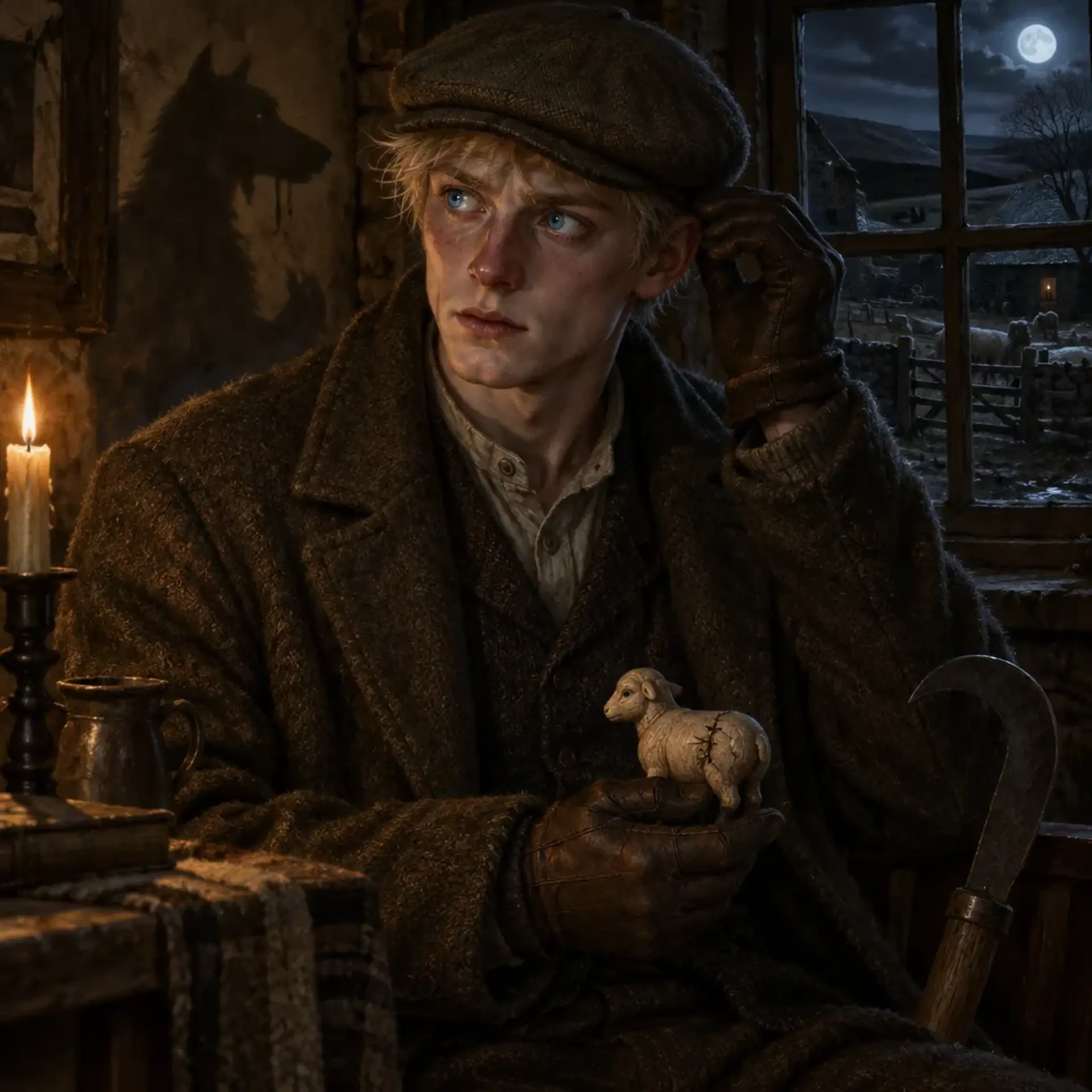
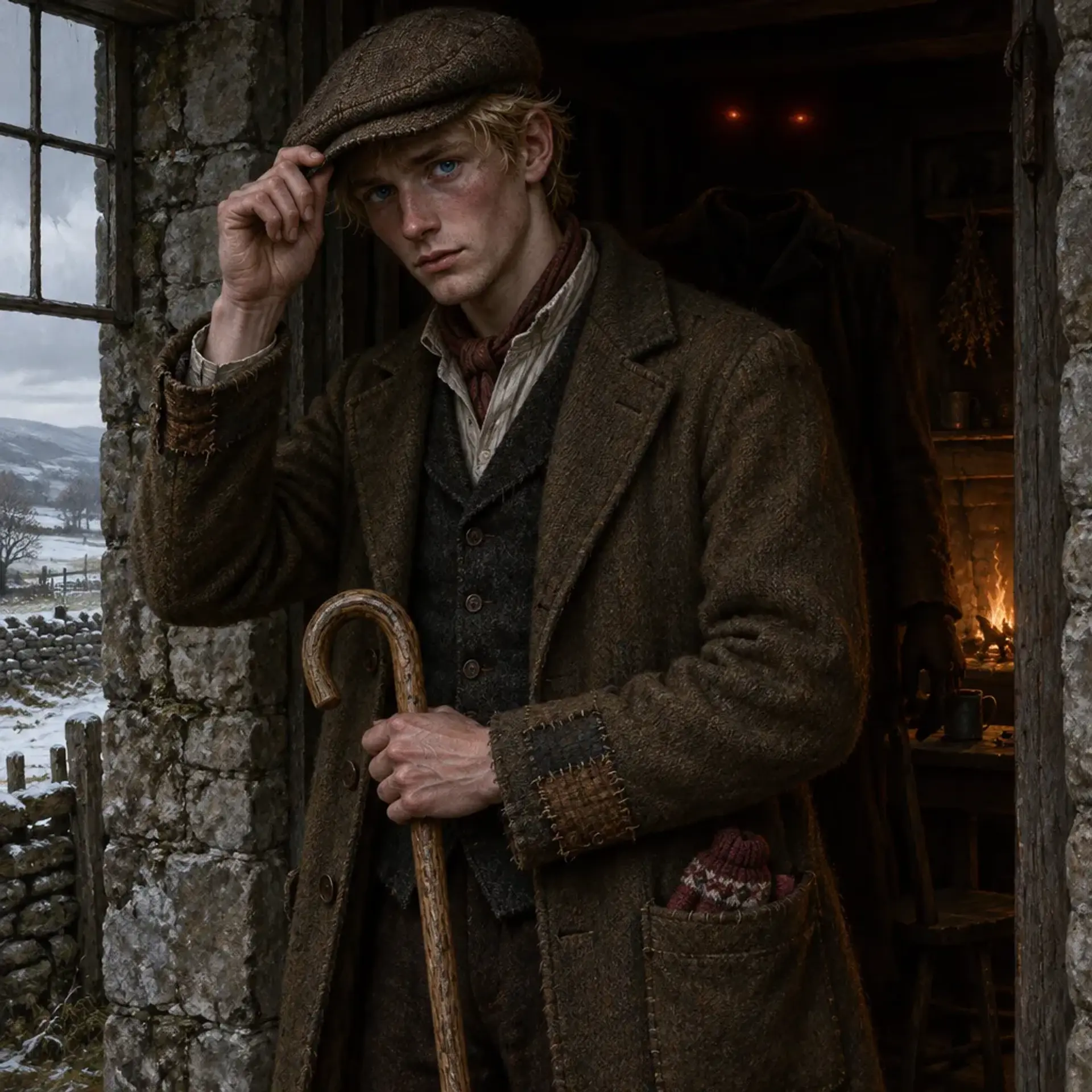
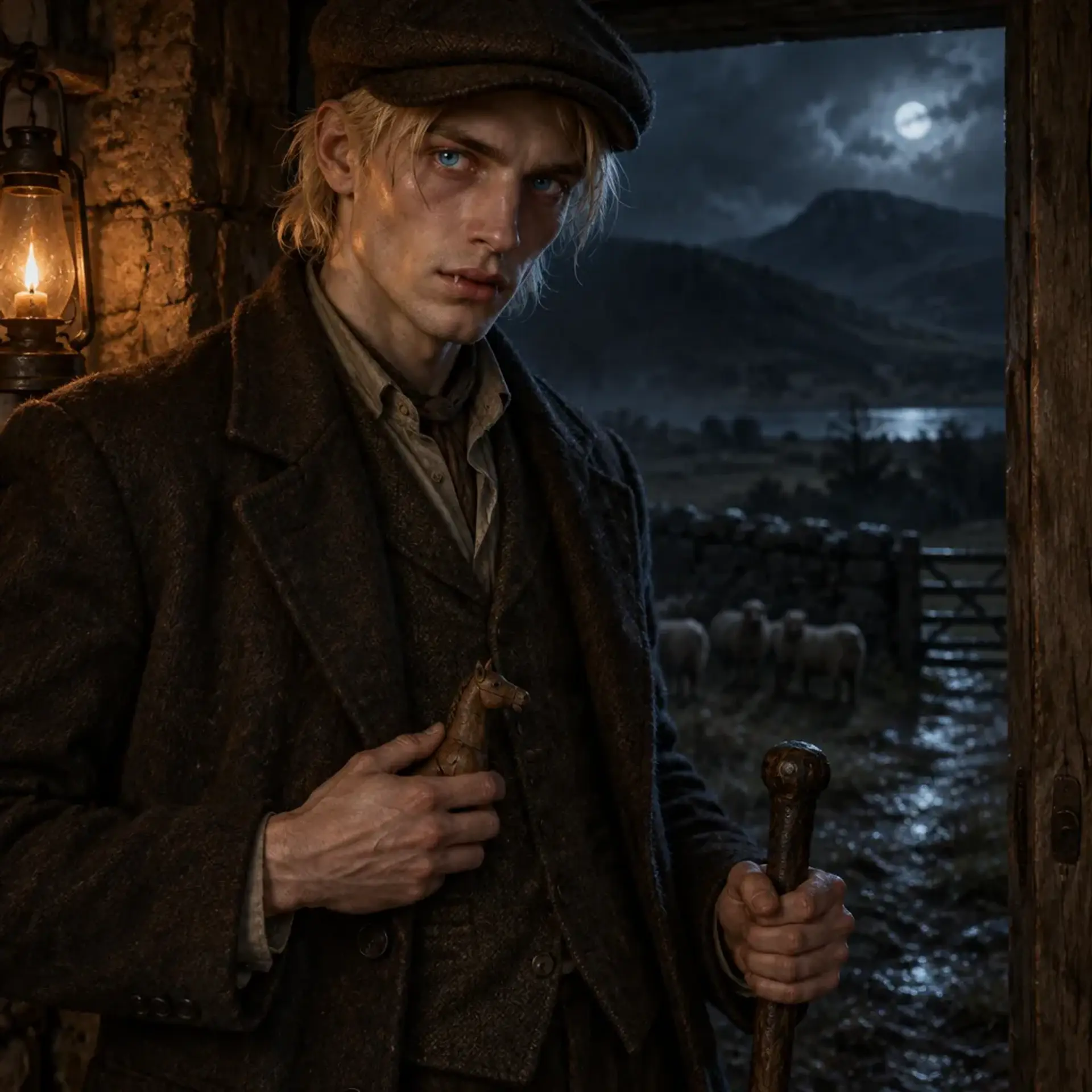
Oswin stands exactly six feet tall, with the narrow, long-limbed look of a young man who has spent more time walking rough upland paths than sitting at table. His pale blond hair is straight and fine, usually tucked under a common flat cap; in damp weather it lies in separated, almost glassy strands against his temples. His eyes are a startling, hot blue, too bright in lamplight and so like William's that Mary cannot look at them for long when the boy is ill. His skin is pale, with the faint, weathered pink of a man who works outdoors, though it never seems to acquire the lasting marks of age. He walks with a measured, forward-leaning gait, placing his feet as if the ground might be listening. When he is tired, he goes unnervingly still, jaw working once before he answers. His teeth are straight but slightly too sharp at the canines, noticeable when he eats meat or laughs without remembering to hide them. He is handsome in the youthful, familiar way Mary remembers, which is more disturbing each year he does not change. The unexpected detail is that he carries a tiny, carefully mended child's wooden horse in his waistcoat pocket, rubbing its worn ears with his thumb whenever he thinks no one is watching.
Clothing
A practical flat cap, a well-kept wool coat, waistcoat, plain shirt, breeches, and boots suited to wet pasture. He dresses respectably for a prosperous sheep farmer, but keeps his sleeves and pockets arranged to avoid accidental contact with iron.
Body language
He angles his body toward doors and open ground, but makes a conscious effort to turn fully toward Mary and William when they speak. His fingers often rub the edge of his flat cap or the worn wooden horse in his pocket. When iron is nearby, his shoulders draw tight and his jaw works. When his temper is rising, he stops moving rather than pacing.
- Height
- 6 feet
- Build
- Lean, long-limbed, and work-hardened without looking fully grown into his frame.
- Eyes
- Clear, burning blue
- Hair
- Pale blond, straight
- Skin
- Pale, weather-pinked by outdoor work, without the usual signs of age
- Age
- Appears about seventeen. His true age spans centuries, though he does not know the exact number and lies about it whenever he can.
- Gender
- Male
- Size
- Medium in human form; Large in hound form, as a custom description rather than a canonical Other size category.
Distinguishing features
Personality
20 traits and drivesOswin is gentle by deliberate choice, not because he is harmless. He learned early that the frightened boy in a strange place could survive by noticing what people needed and offering it before they had to ask. With sheep, children, and anyone sick or grieving, this becomes a patient tenderness: he kneels rather than towers, repeats instructions without scolding, and remembers small preferences. He is especially careful with William, whose delays and fits invite other people to treat him as a problem. Oswin makes time for his son even when work is waiting, though his attention sometimes has the intensity of a sentry rather than a father. That tenderness pulls against his old, predatory instincts. Oswin can read a room like an animal reads a field, weighing exits, scents, and the person most likely to bolt. When danger feels supernatural, his attention narrows. He may stop hearing ordinary explanations and act with frightening speed, convinced that a few seconds of hesitation could cost a life. The same man who will patiently coax a lamb from a ditch can seize a grown stranger by the coat and put them out of reach of his family without warning. He regrets these moments, but regret does not always prevent the next one. He is practical and shrewd, with a farmer's respect for weather, yield, and evidence that can be handled. He wants to use the church's teachings and the new sciences to reassure Mary that darkness need not be proof of fae or devils. He repeats what he has heard about observation, medicine, and natural causes, sometimes with a confidence he does not feel. Yet he cannot make his own experience fit neatly inside those explanations. He knows there are presences on the hills that have no good place in a sermon or a physician's book. His rational voice is sincere as a hope, and also a shield. Oswin is not a showy liar. He prefers a careful truth with one essential piece omitted. He can tell a convincing story about the places he has travelled, the work he has done, and the people he has met because much of it is true. Asked why he looks no older than a youth, he jokes, changes the subject, or claims a distant relative aged badly on his behalf. He does not enjoy deceiving Mary, but he has arranged his life around the belief that confession would be worse. That makes him both loving and patronizing: he wants her safe, yet denies her the knowledge with which she might make her own choices. His moods show most clearly in his movement. In a settled, ordinary day, he walks with a slight forward lean and keeps busy with useful tasks. When content, he lets himself laugh, though the sharpness of his canines sometimes makes the laugh look wrong. When embarrassed, he rubs the brim of his flat cap and gives a small, self-mocking answer. When afraid, he grows still. When angered, he does not become genteel or quiet; he speaks in clipped, practical commands, with the blunt urgency of a man trying to stop a gate from breaking under pressure. The dimming seasons make him difficult to live with. As the evenings grow colder, he checks doors and windows, watches the hills, and wakes at sounds Mary cannot hear. He dislikes being separated from the house after dark and will invent a reason to finish work before the light goes. During the Maypole days, the old customs make his blood feel too close to the surface. He is watchful around dancing, ribbons, and strangers who ask people to follow them out of sight. He can seem sour at a celebration he knows Mary wants to enjoy, then spend the next morning making amends by taking on her chores. All Saints' Day is worse. He remembers funerals where the dogs began howling before the mourners arrived, and he cannot bear to stand in a churchyard after dusk. He watches the windows, loses sleep, and sometimes speaks to the darkness as if a thing there has called his name. Oswin's love of his family is real, but so is his yearning for the years when he roamed. The open road offered a brutal kind of freedom: no one expected him to age, explain himself, or sleep in the same bed every night. He misses the long walks, the sudden friendships, and the feeling that the hills belonged to him. He would never willingly trade Mary and William for that freedom, but he fears that some part of him remains ready to leave. This contradiction embarrasses him. He responds by being present in small, repetitive ways: bringing in the firewood, mending a toy, sitting with William through a difficult hour, and asking Mary what she needs tomorrow. He is proud of his ability to endure. He rarely complains of pain, tiredness, or fear, because in his childhood such admissions brought little help. This pride makes him hard to comfort and reluctant to seek aid. He may accept a practical solution while refusing the emotional care attached to it. If offered a bed for the night, he asks whether the stable needs work. If told someone is frightened for him, he asks what has to be fixed before morning. His humor is dry and local, often directed at himself. He can tease Thomas Pickles without openly insulting him, and he likes to make William smile with small absurdities. But he is not always sure when a joke is welcome. In a room where Mary is afraid, humor becomes a tool for turning attention away from the thing she has noticed. If she catches the evasion, he can grow defensive, then ashamed, then abruptly helpful. His changes of mood are not theatrical; they are the efforts of someone trying to keep several incompatible selves from being seen at once. He treats faith with respect, though not uncomplicated belief. The church offers Mary language for hope and a community that can help the family. Oswin wants that comfort for her. He also knows that a doctrine about demons can make her more certain that her husband and child are damned. He therefore reaches for practical teaching: illness has causes, fear can be eased, and a shadow at a window is not proof of a monster. He rarely admits that he has seen things which make those reassurances hard to maintain. Oswin's deepest moral conflict is not whether he is a monster. He fears that he might be, but he also knows that calling himself one can become an excuse for surrender. He wants to be judged by what he chooses, not only by the face he wears when the old nature breaks through. His greatest tenderness and his greatest danger come from the same impulse: he will do anything to keep his family alive. If he can learn to include Mary and William in the decisions he makes for them, that devotion may become a foundation. If he cannot, his protection may become another kind of cage.
- Alignment
- Protective and compassionate, but capable of frighteningly inhuman violence when his family is threatened.
Quirks
Habits
Traits · 5
Flaws · 5
Fears · 5
Wants and needs · 5
Combat
HP 18 · Custom Other notation: ordinary walking pace in human form; swift running in hound form. Exact distances depend on the table's rules.Oswin tries to end a fight through warning, retreat, or intimidation. He uses farm tools only if cornered and prefers to put himself between danger and his family. If he loses control or believes a supernatural force is reaching for William, he may shift into the hound and become dangerously single-minded. A flowing stream is a real obstacle, and iron can interrupt his transformation. He does not fight like a trained soldier.
Oswin Hirst
Actions
Reactions
Services they sell
Rewards they can give
Equipment
- Flat cap (clothing)Worn flat cap, commonly seen in the district, which helps him look like a respectable local farmer.
- Walking stick (tool)A stout walking stick used on wet pasture and as a last-resort defensive tool.
- Mended wooden horse (personal keepsake)A small wooden horse with its ears rubbed smooth, kept close as a reminder of the child he wants to protect.
- Prayer book (personal item)A plain leather-bound prayer book. Oswin uses its familiar doctrine to comfort Mary, though it cannot explain what he is.
Possessions
Background
Oswin Hirst was born in the Dales in a time so far behind him that he has no reliable count of the years. His mother had been taken by Viking raiders, and Oswin was born after her return, into a world that had little language for what had happened to either of them. She gave him what protection she could and taught him the practical things that kept a child alive: how to read weather from the hills, how to keep close to a fire, and how to tell when an animal had gone quiet for a reason. She died while he was still young. Oswin remembers the cold in the room more clearly than her face. After her death, he was passed between people who thought of him as a burden, a servant, or a strange boy who did not seem to grow as he ought. He began sleeping out, first in barns and then in places where no sensible person chose to spend the night. The Dales were full of stories about wraiths, fae, devils, and the black hound. Oswin encountered things he could not explain and learned, by frightened trial and error, the local rules: do not answer a voice calling from a ditch after dark; do not follow a dog that leaves no prints; do not cross a stream when something behind you has no face. He did not know he was becoming a Barghest changeling. He only knew that sometimes a door opened when it should not, that dogs whined at him, and that iron made his bones feel full of winter. His change came gradually, without a ceremony or a single moment of understanding. As a boy he woke outside with mud under his nails and no memory of leaving his bed. Later, he found animal tracks around a sleeping place that began and ended with his own bare footprints. He learned to hide the evidence and to pass among people as a young man. His apparent youth became both shield and trap. A fresh name, a new parish, a different account of where he had come from could let him start again, but each new life cost him a little more of the ordinary human continuity he wanted. He roved for years, sometimes as a hired hand, sometimes as a guide, sometimes simply moving on before anyone noticed that the face they remembered had not changed. He saw the Barghest at funerals and heard the dogs gather to howl. He learned to fear the seasons rather than any one creature. When nights grew longer and colder, he slept badly and watched thresholds. At the Maypole days, when laughter and ribbons hid old bargains, his blood seemed to run too quickly. All Saints' Day brought the dead close in memory and made him hear phantom chains in the wet lanes. He could live among people, but never quite believe their calendar was safe. The most important change in his life came when he chose, for the first time, not to leave. He met Mary Pickles while passing through the district and found in her a kindness that did not require him to tell a grand story. He told her about his travels, carefully selected true things, and let her believe his youth was simply good fortune. He loved her, and he wanted the solid life she offered: a house better than a farm labourer's cottage, sheep to tend, neighbors who knew his name, and a family who would expect him to be home by supper. Their wedding night broke that hope open. The Barguest form came over him, or through him, and Mary saw a headless figure with red, saucer-like eyes where its head should have been. Oswin remembers terror, confusion, and the shame of knowing that what happened was not a wedding night she had freely understood. He has concealed the truth ever since, telling himself that silence protects her from fear. He knows this is also a way of protecting himself from her judgment. Mary loves the man she remembers, but she watches him when the nights turn dangerous and believes the creature she saw was the Barguest. Their son William, whom locals call Blackby or Black William, was born with black hair despite both parents' blondness and with his father's burning blue eyes. He is slow to speak and learn, cries easily, and sometimes looks through the people speaking to him as if listening to a far-off place. Mary fears that the boy is the devil's offspring, the spawn of the Barguest. Oswin sees a child who needs patience, warmth, and time. He takes hours from even a working day to sit with William, show him animals, and repeat small tasks without scolding. The affection is genuine, but Oswin fears that William's signs of fae and human blood may be the beginning of a life like his own. Oswin's most shameful recent failure came on a cold evening when William had a fit. The child's body stiffened, his eyes rolled toward the fire, and a strange sound came from his throat. Oswin smelled a presence in the room and changed before he could think. The hound's jaws closed around William's blanket and dragged him away from the hearth, claws scraping the floorboards. He meant to pull the boy from what he believed was a spirit reaching through the fire. William came out of the fit screaming and reached for Mary, not Oswin. Oswin changed back, holding the torn blanket, and saw his son recoil from him. Since then he makes himself sit at a distance during William's fits and waits for Mary to decide whether he may come closer. He has never told her how close his teeth came to the boy. Mary's father, Thomas Pickles, is suspicious of Oswin's age, his avoidance of iron, and the stories that do not match. Mary has told Thomas about the night, though Oswin does not know it. Thomas has begun to think that Oswin's secret can be used to secure something for his family. Mary's brothers, Hugh and Edward Pickles, are caught between their father's suspicions and their own wish to protect their sister. The Pickles family still grieves Alice, their oldest daughter, who died of a winter fever after Thomas had already lost too much of his confidence in ordinary explanations. Oswin's present crisis is a collision between the life he built and the nature he cannot explain. Mary has lost pregnancies, including a sickly infant who died soon after birth. Every failure makes her fear stronger and his guilt heavier. He tries to offer her Christian teaching and the new sciences as they develop, hoping that sermons, observation, and practical medicine can replace fear of fae and demons. He cannot make himself believe that reason alone will keep his family safe. He dreams often of the Dales as they were in his roaming years, not as a place he longs to return to, but as a place that remembers him without pretending he is ordinary. He wants to remain a husband and father. He also knows that if the Barghest is hunting his son, hiding the truth may be the most dangerous choice he can make.
Role in the story
A loving but deceptive husband and father whose Barghest nature is both a threat and a source of protection. Oswin can be an ally, a mystery, or a tragic antagonist if fear and secrecy drive him to violence. The central tension is whether he can trust his family with the truth before Thomas exploits it or William's nature draws the old powers close.
“Oswin remembers the cold in the room more clearly than her face.”
- Faction
- No formal faction. He belongs to his household and the ordinary working life of the local sheep-farming community, while remaining entangled with the old supernatural powers of the Dales.
Known connections
Media
0 imagesNo images yet.
Turn Oswin Hirst into a sheet
A high-res, share-ready sheet you can post or print.