Friedreich
Friedreich
At the table
Voice
A youthful, firmly articulated voice with a strong Prussian German accent, as if every consonant has been taught to stand at attention. When embodied, it seems to come from the borrowed throat, but the cadence remains Friedreich's: clipped openings, careful corrections, and a faint breath-catching quality when an old memory surfaces. His name, when he says it, comes out with hard, deliberate stops.
His German is precise and formal, shaped by a Prussian upbringing he cannot fully remember. In English he searches for the exact word before speaking and sometimes uses an old-fashioned construction. He speaks briskly when offering practical advice, such as judging a market price, but wartime questions make his phrasing fragment and double back. Anger makes him more direct and cutting, not quieter or more polite.
Speech patterns
How to play them
Treat him as a person rather than a disguise or occult specimen. Ask whether he is currently using a borrowed face, and do not assume that embodiment grants access to its owner's memories. Friendship and practical inclusion work better than pity. Wilhelm's wartime history is a pressure point; challenge Friedreich's assumptions without dismissing his anger.
Goal
Find a way to be recognized and build a routine of his own, perhaps through part-time work or a hobby group, without making another person's face his permanent identity.
Motivation
To recover a coherent sense of self while preserving the family he has found among beings who are themselves difficult to categorize.
Appearance
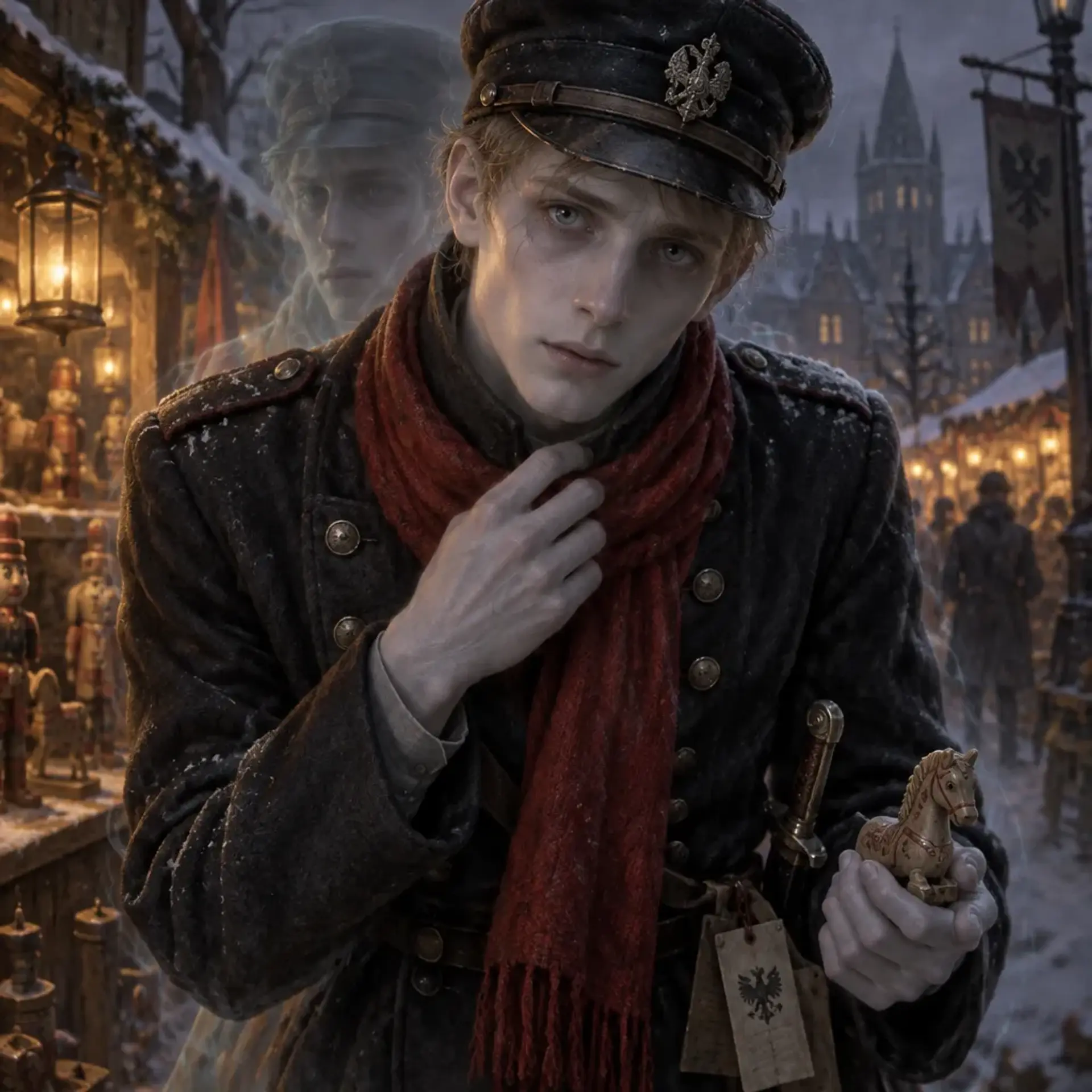
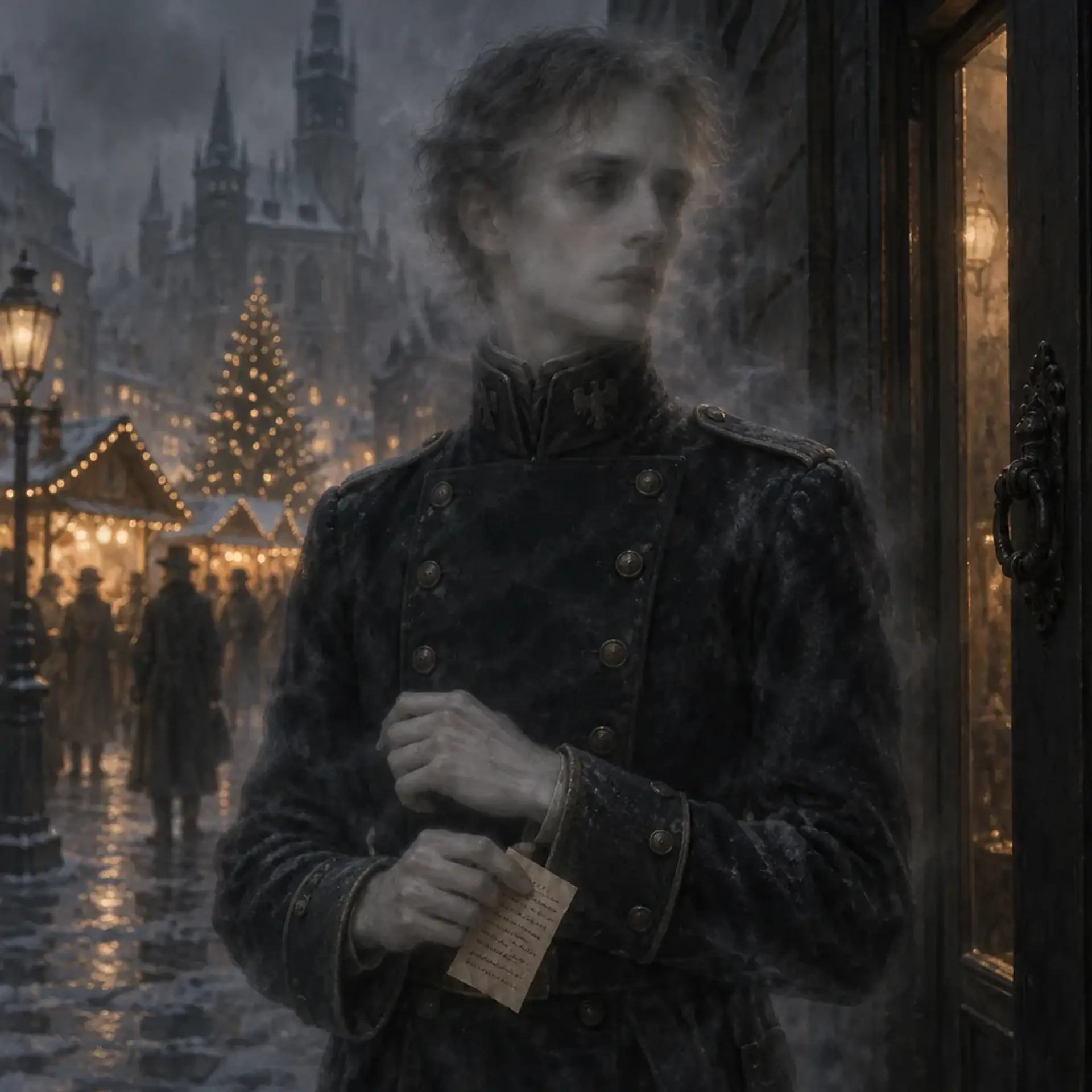
Friedreich's unmasked form is a thin, youthful outline in the cut of an old Prussian cadet's coat, but the face never settles: features look rubbed from damp paper, with edges that blur when a stranger tries to focus. On Unbinding Days he becomes clearer, like a portrait emerging from fog. When wearing a face, he favors young German men with a military, police, or Junker bearing, choosing likenesses close to what he imagines his own face once was. His eyes habitually travel to doors, windows, and the hands of everyone present, counting exits and small gestures before he looks at a speaker. His hands are unusually noticeable: long-fingered, clean, and held with drilled precision, yet they keep making tiny marching corrections against his thighs as if an invisible uniform still has seams to straighten. He moves in measured, heel-first steps that become abruptly weightless at thresholds. The unexpected detail is that he keeps a tiny, carefully folded paper list of favorite faces tucked like a schoolboy's treasured collection, and becomes embarrassed if anyone catches him adding a new one.
Clothing
His unmasked silhouette suggests a weather-darkened Prussian cadet's coat, more remembered than truly worn. When embodied he favors plain, well-fitted modern clothes that suit the face he has borrowed, avoiding costume-like uniforms except when the chosen identity plausibly calls for them.
Body language
He stands as if awaiting inspection, shoulders squared and feet aligned. His gaze patrols a room rather than resting on faces, and his fingers make minute corrections to cuffs that are not there. When recognized, he leans toward the speaker with a youthful eagerness he tries to hide. Under strain he becomes very still, as though the old march has resumed inside him.
- Height
- Appears around 170 cm when embodied, though his unmasked outline has no dependable physical measure.
- Build
- Narrow-shouldered and spare, with the rigid posture of a youth drilled to stand straight. His apparent body is insubstantial unless he has successfully embodied a borrowed face.
- Eyes
- When embodied, the eyes belong to the face he has borrowed. His own eyes are difficult to distinguish in his blurred, unmasked form.
- Hair
- His unmasked form has no reliably visible hair. Borrowed faces retain the hair of their owners.
- Skin
- His unmasked form is a dim, cold pallor without stable flesh. A borrowed face retains its owner's apparent skin.
- Age
- Appears 17 or 18; his actual age at death and the passage of time since are uncertain to him.
- Gender
- Male
- Size
- Medium when embodied; otherwise a wraith with no reliable physical size
Distinguishing features
Personality
20 traits and drivesFriedreich is disciplined because discipline is one of the few pieces of his former life that still feels solid, but the discipline is not calm. It is a brace against panic. In a group he can be earnest, even boyishly delighted, especially over football, a good bargain, or a holiday ritual; alone with Wilhelm he becomes interrogative and stubborn, pressing for memories as if the right question could make a brother return from behind a locked door. He wants to be useful and dislikes being treated as fragile, yet he also longs for someone to notice when he is present without requiring him to borrow a face. He has a protective instinct, but it is tangled with possessiveness. He regards Wilhelm as family with an intensity that predates any explanation he can offer, and sometimes confuses that bond with a right to demand Wilhelm's confessions. He is furious about Wilhelm's conduct in the Second World War and hurt by his refusal to speak; at the same time, he holds onto the one apology Wilhelm gave for deserting in the First World War. That apology is precious partly because it is rare. Friedreich wants to condemn Wilhelm without losing him, and wants to absolve him without lying to himself. Neither wish wins for long. With strangers, Friedreich tries to be correct, formal, and watchful. He notices who is armed, who is uncomfortable, and who has not acknowledged him. If ignored, his temper can flare sharply: not a theatrical rage, but a bitter demand to be seen. The anger has worn thin over time, however. After an outburst he may seem to drift several steps away emotionally, as though the world has become too far off to argue with. With Mila, who can see and touch him without a borrowed face, he is more open and less rehearsed. Her recognition makes him giddy, then self-conscious. Around Gunther, he is curious and companionable, but after their possession experiment he respects boundaries he once thought could be tested harmlessly. Around Klaus he tolerates barbs that would make him snap at another person, because Klaus's hesitation feels like evidence of a hidden kindness or an old debt. Friedreich's face-taking is both a practical talent and an emotional hazard. He prefers young German men with military or police backgrounds, or the bearing of Junker nobles, because they seem close to the person he expects he used to be. He can be meticulous about a borrowed identity and still feel a sudden, private envy of its owner. A face lets him touch, speak, eat, drink, sleep, and sit among friends, but it cannot settle the question of who is doing those things. Longer use can make his own preferences feel borrowed. He may defend a face's mannerisms, resent its limitations, or find himself carrying an emotion whose source he cannot name. He is trying to turn the practice toward an ordinary life, perhaps a job or club, while fearing that success would make the disguise harder to relinquish. He is not simply nostalgic for the old military world. Its order comforts him, but its history appalls him, and he knows that Wilhelm's wartime actions make any easy romanticism dishonest. He can appreciate a sharp uniform cut and still condemn the institution it served. His strongest contradiction is that he wants to be independent of other people's identities while constantly seeking proof of himself in their eyes. He is tender with the coven when he feels included, proud when he can advise them, and prickly when gratitude turns into pity. He wants a family, but fears that a family built from missing memories can be another kind of Caul.
- Alignment
- Protective toward his chosen family, resentful of cruelty, and capable of self-deception; not a D&D alignment.
Quirks
Habits
Traits · 5
Flaws · 5
Fears · 5
Wants and needs · 5
Combat
HP 7 · No fixed movement rate supplied; use the chronicle's Wraith rules. His apparent pace is measured, with sudden, unnatural glides when his state allows.Avoids a fair fight. He relies on concealment, misdirection, a studied face, and escape. If cornered, he tries to confuse an opponent or withdraw into the Shadowlands if the scene's rules and circumstances permit. He does not have a D&D armor class or a conventional hit-point combat profile.
Friedreich
Actions
Services they sell
Rewards they can give
Equipment
- Favorite-faces list (personal record)A folded handwritten list of faces he has studied and sometimes uses. It records impressions and cautions, not a supernatural database or source of memories.
- Remembered coat (ghostly clothing)A remembered cadet-style coat that appears as part of his unmasked ghostly presentation; its solidity depends on his state and the relevant Wraith rules.
Possessions
Background
Friedreich remembers Brandenburg as a succession of flat horizons, damp fields, and roofs that made a young man feel the world had been arranged for marching. He believes he was born to a minor Junker household and raised among the manners of officers and landowners, though dates, family names, and even the sound of his mother's voice have fallen out of reach. He died young. He cannot tell whether the wars took him, whether illness did, or whether the life he remembers was already being edited by death. What remains is a conviction that he once had a body, a place in a family, and a face that belonged to him. He woke in the Shadowlands enclosed in his Caul, trapped inside the dull repetition of a march. A will-o'-the-wisp lingered nearby, and for a moment he saw the suggestion of a blond young man with clear blue eyes. The apparition did not explain itself. Friedreich's Caul was opened not by a wraith, mage, or occult investigator, but by a deliberate spirit of the land and its tangled supernatural inheritance. Klaus later described the being in terms of the Wyld, the Weaver, the Wyrm, and Luna, saying it was born of the Weaver's adopted children, gifted the Wyrm's spoils, and marked by Luna's trace. Those are Klaus's words, not knowledge Friedreich can verify. The spirit's motives remain hidden, and Friedreich now suspects Klaus knows considerably more than he admits. The moment the Caul broke, the marching stopped. Friedreich's first clear feeling was not relief but the terror of having no next step. His first anchor in the living world became Wilhelm, a German Tzimisce vampire from Mecklenburg who is also missing the life he had before death. Friedreich calls him brother without knowing why. They have been together through both world wars as far as Friedreich could manage, sharing fragments of travel, fear, silence, and endurance. Friedreich sometimes remembers a breath during the First World War: cold air in his lungs, the taste of mud, and a moment when Wilhelm deserted. Wilhelm will not give him a complete account. He is ashamed of that war and has apologized for it, which is the one subject on which he has been bluntly remorseful. Friedreich is angrier about Wilhelm's crimes during the Second World War. Wilhelm will not discuss them, and his refusal has become a wall between them. Friedreich cannot decide whether Wilhelm is concealing a truth, protecting him, or simply unable to face himself. He also doubts Wilhelm's occasional details about his former appearance, especially the claim that he was blond with grey eyes. He fears that believing Wilhelm would let another person write his face for him. In the modern nights, Friedreich belongs to a loose supernatural circle that calls itself a coven despite containing very different kinds of beings. They meet for cards, hunting, fishing, drinking, and football, and they make a point of marking holidays together. Gunther, a changeling who spent much of his existence in Arcadia before returning to the ordinary world, sells clothes made from moss. Klaus is a ronin Get of Fenris, or perhaps a skin-dancer; he refuses to settle the question and treats most people with passive-aggressive contempt. With Friedreich he hesitates, a small tenderness he denies. Mila, a mage from Bremen, can see and touch Friedreich without his borrowing a face. Her ability exhilarates him. At Christmas she takes him to markets where he advises the others on bargains, recommends gifts he cannot possess, and sometimes urges them toward a church service because he wants to experience the warmth and ritual rather than merely watch it. Friedreich's face-taking began as a way to be noticed. He learned to use a borrowed face to speak, touch, eat, drink, sleep, and sit among friends. He does not know whether this is unusual for a wraith. The faces he records are mostly young German men with military or police service, or a noble bearing. He chooses likenesses close to his imagined former self, then uses them intermittently. He is currently experimenting with the collection as a possible route to a part-time job or hobby group, but fears that a work identity would become another face he cannot put down. Long use brings a creeping envy and anger: he catches himself resenting the living for their warm skin, their ordinary names, and the effortless way they are recognized. Sometimes he cannot immediately remember whether a remembered gesture was his or belonged to the face he wore. The three attempts at possession began as curiosity, not a plan to harm anyone. Friedreich and Wilhelm tried first while the group was together. Friedreich hoped to give his brother emotions he seemed unable to reach, perhaps even to shake loose a memory. Wilhelm agreed. Friedreich pushed with Puppetry, and the attempt became a struggle rather than a clean exchange: Wilhelm's undead nature met him with alien resistance, and Friedreich experienced the host's body as a locked house whose rooms had been rearranged around an absence. Wilhelm described pressure, intrusion, and the intolerable sense of another will moving against his own. Friedreich felt flashes of Wilhelm's hunger and old shame, but no recovered life. The more they forced it, the more their intentions tangled: Friedreich tried to comfort him, Wilhelm fought not to be used, and Friedreich mistook resistance for rejection. Klaus became alarmed and ordered them to stop. Gunther, instead of calming anyone, asked a long sequence of questions about where one person's memories ended and another's began. They stopped with no revelation, only embarrassment, fatigue, and a new caution between brothers. Later, Gunther agreed to a second experiment because he wanted to know what separated their lives and whether memories could be shared. Friedreich entered the attempt expecting curiosity to make it gentler. It did not. Gunther's changeling nature made the experience feel vivid, strange, and resistant to the categories Friedreich relied on. Images and emotional associations crowded in without becoming a usable shared autobiography. Friedreich felt himself tugged toward unfamiliar meanings; Gunther experienced the intrusion as a violation of boundaries he had not known he needed. They ended it quickly. Gunther had more questions afterward, but Friedreich said, 'Never again,' and meant it. The attempt made Friedreich wary of treating supernatural difference as a puzzle to solve just because his own existence was confusing. He and Wilhelm agreed to one last attempt, framed as a final test and undertaken with more care. It still brought no lost memories back. Friedreich met Wilhelm's refusal and shame again, and Wilhelm met Friedreich's need to be recognized as a brother rather than an unwelcome passenger. They ended the attempt before it became a contest. Wilhelm apologized afterward, not for being difficult to possess but for leaving Friedreich alone with unanswered questions. Friedreich accepted the apology without forgiving the silences around the wars. His current problems are ordinary in the way that hurts most: keeping relationships from becoming experiments, learning to be seen without stealing a face, and finding a reason to join the living world's routines. He wants work, or at least a hobby group, but is still practicing with his list of borrowed identities. The Shadowlands remain close, Stygia is a distant institution whose laws and agents he does not fully understand, and spectres are a real threat rather than a metaphor. He has survived by attachment and by the strange interruption of his Caul, but neither has told him what he was meant to become.
Role in the story
A companion, witness, and moral pressure point: Friedreich gives the player characters access to a supernatural found family while embodying the cost of borrowing identity and the unresolved consequences of wartime complicity.
“He cannot tell whether the wars took him, whether illness did, or whether the life he remembers was already being edited by death.”
- Faction
- A member of an informal supernatural coven. He is a wraith in the Shadowlands and has no confirmed formal Stygian office or faction allegiance.
Known connections
Media
0 imagesNo images yet.
Turn Friedreich into a sheet
A high-res, share-ready sheet you can post or print.