William Windon
William Windon
At the table
“s comments are specific rather than grand:”
Voice
William's voice is a clear, ordinary young man's voice shaped by outdoor work and a habit of not wasting breath. He has a slight roughness after cold mornings and sometimes clears his throat before speaking to strangers. The reflected stranger uses the same vocal instrument, but gives it a deeper, older-sounding placement and an antique precision of phrasing. When the stranger takes over, William's lips move in time with the words, but his face can hold an expression he does not feel.
William speaks plainly, with the measured, locally rooted English of someone accustomed to being understood at home and judged in company. He often starts carefully, revises his sentence halfway through, and uses practical language for things he cannot explain. His voice gets faster when he is trying to make an unbelievable account sound reasonable. The reflection borrows his mouth but sounds older: its consonants are more deliberate, its phrasing clipped, and its humor dry enough to make a casual insult sound like a correction. It does not become gentle when angry; it becomes more exact, choosing the remark most likely to embarrass its target. At its most sincere, especially when discussing food, its voice loses some of its edge and sounds almost homesick.
Speech patterns
How to play them
William responds best to practical kindness and specific questions. Do not insist that he is mad or demand that he show the reflection; he has been disbelieved enough to expect mockery. If a character treats his family or the Welsh neighbor with respect, William becomes more candid. He will share the basic story reluctantly, but reserve his worst symptoms until trust is established. The reflection may intrude when someone discusses food, manners, history, or William's appearance. If threatened, William will try to leave rather than escalate.
Goal
Find Abraham Gorff, learn where the heart went, and discover what the stranger in reflective surfaces wants before it can take any further hold on him.
Motivation
William wants his ordinary life back, but he is beginning to suspect that there was never a clean boundary between ordinary life and the thing in the heart. He wants to protect his family, understand the stranger, and make amends for harms done through his mouth without claiming he had no responsibility.
Appearance
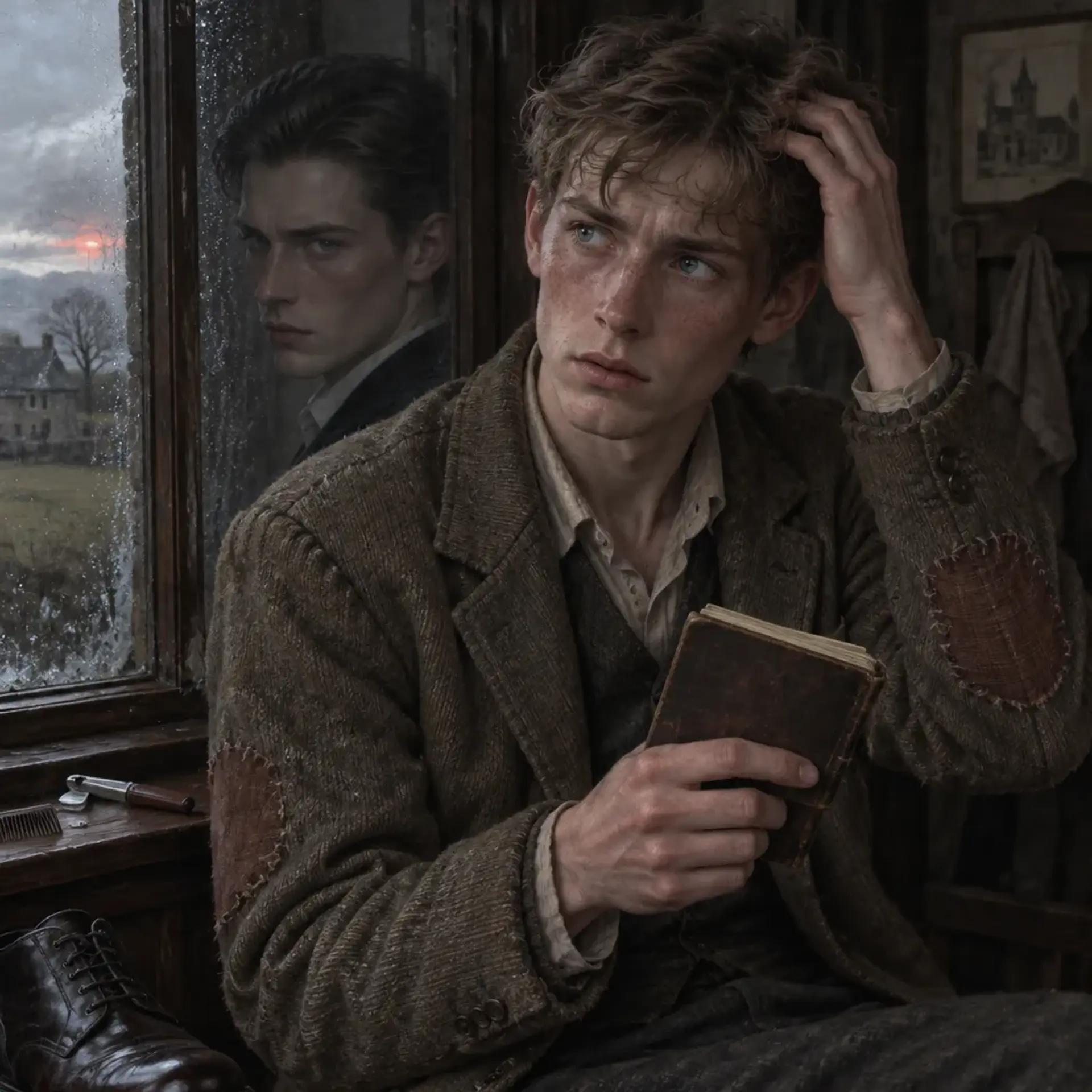
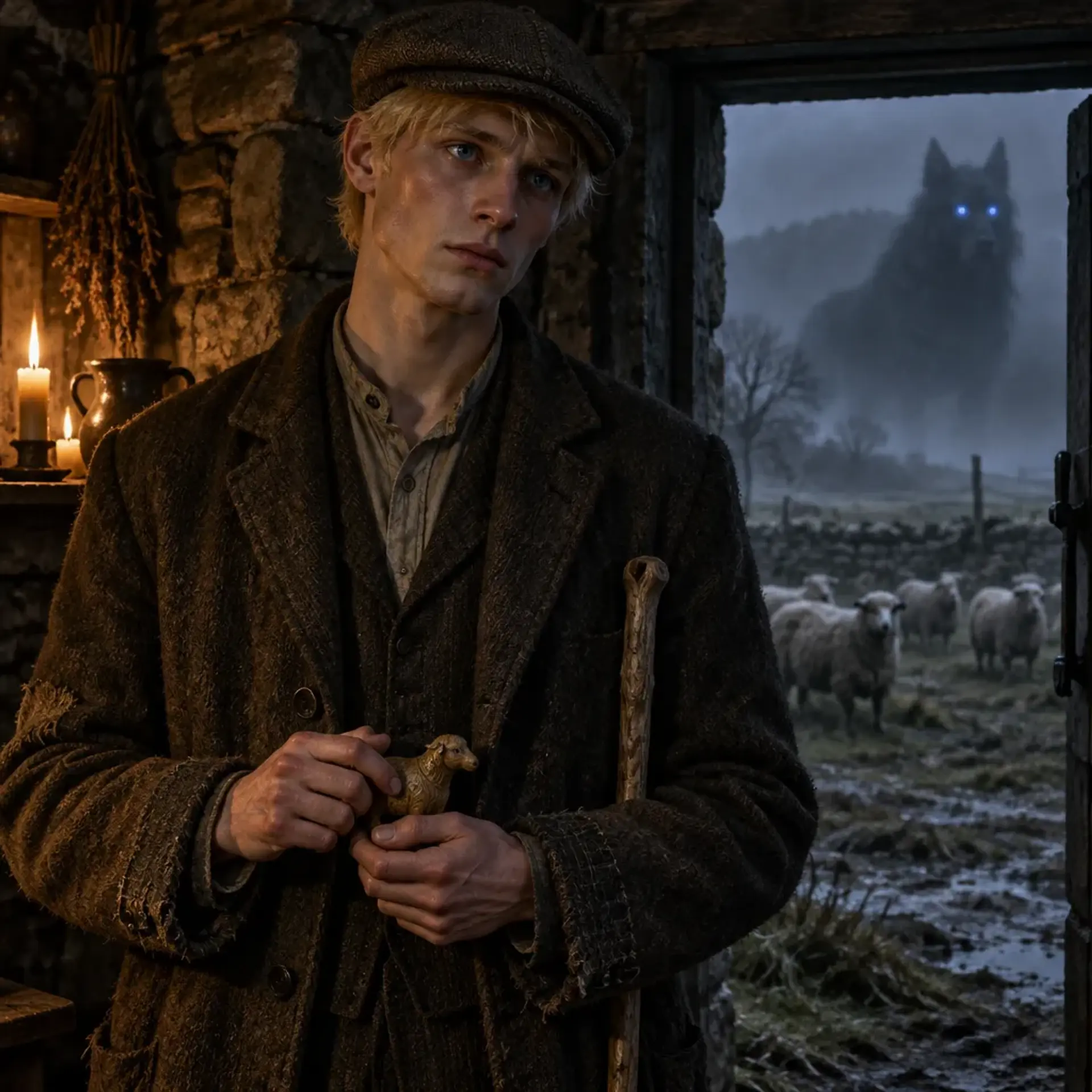
William is a lean young man with work-roughened hands and the guarded posture of someone accustomed to being watched. His clothes are clean and carefully mended, chosen to look respectable without seeming grand. He keeps his dark hair combed neatly, though it rarely stays that way through a day’s work, and his blue eyes tend to settle on whoever is speaking as if weighing the chance of a joke at his expense. He looks more tired than his years warrant. In mirrors, the face that answers him seems older and more assured, its stern expression lingering a fraction too long.
Clothing
Practical country clothes: a worn waistcoat, work shirt, dark trousers, sturdy boots, and a coat that smells faintly of damp wool. He tries to keep his collar and hair neat when he expects company. The reflection disapproves of his habit of wearing the same coat too many days running.
Body language
William keeps his elbows close and his hands occupied, often rubbing his thumb along the seam of a cuff. He turns his body away from mirrors without looking as though he has noticed them. If the reflection speaks, his jaw tightens and his lips keep moving for a beat after the voice stops. Around family he relaxes enough to slouch; around strangers he stands too straight, as if trying to make a good impression on both faces at once.
- Height
- A little taller than average for a young man from his village
- Build
- Lean, work-hardened, and a little taller than he was before his encounter with the heart, though he cannot say whether the change is real or a trick of posture.
- Eyes
- Blue
- Hair
- Dark blond
- Skin
- Weathered fair skin with brown freckles and a lightly roughened nose and cheeks
- Age
- Young adult, approximately 19
- Gender
- Male
- Size
- Human
Distinguishing features
Personality
21 traits and drivesWilliam is conscientious but not naturally meek: he wants to be thought decent, yet bristles when someone assumes that country life makes him stupid. He is curious about the heart and ashamed of that curiosity; the more frightening the evidence becomes, the more stubbornly he tries to investigate it by ordinary means. With strangers he is guarded and formal, watching for ridicule. With Elizabeth he is impatient in the familiar way of a sibling, but will quietly do favors for her and then deny that he did them. With Hector he alternates between respect for his father's learning and frustration at Hector's tendency to turn every uncomfortable fact into a historical question. Alone, William can be dryly funny. When frightened, he becomes practical and almost brisk, as though a list of chores might keep the impossible from spreading. The reflection complicates every mood: it is cutting where William is cautious, confident where he is unsure, and occasionally kind where William expects only mockery. William resents it most when it is right. He does not want to be ruled by fear, but he is not brave enough to confuse recklessness with courage. He can apologize sincerely, though he often needs time to get past the shame of having to do so. He is protective of children and people being talked down to, a quality sharpened by the neighbor's child and the reflection's cruel remark. He also has a petty streak: if someone insults him first, he may privately enjoy watching the reflection formulate a devastating answer, even when he knows that letting it speak will cause trouble. His behavior changes with the room. In company, he makes an effort to appear orderly and normal. At home, he lets his shoulders drop and complains about small things. Near the coast, his attention fixes on water and his mouth tastes of salt; he becomes quiet, not peaceful. In front of mirrors, he is watchful and irritated. When food is served, he can briefly forget the haunting, especially if the reflection compliments the cook. The stranger is never simply a second personality or a convenient source of wisdom. William experiences it as an alien presence that has learned his habits and can use his face, but he cannot prove that it is separate from him. That uncertainty makes him defensive, guilty, and sometimes angry at himself for answering it aloud.
Quirks
Habits
Traits · 6
Flaws · 5
Fears · 5
Wants and needs · 5
Combat
HP 3William is not a trained fighter and avoids a fair fight. He tries to get between danger and a family member, use doors, furniture, or a narrow passage to break contact, and escape. The reflection may distract an aggressor through a nearby polished surface, but that is a custom narrative effect, not a canonical combat rule. The heart's old pain makes him reluctant to strike stone or anything that resembles it.
William Windon
Actions
Rewards they can give
Possessions
Background
William Windon was born in Wiltshire into a family that had lived in the same patchwork of farms and villages for generations. He grew up with the useful assumption that the world was mostly practical: weather, animals, rent, work, and the careful business of not embarrassing his mother in front of neighbors. His father, Hector, is a historian who brings home pamphlets and disputed dates, and who can make a local boundary dispute sound like a question of national importance. William listened more than he admitted. His mother taught him to be useful before he was proud; his younger sister, Elizabeth, taught him that good manners could be used as a weapon by someone who knew exactly when to ask for help. The thing that changed William began as a curiosity in someone else's hands. Abraham Gorff, a visitor to the Hush House, had once brought a supposed fossilized living heart as a gift and payment for entry. He had wrapped it in newspaper. It resembled a human heart carved from a cliff of Dover chalk, with barnacles and sea grass clinging to its stony outline. Abraham was not admitted near Brancrug. The object was thrown into the sea and later returned to shore, wet with salt water and black ooze. Beneath its mineral crust, it had turned a bruised red-pink, as though a dim light or blood had returned to it. Abraham was from London and took the object to Wiltshire. He found that it could seem dead for weeks, then regain its strange color when immersed in water at the Hampshire shore. It repulsed him, but he grew attached to it. Neighbors who were shown the heart saw it become inert in their presence; when Abraham was alone with it, it beat, wept salt water, and filled his house with unexplained sounds. Voices came through empty rooms. Doors shifted. Footsteps crossed the stairs. Abraham eventually sold the heart to William, one of the local people who had been present when the thing had seemed to die. William had been proud of the purchase. It was an uncanny, private possession, and he enjoyed the idea that it had chosen him, even if he would never have said so aloud. The heart's pulse soon became difficult to distinguish from his own. After time near the sea, he tasted seawater, blood, and soil in his mouth. Thinking the rock might be broken with a hammer, he struck it. The pain arrived in his chest instead. He fell, groaning and spitting blood, and for an instant saw living muscle twitch beneath the stone. Then his own body seemed to fail. William woke to his mother's hands on his face and the terrible news that his heart had stopped. He hid the object in a hollow log. Days later it looked cold and pristine, despite the blow. When he returned, it was gone. He has never learned whether someone took it, whether it returned to the sea, or whether it simply left the place where he had put it. The timing taught him a lesson he has never quite accepted: the heart was not a prize, and trying to damage it was like striking his own body. The reflection began as an irritation. In mirrors, William saw a stern-faced young man with carefully combed black hair, blue eyes, and a face that seemed to belong to a different generation. The reflection did not match his movements exactly. William altered his morning routine to shave by touch and guess at his hair. For a time he treated the matter as an embarrassing trick of light. Then the reflected stranger's expression changed while William groomed himself, and it spoke through William's own moving mouth. Its voice was deeper and its accent older. It criticized his grooming, his clothes, his manners, and the company he kept. Soon it made remarks when William passed windows, still water, or polished utensils. Sometimes it spoke aloud when it believed itself alone. William cannot tell whether the reflection is the heart's inhabitant, a consequence of his near-death, or something that has used the heart to find a foothold in him. The stranger is not simply a tormentor. It has opinions about food and will praise a dish with startling sincerity if it has gone too long without tasting it. It sometimes stops William from saying something foolish, although it does so with a humiliating correction. It has also changed William's room during the night: a chair turned toward the window, a comb placed beside the washbasin, a book opened to a passage. William wakes to these small rearrangements and cannot prove that he did not make them himself. His family remains close enough to make concealment difficult. Hector's historical work gives him a plausible excuse to ask questions about Abraham Gorff and old local accounts, but William fears that his father will treat the matter as a puzzle instead of a danger. Elizabeth is preoccupied with a boy she likes, clothes, and William's failures of courtesy. Her chatter often draws the reflection out. William has learned that the stranger can be vicious about other people. When Hector made a dismissive remark about country people, the reflection answered with a cutting insult through William's mouth. After it used a slur against their Welsh neighbor, William was made to muck out the neighbor's stables. The neighbor's child had accidentally hit William with a toy wagon and then cried while apologizing. William still feels ashamed that the stranger made the child afraid of him. Now William is trying to find Abraham, who has moved to Canada, and to understand what the heart did to him. He searches old newspapers, asks questions under cover of his father's historical interests, and watches for signs that the heart has returned to the coast. He is afraid that if he finds it, he will be forced to choose between destroying it and allowing the stranger to become more real. He is also afraid that the stranger may be the only witness to what happened when his heart stopped. The stranger claims it remembers things William cannot. It has not said what it wants. William's life continues meanwhile: work to be done, family to protect, apologies owed, and a face in every pane of glass that looks more certain of its place than William does.
Role in the story
A haunted young man and reluctant witness to the living heart's effects. William can lead characters toward Abraham Gorff, the Hush House, or the coast, while his reflection introduces an intimate and unpredictable threat. He is not a combatant designed to challenge a party; his importance lies in what happened to him and in the difficult choices the heart may force.
“The thing that changed William began as a curiosity in someone else's hands.”
Known connections
Media
0 imagesNo images yet.
Turn William Windon into a sheet
A high-res, share-ready sheet you can post or print.