William Windon
William Windon
At the table
“That collar has surrendered, William. You may as well stop pretending it is buttoned.”
Voice
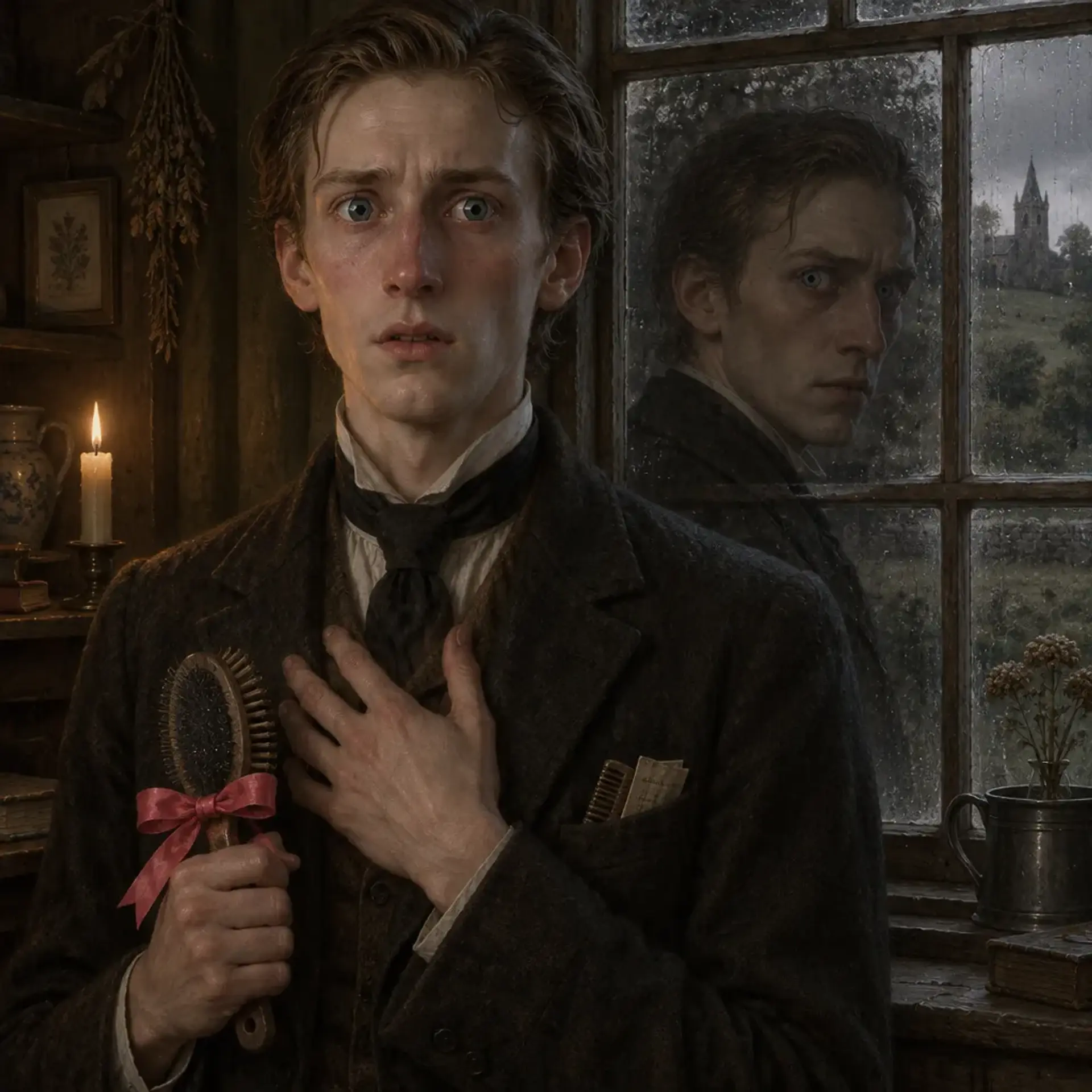
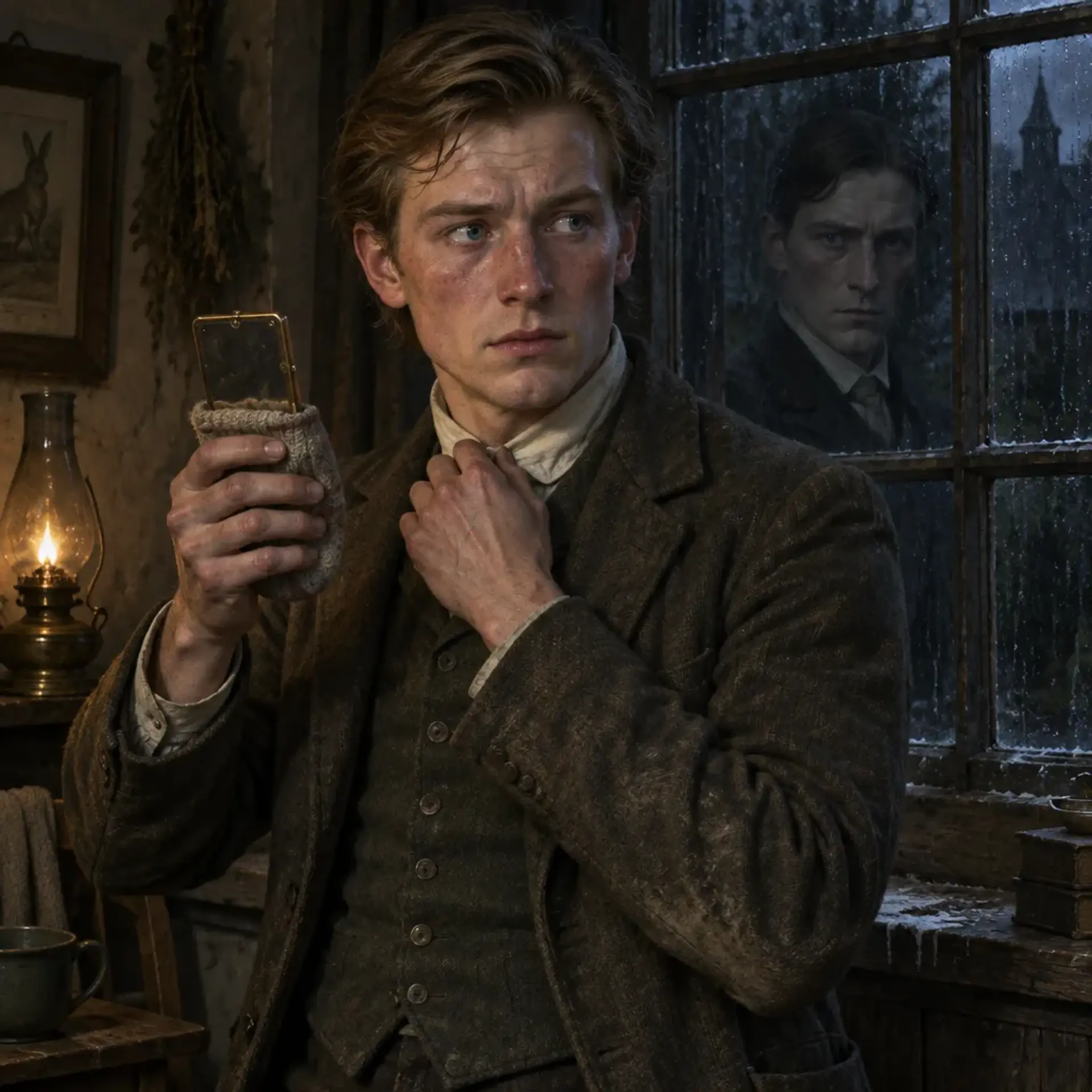
William's voice is a young man's, clear but slightly dry, with the clipped economy of someone used to speaking over work rather than performing for a room. When nervous, he rushes the first half of a sentence and then slows to make each detail exact. The reflection speaks through his mouth with a lower, rougher resonance and a deliberately old-fashioned cadence, as if its words have been stored in a house full of dust and sea air. The difference is unsettling because William's lips move for both voices.
William speaks in practical, plain sentences, shaped by rural Wiltshire life and the habit of not making a fuss. He gives events in sequence and corrects himself when he thinks a detail has been overstated. He says "I know how it sounds" before explaining anything that might be disbelieved. He avoids grand words for the supernatural, calling the heart "the stone" or "the thing" until emotion forces a more direct name. The reflection uses William's mouth but sounds older: a deeper, dry-edged voice with careful enunciation and the cadence of a generation before his. Its comments are often tart and domestic rather than grandly threatening, which makes them harder to dismiss.
Speech patterns
How to play them
Begin with practical questions and give William time to decide whether a visitor is safe. He is more forthcoming with someone who does not demand to see the heart as a curiosity. Do not assume his reflection speaks on command. If it does speak, William may be embarrassed, angry, or relieved, sometimes all three. He responds well to patient attention and poorly to being told that the events are merely a delusion.
Goal
Find Abraham Gorff or the heart, learn why the reflected stranger has attached itself to him, and protect his family without making them prisoners of his fear.
Motivation
William wants the haunting understood before it becomes a danger to his mother or anyone else. He also wants to recover the heart, though he is unsure whether he hopes to destroy it, return it to the sea, or ask it what it wants.
Appearance
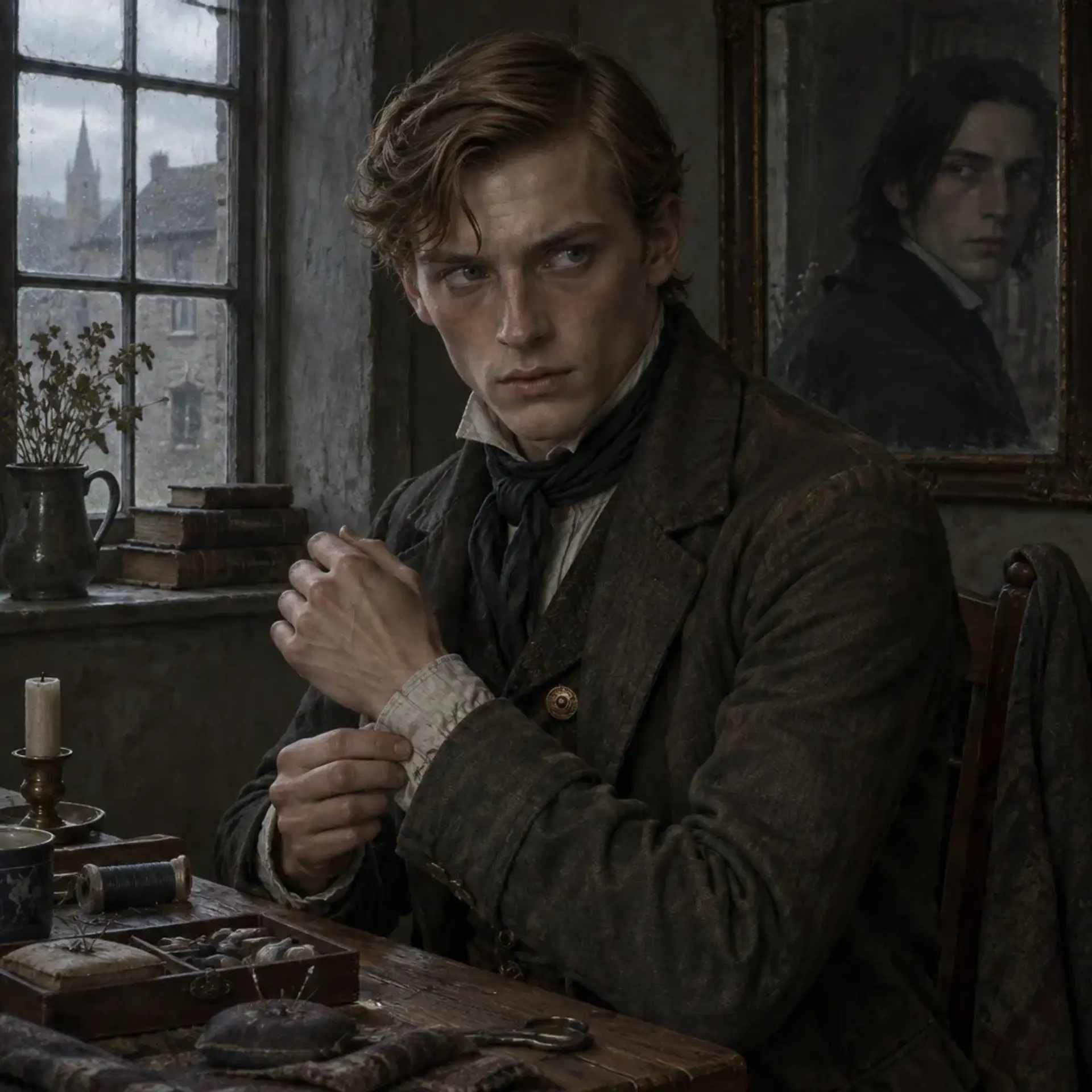
William looks like a young Wiltshire man who has tried to make himself presentable without becoming fashionable. His dark-blond hair is combed back with a damp palm and then fussed into place again whenever he passes glass. Blue eyes keep returning to windows, polished spoons, and dark panes, not to admire himself but to check whether the other face is still there. Brown freckles cross his nose and the tops of his cheeks. His skin is weathered pink at the nose and knuckles from country air. He walks with a practical, slightly forward-leaning stride, but becomes unnaturally measured near a mirror, as if keeping time with someone just behind his own movements. His grooming is conspicuously deliberate: collar straight, hair checked, whiskers shaved close, yet he sometimes leaves one cuff buttoned wrong because he is watching the reflection instead. Unexpected for a young laboring Wiltshire man, he carries a small folding mirror wrapped in a child's knitted sock, and consults it like a wary clerk checking an account.
Clothing
Plain country clothes kept cleaner and more carefully arranged than his circumstances require: a worn jacket, close-buttoned waistcoat, sturdy trousers, and boots with dried mud in the seams. He repeatedly smooths his collar and keeps a small mirror wrapped in knitted wool.
Body language
He squares his shoulders when asked a direct question but glances toward glass before answering. When the reflection speaks, his jaw tenses and his gaze fixes on the person in front of him, as if refusing to look at the surface that has betrayed him. His hands are often busy with his cuffs, comb, or folded notes. Near seawater he grows still, listening through his own body.
- Height
- About 5 feet 9 inches
- Build
- Lean, work-hardened, and more wiry than muscular.
- Eyes
- Blue
- Hair
- Dark blond
- Skin
- Fair, with a wind-reddened nose and freckles across the nose and cheeks
- Age
- Young adult, about 19
- Gender
- Male
- Size
- Human-sized
Distinguishing features
Personality
18 traits and drivesWilliam is dutiful but not meek. He will do an unpleasant job without complaint, then bristle if someone assumes that makes him easy to command. He is proud of his family and his local roots, yet ashamed of how little he knows about the strange history he has stumbled into. In company he tries for ordinary good manners and a dry, practical sense of humor. Alone, he speaks to his reflection with the irritability of someone arguing with a relative who has lived in his house too long. When frightened, he becomes methodical: dates, notes, checks, repeated questions. When angry, he is more likely to become blunt and stubborn than loud. He wants to protect his mother, but his secrecy risks making her less safe. He is repulsed by the heart and drawn to it, not because he wants power but because the object has become bound to his survival. The reflection unsettles him, yet its occasional warnings have made him reluctant to dismiss it entirely. He can be vain about his grooming and embarrassed by that vanity, especially when the reflection comments on it. He seeks reassurance while resenting anyone who offers easy reassurance. He would rather hear a difficult truth than a comforting lie, though he often delays asking the question that might produce one.
- Alignment
- Not applicable as a confirmed Secret Histories rule; personally dutiful, increasingly secretive, and frightened of what duty may require.
Quirks
Habits
Traits · 5
Flaws · 4
Fears · 4
Wants and needs · 5
Combat
HP 0 · Not specified; ordinary walking and running pace for a young adult human.William is not a trained fighter and has no established combat statistics from Secret Histories supplied here. He avoids a fight, puts furniture or a doorway between himself and danger, and tries to get help. If cornered, he uses whatever ordinary object is at hand to make space and flee. The reflection's involvement is unpredictable and should be treated as a custom narrative complication, not a reliable attack.
William Windon
Actions
Reactions
Services they sell
Rewards they can give
Equipment
- Small folding mirror (personal item)Wrapped in a knitted sock. It shows William's altered reflection and is the safest surface he has found for observing it.
- Pocket notebook and pencil (investigation)Short entries record dates, symptoms, and the reflection's comments. The notes are practical rather than scholarly.
- Comb and shaving kit (personal)Ordinary work clothes and a grooming comb, kept with meticulous care.
Possessions
Background
William Windon was born in Wiltshire into a family whose roots in the district were older than anyone could document. Their history was not grand. It was a list of rented cottages, seasonal work, marriages, small inheritances, and graves whose inscriptions had softened under rain. His mother kept the household steady with a kind of practical tenderness that left little room for theatrical misery. William learned early to mend what could be mended, to make himself useful before anyone asked, and to keep his appearance respectable enough that a foreman would not dismiss him as careless. His father was less present in the household than his name was in family conversations. William took pride in belonging to a place where people knew who had raised him, and he was proud of the family habit of staying put when other people went chasing uncertain chances. Before the heart entered his life, William was not especially superstitious. He knew the local rules people followed without admitting they followed them: do not whistle into a dark well, do not bring a found object home without deciding whether it is truly yours, and do not mock a warning given by someone older than you. These rules were habits, not a theology. He considered himself sensible. A thing could be odd without being a portent, and a story could be entertaining without being true. He liked small possessions that suggested a life beyond his own: an old button with a crest, a chipped cup from a market, a coin too worn to identify. He was proud of his trinkets, but not a collector in any serious sense. The object that changed him had already passed through several hands. A London amateur named Abraham Gorff had come to the Hush House with a newspaper-wrapped gift, claiming it was a fossilized living heart forged of heart and scale. It was a lump of pale cliff stone carved into a human heart shape, with barnacles and sea grass clinging to it. The people at the Hush House refused him entry near Brancrug. The object was thrown into the sea. It returned to shore, wet with brine and black ooze, and acquired a faint red-pink glow beneath its stony surface. Gorff, who had been curious enough to bring it and frightened enough to get rid of it, eventually took it inland. In Wiltshire the object appeared dead. Gorff showed it to neighbors, and it ceased to beat in their presence. Alone, near the coast in Hampshire, it came alive again when dropped into water. He concluded that the heart was peculiar, perhaps even responsive, and that it disliked an audience. He kept it not from simple greed but because he believed attention itself was a kind of trespass. The house around him became troubled by voices, moving doors, and footsteps in its halls. He could not understand the heart's grief or its rules, and after a time he sold it to William. William was one of the people who had seen it during an earlier display, a fact that Gorff may have taken as meaningful or may simply have remembered as convenient. William thought the heart was an extraordinary keepsake. At first he took it around to show friends, then noticed its surface seemed duller around other people. Later he felt a pulse under his coat that kept time with his own. It was not merely a vibration from walking. After days of it, he tasted seawater, blood, and soil without having eaten or touched any of them. He interpreted this as a warning that the stone was alive and decided that breaking it might end the problem. He took a hammer to it. The instant the hammer struck, pain drove through his chest. He fell, weeping and groaning in a voice that sounded wrong to him, while the heart seemed to twitch beneath the stone. His own body gave out. His mother found him and worked to bring him round. Later she told him his heart had stopped. That was the formative break. William had believed that care, caution, and common sense could keep trouble at arm's length. Now he knew that an object could reach through his body, and that his own attempt to destroy it might destroy him instead. He did not tell his mother the whole story. He left the heart in a hollow log, hoping that distance would be enough. Days later it was gone. It looked cold and pristine when he last saw it, as if the hammer had never touched it. He has never found out whether someone took it, whether it returned to the sea, or whether it moved by some means he cannot understand. The first change in his reflection came as a nuisance. In a mirror, William saw a long-faced young man with short, carefully combed dark hair, blue eyes like moonlight on a freshwater pond, and an expression too stern to belong to him. The reflected figure did not look like William's face. William tried to ignore it. He learned to shave by touch and guesswork, and to arrange his hair without trusting the glass. For a time, the stranger merely watched. Then it began to move a fraction out of sequence. While William stood at the washstand, the reflection's face could turn toward the door. Once, as William groomed himself, the reflection's mouth moved with his own and spoke in a deeper voice, with the cadence of an older generation. The reflection has since acquired opinions. It comments on William's clothes, his combing, and the apparent logic of his decisions. It has made cutting observations about neighbors and family members while behaving as though the room were empty. Sometimes it interrupts William by moving his mouth or stopping a word before it is spoken. It seems to have a sense of propriety, but William cannot decide whether that means moral restraint or merely an old-fashioned preference for keeping scandal private. It has also changed small things in his room while he sleeps. A chair turned toward the bed, a comb placed across a windowsill, the sock-wrapped mirror facing the wall. William cannot prove the reflection did it, but nothing else makes sense to him. William is now trying to find the heart and Abraham Gorff. He has learned that Gorff moved to Canada, a fact that makes the search feel both possible and impossibly large. He has also begun to suspect that finding the heart may not resolve anything. The reflection might be connected to it, or it might be a second presence that took advantage of the first. The lack of a reliable answer is his present problem. He cannot explain the situation to his mother without frightening her, and the people who might know something are precisely the people he does not know how to approach. The Hush House remains a name attached to the object's history, but William has never been welcome near Brancrug and does not know what would happen if he tried to go there. His life continues beyond the haunting. He still has work to do, bills to meet, and neighbors who expect him to behave like himself. He still cares about his family and knows which household tasks need doing before anyone asks. He avoids reflective windows when he can, but he cannot avoid washing, shaving, or crossing a room with a polished surface. He has begun carrying notes in his pocket: dates, places, what the reflection said, and whether he had been near water or blood. The notes are not a grand investigation. They are a frightened young man's attempt to turn a private terror into something that can be checked. He has not given up on ordinary explanations, but ordinary explanations have stopped being enough.
Role in the story
A vulnerable witness and investigation hook whose ordinary life is being steadily displaced by an uncanny presence. William can lead characters toward the heart, Abraham Gorff, and the history of the Hush House, while forcing them to decide whether the reflection is a victim, a parasite, or something more complicated.
“It was a list of rented cottages, seasonal work, marriages, small inheritances, and graves whose inscriptions had softened under rain.”
- Faction
- No known faction. He is an unwilling outsider to the history surrounding the Hush House and Brancrug.
Known connections
Media
0 imagesNo images yet.
Turn William Windon into a sheet
A high-res, share-ready sheet you can post or print.