William Windon
William Windon
At the table
Voice
William's voice is a little breathy from habitual tension, with a dry edge when he is trying to sound more composed than he feels. His workaday manner favors short, practical clauses. When the heart is mentioned, his breath catches and he clears his throat rather than lowering his voice. The reflected stranger speaks through his reflected mouth in a deeper, older-sounding voice with a different accent and a dry, sarcastic cadence.
William speaks in plain, measured phrases, with a Wiltshire accent softened by careful self-consciousness. His breath catches on the words "heart" and "mirror"; when rattled, he swallows between sentences and sometimes starts again from the beginning. He avoids theatrical declarations, preferring details he can verify. The reflected stranger's voice is not William's: it sounds deeper, older, and carries an accent from a generation before him.
Speech patterns
How to play them
Treat William as a frightened person trying to remain useful and ordinary, not as a ready-made occult expert. Earn his trust with patience and concrete help. He may share the account of the heart once he believes a listener will not mock him or immediately involve his family. Do not assume that the stranger in the reflection is William's ally or enemy.
Goal
Find the heart or locate Abraham Gorff, learn what the reflected stranger wants, and keep his family safe without surrendering his own identity.
Motivation
William needs to establish whether the heart and the reflection are linked before the stranger's influence expands. He also wants to regain the ordinary privacy of being alone in a room.
Appearance
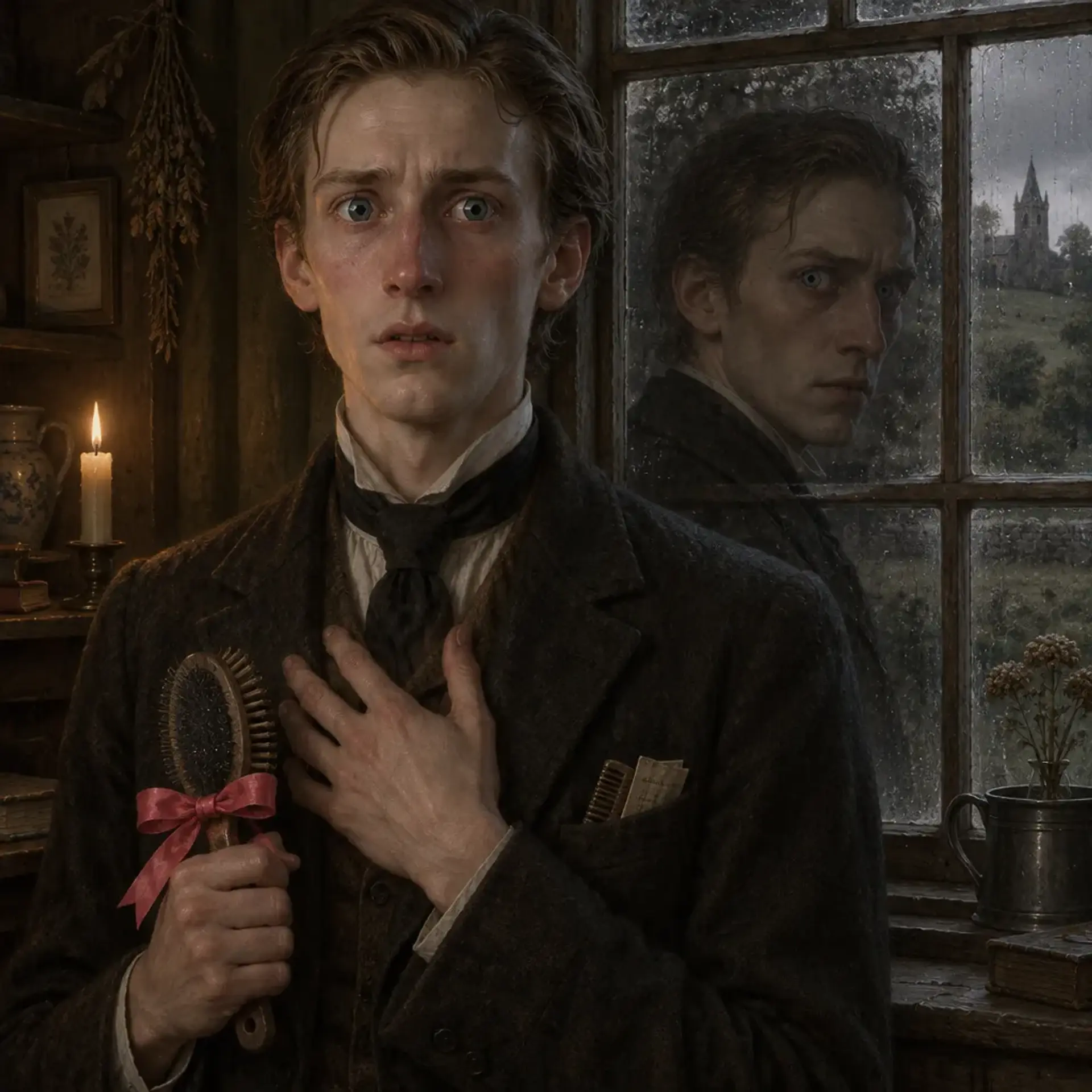
William has the look of a local young man who has dressed carefully for an occasion nobody else knew was important. His dark blond hair is combed into a precise side part, but the wind keeps lifting one stubborn wedge above his brow. His eyes are unusually hexagonal in their apparent shape, an effect of their sharp lids and the way he holds his gaze; people notice them before they can explain why. His clothes are clean but repeatedly mended, with a jacket that sits slightly too long at the wrists and a collar he keeps straightening. He moves in clipped starts and stops, as if listening for a footstep behind his own. Unexpectedly, he is an attentive and rather good mender of small household things: he keeps a needle and thread and will repair a torn hem while talking about something else. In glass, still water, or polished metal, his reflection is no longer reliably his own. Sometimes a long-faced, black-haired young man with pond-blue eyes looks back.
Clothing
A carefully brushed but old jacket, slightly long in the sleeves, over a high-collared shirt. The cuffs are neatly darned, and he keeps one button polished brighter than the rest. He often wears a dark scarf to cover his throat when he feels the pulse there too clearly.
Body language
He keeps his shoulders slightly forward and his hands busy. When speaking about the heart, his fingers close over his sternum without quite touching it. His gaze skips from a person's face to nearby glass, then back. If startled, he goes very still before moving abruptly.
- Height
- About 5 feet 9 inches (175 cm)
- Build
- Lean, with the wiry strength of someone accustomed to walking and doing practical work.
- Eyes
- Blue-grey, with an unusually angular shape
- Hair
- Dark blond
- Skin
- Fair, weathered by outdoor work
- Age
- Young adult, about 19
- Gender
- Male
- Size
- Average adult human
Distinguishing features
Personality
15 traits and drivesWilliam wants to be regarded as sensible and dependable, yet the stranger in the glass has made him doubt his own senses. In company he can be courteous, practical, and even lightly funny; alone, he becomes watchful and compulsively observant. He dislikes frightening his family, so he conceals the worst details, but that protective instinct also leaves him isolated. He is proud of his ability to manage ordinary problems and ashamed that he cannot manage this one. When calm, he tests explanations and notices small inconsistencies. When tired or near the sea, he grows irritable and inward, as if every sound might be an echo from the wrong side of a wall. He can be stubborn about pursuing the heart, then abruptly recoil from the possibility of finding it. He is not certain whether he wants the reflected man gone, or simply wants to know who he is.
Quirks
Habits
Traits · 4
Flaws · 3
Fears · 4
Wants and needs · 4
Combat
HP 0William is not a trained combatant and has no established system-specific combat statistics. He avoids a fight, tries to reach a door or a crowded place, and may use a chair, tool, or other nearby object to create an opening. The heart's effects should be treated as custom fictional complications, not as Secret Histories rules.
William Windon
Actions
Reactions
Services they sell
Rewards they can give
Equipment
- Small pocket knife (ordinary tool)A practical household tool he carries for ordinary errands. He is reluctant to use it as a weapon.
- Mending kit (personal item)Needle and dark thread, kept for mending his cuffs and hems.
- Old newspaper scrap (clue)A folded scrap of newspaper he kept from the heart's wrapping, with no complete account of its origin.
Possessions
Background
William Windon was born in Wiltshire, in a family whose roots there stretch back through generations of parish registers, practical marriages, and stories told over kitchen work. He grew up knowing which lanes flooded, which neighbors would lend a spade, and which adults were only pretending not to hear a quarrel through a thin wall. He is not a country innocent, though he can be mistaken for one: he learned early to watch people closely and to keep his own opinions until he knew what they might cost. His trouble began with a curious object that had already passed through other hands. Abraham Gorff, a Londoner staying in Wiltshire, had bought it from a visitor to the Hush House. The visitor had called it a fossilized living heart, supposedly forged of heart and scale, and had left it wrapped in newspaper as payment for an entry he was never allowed to make. The thing looked more like a piece of Dover cliff chalk carved into a human heart: barnacles and sea grass clung to its sad, crusted surface. It was thrown into the sea and came back to shore, wet with saltwater and black ooze. Beneath its stone-like surface, a red-pink color had returned as if a hidden light or blood had stirred. A young man found it on the shore, carried it home, and discovered it beating beneath his coat after a train journey. That young man was Abraham. The heart repulsed him, but it also drew him in. When he showed it to neighbors, it seemed to die in their presence. After weeks of stillness, it revived when he took it to a Hampshire shore and dropped it in water. Abraham decided that it was special, and that it was his. He did not keep it from others out of simple greed. The heart seemed not to like guests, and the house around it began to behave like a place with an unwelcome occupant: voices in empty rooms, doors shifting, footsteps on stairs. Abraham eventually sold the heart to a seventeen-year-old local boy, William, one of the people who had seen it apparently die during an earlier display. William was proud of his strange purchase. At first it was only a curious stone, and he showed it off. Then its pulse began to match the beat in his own chest. After spending time near the sea, he tasted salt, blood, and soil in his mouth. Convinced that an ordinary rock could be broken, he brought a hammer down on it. The blow did not break the heart. Pain entered William's chest as though the hammer had struck him instead. He fell, groaning and weeping, and a voice unlike his own sputtered through his mouth. He saw a muscle twitch beneath the stone for a fraction of a second. Then he lost consciousness. His mother found him and told him his heart had stopped. William survived, but nobody could explain what had happened. Days later, he abandoned the heart in a hollow log. When he checked again, it looked cold and pristine, unmarred by the hammer. The first disturbances after that were easy to dismiss as shock. In mirrors, William sometimes saw a long-faced young man with black hair and blue eyes, stern as moonlight on a still pond. The face did not match William's, but at first it merely held its expression while William moved. He stopped looking. For a while, avoiding mirrors seemed to help. Then the reflected man began to move for himself. William's image jerked in glass when William stood still, and sometimes it seemed to look away from him. One morning, while William groomed his hair, the face spoke through his reflected mouth: "Time to get a move on now shall we." Its voice sounded older than William's, with an accent that belonged to an earlier generation. Since then, the reflection has made dry, intrusive observations about his clothes, his hair, and the people around him. William has caught it changing things in his room while he sleeps, though he cannot prove what was moved or how. William wants to find the heart or the person who sold it to him. He learned that Abraham Gorff moved to Canada, which gives him a distant name and no easy route to answers. He has also looked for the hollow log, but the heart is gone. Whether it crawled away, was taken, or was never simply a stone remains unknown. William has kept the story from his family as best he can. His mother knows his heart stopped once, and she watches him more closely than he likes. The household has adapted around his evasions: he avoids certain windows, covers mirrors at night, and claims that his sleeplessness is ordinary worry. His life has not paused while the mystery grows. He still has work, errands, relatives, and neighbors who expect him to behave as the same young man they have always known. He is trying to preserve that life without telling them how badly it is changing. The reflected stranger may be a haunting, an attachment to the heart, or something with its own history and intentions. William does not know. He only knows that the face is becoming harder to avoid, and that sometimes it seems to be waiting for him to stop pretending it is not there.
Role in the story
A troubled witness and potential guide into the heart's history. William's account ties the object to Abraham Gorff, the Hush House, and a persistent presence in reflective surfaces. He can provide clues, but his own uncertainty makes him an unreliable interpreter of what the haunting means.
“His trouble began with a curious object that had already passed through other hands.”
Known connections
Media
0 imagesNo images yet.
Turn William Windon into a sheet
A high-res, share-ready sheet you can post or print.