Marta Eichenwald
Marta Eichenwald
At the table
Voice
Marta's voice has a dry, lightly rasped edge from years of speaking through smoke and field dust. Her breath catches slightly on certain words after long days outdoors, and she sometimes clears her throat before answering a personal question. She projects well when calling across a plot, but in a small room she speaks at an ordinary, matter-of-fact volume. Anger makes her diction sharper, not softer.
Her speech is practical and unornamented, shaped by years of calling across fields and speaking over wind, tools, and weather. She begins with the useful fact, then adds qualifications if she thinks someone might mistake certainty for knowledge. She pauses before mentioning the eggs and often redirects questions toward what can be checked. Her dry jokes arrive plainly, without a wink to announce them.
Speech patterns
How to play them
Treat Marta as a person before asking about the eggs. Offer practical help, respect her right to refuse questions, and avoid announcing what the eggs must mean. She responds best to patient, specific questions and to people who include her siblings in their concern without using them as leverage. If pressed for a theory, she may offer observations but will not name the possibility she fears most.
Goal
Discover how the three eggs came to be without surrendering her right to decide what happens to them, and keep her family safe while the settlement's attention is fixed on her.
Motivation
To preserve her family's safety and dignity while learning the truth, without allowing the settlement's fear or wonder to make her into property.
Appearance
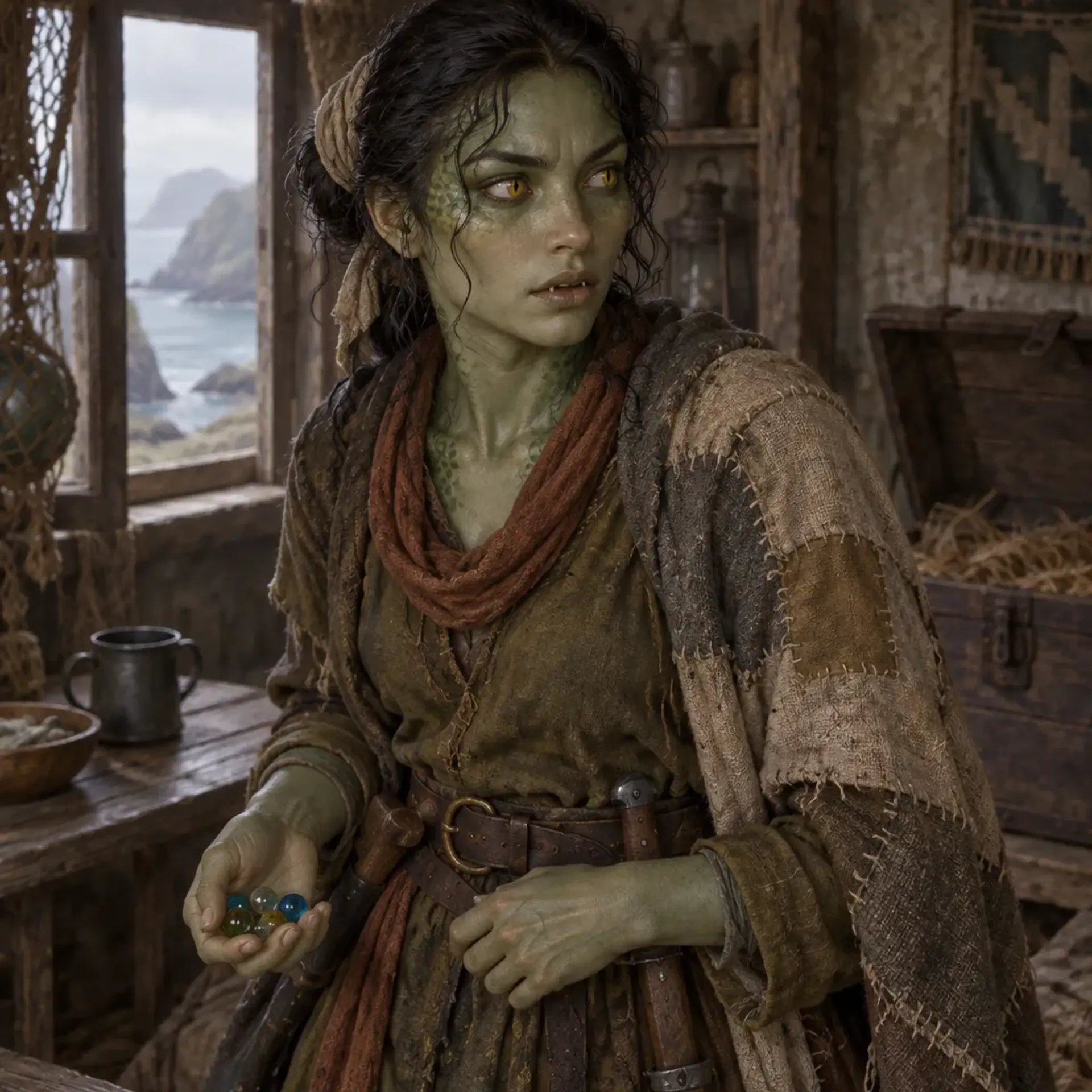
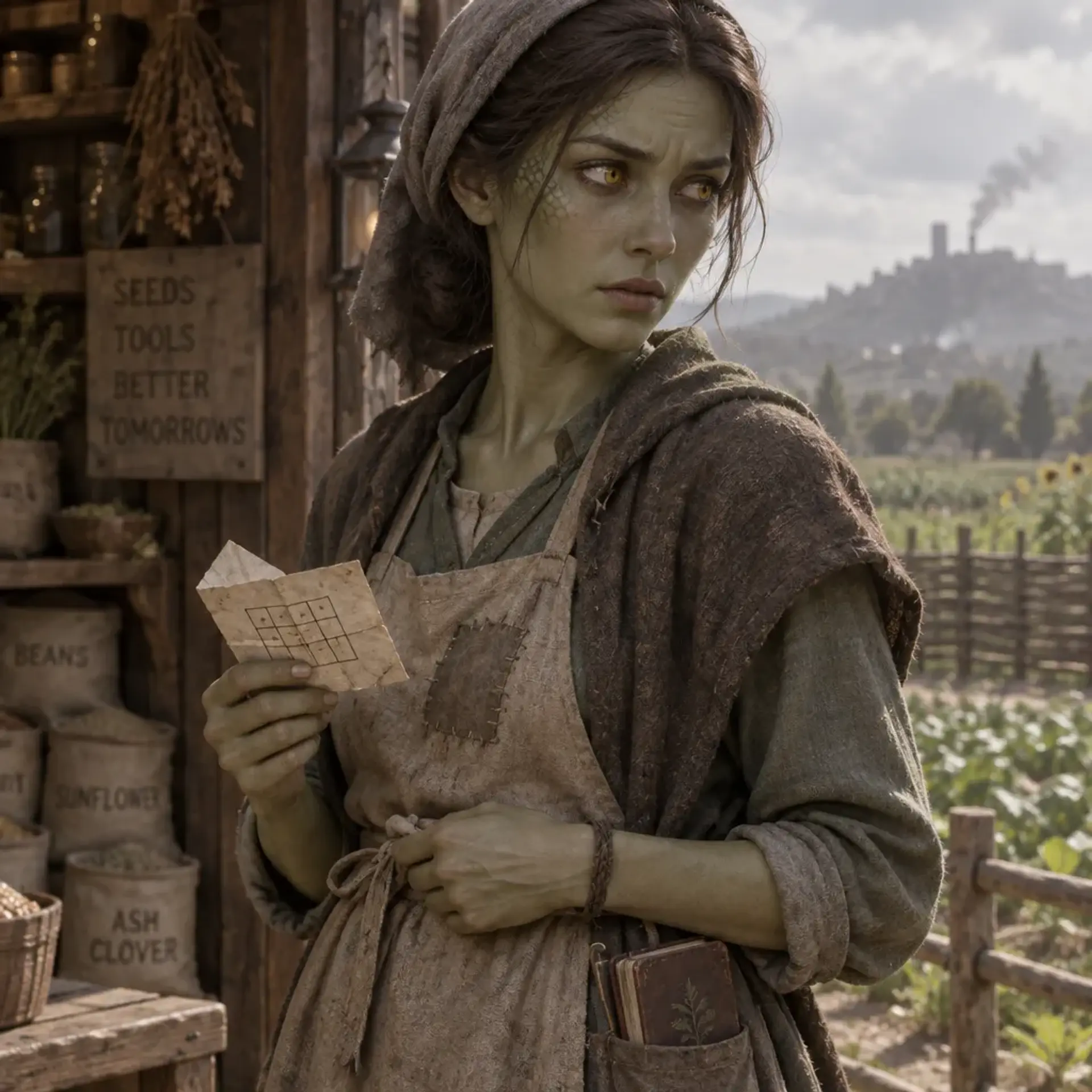
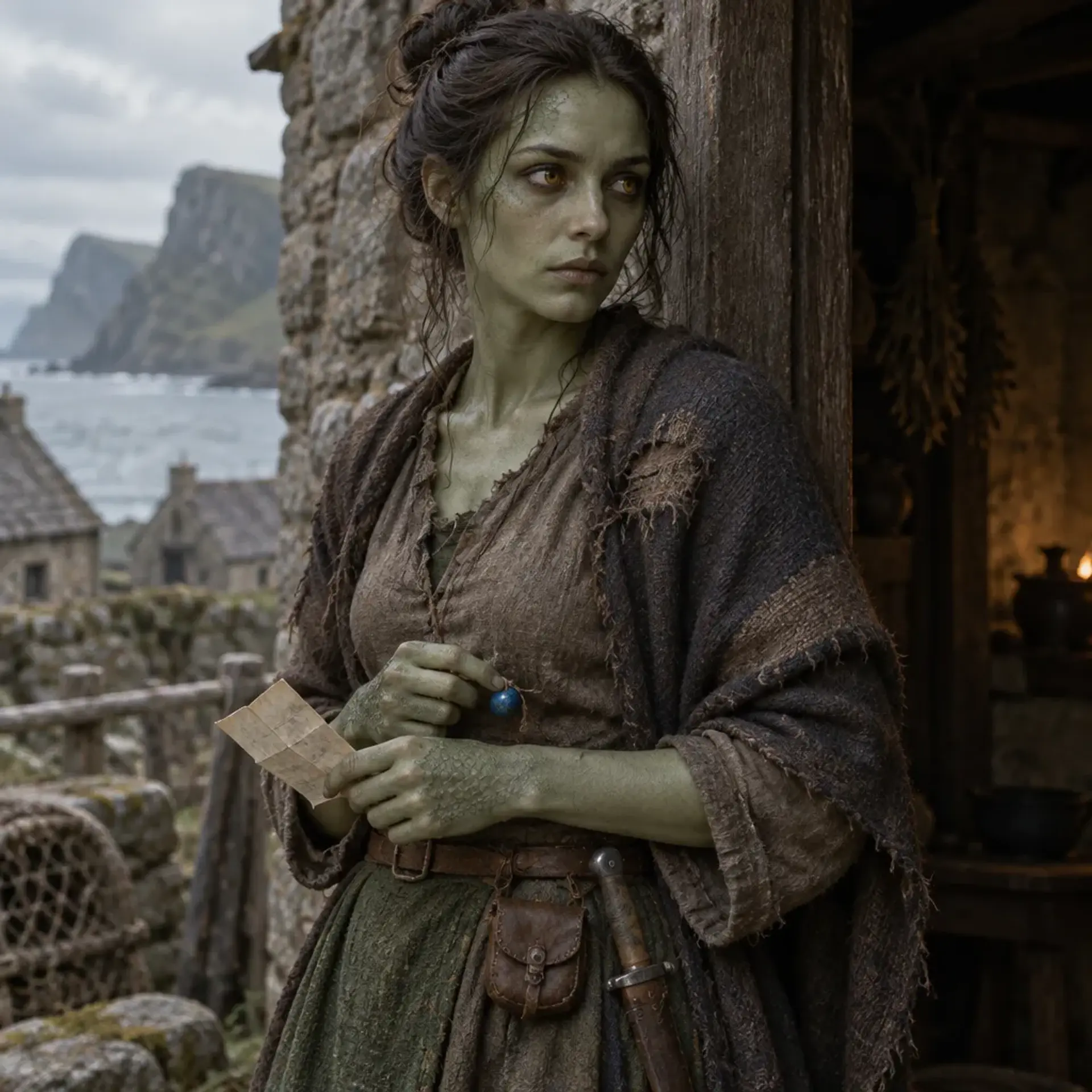
Marta is tall for a halfling-descended islander, with a predator's lithe frame and the poised stillness of someone accustomed to watching a field for trouble. Her pale green skin has a fine, matte texture, interrupted by small patches of close-set scales along her temples, shoulders, and the backs of her hands. Her face is narrow and plain at first glance, until her eyes catch the light: vivid yellow irises ringed in black, steady and startlingly animal. She moves with careful economy, placing each foot as if the ground might crackle under it. Her dark hair is usually bound in a workman's knot, with stray strands stiffened by ash. A chipped blue-glass bead, wrapped in old twine, is tied to her belt; its surface is rubbed nearly smooth on one side from her thumb. The unexpected detail is a habit of keeping a tiny folded paper puzzle in her pocket and working it with intense concentration whenever she is alone. She looks less like a celebrated omen than a tired young woman trying to make herself easy to overlook.
Clothing
A patched work tunic, a close-woven green-brown overskirt, and a weatherproof shawl that smells faintly of smoke. Her boots are repeatedly resoled at the toes. She carries a plain belt with a small knife, a pouch of seed, and the twine loop for her glass bead.
Body language
Marta keeps her shoulders angled toward the nearest exit without appearing ready to flee. She rubs the smooth side of her chipped blue-glass bead with her thumb, often without realizing she is doing it. When someone makes a claim about the eggs, her jaw tightens before her face goes still. Around her siblings, her movements become quicker and less guarded.
- Height
- 5 ft. 3 in.
- Build
- Tall, narrow-waisted, long-limbed, and wiry, with a light-footed, watchful bearing.
- Eyes
- Vivid draconic yellow with black rings
- Hair
- Dark brown, usually tied back in a workman's knot
- Skin
- Pale green, with a matte, fine-grained texture and sparse green scales
- Age
- Young adult, about 24
- Gender
- Female
- Size
- Medium
Distinguishing features
Personality
17 traits and drivesMarta is observant but not naturally suspicious of everyone; she prefers to assume people are busy, tired, or frightened before deciding they are cruel. She is private and self-effacing, yet stubborn about bodily autonomy and practical fairness. Before the eggs, she was content to let louder people lead so long as the work got done. Now that every pause and glance is interpreted as a sign, she finds herself speaking more firmly than she ever wanted to. She can be tender with her siblings and surprisingly dry with people who make grand claims about her. In ordinary company she uses humor to lower the temperature. When someone threatens her family, her humor vanishes and she becomes precise, naming exactly what she will not allow. Her restraint is not the same as calm. Marta feels fear quickly and deeply, but she has learned to keep it from becoming the loudest thing in a room. That makes her seem braver than she feels. She is generous with labor and cautious with trust, especially when help arrives with witnesses. She wants to believe that neighbors mean well, yet she watches what they do after the conversation ends. She dislikes being called special, but she is not immune to the pull of wanting the eggs to mean that the losses endured by her ancestors led somewhere good. She is ashamed of that hope, because it makes her feel she is agreeing to the very story she resents. With strangers, Marta is civil and economical, giving only the information needed to solve the immediate problem. With children and her siblings, she is more playful, capable of teasing and elaborate patience. With elders, she listens carefully but does not mistake age for certainty. When exhausted, she becomes literal and may answer an emotional question with a practical one. When frightened, she touches the bead at her belt and counts exits. When angry, she does not become gentle or quiet; she becomes direct, with a hard focus that unsettles people who expect her to be grateful for their attention. She wants closeness but dislikes being watched. She will accept a bowl of food left at the door more readily than an offer to sit beside her and discuss her feelings. Yet she notices every kindness and remembers who offered it without asking for a reward. Her deepest contradiction is that she wants the truth and fears what truth might demand of her. She believes people deserve honest choices, while withholding the one suspicion that might help others understand what happened. She knows this is unfair, but every time she tries to speak the words, she imagines the community seizing on them and making them a verdict. Marta is not meek, though she often chooses not to fight. She believes most conflicts become worse when people are humiliated in public, and she would rather create an exit than win an argument. But her patience has a boundary. If someone speaks of the eggs as communal property or treats her body as evidence, she will refuse plainly, even if refusal makes her less safe. Her courage is less a lack of fear than a refusal to let fear be the only decision-maker. She is still learning that she may ask for help before a crisis, and that protecting her family does not mean carrying every uncertainty alone.
- Alignment
- Neutral Good
Quirks
Habits
Traits · 4
Flaws · 4
Fears · 4
Wants and needs · 5
Combat
AC 10 · HP 11 · 30 ft.Marta avoids a fair fight. She tries to put a door, cart, or other obstacle between herself and an attacker, calls for help, and uses her knowledge of the settlement to lead people toward cover. If cornered, she swings a work hammer once to make space, then escapes. She does not attack to protect an abstract claim over the eggs, but she will put herself between an aggressor and a sibling.
Marta Eichenwald
Actions
Reactions
Services they sell
Rewards they can give
Equipment
- Work hammer (simple melee weapon)A worn, chipped hammer used for small repairs and, in desperation, self-defense.
- Belt knife (tool)A plain belt knife used for cutting cord, trimming roots, and preparing food.
- Blue-glass bead (personal keepsake)A smooth-sided chip of blue glass tied to old twine. Marta cannot explain why it matters so much to her.
- Pocket papers (personal effects)A folded scrap with crop notes, tide observations, and a small puzzle she works when she needs to occupy her hands.
Possessions
Background
Marta Eichenwald was born after the crossing, not during it, but she grew up inside the story of the shipwrecked halfling families who had crossed dragon-haunted wilderness to reach the island. The elders called the place a refuge. The children learned the less comforting version: the island had looked blessed from offshore, and then ash fell on the crops, sickness moved through the tents, and the survivors had to decide whether surviving meant they had been chosen or merely spared for later hardship. Her mother, Oda, worked the communal plots and kept a careful record of which beds recovered after each ashfall. Her father, Heddan, repaired fences and traps, though neither parent spoke much about the crossing. Marta had two older sisters, Brina and Efa, both Low-blood, and a younger High-blood brother, Tovin, whose adolescence has been difficult. His skin has developed small scales along his spine, and painful changes in his joints come and go without warning. Marta learned early to recognize the moment he was about to pretend he was fine. She would distract their neighbors, make a chore of carrying water, or sit near him without asking questions. She never thought of this as bravery. It was simply family work. Marta was unremarkable by local standards. She helped weed blighted crops, hauled baskets, and kept a small patch of hardy greens alive where the soil was least bitter. She preferred to be useful without becoming a story. The village had plenty of stories already: about the dragon whose territory had driven their ancestors across the wilderness, about whether the island was truly protected, and about the bloodline that gave some descendants scales, unusual appetites, or other changes. Marta's own traits were mild enough that people generally noticed her only when she was doing a job well. Her life altered over a season of strange behavior. She woke before dawn with ash on her tongue though the shutters were closed. She sometimes stopped in the middle of a sentence, listening to something nobody else could hear. For several weeks she dreamed of a low, warm pressure beneath the earth and of a voice that never used words. She began walking the outer shore alone. When asked why, she said she was checking the tide pools. This was not entirely untrue, but she never brought back anything she had gathered. Then she laid three eggs. There was no known sire, no courtship anyone could identify, and no explanation that satisfied even the people most eager to provide one. The eggs were found in a sheltered hollow lined with dry grass. They were small enough to cradle in two hands, with shells the color of pale stone and thin greenish tracery that appeared and vanished in changing light. Marta was frightened by the pain, more frightened by the silence afterward, and horrified when the first neighbors arrived. Word traveled faster than her family could close the door. The community reacted in competing ways. Some treated the eggs as a blessing that might prove the island had chosen their people. Others feared a curse, an illness, or an unknown dragon's claim. A few argued that the eggs should be moved to a shrine or guarded by the elders. Two families insisted that the event gave them a right to speak for the future of the settlement. Marta heard all of this while she was still trying to understand what had happened to her body. Her sisters kept the first visitors from crowding the house. Brina argued openly with anyone who called Marta a vessel. Efa, who is gentler in manner but no less stubborn, arranged for food to appear without making Marta ask. Their younger brother Tovin has been quieter since the eggs appeared. He fears that the adults' attention will turn from his own frightening changes, and he is ashamed of that fear. Marta knows this, and she has not yet found a way to tell him that his place in her life has not shifted. The eggs are now kept in a padded wooden cradle in the coolest room of the family home. Marta insists on checking them herself each morning, though she dislikes the attention that task draws. Their shells have not cracked. She does not know whether they are viable, whether they are a natural consequence of her ancestry, or whether somebody deliberately interfered with her. The last possibility terrifies her most because it would mean that someone had chosen her body as a place to make a point. There are clues, though none is conclusive. On the morning the eggs were found, Marta's blue-glass bead was missing from the twine at her belt. It turned up two days later in the grass beside the cradle, though she remembers touching it just before bed. One egg is faintly warm when the wind comes from the inland ridge. Marta also recalls, in fragments, a sound like a heavy wing closing during one of her strange dawn walks. She has theories about these details, but each theory leads to a name, a creature, or a revelation she is too afraid to say aloud. She worries that speaking a possibility will give it shape and invite it nearer. Her current problem is not merely what the eggs mean. It is who gets to decide what happens to them. The settlement needs cooperation to survive another failing harvest, and the eggs have become a symbol that every group wants to claim. Marta wants the community to endure, but she refuses to let gratitude, fear, or prophecy erase her own consent. She is gathering trustworthy witnesses and trying to learn what happened during the weeks she cannot remember clearly. Meanwhile, she continues practical work whenever she can, because a bucket still needs carrying and a field still needs tending, even when neighbors stare at her as if she has become an answer. Marta's formative experience was the night Tovin's adolescence first turned painful. His back cramped so badly he could not stand, and their mother was away at the distant well. Marta was young, frightened, and certain that any cry for help would bring a crowd. She stayed with him, cooled his skin with wet cloth, and kept talking about ordinary things until the pain passed. That night taught her that quiet care can matter more than a dramatic rescue. It also taught her to hide fear until the immediate need is met. Since the eggs appeared, that habit has become both her strength and her trap. She does not want to be a prophet, a mother-symbol, or a community's proof of divine favor. She wants the truth, a safe choice for the eggs, a way to protect her siblings, and the chance to return to a life in which people ask her about the crops before they ask what she has produced. She may be forced to accept that the mystery cannot be solved without confronting the very possibility she keeps refusing to name.
Role in the story
A central civilian in a mystery about three unexplained eggs. Marta is the person most directly affected and the person least willing to be turned into a symbol. Her observations can direct investigation toward natural, magical, or deliberate causes, but she does not know which explanation is true. Protecting her interests may require negotiating among worried families, elders, and would-be guardians while respecting her agency.
“Her mother, Oda, worked the communal plots and kept a careful record of which beds recovered after each ashfall.”
- Faction
- No formal faction. She belongs to one of the shipwreck-descended halfling families on the island and is caught between the settlement's competing claims over the eggs.
Known connections
Media
0 imagesNo images yet.
Turn Marta Eichenwald into a sheet
A high-res, share-ready sheet you can post or print.