Marta Eichenwald
Marta Eichenwald
At the table
Voice
A dry, lightly rough voice shaped by sea wind, smoke, and years of speaking over household work. Her breath is steady when she is focused; when startled, it catches audibly and she pauses to reset it. Her jaw works visibly when she is restraining anger, making her pointed teeth show at the corners of a tight mouth. Her name, Marta, comes out with a clipped, grounded firmness.
Marta speaks in a practical, measured way, with the slight rasp of someone accustomed to salt air and smoke. Her breaths are normally even, but when rattled they catch high in her chest and she has to deliberately let air out before continuing. She does not soften her voice when angry; her jaw tightens, her pointed teeth press together, and her sentences become short and exact. She pauses before answering questions about the eggs, as if checking each word for the story someone else might build from it.
Speech patterns
How to play them
Treat Marta as a person, not an omen. Ask before approaching or touching the egg chest, be honest about what you know, and offer concrete help rather than grand promises. She warms to patient listeners and people who make room for her family to speak. Threats, demands for access, or claims that the eggs belong to the community make her guarded and likely to call her sisters.
Goal
Learn what happened to her and the three eggs without letting the island's factions seize control of either her life or her family.
Motivation
To reclaim the right to decide what happens to her body and the eggs, while keeping her siblings and neighbors safe from panic or exploitation.
Appearance
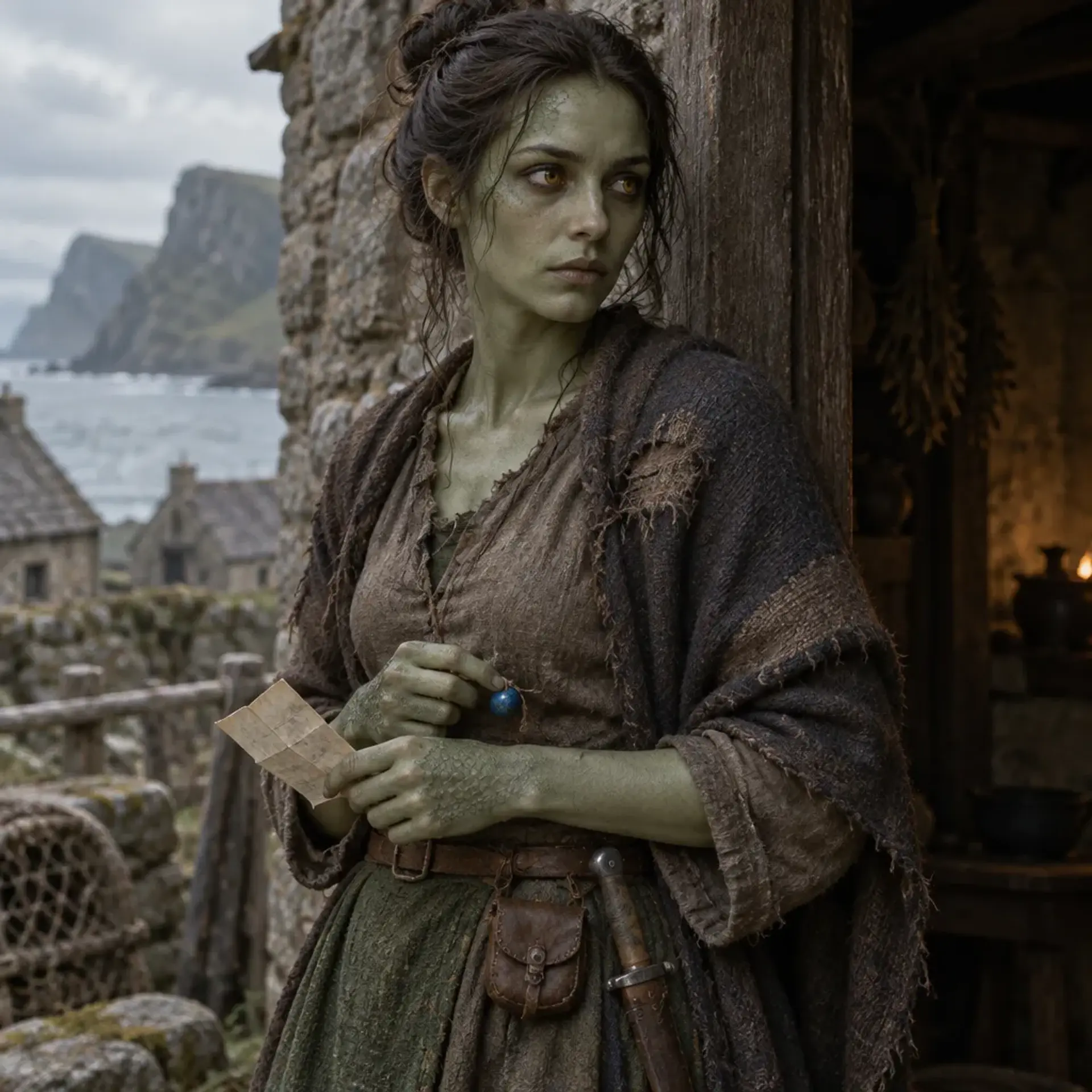
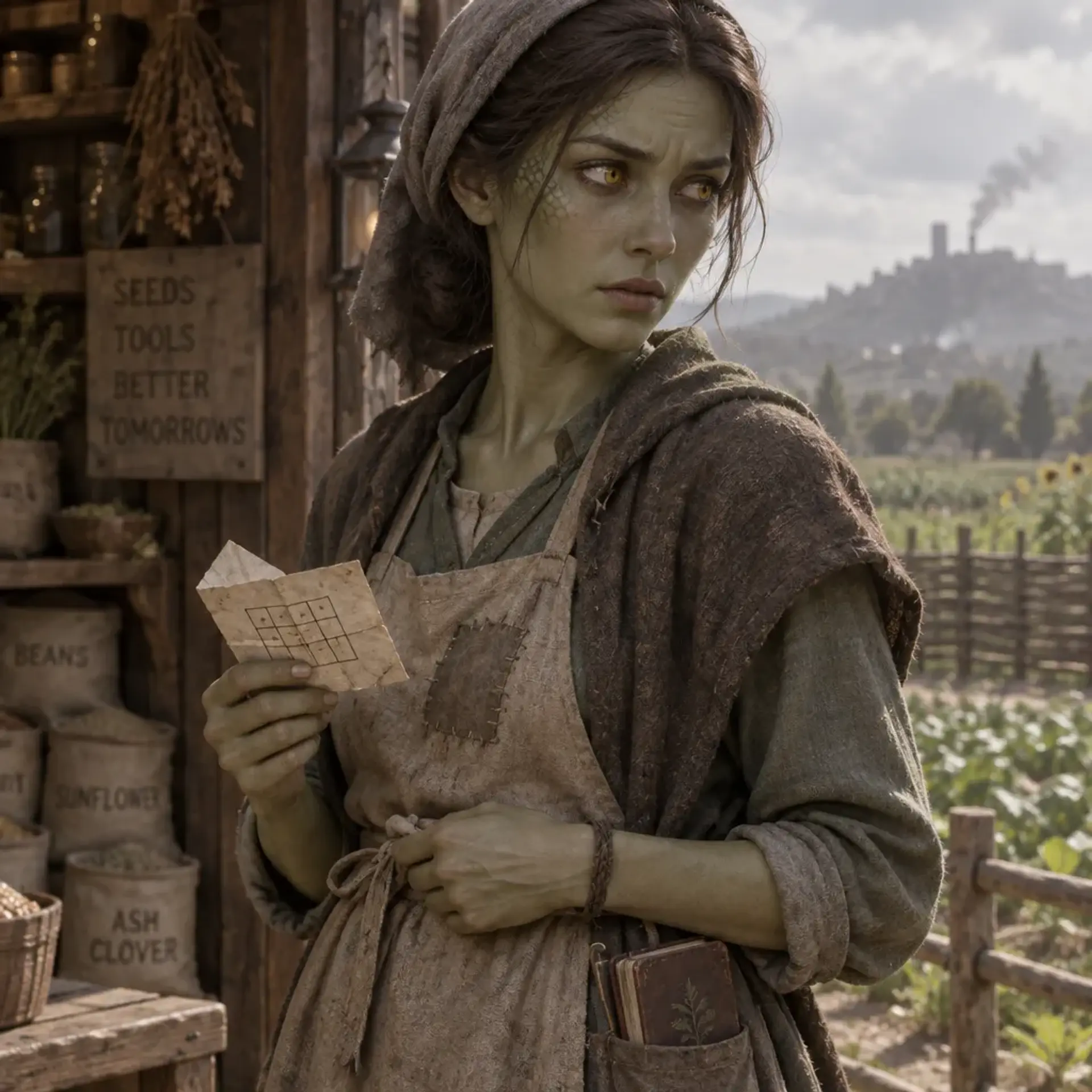
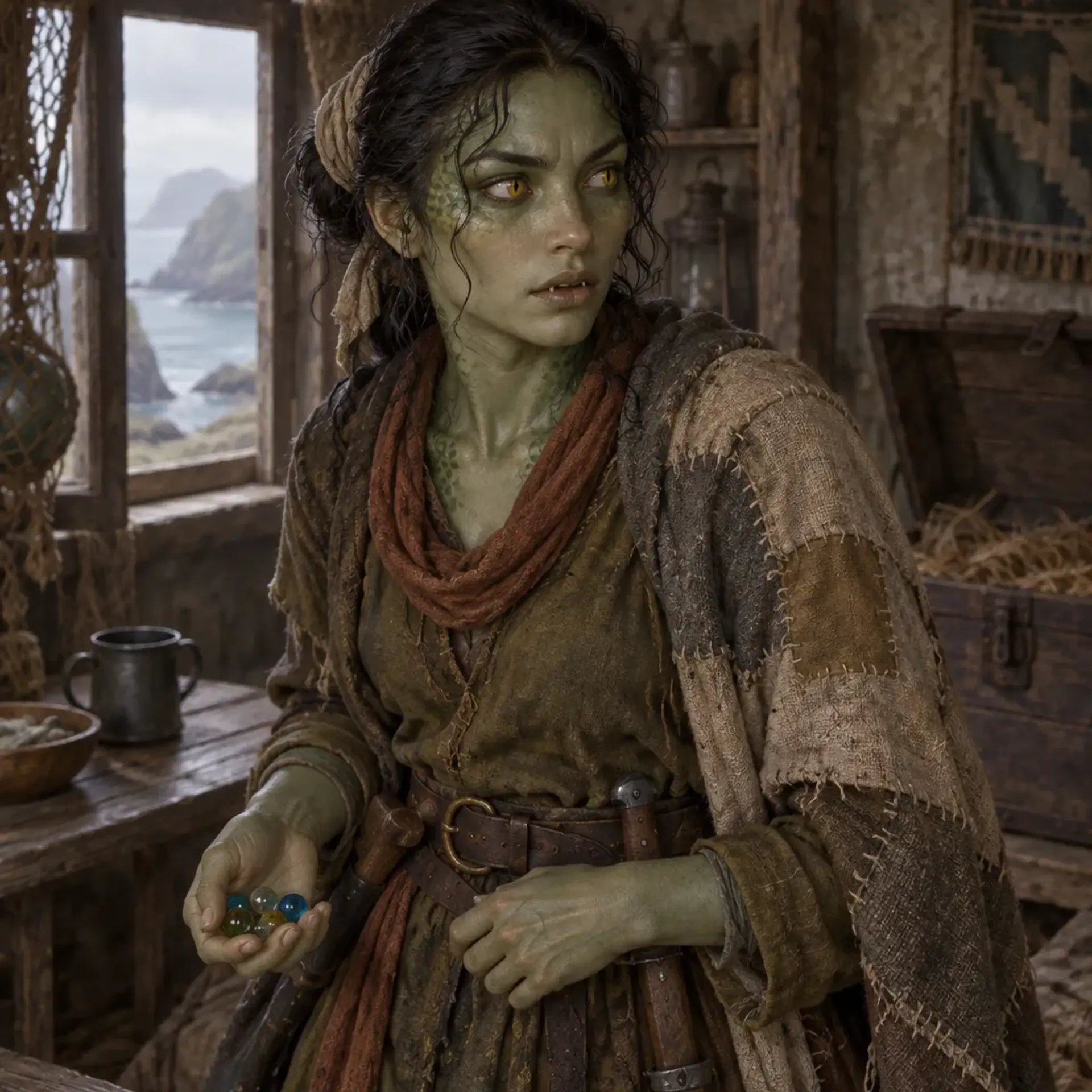
Marta has a predator's spare, lithe frame, all long reach and economical movement. Her pale green skin has the matte, slightly pebbled texture of young leaves after rain, with fine olive scales scattered along her temples, collarbones, and the backs of her hands. Her eyes are a startling yellow, their black pupils narrow in bright light; when startled, she fixes on movement before she looks at a face. She walks with her weight forward and her heels barely audible, a habit that makes people turn to find her already at their shoulder. Her jaw is narrow but strong, and small pointed teeth show when she bites through tough fruit or tries not to laugh. An unexpected detail: she keeps a pocketful of brightly colored children's marbles and sorts them by touch when she needs to think. Since the eggs, people who once found her unremarkable now stare as if every gesture might be an omen. She hates that more than she admits.
Clothing
A patched moss-brown work tunic, a faded rust-red scarf, a wide belt with a small mallet and utility knife, and a weatherproof cloak repaired with mismatched squares of sailcloth. She wears sturdy boots but often loosens them indoors, claiming she needs to feel the floorboards settle.
Body language
Marta's head turns toward small sounds before the rest of her body follows. She holds her shoulders low and her hands close to her sides, ready to move without looking as though she is preparing to flee. When cornered by questions, she presses her molars together until the points of her teeth show against her lower lip. If truly frightened, her breath catches high in her chest and she has to force herself to exhale before she can answer. She rarely points; she angles her chin toward what she means.
- Height
- 5 feet 8 inches
- Build
- Lithe and long-limbed, with a rangy strength built by carrying water, hauling wood, and walking uneven ground. Her movements are quiet and quick rather than graceful for show.
- Eyes
- Golden yellow with narrow black pupils
- Hair
- Dark brown, nearly black, usually tied back with a strip of sailcloth; loose strands curl around her temples in damp weather.
- Skin
- Pale green with a matte, faintly pebbled texture and scattered olive scales
- Age
- Young adult, approximately 24
- Gender
- Female
- Size
- Medium
Distinguishing features
Personality
16 traits and drivesMarta wants to be left alone, but she cannot watch someone in trouble without stepping in. She dislikes attention, yet she is stubborn about being heard when people make decisions that affect her. In ordinary company she is wry and observant, often more comfortable with a shared task than a heart-to-heart. With family she is protective, teasing, and sometimes impatient. Around elders or strangers who speak of her as a sign, she becomes precise and difficult to move: she will answer a fair question, then refuse the assumptions tucked inside it. When exhausted, her humor turns sharp. When afraid, she becomes practical, checking doors and counting supplies instead of admitting she is frightened. She does not confuse kindness with trust, but she notices who offers help without asking for a story in return. She is curious about the eggs and privately desperate to know their origin, while resenting the way curiosity from others has become entitlement. Marta can be generous with food and labor, yet possessive of information; she tells herself she is protecting her family, though sometimes she is also delaying a choice she fears making. She is neither a natural leader nor willing to be led blindly. Her strongest instinct is to keep people alive until they have time to think.
- Alignment
- Neutral Good. Marta wants to protect her family and community, but distrusts anyone who treats her as a symbol rather than a person.
Quirks
Habits
Traits · 4
Flaws · 4
Fears · 4
Wants and needs · 4
Combat
AC 12 · HP 9 · 30 ft.Marta avoids a fight if there is any other option. She tries to put a barrier between attackers and her family, calls for help, and uses the room's furniture or a doorway to make escape possible. If forced to fight, she swings her work mallet once to create space, then retreats. She is not a trained combatant and has no special draconic attacks.
Marta Eichenwald
Actions
Reactions
Services they sell
Rewards they can give
Equipment
- Work mallet (weapon)A short-handled mallet with a smooth, darkened grip, used for household repairs and as a weapon in desperation.
- Handaxe (weapon)A simple handaxe for roots, kindling, and rough carpentry.
- Traveling work gear (adventuring gear)A patched cloak, utility knife, water flask, and a few scraps of dried food.
- Egg chest (personal possession)A small wooden chest lined with clean straw, used to keep the three eggs sheltered. It is not magical or especially secure.
Possessions
Background
Marta Eichenwald was born on the island after her parents' generation crossed a dragon-haunted wilderness in a flotilla of battered wagons and borrowed boats. The halfling families who made that crossing had been shipwrecked far from any safe harbor, then driven inland by ashfall, hungry predators, and rumors that a green dragon watched the valleys. They found the island at last and called it blessed because its springs ran clear and its sheltered coves seemed to promise a beginning. The blessing did not last. Ash poisoned the first planting; a sickness followed, taking children and elders before the families learned which low ground flooded and which wells turned foul after rain. Marta grew up among people who survived by treating hope as useful, but never as proof. Her mother, Ilse, mends nets and knows every tidepool where edible shellfish can still be found. Her father, Branik, repairs roofs and keeps a careful tally of the community's seed stores. Marta is the third of four children. Her older sisters, Anja and Lotte, are Low-blood and have both built lives that draw little attention: Anja keeps the shared smokehouse, while Lotte runs messages and supplies between scattered households. Her younger brother, Timo, is High-blood and entering the difficult adolescence common among Ashenbough High-blood. His scales are coming in unevenly, his appetite swings from ordinary to alarming, and he has begun waking with cramped shoulders and a temper he cannot explain. Marta knows how it feels to be watched for changes before she understands them herself. She tries to help him without making him feel like a problem to be solved. Before the eggs, Marta's life was ordinary by design. She hauled water, tended a small patch of hardy beans, and worked with her sisters to gather driftwood and salvage useful timber after storms. She was good at tasks that required patience and disliked public arguments. When the island's neighbors disagreed over access to a spring, Marta was usually the person who carried a message between them, not the person who stood on a crate to deliver it. She liked being known as reliable rather than remarkable. In private she collected marbles, buttons, and smooth bits of colored glass, little bright objects she could sort when her thoughts would not settle. The first change came during the end of the ash season. For several weeks Marta slept badly. She woke with a dry mouth and a faint taste of metal, then walked outside before dawn and stood facing the eastern ridge. Some mornings she returned carrying a stone or a twig she did not remember picking up. She began refusing certain foods, especially eggs and smoked fish, while craving sour berries and warm broth. Once, she told her mother that the rain sounded like someone tapping from inside a wall. When asked what she meant, she could not explain. She kept working and insisted she was merely tired. Her family had seen High-blood adolescence cause strange appetites and moods, and they did not want to turn ordinary discomfort into a spectacle. Then Marta laid three eggs. It happened in the family home, in the hours before sunrise. Ilse heard her daughter calling from the little room where Marta slept and found her frightened, shaking, and unable to say what was happening. The eggs were there afterward, three of them, warm and intact. Their shells were dull green-brown with faint, irregular marbling. They did not resemble the eggs of any animal kept on the island, but no one could agree on what they did resemble. There was no known sire. No one had seen Marta with a lover, and she had made no claim about one. She was examined by the community's healers and questioned by its elders; no examination gave a certain answer. The event might be natural, magical, or the result of deliberate interference. It might be something nobody on the island has language for. Marta remembers fragments from the days around it: the tapping sound, a dream of standing under branches with no leaves, and the sensation of being watched from a height. These fragments do not prove anything, and she refuses to let other people stitch them into a story on her behalf. She has private theories. One frightens her because it could mean someone used her without her knowledge. Another is so strange that speaking it aloud would make it feel real. The third would put a living person she loves under suspicion. She has told no one which theory she finds most convincing. The eggs changed her standing overnight. Some families see them as a promise that the Ashenbough bloodline is changing in a way that could help the community survive. Others fear a dragon's influence, an illness, or a threat that could bring danger to the island. A handful of people have tried to claim authority over the eggs, each for a different reason. One elder wants them kept in a guarded room until they hatch. A practical-minded neighbor wants them moved away from the crowded settlement. A stranger from a passing ship offered supplies in exchange for permission to study them, then left when Marta refused. Even people who mean well ask her questions as though she were a shrine that might answer back. Her sisters have taken different roles in the uproar. Anja stands between Marta and anyone who tries to enter the family home without permission. Lotte asks questions in the surrounding settlements and passes along rumors, but she has not told Marta everything she has heard. Their younger brother Timo is both fascinated and hurt that the whole community has begun watching Marta's body while he struggles with his own High-blood changes. Marta tries to reassure him, but the attention has made her impatient, and once she snapped that at least nobody was calling his growing scales a prophecy. She apologized. He has not quite accepted it. Marta's parents want to keep the family together, though their approaches differ. Ilse believes the eggs should remain near Marta, where she can care for them and decide what happens next. Branik worries that their home has become a target and wants the family to move them somewhere defensible. Neither is sure what safety means when the threat might be rumor, magic, or a person pretending to help. Marta has begun keeping watch at night, although she is not a trained guard. She checks the shutters, listens for footsteps, and sits with a hand on the little wooden chest where the eggs rest in straw. She does not know whether they need warmth, quiet, or anything at all. A formative experience came when she was thirteen. A storm destroyed the family bean patch, and a fever took her aunt within the same month. Marta had watched the adults argue over whether the island's supposed blessing had failed them. Her aunt, feverish and lucid between bouts, told her that surviving a disaster did not mean the disaster had chosen them for a purpose. Marta took that lesson seriously: people could make meaning from hardship, but meaning was not evidence. She learned to help first and interpret later. Now the eggs have placed her at the center of exactly the kind of story she distrusts. Marta wants the eggs protected, but she does not know whether protection means hiding them, studying them, or letting them remain where they are. She wants the community to stop treating her as proof of whatever it already believes. She also wants to know what happened, even if the answer will hurt. Her immediate problem is practical: there is not enough food for a long crisis, the island's old sickness has returned in isolated cases, and people are already using the eggs to argue over who should make decisions for everyone. Marta is quietly building a list of people she trusts to keep a confidence, a list that changes whenever someone speaks of her as if she were absent. At present she remains in the family's crowded house, doing chores when she can and refusing to leave the eggs unattended for long. She will speak to travelers who approach without demands, especially those willing to help with food, medicine, or keeping the peace. She does not ask anyone to believe that the eggs are miraculous. She asks them not to decide what they mean before she has had the chance to find out whether they mean anything at all.
Role in the story
A living mystery at the center of a community's competing hopes and fears. Marta can become a cautious ally, a person the party must protect from factions, or the one who insists that the investigation begin with her consent. The eggs are not automatically magical, prophetic, or dragon-bred; their nature remains an open question for the game.
“They found the island at last and called it blessed because its springs ran clear and its sheltered coves seemed to promise a beginning.”
- Faction
- No formal faction. Marta belongs to the Eichenwald family and is caught in the island community's competing claims over the eggs.
Known connections
Media
0 imagesNo images yet.
Turn Marta Eichenwald into a sheet
A high-res, share-ready sheet you can post or print.