Marta Eichenwald
Marta Eichenwald
At the table
“I can tell you what I know. I will not dress guesses up as answers.”
Voice
Her voice has a faint rasp from ash and outdoor work, with a grounded, matter-of-fact cadence. She places emphasis on concrete nouns and measured details, not grand declarations. When she says Marta Eichenwald, she gives her own name the same straightforward weight she gives a tool or a weather report.
Marta speaks in a practical, unhurried voice with a dry rasp from years of dust and field air. Her words are plain and well chosen; she often pauses to decide whether a statement is something she knows or only suspects. When she is frightened, her sentences grow more detailed rather than softer. When angry, she speaks quickly, with the clipped precision of someone listing evidence.
Speech patterns
How to play them
Treat Marta as a person before treating her as a mystery. Ask what she has observed and what she wants before offering theories. She responds well to practical help, especially help that leaves decisions in her hands. She becomes guarded if someone proposes taking the eggs, displaying them, or making her a symbol without her consent.
Goal
Keep the three eggs safe without surrendering control of her life, and find out whether their appearance is connected to the island's ash sickness or to deliberate interference.
Motivation
Marta wants agency, safety for the eggs and the settlement, and the truth about the strange events without letting any one answer become an excuse to take control of her.
Appearance
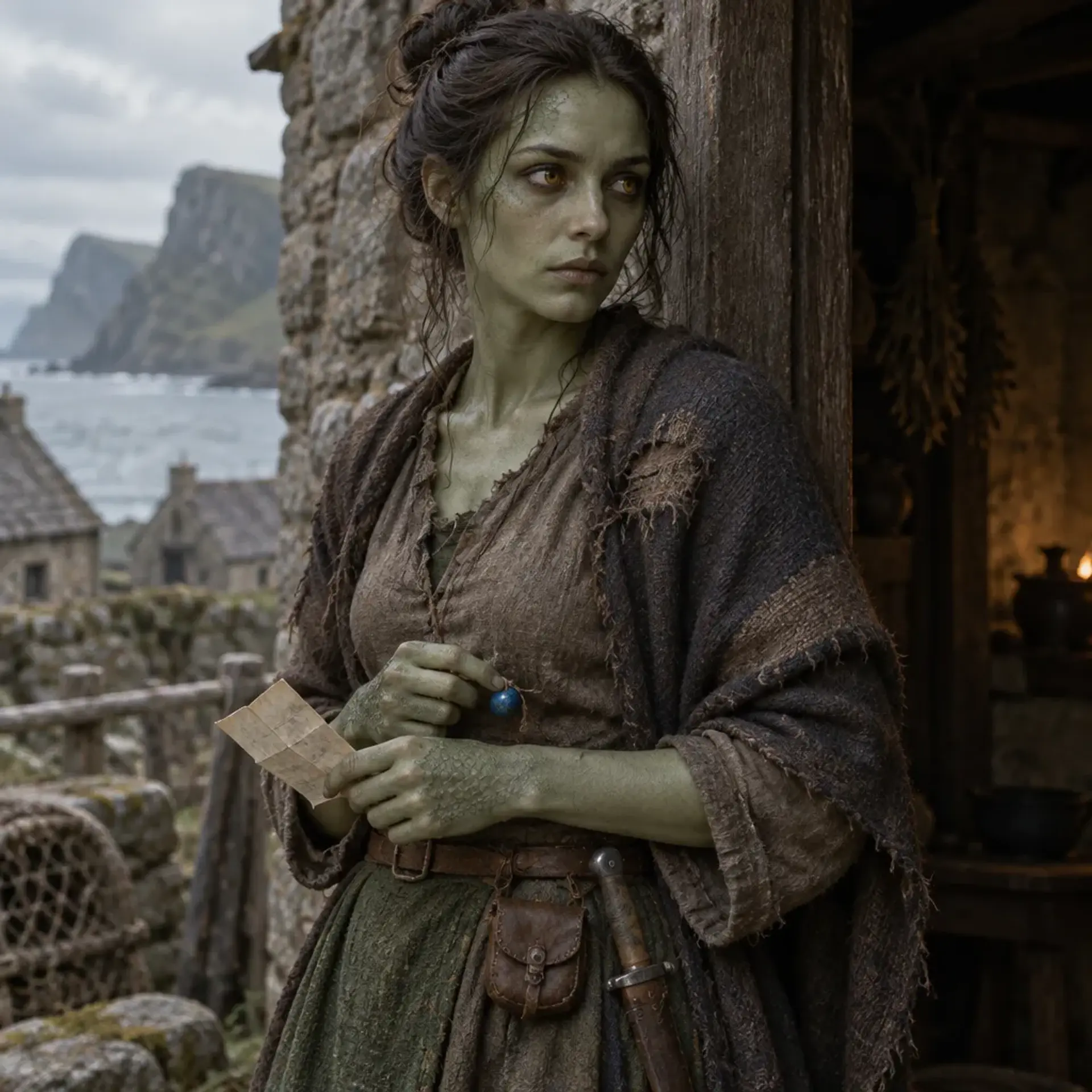
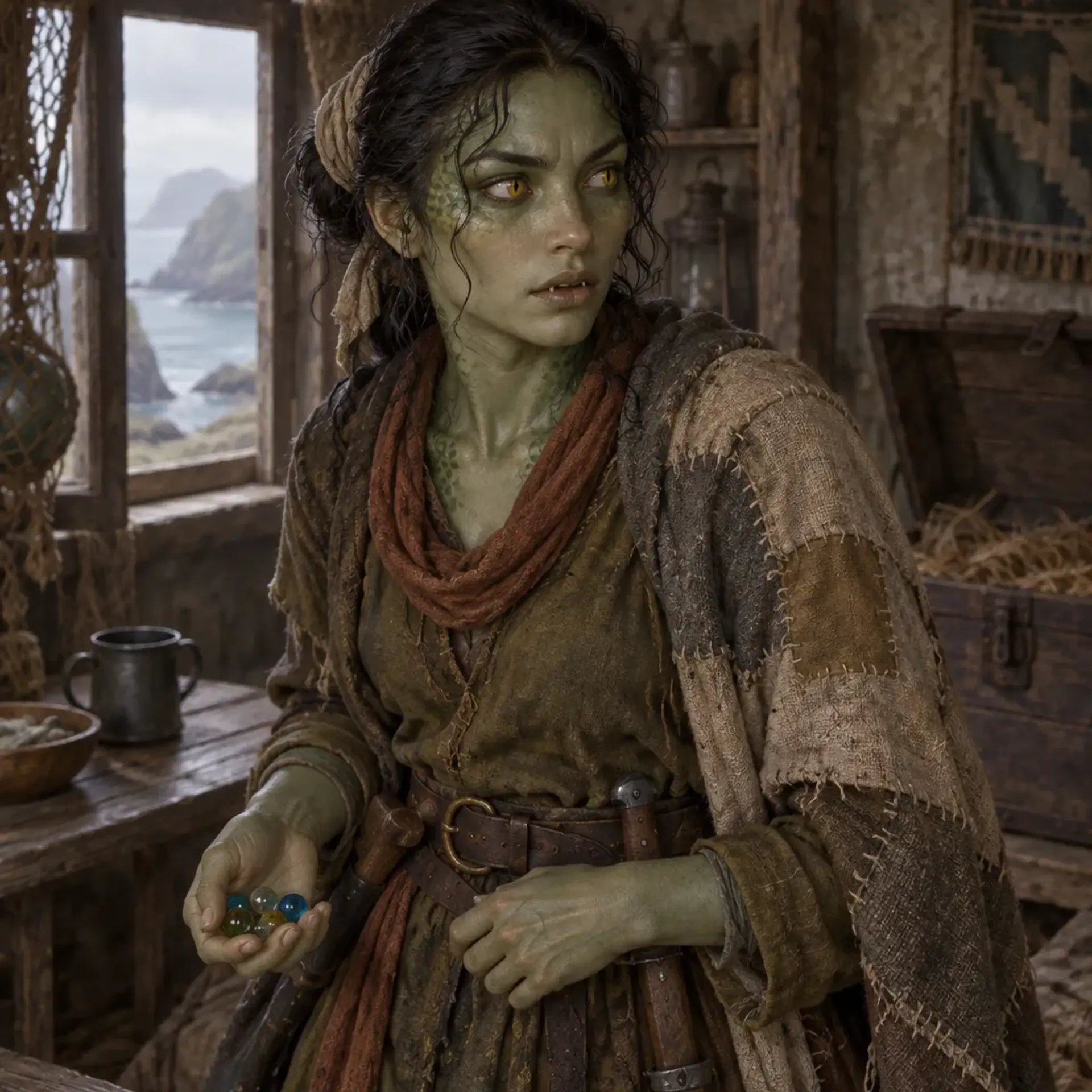
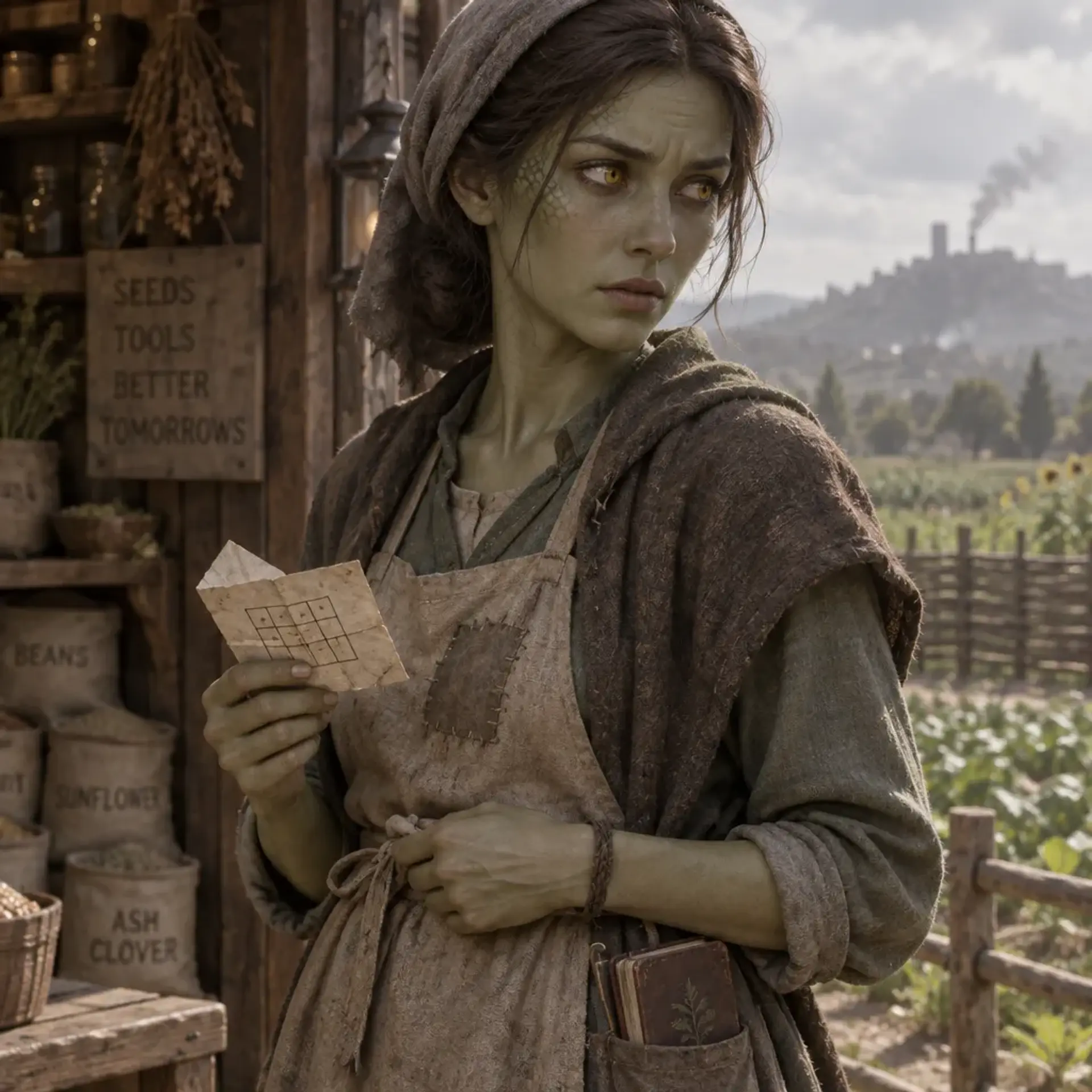
Marta looks as if she was made to pass unnoticed until she stands still. She is tall for a woman of her community, narrow through the waist and shoulders, with a predator's economical balance: each step lands quietly, and her head turns before the rest of her body follows. Her pale green skin has a weathered, slightly waxy cast, its surface roughened at the knuckles and browned faintly by years under an ash-bright sky. Small scales lie flat along her temples and disappear beneath her collar; more form a faint ridge down her ribs. Her yellow eyes have round black pupils, and seem brighter when she is frightened. Her dark hair is usually tied low with whatever cord is handy. She has no grand bearing, no ceremonial ornament, and no theatrical draconic display. People remember instead the way she unconsciously checks the knots of her apron and the impression of a patient animal deciding whether it needs to bolt. The unexpected detail is that she keeps a little folding paper puzzle in her pocket and works it with intense concentration whenever someone argues over her future.
Clothing
A weather-stained work dress beneath a patched apron, a wool wrap for cold nights, and a hood she can pull up when ash blows. Her clothes are mended neatly but without decoration. She wears a cord bracelet from her mother and carries a small paper puzzle tucked into an inner pocket.
Body language
Marta holds her shoulders slightly forward and keeps her weight balanced on the balls of her feet. She rubs a thumb over the apron knots when anxious, then catches herself and folds her hands. She watches exits without seeming to, and the scales at her temples lift subtly when she is startled.
- Height
- 6 feet 1 inch
- Build
- Tall, lean, and lithe, with a careful, balanced way of moving.
- Eyes
- Golden yellow with round black pupils
- Hair
- Dark brown, usually tied low and tucked beneath a hood
- Skin
- Pale greenish, weathered and faintly roughened by ash and outdoor work
- Age
- Young adult
- Gender
- Female
- Size
- Medium
Distinguishing features
Personality
16 traits and drivesMarta wants to be useful and wants, just as fiercely, to be left alone. She believes careful attention can keep people safe, yet she dislikes being treated as the cleverest person in a room because that usually means everyone is waiting for her to solve their fear. In calm company she is dryly funny, good at noticing small comforts, and willing to let silence stretch without filling it. Around the eggs she becomes protective and exacting, correcting anyone who calls them omens as if they were already dead objects. When people are frightened, she listens first and offers practical help; when they grow controlling, her patience turns into a hard, clipped refusal. She is tender with children and awkward with praise. She can resent the attention the eggs bring, then feel ashamed of that resentment and overcompensate by checking on them again. Marta has an instinct for watching people but not an easy talent for trusting them. She knows that certainty is often a disguise for fear, yet she sometimes treats every confident explanation as a threat. Her sense of responsibility is real, but it can become a hiding place: if she is busy carrying water, counting seed, and checking the basket, she does not have to admit how frightened she is of what the eggs may mean. She misses the quiet life she had before, and she also recognizes that silence can shelter injustice. Her hardest choice is not between believing or disbelieving in a miracle. It is deciding how much of herself she can give to a community that is frightened, hungry, and already arguing over what belongs to whom.
- Alignment
- Neutral good
Quirks
Habits
Traits · 4
Flaws · 4
Fears · 4
Wants and needs · 4
Combat
AC 10 · HP 9 · 30 ft.Marta avoids a fight and tries to get others to safety. If cornered, she puts furniture or a doorway between herself and an attacker, uses a nearby tool defensively, and flees as soon as there is an opening. She will risk herself to protect the eggs or a child, but will not pursue a retreating foe.
Marta Eichenwald
Actions
Reactions
Services they sell
Rewards they can give
Equipment
- Hoe (tool)A worn wooden-handled hoe, useful for work and an improvised defense.
- Egg-care supplies (supplies)A small pouch of cloth, twine, and clean scraps used to keep the eggs' basket warm and secure.
- Field notebook (personal item)A weatherproof notebook with observations about the ash, fields, water, and sickness.
- Paper puzzle (keepsake)A little folded paper puzzle, creased and re-creased at its corners.
Possessions
Background
Marta Eichenwald was born during the first winter after the halfling families reached the island. The crossing had taken them away from a dragon-haunted wilderness, where the smoke of distant lairs darkened the horizon and the trails were too dangerous for children to travel alone. The island seemed like an answer to their prayers: sheltered coves, a spring of clear water, and soil deep enough to swallow a seed. People called it blessed before they had learned its seasons. Marta grew up in a settlement of patched roofs, shared kitchens, and long arguments about whether the next year would finally be easier. Her mother, Hella, kept the communal seed stores and could name every family that had contributed a handful. Her father, Beren, repaired nets and quietly took in any child who arrived at supper late. Marta was not remarkable. She carried water, weeded rows, and learned to read the weather by watching the ridge. She liked work with a clear end and people who did not make a spectacle of themselves. As a girl she was proud of being dependable, the sort of person whose name came up only when something had gone right. Then the island's harvest failed. A grey fall of ash covered the fields, and a sickness followed it through the grain. Stalks blackened at the roots. Children developed a rasping cough. The elders blamed the island's bad temper, then one another, then the dragon stories brought over from the mainland. Marta's formative experience came during the worst week, when her younger cousin Nessa collapsed beside an irrigation ditch. Marta carried her to the settlement herself, through dust that stung her eyes and turned her mouth bitter. Nessa recovered, but Marta saw how quickly fear could make neighbors into accusers. She began keeping careful notes about which fields had been dusted first, where the water ran, and who had reported symptoms. She discovered that one low plot smelled sharp and metallic after the ash, while other ground did not. Her observations did not solve the sickness, but they helped the community stop using one contaminated ditch. The crop failure changed her from a quiet worker into a quiet watcher. She learned that people listened more readily to a person who could say exactly what she had seen than to one who claimed to know what it meant. In the years afterward, Marta worked wherever she was needed: tending sick neighbors, sorting seed, repairing fences, and helping Hella keep the stores honest. She was not a healer, but she learned which questions to ask before an argument turned into a mob. She became fond of the island's ordinary routines, even when they were hard. She had a place at the drying racks and a small room with a window facing the water. She expected her life to continue that way. Then she began sleeping badly. For several nights she woke before dawn with her jaw clenched and a strange mineral taste in her mouth. She walked in her sleep once, according to her mother, and stood beside the old cistern with both hands pressed against the stones. Marta remembers none of this. She did remember the day she went to the settlement's midwife with a sharp pain and returned with the impossible knowledge that she had laid an egg. Then another. Then a third. No one knew of a sire. Marta had not been with anyone. The eggs were warm, leathery, and marked with irregular pale flecks, unlike anything the island's hens laid. The discovery made an ordinary young woman into a public question. Some called the eggs a sign that the green dragon's gift had awakened in her. Some said they proved the island itself was changing. Others claimed a hidden parent, a curse, or deliberate tampering. The families that had lost children to the crop sickness began asking whether the eggs might contain a cure, a warning, or a threat. Marta was horrified less by the eggs than by how quickly others began speaking as if she had ceased to be a person. Her mother wanted to keep them inside the family home. The midwife, Sada, argued that they needed expert care. A persuasive local speaker, Orum, proposed placing them in the meeting house so every family could witness them. Marta refused. The disagreement fractured old friendships. Hella now sleeps beside the basket, while Sada keeps a careful record of the eggs' temperature and appearance. Beren tries to calm the neighbors by mending whatever they break in the arguments, but Marta sees how tired he has become. Her closest friend, Jun, is a fisher who brings her news from the shore and refuses to call the eggs holy or monstrous. He is the only person who still asks whether she has eaten. The immediate problem is practical as well as political. The eggs need warmth and protection, but the settlement has no safe incubator, and the old stone storehouse where Marta proposed placing them sits near a crack in the ground that has begun to vent warm, sulfurous air. The ash sickness has not vanished. A few people now believe the eggs are connected to the poisoned fields, and someone has been leaving scraps of ash at Marta's door. Marta suspects that at least one person in the settlement knows more about the strange nights before the eggs appeared. She cannot prove it. She has begun visiting the cistern again, not because she believes it will answer her, but because she needs to know whether something was done to her without her consent. She is torn between protecting the eggs and refusing to let them become an excuse for anyone to control her. Each egg is alive, as far as she can tell. She has not decided whether that means she is their mother, their keeper, or merely the person the mystery happened to. For now, she wants the community to survive the coming season, her family to remain whole, and the eggs to be treated as living things rather than symbols. She still misses being unremarkable. She also knows that if she turns away, someone else will decide what her life means.
Role in the story
A grounded civilian at the center of a community's competing hopes and fears. Marta can connect the characters to the settlement's crop failure, local relationships, and the mystery surrounding the eggs, while insisting that the people affected get a say in what happens next.
“The island seemed like an answer to their prayers: sheltered coves, a spring of clear water, and soil deep enough to swallow a seed.”
- Faction
- No formal faction. Marta is part of the shipwrecked halfling settlement and is increasingly caught between those who want the eggs kept private and those who want them made a public sign.
Known connections
Media
0 imagesNo images yet.
Turn Marta Eichenwald into a sheet
A high-res, share-ready sheet you can post or print.