Marta Eichenwald
Marta Eichenwald
At the table
“A name is not an explanation.”
Voice
Her voice is clear but a little rough at the edges, with the dry catch of someone used to speaking across a field or through a room full of worried people. A small rasp comes through when she is tired, likely from ash and long days outdoors. She projects when giving practical directions; in close conversation she keeps her voice steady and matter-of-fact. The name Marta Eichenwald has a plain, worn-in sound when she says it, as if introducing herself is another task to finish before work begins.
Marta speaks in a grounded, working cadence shaped by years of giving instructions over wind, water, and household noise. Her words are direct, with little ornament; she pauses to find the most accurate concrete detail rather than reaching for a grand explanation. Her vowels carry the rounded, practical rhythms of her family’s island community. When anxious, she counts facts aloud. When amused, a rough breath catches in her chest before the laugh comes out.
Speech patterns
How to play them
Begin with practical help rather than questions about the eggs. Marta responds well to people who respect boundaries, share useful observations, and admit what they do not know. She becomes guarded when visitors announce a prophecy, demand access to the eggs, or treat her as a symbol. A character who helps the sick or investigates the ash without making promises can earn her trust. If approached gently, she will share her notes and ask for help testing one small, specific theory.
Goal
Keep the three eggs safe, find out why the eastern crops and residents are falling ill, and help Noll survive without surrendering her choices to frightened neighbors.
Motivation
Marta wants to protect what depends on her without letting fear, superstition, or community need erase her own judgment. Beneath that, she wants to make a home where a child can be strange or sick without being treated as a warning.
Appearance
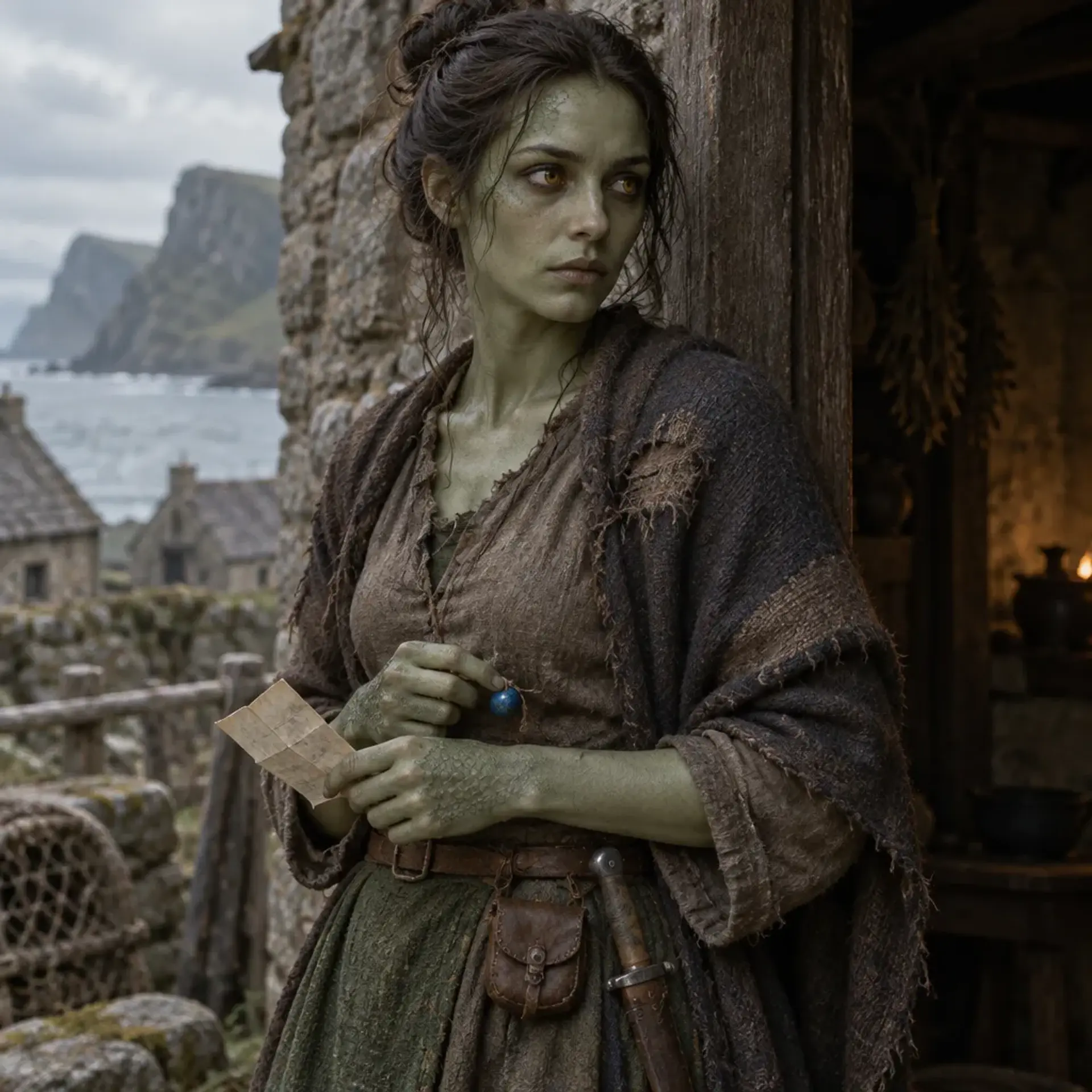
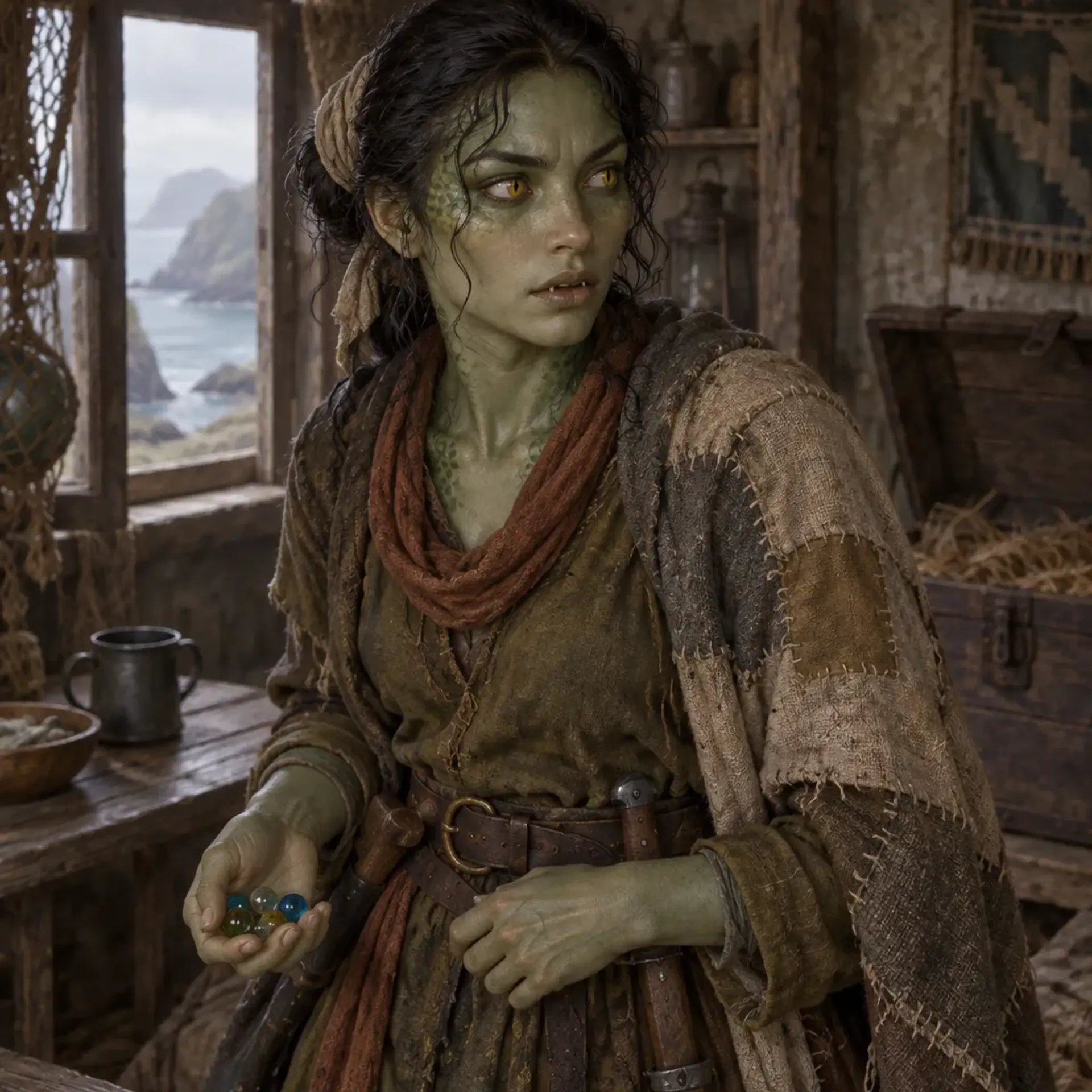
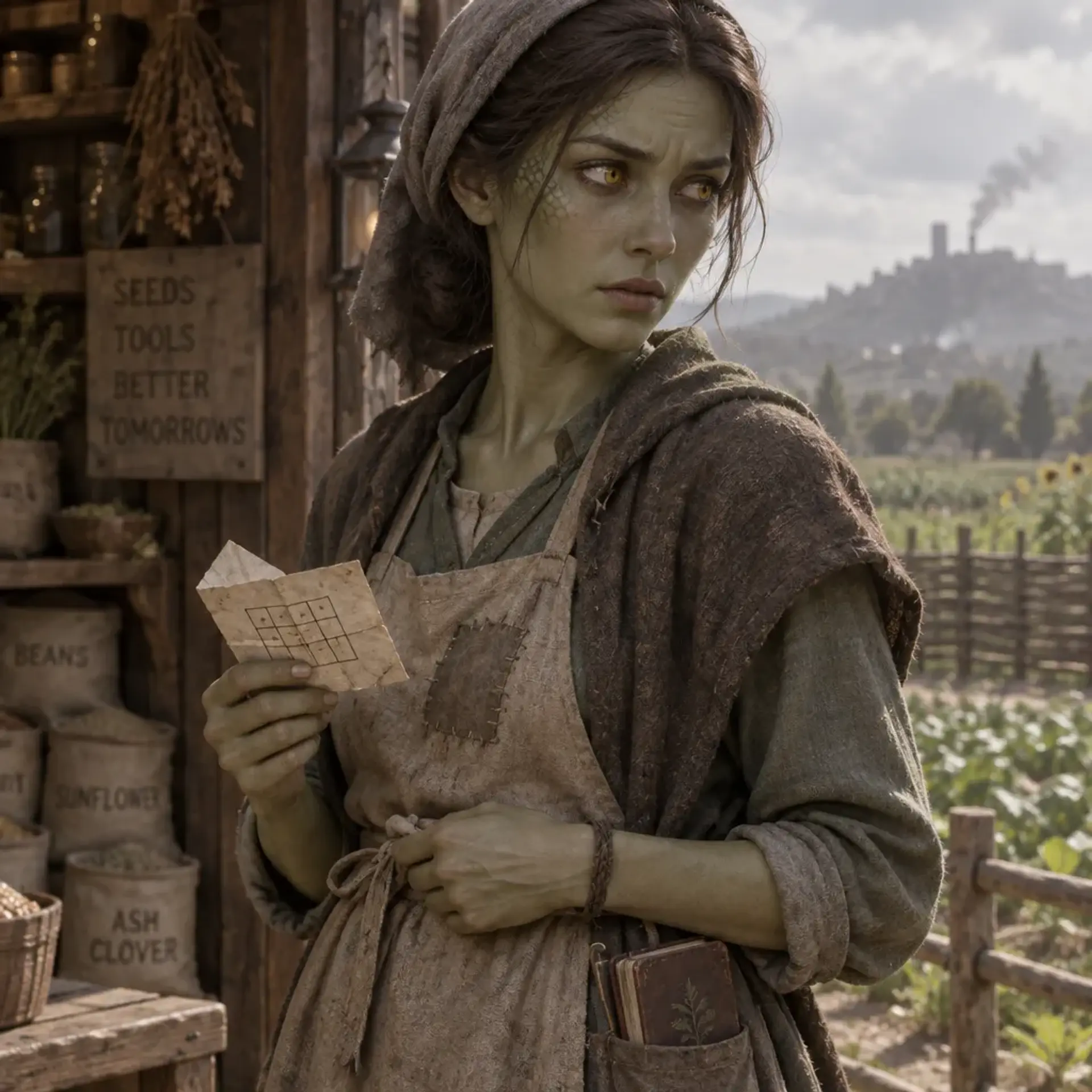
Marta is a tall, broad-shouldered young woman whose greenish skin has the matte, slightly waxed look of a leaf after rain. Small scales gather in uneven patches at her temples, along her collarbones, and down the outside of her forearms; they catch light like old bottle glass, not polished armor. She walks with her weight pitched forward, as if bracing into a wind that no one else can feel, and turns her whole torso rather than twisting sharply at the waist. Her clothes are patched for work, but one strange exception draws the eye: she has carefully darned the inside of her left cuff with bright yellow thread, making a hidden sunburst visible whenever she reaches. People tend to remember her steady stare, her practical stillness, and the way she checks the ground before sitting.
Clothing
A faded work dress beneath a sleeveless wool oversmock, mended at the elbows with uneven patches. She wears a wide belt with a knife sheath, seed pouch, and a folded rag. The left cuff is meticulously darned with bright yellow thread on the inside, a small private sunburst she refuses to explain. Her boots are practical and perpetually dusted with pale ash.
Body language
Marta plants both feet as if expecting the ground to shift. In conversation, she often angles one shoulder toward the person and keeps the other oriented toward the nearest exit or the egg room. She rubs a thumb over the scale plates at her wrist when resisting an answer. When she feels safe, she leans her hip against a table and lets her hands rest open; when alarmed, her elbows draw close to her ribs and her chin dips, making her silhouette seem even more protective.
- Height
- 6 feet 1 inch
- Build
- Tall and solidly built, with work-strength in her shoulders and forearms; she carries herself as if accustomed to lifting water, seed sacks, and other people’s burdens.
- Eyes
- Moss-brown with a fine amber ring around each pupil
- Hair
- Dark brown, coarse and usually tied back with a strip of linen; loose strands curl at her temples in damp weather.
- Skin
- Pale green, with a slightly waxed, leaflike surface and scattered green-gray scale patches
- Age
- Young adult, about 24
- Gender
- Female
- Size
- Medium
Distinguishing features
Personality
19 traits and drivesMarta is generous with labor and guarded with explanations. She will carry water for a neighbor who has insulted her, but she will not pretend the insult did not happen. She wants to believe people are mostly frightened rather than cruel; nevertheless, she watches what they do with their hands when they speak about the eggs. In ordinary moments she is dryly funny, particularly about broken tools and grand plans. When grief is close, humor disappears and she becomes exact, naming dates, meals, and small failures rather than speaking in comforting generalities. She is capable of tenderness, but dislikes being praised for it because praise often arrives just before someone asks her to sacrifice more. Marta is both rooted and restless. The island is home because she has buried family there, learned its soils, and helped build its shelters. It is also the place that took her brother and continues to poison the people she loves. She longs to leave the eastern fields behind and fears that leaving would mean abandoning everyone who cannot travel. She is curious about the eggs and frightened of what curiosity might invite. She wants a clear answer, yet distrusts anyone who offers one too quickly. When people argue over whether the eggs are a blessing, she does not join either side. She asks what the claim would require her to do. Her manner changes with the company. Around children and the sick, she is patient, practical, and willing to sit through silences. Around officials or self-appointed leaders, she is more formal and asks them to state exactly what they want. With friends, she lets herself complain and sometimes laughs too loudly at small jokes. Alone, she becomes absorbed in lists and repeated checks, arranging jars of ash by date and inspecting the egg shells for changes. Under pressure, she does not become meek or grand. She becomes stubbornly useful, which can keep people alive and also prevent her from recognizing that she is exhausted. Marta wants to trust her family, but she is angry that they sometimes hide their fear behind cheerfulness or reassurance. She values her mother’s honesty and resents how often she has to ask for it. She loves her father’s warmth but can hear when a joke is being used to end a conversation. She appreciates Toma’s loyalty and fears the certainty behind his suggestion to move the eggs. She sees why Jori wants a shared hope, but will not let the settlement vote on who may touch her children. She is not immune to persuasion; she is simply more likely to be persuaded by consistent care than by eloquence. Her deepest tension is between protection and belonging. Marta wants the settlement to survive, and she does not think of herself as separate from its people. At the same time, the attention around the eggs has made every act of care feel as if it might become a claim. She can accept help carrying food, guarding a doorway, or looking for the source of the sickness. She struggles to accept help that asks her to hand over the decision. She may test a stranger by asking them to do an unglamorous task, such as carrying clean water to a feverish neighbor. If they do it without turning the act into a performance, she remembers. She does not imagine herself as a hero, and can be embarrassed when other people tell stories about her as if she had chosen the eggs or understood their meaning. Yet she is not passive. She will stand in a doorway, refuse a demand, and take responsibility when no one else will. She can be unexpectedly brave when the danger is visible, but freezes when faced with many competing explanations and no reliable way to compare them. She dislikes being rushed into certainty because, in her experience, people who rush are often trying to make their fear someone else’s duty. When she is calm, Marta notices small kindnesses and remembers them. When angry, she names the boundary being crossed and expects it to be respected. When frightened, she writes, sorts, checks, and works until the immediate task is complete. When deeply hurt, she withdraws into the field notes and may answer even a loved one with the same clipped precision she uses for a stranger. An apology matters to her, but changed behavior matters more. She does not forgive quickly merely because someone is suffering, though she will still help them if they need it. Marta’s hope is stubborn rather than bright. She believes things can improve because people can learn, share work, and admit mistakes, not because the island has promised to reward them. She wants the eggs to live, but she is afraid of what they may be. She wants the community to see them as lives rather than symbols, while knowing that symbols are easier for hungry people to hold onto. She is trying to become a mother without becoming a public answer to questions she cannot answer herself.
- Alignment
- Neutral good
Quirks
Habits
Traits · 5
Flaws · 4
Fears · 5
Wants and needs · 5
Combat
AC 10 · HP 9 · 30 ft.Marta is a commoner, not a trained combatant. She avoids a fair fight, uses furniture and doorways to block access to the eggs, and calls for help. If cornered, she strikes with a wooden ladle or throws a stone to create a chance to escape. She prioritizes getting bystanders and the eggs to safety over dealing damage.
Marta Eichenwald
Actions
Reactions
Services they sell
Rewards they can give
Equipment
- Wooden ladle (improvised weapon)A broad wooden kitchen ladle with a thick handle, used mainly for work and only as a last-resort weapon.
- Belt knife (tool)A plain belt knife used for cutting twine, roots, and food. It is a tool, not a sign of training.
- Field notes (personal record)A cloth-wrapped notebook recording crop failures, ash samples, fevers, and changes in the eggs.
- Seed pouch (supplies)A small pouch of saved seed from the last harvest, with each variety wrapped separately and labeled in Marta’s uneven hand.
- Egg cradle (personal treasure)The eggs rest in a shallow wooden cradle lined with moss, wool, and a blanket that belonged to her brother.
Possessions
Background
Marta Eichenwald was born during the last leg of the Ashenbough families’ crossing, in a canvas shelter pitched beneath a leaning cedar. Her mother, Anka, had spent the night bargaining with a feverish midwife and the morning listening for the distant wingbeats of the green dragon said to haunt the wilderness behind them. Marta arrived with a shock of dark hair, long limbs, and skin that looked faintly green even beneath the grime. In her family, that was not an omen so much as a familiar possibility: Ashenbough High-bloods often bore visible traces of the dragon’s old gift. The adults called her strong, then hurried to finish packing before dusk. The families had left a shipwrecked coast behind them. Their little vessels had gone to pieces on reefs, and the survivors crossed a hostile stretch of dragon-haunted wilderness because they had heard that a remote island was blessed, fertile, and safe. They arrived hungry enough to believe the promise. For a few seasons, the island seemed to prove it true. A freshwater spring ran clear even in dry weather. Wild onions grew beside the stream. The soil was black and soft underfoot. People built huts from salvaged timbers, cleared plots, and gave their settlement an old name that was gradually worn down in their mouths until almost nobody remembered what it meant. They called it Noll. Then the crops began to fail. Ash drifted over the eastern fields, though no one could see a fire. Seedlings blackened at the roots. A sickness followed: coughing fits, shaking chills, and a weakness that took the strength from a person’s legs. Marta was still small when her younger brother, Hanno, fell ill. Her mother carried him from bed to bed, asking everyone for a cure; he died before the first hard frost. Marta remembers her mother refusing to wash the ash from his blanket until spring. She remembers the other children being told not to ask why the green dragon had let them come so far only to be hungry again. As a girl, Marta learned to count seed, mend nets, and recognize the difference between ash blown from a cooking fire and ash that had traveled too far. She was not the quickest learner, but she watched carefully and did not forget what she saw. Her father, Odo, was a halfling carpenter who thought every problem could be improved by making a sturdier shelf. Her mother became the settlement’s practical healer, though she had no magic and no patience for people who mistook confidence for knowledge. Their home was crowded, affectionate, and often loud. Marta loved her father’s jokes and resented the way he used them to dodge grief. She learned from her mother to keep working while angry, then discovered that work did not always make anger smaller. At thirteen, Marta’s adolescence began with a painful, bewildering change. The scales along her arms thickened and split in places, and hard ridges rose beneath the skin at her shoulders. For several weeks, fever and aching joints kept her from carrying water. She woke at night convinced something was trying to grow through her back. Her mother sat with her through the worst of it, refusing to promise that the changes would stop. When the fever passed, Marta’s skin was more visibly green, her shoulders broader, and the ridges had flattened into small plates. She left that illness with a new rule: never tell a frightened person that nothing is wrong just because you hope it will be true. Marta was working in the settlement’s shared seed shed when the first odd behavior began. She stopped sleeping properly. She would wake before dawn and sit facing the north wall, palms pressed flat to the boards. Some mornings she came back from the well with the bucket full but no memory of drawing the water. She developed an appetite for bitter greens and a sudden revulsion toward smoked fish, which had been one of her favorite foods. Once, she walked into the eastern field and stood in the ash for nearly an hour, holding a fistful of dead seedlings. When asked what she was doing, she said she was listening. She did not know what she meant. The first egg came during a storm, in the back room of her parents’ house. Marta had been alone, scrubbing a pot. She called for her mother, frightened by a cramping pain and the undeniable fact of what her body had produced. The egg was large enough to fill both her hands, pale green and marked with delicate gray veining. No one knew of a sire. Marta had not been with anyone, and she had no explanation that satisfied even herself. Her parents sent for the midwife, who arrived carrying a lamp and a knife she never used. For days, nobody touched the egg except Marta. Two more eggs followed over the next week. The settlement responded with a mixture of wonder and fear. Some called the eggs proof that the island’s old blessing was real. Others said they were a warning, or a dragon’s claim, or evidence that Marta had been used in some hidden rite. A few people insisted the eggs belonged to the whole community because the community had sheltered her. Marta heard every version from behind a door while trying to decide whether the gentle tapping she sometimes felt from within the shells was real. She has placed the eggs in a shallow cradle lined with dry moss, wool, and one of her brother’s old blankets. The shells have not hatched. They remain warm at dawn, even when the room is cold. Marta has no certainty about whether they are natural, magical, or the result of deliberate interference. She knows only that they are hers to protect until someone can explain what they are without taking them away. Her mother, Anka, supports her but is privately terrified that the eggs will draw the dragon or a human faction to Noll. Her father, Odo, tries to lighten every tense conversation, then spends long hours carving replacement latches for the egg room. Marta’s closest friend is Toma, a halfling net-mender who believes the eggs should be taken to the island’s spring and examined by the settlement’s oldest midwife. Marta trusts Toma’s kindness but fears his certainty. The midwife, Besa, urges patience and has begun collecting old Ashenbough family stories, looking for a precedent. She has not found one. A rival voice has emerged in the shape of Jori, an earnest young speaker for the settlement’s families. Jori argues that the eggs may be a sign meant for everyone and that Marta has no right to keep the community from understanding it. He is not cruel; he has watched children go hungry and wants a hope that can be shared. But he has started bringing visitors to the house without permission. Marta has sent him away twice and still hopes to find a way to make him listen without making an enemy of him. The practical crisis is worsening. The ash has returned to the eastern fields, and a new rash of fever has struck the settlement. Marta suspects that something beneath the ground is poisoning the crops, but she has no proof. She spends her days helping with sick neighbors, guarding the eggs, and walking the boundaries of the settlement to inspect the soil. At night, she keeps a list of what she has noticed: where the ash settles, which plants die first, and whether the eggs’ warmth changes with the weather. Her notes are rough and smudged, but she refuses to stop writing. Marta’s life is not solely the eggs. She repairs tools for neighbors, shares food with families whose crops have failed, and carries water to the sick without waiting to be asked. She likes children, but she is cautious around anyone who talks about destiny as though it were a plan she ought to obey. She misses her brother and has never forgiven the island for making survival feel like a test that some people fail. She wants the settlement to last, but not at the cost of letting the loudest people define what her body means. The formative experience that changed her most was Hanno’s death, followed years later by the painful changes of adolescence. Together, they taught her that affection cannot guarantee safety and that a frightening body is not a public possession. The eggs have made those lessons urgent. Marta is not a chosen hero, a trained spellcaster, or a secret ruler. She is a working woman with a household to defend and a community that may need her. Her question is not whether the eggs make her important. It is whether she can protect them, and still help the people around her, without allowing fear to turn everyone into an enemy.
Role in the story
A vulnerable but determined community member at the center of competing claims about a mysterious birth. Marta can connect the party to Noll’s crop blight, illness, local politics, and the mystery of the three eggs. She should remain a person with choices, not a puzzle or prize to be claimed.
“Marta arrived with a shock of dark hair, long limbs, and skin that looked faintly green even beneath the grime.”
- Faction
- A member of Noll’s Ashenbough settlement. She has no formal faction membership and resists claims that the eggs belong to any group.
Known connections
Media
0 imagesNo images yet.
Turn Marta Eichenwald into a sheet
A high-res, share-ready sheet you can post or print.