William Windon
William Windon
At the table
Voice
William's voice has a lightly rough, work-worn edge, as if shaped by outdoor air and years of speaking over wind rather than by formal training. Before a difficult answer he draws a brief breath through his nose. The reflection uses the same throat and mouth, but the sound seems to sit lower and arrive with more certainty; its accent belongs to an older generation, and its precise, dry phrasing makes even an ordinary remark feel like a correction.
William speaks in a straightforward Wiltshire manner, with a local country cadence and occasional pauses as he searches for the right words. He often sounds as if he is checking an answer against something inside himself. The reflection's speech comes through the same mouth but has a deeper, more settled quality and an older-generation English accent. It favors exact observations, dry wit, and severe judgments about manners. When it describes its past, it reaches for comparisons to weather, water, and forge work instead of naming feelings directly.
Speech patterns
How to play them
Approach William with patience and do not treat him as a monster or a puzzle. Ask permission before discussing his illness, the heart, or the reflection. Address the reflection as a person if it speaks, while making clear that William's consent and safety matter. It responds to direct questions, dry humor, films, historical details, grooming, and conversations about its family, but grows defensive if called a possession or dismissed as imaginary. Do not assume the reflection's memories are reliable or that William consents to its actions.
Goal
Find the missing Heart of England and Abraham Gorff, learn what the reflection is, and reach an arrangement that lets William remain himself without condemning the stranger to silence.
Motivation
William wants a life in which he can work, study plants, and love Adaline without wondering whether his next words or movements belong to him. The reflection wants recognition, freedom to explore, and a chance to understand or recover the family it speaks of in fragments.
Appearance
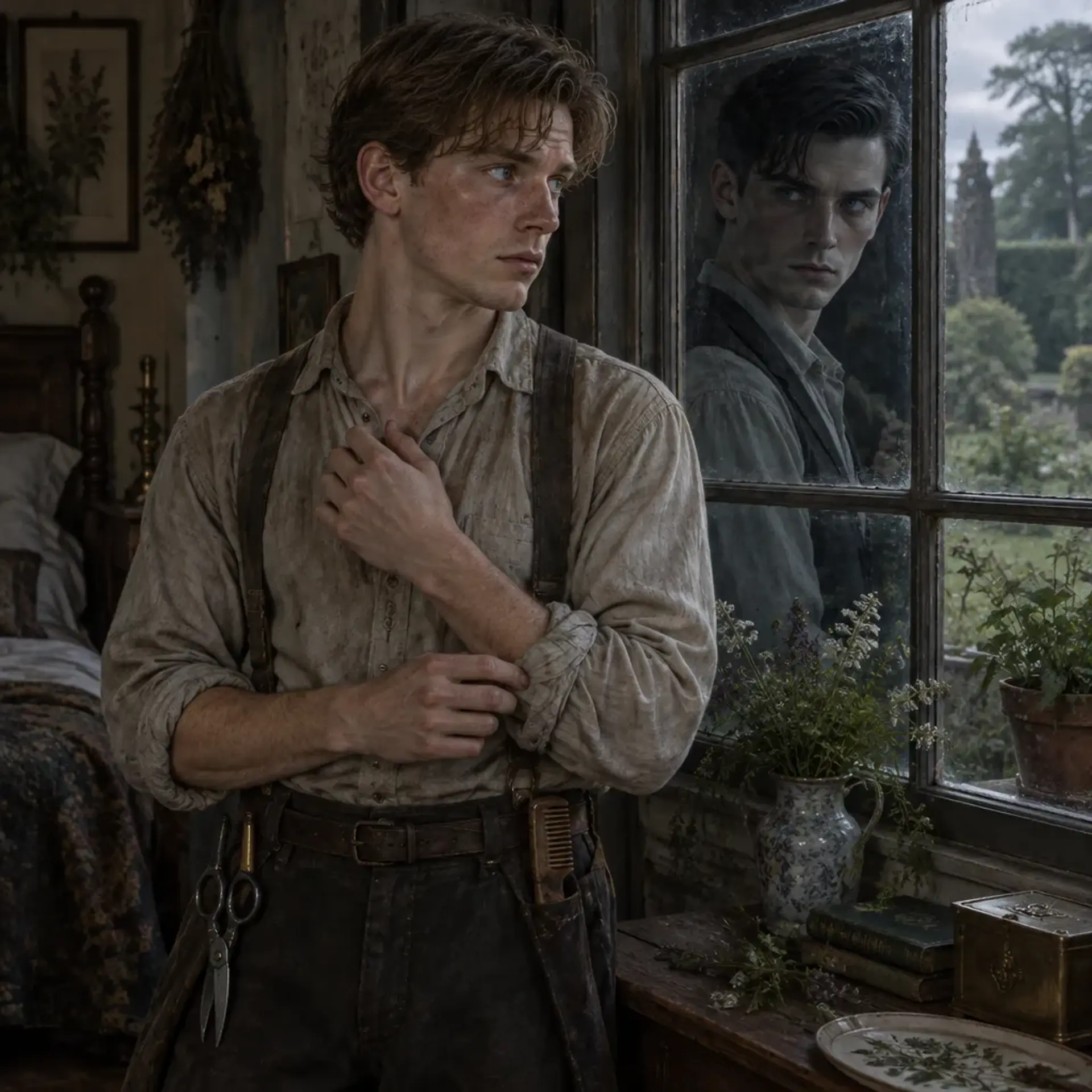
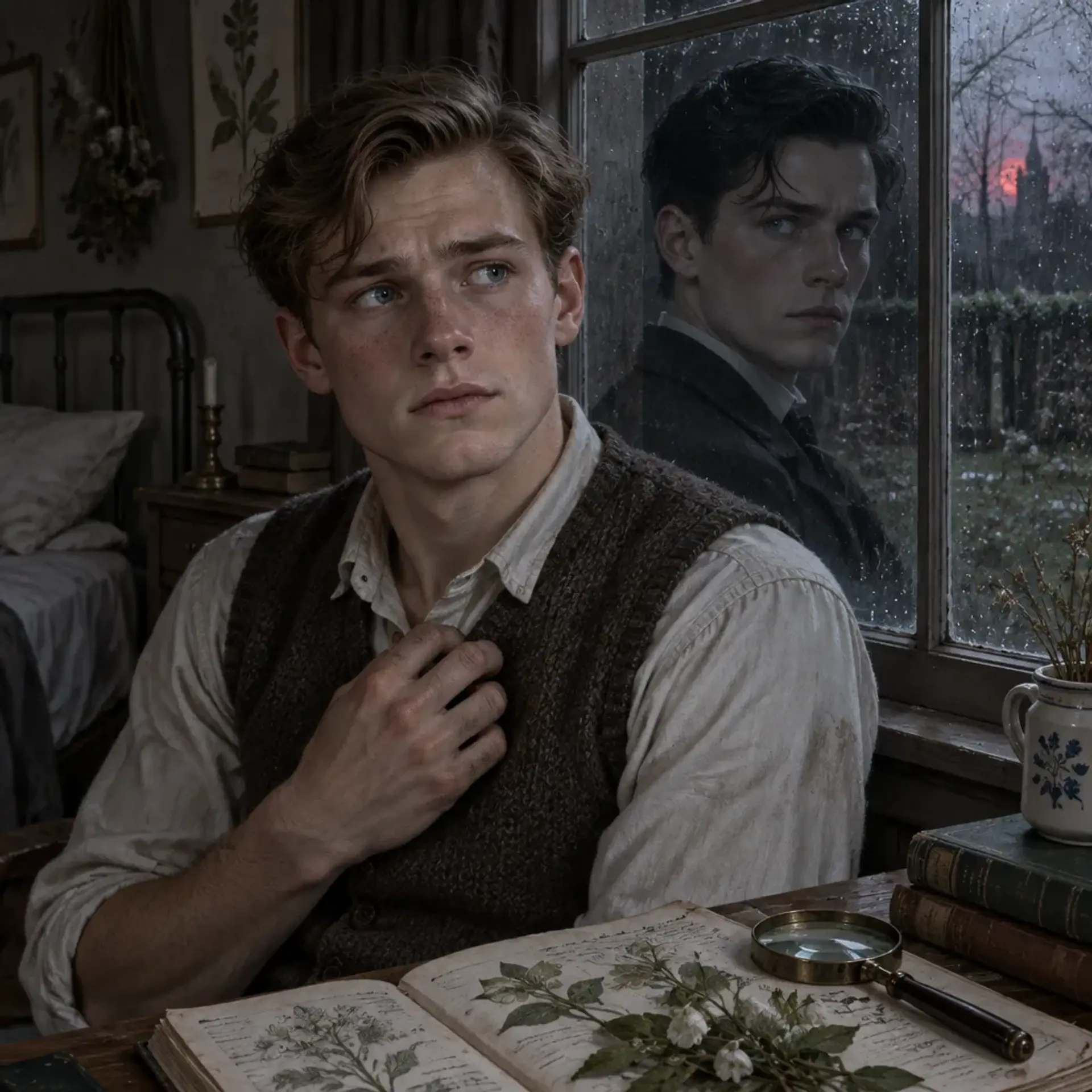
William Windon is a country-bred young man with a dark-blond head of hair, blue eyes, and brown freckles scattered across his face. His face is open and a little too easy to read: his worry gathers between his brows, and he looks at people as if expecting them to be kinder than they turn out to be. His hair has the soft, unruly texture of someone who works outdoors and has only recently begun taking daily grooming seriously. He is long-limbed and lean from gardening, though illness has left him pale and temporarily slack in the shoulders. He moves carefully now, as if testing each step against the possibility that his heart might fail again. Before he speaks, he tends to draw a small, bracing breath through his nose, a habit that makes him seem about to object even when he is only asking a question. His hands are nicked and soil-marked from estate work, with earth stubbornly caught around the nails. The unexpected detail: despite his country upbringing and practical work, William is passionately fond of cinema and can become absorbed in a film with almost childlike physical excitement, tapping his fingers or leaning toward the screen.
Clothing
Practical country clothes suited to estate gardening: sturdy trousers, worn shirts, a knitted layer, and boots that often carry traces of soil. During recovery he wears loose shirts and comfortable clothes. He has begun paying more attention to his hair and shaving because the reflection insists on proper grooming.
Body language
William's movements are cautious since his heart stopped. He sits forward when discussing plants or films, but folds inward when family members ask about his health. The reflection gives his body a rigid, practiced posture: chin level, shoulders squared, hands placed deliberately. When they disagree, William's hands may pause in mid-action or his face may briefly set into the stranger's stern expression.
- Height
- Approximately 5 feet 10 inches (178 cm).
- Build
- Lean, long-limbed, and lightly muscled from gardening; currently weakened by illness and bed rest.
- Eyes
- Blue; the reflection's are a deeper pond-blue, like moonlight on freshwater.
- Hair
- Dark blond; the reflection has short, carefully combed black hair.
- Skin
- Fair, with brown freckles and a pallor made more noticeable by illness.
- Age
- Young adult, approximately 18
- Gender
- Male
- Size
- Human-sized
Distinguishing features
Personality
19 traits and drivesWilliam is earnest but not naïve: he wants to believe people are kind, yet he has learned to look for the cost of a promise. He is practical with plants and tools, and anxious around matters he cannot fix by working at them. When he is well enough to talk about gardening or a film, his warmth returns quickly; when his family watches him too closely, he becomes guarded and jokes to keep them from seeing how frightened he is. He dislikes being treated as fragile, but is frightened of another collapse. The reflection is not William's dark side. It has its own preferences, embarrassment, humor, pride, and opinions. It can be helpful in ways that feel intimate, such as correcting William's grooming or guiding him through a social exchange, and controlling in ways that feel like an invasion. It values manners and inherited standards, yet can be cruelly blunt and has already caused trouble with the neighbour's family. It is curious about ordinary life, films, books, food, and William's sister, but its curiosity can feel possessive. It can be playful when drinking or watching something it enjoys, and severe when a war film brushes against its buried terror. It is afraid of ghosts and fae despite presenting itself as worldly. It wants to be understood, but offers its history indirectly, as if describing a storm or a forge rather than admitting that it is lonely.
Quirks
Habits
Traits · 5
Flaws · 5
Fears · 5
Wants and needs · 4
Combat
HP 0 · No Secret Histories movement statistic asserted; describe as a cautious, ordinary walking pace, reduced while recovering.William avoids violence and has no established combat training. If cornered, he tries to get away or protect someone nearby. The reflection may seize control briefly if it perceives an immediate threat, but its war-film episode shows that its responses can be uncontrolled and distressing. No canonical combat procedure, damage, or defense value is asserted here; use the relevant Secret Histories rules at the table.
William Windon
Actions
Reactions
Services they sell
Rewards they can give
Equipment
- The Heart of England (uncanny object)The supposed fossilized heart was carved from cliff-like stone, barnacled and sea-grass-streaked, and once beat in William's pocket. It is currently missing.
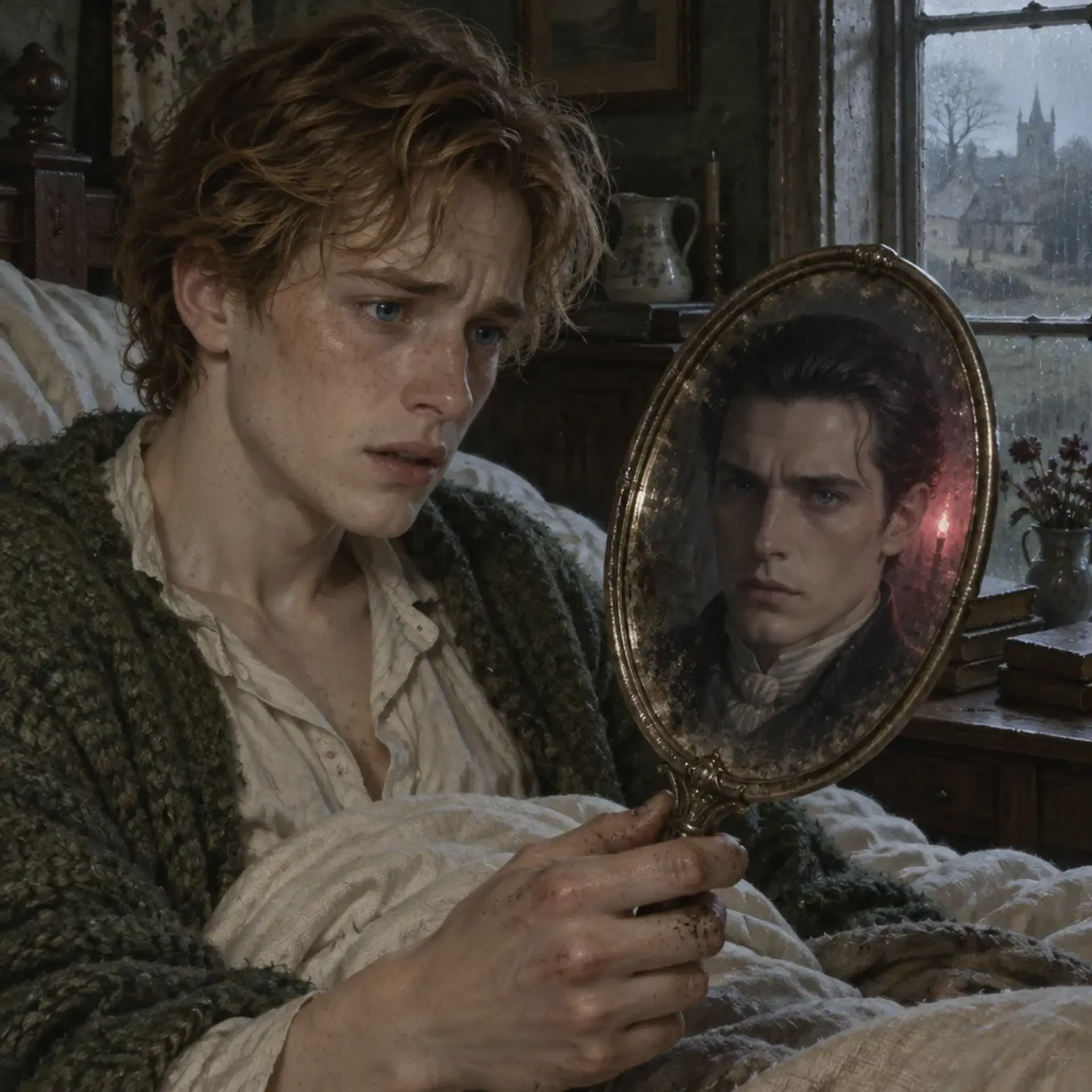
- Grooming mirror (personal item)A small hand mirror that William uses reluctantly for grooming; its surface may show the stranger instead of William.
- Gardening kit (work equipment)Gardening clothes and practical tools associated with his estate work. He is currently on bed rest and should not be assumed to have a weapon.
- Bedroom cache (personal effects)A stash of sweets, cheese, tinned fish, cigarettes, and other small items that appears to grow and change without William's permission.
Possessions
Background
The first person to take the heart home was Abraham Gorff, a London amateur arcanist who arrived at Hush House with a newspaper-wrapped object and the confidence of a man who thinks that knowing a name is the same as knowing a thing. He called it the Heart of England. He had been told it was a fossilized living heart, forged of heart and scale, and he offered it as payment for entry. It looked more like a lump of Dover cliff chalk carved into the outline of a human heart. Barnacles and dry sea grass clung to its sad, rough surface. Abraham was never allowed near Brancrug again. The object was thrown into the sea. It returned to shore ingloriously, slick with salt water and black ooze. Beneath its stony surface, a red-pink light seemed to kindle, as if the stone had remembered blood. A young man picked it up and put it in his coat pocket, intending to take the queer thing home. On the train, it beat against his chest. That young man was Abraham Gorff, who had come from London to Wiltshire. At first, the object's strangeness repulsed him. Then it drew him in. He showed it to his neighbours, and in their company it seemed to die: cold, grey, no pulse, no light. When he took it to a shore in Hampshire weeks later and dipped it into the water, its red-pink colour returned. Abraham decided it was special, and that it was his. He stopped allowing other people to see it, not simply out of greed but because the heart seemed to dislike visitors as much as he did. The house changed around it. Voices came from empty rooms. Doors shifted on their hinges. Footsteps crossed halls and climbed stairs when nobody was there. Abraham began to understand that the stone beat and wept salt water. The haunting frightened him, but the object's quiet dependence frightened him more. He eventually sold it to a seventeen-year-old local boy who had been among the neighbours present when the heart first appeared to die. That boy was William Windon, born in Wiltshire to a family that had lived there for generations. He was proud of his strange new treasure. Then he began to feel the heart beat in his chest as if it were his own. After spells near the sea, he tasted salt, blood, and soil. Terrified that the rock was doing something to him, he fetched a hammer. He struck it hard. The pain landed in his chest. William fell to the ground, groaning, and blood came into his mouth. For an instant he saw a muscle twitching violently inside the stone. Then his own body seemed to give out. His mother, Clare, found him and held his face while he came around. His heart had stopped. That was enough for William to abandon the heart in a hollow log. Days later, the object looked cold and pristine, despite the hammer blow. Afterward came the reflection. At first William assumed a mirror had caught him at a bad angle. The face looking back was a young man's, roughly his age, but it was not William's face. It was long and handsome in a strict, old-fashioned way, with short black hair carefully combed back and trimmed at the sides. Its eyes were blue like moonlight over a freshwater pond. Its expression was stern, even when William was smiling. William began to watch himself while grooming, wary of finding the stranger where his own face ought to be. For a while the reflection merely irritated him. It moved a fraction late, then a fraction early. It seemed to want to turn away when William was still looking straight ahead. Sometimes William's own face became serious in the glass while he was relaxed. The stranger's posture was straighter, more deliberate, as if he had been raised to expect good manners and obedience. William tried to ignore it. He had a serious illness to recover from, and a family who were already frightened. One evening, while William performed his bedtime routine, the reflection moved its mouth with his. In a voice deeper than William's, marked by an older generation's accent, it observed, "Well, it's not often you use that one." The words were so ordinary that William spent several seconds wondering if he had said them himself. Then the reflection paused too, apparently surprised by its own speech. William stopped shaving, stared at the glass, and asked who it was. It gave no answer. The face gradually appeared in more than the mirror over his washstand. Windows, the dark television screen, the polished side of a kettle, even the surface of bathwater began to show the stranger. It did not look like William in any of them. The stranger's face had a different structure, a more severe mouth and longer bones. William sometimes turned his head quickly, hoping to catch a trick of the light. The reflection would already be looking back at him. The first time it acted in front of other people was when William's schoolmates visited: Tommy DeHare, John Mollask, and Ryan O'Leary. William was on bed rest, restless and embarrassed by the attention. The boys tried to behave normally, but their visit soon became a contest to keep the atmosphere from turning solemn. Tommy asked about the heart and whether it really had beaten in William's pocket. John wanted to know if the thing was still in the log. Ryan, who was the quickest to joke when uncomfortable, asked whether William had become a haunted house himself. William answered as best he could. The reflection did not remain an image. When the boys spoke to William, his mouth made a reply he had not chosen: a dry correction about the difference between a haunted house and an ill-kept one. John laughed before he realized William had not meant to say it. The stranger's eyes shifted toward Tommy while William's body was still facing Ryan. Then William's hand reached for a cup, stopped midway, and set it down with a carefulness that was not his. His friends went quiet. Tommy asked whether William was all right. William said yes, but the voice that answered sounded older and more controlled. The three boys left with promises to visit again, and with the unsettled look of people who had met someone they could not explain inside a familiar friend. William wanted to find the heart, and then Abraham Gorff, who had moved to Canada. He did not know whether the heart had made the reflection, whether the reflection was the heart's occupant, or whether the near-fatal blow had opened some door between them. He did know the stranger was becoming harder to dismiss. William's father, Hector, is a historian. His sister, Elizabeth, has begun to pester William about a boy she likes, attractive clothes, and his poor manners. William has also learned that the reflection has opinions about both. It calls Hector's smugness out when he dismisses country people, and William got in trouble for the cutting remark his own mouth delivered. When a neighbour's child accidentally knocked William with a toy wagon and made a girl cry while apologizing, the reflection used a slur against the Welsh neighbour's child. William was made to muck out the neighbour's stables. He has not forgiven the reflection for that, and it has not admitted that it was wrong. The reflection treats Elizabeth with a fascination it calls "interesting." It attends to her stories about the boy she likes with the unnerving concentration of a naturalist observing a rare insect. It comments on her clothes, her taste, and her habit of speaking freely at the table. Sometimes it offers William a polished, almost chivalrous suggestion about how to answer her. Sometimes it makes a remark so pointed that William has to interrupt it before Elizabeth hears. It does not seem to want to hurt her. It does seem to regard her as a puzzle, and it has not learned that being curious about someone is not the same as knowing them. William works as a gardener on an estate and is eagerly training to become a botanist. He is on bed rest after his heart stopped, leaving him with too much time to think and too little useful work to do. The reflection has taken an interest in books and films, especially historical films, though it reacts to them in ways William cannot predict. It makes William's hands move with excitement when it likes a scene. It sneaks through the house when William is supposed to be resting, and he has found household things hidden in his room: cigarettes, cigars, cheese, sweets, tins of fish, and once a bottle of apple juice that turned out to contain alcohol. His family assumes William is hoarding them. William suspects the reflection is building a private larder for a person who does not have a body of his own. Tea has become another negotiation. The reflection has strict rules about manners and table conduct, sometimes invoking its father or siblings as if these people were as present as the family around the table. It will correct William's posture through his shoulders, stop him from speaking when it considers his words improper, or make his hand wait until the right moment to take a cup. William finds this infuriating, especially when Hector is watching. The reflection insists it is only preserving standards. William thinks it is trying to make his life fit an old household whose members he has never met. Adaline, William's girlfriend, has become the most personal source of tension. She has auburn hair and soft brown eyes, and William finds her pleasing to look at in the ordinary, affectionate way of someone who knows her laugh and likes being near her. The reflection saw her once and decided it wanted her. It began to comment on her appearance, but its remarks mixed sincere admiration with a possessiveness that made William uncomfortable. It watched her with William's eyes and occasionally tried to steer his body into a better posture when she came near. It has criticized William's clothes before a visit, corrected his hair, and once made his face hold a smile after he had become nervous. William is trying to protect his relationship without pretending that the reflection is merely a bad habit. Adaline has noticed the shifts in his manner. He has not yet told her the whole story. The reflection has a life of its own, or something close enough to one to make William uneasy. It has emotions, preferences, memories, and an evident dislike of paranormal entities. Ghosts and fae frighten it; it avoids the subject and grows tense near stories or places associated with them. It talks of a father and siblings, and gives occasional details, but describes them as if they were weather, forge work, or a change in the sea rather than people who breathe. William once dreamed that he was the reflection, watching a young man beside a pond in wild woods. He has not been able to decide whether it was a memory, a metaphor, or only a feverish dream. The most alarming incident began with a war film on television. The reflection reacted sharply to the images. William lost control of his body as if caught in a terrible remembered terror. His family thought his heart had stopped again. Then he fought, flinched, and struggled against something no one else could see. Elizabeth changed the channel and watched with wide-eyed concern. Later, in bed, William's mouth offered a mumbled apology in the stranger's voice. The reflection gave him a memory as consolation and a partial explanation, but the details were strange and incomplete. William now knows the stranger carries some experience of war, though he cannot tell whether it lived through one, witnessed one, or inherited the horror as memory. The whisky night revealed more and made matters worse. Hector had left scotch and bourbon for William's health, not knowing that the reflection might be able to experience what William drank. On a night when William felt better, he had some without thinking through what that meant. The stranger became drunk. It argued with William, teased him, smiled through his face, yelled at him, and seemed delighted by ordinary sensations. It sang badly, then laughed at its own performance. William's efforts to tell whether he was drunk, whether the reflection was drunk, or whether both were sharing one muddled experience became increasingly useless. When William asked if it was the stone, the reflection scoffed: "Dad isn't here." The line was not an answer, but it made William realize that the reflection had been thinking of its father as an actual presence. Elizabeth heard the noise and came into his room. She found her brother's body sitting on the bed with a cigarette in hand, but the face was not William's. Pale skin, short black hair, and pond-blue eyes looked out of William's clothes. The stranger spoke and moved with startling assurance. Elizabeth stared at him. William was present somewhere behind the eyes, confused and unable to say how much of the moment belonged to him. The stranger was not simply a reflection now. It could inhabit the room through William, and it could be seen by someone else. The next morning, William found the cigarette, the bottle, and Elizabeth's frightened silence. She did not tell their parents what she saw. William has since tried to be careful with alcohol, mirrors, bathing, and sleep. Baths are awkward because the water shows the stranger, and both young men appear to possess enough English prudishness to find the situation mortifying. Sometimes the reflection takes over the washing and grooming when William is too embarrassed to continue, offering sarcastic commentary on his body. It takes shaving seriously and will remind him to do it later if he skips it. Once, William felt the stranger blush through him. William is looking for the heart, Abraham Gorff, and an explanation that will not require him to surrender his body. The reflection is trying, in its own obstructive fashion, to tell him about itself. Their lives are bound together, but neither has agreed on what that means. William wants his future back. The reflection wants a place in the world, a chance to pursue its interests, and perhaps a way to return to a family it can only describe in fragments. For now, they share one body, one bedroom, and a mirror that no longer promises to show William his own face.
Role in the story
A vulnerable but active mystery at the center of a supernatural investigation. William is a witness to the Heart of England's strange history and a person trying to protect his future. The reflection is a second personality with its own needs, fears, and possible history, not simply a villain or possession to be exorcised.
“He had been told it was a fossilized living heart, forged of heart and scale, and he offered it as payment for entry.”
- Faction
- No known faction. William is connected to the estate where he works and his family's long-established Wiltshire community. The Heart of England's history links him indirectly to Hush House and Brancrug.
Known connections
Media
0 imagesNo images yet.
Turn William Windon into a sheet
A high-res, share-ready sheet you can post or print.