William Windon
William Windon
At the table
Voice
William's voice is bodily and direct, slightly breathy after his illness, with the ordinary warmth of a young man used to speaking outdoors over work. The stranger uses the same mouth but gives it a deeper, older sound, with consonants placed carefully and a dry edge that makes even a mild observation seem like a judgment. After the whisky, it became loose, loud, and cheerfully argumentative. In moments of fear, the two voices can catch against each other, as if William is trying to speak through a thought that arrived first.
William speaks in a plain, contemporary local manner, with a warm, slightly hesitant rhythm. He often begins a difficult thought, revises it, and then says it more plainly. When the stranger speaks through him, the words become clipped and dry, with older turns of phrase and a deeper, more deliberate sound. The difference comes from the stranger's history and bearing, not from William changing his natural voice permanently.
Speech patterns
How to play them
Approach William gently and speak to him directly, not to the reflection as if William were absent. Ask permission before testing mirrors, the heart's history, or the stranger's control. He responds to practical kindness and honest curiosity. The stranger responds to competence, old-fashioned courtesy, and people who notice details, but dislikes being treated as a ghost or a possession. If the stranger speaks through William, address the speaker without pretending William has disappeared. Never use Adaline as leverage.
Goal
Recover his health, find Abraham Gorff or the missing heart, and learn whether the stranger can remain with him without taking his life or his relationships.
Motivation
William wants a life that remains his own: recovery, work with plants, and the people he loves. The stranger wants company, sensory experience, and some lost relationship or history it cannot yet describe. Their motivations overlap in the desire to keep the shared body alive, but they disagree about manners, privacy, risk, and whom William should love.
Appearance
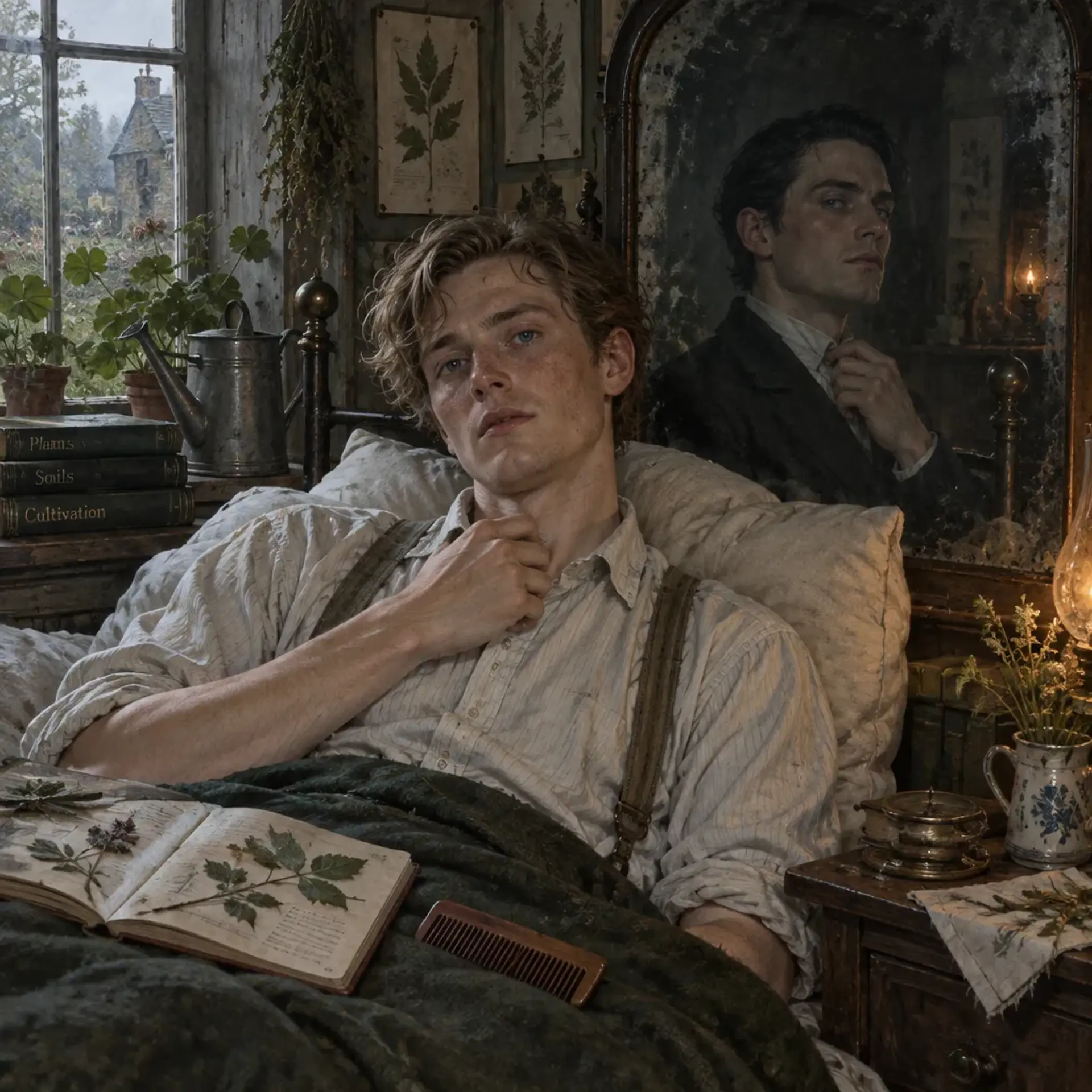
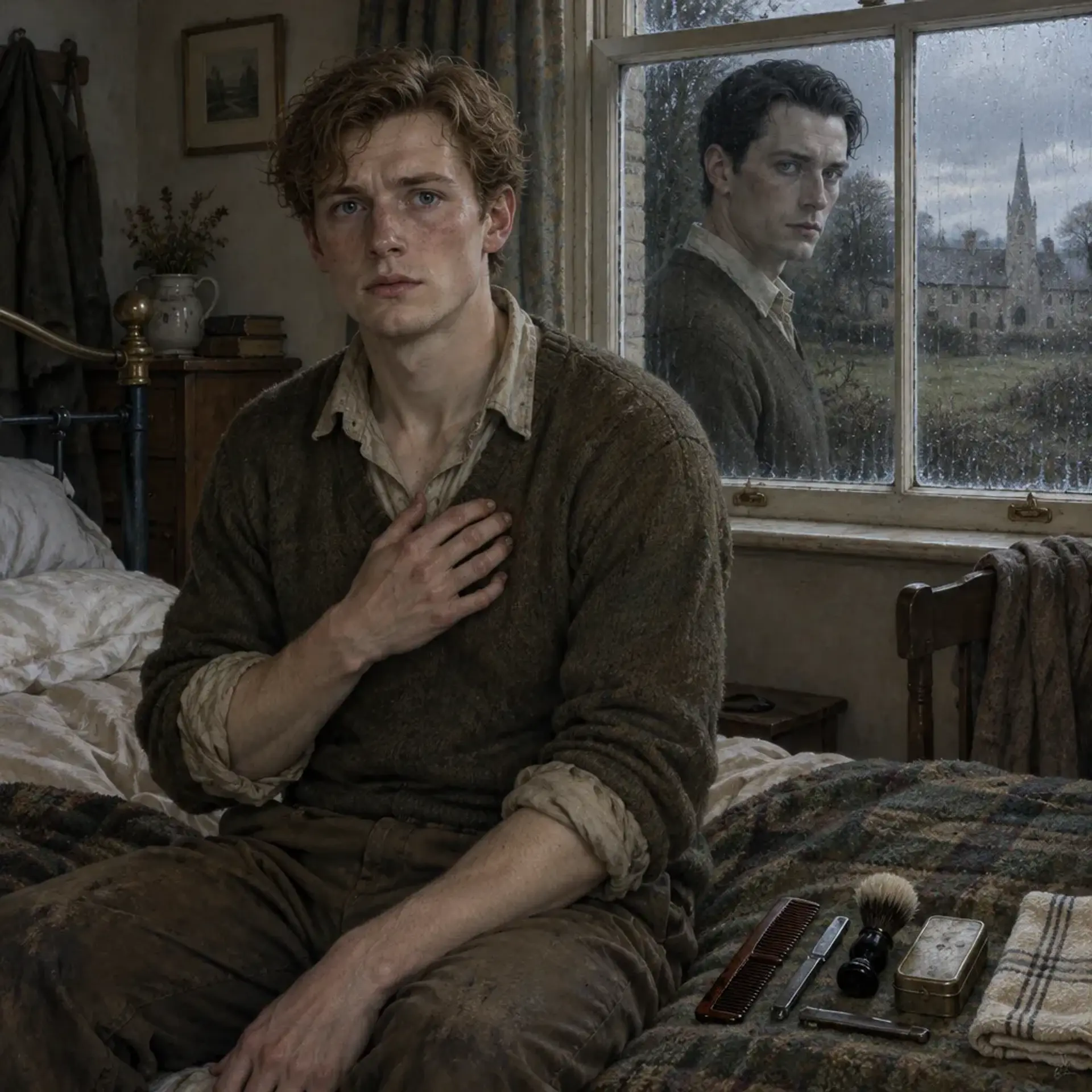
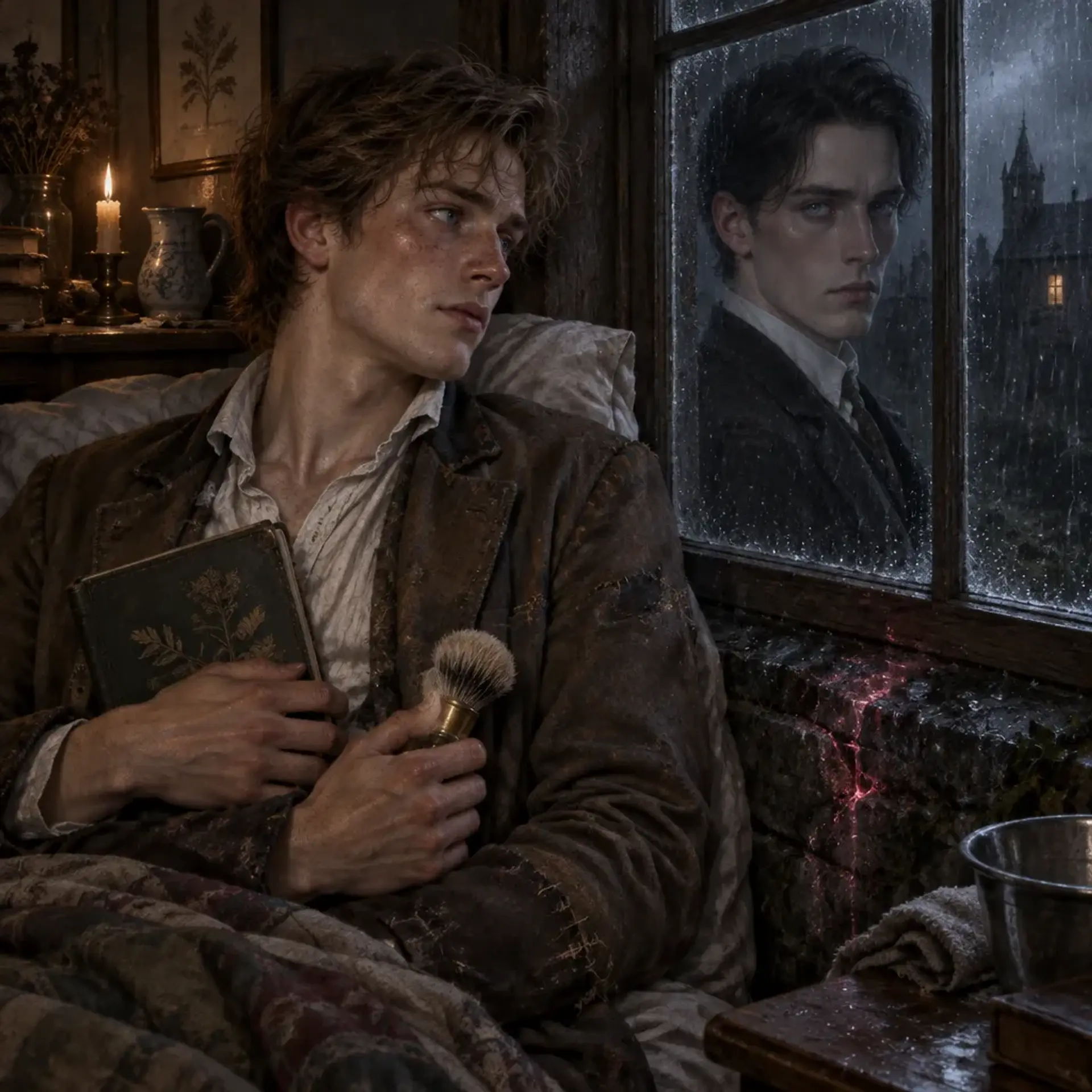
William is a young Wiltshire man with a warm, open face, dark-blond hair that never quite lies flat, blue eyes, and brown freckles scattered across his nose and cheeks. He is taller and more spare than he was before his heart stopped, with the cautious, slightly hollow look of someone recently confined to bed. His movements are ordinarily considerate: he turns sideways to let others pass, holds doors, and handles plants as though they might bruise. When the stranger takes the lead, the same body becomes unnervingly economical. His chin lifts, his shoulders square, and his hands move as if following an old drill. In mirrors, windows, polished kettles, and bathwater, the face is not William's: it belongs to a long-faced young man with neatly combed black hair, close-trimmed sides, moonlit blue eyes, and a stern, handsome English composure. The stranger's face wears whatever William has on, though it never resembles him. William's gardening clothes are mended at the elbows and often carry damp soil at the cuffs; he takes absurd care of one small, brass-handled shaving brush, whose handle has been polished bare where his thumb rests. He leaves the impression of a kind young man accompanied by a second presence that has already judged the room.
Clothing
Practical gardening clothes: mended wool trousers, shirts with soil-dark cuffs, and a jacket that fits poorly at the shoulders. William keeps his clothes serviceable rather than fashionable. The stranger copies every garment exactly in reflective surfaces, but disapproves of William's casual combinations and insists on a properly arranged collar.
Body language
William's ordinary posture is open but careful, with his hands occupied by a book, blanket edge, or small gardening task. He turns his head toward a window before he admits he is checking for a reflection. When the stranger takes the lead, William's spine straightens, his mouth tightens, and his hands become precise and formal. During the whisky night, the stranger's control was unmistakably loose: William's shoulders rolled, his grin widened, and one finger wagged accusingly at the bottle.
- Height
- Tall for his age, though presently diminished by illness and bed rest.
- Build
- Tallish and lean, recently weakened by illness; careful movements give way to unnerving precision when the stranger takes control.
- Eyes
- Blue, with brown freckles across the bridge of his nose; the reflected stranger's blue eyes appear paler and colder.
- Hair
- Dark blond.
- Skin
- Fair, with brown freckles across his nose and cheeks.
- Age
- Young adult, approximately 19
- Gender
- Male
- Size
- Medium
Distinguishing features
Personality
22 traits and drivesWilliam is warm and sensitive, but not a pushover. He notices when someone is embarrassed and will try to make room for them, yet he can become unexpectedly stubborn when his family dismisses his ambitions. He has inherited Hector's suspicion of rigid social systems without inheriting Hector's confidence in publicly condemning them. Around his mother and sister, he is affectionate and easily flustered; around his father, he becomes guarded and more argumentative than he intends. With friends he tries to seem normal, then grows tense when a reflective surface is nearby. The stranger is not simply William's opposite. It shares his curiosity and can be protective, but has older standards of propriety and a much sharper tongue. It takes grooming seriously, enjoys books and films, and loves alcohol with embarrassing enthusiasm. It can be vain about its composure while secretly liking new sensations. It may correct William's manners one moment and steal food the next. Its interest in Adaline is a contest William never wanted, while its fear of ghosts and fae makes it suddenly vulnerable. Both are capable of affection; neither is reliably generous when frightened.
- Alignment
- Not applicable as a Secret Histories rules category. In ordinary terms, compassionate and self-directed, but increasingly divided by the stranger's older codes.
Quirks
Habits
Traits · 6
Flaws · 5
Fears · 5
Wants and needs · 6
Combat
HP 5William avoids direct combat and tries to get himself and others out of danger. He uses whatever is nearby to block, distract, or make space, and his recent heart stoppage makes exertion dangerous. The stranger may take control for a short defensive reflex, but it is not a trained fighter. Loud war imagery can trigger a frightening loss of control rather than a useful combat advantage. These are narrative guidelines for a custom, table-adjudicated Secret Histories NPC, not canonical combat rules.
William Windon
Actions
Reactions
Rewards they can give
Equipment
- Botanical notebook (personal item)Kept close while he is recovering; he uses it to identify and sketch plants, not as a weapon.
- Shaving brush (personal item)A worn, brass-handled brush with a thumb-polished patch; the stranger considers grooming a duty.
- Gardener's hand lens (tool)A small hand lens used for close inspection of leaves, seeds, and soil.
- The Heart of England (missing supernatural object)The original heart is missing. William has no verified way to summon or locate it.
Possessions
Background
William Windon was born in Wiltshire into a family with roots in the county stretching back generations. Before the heart, he was a warm, sensitive young man who noticed when people were left out and who preferred the company of growing things to arguments about what a respectable young man ought to study. His father, Hector, works as a historian. Hector is proud of William's studiousness in principle, but their affection is strained by a familiar disappointment: Hector wants his son to pursue more fashionable, worldly interests, while William is training himself toward botany and would rather learn the names of plants in a hedge than impress visitors with an opinion. Hector's own father, remembered as Bobby, was a fierce veteran of the Second World War. Hector has reacted against the old certainties he inherited. He favors newer art and social causes, dismisses rigid class codes, and can be neurotically scornful of what he considers backward. William has absorbed some of that skepticism, but not Hector's habit of turning every old custom into a target. His mother Clare is practical and affectionate, and she was the first person to understand how close William came to dying. His sister Elizabeth is young enough to bring him questions about attractive clothes, boys, and manners as if he were still the dependable brother who can be embarrassed into an answer. William loves her, even when he would rather be left to read. He works as a gardener on an estate and is eagerly trying to become a botanist. The work suits his patience and his eye. His hands know how to lift a root ball without breaking it and how to tell whether a plant is failing from thirst or bad soil. He has friends from school: Tommy DeHare, John Mollask, and Ryan O'Leary. They knew him before his illness and are among the few people who might still persuade him to leave his room. Adaline, his girlfriend, has auburn hair and soft brown eyes. William cares for her, and that care has become a source of dread: the stranger in the reflection has noticed her and is interested in her in a way William experiences as competition with himself. The object that changed his life began as a gift to the Hush House. Bartholomew Golden, an amateur arcanist, arrived with a thing wrapped in newspaper and called it “The Heart of England.” It looked like a human heart carved from Dover cliff rock, with barnacles and sea grass grown into its sad shape. It was refused, thrown into the sea, and returned to shore slick with salt water and black ooze. Beneath the stone, a red-pink hue seemed to return, as if blood or light had awakened. Abraham Gorff, a young man from London, picked it up and took it home to Wiltshire. It beat beneath his coat on the train. At first, Abraham showed it off to neighbors. In company, it seemed to die: inert, cold, and no more remarkable than an ugly stone. When he took it back to the Hampshire shore and let it touch water, the pink color and beating returned. Abraham decided it was special and belonged to him. He was not simply greedy. He had learned that the heart disliked an audience, and he began to guard it as if privacy were a kindness. His house filled with disturbances: voices, doors that opened without hands, and footsteps on empty stairs. Abraham could no longer deny what he had brought home. He sold the object to William, one of the local boys who had seen it during its apparent death. William was proud of his strange purchase until he began to feel its beat inside his own chest. After tasting seawater, blood, and soil in his mouth, he tried to break it with a hammer. The blow did not break the stone. It sent pain through him as if he had struck his own heart. He collapsed, groaning and spitting blood, and for one instant saw muscle twitch violently beneath the stone's surface. His own body failed with it. William awoke with Clare's hands on his face. His heart had stopped. That was the formative event. It turned a curious boy into someone who measures every day by the fact that he nearly did not have another. The stone was left in a hollow log days later. When William checked, it looked cold and pristine despite the hammer blow. Then it was gone. Afterward, the reflection began to differ from him. At first it was merely inconvenient: a stranger's stern face appearing in the mirror when William groomed himself. William tried not to look too closely. He could tell that the face had its own intentions because the reflection's movements began to jerk away from his, trying to turn or reach for things William was not touching. One evening, while William was going through his bedtime routine, the reflected mouth moved with his and said, “Well, it’s not often you use that one.” The voice was William's mouth speaking, but not William's voice: older, deeper, and shaped by an accent from a generation before his own. The stranger has since become a second presence bound to William's body. It shows up in windows and polished surfaces even when William cannot see himself. It has begun changing things in his room while he sleeps, hiding cigarettes, cigars, cheese, sweets, tinned fish, and once a bottle of apple juice that turned out to be alcohol. It enjoys films and books, becomes physically excited by exploration, and has a disconcerting appetite for places William has been told not to go. It speaks through William's mouth when it considers him alone, comments on his hair and clothes, and occasionally stops him from saying something it considers improper. Its ideas of propriety are not William's. It has strict old rules for tea, manners, and how one ought to address people. Once, after Hector made a dismissive remark about country people, the stranger delivered a cutting answer through William's mouth. Hector punished William for it. Another time, it called a Welsh neighbor's child a slur after the child accidentally ran into William with a toy wagon and made a girl cry while apologizing. William will not repeat the word. The neighbor made him muck out the stables. William was ashamed, angry, and not entirely sure the punishment had been unfair. The stranger dislikes William's cousin Ronald White, who calls himself a modern man. The dislike is immediate, absolute, and full of contempt for Ronald's self-assurance. It also finds Elizabeth “interesting,” a word it uses with an unsettling lack of explanation. William's friends discovered that the presence could react to them physically and speak without using a reflective surface. The discovery has made William afraid to be alone with the people he loves. He still wants to find the vanished heart and Abraham Gorff, but has learned that Abraham moved to Canada. His search is complicated by the fact that the heart may be the stranger's origin, or only the thing that brought it near him. The stranger speaks of siblings and a father as if discussing weather, the sea, or work at a forge. William has no dependable way to tell whether these are memories, metaphors, or deliberate evasions. He once dreamed that he was the reflection, watching a young man beside a pond in wild woods. The dream made him wonder whether the stranger was not a dead soul trapped in glass, but something alive that had been looking out from somewhere else all along. William is currently on bed rest after his heart stoppage. He has been told to rest, which leaves him a great deal of time alone with the one companion he cannot ask to leave. One night he woke cold and shivering, went into the hall with a small light, and spoke to Elizabeth. The voice and accent that came out were not his. Another night he woke feeling better but strangely cold, went to the study to warm himself by the private fireplace, and fell asleep on the lounge. Hector found him dreaming of salt, forges, and dark woods. The most frightening interruption came during a war film. The stranger reacted as though the sounds on the television had become immediate. William lost control of his body, suffered a terror he could not explain, and began to fight. His family feared another heart attack until they understood that he was struggling against something no one else could see. Elizabeth changed the channel, watching him with wide-eyed concern. At bedtime, the stranger used William's mouth to mumble an apology. It offered a fragment of memory in consolation and an explanation, though neither was complete. The episode suggests a buried history of violence, perhaps a war, perhaps a memory the stranger cannot bear to name. It also confirms that the stranger has begun trying to communicate rather than merely comment. The strangest recent event was the whisky night. Hector had left scotch and bourbon for William's health, not realizing how the stranger would take to them. William tasted the first drink cautiously. The reflection's eyes brightened. It took over the expression on William's face and promptly demanded another. The stranger grew drunk through William's body, smiling, teasing, arguing, and laughing as if they were two old companions in a pub. It sang badly, then loudly, and accused William of being a joyless child who had never learned to enjoy a proper drink. William protested that they were not in a pub and that the bottle belonged to his father. The stranger grinned at their shared face and answered, “Dad isn’t here.” It nearly removed William's shirt as an act of rebellion, then accepted that taking off the trousers would be going too far. William laughed despite himself. For a little while, the stranger was not a threat or a mystery but an obnoxious, delighted companion. By morning, William had a headache, a stolen glass hidden under his bed, and no certainty about whether the warmth he remembered was his own. His present problems are concrete as well as uncanny: he must recover without provoking another heart stoppage, decide how much control to grant the stranger, maintain his work and botanical ambitions while confined to bed, repair things with Hector, and keep Adaline from becoming a prize in a contest she never agreed to enter. He wants answers about the heart and Abraham, but he is also beginning to fear that finding the stone may not free him. The stranger has emotions and opinions of its own. It is not a simple haunting and does not behave like a polite guardian. It can be funny, curious, vain, protective, cruel, embarrassed, and afraid. Its fear of ghosts and fae is genuine, and William has learned that an unseen supernatural presence can make the stranger retreat in a panic. Their relationship is therefore not a possession to be cleanly exorcised, but a tense cohabitation between two people who share one body, disagree about what it means to live, and have begun, against their better judgment, to care what happens to each other.
Role in the story
A living mystery and potential ally: William needs help understanding the heart and the stranger, while also protecting his health and relationships. He can lead characters toward Abraham Gorff, the Hush House, or the missing stone. The stranger is a second voice with its own fears, appetites, memories, and possible agenda, not a simple curse to remove.
“Hector's own father, remembered as Bobby, was a fierce veteran of the Second World War.”
- Faction
- No formal affiliation. William is employed as a gardener at an estate and is connected to his local family, friends, and the Hush House incident.
Known connections
Media
0 imagesNo images yet.
Turn William Windon into a sheet
A high-res, share-ready sheet you can post or print.