William Windon
William Windon
At the table
Voice
The voice comes from a young man's body still recovering from illness: normally clear, warm, and a little breathless after exertion. William often takes a small preparatory breath before speaking about his health. The reflection's delivery has a controlled pause and a dry, older cadence, shaped by some history William does not possess. Its words land with the clipped certainty of someone used to being obeyed at table, though a sudden burst of laughter or a war-triggered gasp can break that composure.
William has a clear, contemporary local English voice, softened by his habit of apologizing and choosing words carefully. He sometimes clears his throat before difficult subjects, then rushes through the first sentence. The reflection uses the same mouth but changes its timing: it leaves a deliberate beat before speaking, then delivers dry remarks with an older, more formal English cadence. Its voice seems to sit behind William's voice rather than simply imitate it. After frightening episodes, William may speak in the stranger's cadence without realizing it.
Speech patterns
How to play them
Treat William as a frightened, intelligent young man rather than a possessed monster. Offer privacy, concrete help, and time to answer. Avoid forcing him to perform for a group or confronting him with a mirror as a trick. Ask permission before involving his family. If the reflection speaks, address it directly without assuming it is William's voice or that its wishes are William's. The reflection responds to composure and wit better than pleading, but reacts badly to mockery of its family or to being called a mere object.
Goal
Find the fossil heart and Abraham Gorff, discover what the reflection is, and recover enough to return to gardening without losing his family, friends, or Adaline.
Motivation
William wants his health, ordinary work, and loved ones back without abandoning the stranger to an unknown fate. The reflection wants recognition, access to William's life, and a way to understand its own family and past.
Appearance
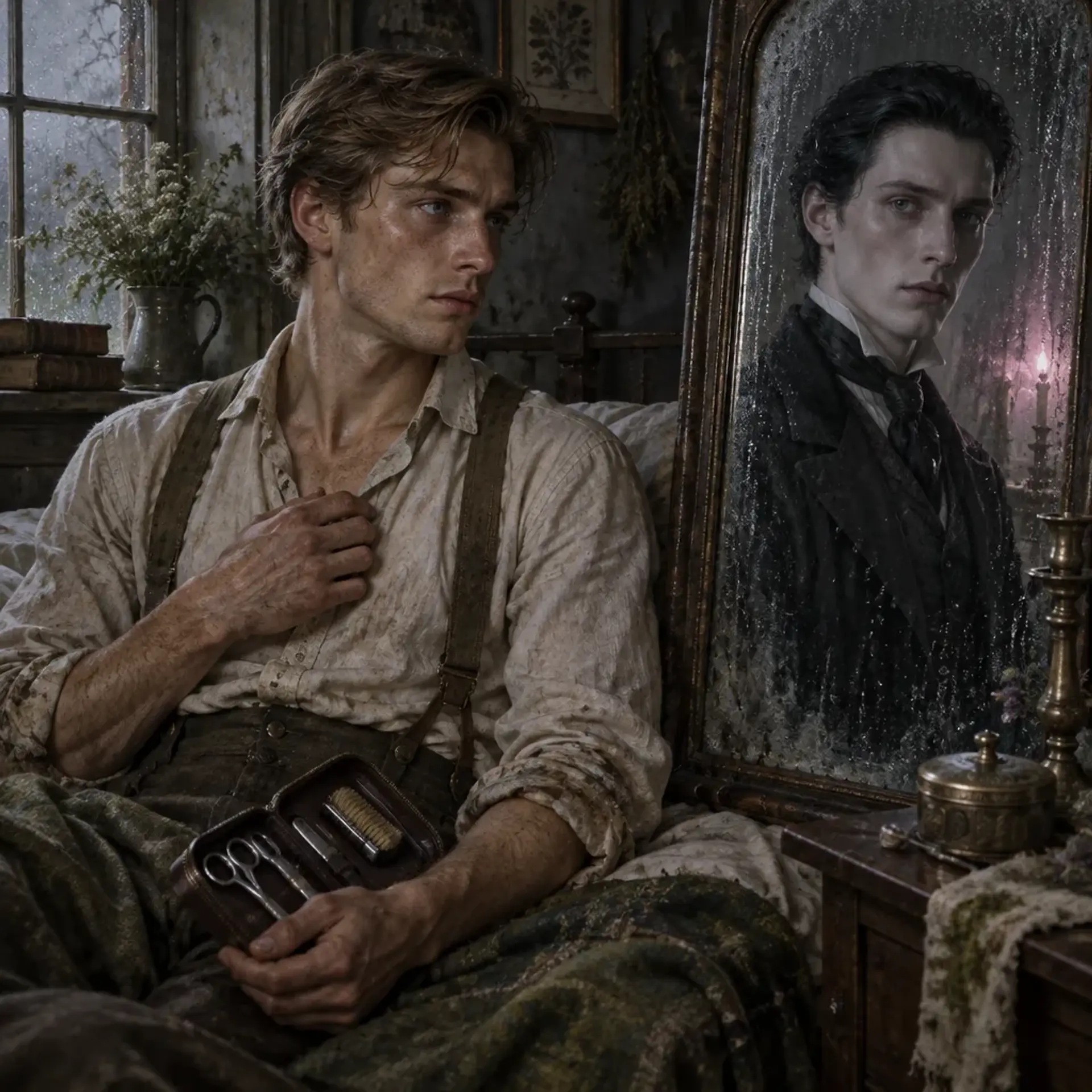
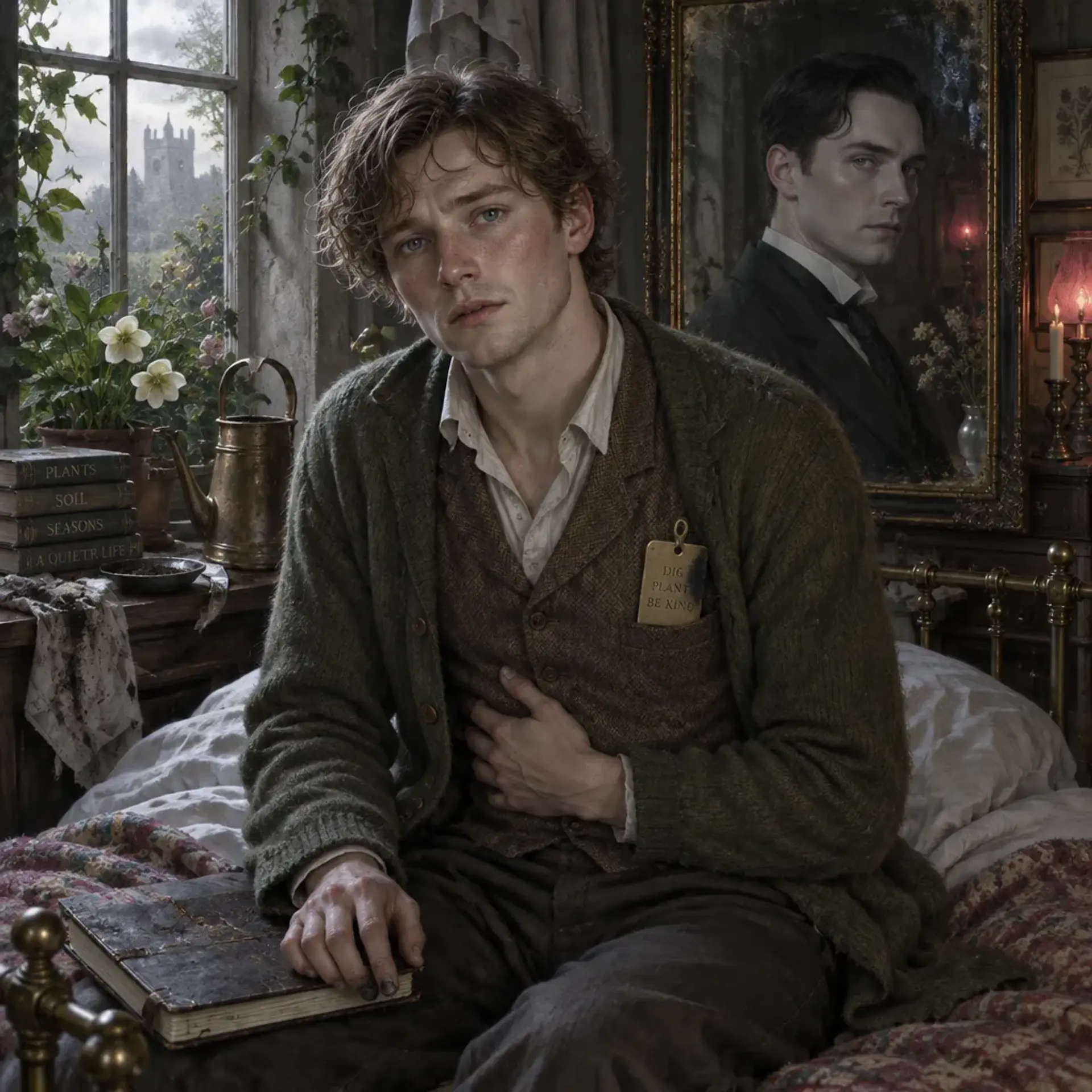
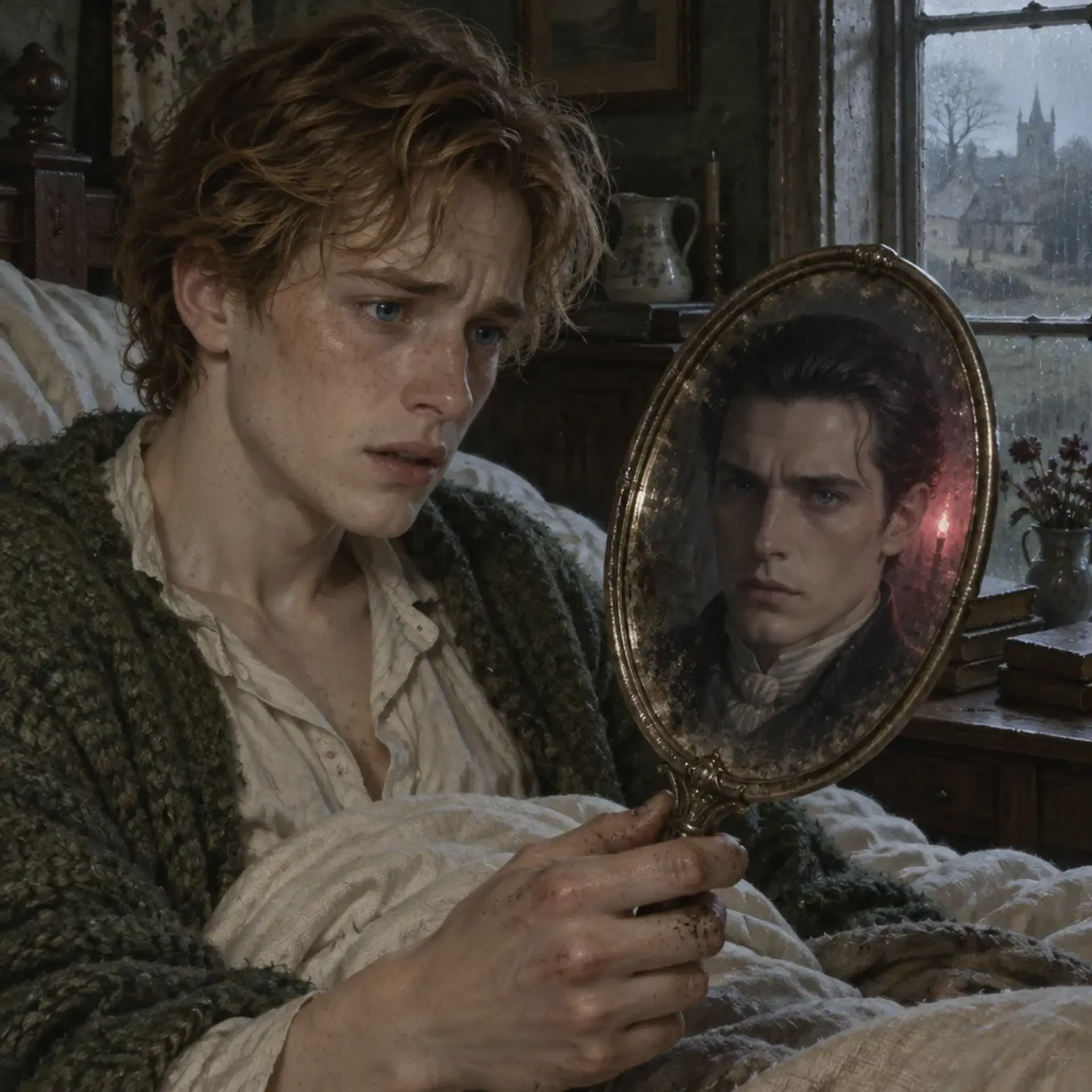
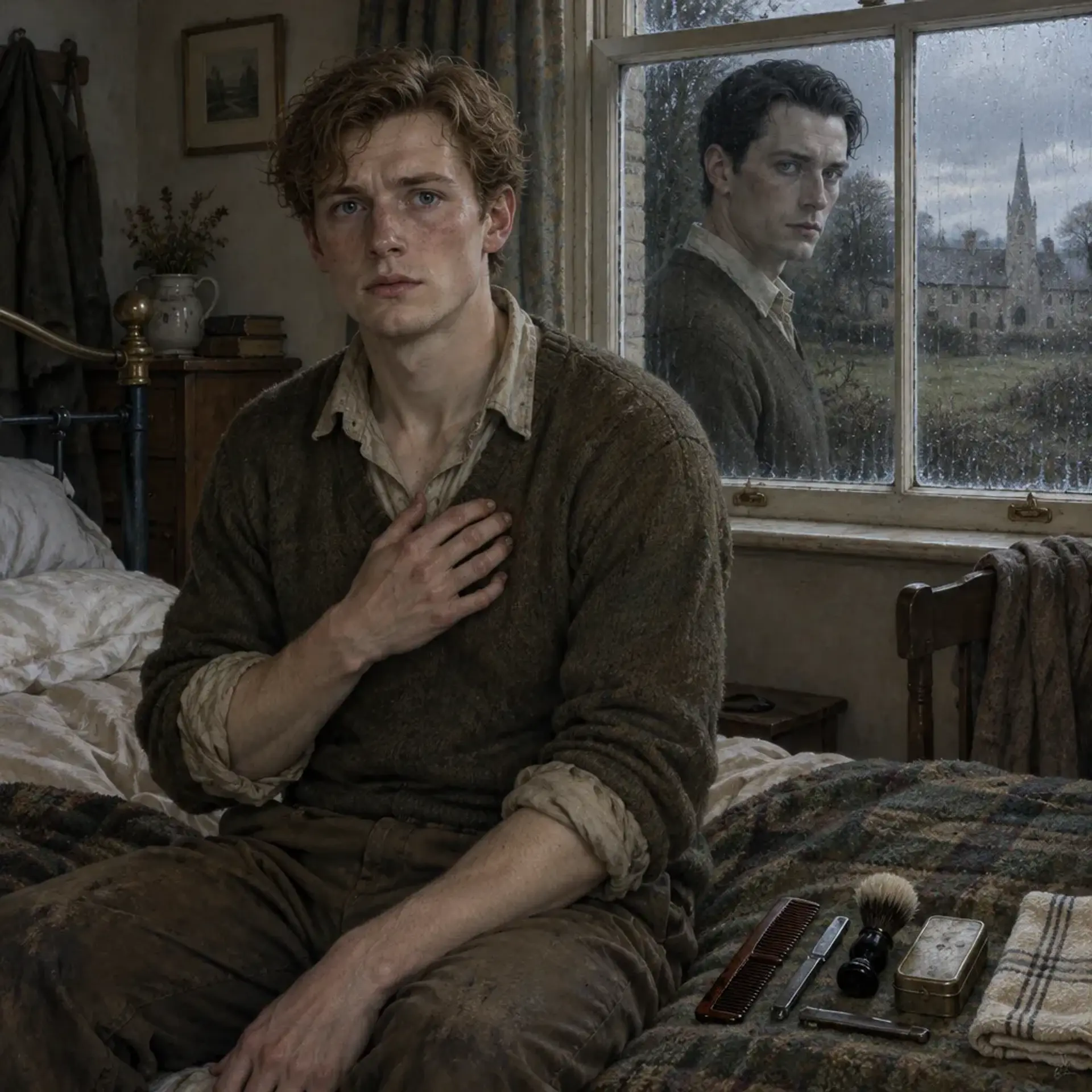
William is a young Wiltshire gardener with a soft, open face, brown-spotted fair skin, blue eyes, and dark-blond hair that never stays neat for long. His clothes fit like work clothes should: cuffs rubbed pale, knees marked with garden earth, and a faint green smell of crushed stems about him. He moves carefully since his heart stopped, avoiding sudden exertion and sometimes pausing with his palm at his breastbone as if waiting for a familiar beat. The unexpected detail is his conspicuously exact grooming ritual: even on bed rest he lays comb, shaving things, and clothes in a precise order, a fastidiousness that belongs as much to the reflection as to him. In mirrors, windows, polished kettles, and bathwater, another young man looks out: long-faced, pale, handsome by an older English ideal, with short, glossy black hair combed back and trimmed at the sides, and blue eyes like moonlight on a pond. The face is structurally unlike William's, but it wears William's clothes exactly. It holds itself as if the room and its furniture ought to know their proper places.
Clothing
Practical shirts, wool jumpers, worn trousers, and gardening clothes marked by earth and plant stains. He keeps a comb and shaving kit close. The reflection wears precisely what William is wearing, even when it clearly regards the clothes as beneath its standards.
Body language
William's movements are gentle and slightly guarded, with a hand often hovering over his chest after exertion. When the reflection presses forward, his spine straightens, his chin lifts, and his gestures become economical and possessive. In mirrors, its expression can change before his does. He rubs soil from his fingertips even when they are clean.
- Height
- Average young-adult height
- Build
- Lean, healthy-looking but recently weakened by a cardiac crisis; the gardener's shoulders and forearms are more evident than his bed-rest pallor suggests.
- Eyes
- William's eyes are blue. The reflection's are a deeper, pond-blue, like moonlight on still freshwater.
- Hair
- William's hair is dark blond. The reflection's hair is short, black, glossy, combed back, and trimmed at the sides.
- Skin
- Fair skin with brown freckles and spots
- Age
- Young adult
- Gender
- Male
- Size
- Average human
Distinguishing features
Personality
22 traits and drivesWilliam is kind without being naturally meek. He wants to believe the best of people, but becomes quietly stubborn when someone is mocked or treated as disposable. He is sensitive to embarrassment and often apologizes before deciding whether he has actually done anything wrong. He is studious, observant, and eager to learn plants, yet can be reckless when curiosity promises a clear answer: he struck the heart with a hammer because he believed a rock must behave like a rock. Around family he tries to be easy company, especially for Elizabeth, but illness and the reflection have made him guarded. With friends he longs to return to their old familiarity, then watches their faces for signs that they are frightened of him. The reflection pulls against William in nearly every social situation. It is self-possessed where he is uncertain, exacting where he is forgiving, and amused by rules until it decides a rule is important. It can be protective in a manner that looks like possessiveness. It dislikes being pitied, yet it is hungry for acknowledgment. It can be cruel about the appearance or manners of people it considers foolish, then unexpectedly tender toward someone who is frightened. It is not a second version of William: it has tastes, memories, and loyalties of its own. Its comments about Elizabeth are often simply “interesting,” but the word carries an attention William cannot comfortably interpret. When William is tired or afraid, he tries to keep everyone calm and ends up withholding important facts. When the reflection is afraid, it may become formal and commanding, or seize the body and flee. When it is amused, its remarks are quick and devastating. When it is ashamed, it may apologize in a low, awkward mumble and offer a memory as if a memory were a gift that could repair harm. After alcohol, it is lively, affectionate, argumentative, and much less careful about concealing its enjoyment of William's life. Its interest in Adaline brings out its most competitive side. It studies her reactions and tries to charm her, while William worries that the reflection's confidence will make his own affection seem inadequate.
- Alignment
- Not applicable as a rules category. William is compassionate and conscientious; the reflection is proud, protective, and capable of spite.
Quirks
Habits
Traits · 6
Flaws · 5
Fears · 5
Wants and needs · 6
Combat
HP 0William avoids violence and is physically unwell. He will protect family or friends if cornered, using improvised objects and trying to escape rather than win. The reflection may seize control under a strong trigger, but its old panic can make it lash out or flee unpredictably. Use the table's established Secret Histories rules for ordinary human actions; no canonical combat profile is asserted here.
William Windon
Actions
Reactions
Services they sell
Rewards they can give
Equipment
- Grooming kit (personal)An ordinary comb and shaving kit arranged with almost ritual precision.
- Gardener's tools (work equipment)Gardening tools kept for his work; a trowel is more familiar to him than a weapon.
- Under-bed cache (possessions)A hidden, shifting stash of sweets, cheese, tinned fish, cigarettes, cigars, and sometimes alcohol, assembled by the reflection.
Possessions
Background
Bartholomew Golden arrived at the Hush House with a parcel wrapped in newspaper and the self-satisfaction of a man who had discovered something before anyone better qualified could stop him. He called it the Heart of England, a supposedly fossilized living heart forged of heart and scale. It looked like a piece of Dover cliff, shaped into a human heart by some patient sculptor or an accident of erosion. Barnacles clung to its ridges; dead sea grass had purchased a home in its hollows. Golden offered it as payment for entry. He was never allowed near Brancrug after that visit. The house's people threw the object into the sea. It returned to shore in a sorry condition, crusted with salt, dripping water and black ooze. Beneath its stony surface, however, a red-pink hue appeared, as if light or blood had returned to it. No one could say what it was. A young man named Abraham Gorff found it, picked it up, and slipped it into his pocket to take home. On the train, the thing beat against his coat. Abraham was from London, though he had settled in Wiltshire. At first the heart repulsed him. Then curiosity took hold. He showed it to neighbors, and in company it promptly seemed to die: cold, dull, and stone-like. He took it to a shore in Hampshire after weeks of inactivity. Water touched it; the red-pink color returned. Abraham decided it was special, and that it was his. He did not hide it out of simple greed. He came to believe that the heart disliked visitors as much as he did. The house changed around it. There were voices with no speaker, doors moving after they had been shut, and footsteps on stairs when nobody was climbing them. The heart wept salt and water. Abraham understood that it was beating, and that something in his home had begun to answer it. Frightened and ashamed of his own fascination, he sold it to a seventeen-year-old local lad who had been among the neighbors who saw it die. That lad was William Windon, born in Wiltshire to a family with generations in the county. William was pleased to own an oddity. He was warm, studious, and softer-hearted than he thought a young man ought to be. He worked as a gardener on an estate and hoped to train as a botanist. For a while, the stone was an intriguing possession, an object to show off and speculate about. Then he began to feel its beat in his chest, like a second rhythm matching his own. After exposure to the sea, he sometimes tasted salt, blood, and soil in his mouth. William decided a rock could be broken. He brought a hammer down on it. The blow did not break the heart. Pain struck through his chest as if the hammer had landed there. He fell, groaning and weeping, and heard a voice that was not his sputter through his mouth. For a fraction of a moment he saw muscle twitch violently beneath the stone. Then his own body gave out. His mother, Clare, found him and later told him his heart had stopped. He woke again, alive, with the terrible certainty that the object had hurt him as though he were part of it. Days later he left it in a hollow log. It looked cold and pristine, despite the hammer mark. He thought he had escaped the trouble. He had not. The first change was small enough to blame on a tired eye. When he groomed himself, the reflection in the mirror was not William. It was a long-faced young man with neatly combed, slicked-back black hair, trimmed at the sides, pale skin, and blue eyes that seemed lit by moonlight over a freshwater pond. The stranger wore whatever William wore, but the face was clearly not his. William began checking mirrors cautiously, turning away from them when the reflection looked too stern. For a while the stranger only annoyed him. Its movements did not always follow William's. It would jerk as if it wanted to look somewhere else, or fix William with an expression he was not making. One evening, while William performed his bedtime routine, the stranger spoke with William's moving mouth. “Well, it's not often you use that one.” The remark was plain, almost conversational. The voice had an older generation's accent, deeper and more formal than William's. It sounded less like a ghost announcing itself than a man making an observation in a room where he had every right to be. The heart had vanished from the log. William began looking for it and for Abraham Gorff, only to learn Abraham had moved to Canada. Meanwhile the reflection grew bolder. William no longer saw himself reliably in windows. The stranger began moving things in his room while he slept, or so William suspected. It commented on his clothes and combing habits in the morning, sometimes using William's mouth to say something William would never have chosen to say. When it thought itself alone, it made dry, cutting remarks about his family or neighbors. It sometimes stopped William from speaking when it thought his manners were improper. The correction could be as small as an interrupted word or as humiliating as being made to swallow a retort in front of someone who had earned it. The stranger's opinions were not simply William's instincts given a new voice. It liked some foods, books, films, and forms of dress, and disliked others. It had an odd, fragmentary grasp of history. It spoke of old events as if describing weather, a tide turning, or a piece of forge work. When William asked where it had learned something, it might answer with an image instead of an explanation: a shore under a black sky, a door that had not yet been built, a family whose names it would not give. It insisted it had siblings and a father, but spoke of them less like living relatives than recurring conditions of the world. It avoided the supernatural when it could. The mention of ghosts or fae could make it recoil with a fear William found more vivid than any of its pride. The heart's absence did not end the haunting. Its presence had become a problem of identity, not location. William would wake cold, shivering, and hear a voice in his own throat with another accent. Once he stepped into the hall with a small light and encountered Elizabeth, his sister, looking at him strangely. He spoke to her and heard the stranger's voice come out. It was not merely an imitation. It was as if an older man had borrowed William's mouth and was trying to pass through a family house without drawing attention. William's friends Tommy DeHare, John Mollask, and Ryan O'Leary came to visit while he was recovering. William was relieved to have them there. Their presence made his room feel ordinary again, at least at first. They talked about school, gossip, and what William could do while on bed rest. The reflection watched from the glass. It began commenting in the middle of William's sentences, with the dry confidence of someone who had been invited into the conversation. William tried to pass the remarks off as jokes. His friends noticed the timing was wrong: William's expression would stay fixed while his mouth delivered a rebuke in a different cadence, or a mirror would turn its head toward one of them when William had not moved. One of the boys asked whether William was rehearsing impressions. William could only deny it, which made the denial sound like another performance. The reflection demonstrated that it could react to people physically. It leaned forward in the glass when one of the visitors approached, and William's shoulders moved with it. A remark came through his mouth without his choosing it. The boys' joking stopped. William asked them to leave, then hated himself for it. His friends did not abandon him, but their next visit was cautious. They brought ordinary things to talk about and watched the mirrors without admitting they were watching. William now fears that if they see too much, they will be afraid of him; he fears just as much that they will pretend nothing happened. Home did not provide an easy refuge. William's father, Hector, is a historian and a liberal man who dislikes the rigid culture of the upper classes and prefers modern art and social causes. His father, remembered by the family as Bobby, was a fierce veteran of the Second World War. Hector is dismissive of some of the actions his country took during the war, and he has little patience for what he calls old-fashioned certainty. He was proud of William's studies until he began to think his son's new concerns were silly. The reflection once answered Hector's dismissiveness about country people with a cutting remark. William got into trouble for it, though he had not meant to speak. The stranger seemed pleased by the quality of the insult, not by the family argument it caused. William's mother, Clare, remains the person who most quickly notices his pallor or a change in his breathing. She remembers his heart stopping and watches him with a care that makes him feel both loved and trapped. His sister Elizabeth pesters him about the boy she likes, nice-looking things, and whether he has any sense of manners. The reflection finds her “interesting.” It responds to her questions with a mixture of amusement and attention that unsettles William. It may criticize her clothes, correct her table manners, or offer an unexpectedly careful observation about what she is feeling. When Elizabeth is hurt or frightened, the stranger often becomes less cruel, though it rarely admits concern. It watches her in reflections longer than it watches anyone else, and William cannot tell whether this is protectiveness, fascination, or the cold curiosity of a historian examining a family custom. The household has acquired new hiding places. The reflection steals cigarettes, cigars, cheese, sweets, tinned fish, and other nonperishable food, then stashes them in William's room. William once found a bottle of apple juice under his bed that was actually alcohol. The stranger treats these caches as private stores and is affronted when William throws them away. Tea is now a negotiation. The reflection has rules, often attributed to its father or siblings: how a guest should be received, when one may interrupt, what counts as proper conduct at table. It can sound as though the rules were inherited from a household long vanished. William's family is left watching him pause over a cup of tea as if listening to an invisible relative's instruction. One of the stranger's worst moments came when a neighbor's child ran into William with a toy wagon and made a girl cry while apologizing. The reflection called the child a slur. Do not repeat the word; William will not. He was made to muck out the neighbor's stables, a punishment he accepted as deserved. The work embarrassed and angered him, but he was also frightened by how quickly the stranger could turn an ordinary accident into contempt. William now tries to apologize promptly, even when the reflection has not yet spoken, as if speed might keep the insult from escaping. His cousin Ronald White, who calls himself a modern man, draws a particular dislike from the stranger. The reasons are unclear. It may be the cousin's confidence, his self-conscious display of new opinions, or some older association the reflection has not explained. The stranger makes small, precise remarks about Ronald that William has to work hard not to repeat. William suspects this hostility is more personal than its usual contempt for modern fashions. Adaline, William's girlfriend, changed the contest. She has auburn hair, soft brown eyes, and an easy beauty William finds comforting rather than intimidating. The reflection saw her and decided it wanted her. It has treated courtship as a game it means to win, commenting on her appearance, her clothes, and William's awkwardness with a proprietary frankness. It may make William stand straighter when she arrives, or look at her a beat too long in a shop window. It has offered opinions about what she might like and recalled the way she smiled at a remark, as if assembling evidence. William is sometimes jealous of the stranger's confidence and sometimes ashamed of feeling jealous of himself. He worries that Adaline will mistake the reflection's attention for his own intentions. The stranger's interest is not simply lust or mockery; it wants to be acknowledged by her, and may be trying to find out whether she can see it. William has not told her the whole truth. He has told her enough that she knows something is wrong and that he is afraid of being left alone with it. Bed rest has made the house feel smaller. William is supposed to recover from the heart stoppage, but inactivity gives the stranger long hours to talk. It comments on films and books, and its body sometimes moves with excitement before William can stop it. It enjoys exploring and sneaking into places where it should not go. A night of cold led William to the study, hoping to find warmth by a private fireplace. He fell asleep on the lounge and dreamed of salt, forges, and dark woods. Hector found him there and woke him with a strange look. William could not explain the dream without sounding ill. The war film was worse. When it appeared on television, the reflection reacted sharply. William lost control of his body as if he were inside an old terror. He fought, flinched, and struggled against something his family could not see. His parents thought he was having another heart attack. Elizabeth changed the channel, wide-eyed with concern. When William went to bed, the stranger used his mouth to offer a mumbled apology. In place of a clear explanation it gave him a memory: noise, confinement, a body braced for impact, and a helplessness that did not belong to William's own life. The apology was sincere, but the memory made the stranger's past more frightening rather than more comprehensible. Bathing has become awkward. The stranger appears in the bathwater, and both it and William possess an English prudishness that makes the whole business intolerable. Sometimes the reflection takes the lead in washing or arranging William's grooming, while making sarcastic comments about his body. William has felt it blush with embarrassment. The reflection takes shaving seriously; if William skips it, it will remind him that he should do it later or tomorrow. The reminders are irritatingly practical, which makes them difficult to reject. The whisky night was almost funny. Hector had left scotch and bourbon in the house for William's health, not intending to start a supernatural experiment. William and the reflection both misjudged what the alcohol would do. The stranger loved it. Its usual stiff composure loosened into laughter, teasing, argument, and fragments of song. It became cheerful, loud, and argumentative, and William found himself answering it out loud. At some point the stranger took off his shirt in an act of rebellion, almost went further, then accepted that they should not. William asked if it was the stone. The stranger scoffed and said, “Dad isn't here.” It was the first time it had answered a direct question with a family-shaped joke instead of a riddle. Elizabeth heard the noise from her room and came in. What she found was not an empty bed or an unseen voice. She saw a stranger with black hair, pale skin, and pond-blue eyes wearing her brother's clothes and sitting in William's bed with a cigarette in his hand. The stranger looked as startled as she did. William remembers the next few minutes as a muddle of panic, Elizabeth's fixed stare, the stranger's attempt to act as though this were entirely normal, and the taste of alcohol and smoke. The event made it impossible to pretend the reflection was only an oddity in glass. Elizabeth has kept quiet, though she now watches William's face as if waiting to learn who is looking out through it. William's private goal is to find the heart and Abraham Gorff, though the trail to Canada is painfully thin. He wants to know whether the object caused the stranger or merely gave it a road into him. His practical goal is to recover enough to return to gardening and begin botanical training. The stranger wants a past of its own, a family it can speak about without turning them into metaphors, and an answer to the war memory that does not reduce it to a startled reaction. It also wants Adaline, or at least wants to know what being wanted by her would mean. It has not decided whether William is a host, a brother, a rival, or the only home it has left.
Role in the story
A vulnerable witness and potential ally whose private haunting connects an ordinary Wiltshire household to the strange history of the fossil heart. William can offer clues, but his central conflict is personal: whether the stranger is an invader, a lost person, or someone he has become responsible for.
“He called it the Heart of England, a supposedly fossilized living heart forged of heart and scale.”
- Faction
- None known. The Hush House's former keepers rejected Bartholomew Golden's gift, and William has no confirmed affiliation with any Secret Histories faction or institution.
Known connections
Media
0 imagesNo images yet.
Turn William Windon into a sheet
A high-res, share-ready sheet you can post or print.