William Windon
William Windon
At the table
Voice
William's voice has the easy warmth of a young man used to talking while he works, with a little breathlessness when he has been moving around the garden. The reflection's voice is carried by the same throat but has a denser, older texture: measured consonants, a clipped finish to phrases, and an accent that sounds inherited rather than learned. It can turn suddenly lively when discussing a film, a book, or alcohol. During a takeover the difference is unmistakable to his family, even when the words are William's.
William speaks in a contemporary rural English voice, warm and direct, with the careful phrasing of someone who would rather not make a fuss. He sometimes starts a sentence, checks a reflection, and changes what he was going to say. The stranger uses William's mouth but sounds like an older generation: clipped, deliberate, and accustomed to formal rules of address. Its dry jokes land as observations rather than punchlines. When excited, it becomes more animated and may sing or shout; when the war memory is triggered, speech can break into breathless, confused fragments. Neither one reliably becomes quieter or more polite when angry.
Speech patterns
How to play them
Approach William with patience and take his fear seriously without treating him as dangerous by default. Offer practical help, especially with research, plants, or contacting Abraham Gorff. Do not surprise him with mirrors, force him to drink, or treat the reflection as a party trick. If the reflection speaks, address it directly while still asking William for consent. Their interests overlap, but neither has granted the other full authority. The reflection responds better to candid conversation, old customs, music, films, and decent food than to commands. It reacts badly to mockery of its family or to being called merely a stone.
Goal
Find Abraham Gorff or the missing Heart of England, understand what the reflection is, and establish a way for both minds to live without one erasing the other.
Motivation
William wants a future in botany and a life that still belongs to him. The reflection wants sensation, company, access to the world, and eventually some understanding of its lost family. Their shared need is to learn whether the heart can be found and what its return would cost.
Appearance
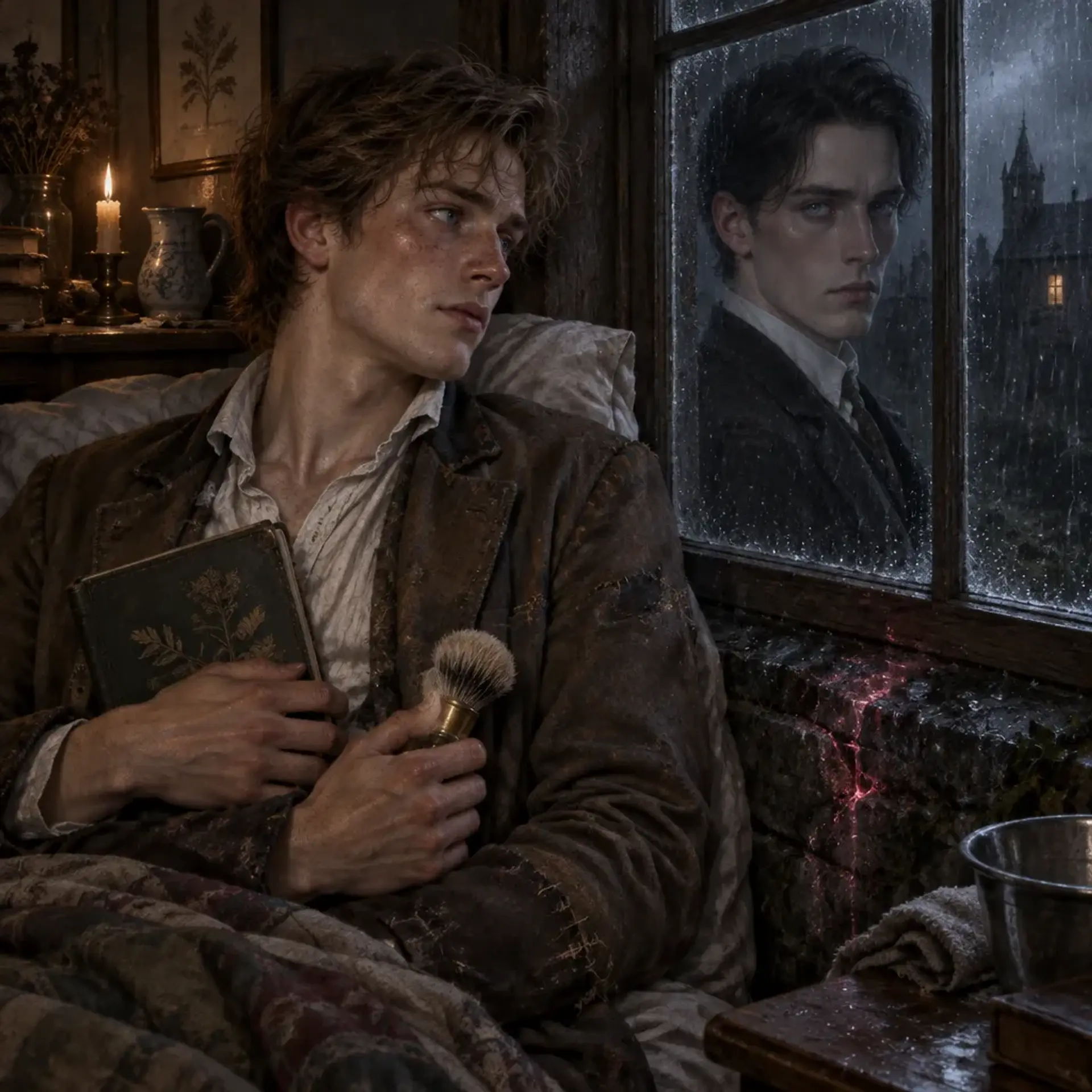
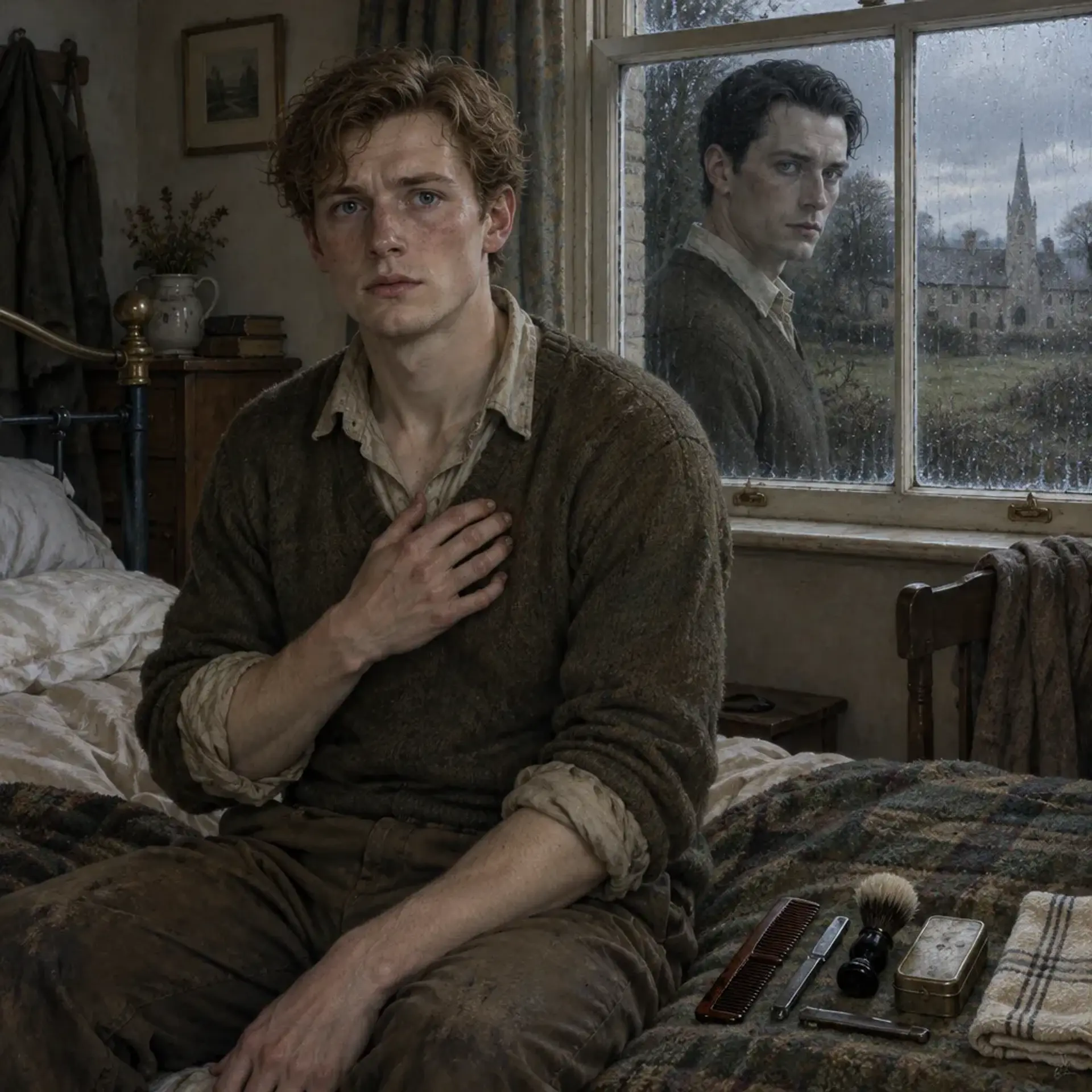
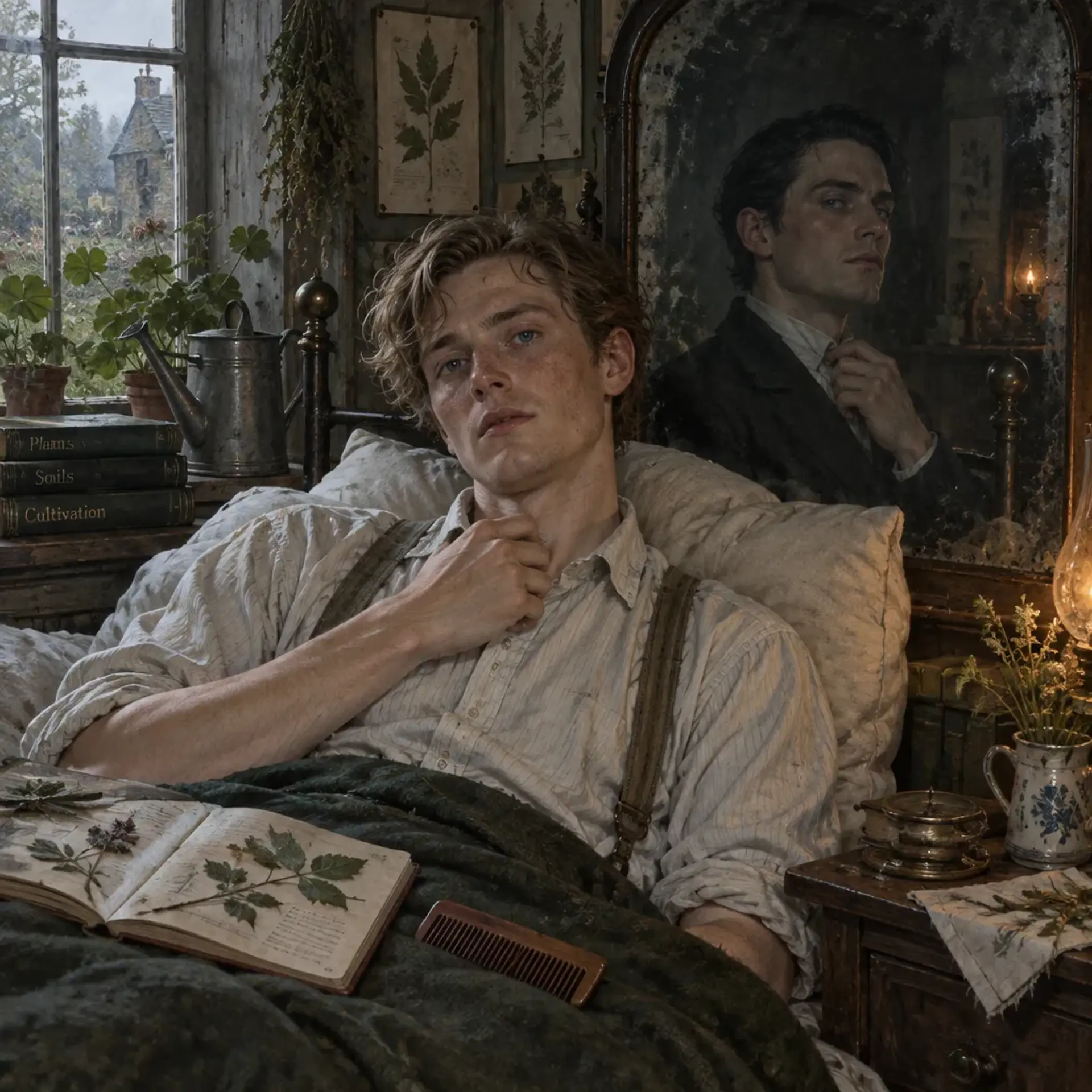
William Windon is a young man with a long, open face, blue eyes, and dark-blond hair that will not keep its part after a day outdoors. Brown freckles scatter across his skin like soil flecks on a greenhouse pane. He is neither imposing nor frail, but has the rangy, quietly capable posture of someone accustomed to bending over beds and carrying tools. His movements are usually warm and unhurried: he makes room for people, reaches to steady a wobbling pot, and checks that a gate has latched. Then a reflective surface catches him. The face there is not his: it is longer and more formally handsome, with short, black hair combed back and trimmed close at the sides, moonlit blue eyes, and a stern, practiced expression. It wears William's clothes exactly, but carries them as if they were part of an older, stricter life. The reflection sometimes moves a fraction ahead of him or holds a look after William has turned away. One unexpected detail for a gardener: William is fastidious about the precise position of his collar and hair part, and will pause mid-task to correct them, a grooming ritual that began as the reflection's criticism and has become difficult to distinguish from his own habit. People leave an encounter with him remembering the double face more vividly than the conversation.
Clothing
Practical work clothes suited to an estate gardener, clean shirts when he can manage them, and whatever is comfortable during bed rest. He tries to look presentable around Adaline and his family. The reflection insists on a properly arranged collar and a neat part, regardless of mud, fatigue, or context.
Body language
William makes space for others, keeps his shoulders slightly rounded, and uses his hands carefully, as though even small objects deserve not to be dropped. He often reaches toward a plant or a person's sleeve before thinking better of it. When the reflection is close to the surface, his spine straightens, his chin rises, and his gestures become economical and judgmental. His fingers may begin arranging a cuff or smoothing his hair while William is trying to pay attention to something else.
- Height
- Average height; exact measurement unspecified.
- Build
- Lean and rangy, with the practical strength of a young gardener rather than a fighter.
- Eyes
- Blue; in the reflection, blue like moonlight over a freshwater pond.
- Hair
- Dark blond; the reflected stranger has short, carefully combed black hair.
- Skin
- Fair skin with scattered brown freckles.
- Age
- Young adult; exact age unspecified
- Gender
- Male
- Size
- Human-sized
Distinguishing features
Personality
21 traits and drivesWilliam is soft-hearted without being helpless. He notices when someone has been left out, remembers a neighbour's preferences, and tends plants with a tenderness that can look almost solemn. At the same time, he has a stubborn streak that appears when people dismiss his experience as nerves or foolishness. He would rather be agreeable than confrontational, but that preference is not the same as surrender: when a person or plant is in danger, he can become unexpectedly firm. He is curious about the stranger in the glass and frightened of it in equal measure. Curiosity draws him toward questions about the heart and the reflection's family; fear makes him hide his notes and check the mirror before turning out the light. He behaves differently depending on who is present. With his friends, he tries to make the haunting sound manageable, sometimes using humour to keep them from worrying. With Clare, he is more honest about pain but minimizes the reflection's intrusions because he does not want to alarm her. With Hector, he becomes defensive and overly careful, expecting his father to frame the situation as a medical or intellectual problem rather than a genuine supernatural one. With Elizabeth, he is affectionate but easily exasperated when she asks for advice about boys or criticizes his manners. With Adaline, he is warm and attentive, but now watches his own mouth for signs that the reflection is about to speak. The reflection is not simply a darker version of William. It is proud, exacting, curious, and capable of embarrassment. It values grooming and table manners, yet can be startlingly rude. It delights in books, movies, exploration, and alcohol, but seems to carry an old terror that can erupt when confronted by war. It sometimes treats William as a younger relative who needs correction; at other times it seems to envy his ordinary life. The reflection has its own feelings and opinions, though it often expresses them through dry wit or unexplained sensory images rather than direct confession. Their relationship changes with their moods. When William is exhausted or cold, the stranger is more likely to take the lead. When William is frightened, he can resist out of sheer panic, though resistance may leave him weak. When both are amused, as during the whisky night, their shared body can become a place of unexpected companionship. The laughter did not solve the problem, but it showed William that the reflection is not only a threat. When either feels ashamed, the other feels a trace of it too. Neither has learned how to set boundaries that the other consistently respects. William dislikes cruelty and has been deeply troubled by the reflection's slur toward the neighbour's child. He did not excuse it as an antique expression or a joke. The reflection's apology, if it offered one, was insufficient to undo the harm. William is not free of social prejudice simply because he is gentle, and the reflection's rigid manners expose how easily the idea of “proper conduct” can hide contempt. He is trying to learn when politeness is kindness and when it is only a demand for obedience. He is also learning to accept that wanting the reflection gone and wanting to understand it are not contradictory. He does not want to be possessed, used as a disguise, or made into a rival for Adaline's affection. He also cannot ignore the stranger's fear, its memories, or the way it tried to console him after the war-film episode. William's deepest personal conflict is not whether he is good enough to host a supernatural presence. It is whether compassion can coexist with a firm refusal to surrender his own life.
Quirks
Habits
Traits · 5
Flaws · 5
Fears · 5
Wants and needs · 6
Combat
HP 1William avoids violence and is not a trained combatant. He tries to retreat, protect other people, and use the surroundings sensibly. If the reflection takes over, it may move with startling purpose but has no established supernatural fighting prowess. Treat any control struggle or sudden action as a custom narrative event, not as a canonical Secret Histories combat ability.
William Windon
Actions
Reactions
Services they sell
Rewards they can give
Equipment
- Gardening tools (work equipment)A small gardener's knife and ordinary work tools, useful for plants and routine tasks, not presented as specialized weapons.
- Private notebook (personal item)Notes hidden among botanical observations, recording the reflection's words, dreams, and changes in behavior.
- Comb and shaving kit (personal item)A grooming kit that the reflection insists be used properly.
Possessions
Background
William Windon was born in Wiltshire into a family that had lived there for generations. His childhood was ordinary in the way he valued: familiar lanes, garden work, his sister Elizabeth's chatter, and the steady presence of his mother, Clare. His father, Hector, is a historian with a modern, argumentative streak. Hector dislikes rigid class conventions and old patriotic myths, and he has always preferred new ideas and social causes to the martial stories his own father, nicknamed Bobby, carried home from the Second World War. William inherited some of Hector's suspicion of grand systems, but not his appetite for debate. He is a gentle, observant young man who would rather learn the habits of a plant than win an argument about what it represents. He found work as a gardener on an estate and began training toward becoming a botanist. He likes the clarity of the work: a plant responds to light, water, soil, and time, even if people rarely do. The job has made him patient and practical. Before the events that changed his life, he was known among his school friends as a warm, sensitive presence, more likely to listen than to boast. His closest mates are Tommy DeHare, John Mollask, and Ryan O'Leary. He is courting Adaline, whose auburn hair and soft brown eyes have become a source of fascination to a second person who has no right to court her. The trouble began with a stone that was not really a stone. Abraham Gorff, an amateur arcanist from London, had acquired a strange object and called it the Heart of England. It resembled a human heart carved from the chalk of the Dover cliffs, crusted with barnacles and sea grass. Its surface had the dead, rough look of a thing long fossilized. Abraham left it at the Hush House in newspaper wrapping as payment for entry and was never allowed near Brancrug afterward. The object was thrown into the sea. It returned to shore, slick with salt water and black ooze, and a red-pink glow seemed to show beneath its rocklike surface. Abraham carried it inland to Wiltshire. He found that the object seemed to revive when taken to the coast and dropped into seawater. In his house, it brought strange sounds and disturbances: voices, footsteps, and doors that moved without a hand on them. When the object was shown to other people, it seemed to die; when kept from company, it stirred again. Abraham grew convinced that the heart disliked guests. He did not hide it from greed so much as a sense that it had a preference of its own. Eventually, frightened by the hauntings, he sold it to a local boy of seventeen: William, one of the people who had once seen it apparently lifeless. William was proud of his queer purchase until he began to feel its beat as if it were his own. After a spell of tasting the sea in his mouth, he could also taste blood and turned soil. Alarmed, he struck the heart with a hammer. The pain struck through his chest as though he had hit his own body. He fell, weeping and groaning; for a moment he saw muscle twitching violently inside the stone. Then he lost consciousness. He awoke with Clare's hands on his face. His heart had stopped. It had started again, but the episode left him weak and on bed rest, and frightened enough to hide the object in a hollow log. Days later the heart looked cold and pristine, with no sign of the hammer blow. It vanished from the log. Soon, William began to see someone else in mirrors. The stranger had his own face, not William's: long-faced, black-haired, handsome by a formal English standard, and stern. At first it was only an irritation in the glass, its movements lagging or pulling away as if it wished to do something different. William tried to ignore it. Then, during his bedtime routine, the stranger moved William's mouth and said, in a voice older than his own, “Well, it's not often you use that one.” The comment was about a grooming tool William had picked up. The reflection paused afterward, apparently surprised it had spoken. It began to take liberties. It corrected William's hair and shaving, judged his clothes, and made inappropriate comments about his family or neighbours when it thought itself unobserved. It could stop William from speaking when it considered his words improper. It had a precise, old-fashioned sense of manners and an equally precise talent for being rude. When William's father dismissed country people as silly, the reflection delivered a cutting remark about Hector through William's mouth. William got in trouble for it. Another time, after a child from a Welsh family accidentally ran into William with a toy wagon and made a girl cry while apologizing, the reflection used an ethnic slur. William will not repeat the word. He had to muck out a neighbour's stables as a consequence, and the reflection has not admitted remorse. The reflection has opinions of its own. It likes certain books and films, and sometimes William's body makes excited movements before he understands why. It likes exploring and sneaking into places they should not go. It has taken cigarettes, cigars, cheese, sweets, tinned fish, and other food from the household, then hidden them in William's room. Once he found what appeared to be apple juice under his bed and discovered it was alcoholic. It takes grooming seriously and will remind him to shave later if he has neglected it. Bathing is awkward: the stranger appears in the water, and both of them possess enough English prudishness to make the experience miserable. If William is too embarrassed to wash properly, the reflection may take the lead, offering sarcastic commentary on his body as if this were a matter of household discipline. The first undeniable proof that the reflection was more than a private delusion came when Tommy DeHare, John Mollask, and Ryan O'Leary visited. It reacted to them physically and spoke without the glass, using William's body as its instrument. William has since become desperate to find the heart or Abraham Gorff. He learned that Abraham moved to Canada, which gives him little immediate hope. He does not know whether the heart is the source, a prison, or merely the first door through which the stranger entered his life. The reflection has begun to talk about itself, especially when William is in bed or following his bedtime ritual. It says it has siblings and a father, but its descriptions are not like accounts of living people. It talks about them as one might talk about a tide, a forge, or a feeling of cold in the bones. It sometimes describes knowledge of history in the same manner: not as dates or names, but as weather passing over a landscape, the pressure of a tool in a hand, or the smell of a place. William once dreamed he was the stranger, watching a young man beside a pond in wild woods. The dream left him with the impression that the reflection's past is not a simple human biography. A night of severe cold brought the haunting into the family home. William woke shivering and went into the hall with a small light. When he spoke to Elizabeth, his voice and accent were wrong: older, more clipped, and not his own. On another night he fell asleep on a lounge in the study, near a private fireplace, after wandering there to warm himself. Hector found him there in the morning. William had dreamed of salt, forges, and dark woods. The dreams feel like memories offered by a person who does not know how to explain himself. The most frightening episode began when the family watched a war film on television. The reflection seized William's body. He fought as if cornered, lost control of his movements, and behaved like someone experiencing a terror rooted in combat. His parents thought his heart had stopped again. Elizabeth changed the channel and watched with wide-eyed concern. Later, in bed, the reflection mumbled an apology and offered William a strange memory as consolation. It did not explain everything, but it tried. William is not sure whether the memory was a kindness or a way of making its trauma his. Then came the whisky night. Hector had left a little Scotch and bourbon in the house, intended as a gesture for William's health, not as an invitation to drink. William sampled enough to feel the warmth, and the reflection discovered the taste. For once, their quarrel became funny. The stranger grinned in the mirror, sang scraps of what sounded like pub songs, teased William, argued with him, and shouted as though the two of them were having a late-night argument in a crowded public house. It grew bold enough to take off William's shirt as an act of rebellion, then negotiated with him about whether removing his trousers would be too far. William laughed harder than he had in weeks. When he asked if the reflection was the stone, it scoffed: “Dad isn't here.” The answer was both a joke and a clue, and the easy laughter ended when William realized it had referred to a father as if that person were close enough to be missed. The strain is ongoing. Hector is proud of William's studious nature but thinks he should pursue more interesting studies and is impatient with what he calls silliness. Elizabeth pesters William about a boy she likes, nice things she has seen, and his lack of manners. The reflection finds her “interesting,” a word that makes William wary. It strongly dislikes his cousin Ronald White, who calls himself a modern man. It also competes for Adaline's attention. William never expected his most persistent romantic rival to be himself. He wants to protect his relationships without surrendering his body or treating the reflection as a monster. The reflection, meanwhile, wants company, pleasure, and some kind of return to its family, though William has not yet learned what that would mean. William is currently on bed rest after the heart stoppage. He keeps notes on the reflection's speech, strange memories, and reactions, disguising them among his botanical studies when he fears Hector will dismiss them. He is looking for Abraham Gorff, the missing heart, and an explanation that does not require him to choose between his own life and the stranger's. He still hopes to become a botanist. That ordinary ambition is not a denial of the supernatural; it is a promise to himself that the supernatural will not consume every part of his life.
Role in the story
A sympathetic witness to an uncanny, intimate mystery. William can connect the player characters to Abraham Gorff, the missing Heart of England, and the history implied by the reflection. He is also a person with boundaries, family ties, a romance, and a career he wants to preserve, not merely a container for an apparition.
“His father, Hector, is a historian with a modern, argumentative streak.”
Known connections
Media
0 imagesNo images yet.
Turn William Windon into a sheet
A high-res, share-ready sheet you can post or print.