Oswin Hirst
Oswin Hirst
At the table
Voice
Oswin's voice has the rough, dry rasp of a man who works outdoors in cold air, with a faint breath-catching quality from too many nights spent awake. He does not boom or whisper; he places words carefully, as if weighing whether they belong in this world. When he speaks old languages, his mouth shapes the sounds with unsettling ease. In May his laugh comes readily and rings out too brightly. After All Saints' night, his voice can sound tired and crowded, as if he has been answering people no one else heard.
His speech is plain and grounded in farm life, but old phrases sometimes surface without warning. He speaks Norse and Old English fluently, and understands stranger tongues he refuses to voice. He avoids direct answers about his age and origins, often replacing them with a weather observation or a practical suggestion.
Speech patterns
How to play them
Meet practical concerns with practical help. He is patient with Mary and kind to William, but evasive about his history, the iron taboo, and his changing nature. If confronted with evidence, he admits one truth at a time. Threats to his family make him direct and frightening; respectful curiosity may earn a rare, honest story.
Goal
Keep Mary and William safe without surrendering his remaining humanity or drawing Thomas into a dangerous bargain.
Motivation
To preserve the family life he has built, and to prove to himself that the human boy he once was has not vanished entirely.
Appearance
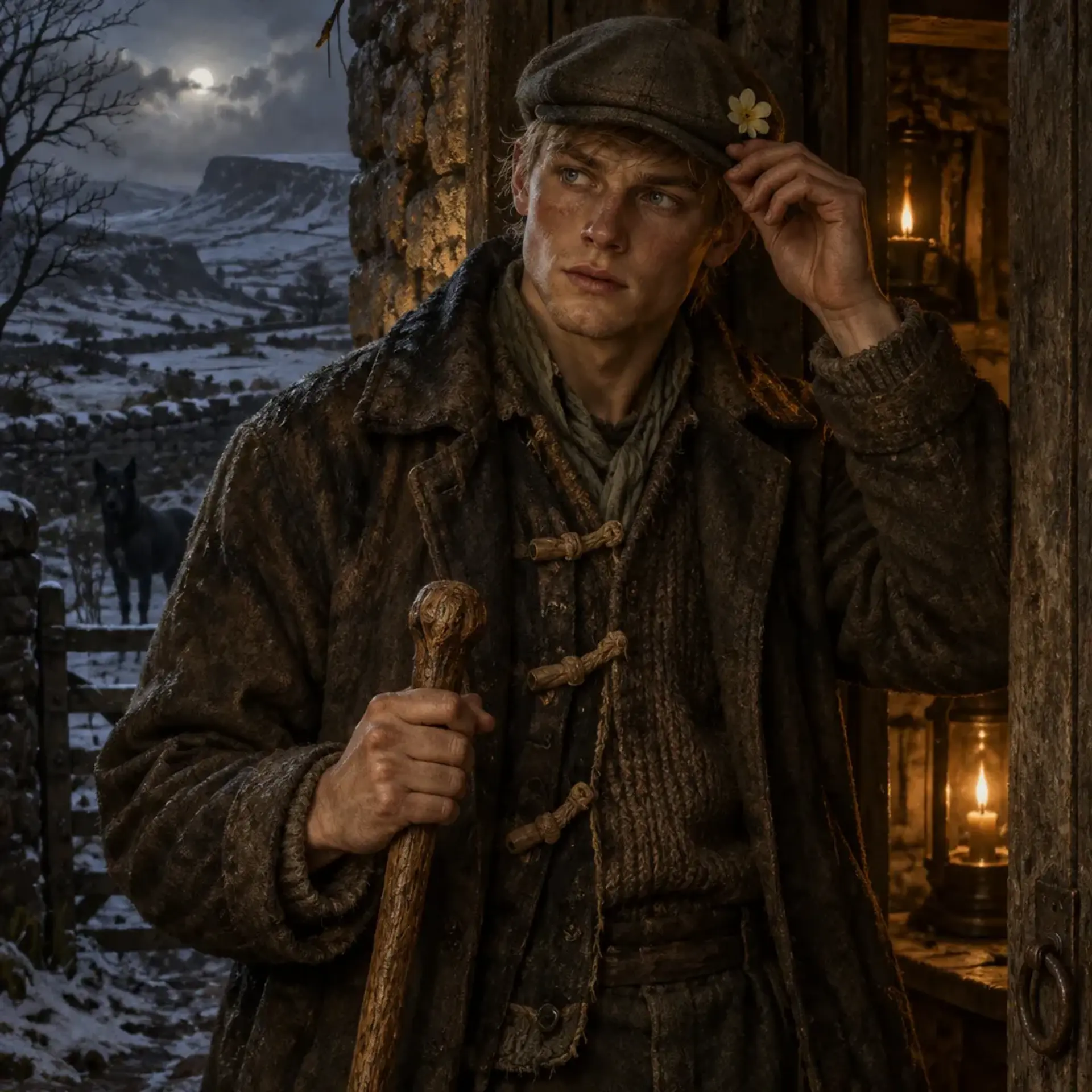
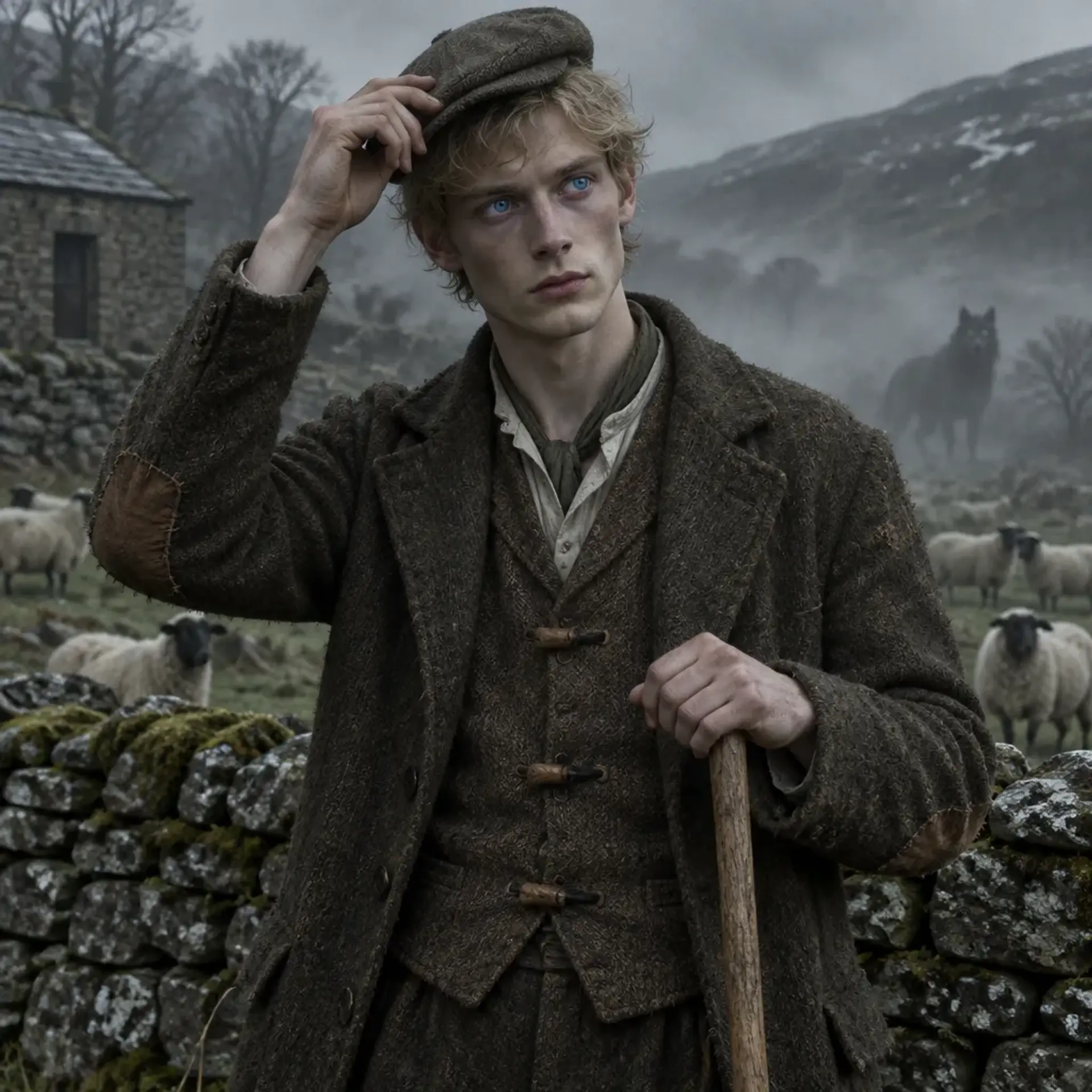
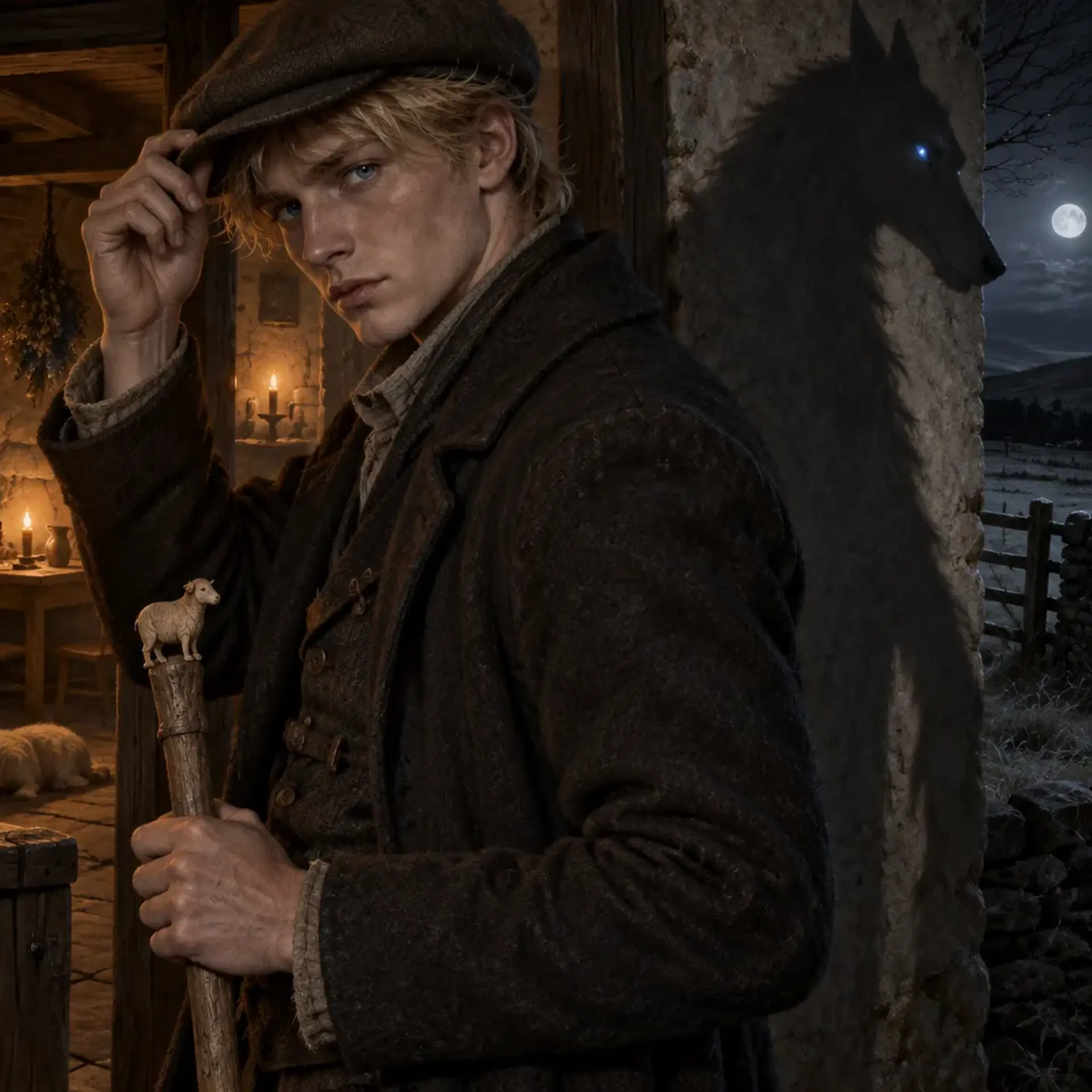
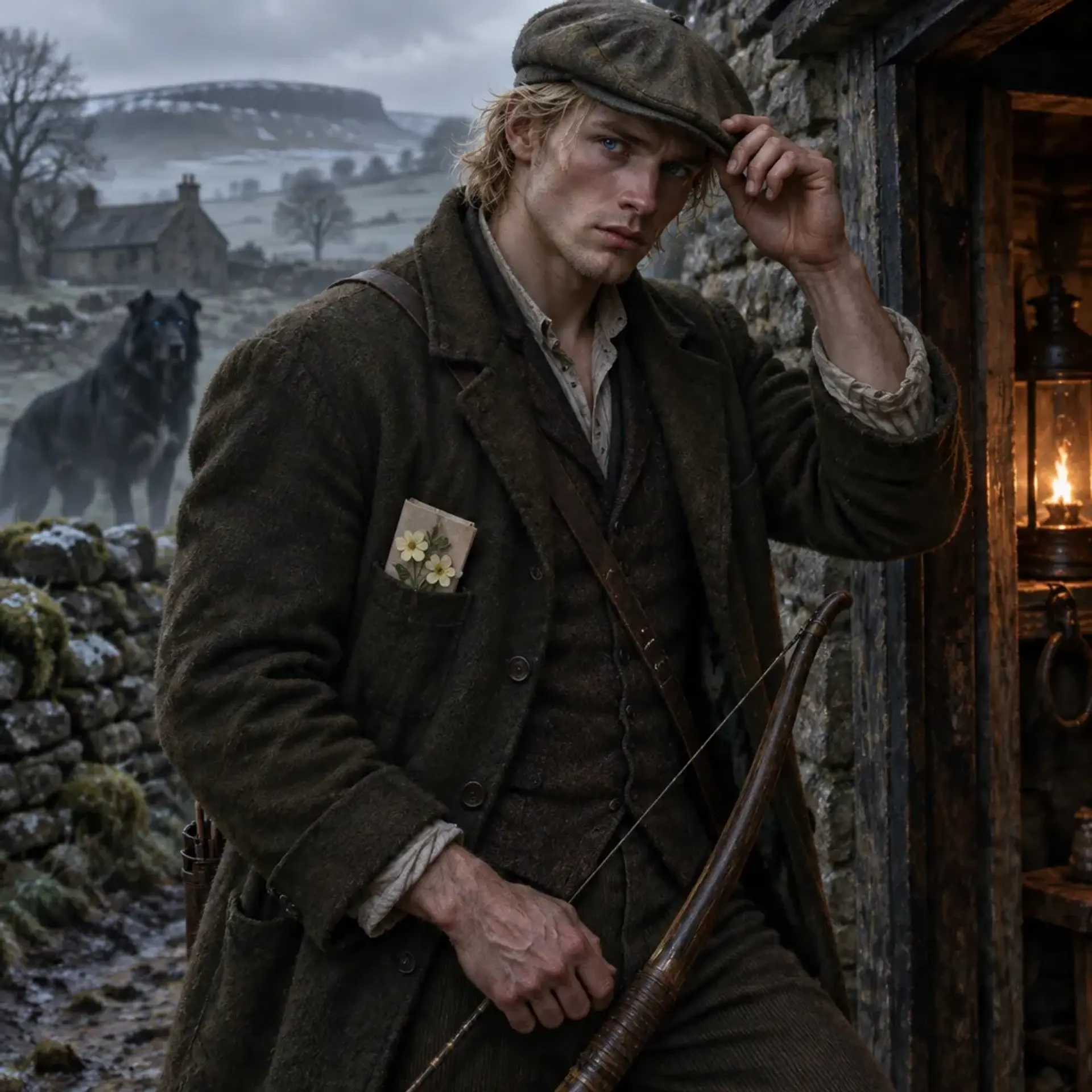
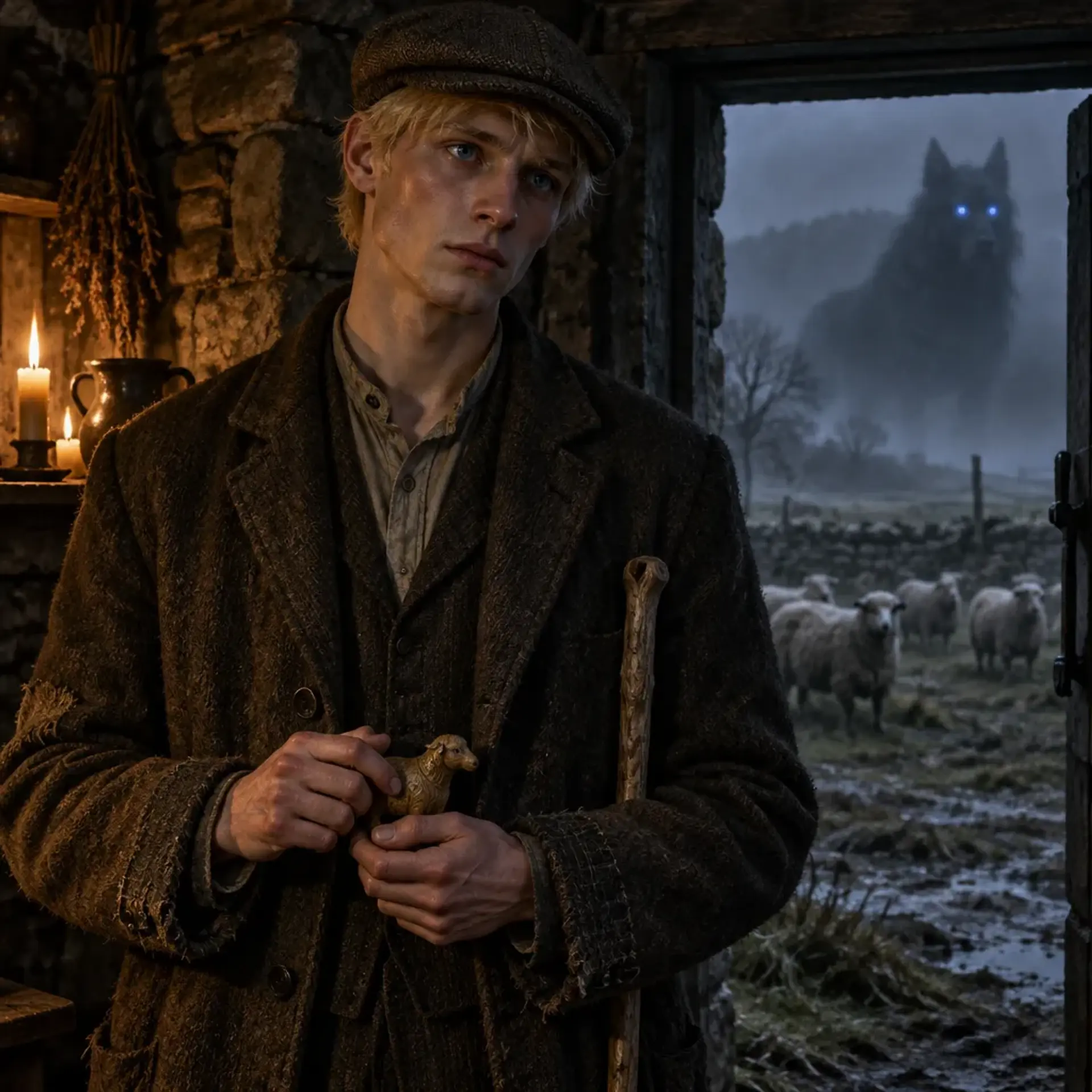
Mary says Oswin looks like a young man who has stepped out of an old story and put on a farmer's clothes. He stands six feet tall, pale and straight-backed, with a handsome, unlined face that has not changed since she first knew him. His blond hair falls in a smooth, stubborn sheet beneath his flat cap; his eyes are a clear, burning blue, bright enough to seem lit from behind when he is tired. His skin is winter-pale, with a faint grey cast after sleepless nights. He walks with a shepherd's quiet economy, placing each foot as if testing ground only he can see. When unsettled, he becomes abruptly still, head tipped as though listening to a sound beneath the floor. His coat is ordinary wool, but carefully mended at the cuffs, and the cap is brushed clean even in lambing season. The unexpected detail is that he keeps a little wooden toy sheep tucked into his coat, whittled for William and polished smooth by his thumb. In hound shape he is immense, black as a wet grave, with blue fire behind his eyes and paws that make less sound than the mud should allow.
Clothing
A plain flat cap, weathered wool coat with neat repairs, work shirt, sturdy trousers, and boots kept clean when possible. He wears no iron buckle or metal ornament.
Body language
He stands very still when listening, then moves with sudden, economical purpose. His hand often checks the brim of his cap or rubs his thumb over the toy sheep in his pocket. He angles his body away from iron without appearing to notice. When May stirs his fey nature, he smiles too quickly and watches other people's reactions as if their discomfort were a new and fascinating game.
- Height
- 6 ft
- Build
- Tall, lean, and strong from years of farm work, with an unnervingly youthful face
- Eyes
- Bright, burning blue
- Hair
- Pale blond, straight
- Skin
- Pale, with a cold grey cast after sleepless nights
- Age
- Appears about 25; says he is 17, though his true age reaches back to the Danelaw
- Gender
- Male
- Size
- Medium
Distinguishing features
Personality
16 traits and drivesFrom Mary's perspective, Oswin is kind in the small, dependable ways that matter. He rises when William cries, fixes what breaks, and remembers which neighbor needs help before they ask. Yet his kindness can sit beside a cold, alien curiosity. When a frightened person tells him a terrible story, he comforts them; when a cruel person stumbles, the May part of him may find the fall funny. He wants to be a husband and father, but part of his mind still understands affection as possession, hospitality as a binding bargain, and fear as proof that someone has noticed him. He is practical about sheep, weather, money, and sickness. He can judge a lamb's weakness by its breathing and repair a fence in the dark. About himself, he is evasive and superstitious in ways he would mock in another man. He reads new scientific works and repeats the church's teachings to persuade Mary that there is an explanation for everything. Then he avoids an iron nail as if it were a live coal. He behaves differently according to season. In winter, especially at Christmas, he is most recognizably human. He sits close to the fire, listens while Rose tells family stories, and lets the church service settle his thoughts. He does not enjoy grief, but he can bear it more plainly then. At Christmas after Alice's death, he stayed with the Pickles family through the whole evening. He helped Hugh carry fuel, listened while Edward spoke of the graveyard, and let Rose put food on his plate despite his lack of appetite. Mary saw him choose to remain among sorrowing people rather than flee into the hills. She treasures that memory because it felt like a promise. All Saints' night pulls in the opposite direction. Oswin becomes watchful, not openly cruel, but strained by the dead who approach him. During the night he accompanied Edward to the graveyard after Alice's death, he kept one hand near his staff and the other extended toward his brother-in-law. Edward later said Oswin murmured to someone behind a gravestone, then asked the unseen visitor to leave the family alone. Oswin did not tell Edward what the dead wanted. He did, however, walk him home and wait outside until the house lights were lit. Mary noticed that he remained at the window until dawn. May is when the contradiction becomes hardest to ignore. Oswin grows exhilarated, daring, and quick to laugh, as if every danger is a private joke. He becomes attentive to colors, scents, and small acts of disorder. He may spend an hour admiring a beetle, then become irritated when Mary asks him to come inside. He knows the first days of May are dangerous and tries to stay near church, the house, or familiar company. His attempts do not always work. Once, while checking the boundaries with Hugh, he heard something calling from beyond the hedgerow. Hugh saw him step off the path and vanish between two hawthorns. Oswin returned at daybreak, pale with exhaustion, with strange petals caught in his cap. He said he had crossed into the Other Side. Hugh has never accepted the explanation that it was only a few minutes for him. Hugh brings out Oswin's guarded, workmanlike side. The two can labor together in silence, but Hugh watches for signs that Oswin is lying. Oswin respects that suspicion more than he admits. Edward brings out his protective side. Since the graveyard night, Edward will sometimes ask him to walk the lanes after dark. Oswin says yes, then pretends it was no trouble. He has more difficulty with Thomas, whose questioning feels like a hunt conducted with manners. He responds to Thomas with courtesy that can become unnervingly formal. He likes Rose's kindness, though her direct questions unsettle him more than Thomas's schemes. Mary believes Oswin wants her not to be afraid because he loves her. She also believes he wants her not to look too closely. He has not aged since they met. He avoids iron. He speaks of journeys and old kingdoms as if he has personally crossed their roads. He sleeps badly when the seasons turn. The most painful fact is that none of these signs erase his tenderness. He has taken William into his arms after the child was mocked for being slow, and once stayed awake all night because William had a fever. In the morning, Oswin looked more tired than the boy. He can be generous, even self-sacrificing, but the fey part of him does not understand why love should require honesty. That is the conflict Mary lives beside: a good man who may not be entirely a man, trying to protect his family with lies that could destroy their trust.
- Alignment
- Neutral, with an Unseelie pull toward unsettling bargains and private rules
Quirks
Habits
Traits · 4
Flaws · 4
Fears · 4
Wants and needs · 4
Combat
AC 13 · HP 38 · 30 ft.Prefers to frighten intruders away and fight only when cornered or when his family is threatened. He uses his hound form to pursue or drive off enemies, then retreats toward familiar ground. Iron causes him pain and disrupts his confidence. He avoids killing humans if a warning, bargain, or escape will suffice.
Oswin Hirst
Spells
Actions
Reactions
Services they sell
Rewards they can give
Equipment
- Ash walking staff (weapon)A sturdy walking staff used for farm work and self-defense.
- Flat cap (clothing)A plain flat cap, carefully brushed and worn in all weather.
- Wooden sheep (keepsake)A small toy sheep he made for William; its fleece is worn smooth from handling.
- Seasonal charms (folk protection)A little bundle of rowan twigs and dried primrose petals, carried in spring despite his claims not to believe in protections.
Possessions
Background
I am Mary Hirst, and I have spent years telling myself that a man can be strange without being wicked. Oswin is gentle with William. He mends the boy's toys, carries him when his legs tire, and makes time for him even when the flock needs tending. He has a fine house for a sheep farmer, a steady hand with sick lambs, and a way of making frightened people feel that the worst has passed. Yet the first thing I learned about him was that his stories did not fit the years in which he claimed to have lived. He told me he came from the Yorkshire dales, and spoke of old roads, ruined halls, and winters whose names no priest in our parish remembers. He called himself seventeen once, with a straight face, though he looked older than that and had already traveled farther than most men manage in a lifetime. Later he told me he had been born under the Danelaw, when raiders carried off his mother. He remembers being human: a boy with cold feet, a mother's rough hands, and the smell of smoke caught in a thatch roof. When he speaks of that memory, his face changes. For a moment he seems not uncanny but bereaved, as though the child he was still waits somewhere for a door to open. His other memories are less human. He once described the Other Side to me after waking from a night of no sleep. The sky there was not above the land but laid across it like a shining ceiling; paths moved when travelers looked away, and a stream ran uphill carrying dead leaves that whispered names. He said he had crossed there during a Mayday, following music he could not stop himself from wanting. He returned after what felt like three days, though only a few hours had passed here. His boots were dry, his pockets full of white petals, and he could not remember his own name until I said it. He would not tell me what had invited him back. I know something changed in him over the long years of contact with fae, the dead, and devils. He understands forbidden tongues better than he admits, and refuses to speak them even when a spirit begs. He sees the dead and can converse with them as easily as a neighbor at market, though he calls their requests dribble and avoids graveyards when he can. He has friendly arrangements with some creatures of the night and drives others away from the town's boundaries. I have watched him pause before a familiar dark shape in the field, his hand tightening at his side, unable to decide whether it is a friend or a meal. The seasons govern him more than he wishes. May comes on him like a hammer. In the first days of the month he grows bright and restless, full of laughter that seems too large for one man's chest. He takes delight in small cruelties of chance: a door that will not latch, a neighbor's startled curse, a lamb that escapes a pen. Afterwards he hates himself for it. Once, during Mayday, he went out with my brother Hugh to check the boundary walls. Hugh later told me Oswin became almost joyful when the first bonfire was lit, then slipped away from the road without a sound. Hugh found him at dawn sitting in a hawthorn tree, his boots muddy with soil that did not match any field nearby. Oswin claimed he had only been walking. I saw the white petals in his cap. The first three days of May are worst. He eats little, sleeps less, and speaks of the hills as if they have called him by an old name. He says he wants to be ordinary, but sometimes I catch him staring at the door as though it has opened onto somewhere else. At Christmas he steadies. Church bells and familiar prayers seem to pull him back into his body. One Christmas, after my sister Alice had died of fever, the whole Pickles family gathered in our house. My father Thomas watched Oswin closely, while my mother Rose set a place for him and refused to let grief turn supper into silence. Oswin helped Hugh carry wood, sat with Edward by the fire, and let William sleep against his shoulder. For that evening, at least, he seemed wholly present. All Saints' night is another matter. The dead come asking things of him: messages carried, bones found, apologies delivered to the living. During one Halloween, he went with my brother Edward to the graveyard after a black hound had been seen near the graves. The night before, Edward had lost Alice, and the whole family was raw with fear. Oswin stood among the stones while the dead gathered close enough that his breath smoked. Edward saw him answer someone no living person could see. Oswin then led my brother out by the hand and kept the hound from crossing the churchyard wall. He said little afterward. Edward says he saved him; Oswin says the dead merely wanted directions. William's birth made the questions impossible to ignore. Both Oswin and I are blond, yet our son was born with black hair and his father's burning blue eyes. The village calls him Black William or Blackby. He is slower to speak and learn than other children his age, though he notices things adults miss. One sickly child died shortly after birth, and since then my pregnancies have ended too soon. I keep iron scissors on me and an iron thimble near William. Oswin avoids both. He has never told me why, and I have never asked without already fearing the answer. Recently he touched iron by accident while helping repair a gate. His hand closed around the nail. He jerked back as if burned, went grey, and could not speak for several breaths. Then he laughed and called it a foolish trick of the cold. I saw the mark redden across his palm. The next morning, I found him standing outside William's room, unable to cross its threshold while the iron thimble sat on the sill. He did not wake the boy. He only watched him sleep. My father Thomas is suspicious. He has a cottage a good distance from ours and a patient way of asking questions whose answers he already suspects. He plans to use what he learns about Oswin for the family's advantage, though he dresses ambition as concern. I told him about the night Oswin changed shape. I regret it, but I feared for William. Thomas thinks the truth could buy protection or land; he does not understand that secrets like Oswin's are not things one can safely sell. My brothers Hugh and Edward disagree about him. Hugh trusts Oswin's labor but not his silences. Edward trusts the man who stood with him among the graves. My mother Rose sees the strain in all of us and tries to keep the family together with food, church visits, and blunt questions. I believe William's father may be the Barguest, or something near enough that the distinction will not comfort me. Oswin says he wants me not to fear the dark. He cites church doctrine, then the new sciences he reads by candlelight, as though either could explain the blue fire in his eyes. He asks me to trust him. I do, in the way one trusts a bridge that has carried you before, while still listening for the crack beneath your feet. He loves us. I have seen that plainly. I have also seen the part of him that does not know what human love is supposed to ask of him.
Role in the story
A loving husband and father whose strange nature makes him both guardian and danger. Mary is the emotional lens through which his secrets, family bonds, and seasonal changes come into view.
“He mends the boy's toys, carries him when his legs tire, and makes time for him even when the flock needs tending.”
- Faction
- No formal faction. He keeps an uneasy understanding with certain local night creatures and maintains the safety of the town's field boundaries.
Known connections
Media
0 imagesNo images yet.
Turn Oswin Hirst into a sheet
A high-res, share-ready sheet you can post or print.