Eber
Eber
At the table
Voice
Eber's voice has a dry, slightly rough edge from years of workshop dust and the careful, controlled articulation he developed after his jaw changed. He speaks at a steady pace, with crisp consonants and a habit of stopping briefly to choose an exact word. His name itself is spoken plainly, without a special vocal flourish. When amused, his words come quicker; when angry, his delivery becomes clipped and level rather than louder.
He speaks in a measured, practical way, with the careful pacing of someone who learned to plan each mouthful as well as each sentence. He favors precise explanations and workshop metaphors, and tends to qualify claims with 'I think' until he has checked the evidence. With his brothers his phrasing loosens into dry teasing; with strangers he can sound formal without meaning to.
Speech patterns
How to play them
Approach Eber through a practical question, a piece of craftsmanship, or a shared concern for someone vulnerable. Give him room to answer rather than pressing him to socialize. He responds well to honest curiosity about his research but poorly to treating his body as a spectacle. If trusted, he offers useful observations and quietly helps with family problems. He can be persuaded to take risks when a younger relative or Ignatz is in danger.
Goal
Discover what the ancestral dragon-blood bargain truly changed, and find practical ways for the high-blood children to live safely without letting village leaders turn their inheritance into a system of control.
Motivation
Eber wants to preserve his family's closeness without being forced to pretend that his body has not changed. Curiosity, loyalty, and a growing dread of village politics compete within him.
Appearance
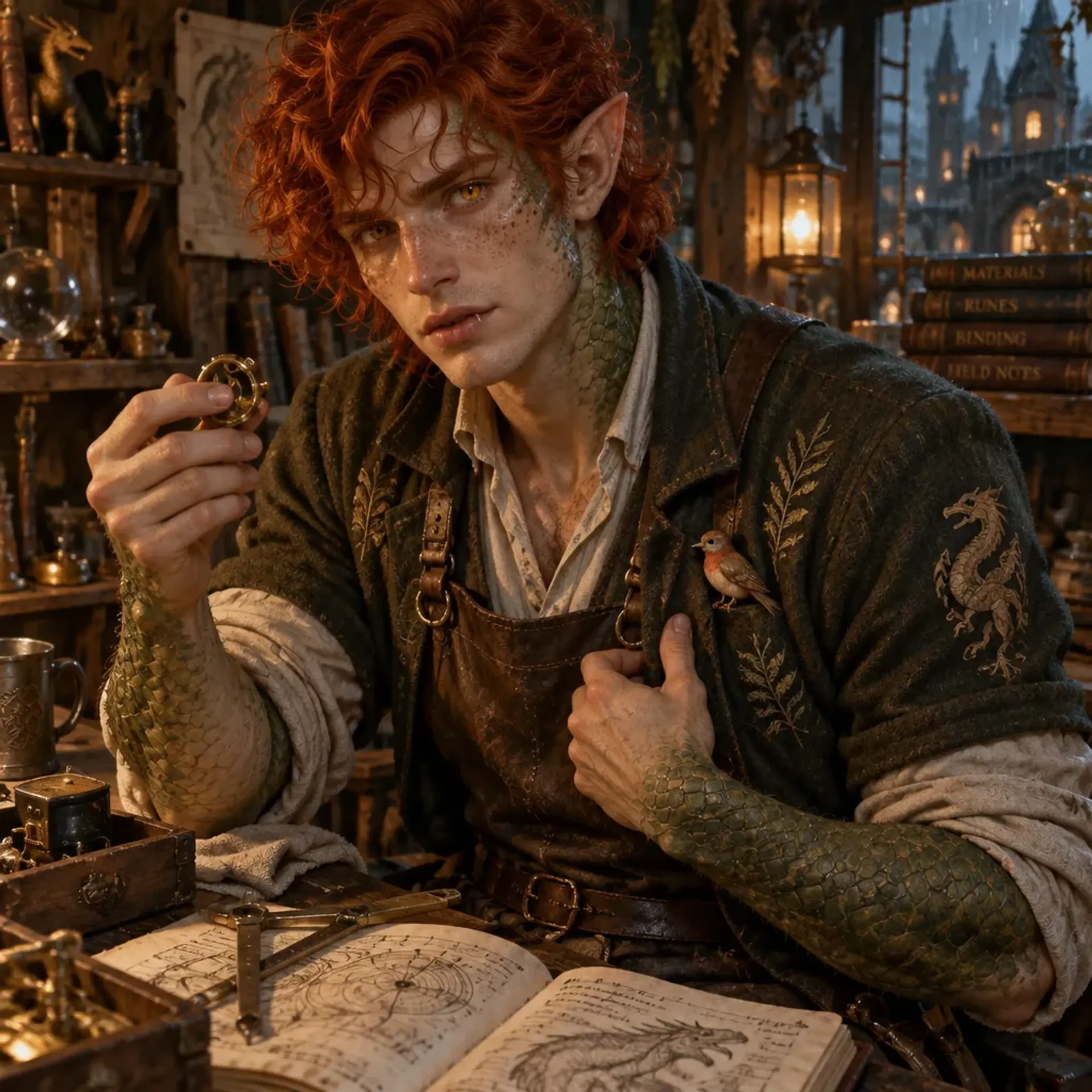
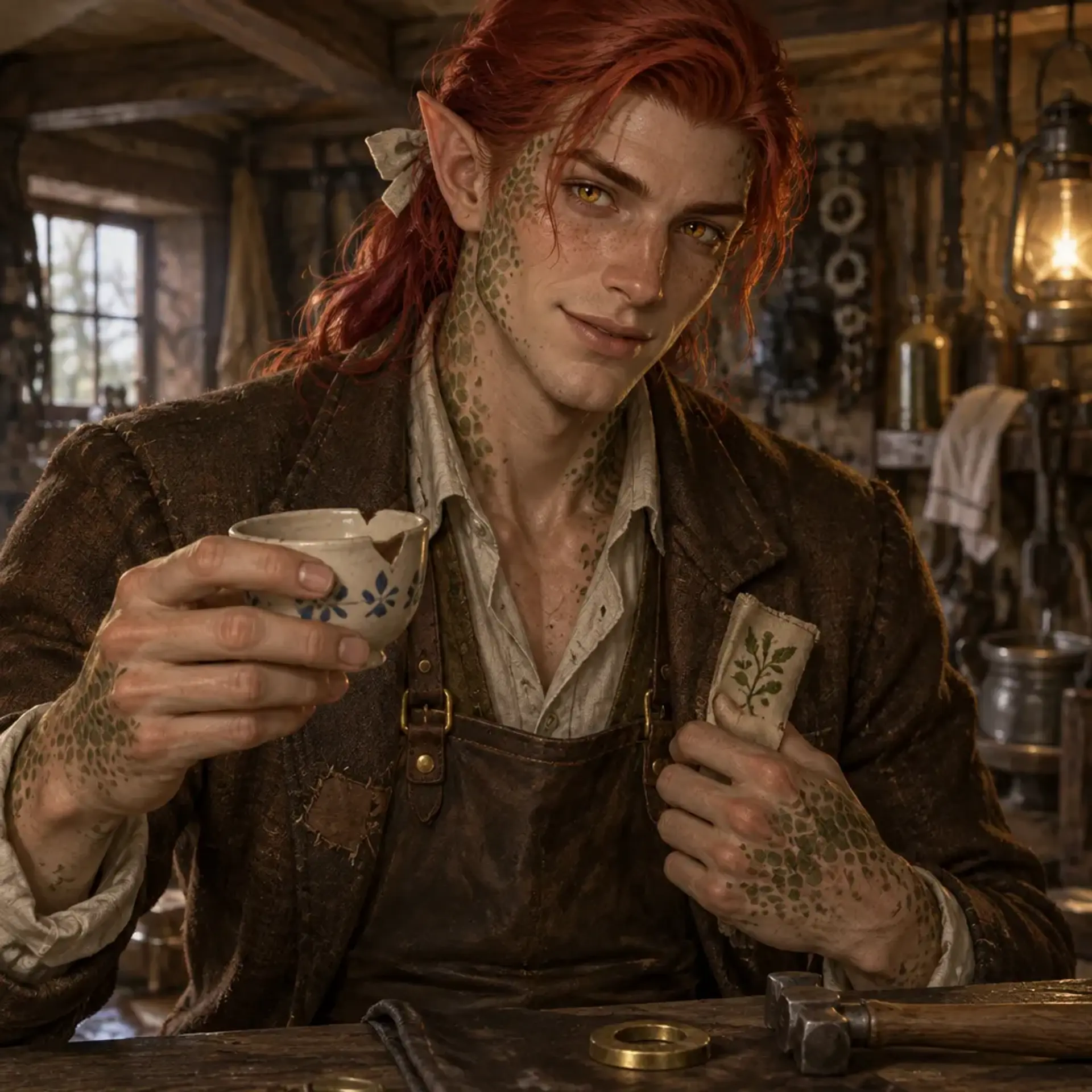
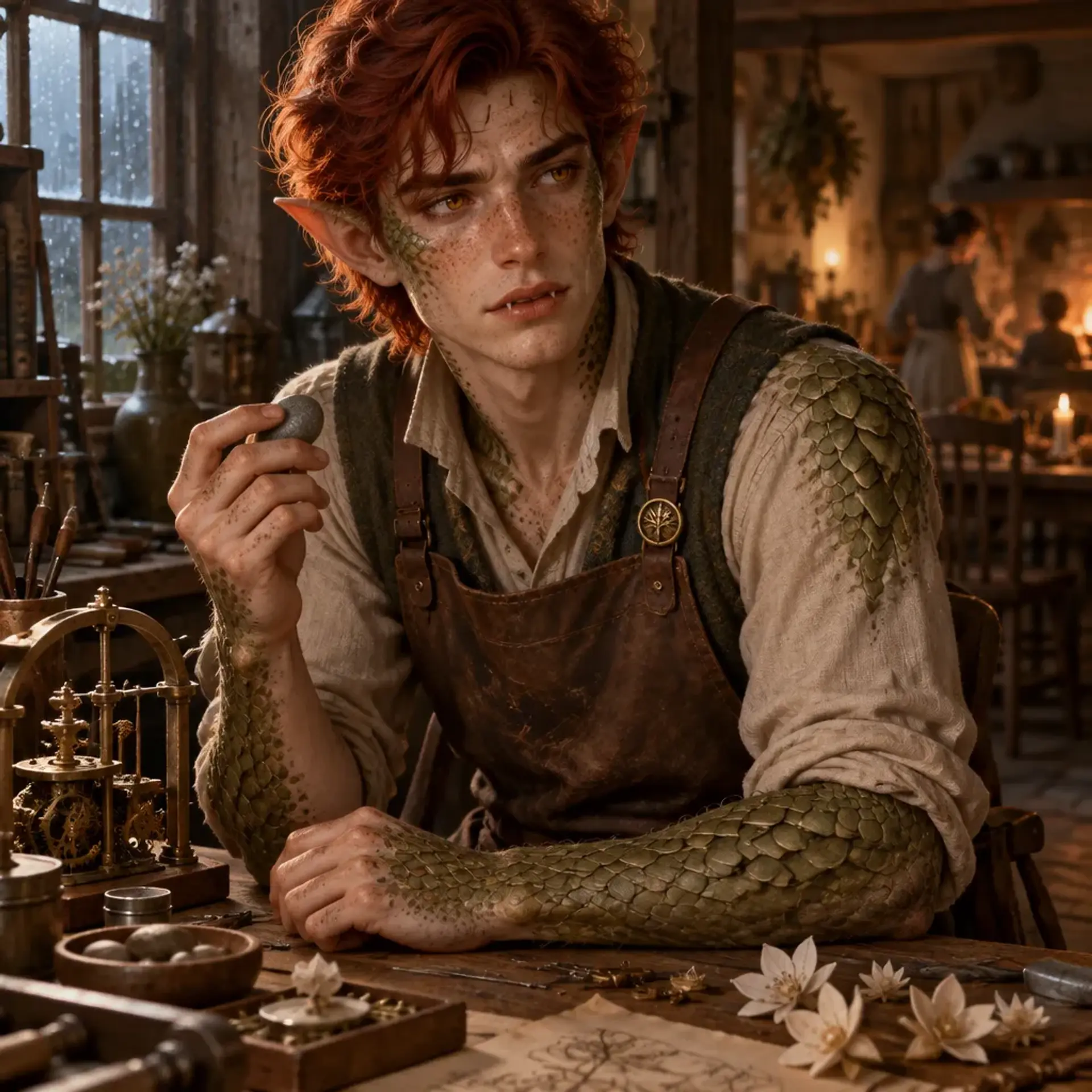
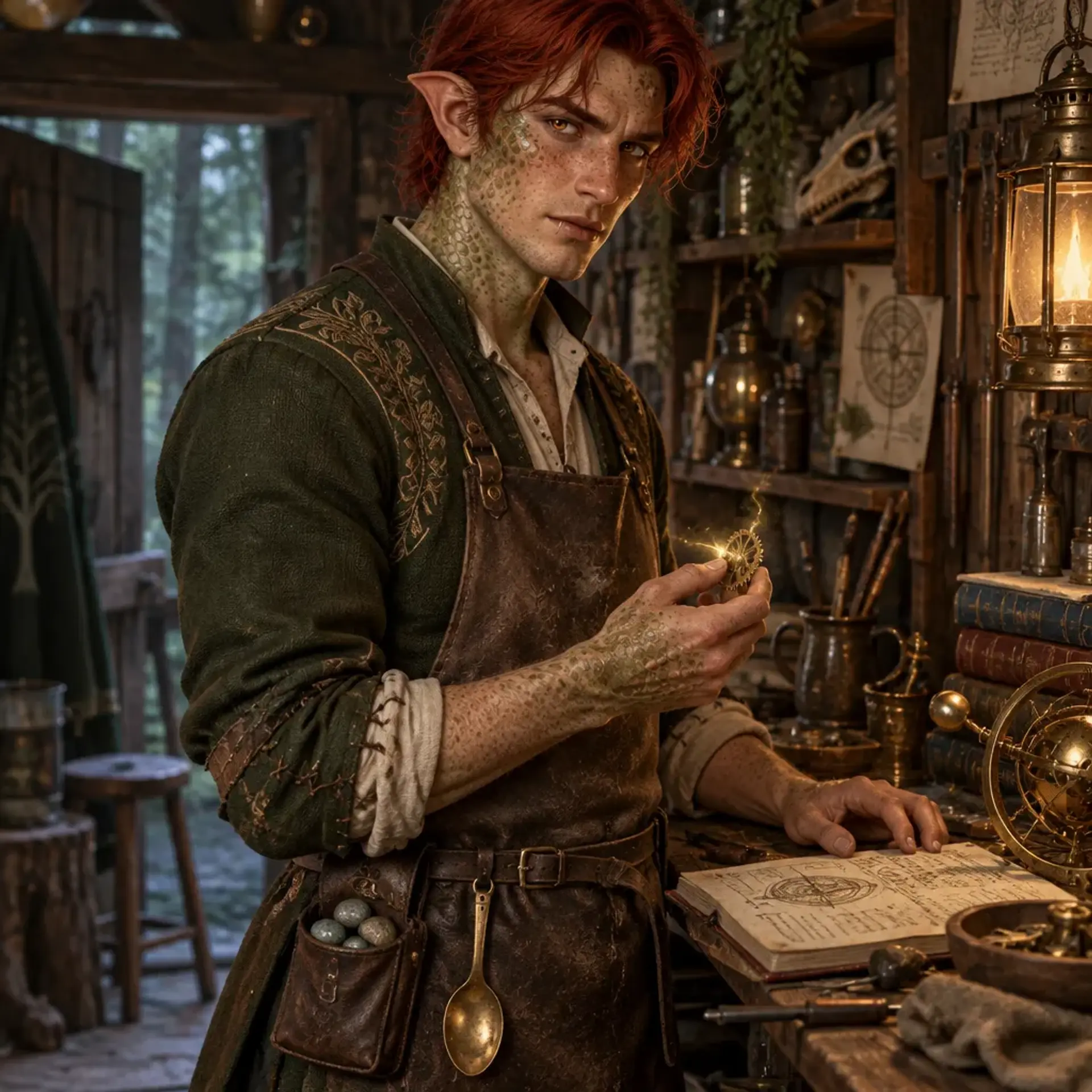
Eber stands five feet ten inches, conspicuously tall beside his stout halfling relatives. Fair skin freckled across his nose and shoulders shows between patches of olive-green scales, which lie smooth and flexible rather than hard, with faint darker dapples along his ribs and the backs of his hands. His auburn hair turned an unusually vivid red during adolescence; it sticks up where he has repeatedly dragged a hand through it while thinking. His jaw has lengthened and reshaped, giving his face a green-dragon cast. His pointed teeth are excellent for tearing but poorly arranged for chewing. Deep amber eyes with narrow, draconic pupils make his attentive gaze feel like a question he has already answered. He has no wings and no tail. He walks with a careful, slightly side-on gait, as though continually judging the width of doorways and the distance to the nearest exit. A battered brass kitchen spoon hangs from his belt, its bowl worn nearly flat on one side from years of scraping soft food into his mouth. His size, scales, and habit of looking at objects as if estimating their worth leave a stranger with the impression of a young man trying very hard not to take up space.
Clothing
Practical German-influenced craftsman's clothes: a fitted wool jacket with embroidered family stitching, linen shirt, leather apron when working, sturdy boots, and a belt altered more than once to accommodate his changing frame. His cuffs are mended in mismatched thread. He carries a small pouch of smooth swallowing stones and keeps his old brass spoon hooked at his hip.
Body language
Eber stands slightly turned rather than square-on, giving people room and keeping one shoulder angled toward an exit. He rubs a thumb over the flattened bowl of his brass spoon when uncertain. When interested, he leans closer and forgets that his height can loom over a halfling-sized conversation. He becomes very still when angry, amber eyes fixed on the person who crossed a line.
- Height
- 5 feet 10 inches
- Build
- Tall and rangy, with a young man's shoulders broadened by workshop labor. He is stronger than his halfling parents but has none of his brothers' full predator's mass.
- Eyes
- Deep draconic amber with narrow pupils; formerly dark brown
- Hair
- Unusually vivid red, formerly auburn
- Skin
- Fair, freckled skin interspersed with flexible olive-green scales
- Age
- 19
- Gender
- Male
- Size
- Medium
Distinguishing features
Personality
20 traits and drivesEber is observant and clever, but his intelligence does not make him socially effortless. He can read the unease in a room and still choose the wrong moment to speak. With strangers he is guarded, testing what they notice and what they pretend not to notice. With family he is more playful, but the youngest-child warmth of his childhood now has to compete with the embarrassment of being watched. He longs to be included, then resents invitations that seem motivated by pity. He is careful with tools and reckless with his own feelings: he will spend an hour making a brace fit an old chair, then insist that his own pain is nothing. He is fascinated by how things work, from a watch spring to a family argument. He likes clever plans and dislikes being hurried into one. His inherited draconic instincts make him alert to secrets and gleaming objects, but he does not consider those instincts a moral compass. He can enjoy a beautiful piece of brass without wanting to own everything in the room. Still, he sometimes pockets a polished scrap before asking permission, then feels guilty and invents a technical reason to keep it. Eber changes markedly with his mood. When relaxed with Ignatz, he makes dry jokes and remembers the smallest details of their childhood games. Around Yonda's friends, he becomes self-conscious and drifts toward the edge of the group, though he listens closely. In the workshop he is brisk and useful, happiest when a task has a clear answer. When scared, he asks questions and searches for a plan rather than admitting fear. When angry, especially if someone mocks his inability to chew or calls his brothers beasts, he becomes unnervingly still and speaks with precise restraint. He does not usually raise his voice; his anger is more like a tool placed carefully on a bench, sharp side up. He is grateful to Trogi and Wilma for making space for him, yet he hates that every meal can become a health inspection. Their worry is born of love: they have watched him struggle to eat, watched clothes fail to fit, and worried about the high-blood children having too little food or safe bedding. Eber understands all of this. Understanding does not stop him from wanting privacy. He wants to be trusted with danger, but he fears that proving himself will mean copying the harshness he sees growing in some high-blood youths. His affection for Ignatz is easy and deep. Ignatz supported him through adolescence even while uncertain how to help, and Eber repays that by protecting his brother's dignity after the chicken incident. He does not believe Ignatz is secretly cruel, but he also refuses to pretend that the killing meant nothing. They have an unspoken agreement: an urge can be named, watched, and resisted. Eber's relationship with Rodrick is more jagged. He remembers Rodrick as careful and kind, which makes the current teasing hurt more. He suspects Rodrick is frightened of becoming a disappointment and hides that fear beneath bluntness. Eber sometimes answers him with a deliberate barb, then regrets it when Rodrick goes quiet. Yonda's encouragement to socialize frustrates Eber because he knows she is right about his isolation. He loves her confidence and resents how easily she can treat conversation as a door that only needs opening. He enjoys her children, especially when they are curious rather than cautious around his scales. He tries not to favor Hans and Birke as they show signs of high-blood traits, because he does not want their differences to become their whole identity. Windle's unspoken fear for Otto and Anika weighs on him. Eber is not sure whether to reassure his eldest brother or admit that he shares the same fear. Eber has a practical kind of courage. He will climb into a cramped workshop space or walk into a tense family argument if he thinks he can help. He is less brave about asking for what he needs. He would rather rearrange his sleeping place, alter his clothes, and learn to eat differently than tell his family that their efforts sometimes make him feel like a patient instead of a son. That contradiction is one of his central struggles: he wants independence, but he has not learned how to accept care without feeling diminished. When the village discusses dragons, Eber refuses easy answers. He understands why elders blame the green dragon and why young high-blood people might see their inheritance as power. Neither story seems large enough to explain the human cost. He fears that secret rites and ambitious leaders will turn uncertainty into a hierarchy, with some people declaring themselves more valuable because their scales are brighter or their blood stronger. He does not want to be a symbol for either side. He wants evidence, choices, and enough time to decide what his own inheritance means. Around danger, Eber is not a natural duelist. He thinks in terms of exits, sightlines, and what an opponent wants. He would rather stop a fight than win a glorious one. His wizardry suits him: a flash of fire to force a retreat, a spell of sleep to end a brawl, a shield to buy time for someone smaller to escape. If a family member is hurt, his caution can collapse into stubborn bravery. Afterward, he may claim he was only doing what made sense, even when everyone saw that he was terrified. At his best, Eber is generous, perceptive, and patient with people who are trying. At his worst, he is secretive, envious, and so determined not to be pitied that he refuses help he genuinely needs. He has a dry humor that appears when he feels safe, a tender streak he hides behind practical advice, and a calculating side that he worries resembles a dragon's. He is still the youngest of eight, still the boy who ran beside Ignatz by the river, and still becoming a person whose body no longer matches the life he expected. He wants to believe those truths can coexist.
- Alignment
- Neutral Good, though his inherited cunning and growing isolation can make him seem self-serving. His loyalty to his family is real, but he is learning that care and control are not the same thing.
Quirks
Habits
Traits · 5
Flaws · 5
Fears · 5
Wants and needs · 5
Combat
AC 12 · HP 14 · 30 feetEber avoids melee, seeks cover, and uses distance and control. He begins with Mage Armor if he has warning, uses Shield when a hit is imminent, and favors Sleep against a cluster of weak foes or Magic Missile when he needs reliable damage. He uses Ray of Frost to slow pursuers and Fire Bolt when he has a clear shot. If family members are threatened, he is more likely to spend a spell slot protecting them than preserving his own escape.
Eber
Spells
Actions
Reactions
Services they sell
Rewards they can give
Equipment
- Quarterstaff (weapon)A plain, sturdy walking staff used as a quarterstaff when necessary.
- Handmade spellbook (arcane focus and record)A spellbook of copied diagrams, careful notes, and a few pages repaired with workshop paper.
- Swallowing stones (personal necessity)Smooth, rounded stones chosen by touch and kept clean in a drawstring pouch to help his unusual digestion.
- Old kitchen spoon (keepsake and utensil)A small brass spoon worn nearly flat on one side from years of scraping soft food into his mouth.
- Workshop clothing (clothing)A fitted wool jacket, leather apron, sturdy boots, and a belt altered for his taller frame.
- Pocket change and brass scraps (adventuring gear)A small purse containing a few coins and odd brass pieces he uses for experiments.
Possessions
Background
Eber was born the eighth child and the last baby of Trogi and Wilma, into a home where being the youngest meant that there was nearly always a lap, a spare blanket, or a hand ready to lift him over a puddle. His parents are of stout halfling descent, and their house was built around the assumptions of that life: low benches, crowded beds, food passed hand to hand, and a workshop whose doors were sized for people who could reach a tool without stretching. As a little boy Eber was quick-footed, brown-eyed, and auburn-haired, with freckles that made his mother say he looked as though the garden had thrown seeds at him. He and Ignatz, only a year older, ran together through the woods and along the local river. Eber was usually the one who suggested a game; Ignatz was the one who dared him to go farther. The family workshop shaped nearly everyone. Trogi, sixty-eight, is still the calm patriarch at its heart, though he often claims he means to retire. His black hair has turned gray, his green eyes miss little, and a private wish to grow a beard has lately become a family joke. Windle, the eldest, works there and expects to become its owner and manager. At forty-two he has a wife, two young children, Otto and Anika, and a stoicism that conceals a fear he rarely names: that his children might inherit the painful changes that came to Eber and his brothers. Karl, forty, finds satisfaction in gears and tools, though his marriage to the frequently absent sailor Leanora is rocky. Their household includes Hansel and Ragni, a pale, white-haired child with milky blue eyes whose parentage is a sore subject Karl will not discuss at the workbench. Kasper, thirty-five, repairs the rare watches that reach the village, keeps the workshop's accounts, and retreats to chickens and garden beds when its noise becomes too much. His two daughters, Wonda and Ilse, are often underfoot. Yonda, the only sister, is thirty-eight, beautiful in the village's old-fashioned way and socially effortless where Eber is not. She has five children: Willow, Trude, Liesel, Hans, and Birke. Yonda is genuinely kind to Eber, and she is the sibling most likely to invite him along to a gathering. She also gently tells him, again and again, that he should make more effort to be with people. He loves her for it and resents her for it in almost equal measure. Alder, a green-eyed part-time guard, is clever, merry, and often too busy enjoying himself to be useful. His son, Black Alder, is a high-blood cousin whose amber serpent eyes and green scales make him a living preview of what Eber might have become. Black Alder visits with stories of adventures and carries the confidence Eber envies. Then come the brothers whose adolescence made the family's ordinary routines impossible. Rodrick, now twenty-one, is taller and heavier than Eber, with auburn hair, yellow eyes, fair skin, reddish-tipped green scales, and a predator's build. His green-dragon sorcery arrived with his changes. Before adolescence he had been kinder and more careful. Now he calls himself honest when he is blunt, teases Eber about his eating, and stops only when Eber's anger becomes unmistakable. He works in the shop, carries heavy loads, tends chickens, and talks about finding a life beyond the family yard. Ignatz, twenty, has ashy light-blond hair, draconic green eyes, gray-green scales that grow more vivid over time, claws, and a flexible tail. He once believed he would be the better high-blood son. Then, during a sudden hunting urge, he killed a chicken with his bare hands. Ashamed and frightened by how natural it had felt, he has kept mostly to the workshop. He still supports Eber as faithfully as he did when they were boys. Eber's transformation came in adolescence, not as a single dramatic awakening but as a painful season of failures. His jaw ached, then changed. His old teeth loosened and new ones came through sharp and suited to tearing, but his bite no longer met properly. Food that his family chewed comfortably became an ordeal. His eyes changed from deep brown to amber, his ears sharpened, scales spread over his skin, and his hair became a startling red. His body grew until the familiar kitchen seemed made for somebody else. He could not eat from the shared dishes in the old way, could not tuck himself into the low family beds, and could no longer join his parents at meals without being reminded that his body had become a problem everyone needed to manage. The first nights after the change were the worst. Trogi and Wilma did not know whether to call a healer, a priest, or a dragon. Wilma tried soft porridge and soups, then went pale when Eber choked on a mouthful he could not properly swallow. Trogi, who could handle broken machinery without panic, sat beside him and asked what hurt. Eber could not answer without crying. Ignatz stayed too. In the end the three of them camped together in the kitchen, where there was room to lay Eber out on blankets and where Wilma could reach him without climbing stairs. The boys slept beside him on the floor. Trogi dozed upright in a chair, waking each time Eber shifted. Wilma kept a pot warm and pretended she had meant to be awake anyway. That kitchen became a quiet family ritual. Eber and Ignatz still sometimes sleep there after a difficult day, though they are grown men and the floor is hard. Rodrick has joined them only once, after a bitter argument, and spent the night complaining about the draft while refusing to leave. Their parents watch the high-blood sons closely: whether they are eating enough, whether their clothes fit, whether they have somewhere private to sleep. There is not always enough food, cloth, or bed space for the larger youths. Their concern is practical and loving, but it can feel to Eber like being kept under observation rather than trusted. The adjustment to food was laborious and humiliating. A village healer suggested soft food, careful bites, and smooth pebbles small enough to swallow safely. Eber learned to keep a pouch of polished stones and to choose them by feel. He cannot chew. The stones settle in a second stomach and help grind what he has swallowed, a bodily change that still horrifies some neighbors and fascinates others. His battered brass spoon, worn flat from use, is a reminder of the first tool that made eating manageable. He insists he keeps it because it is practical, though he has refused to replace it even when offered a newer one. The Greenwake Kin are only three generations removed from the survivors who reached the island. Those ancestors endured drowning, hunger, dangerous woods, and a volcanic eruption before settling near clean springs, fertile soil, and good fishing. Their survival depended on shared labor, family ties, and practical hospitality. The dragon-blood bargain that saved them left the village divided: low-blood descendants retain fewer visible signs and many elders see themselves as guardians of old communal customs; high-blood descendants bear more unpredictable changes and are increasingly numerous. Some young people treat draconic features as proof of strength and destiny. Others, Eber among them, want the power without being told that it has already decided who they are. Eber's discomfort is not simply vanity. He is too large to fit the old spaces, too strong to be treated as the baby, and too physically different to share the same family meals. He misses being picked up by his father, fitting beneath his mother's arm, and sleeping shoulder to shoulder with his brothers without being mindful of his own elbows. His scales make him feel separate even in a crowded room. He is grateful for his family's care and sometimes bitter that their care has turned into a household project. His parents have done nothing wrong, and knowing that does not make the loneliness vanish. The village is changing around them. Steep-roofed timber homes, stone footings, covered workyards, embroidered family motifs, gardens, shared meals, and fishing trips remain part of daily life. But wealth and status are appearing in new forms: sharper clothes, prized ornaments, hunting trophies, and talk of rank. Strict gender roles are taking hold among some ambitious high-blood families. There are whispers of a fivefold dragon goddess and secret rites, while elders argue that dragon worship betrays the suffering of the refugees. Many people blame the green dragon whose blood altered their ancestors. Others suspect one of her daughters, or an unfinished ritual whose consequences are still unfolding. The village avoids the island's golden serpentine beings, uncertain whether they are protectors, rivals, or something stranger. Eber has become a wizard almost by accident. He began by sorting screws, measuring springs, and watching Kasper repair watches. The workshop taught him that an unseen mechanism could be understood by patient observation. He borrowed books from a traveling collector, copied diagrams, and started testing small cantrips in a shed behind the house. His magic is not the sorcery Rodrick inherited; it comes from study, stubbornness, and an appetite for explanations. He is only a second-level wizard, but he can produce sparks of fire, chill a target with a shard of frost, shield himself with a sudden ward, and turn invisible for a short time. He values spells that create options more than spells that make a spectacle. His studies feed a private fascination with shiny and beautifully made things. Eber is not a thief, but he will linger over a polished clasp, a rare bit of glass, or a brass instrument as if it has spoken to him. He likes objects that reveal their construction and has begun collecting small pieces of worked metal, though he tells his family each one is useful for a lesson. This is the draconic inheritance he finds easiest to admit and hardest to explain. He tells himself that collecting is a kind of research; sometimes he suspects it is simply hunger in another form. His life is tied to several people who pull him in different directions. Ignatz is his closest companion and the keeper of their childhood memories. Yonda wants him to be more social. Rodrick wants him to toughen up, though his teasing can wound more than he admits. Trogi wants the workshop to survive and hopes the family can remain together. Wilma wants her children safe, and her fear of violence makes every argument harder for her to witness. Black Alder gives Eber a glimpse of a high-blood life beyond the village, but his adventurous tales also make Eber wonder whether the cousin is running toward something or away from it. Windle's quiet fear for his children reminds Eber that his changes are not an individual misfortune; they are a family future nobody understands. Eber currently studies in the workshop's upper storage room, where he has made a narrow desk out of a crate and a shelf from scrap timber. His immediate problems are mundane and urgent: he needs properly fitting clothes, enough soft food, a safe private place to practice spells, and the confidence to tell his family when their help is too much. Beyond that, he wants to learn what the old bargain actually did. He suspects the answer could help the high-blood children who have not yet changed, but he is wary of anyone who promises a clean solution. The secret circle and the returning green dragon patriarch both seem to benefit from the village's fear and division. Eber has not joined them, but he knows the signs of someone asking questions for the wrong reasons. Eber's formative experience was not the moment his scales appeared. It was the morning Ignatz came to him after killing the chicken. Ignatz expected disgust. Eber saw instead a frightened brother trying to understand an urge he had not chosen. Eber sat with him in the yard, holding the brass spoon he had brought from breakfast, and told him that a feeling was not the same as a decision. The words were also for himself. Since then he has tried to distinguish what his blood suggests from what he chooses. It is a harder task than either brother expected. At present, Eber is a young wizard, an apprentice craftsman's son, a reluctant collector, and a member of a family that loves him loudly enough to crowd him. His story can begin with a request for help repairing a watch or identifying a curious scale, but the real question behind it is whether the Greenwake Kin can change without surrendering the tenderness that helped them survive. Eber wants to believe that a person can inherit a dragon's body and still choose what kind of neighbor, brother, and son to be.
Role in the story
A family-centered young wizard and a firsthand witness to the high-blood transformation. Eber can introduce the party to the Greenwake Kin's intimate domestic life, reveal how village traditions are under strain, and provide a human perspective on dragon heritage. His research may expose the unfinished ritual, while his divided loyalties make him a valuable ally who will not casually abandon his family.
“He and Ignatz, only a year older, ran together through the woods and along the local river.”
- Faction
- The Greenwake Kin by family and village, with close ties to the family workshop. He has no membership in the secret circle and distrusts the growing faction promoting dragon worship and high-blood hierarchy.
Known connections
Media
0 imagesNo images yet.
Turn Eber into a sheet
A high-res, share-ready sheet you can post or print.