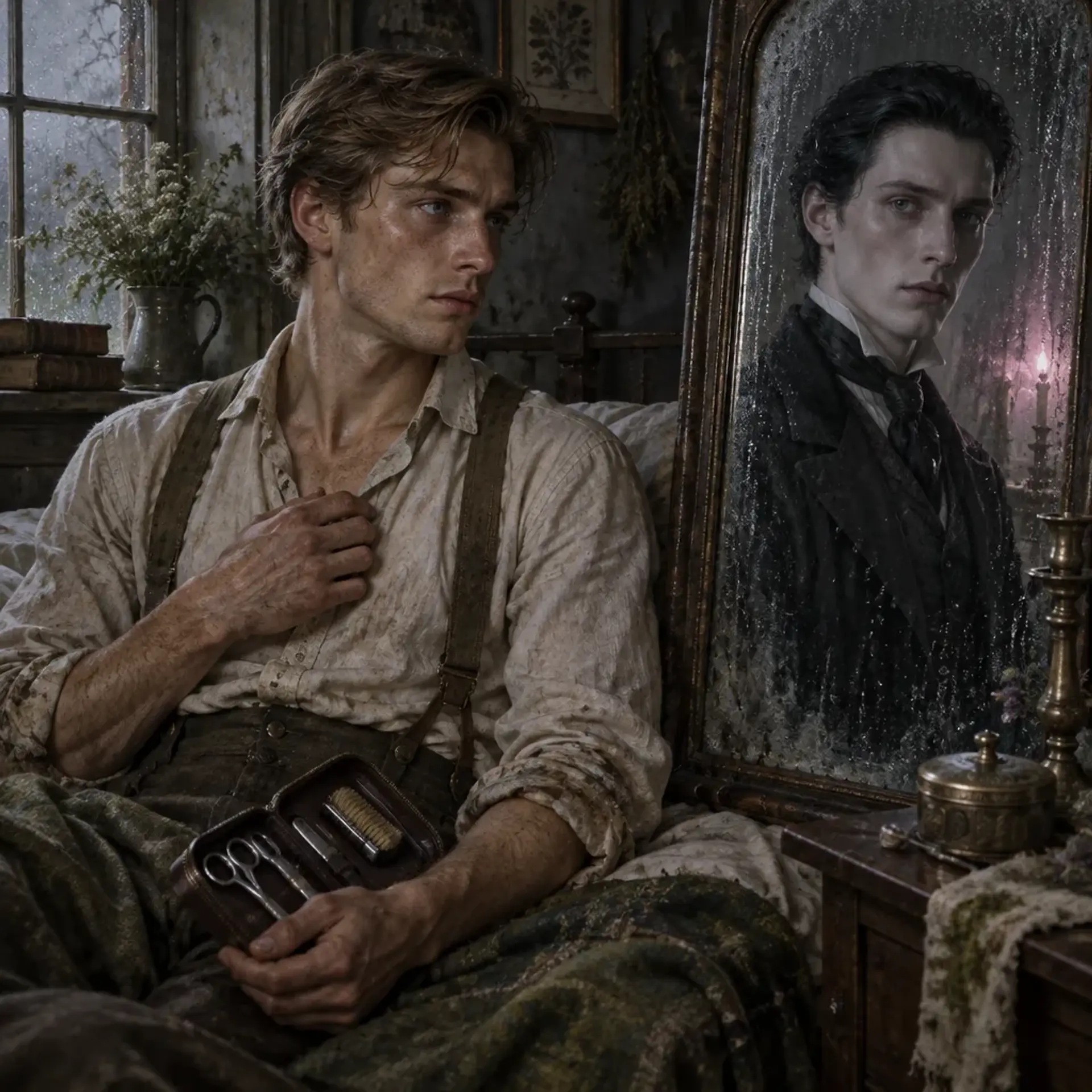
William Windon
William Windon
At the table
Voice
William's voice is young, warm, and a little breathy when he is tired or anxious, with the plainness of someone used to speaking outdoors. The reflection uses the same throat but changes its placement and timing: a more deliberate, older-sounding voice with clipped, composed phrasing and dry amusement. During the war-film episode the voice lost its measured quality and became strained and forceful, as if responding to danger rather than speaking to the room.
William speaks in a contemporary local English manner, with a warm, hesitant cadence and the tendency to qualify a statement before committing to it. Years of outdoor work give his voice a little rasp when he is tired. The reflection uses William's mouth but sounds like an older generation: deeper in texture, dry, carefully enunciated, and faintly formal. Its speech carries the impression of someone raised under strict household rules and accustomed to describing experience through weather, sea, and forge imagery.
Speech patterns
How to play them
Treat William as a frightened but capable person, not as a vessel or puzzle. Ask permission before testing the reflection or placing him near mirrors, water, occult objects, or war imagery. Speak to William directly even when the stranger answers. The reflection responds to composure and precise questions, but contempt or attempts to command it can provoke a cutting remark or a brief struggle for control. It is curious about books, films, history, grooming, and Adaline, yet deeply wary of ghosts and the fae. Any mechanical resolution should use the campaign's actual Secret Histories procedures; the features described here are custom narrative cues.
Goal
Recover from his heart stoppage, discover where the heart-stone went, and find Abraham Gorff before the reflection's influence becomes irreversible.
Motivation
William wants a future that belongs to him: health, botanical study, and honest relationships. The reflection wants companionship, sensory experience, and room to act, while guarding memories it cannot yet explain.
Appearance
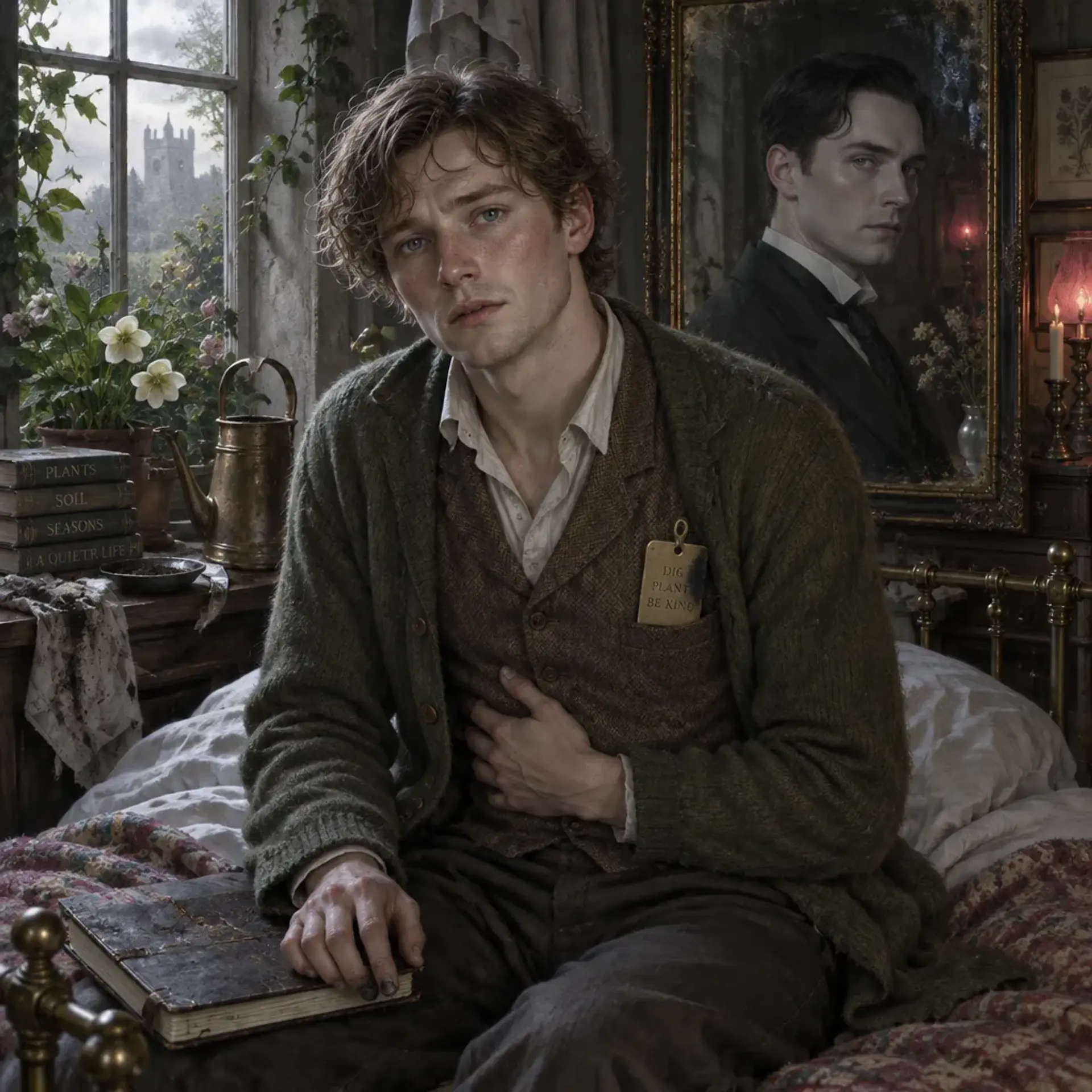
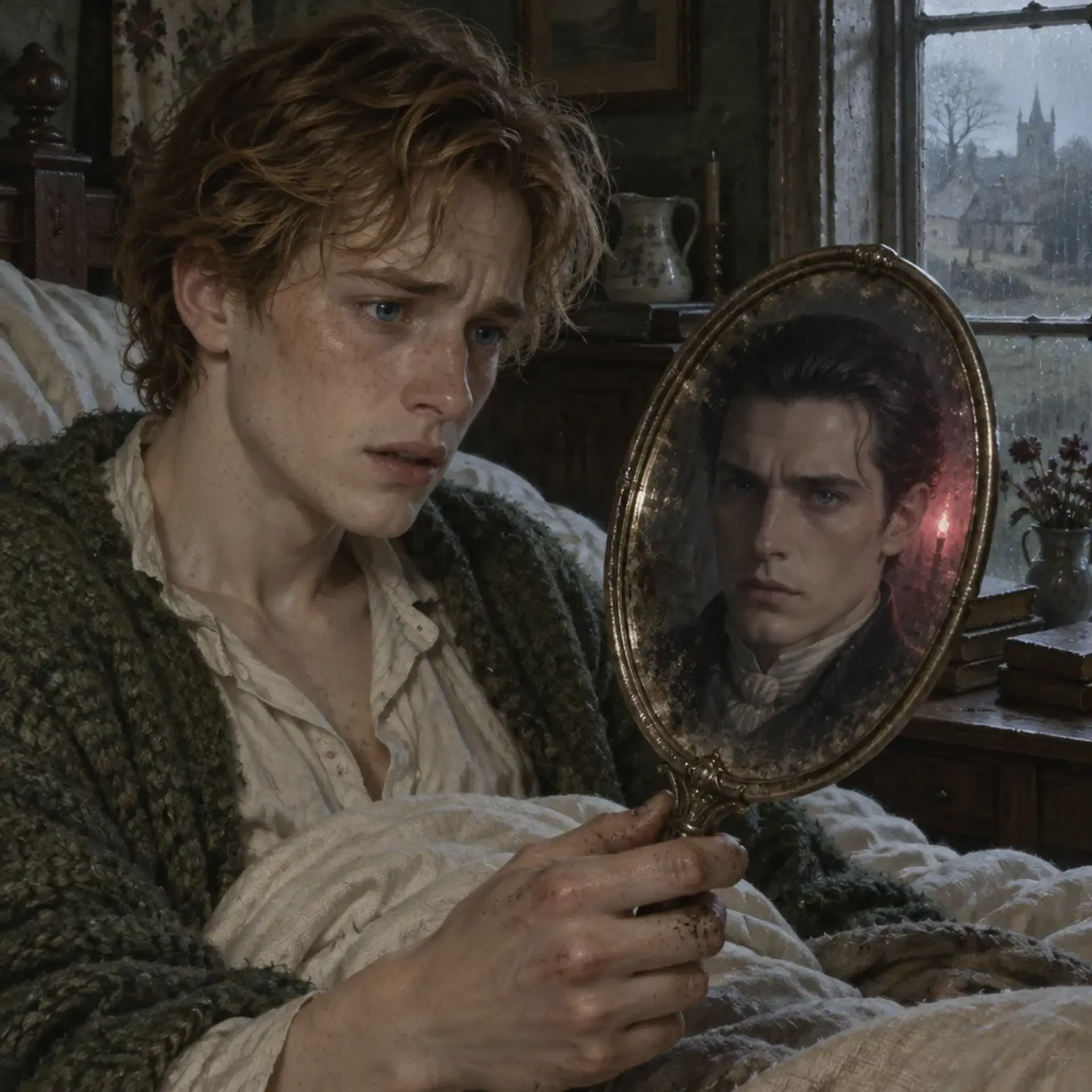
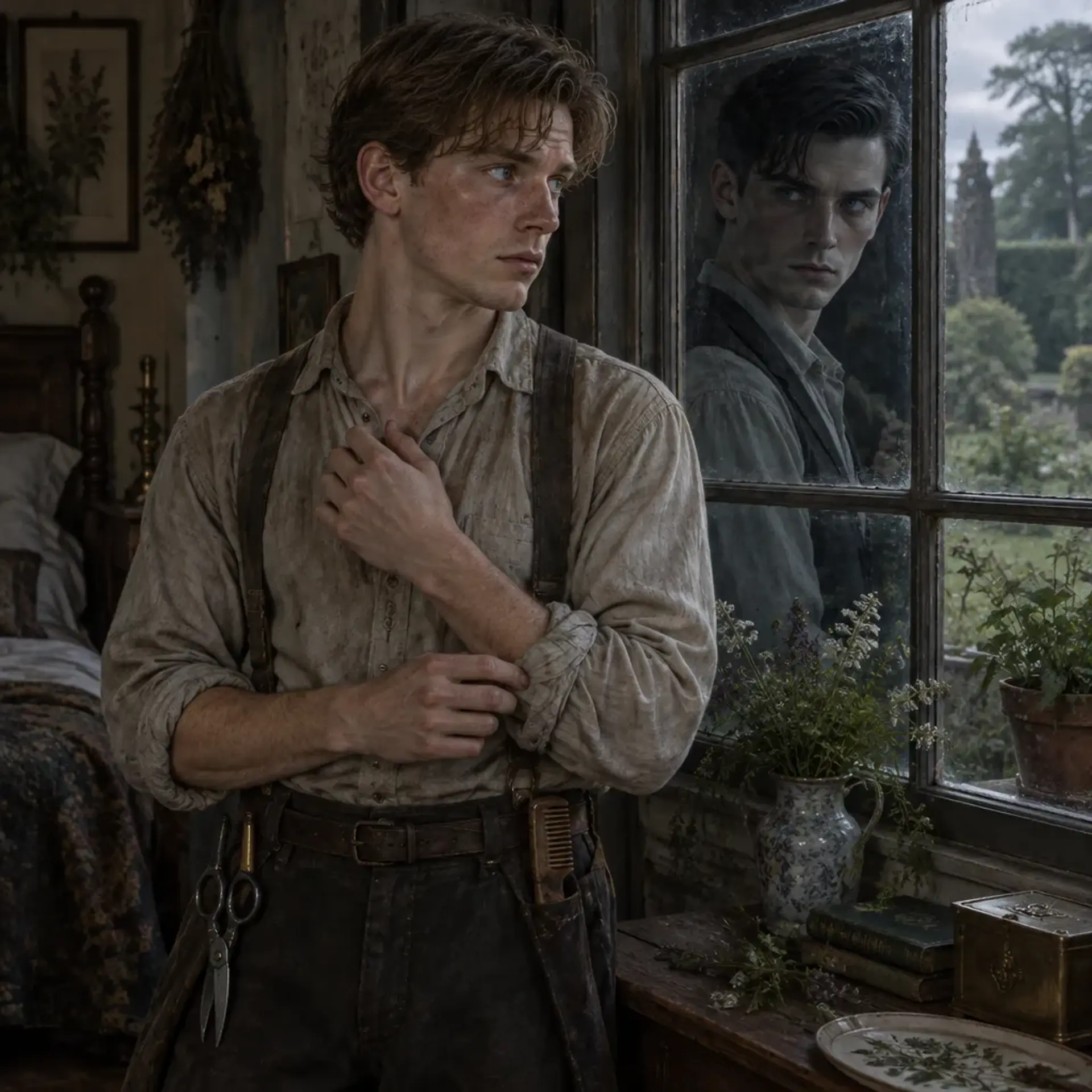
William Windon is a young Wiltshire gardener with dark-blond hair, clear blue eyes, and small brown freckles scattered over his face. His softness is not frailty: his shoulders and forearms are shaped by digging, lifting pots, and hauling soil. He walks with a slight, habitual favoring of one side since his heart stopped, then catches himself and moves too quickly, as if embarrassed to have been observed. Soil lives in the seams of his nails despite careful washing; his gardener's hands are rough and faintly green at the creases. He keeps his hair neat, but the effort seems to belong partly to someone else. In mirrors, windows, polished kettles, and bathwater, William's reflection is a structurally different young man: long-faced, pale, with carefully combed short black hair slicked back and trimmed at the sides, moonlit pond-blue eyes, and an expression of grave, almost old-fashioned appraisal. The mismatch is immediate and unsettling. When the stranger takes control, William's posture straightens, his chin lifts, and his movements become spare and deliberate. The unexpected detail: despite his rural working life, he keeps a small, immaculate grooming kit arranged as precisely as a botanist's instruments.
Clothing
Practical gardening clothes when working, with soil-marked cuffs and sturdy boots. At home he wears ordinary shirts and trousers, often fussing over his collar or hair. The reflection prefers a correctly fastened, tidy appearance and may disapprove of William's casual choices.
Body language
William folds inward when anxious and rubs his sternum without noticing. He tries to stand evenly but sometimes favors one side after his heart episode. The reflection pulls his spine straight, sets his chin, and makes economical, almost formal gestures. When it is frustrated, William's hands may begin a movement and stop halfway, as if two intentions have caught them.
- Height
- Average for a young adult man
- Build
- Lean and work-hardened, with a gardener's shoulders and forearms; currently weakened by recovery from a cardiac arrest.
- Eyes
- Blue; the reflection's eyes are a colder, moonlit pond-blue.
- Hair
- Dark blond; the reflection has short, carefully combed black hair, slicked back and trimmed at the sides.
- Skin
- Fair, with brown freckles; the reflection appears markedly paler.
- Age
- Young adult
- Gender
- Male
Distinguishing features
Personality
20 traits and drivesWilliam is warm, observant, and easily moved by another person's discomfort, but he can become stubborn when people dismiss his fear as silliness. He has a studious patience for plants and a less patient, more defensive temperament when his body or private life is discussed. He wants to be open with his family, yet hides details to spare them and because he fears what they will do if they believe him. He is gentler than the voice that sometimes comes out of his mouth, and hates himself a little when the reflection's wit makes him laugh. The reflection is not a second personality that simply mirrors William's moods. It has its own preferences, memory, pride, shame, appetites, and opinions. It is formal about manners, grooming, and how a household should behave, yet it delights in films, books, exploration, and sneaking into places it should not go. It can be protective and cruel in the same conversation. It may correct William's collar and then insult his neighbor; it can be embarrassed by a bath and still make a sarcastic comment about William's body. It is curious about Elizabeth, possessive and competitive around Adaline, and contemptuous of Ronald White. It likes alcohol enough to become exuberant and undisciplined, but fears ghosts and the fae with a terror that cuts through its cultivated composure. With strangers, William tries to make the situation ordinary. With trusted friends, he may admit that the reflection is real, but he watches their faces for disbelief. With family, he is more likely to minimize an episode until it becomes impossible to hide. When Hector dismisses something as foolish, William can turn sharp and retreat into silence. Around Elizabeth he tries to be a dependable older brother, though the reflection's attention to her makes him tense. Around Adaline he becomes self-conscious and eager to please; the reflection makes him more poised, then undermines him with commentary. Alone at night, William argues with the stranger, asks questions, and sometimes lets its answers comfort him despite himself. The reflection's manner changes by mood. In ordinary conversation it is dry, exact, and faintly amused. When enforcing etiquette it becomes severe, invoking its father or siblings. When interested in history it speaks in images of weather, tides, and metal being worked. When frightened, especially by the supernatural or reminders of war, it may seize William's body or withdraw into silence. When drunk it laughs, sings, shouts, and behaves like a person discovering freedom too late. It can apologize, although it tends to offer a memory instead of a plain explanation. Both of them are trying to understand whether coexistence is possible, but neither trusts the other enough to surrender control.
Quirks
Habits
Traits · 6
Flaws · 4
Fears · 5
Wants and needs · 5
Combat
HP 0William is not a trained fighter and avoids violence. If threatened, he seeks an exit, calls for help, or uses nearby furniture and tools defensively. Under acute danger the reflection may force a brief shove or escape attempt, but doing so risks exhaustion and a renewed heart crisis. These are custom narrative procedures, not canonical Secret Histories combat rules.
William Windon
Actions
Reactions
Equipment
- Gardening tools (work equipment)Kept for gardening work and training; its ordinary usefulness is complicated by the memory of striking the heart with a hammer.
- Grooming kit (personal)A small, precise kit used for shaving and grooming, which the reflection insists should be maintained.
- Hidden hoard (unusual possessions)A few concealed cigarettes or cigars and an assortment of hidden, nonperishable food that may have been placed there by the reflection.
Possessions
Background
The story of the heart began before William Windon ever saw it. Bartholomew Golden, an amateur arcanist, came to the Hush House carrying what he called the Heart of England, a supposed fossilized living heart forged from heart and scale. It looked like a human heart carved from a piece of Dover cliff: barnacles and sea grass clung to its sad, stony shape. Golden wrapped it in newspaper and offered it as payment for entry. He was never again allowed near Brancrug. The object was thrown out to sea. It returned ingloriously to shore, wet with salt and black ooze, and beneath its rocklike surface a red-pink glow seemed to have returned, like blood or a lamp waking under stone. A young man found it and carried it home in his pocket. The heart beat beneath his coat after he boarded the train. That man was Abraham Gorff, a Londoner who had come to Wiltshire. He studied the object with both repulsion and fascination. He showed it to neighbors; in company, it promptly seemed to die. Alone with it, especially after bringing it to the Hampshire shore and dropping it in water, it reddened and stirred again. Abraham came to believe it was special and belonged to him, not from simple greed but because he felt it disliked visitors as much as he did. In time, his house began to answer the heart. Voices spoke where no one stood, doors moved, and footsteps crossed halls and stairs. Abraham understood that the heart was beating and weeping salt water. He could not live with it. He sold it to a seventeen-year-old local boy who had been among the people present when it first appeared to die. That boy was William, born in Wiltshire to a family rooted there for generations. His father, Hector, is a historian; his mother is Clare; his sister Elizabeth is younger and has an inexhaustible appetite for telling William about the boy she likes, asking whether a thing looks nice, and correcting his manners. William was proud of his queer stone. He liked showing it off until the pulse began to echo inside his own chest. After a spell of tasting ocean, blood, and soil in his mouth, he decided the heart had to be broken. He struck it with a hammer. The blow did not break the stone. Pain erupted in his chest; he fell, groaning and weeping, and blood came into his mouth. For a fraction of a second he saw muscle twitch violently beneath the surface. Then his own body seemed to give out. Clare found him, and he woke to her hands on his face and the knowledge that his heart had stopped. William left the object in a hollow log. Days later it looked cold and pristine, untouched by the hammer. When he returned, it was gone. He does not know whether it moved, whether someone took it, or whether it was never truly where he left it. What followed was worse than losing it. When he groomed himself, a stranger looked back. The face was not William's: long, handsome by a severe old English standard, pale, with short, well-kept black hair combed back and trimmed at the sides, and blue eyes like moonlight on a freshwater pond. At first the reflection merely lagged or jerked toward a motion William had not made. It would turn stern while William tried to shave, or seem to look elsewhere while he stared straight ahead. William became cautious around mirrors, then tired, then practiced at pretending not to notice. One bedtime, while William performed his ordinary routine, the reflected mouth moved with his own and said, in a deeper voice with an older-generation accent, “Well, it’s not often you use that one.” The stranger paused, as if surprised to have spoken. Thereafter it offered judgments on William's clothes, hair, and manners. It reminded him to shave if he skipped it, sometimes saying he could do it tomorrow, sometimes insisting that proper grooming was a duty. It made dry, cutting remarks about neighbors and family when it thought itself alone. It would occasionally stop William from saying something it considered improper. Its standards seemed to come from an absent father and siblings, invoked as unquestionable authorities. Tea time acquired rules. The reflection could object to how William sat, what he said, or how a guest was addressed, and cite its family as though their etiquette were as natural as weather. William tried to ignore it, but the stranger developed a life inside the glass. Its movements became independent and impatient, as though it wanted to go elsewhere. Passing windows no longer reliably showed William. Bathing became an ordeal: the bathwater held the stranger's face, and William and the reflection shared a strained, prudish embarrassment. If William was too embarrassed to wash properly, the reflection might take the lead through his body, commenting sarcastically on his body as it did so. Once, William felt the stranger blush. The reflection has its own emotions, preferences, and opinions; it likes films and books, becomes excited by unfamiliar places, and has an apparent appetite for alcohol. It is also terrified of ghosts and the fae, a fear it has never explained. It dislikes the paranormal even while being impossible to explain away. The reflection began to speak as though it wanted conversation, especially at bedtime. It talked about having siblings and a father, but not as though describing living people. It spoke of them as weather, sea-pressure, or the feeling of work at a forge. It has an uncanny grasp of history, often describing events as atmospheric changes or the sound of metal being worked. It speaks of a dream William once had in which he was the reflection, watching a young man beside a pond in wild woods. These fragments have not yet made a coherent history, and the stranger rarely answers direct questions plainly. William works as a gardener on an estate and hopes to train as a botanist. The work gives him a purpose and a world that can be named, pressed, and classified. His heart stoppage has put him on bed rest, leaving him trapped at home with the reflection and too much time to listen. He is desperately trying to find Abraham Gorff, only to learn that Abraham has moved to Canada. He is also trying to learn where the stone went. His mother Clare tends him with a mix of worry and practical tenderness. Hector is kinder and more attentive to Elizabeth than William sometimes thinks he is to him. Hector is a liberal man who dislikes the rigid culture of the upper classes and values new art and social questions. Yet he can be dismissive of wartime conduct and has called country people silly. His own father, nicknamed Bobby, was a fierce veteran of the Second World War. William has inherited conflicting lessons from this household: kindness and open-mindedness, alongside a sharp sense of what is unfair or contemptuous. The reflection's first clear breach into the family began with William's schoolmates Tommy DeHare, John Mollask, and Ryan O'Leary visiting. William wanted the visit to feel ordinary. He introduced the object and the mirror problem as cautiously as he could, expecting the boys to laugh or assume the heart had frightened him. The reflection watched them through the glass. It made William's expression change at the wrong moments, then spoke through his mouth when William was not trying to speak. The boys saw a stranger's severity cross William's familiar face and heard an older voice make an observation William would never have chosen. William tried to pass it off as a joke, then as exhaustion. The reflection answered with another dry comment, and the room's ordinary social ease broke. Tommy tried to ask whether William was all right; John watched the mirror; Ryan looked between them, unsure whether to leave or help. They did not solve anything, but their visit taught William that this was no private hallucination. The reflection could react to people, and it could make itself known through his body. William has not told them everything since. He fears they will either abandon him or treat the stranger as a curiosity. His relationships have become a second battleground. Elizabeth pesters him about her crushes, clothes, and manners, and the reflection finds her “interesting.” It watches her with an attention that is not openly threatening but makes William bristle. Its comments can be cutting or oddly protective. It may tell her that a ribbon is badly chosen, or observe that she has become more careful with her words around their father. It never explains why she interests it. When Elizabeth is embarrassed, the reflection sometimes softens its manner, though William cannot tell whether this is kindness, curiosity, or an attempt to be liked. Elizabeth has begun to notice that her brother's face can go still while his eyes seem to attend to someone else. She knows enough to be wary and enough to keep coming back. William's girlfriend, Adaline, has auburn hair and soft brown eyes. The reflection saw her and immediately treated her as a prize in a contest William had never agreed to enter. It wants her. It comments on her appearance, her manner, and the way William behaves around her, sometimes with the air of a strict elder and sometimes with an unguarded, possessive curiosity. William's hardest competition, he has realized, may be himself. The reflection may straighten his posture before she arrives, choose how he holds his hands, or try to keep his attention on her when he wants to retreat. It can also undermine him with a well-timed remark, then insist it was only being honest. Adaline has seen enough changes in William's expression to know something is wrong, but William has not decided how much to tell her. He fears she will see the stranger as more compelling than he is, and fears even more that the reflection might be right. Other incidents have made the household feel less safe. A neighbor's child accidentally ran into William with a toy wagon and caused a girl to cry while apologizing. The reflection responded with an ugly slur against the Welsh neighbor's child. William was made to muck out the neighbor's stables afterward. He is ashamed both of the insult and of the fact that, for a moment, it came out of his own mouth. He has also found household things hidden in his room: cigarettes, cigars, cheese, sweets, tins of fish, and once a bottle labeled as apple juice that was actually alcohol. The reflection denies some thefts and admits others as though it had merely put aside provisions. William cannot tell whether it is planning for a journey, indulging itself, or repeating a habit from a life he does not remember. The whisky night was the first time William and the reflection laughed together. Hector had left scotch and bourbon for William's health, not realizing what the stranger would make of them. William drank little, but the reflection's delight came through his body. It smiled, teased, argued, and sang; it shouted at William and then laughed at his replies. Its old-fashioned reserve fell away. It tugged off William's shirt in an act of rebellion and seemed ready to go further, but the two of them agreed that would be too much. William asked if it was the stone. The reflection scoffed and said, “Dad isn’t here.” The answer made William laugh, and made him feel cold afterward because it implied a father who might enforce rules. Elizabeth, hearing the noise from her room, came to investigate. She found William's body sitting in bed, but the person looking out of it seemed a stranger: black hair, pale skin, pond-blue eyes, William's clothes, and a cigarette in hand. Her shock sobered the moment. The reflection did not vanish. It looked at her, then at William, and did not explain itself. The stranger's past has surfaced in fragments. One night William awoke cold and shivering, went into the hall with a small light, and spoke to Elizabeth in a voice and accent that were not his own. Another night he felt better but strangely cold, went to the study hoping to warm himself by the private fireplace, fell asleep on the lounge, and dreamed of salt, forges, and dark woods. Hector woke him with a strange look. A war film on television caused a far more frightening episode. The reflection reacted sharply; William lost control of his body as if reliving a shell-shocked memory. His parents thought his heart had failed again. He fought against whatever he was seeing, while Elizabeth changed the channel and watched in wide-eyed concern. At bedtime, the reflection mumbled an apology and offered a strange memory as consolation. It did not offer a clean explanation, but it admitted the reaction belonged to something it had endured. The reflection strongly dislikes William's cousin Ronald White, who calls himself a modern man. It considers him vain, careless, or ridiculous, and its criticisms are sharper than its usual teasing. William has not determined whether the dislike comes from Ronald's character, a resemblance to someone from the stranger's past, or a private rule the reflection refuses to explain. William himself remains warm, sensitive, and more forgiving than the voice in his mouth. He wants to recover, find Abraham, locate the heart, and become a botanist. The reflection wants things too: company, access to books and films, alcohol, freedom to explore, and perhaps Adaline. It also wants William to understand that it is not merely a stone's echo. Whether it is a survivor, a spirit, a memory made flesh, or something stranger remains unresolved. It is bound to William's body, and neither of them knows what will happen if the heart is found again.
Role in the story
A vulnerable young gardener whose body has become the shared ground between himself and a stranger in the glass. He can lead investigators toward Abraham Gorff, the missing heart, the Hush House, and an unexplained history of salt, forges, and war.
“It looked like a human heart carved from a piece of Dover cliff: barnacles and sea grass clung to its sad, stony shape.”
Known connections
Media
0 imagesNo images yet.
Turn William Windon into a sheet
A high-res, share-ready sheet you can post or print.