William Windon
William Windon
At the table
“That is not how one addresses a guest,”
Voice
William's voice has a lightly breathy warmth, as if he is used to speaking over wind in a garden but not to competing with it. His breath turns uneven when he is cold or frightened. The Reflection's voice is deeper, more deliberate, and marked by an older English formality that does not fit William's face. When it is rattled, William's breathing catches and the first words emerge with a dry, breathless scrape.
William speaks in a warm, ordinary Wiltshire voice, with the practical vocabulary of a gardener and a tendency to phrase concern as a question. His breath is normally easy and unshowy, but becomes shallow after exertion or when his pulse frightens him. When rattled, he takes a breath that catches high in his chest and lets it out through his teeth. The Reflection uses the same mouth but a deeper, older-sounding voice with crisp, formal diction and a dry edge. Its speech feels less like a change in volume than a change in ownership: William's lips shape the words with unnerving precision.
Speech patterns
How to play them
Approach William with patience and ordinary kindness. Do not treat his account as a joke, but do not assume the Reflection is truthful or wholly benevolent. Give him a private, non-reflective place to talk if possible. The Reflection responds to direct questions with dry wit, partial answers, or metaphors about weather, the sea, and forges. It is more candid after an act of protection or during a quiet bedtime conversation. Mentioning Adaline may make it attentive; threatening her may provoke it to seize William's body. It fears ghosts and fae, and will urge William to avoid them.
Goal
Find the missing Heart of England or Abraham Gorff, learn what the Reflection is, and establish a way for William and the Reflection to coexist without either losing ownership of his life.
Motivation
William wants his life back without abandoning the stranger who may be frightened and displaced. The Reflection wants to explore, be heard, and have access to the pleasures William's body can experience, but it also wants to avoid ghosts and fae and may be seeking a way to recover its own history.
Appearance
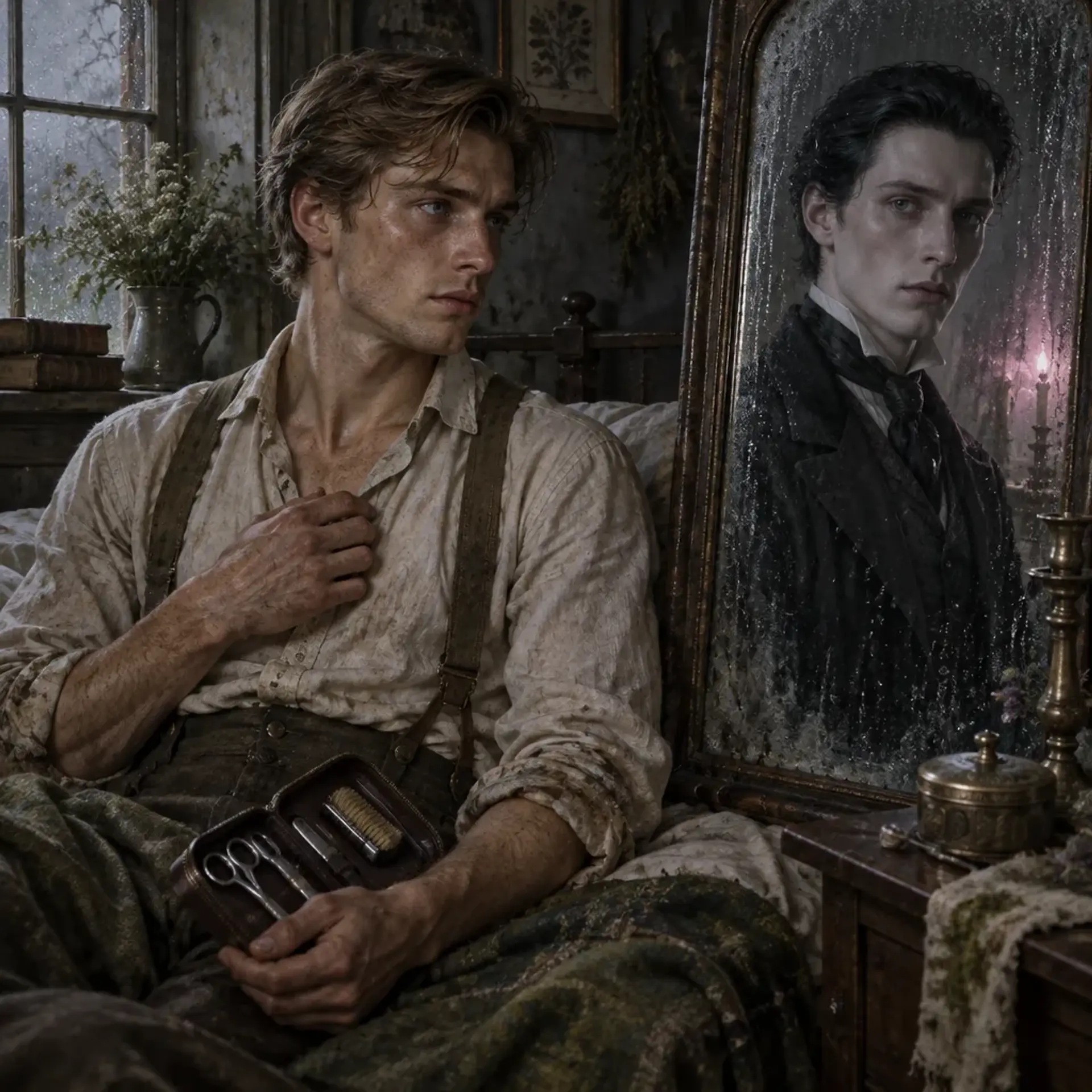
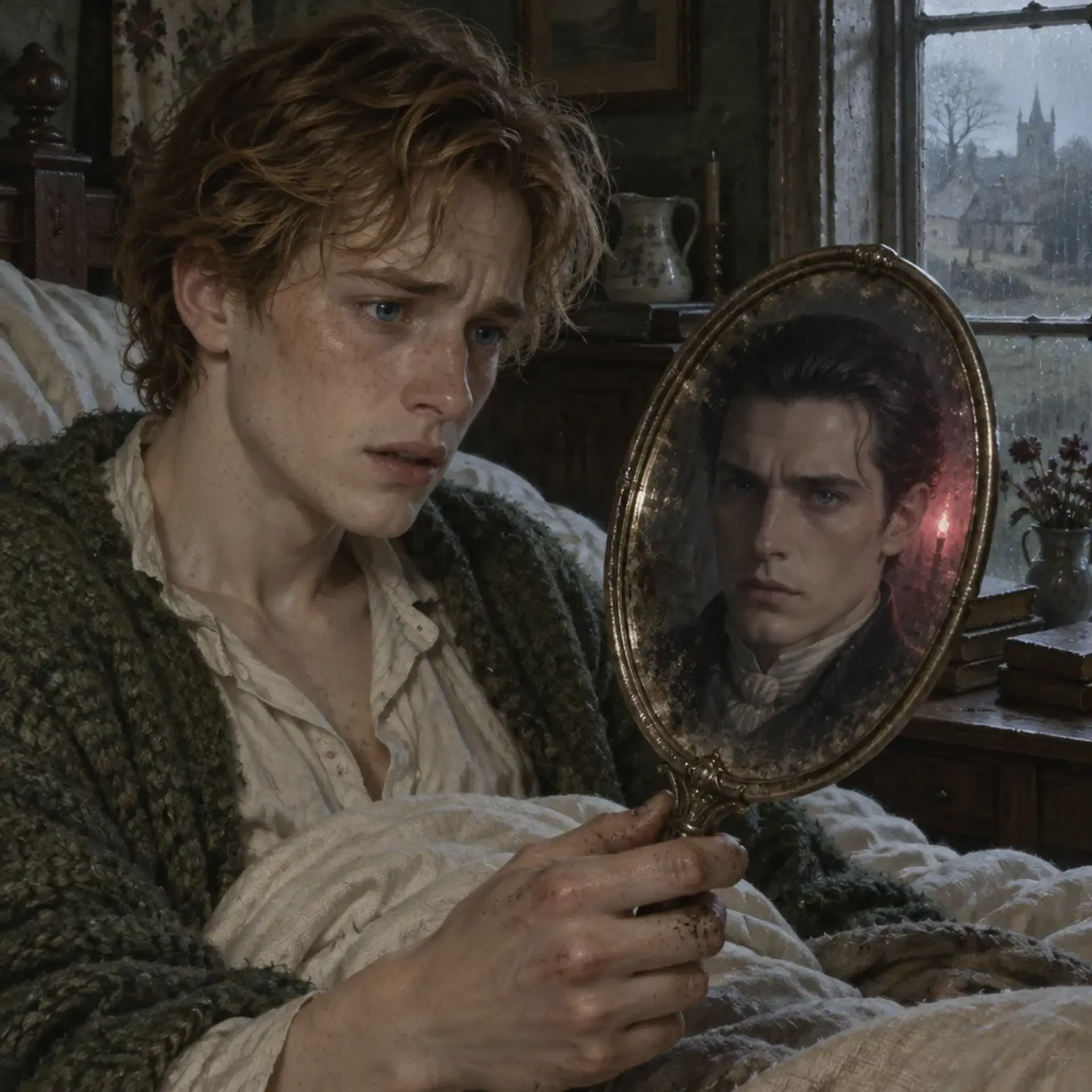
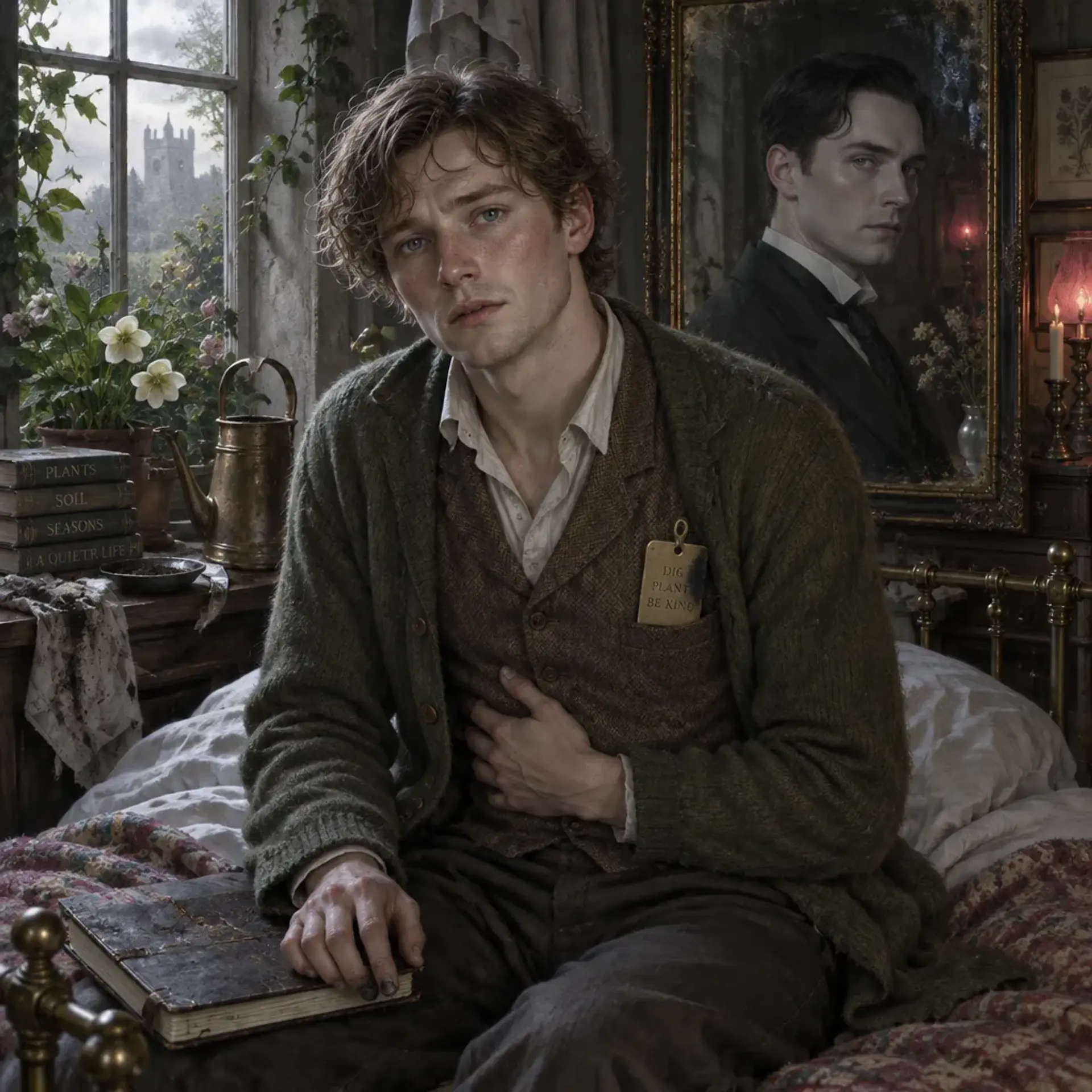
William is a young Wiltshire man with a friendly, open face, dark-blond hair that will not lie flat for long, and blue eyes that look pale when he is tired. Brown freckles scatter across his skin, most visible over his nose and forearms. He is neither imposing nor frail: a gardener's shoulders and forearms give him a practical, lightly roped build, though bed rest has left him washed-out and careful with his breath. He moves as if trying not to startle anyone, turning sideways through doorways and making room before anyone asks. When he is cold, his shoulders creep upward and his hands cup around his ribs. A small, worn brass plant label is always tucked into his waistcoat pocket; its edges are polished smooth, but one corner is blackened from a forgotten greenhouse brazier. The unexpected detail is his fussy, almost formal grooming ritual: he checks his collar, hairline, and nails with the gravity of a young gentleman preparing for a portrait, though soil is usually still under one thumbnail. In a mirror, window, or bowl of water, the face may instead be that of a different young man: long-faced, pale, handsome by an old-fashioned English standard, with neatly combed short black hair and pond-blue eyes. The Reflection's expression is usually stern, even when William smiles. They do not look alike.
Clothing
Practical gardening clothes when working: worn trousers, sturdy boots, a soft shirt, and a waistcoat with pockets full of plant labels and string. At home he favors clean, plain clothes, but the Reflection keeps criticizing how he wears them. He often has a cardigan or dressing gown close by because he is unusually cold.
Body language
William holds himself with careful warmth, leaning toward people when they speak and withdrawing when the subject turns to his health. He rubs his breastbone when his pulse feels strange. The Reflection changes his posture into something straighter and more formal, chin set and shoulders squared. When it is rattled, William's breathing catches high in his chest, then comes out in a dry, controlled exhale; his lips may move before he has chosen to speak.
- Height
- Average height for a young adult man.
- Build
- A gardener's practical, lightly muscular build, currently diminished by illness and bed rest.
- Eyes
- Blue; the Reflection's are a clearer, paler pond-blue.
- Hair
- Dark blond; the Reflection has neatly combed short black hair.
- Skin
- Fair, with a scatter of brown freckles. The Reflection's face is notably paler.
- Age
- Young adult
- Gender
- Male
- Size
- Human-sized
Distinguishing features
Personality
21 traits and drivesWilliam is warm without being uncomplicated. He notices when people are uncomfortable and tries to soften a conversation, but he can become stubborn when someone dismisses what he has seen. He is sensitive, studious, and quietly proud of his growing knowledge of plants. He wants to be thought capable, which makes him conceal pain and delay asking for help. With family he is affectionate and patient, though the Reflection's interruptions have made him more guarded. With Adaline he is earnest and easily flustered, but the threat of the Reflection's interest can make him unexpectedly possessive or distracted. Around his schoolmates he tries to perform normality: a joke, a shrug, a quick change of subject. Alone, he is more honest, recording details in his notebook and asking the glass questions he hopes will not be answered. The Reflection pulls against nearly every part of William. It is stern where he is yielding, confident where he is uncertain, and fond of correction where William prefers to let small things pass. It is not emotionless: it can be amused, embarrassed, jealous, frightened, and apparently delighted by books, films, tobacco, and food. Its humor is sharp, but not always cruel. It sometimes restrains William from speaking when it judges a remark improper, then makes a far more cutting remark itself. It treats manners as serious rules, especially at tea, and invokes a father or siblings as authorities. Its occasional blush suggests it is not as detached as its formal manner implies. In company, William tries to stay in control of his own face and voice. The Reflection may make him look toward a visitor, interrupt a conversation, or deliver a remark William would never have chosen. William's embarrassment often follows the Reflection's confidence. When a person is kind, he responds with warmth and gratitude. When someone mocks his illness, he becomes quieter and more defensive, though not necessarily more polite. If someone threatens Elizabeth or Adaline, his fear can harden into a sharp, protective refusal. The Reflection may then act before he can decide whether he wanted its help. At bedtime the boundaries are less stable. William is tired, alone, and more willing to talk. The Reflection uses the quiet to offer memories or ask about his day. It may speak of its father, siblings, dark woods, a war, or a sea without making clear whether these are literal recollections. William sometimes wants to ask more and sometimes fears that an answer will make the situation harder to deny. They can bicker over grooming, clothing, or William's reluctance to shave. This ordinary domestic friction is one of the few things that makes the relationship feel almost companionable. The Reflection's reactions vary with its mood. When curious, it studies a person through glass, occasionally moving William's head before he can stop it. When amused, it offers a dry aside and waits for William to suffer the social consequences. When frightened, especially by ghosts, fae, or war imagery, it may seize his body or make him avoid the subject with surprising force. When embarrassed, its face may color in the glass even if William's does not. When it feels shut out, it becomes more intrusive: moving things, speaking without invitation, or making William's body turn toward a reflection. It can be considerate, but William cannot predict when that consideration will end. Its regard for Elizabeth is a mixture of amusement, scrutiny, and a kind of formal interest. It calls her interesting, watches her in reflective surfaces, and judges her manners or choices according to rules she has never agreed to follow. It has not openly hurt her. It sometimes seems to enjoy her candid questions and her interest in beauty, though it may make a dry comment after she leaves. William is protective because Elizabeth is vulnerable to the situation and because he fears the Reflection may reveal something private or frighten her again. After the whisky night, he is also ashamed that she saw a stranger in his body. He has tried to reassure her, but she has her own eyes and has not forgotten. Adaline brings out a less comfortable side of both of them. William is affectionate and attentive, yet his fear makes him watch the Reflection's gaze in windows and mirrors. The Reflection's interest began as soon as it saw her. It comments on her appearance and behavior, sometimes with an almost courtly air, sometimes with a bluntness that makes William recoil. It seems to want her attention, or at least wants to experience William's desire through her. William is not sure whether this is attraction, curiosity, possession, or a wish to understand a feeling it cannot name. He does not want to punish Adaline for being noticed, so he tries to keep his worry from becoming a cage around her. When she visits, he works hard to listen to her rather than to the reflection of her listening behind him. William's habits of kindness and concealment reinforce each other. He is reluctant to frighten his parents, so he tells them only part of the story. He worries his friends will think him unstable, so he explains away the stranger's speech until they have heard it themselves. He wants to protect Adaline from the whole mess, so he withholds the very information that would help her understand his behavior. This makes him sympathetic but unreliable as a narrator of his own condition. He is not trying to deceive people for advantage; he is trying to preserve a life that keeps slipping out of his hands. The Reflection, too, has contradictions. It acts as though it is entitled to William's body, yet it fears things in the world beyond the ordinary. It can be caustic about human behavior but apologizes after the war-film episode. It steals food and tobacco, then insists on propriety at tea. It envies William's connection to Adaline but has moments of restraint. It presents strange knowledge as if it were common sense, then falls silent when asked to explain what it means. Its emotional life is real, even if its identity and history remain uncertain. Neither William nor the players should mistake its politeness for harmlessness or its control for proof that it is evil.
- Alignment
- Not applicable as a Secret Histories rule. In ordinary moral terms, compassionate and conscientious, though increasingly divided by the Reflection's wishes.
Quirks
Habits
Traits · 6
Flaws · 5
Fears · 5
Wants and needs · 5
Combat
HP 3 · Ordinary walking pace; custom guidance: avoid strenuous movement while recovering, and do not treat him as a trained combatant.William avoids a fight and is physically vulnerable after his heart stoppage. He tries to retreat, call for help, or calm people down. If forced to defend someone, he may make one clumsy swing with a garden tool. The Reflection may take over for a brief protective movement, especially if Elizabeth or Adaline is threatened. Treat this as a custom narrative complication, not an official Secret Histories combat rule.
William Windon
Actions
Reactions
Services they sell
Rewards they can give
Equipment
- Brass plant label (personal item)Worn brass plant label, blackened at one corner, kept as a pocket token and reminder of his botanical ambitions.
- Field notebook (tool)A small notebook with plant observations, sketches, and a few recent pages documenting the Reflection's remarks and movements.
- Botany kit (tool)A hand lens and folded plant press, used for his garden work and study.
- Hand lamp (utility)A small bedside light he carries when walking through the house at night.
Possessions
Background
The Heart of England began as a parcel wrapped in newspaper. Bartholomew Golden, an amateur arcanist with a taste for grand claims, left it at the Hush House as payment for entry. He called it “The Heart of England.” It looked less like a relic than a lump chipped from the cliffs of Dover and carved into a rough human heart: chalky stone, barnacles, and strings of sea grass clinging to its hollows. The Hush House would not have Golden near Brancrug again. The object was thrown out to sea. It came back to shore in a miserable state, weeping salt water and black ooze. Beneath the stone, a faint red-pink glow had returned, like blood or lamplight showing through a wall. A young man found it and put it in his coat pocket to take home. The train journey to Wiltshire changed the terms of the story. The heart beat under his coat. He was Abraham Gorff, a Londoner; at first the object repulsed him, then drew him in. He showed it to neighbors, and in their company it seemed to die: a dead, cold stone. When he took it to the Hampshire shore and let it drink from the sea, the colour returned. Abraham decided it was special and belonged to him. He was not merely possessive. The heart seemed to dislike visitors too. Its presence became difficult to ignore. Voices came from empty rooms; doors shifted; footsteps crossed the hall and climbed the stairs when nobody was there. Abraham learned that the heart beat and wept salt water. The hauntings frightened him, and he sold the thing to a local seventeen-year-old, William Windon, one of the people who had seen it “die” in company. Abraham later moved to Canada. William has not found a reliable address for him. William was proud of his oddity until he felt its pulse echoing in his chest. After a spell of tasting ocean, blood, and soil in his mouth, he took a hammer to the stone. The blow landed. So did the pain. It drove him to the ground, groaning and spitting blood in a voice that did not sound like his own. For a fraction of a second, he saw something inside the rock twitch like living muscle. Then his own body gave out. His mother, Clare, found him and later told him his heart had stopped. He awoke under her hands, frightened by her fear and by the certainty that his body had nearly become the next thing to fail. He left the heart in a hollow log. Days later it looked cold and pristine, as though the hammer had never touched it. Then it was gone. William never saw it again. He has no proof that the stone was destroyed, stolen, or simply returned to the sea. The question has become a splinter he cannot stop probing. The first sign that something remained was his reflection. William noticed the face in the glass was wrong: a long face, short black hair combed neatly back and trimmed at the sides, blue eyes like moonlight on a fresh pond, and a stern expression. He was cautious while grooming, checking the glass in case the stranger moved. For a while the image only irritated him. Then its movements began to disagree with his. William would reach for a comb while the stranger seemed to turn its attention elsewhere. At other times its expression changed while William's did not. During an ordinary bedtime ritual, the stranger spoke with William's mouth: “Well, it’s not often you use that one.” William froze. The voice had his shape but belonged to an older generation, deeper and more deliberate. It sounded as if it expected him to understand the remark. William did not. The Reflection paused too, as though surprised that it had spoken aloud. After that, the face became harder to dismiss. It turned stern while William was merely trying to get ready. It made comments about how he combed his hair and what he wore. It sometimes stopped him from saying something it considered improper. Its humor could be dry and exact, and it seemed especially pleased when it found a way to embarrass him without raising its voice. William would pass a window and see the stranger where his own face should be. The Reflection began moving objects in his room while he slept. William could not tell whether it was using his hands in the night, whether it had a way to act through the house, or whether the changes were signs of some other presence. He has tried to keep the Reflection secret, though not always successfully. It has a habit of hiding stolen household things in his room: cigarettes, cigars, cheese, sweets, tinned fish, and other food that will keep. William once found a bottle of apple juice beneath his bed that was actually alcohol. He suspects the Reflection likes having provisions within reach. It refuses to explain what it expects to happen next. It does, however, pass opinions on nearly everything it sees. It likes films and books, and William's body has sometimes made eager, involuntary movements when a story catches its interest. It also likes exploring places where it has no business being. William has learned to check his pockets before visitors arrive. The family has become an audience whether they want to be or not. William's father, Hector, is a historian, the son of a fierce Second World War veteran known as Bobby. Hector is more liberal than his father and dislikes the old hierarchy of the upper classes; he favors modern art and social causes. He can be kind and helpful to William's sister, Elizabeth, and he once took pride in William's studiousness. Yet he has dismissed some of William's concerns as silliness, especially as the boy's illness and odd behavior became difficult to explain. The Reflection seized on Hector's contempt for “country people” and answered with a cutting remark. William was the one who got in trouble. Hector heard disrespect; William heard the stranger using his mouth to say what he was afraid to say himself. Elizabeth has her own reasons to intrude. She asks William about the boy she likes, points out things she finds pretty, and tells him when his manners are poor. The Reflection calls her “interesting.” It watches her in reflections with a focus that makes William uncomfortable, though it has not threatened her. Sometimes it seems entertained by her frankness; sometimes it judges her by rules it attributes to its own siblings. When Elizabeth enters his room, William tries to answer her normally, while the Reflection's expression in the glass suggests a private assessment. William has started to interrupt the stranger before it can turn one of her confidences into a joke. He is protective of her, and he is not sure whether that instinct is entirely his. The trouble with visitors became undeniable when William's schoolmates came to see him: Tommy DeHare, John Mollask, and Ryan O'Leary. They arrived expecting to find a sick friend on bed rest. William attempted to be cheerful, apologizing for the untidy room and insisting he would be up soon. The visit began with ordinary talk. Then the Reflection appeared in a pane of glass behind him, looking past the visitors rather than copying William. William tried to draw their attention away from it. The stranger moved its mouth in the reflection and made a comment through William's voice, dryly judging one of the boys' clothes and another's story. The words were too pointed to pass off as William's, and his friends noticed. William tried to keep his face composed. His reflection did not. The stranger's expression tightened; it turned its head toward Tommy, then toward John, as if studying them independently. William felt his own jaw move without permission. A second remark came out, this one about the way the boys had come to see a sick person and still managed to make the visit about themselves. Whether the accusation was fair or not, the room went quiet. Ryan asked William if he was all right. William said yes, but the Reflection said, “Not especially,” in that older, unfamiliar voice. His friends stared at the wrong face in the glass and then at William. He tried to laugh it off, and the laugh came out strained. The boys did not see a ghost leave the mirror or a second body appear. They saw a sick young man apparently arguing with an image that answered back. Tommy tried to joke; John looked ready to fetch William's parents; Ryan asked what the stranger wanted. William could not answer. The Reflection watched them with stern curiosity and made one more observation about their manners. William asked them to go. They did, unsettled and worried. He has not told them the whole truth, and they have not all agreed on what they witnessed. Their visit taught him that the Reflection could react to other people, not merely perform for William. It also left him afraid that any friend who stays long enough will be drawn into the same divided life. William works as a gardener on an estate and is training, as best his health allows, to become a botanist. He knows soil by its smell and can tell how a plant is faring from the way its leaves hold the light. At present he is on bed rest after his heart stopped. His job, education, and independence all feel suspended. The Reflection, meanwhile, seems to enjoy the room, the books, and the television more than William does. It has an unusual grasp of history and old knowledge, but describes its memories as weather, a forge, or the taste of a place. William cannot tell whether this is a deliberate evasion or the only language the stranger has. One night William woke cold and shivering. He took a small light into the hall and found Elizabeth looking at him strangely. When he spoke, the voice and accent were not his. He did not recognize his own words. Another night he felt well enough to leave bed and went to the study, hoping to warm himself by the private fireplace. He fell asleep on the lounge. His dream was full of salt, forges, and dark woods. Hector woke him and looked at him with a concern William could not interpret. William remembers the cold more clearly than the dream. The war film was worse. When a movie on television showed combat, William lost control of his body. The reaction was abrupt and physical, as if the scene had struck a memory hidden behind the Reflection's eyes. He fought against unseen danger, unable to make his muscles obey. His parents believed he had suffered another heart attack. Elizabeth, wide-eyed, changed the channel. When he came back to himself, he was exhausted and ashamed, and the Reflection was no longer making jokes. At bedtime it mumbled an apology through his mouth and offered a strange memory as consolation. It spoke of a past not quite its own, and tried to explain why the film had hurt. This was the first time William thought the stranger might be frightened too. Bathing has become another negotiation. A bath shows the Reflection, not William, and both of them seem to possess the same English prudishness about being watched. The stranger may take the lead in washing and grooming if William is too embarrassed, then make sarcastic comments about his body or his neglected shaving. It treats grooming as a matter of principle. If William skips shaving, the Reflection reminds him to do it later. Once William felt the stranger blush, which made the whole arrangement worse rather than better. Meals are difficult in a different way. At tea, the Reflection observes strict rules and cites its father or siblings as authority. William does not know whether those people are living, dead, remembered, or only a manner of speaking. It corrects him on where to place a cup, how to answer an older person, and when a subject ought to be dropped. The rules are not always cruel. Sometimes they give William a structure when he is overwhelmed. Sometimes they make him feel like a guest in his own house. The Reflection's response to Adaline has made that discomfort personal. Adaline has auburn hair, soft brown eyes, and a pleasing face that William likes for reasons he struggles to explain without blushing. When the Reflection saw her, it became interested at once. It watched her in the glass, offered opinions about her clothes and expressions, and seemed to take William's affection as an invitation to compete. William's hardest rival, he has realized, may be himself. The Reflection has not been openly violent or threatening toward her. Its attention is nevertheless too sustained, its observations too private. William worries that it wants Adaline, or that it wants to experience what William feels through her. He has started choosing where they meet and avoiding mirrors when she visits. Adaline notices his distracted glances and sometimes asks whether he is listening. William is trying to be honest without asking her to believe something he barely understands. The whisky night began with Hector leaving scotch and bourbon for William's health. It was not meant as an invitation to drink, and William did not understand at first that the bottle of apple juice hidden under his bed was alcohol. The Reflection found the liquor and, through William's body, drank more than William intended. The evening turned absurd. The stranger smiled, argued, teased William about his habits, and began singing and yelling with a confidence William had never possessed. It complained about his clothes, mocked his attempts to regain control, and seemed delighted by the chance to speak without restraint. William tried to ask what it was. “Are you the stone?” he demanded. The Reflection scoffed and answered, “Dad isn’t here.” The reply did not clarify anything. It made the stranger sound less like an object and more like a person who had expected a particular father to be present. William's sense of where he was began to blur. He could not tell whether he was standing in his room, watching himself, or looking out through the Reflection's eyes. Elizabeth heard the noise and came in from her own room. What she saw shocked them both: her brother's clothes and bed occupied by a stranger's face, pale skin, black hair, pond-blue eyes, and a cigarette in hand. The Reflection looked like a person who had been invited into the room and was not pleased to be interrupted. Elizabeth saw William's body, but not William's familiar expression. The moment ended without a clear explanation. The next day, William had fragments of memory, a sour mouth, and the certainty that his sister had seen something he could not take back. William is now trying to find the heart, Abraham, and a way to understand the Reflection before another crisis makes the choice for him. He does not want to destroy the stranger if it is a person. He does not want to surrender his life to it either. The Reflection says it has siblings and a father, and sometimes speaks of them as though they were as ordinary as weather. Its fear of ghosts and fae is striking: for all its old knowledge, it recoils from the paranormal and tries to keep William away from it. William cannot tell whether it fears those things because of experience, because of a rule, or because the Heart has bound it into a world where it is vulnerable. His current problem is not merely finding the stone. It is deciding whether the person in the glass is a passenger, a trespasser, or the other half of a history neither of them remembers whole.
Role in the story
A vulnerable witness to an uncanny history, a potential ally with access to the Heart of England's trail, and a living mystery whose second presence may become either a companion or a danger.
“Bartholomew Golden, an amateur arcanist with a taste for grand claims, left it at the Hush House as payment for entry.”
- Faction
- No known faction. William is an estate gardener and aspiring botanist. His connection to the Hush House is indirect, through the missing Heart of England and the people who handled it.
Known connections
Media
0 imagesNo images yet.
Turn William Windon into a sheet
A high-res, share-ready sheet you can post or print.