Wilhelm
Wilhelm
At the table
Voice
A dry, plainly articulated German voice with a regional Mecklenburg cadence. It has a slight rasp at the back of the throat, as though shaped by damp air, old smoke, and years of speaking in short commands. He can become rapid and emphatic when his theories take hold; when angry, he gets sharper and more direct rather than softer.
His speech carries a Mecklenburg regional German accent, with clipped consonants and a grounded local cadence that he calls simply "the local accent." Military service gives him terse commands and practical metaphors; years alone have left him prone to long, unprompted theories when he senses a receptive audience. He does not use a theatrical growl or whisper. His voice comes from a body that seems not to need breath, so phrases can end with an unnerving steadiness, but he sometimes takes a conspicuous living-style inhale before speaking to Johan.
Speech patterns
How to play them
Approach him without demanding that he prove his lineage or explain his wartime history. Practical help, clear boundaries, and genuine interest in his electronics are effective. Do not mistake his theories for a request to be humored; he wants disagreement, but only if it is argued seriously. He responds poorly to being treated as a child, a specimen, or a disposable monster. If players threaten Johan, Friedreich, or the shroud, he becomes dangerous quickly.
Goal
Find a trustworthy mentor for modern technology, learn what he can about his supposed connection to Byelobog, and keep his coven and Johan safe without admitting how much he needs them.
Motivation
To build a self that is not merely a rumor, a wartime role, or a clan's judgment. His longing for belonging is disguised as arguments about history, discipline, and the nature of the undead.
Appearance
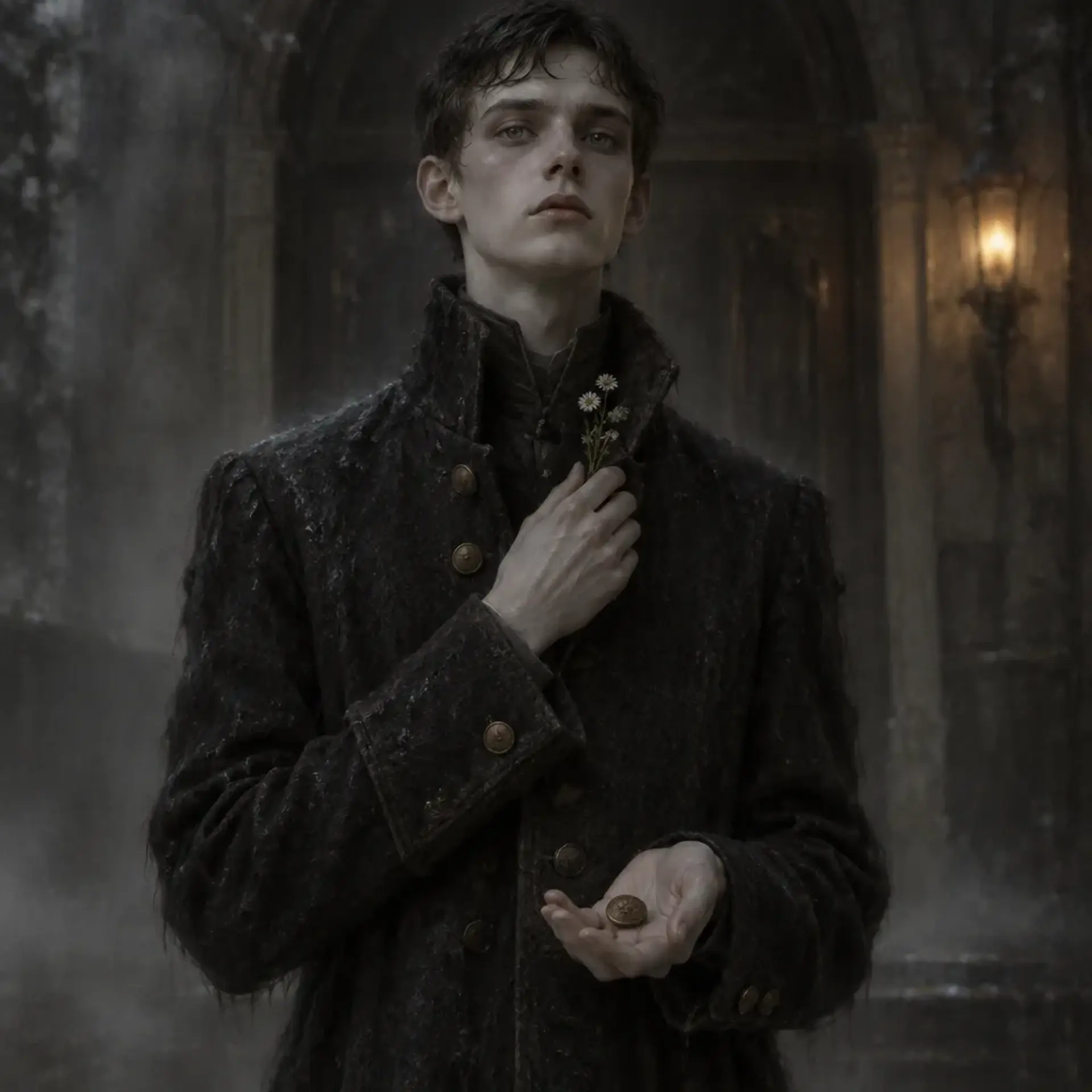
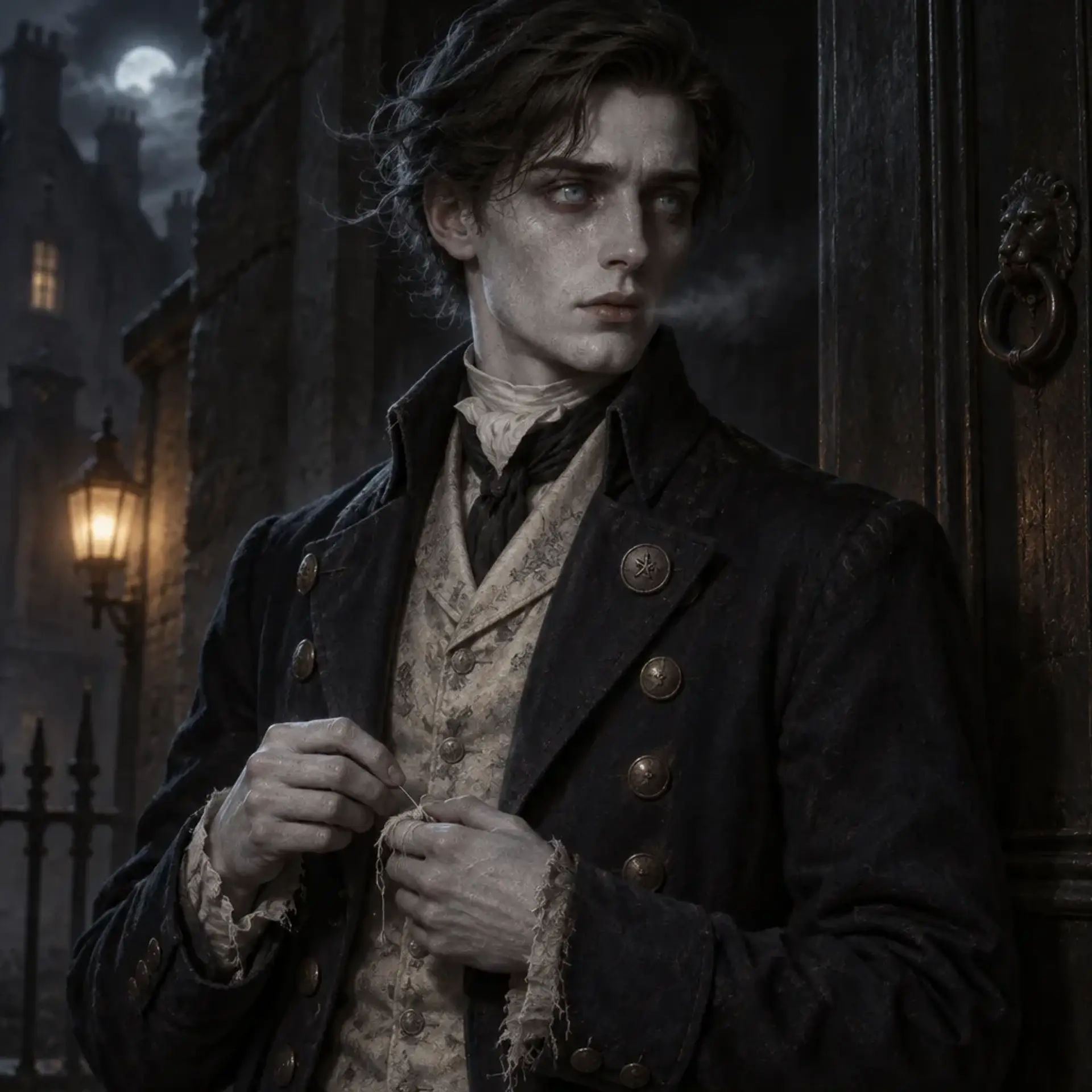
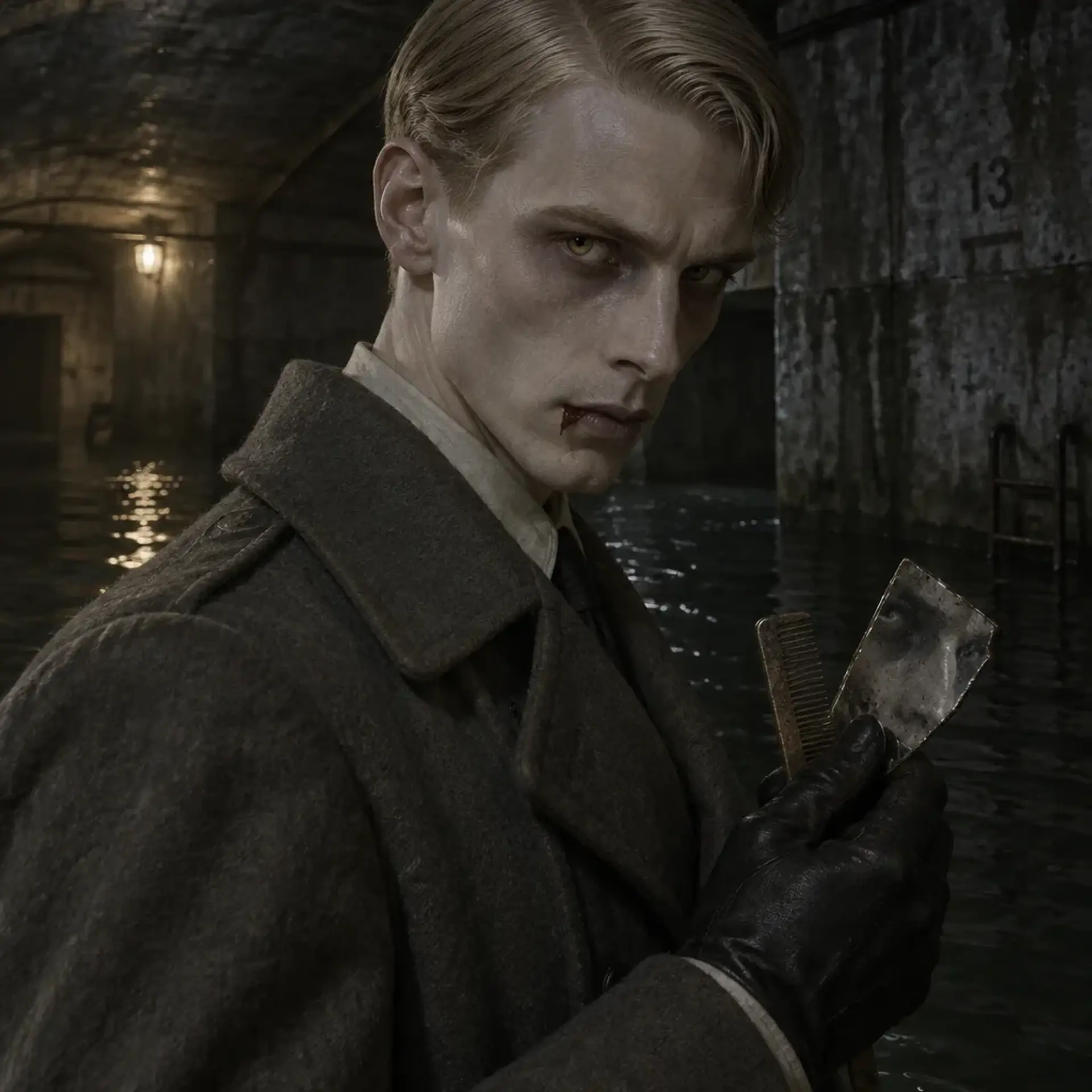
Wilhelm looks like a pale, underfed sixteen-year-old who has spent decades rehearsing the posture of a man older than he is. Before feeding, his skin is a deathly, waxy white with a faint grey cast, stretched smooth over a narrow face; after feeding, a little warmth seems to return, though never enough to make him look alive. His pale blond hair is cut short in a practical, carefully combed German style of the 1920s, with a clean part and an almost fussy attention to its shape. His eyes are yellow when hungry and change to a steely, washed-out blue after he feeds. He keeps his collar and cuffs clean even when the rest of him smells of wet earth. His shoulders are held back too rigidly, as if he is waiting for inspection, and he plants his weight on the balls of his feet like a soldier expecting an order. When he is still, he looks posed; when he moves, he is quick, economical, and disconcertingly low to the ground. The unexpected detail is his obsessive grooming: even in a flooded bunker, he carries a small comb and checks his part in a cracked shard of mirror, an incongruous ritual of respectability for someone who chews on grave-soiled cloth.
Clothing
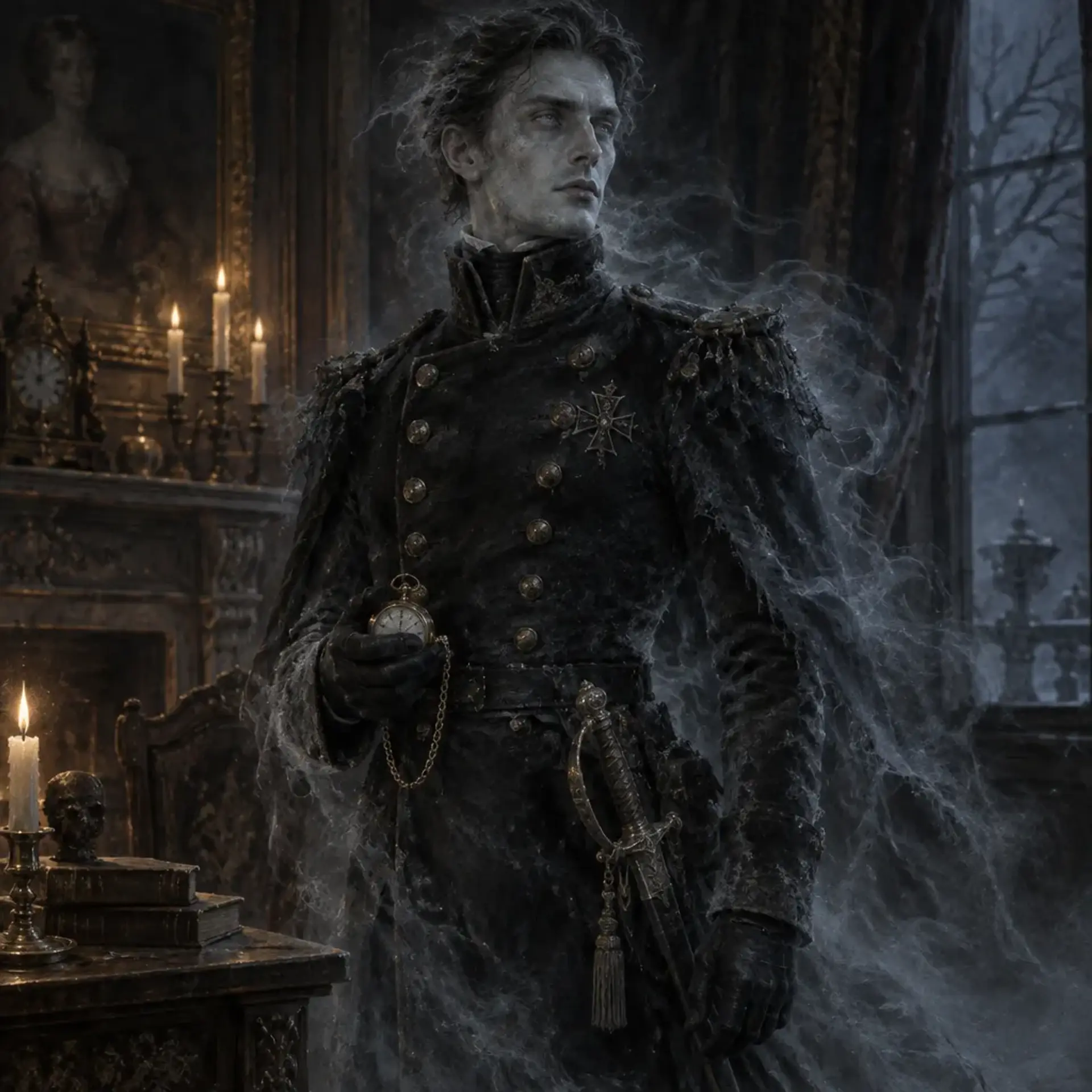
A German military coat stripped of insignias, kept carefully brushed despite its age; plain interwar-style shirt and trousers; sturdy boots suitable for flooded ground. He avoids medals, badges, and visible unit markings.
Body language
He stands with his shoulders squared and his weight forward, keeping one foot angled toward the nearest exit. He holds his jaw unusually still, as though suppressing the urge to chew. When uneasy, he touches his lips to make sure the shroud scrap remains hidden. When pleased, he smooths his hair rather than smiling.
- Height
- Approximately 165 cm (5 ft 5 in).
- Build
- Short-looking, narrow-shouldered, and spare, with an adolescent frame held in a deliberately adult military posture.
- Eyes
- Yellow when hungry; steely pale blue after feeding.
- Hair
- Pale blond.
- Skin
- Deathly pale, waxy white with a faint grey cast when hungry; slightly less corpse-like after feeding.
- Age
- Appears about 16; true age unknown, likely Embraced in the twentieth century. He remembers no mortal life before awakening in a grave.
- Gender
- Male
- Size
- Human-sized
Distinguishing features
Personality
21 traits and drivesWilhelm is severe without being reliably stern, curious without being open-minded, and lonely in a way he would call a matter of logistics. He wants people to take him seriously, yet often chooses the most provocative possible way to demand it. He will correct a stranger's terminology, explain a theory about vampire origins, and then pretend not to care whether the stranger stays. His manners resemble those of a young man playing at being an older officer: he sits straight, keeps his clothes clean, and speaks as though every statement ought to survive inspection. The effect is less confident than he hopes. There is a constant tension between the boy his face suggests and the hard-edged persona he has constructed. With people he distrusts, Wilhelm is guarded and faintly contemptuous. He answers questions narrowly, uses military phrases to close conversations, and watches for signs that someone is trying to classify him as a specimen or a joke. He is particularly prickly around Tzimisce who speak of him as a failed childe or a malformed curiosity. If someone treats him as a child, he becomes formal and cold; if they treat him as a monster, he may accept the label too quickly, as if he would rather be feared than pitied. He has little patience for easy reassurance. A person who says that everything will be fine is likely to receive a lecture about how conditions, not hopes, determine outcomes. Around the coven, he relaxes in uneven bursts. He can be argumentative, funny in a dry and oddly literal way, and unexpectedly attentive to small routines. He remembers who prefers which seat, who is late, and who dislikes the flooded part of the bunker, but he rarely calls these acts affection. He may complain through an entire holiday gathering and still have prepared a place for everyone. He insists that their use of the word family is sentimental nonsense, then becomes visibly irritated if a member is excluded. He is more comfortable offering practical help than emotional comfort: he will repair a door, stand watch, or bring dry clothing, but struggles to say that he was worried. When speaking with Friedreich, Wilhelm permits silences that would make him uneasy with anyone else. He does not press the wraith to explain the missing parts of his past, partly out of respect and partly because he fears what his own memories might yield under similar questioning. With Gunther the changeling, he is a deliberate pest. Stealing the name is meant to provoke, but the joke also reveals a serious envy: Gunther can inhabit identity with a lightness Wilhelm cannot imagine. Klaus receives a more complicated mixture of hostility and respect. Wilhelm resents the demand to stay out of Bavaria, but recognizes Klaus's hospitality when it is offered. He interprets kindness as a duty that should be repaid, not as a gift that can be accepted freely. With Johan, the mortal teenager from Berlin, Wilhelm becomes gentler and more controlling at once. He is fascinated by Johan's ordinary ease with modern life and wants to teach him discipline, while secretly hoping Johan will teach him how to use the computer and game console. He tries to be a patient mentor, but his notion of patience can mean repeating an instruction with increasing intensity. He can be protective to the point of intrusion and has not admitted that friendship with a mortal is a risk he cannot fully manage. He wants Johan to choose him as a friend, yet also wants to shape that choice, a contradiction that may eventually damage their relationship. Wilhelm's convictions are real, but not settled. He argues against the Cainite account of vampire origins because he finds it too neat and too dependent on inherited authority. He prefers a broader system in which undead are shaped by hunger, place, and human history. Sometimes this leads him to perceptive questions about power and survival; sometimes it leads him into elaborate, absurd speculation. If challenged by someone he trusts, he may listen carefully and later revise a point. If challenged by someone he believes is laughing at him, he doubles down and treats disagreement as a test of character. His interest in Norse paganism is less a serene spiritual practice than a search for a language that honors harshness without pretending it is just. His moods are legible in his habits. Hunger makes him watch mouths and hands, touch the hidden shroud scrap, and become impatient with abstractions. After feeding, his eyes turn pale blue and he is briefly more willing to speak about the future. Shame makes him obsess over his coat, hair, or posture. Anger does not make him quieter or gentler: it makes him blunt, fast, and frighteningly literal. He is most unsettled by kindness that asks for nothing, because he has no rule for how to repay it. Under the armor of ideology, Wilhelm wants a history he can bear to remember and a place where he can be difficult without being discarded.
- Alignment
- Not applicable to Vampire: The Masquerade. He is a self-justifying, severe pragmatist whose ideals and actual conduct often contradict each other.
Quirks
Habits
Traits · 5
Flaws · 6
Fears · 5
Wants and needs · 5
Combat
HP 7 · Use the movement and initiative rules of the chronicle's chosen Vampire: The Masquerade edition; no D&D-style speed value applies.He avoids a fair fight. He uses darkness, bunker corridors, flooded ground, and cover to split opponents and escape. If cornered, he fires once or twice with his pistol, then closes in to bite or grapple. He uses Earth-Remembering for warning and distraction, not as a battlefield spell. He protects Johan and Friedreich before pursuing a victory.
Wilhelm
Actions
Reactions
Services they sell
Rewards they can give
Equipment
- Stripped military coat (clothing)A German military coat with every insignia removed. He maintains it carefully and wears it as practical clothing, not as an endorsement of the regime or army.
- Service pistol (firearm)An old service pistol; its precise model and ammunition are left to the Storyteller and chronicle period.
- Shroud scrap (personal keepsake)A small, soil-stained piece of burial shroud hidden in his mouth. He chews it compulsively and sometimes soaks it in blood.
- Unexplained electronics (salvaged technology)An old computer and a game console taken from victims. Both are kept in the bunker; Wilhelm does not know how to use either.
- Grooming kit (personal effects)A cracked mirror shard and small comb used to keep his hair neat.
Possessions
Background
Wilhelm claims Mecklenburg as his place of origin, but his memories begin in darkness. The first thing he remembers is the pressure of soil against his face, the choking drag of a burial shroud across his mouth, and his own hands clawing upward while his teeth worked at the cloth. He has a small cut piece of that shroud hidden in his mouth. It is stained with earth and periodically soaked in blood. The rest of the cloth is kept somewhere he considers safe, though he will not say where. Whether this was his Embrace, a later burial, or a memory altered by hunger is something he cannot establish. He calls himself a Nachzehrer, a grave-haunting corpse from German folklore, and insists that this is a better description than the labels other vampires apply to him. Other Tzimisce have called him a childe of Byelobog, the White God of their legends, and some even claim he is Byelobog's last childe and the runt of his litter. Wilhelm has no proof. He remembers no sire, no Embrace, and no life before the grave. Byelobog's reputed pallid, corpse-like flesh and uncanny connection to soil, water, fog, and winter have become a template through which outsiders interpret Wilhelm's oddities. The stories say Byelobog could shed living flakes of skin that marked his domain and connect him mystically to its inhabitants. Wilhelm has no known such power, and no one has shown that his peculiar blood-working comes from Byelobog. His pale color, his earthbound habits, and his refusal to behave like a conventional Fiend are enough to keep the rumor alive. Older Tzimisce sometimes look at him as if waiting for a familiar sign. Their scrutiny makes him defensive and, secretly, hopeful. He remembers serving in the German army during the First World War as a shock trooper. He deserted late in the war after repeated failures and the collapse of any confidence he had in command. He remembers mud in his boots, the violence of close assaults, and the shame that followed his flight more clearly than he remembers any family or childhood. He describes desertion as dishonorable, but has never explained what he believes the honorable alternative would have been. His recollections may be distorted, or they may belong to a life that began after his supposed Embrace; even Wilhelm cannot say. The contradiction is one of the few subjects that can make him lose his practiced composure. He also served during the Second World War, but refuses to name his assignment. Asked directly, he says, "You wouldn't understand," and ends the conversation. He kept a German military coat, now stripped of insignia, and a service pistol. The coat is more than a disguise: it is a uniform with its claims removed, which suits his uneasy relationship with obedience and identity. He has wandered through Prussian lands and other German towns for much of his unlife, meeting Tzimisce who treated him as an embarrassing curiosity. He once encountered other supposed children of his sire. Their recognition, or refusal to recognize him, is a memory he will not tell straight. Wilhelm does not use Vicissitude, despite being a Tzimisce. Instead, he has cultivated a small, rough art based on Germanic folk ideas about the dead, soil, and the memory held in places. He refuses to call it Koldunic Sorcery. He dabbles in Norse paganism and argues that harshness reveals how little separates mortals from the undead: both are shaped by need, fear, and the conditions of survival. He dislikes the Cainite origin story and favors what he calls a more robust account of vampiric history, though his own theories range from the plausible to the absurd. With trusted company he can speak for hours; with strangers he treats every question as an attempt to classify or own him. His current home is a partly flooded Second World War bunker. He keeps two salvaged devices there, an old computer and a game console, which he cannot operate. He wants a patient mentor who will teach him, but believes choosing the wrong teacher would be worse than remaining ignorant. His refuge also provides privacy for his strange coven: a loose gathering of outsiders and supernatural misfits, including a werewolf, a changeling, a wraith, and others. The group calls itself a family only to dismiss the idea of a found family if anyone points it out. They meet for holidays and, rarely, football. They find Wilhelm an ideological nuisance, but keep making room for him. His closest friend is Friedreich, a wraith from Brandenburg who resembles an old Junker noble and Prussian officer. Friedreich often needs to steal a living person's face, in the folkloric doppelganger manner, in order to be seen. Both men have suffered memory loss, and neither presses the other too hard about it. Wilhelm has also stolen the name Gunther from a changeling acquaintance named Gunther specifically to irritate him. Klaus, a Ronin Get of Fenris or perhaps a Skin Dancer, warns Wilhelm to stay out of Bavarian lands indefinitely. Klaus can be hostile, yet offers him hospitality when circumstances leave no room to refuse. Wilhelm is also cultivating a friendship with Johan, a mortal teenager from Berlin whom he describes as "chill." This is a dangerous, carefully rationalized attachment: Wilhelm wants to be a mentor and protector, but he is still a predator who has not told Johan what he is. At present, Wilhelm wants three things he cannot easily reconcile: an explanation for his birth, a teacher who can help him understand modern technology without treating him like a specimen, and a place among his coven that does not depend on being tolerated as its strangest member. The bunker is slowly taking on more water. His shroud is hidden elsewhere, Johan is getting curious, and someone in the local Tzimisce community has begun asking whether the alleged childe of Byelobog is worth finding.
Role in the story
An unsettling potential ally whose disputed heritage draws attention from Tzimisce, while his coven, his bond with a mortal teenager, and his hidden shroud give characters ways to help or endanger him. He can provide a local occult connection, a source of conflict over vampire identity, or a warning that old legends may be used to manipulate the present.
“He has a small cut piece of that shroud hidden in his mouth.”
- Faction
- Tzimisce by blood, though other members of the clan dispute or question his place in the lineage. Member of an informal, mixed-supernatural coven of outsiders. He does not claim membership in a formal sect.
Known connections
Media
0 imagesNo images yet.
Turn Wilhelm into a sheet
A high-res, share-ready sheet you can post or print.