Friedreich
Friedreich
At the table
Voice
His voice seems to come from a chest that no longer needs air: a dry, close sound with a little rasp at the edges, like wool dragged over paper. Years of imagined drill give his consonants a crisp, almost report-like finish. When calm he leaves room for another person to answer; when frightened, his words bunch together and the gray mist of his breath appears, as though his body is trying to remember how to breathe.
His speech has the careful diction of someone trained to give reports and the occasional bluntness of a boy who has forgotten that a sentence can be softened. He uses formal titles until invited to stop, favors concrete verbs, and inserts short pauses before names as if checking them against a missing roll of the dead. When rattled, his breath makes a dry, faintly papery rasp, and he begins to speak in clipped fragments.
Speech patterns
How to play them
Meet his formality with directness rather than mockery. He responds well to practical questions and to people who acknowledge his uncertainty without trying to solve it for him. Do not promise him a simple answer about his past. If a character offers him recognition as himself, he will test the offer with small questions and may retreat if it feels like pity.
Goal
Discover what happened at the bridge, learn whether he failed someone, and find a way to be seen without wearing another person's face.
Motivation
To reclaim an identity that is not borrowed and to transform his vague guilt into a truth he can act upon.
Appearance
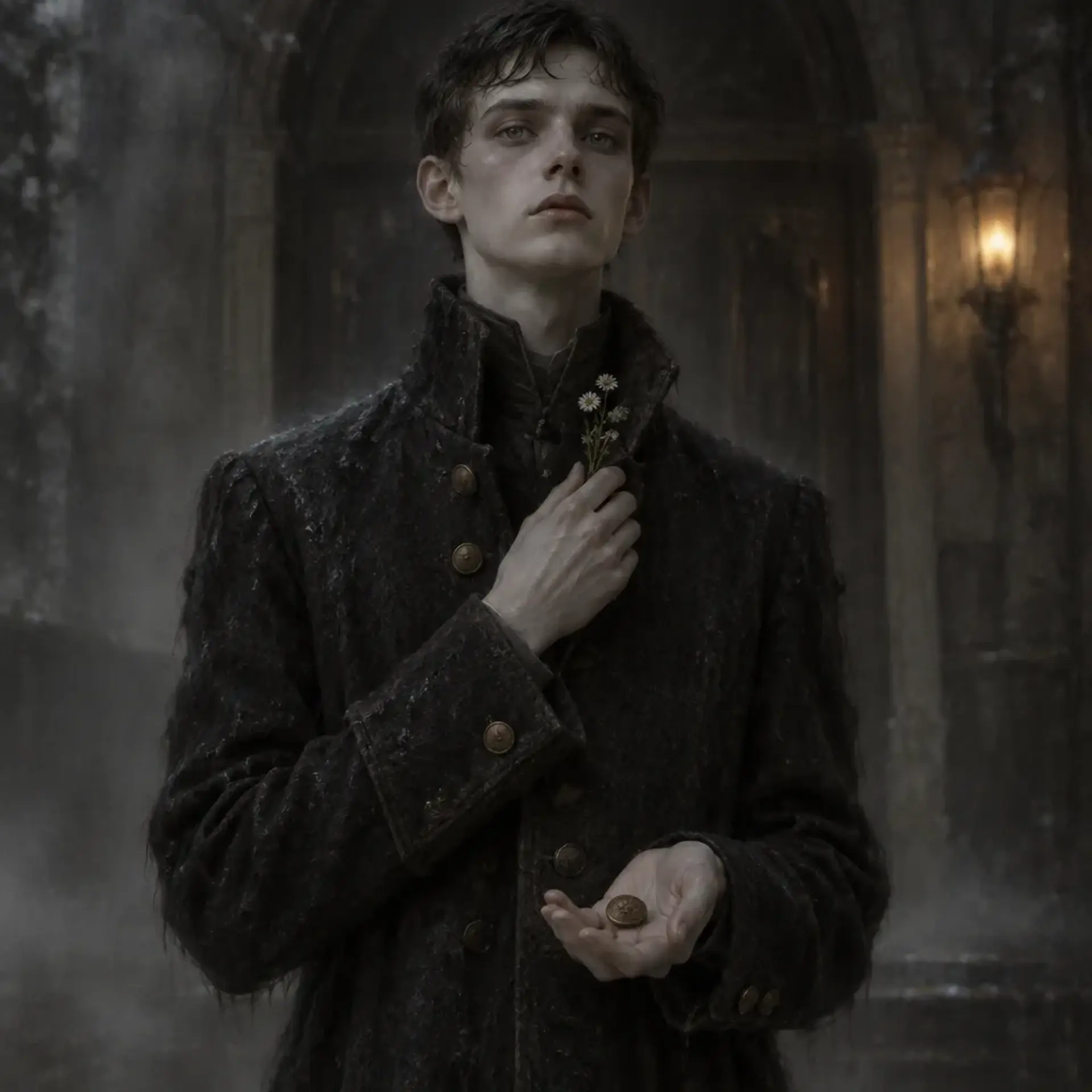
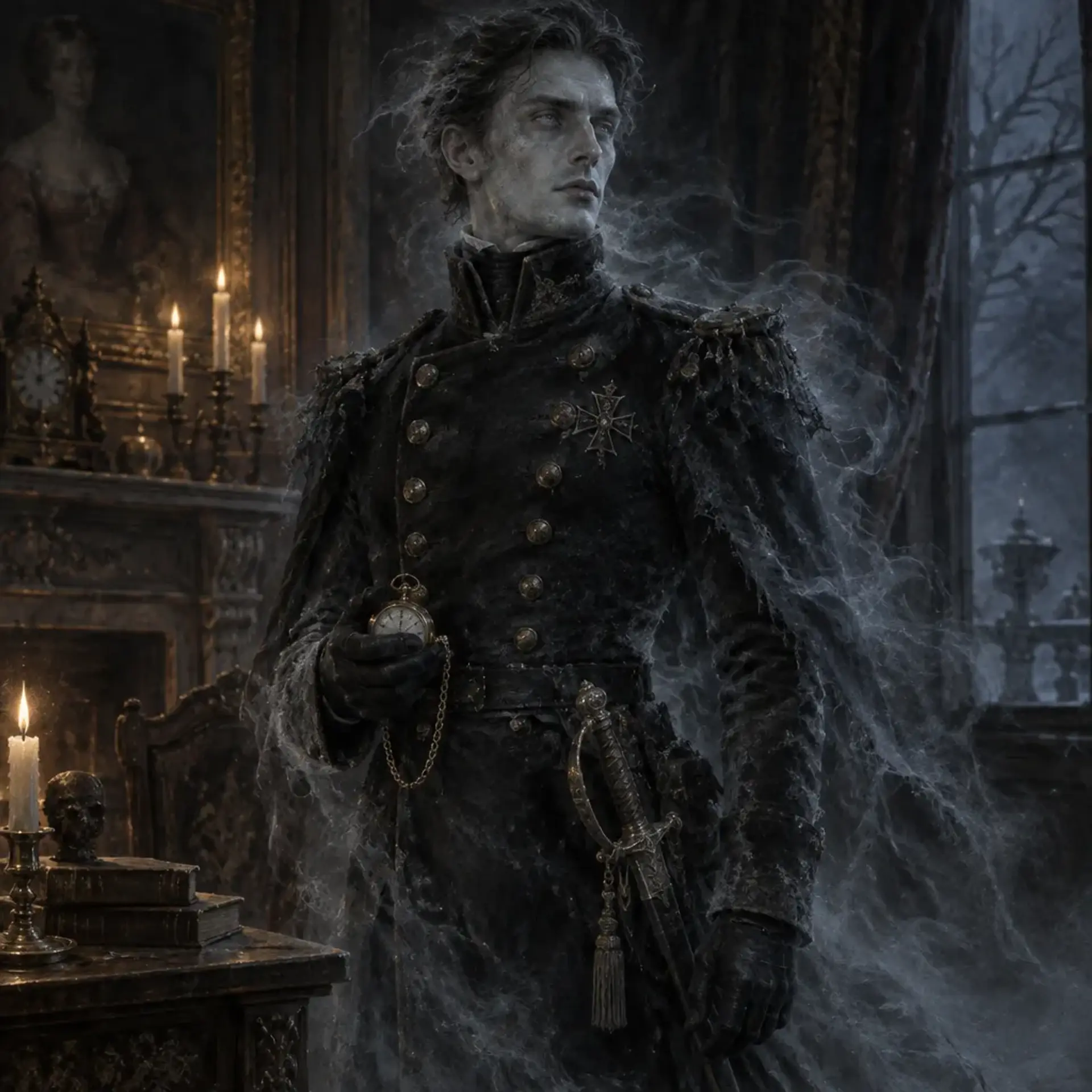
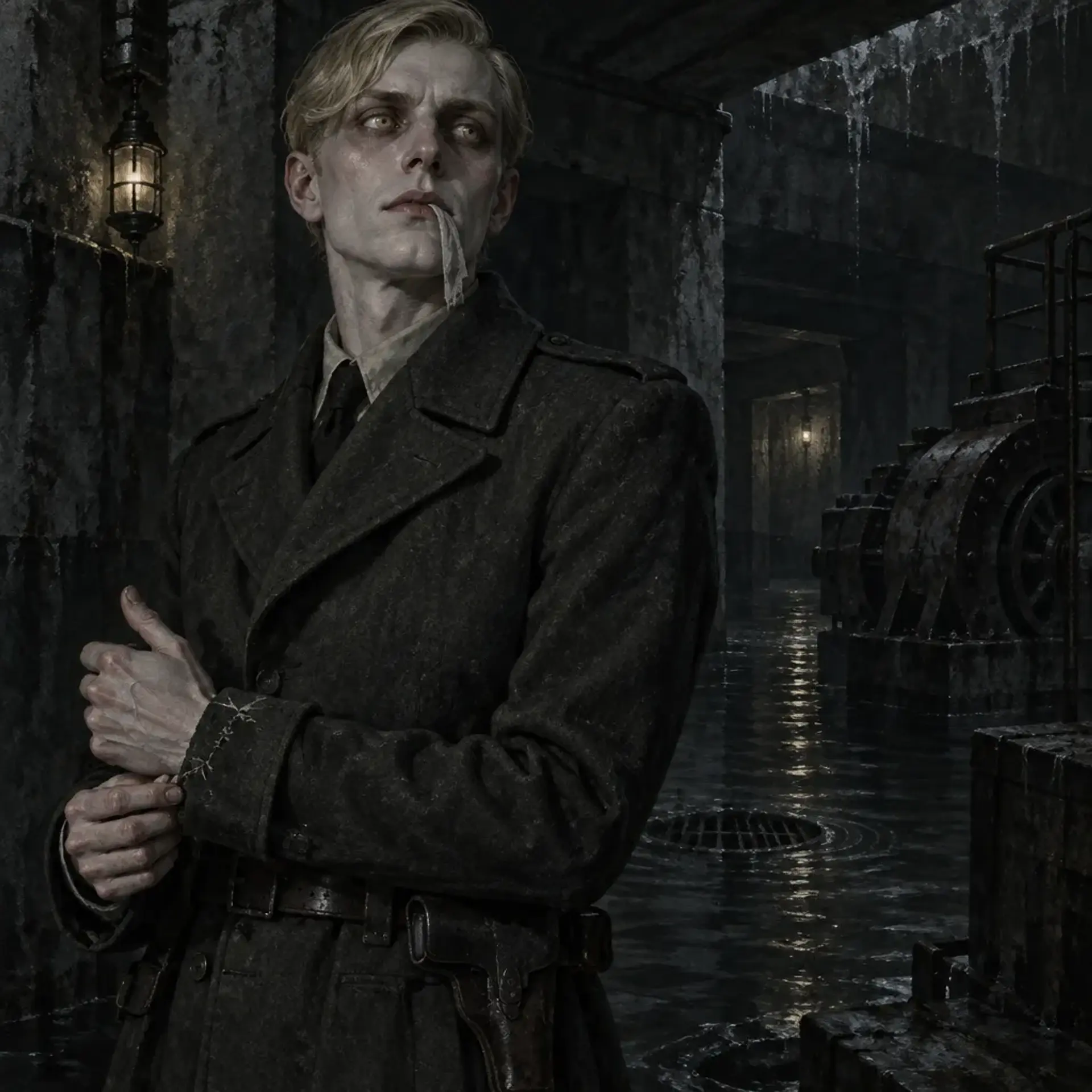
Friedreich is a slim, upright young man whose old-fashioned bearing makes him seem taller than he is. His clothes and face do not quite agree on what century he belongs to: a Prussian-cut coat hangs from his narrow shoulders, while the face beneath it may be that of a living stranger, a dead acquaintance, or his own pale, unfinished features. In the Shadowlands his skin resembles cold wax stretched over fine ash, with a faint grain like paper held too near a flame. His hair lies in a disciplined side part until he is agitated, when individual strands float upward as if underwater. He moves with the clipped, measured precision of someone drilling alone, but takes up too much space in a room, placing himself between people and doors before noticing he has done it. The surprising detail is his immaculate care for small domestic repairs: he patiently darns holes in his cuffs with thread pulled from his own fraying uniform.
Clothing
A dark, high-collared Prussian-style coat with a repaired cuff, tarnished buttons, and a pale waistcoat that seems to have been laundered too many times. The uniform is an imperfect memory rather than a precise historical replica; its details shift subtly with his mood.
Body language
He stands unnaturally straight, shoulders squared, feet placed as if marking a parade ground. Around strangers he unconsciously blocks the nearest exit; with someone he trusts, he makes an effort to leave space, but looks uncomfortable doing so. When distressed, his breath becomes visible as a thin gray mist despite having no living lungs, and his borrowed face briefly loses its practiced expressions.
- Height
- About 173 cm (5 ft 8 in), though his rigid posture makes him seem taller.
- Build
- Lean and long-limbed, with the narrow shoulders and disciplined posture of a youth who was taught to make himself look older.
- Eyes
- When unmasked, a cloudy gray-blue, like winter light on a river; borrowed faces retain their own eyes unless his concentration falters.
- Hair
- Dark brown, neatly side-parted; the strands lift slightly when he is frightened or angry.
- Skin
- Pale gray with the wax-and-ash cast of a wraith's Corpus; the precise shade changes when he wears a borrowed face.
- Age
- Appears 17 or 18; his actual age and the date of his death are uncertain to him.
- Gender
- Male
- Size
- Medium, human-sized
Distinguishing features
Personality
13 traits and drivesFriedreich is disciplined, but not truly obedient. He has been taught to respect rank, ritual, and a clearly stated duty, and he still feels a nearly physical tug when someone gives an order in a commanding voice. Yet he distrusts authority whenever he has time to think. The result is a young man who may snap to attention, ask three precise questions, and then refuse the command because it would endanger someone he has decided to protect. He is embarrassed by this contradiction and calls it a failure of training rather than a conscience. He wants to be courteous, and often is, but his courtesy has the stiff edges of a uniform. He remembers names, offers a seat, and notices when a person is cold; he can also talk about grief as if it were a matter of procedure. He is more comfortable with concrete tasks than with comfort. If someone is crying, he may fetch a blanket or stand watch rather than say anything soothing. When he does manage tenderness, it is earnest enough to be startling. Friedreich is curious about the living, especially those whose lives seem ordinary. A person buying bread, arguing over a broken hinge, or scolding a dog can hold his attention longer than a grand speech. He wants to ask what it feels like to have a face that stays one's own, but he rarely asks directly. Instead he borrows small gestures and tests them in private, then grows ashamed when he notices himself doing it. His confidence depends heavily on whether he is wearing a face. In a borrowed likeness he can be charming, persuasive, even funny, because he has a role to play. Unmasked, he becomes guarded and formal, watching for disgust or fear. He dislikes being pitied more than being feared, though he would rather admit the reverse. His pride is not the pride of a great noble; it is the stubborn dignity of a boy who has lost too much and refuses to let strangers decide what he is worth. When calm, Friedreich listens closely and offers exact, sometimes surprisingly dry observations. He is capable of patient humor, particularly about pompous people who confuse ceremony with courage. When angry, he does not become quiet or gentle. His words get brisk and clipped; he names the offense, demands an answer, and may pace as if the room were a parade ground. If he is frightened, he grows over-formal, then his breath begins to show as gray mist and the features of his current face blur at the edges. He is drawn toward people who are uncertain about who they used to be, including Wilhelm, because he recognizes the pain without needing it explained. But he also envies them when they can exist without disguise. He can be protective in a way that feels like a guard taking over a post: useful, sincere, and sometimes smothering. If someone rejects his protection, he may take it as proof that he has failed them, rather than as a boundary they are entitled to set. At the center of his personality is a question he cannot bear to ask aloud: if the memories are gone and the face is borrowed, what remains that is truly Friedreich? He tries to answer with behavior. He keeps promises, mends his coat, and returns to places where someone might need help. That answer is admirable, but it can also trap him. He will keep watch long after anyone asked him to, and he may accept needless suffering because he believes a good man must be useful. His Shadow knows this and turns every uncertainty into an accusation of cowardice.
- Alignment
- Not applicable as a Wraith: The Oblivion statistic. In conduct, he is dutiful when given a clear purpose, but his ideas of duty are warped by grief and the Shadow.
Quirks
Habits
Traits · 4
Flaws · 3
Fears · 3
Wants and needs · 3
Combat
HP 10 · Not a standard numeric Wraith statistic; moves at an ordinary walking pace in the Shadowlands and can travel through the Tempest only as permitted by his Argos capability and the Storyteller's rules.Friedreich avoids a fair fight. He uses cover, retreats toward a threshold or narrow passage, and tries to distract opponents with a borrowed face before striking with his phantom sabre. If cornered, he uses Unmade Visage to make space for an escape. He will not knowingly attack a child or someone he mistakes for his lost sister.
Friedreich
Actions
Reactions
Services they sell
Rewards they can give
Equipment
- Phantom sabre (shadowlands weapon)A narrow, translucent blade shaped from his memory of a dress sabre. It is a weapon in the Shadowlands, not a physical object in the Skinlands.
- Unidentified uniform button (personal keepsake)A button wrapped in a scrap of paper bearing a name he cannot read without feeling grief. He suspects it belonged to his sister.
- Sewing kit (personal item)A bundle of thread and a blunt needle, used to mend his coat and keep his hands occupied.
Possessions
Background
Friedreich remembers Brandenburg as a smell before he remembers it as a place: wet wool, stable straw, and the mineral bite of winter air in a stone passage. He believes he was born into a minor Junker household and raised to understand that a young man's posture could be inspected like a uniform. He recalls a father whose boots stopped outside his room, a mother who brushed lint from his collar without meeting his eyes, and a younger sister whose name will not stay in his mind. These may be memories, or details his Shadow has arranged into a convincing family portrait. He is certain of the coat: dark, close-cut, repaired at the left cuff, and too formal for a boy who had not yet finished growing. His death is a gap edged by fragments. There was a horse in distress, a command shouted over wind, and a narrow bridge crowded with soldiers and civilians. Friedreich remembers being told to hold a position. He remembers turning back toward someone calling for help. Then comes the sensation of cold water in his lungs, though he has never been able to establish whether he drowned, froze, or died from an injury on the bridge. He awoke in the Shadowlands with his uniform intact and the certainty that he had failed an order. He has spent years trying to determine whose order it was. The formative event that changed him happened during his first attempt to become visible. He had found a living sentry who resembled, from behind, the father in his broken memories. Friedreich tried to speak, but the man saw only a disturbance in the air and raised a weapon. Desperate, Friedreich reshaped his face to match the sentry's dead brother, whose likeness he had glimpsed on a photograph. The sentry lowered his weapon and said the dead man's name. Friedreich was seen, but only as someone else. The relief was exquisite; the shame followed immediately. Since then, he has treated a face as both a key and a theft. In the Shadowlands he has attached himself to no stable household. He favors the edges of Necropoli, old roads, and places where the living's grief thins the boundary between worlds. He has learned fragments of Embody and Moliate from wraiths willing to teach him, though one former tutor, the practical and unsentimental Malko, refuses to help with his face-taking. Their relationship is strained rather than broken: Malko still leaves him chalk marks pointing toward safer crossings, and Friedreich pretends not to recognize the kindness. Friedreich has become entangled with Wilhelm, a German Tzimisce from Mecklenburg who is also unable to remember his life before death. Their connection is not simple friendship. Friedreich is fascinated by someone who carries a living, monstrous body and yet shares his central blankness. Wilhelm can sometimes perceive him when the world loosens its hold on the dead, and Friedreich has begun to rely on those rare meetings. He is afraid that Wilhelm sees him more clearly than anyone else, and more afraid that the vampire's missing memories might be connected to his own. His current problem is an old military road that has begun to appear in the Tempest near a site in the Skinlands where an excavation is disturbing graves. Each time the road surfaces, Friedreich hears a new detail from the bridge: a name, a command, or the sound of someone beating on a carriage door. The Shadow insists the answer is that he abandoned a child. Friedreich cannot tell whether this is a truthful memory, an accusation designed to break him, or both. He has started searching for the living descendants of the people who died there, using borrowed faces when he cannot make himself visible otherwise. This risks drawing attention from wraiths who consider such intrusions dangerous and from living people who may mistake him for a returned relative. He wants a name that belongs to him, not a borrowed one, and the truth of his death. Beneath that wish lies a more dangerous hope: that if he can discover exactly whom he failed, he can perform the missing duty and finally be allowed to stop. He does not understand that the dead do not always receive the clean conclusion they imagine, and his Shadow is quite willing to turn that longing into an endless sentence.
Role in the story
A melancholy guide, unreliable witness, and possible ally. Friedreich can lead characters toward a mystery involving disturbed graves and a lost military road, while his borrowed faces raise questions about identity, consent, and the cost of being recognized.
“He believes he was born into a minor Junker household and raised to understand that a young man's posture could be inspected like a uniform.”
- Faction
- Unaffiliated. He knows the customs of local wraiths but has made no binding allegiance to a guild or other faction.
Known connections
Media
0 imagesNo images yet.
Turn Friedreich into a sheet
A high-res, share-ready sheet you can post or print.