Friedreich
Friedreich
At the table
Voice
A dry, papery rasp with a faint breath-catching edge. His consonants are deliberate and his phrasing carries the formality of a Brandenburg household and military instruction. The sound grows strained around memories of wartime breath, not softer or more courteous when he is angry.
His voice carries a dry rasp, like wool dragged across paper, with clipped consonants shaped by German speech and the habits of formal instruction. It is not loud, but it has the carrying precision of someone accustomed to giving short directions across a crowded station or field. His breath sometimes catches on words connected to the First World War, as though his body remembers inhaling before his mind does.
Speech patterns
How to play them
Approach him with a concrete question or practical task, then allow silence. He responds to consistency better than grand declarations. Asking permission before requesting his face-borrowing knack earns trust; demanding that he prove his relationship to Wilhelm makes him retreat into stiff politeness. He is more open while watching football or discussing clothing with Gunther.
Goal
Discover the identity of the first person whose face he borrowed, determine what the remembered breath means, and preserve his bond with Wilhelm without making either of them dependent on a fabricated past.
Motivation
To become recognizable without making another person pay the price of his visibility.
Appearance
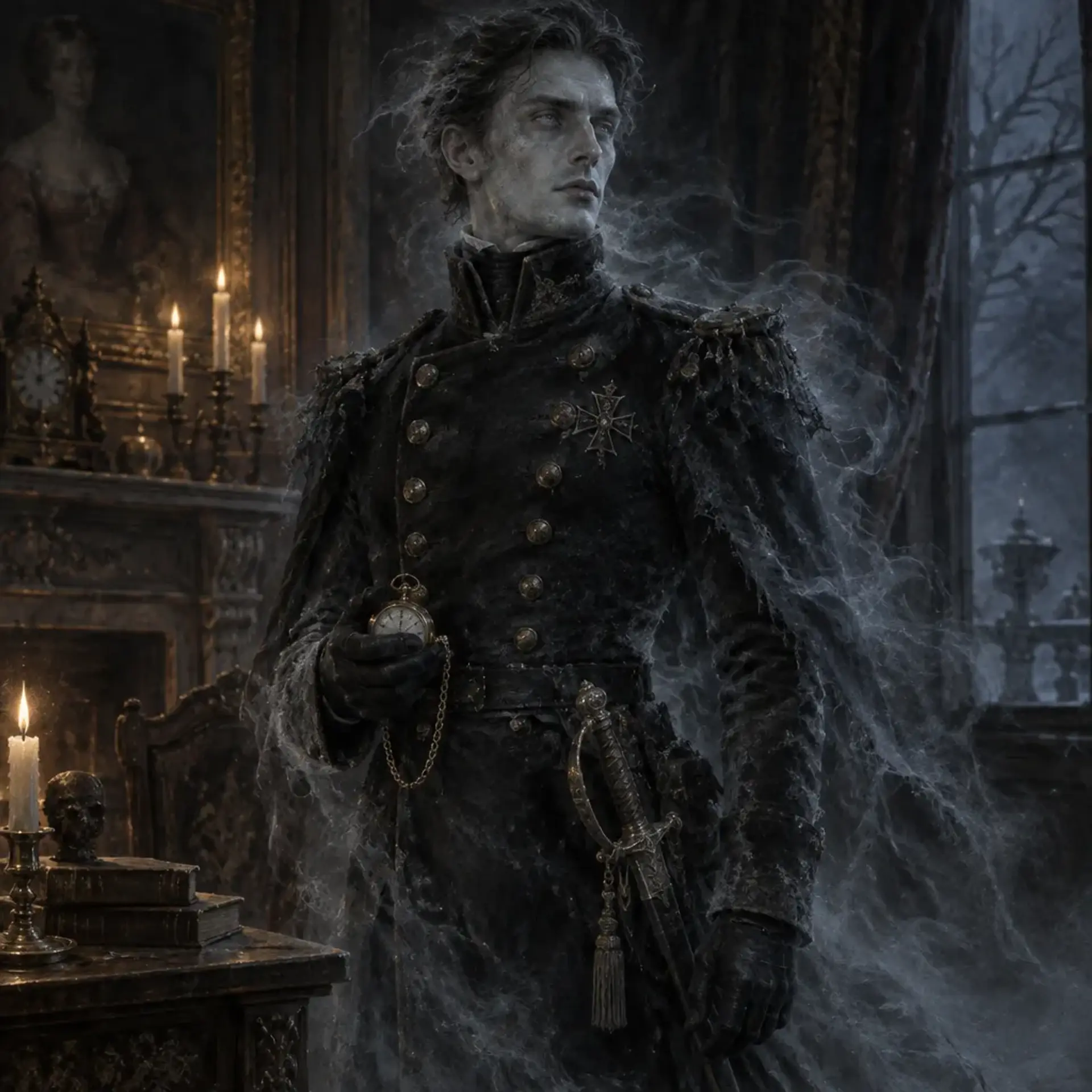
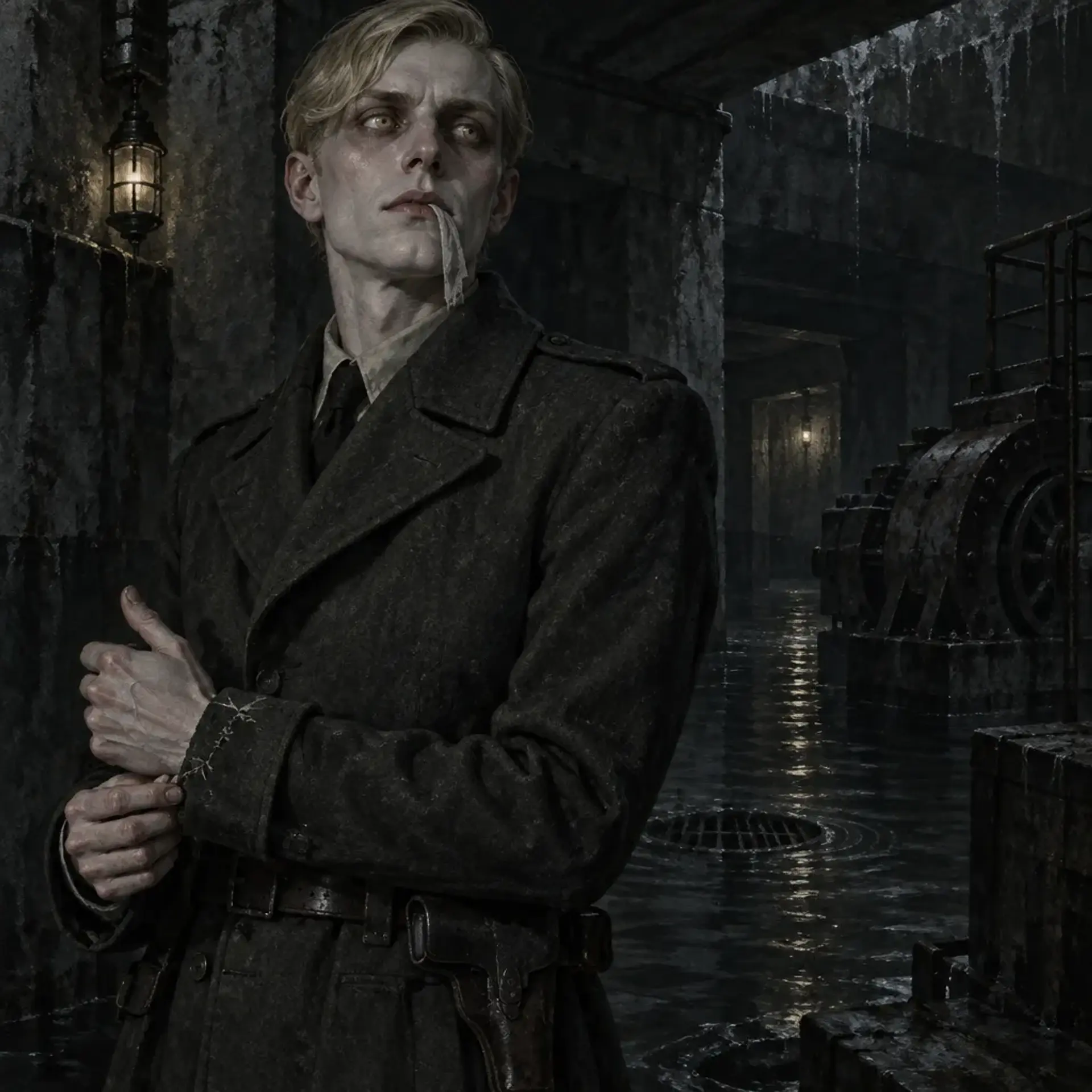
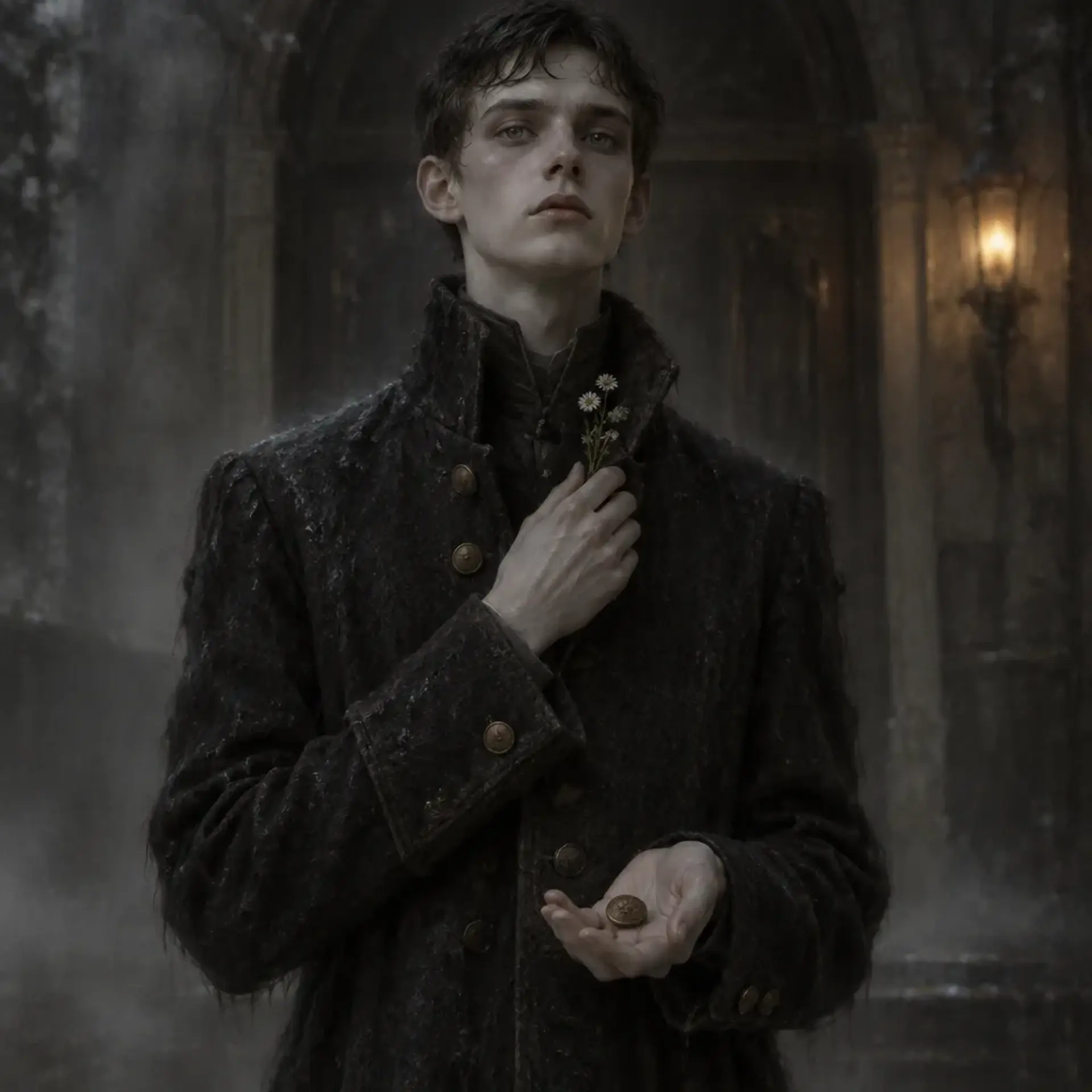
Friedreich is tall for the boy he appears to be, with a long-backed, almost parade-ground posture that makes a doorway seem narrower when he enters. His outline is never quite settled: the wool of his coat and the edges of his jaw ripple as if seen through cold water, and on strong nights his skin has the dry, powdered look of old portrait paint. He moves with careful, economical steps, but he habitually leaves too much space between himself and other people, as though an invisible rank of soldiers stands there. He smells faintly of wet wool, extinguished lamp oil, and the mineral chill of a cellar. The unexpectedly homely detail is a tiny stitched sprig of embroidered chamomile inside his severe collar, a careful bit of needlework he will not explain. On nights when the world loosens its hold on the dead, his features sharpen into those of a pale, stern adolescent, and strangers sometimes mistake him for a living boy in an obsolete uniform.
Clothing
A dark, old-fashioned wool coat cut in a severe Junker-inspired style, with a high collar, dull brass buttons, and a worn lining that seems perpetually damp. The tailoring is an impression more than a stable object when he is incorporeal. He keeps a small stitched chamomile sprig hidden inside the collar.
Body language
He stands as if awaiting inspection, shoulders square and chin slightly lifted, but leaves a conspicuously wide berth around companions. His gaze tracks doorways and hands. When praised, he straightens; when recognized, his posture folds inward as if he has been caught wearing stolen clothes.
- Height
- Tall for a boy of seventeen or eighteen, approximately 180 cm when clearly manifested.
- Build
- Tall, narrow-shouldered, and long-limbed, with the stiff carriage of someone drilled in posture rather than strength.
- Eyes
- Grey-green when his features are clear; otherwise the eyes blur into the same rain-softened darkness as his face.
- Hair
- Dark brown, close-cropped in an old-fashioned style; it softens and blurs when he is only partly manifest.
- Skin
- Pale grey with the soft, powdered finish of old portrait paint when clearly manifested; otherwise indistinct and blurred.
- Age
- Appears 17 or 18; the age of his death is uncertain to him. He has existed as a wraith through both World Wars.
- Gender
- Male
- Size
- Medium
Distinguishing features
Personality
16 traits and drivesFriedreich is caught between the polished self-control he associates with a Prussian household and the tenderness of someone who has never been certain he belongs anywhere. He wants to be useful, but hates being treated as an instrument. He is protective of Wilhelm with an intensity that can look like military discipline, yet privately he worries that he has mistaken need for kinship. His courtesy is genuine, not merely a disguise, but it also gives him a safe script when he has no idea what a living person expects. In calm company he is observant, patient, and unexpectedly willing to listen to small complaints. He remembers the precise order of a football match's plays more readily than the details of his own death. With Klaus, he can relax into dry, blunt remarks and does not take the ronin's rough manner as a reason to leave. With Gunther he is curious and careful, asking about the feel and growth of moss textiles as though they might offer a way to exist without appropriation. Around Wilhelm he becomes more formal and more vulnerable at once: he stands guard, uses old-fashioned courtesies, and searches Wilhelm's face for recognition that neither may possess. When frightened, Friedreich does not usually panic outwardly. He becomes rigid, speaks in complete and careful sentences, and tries to identify the nearest exit and the safest person to protect. If someone is threatened, this composure can snap into abrupt action. He will put himself between an attacker and a companion without considering whether his own Corpus can withstand it. That brave impulse is not pure selflessness. He also fears that if he is not useful, he will be abandoned or forgotten. He has a romantic idea of duty, uniforms, and old houses, but he is not blind to their cruelties. He is drawn to ceremony because ceremony promises that people can be named and remembered. At the same time, he resents inherited authority and distrusts anyone who assumes a title makes a person worthy of obedience. He can sound like a young officer while arguing against the very hierarchies he imitates. His face-borrowing knack makes intimacy difficult. Friedreich wants to be seen, but worries that being seen under someone else's features turns every welcome into a lie. He asks permission whenever there is time, and when there is not, he often chooses to remain unseen even if that makes a rescue harder. On a bad night, however, loneliness can overcome his scruples. He may take a familiar face for a few minutes simply to hear someone say his name without fear. Afterwards he is ashamed, and his Shadow tells him that shame is only vanity. Friedreich's central contradiction is that he is both an idealist and a careful skeptic. He wants to believe Wilhelm is his brother, that the breath in the trenches belonged to him, and that the boy beneath the disguises can be found. He distrusts these beliefs precisely because they matter. When hopeful, he takes small risks and offers help before being asked. When despairing, he retreats into clipped reports and insists that no one owes a ghost anything. He is not consistently noble, but he keeps trying to choose a kind of loyalty that does not require another person to surrender their identity.
- Alignment
- Protective and dutiful, but governed by personal loyalties rather than law or abstract virtue.
Quirks
Habits
Traits · 4
Flaws · 4
Fears · 4
Wants and needs · 4
Combat
HP 7 · As a wraith, movement and interaction depend on the scene and the Storyteller's Wraith rules. When physically manifested, he moves at an ordinary brisk human pace.Avoids a direct fight. He uses cover, misdirection, and Embodiment to interrupt a threat long enough for allies to escape. He prefers to grapple or shove rather than inflict lasting harm, and retreats if protecting someone would require taking a living person's face without consent. His abilities are not a substitute for a wraith's full rules; resolve Arcanos costs and effects using the table's Wraith edition.
Friedreich
Actions
Reactions
Services they sell
Rewards they can give
Equipment
- Wool coat (personal effect)An old-fashioned coat whose solidity depends on his state of manifestation; its lining bears the hidden chamomile embroidery.
- Loose brass button (memento)A tarnished brass button he believes came from a uniform connected to his lost life, though he cannot prove it.
Possessions
Background
Friedreich remembers Brandenburg in fragments that arrive like objects lifted from a flooded cellar: a gravel drive, a brass latch cold beneath his palm, the smell of horse sweat, and a woman saying his name as if it were both a warning and a prayer. He cannot tell whether these are memories of his childhood, borrowed images from a face he has worn, or details his Shadow has assembled to give his emptiness a respectable shape. He is certain only that he died young, that he had been taught to stand straight, and that someone expected him to become a man of consequence. His first years as a wraith were not a clean awakening. He remembers an abrupt sensation of air in his lungs during the First World War, a breath so startlingly real that he clawed at his own chest. The memory might belong to his death, to a living soldier he watched, or to a moment of Embodiment he has misfiled. He has never been able to recover what happened next. In the confusion of the war, he learned to survive by attaching himself to living faces. A familiar face could make him legible to the living, could get a door opened, could let him pass through a hospital corridor without becoming a cold draft and a panic. He came to think of this as borrowing rather than stealing. The distinction has never comforted the people whose faces he has used. The years between the wars gave him scraps of names but no reliable chronology. He watched borders move, uniforms change, and families vanish from houses he half remembered. By the Second World War, he had become a shadow on the edge of other people's campaigns, able to help with warnings, messages, or an appearance at a crucial moment, but never able to remain fully present. His recollections of both wars overlap. Sometimes he speaks as if he walked beside a living soldier; sometimes he insists he was only watching from the other side of a wall. He has learned not to trust a memory merely because it feels noble. Wilhelm is the person who unsettles this careful skepticism. Wilhelm, a German Tzimisce from Mecklenburg, is a vampire with his own missing life before death. Friedreich regards him as a brother without knowing whether the feeling comes from shared history, a promise, or a need to make kin out of another amnesiac. He accompanied Wilhelm as much as he could during the wars, and he has stayed near him ever since. Friedreich protects Wilhelm with the grave formality of a younger sibling who believes he has been appointed to guard an older one. Wilhelm's own feelings about this are harder to read. Friedreich fears that asking for proof of their bond will make it disappear. His current circle is an uneasy supernatural coven of wraiths, vampires, werewolves, and changelings, held together by repeated company rather than a charter. Gunther, a changeling who spent much of his life in Arcadia before returning to the real world, makes and sells moss-based clothes. Friedreich treats Gunther's living, growing textiles with an almost religious caution, and has quietly asked whether a garment could hold the shape of a face without taking it from a person. Klaus, a ronin Get of Fenris, or perhaps a skin-dancer, is abrasive toward nearly everyone. With Friedreich he hesitates. The two sometimes watch football together, exchanging little more than comments about positioning and bad refereeing. These evenings are among the few times Friedreich feels he is not serving as anyone's guard or ghostly instrument. His formative change came during a winter in which he borrowed the face of a frightened young nurse to warn a family away from a dangerous building. The family believed the nurse had betrayed them. Friedreich watched their trust in her collapse and understood that a useful disguise could still injure the person it imitated. From then on, he began asking permission when he could, and choosing his own blurred shape when he could not. This rule has cost him opportunities and has not erased the harm he did before he formed it. Now he is searching for the first face he remembers wearing, hoping it will lead to his own name, his death, or a person who can tell him why Wilhelm feels familiar. He is also trying to discover whether the remembered breath was his. His Shadow urges him to stop looking: it offers a simpler explanation, that there was never a boy beneath the borrowed faces, only hunger dressed in a Junker's coat. Friedreich keeps that voice secret from his friends, but its logic grows persuasive whenever he has to choose between being seen and leaving someone else's life undisturbed.
Role in the story
An ally, uneasy witness, and living bridge between wartime history and a supernatural circle. Friedreich can help the characters approach Wilhelm or reveal fragments of a shared past, but his memories are not dependable evidence. His struggle over borrowed identity can also create a moral choice: use a useful disguise, or protect the person whose face would make it possible.
“He is certain only that he died young, that he had been taught to stand straight, and that someone expected him to become a man of consequence.”
- Faction
- A loose cross-supernatural coven or circle with Wilhelm, Gunther, Klaus, and others. He is a wraith of the Shadowlands, not a member of a formal organization by default.
Known connections
Media
0 imagesNo images yet.
Turn Friedreich into a sheet
A high-res, share-ready sheet you can post or print.