Oswin Hirst
Oswin Hirst
At the table
Voice
His voice has a dry, breath-catching edge, shaped by cold air, farm work, and years of speaking over wind and livestock. He begins some sentences with a small intake through his nose, as if scent has reached him before the thought. His words are usually steady and workmanlike; after a sleepless seasonal night, the rhythm becomes clipped and he leaves gaps where he is listening. When angered, he does not grow quieter or more courteous. His consonants sharpen, his breath roughens, and he speaks with the blunt certainty of someone warning an animal away from a gate.
Plain Yorkshire phrasing, practical and unshowy. He uses concrete examples from livestock and weather to explain difficult subjects. His account of the supernatural is matter-of-fact, while he becomes indirect and evasive when asked about his own past.
Speech patterns
How to play them
Begin with practical help, honest kindness, and an offer of work or food. He responds well to patient questions, especially about farming and family. Do not corner him with iron or threaten William. If confronted with evidence of his nature, he may tell a small truth first and then become defensive when asked to explain the parts he does not understand himself.
Goal
Keep Mary and William safe without making them afraid of the dark, the fae, or him. He hopes Christian doctrine and new natural sciences can give Mary explanations that leave room for a peaceful family life.
Motivation
Love for Mary and William, mixed with a stubborn hope that ordinary family rituals can keep supernatural danger at the edge of their lives.
Appearance
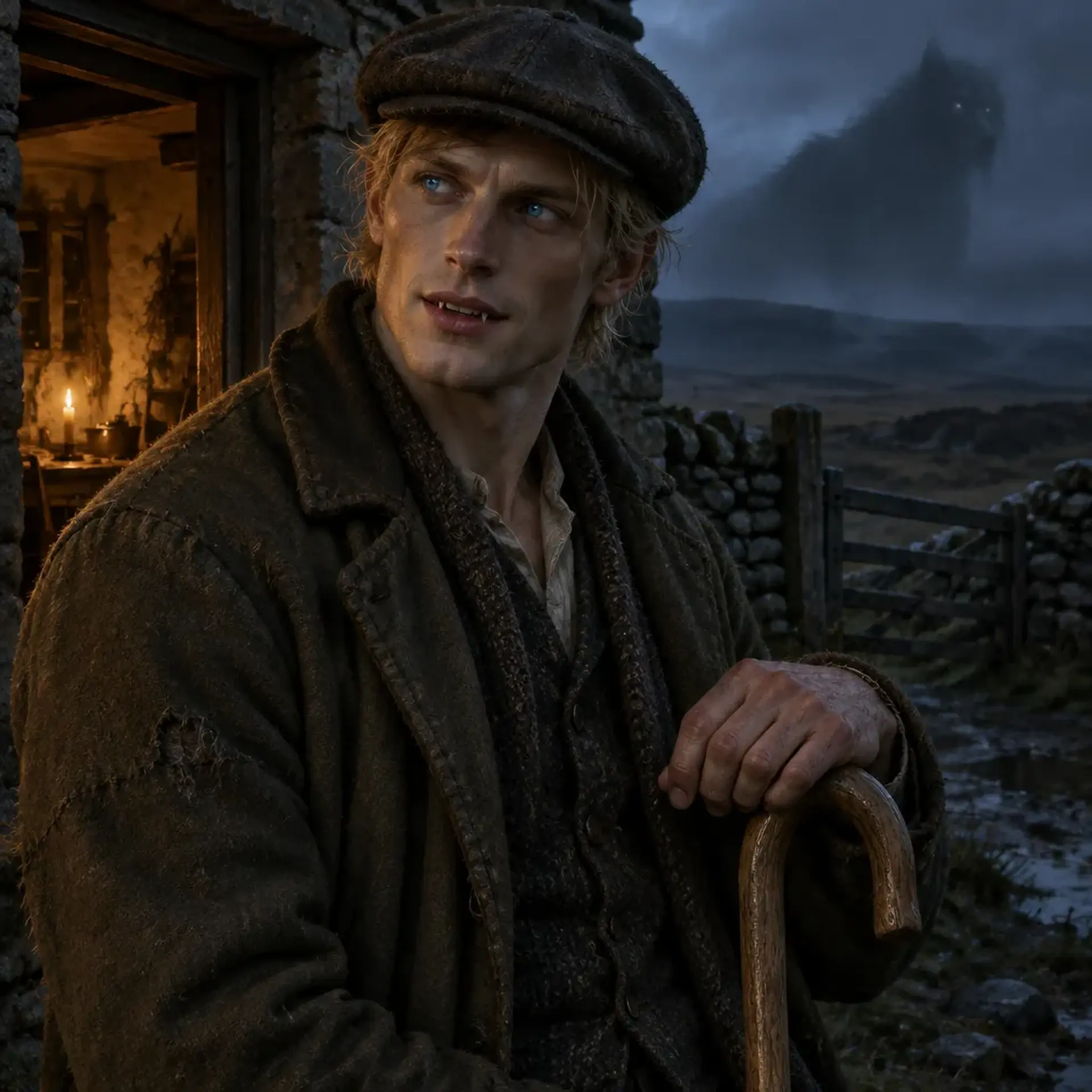
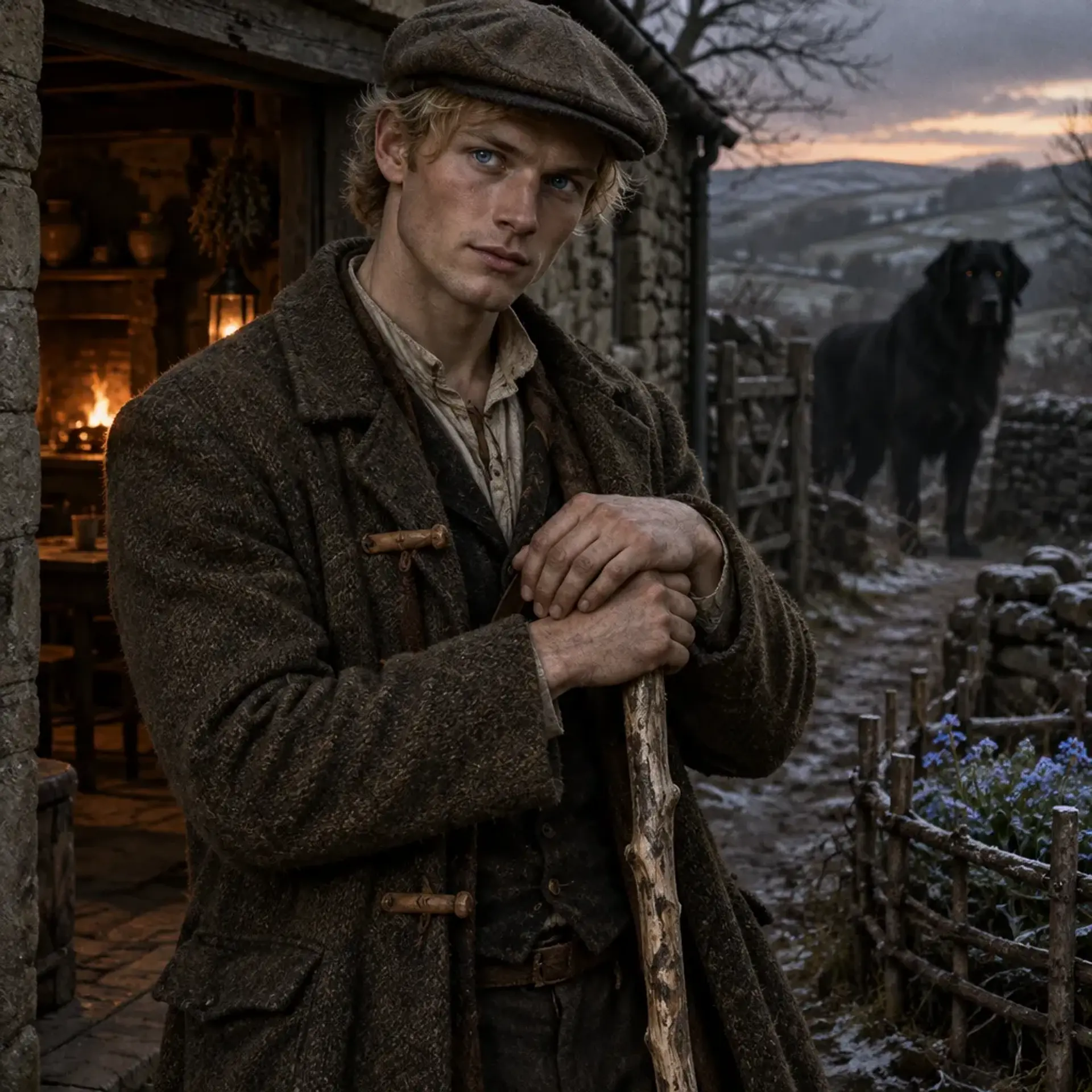
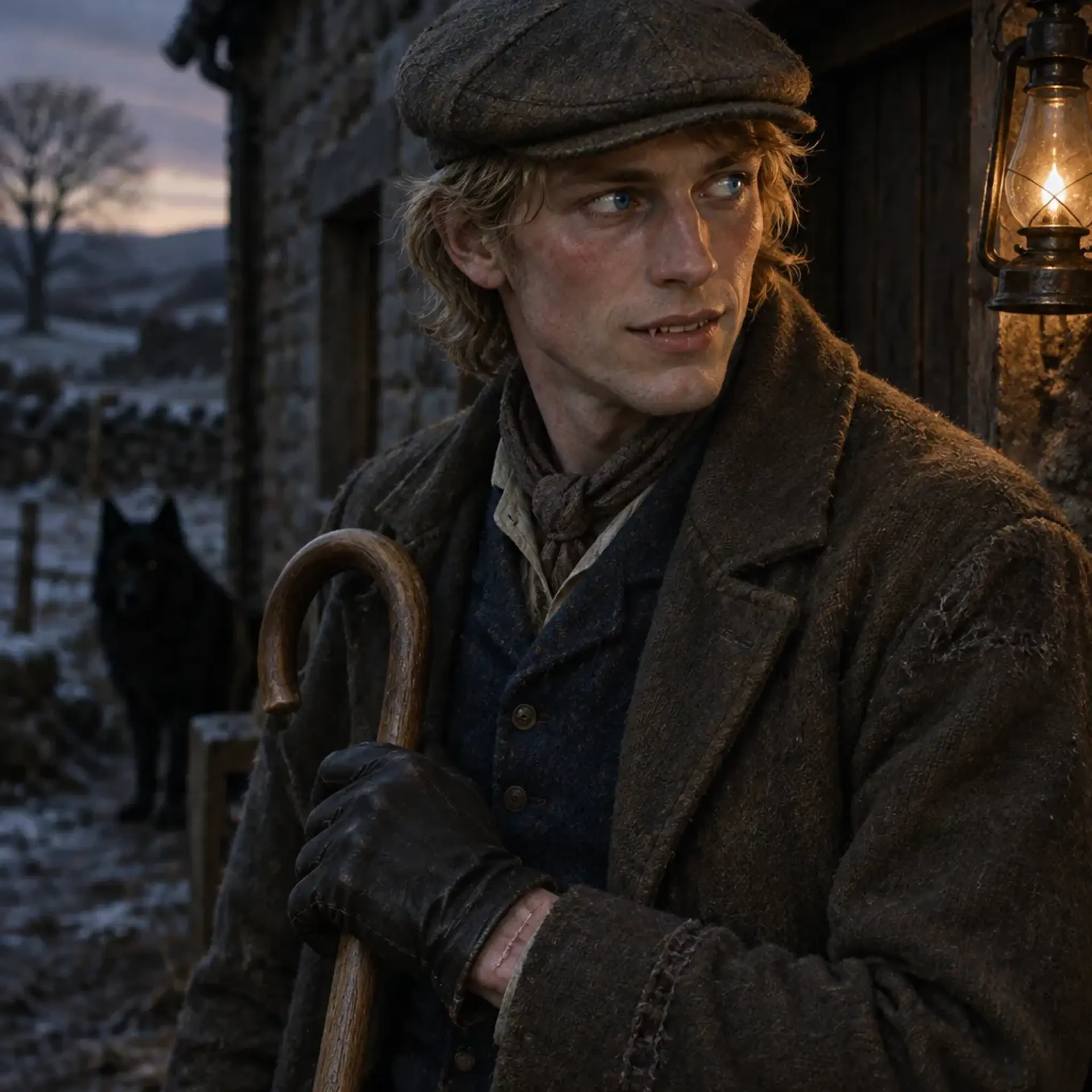
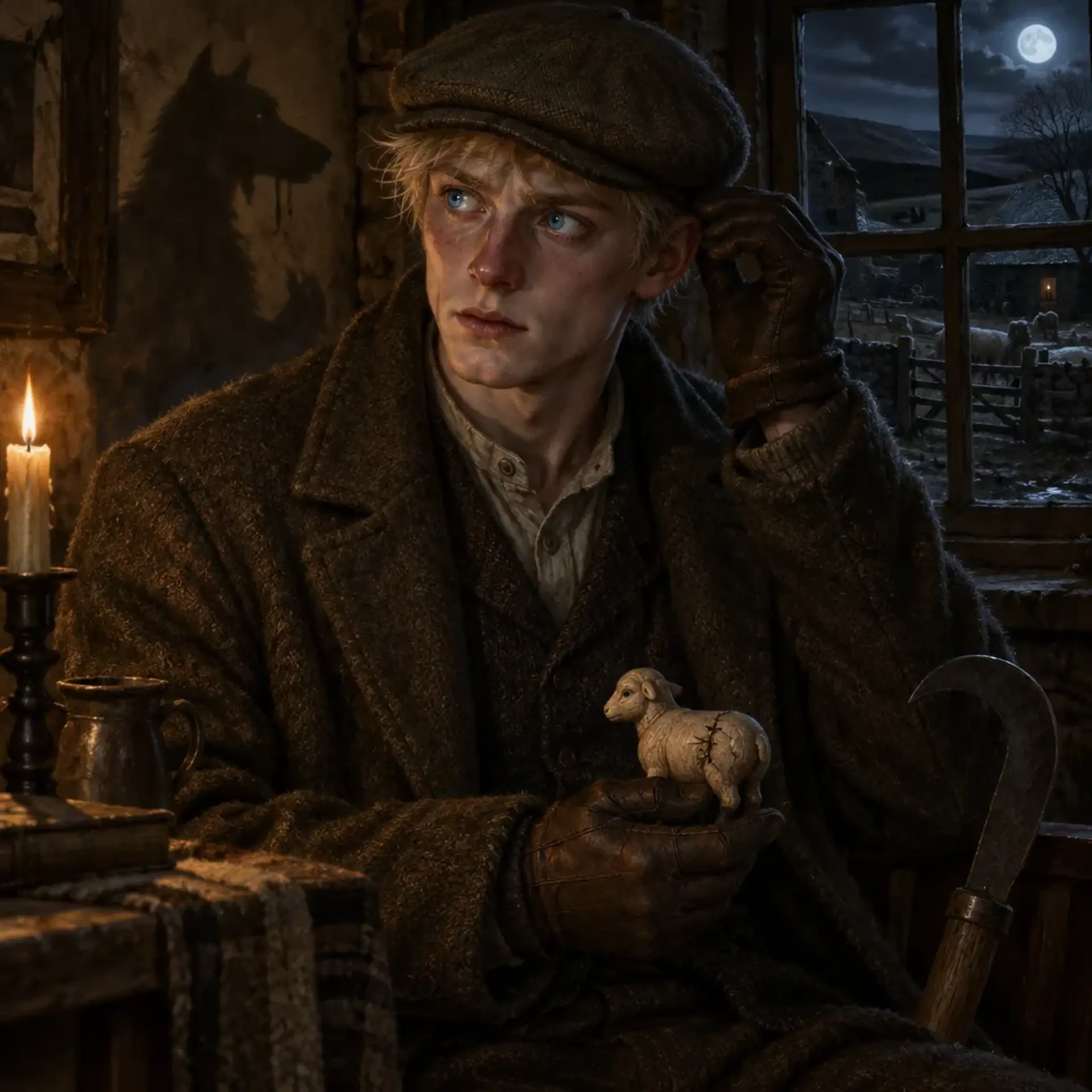
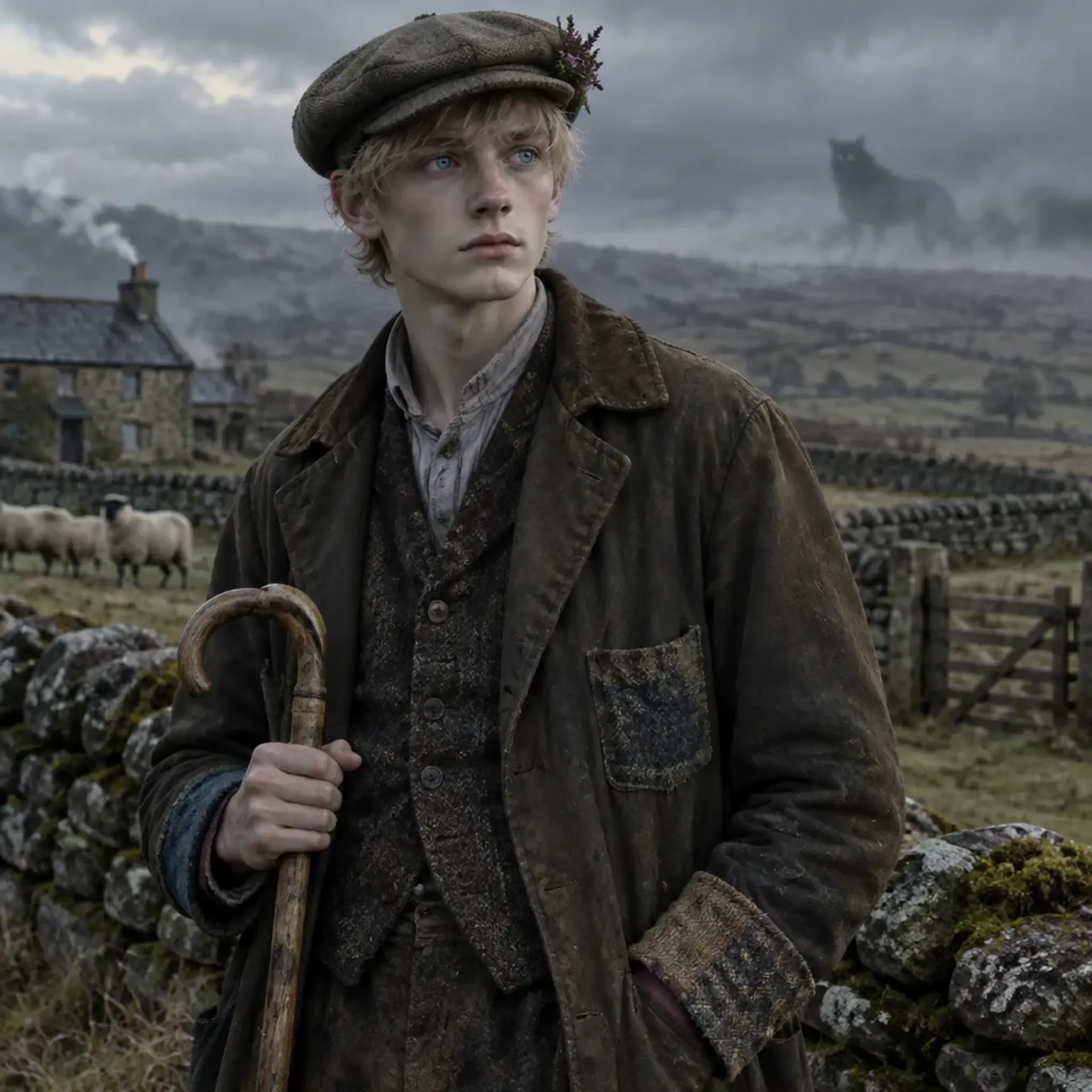
Oswin stands six feet tall, with a face that looks scarcely older than the boy he appears to be. His straight pale-blond hair lies flat beneath a common Yorkshire flat cap, but damp weather pulls it into thin, shining strings against his temples. His skin is winter-pale, with a faint grey cast after sleepless nights. His blue eyes are bright enough to seem lit from behind, especially when he is startled or angry. He moves with a shepherd's careful economy across rough ground, placing his feet as if he can feel every stone through his boots; when distracted, he stops mid-step and watches an empty patch of air. His coat is sound but repeatedly altered at the cuffs, and its left pocket is carefully mended with cloth of a different weave. Unexpectedly, he keeps a little sprig of flowering thyme tucked in his cap, replacing it even in weather when the plant should not be in flower. People remember the impression of a young man standing too still, listening to something that has not yet happened.
Clothing
A serviceable, well-kept farmer's coat with repeatedly altered cuffs, a wool waistcoat, hard-wearing trousers, and mud-marked boots. He wears a plain flat cap common in the town. His cap is his most carefully maintained possession, and a sprig of thyme is usually tucked into its band. He keeps away from iron fastenings where he can.
Body language
In company he keeps his shoulders relaxed and his hands visible, an effort at reassurance that sometimes looks rehearsed. He watches doors without turning his head. When iron is near, his fingers curl into his palms. Around William he increasingly crouches to the boy's height and waits for permission before touching him. At seasonal turning points he stands facing the wind as if listening with his whole body.
- Height
- 6 feet
- Build
- Lean, long-limbed, and capable from years of walking rough pasture rather than from showy strength.
- Eyes
- Bright blue, seeming to burn when his temper or fear breaks through.
- Hair
- Pale blond, straight, and usually flattened beneath his cap.
- Skin
- Very pale, with a faint grey cast after sleepless nights.
- Age
- Appears about 17; his actual age spans many centuries, though his memories of the earliest years are fragmentary.
- Gender
- Male
- Size
- Medium in human form; Large in custom hound form
Distinguishing features
Personality
20 traits and drivesOswin is gentle by choice, not by nature. He takes care to make himself useful in a room: carrying a basket, fixing a hinge, finding a missing lamb. He prefers to help before anyone has to ask, partly because kindness is real in him and partly because practical tasks give him a human script to follow. He is patient with William's slowness and tears, and can sit through a long, halting story without finishing the child's sentences. Yet his patience is not limitless in the way he imagines. When danger appears, he can become abrupt and frighteningly decisive. He does not always understand why a frightened person remains afraid after the immediate danger has passed. He is practical and shrewd about land, weather, livestock, and money. He notices a broken fence from across a field and can tell by a sheep's stance that it is unwell. This competence sits beside a startlingly alien judgment about people. Oswin may recognize a fae bargain before a human threat, or trust a ghost because it has kept its word while distrusting a neighbor who has not. He often treats the strange as normal and the normal as a puzzle. He is not foolish; he simply learned his rules in a world where a promise made at dusk could matter more than a written contract. His affection for Mary is sincere, but his secrecy makes it difficult for her to trust that affection. Oswin wants to protect her from fear, so he recasts what he knows in the language of the church and the new sciences. He speaks of nerves, inherited temperament, seasonal illness, and providence. He does not mean to mock her faith. He wants a vocabulary in which she can live without fearing every dark lane. Still, he avoids the one explanation that might help her understand him. He can be tender at breakfast and evasive by night, then feel hurt when Mary watches him closely. He is proud of his house and the ordered life he has built there. The farm is proof, to him, that he can stay. He takes pleasure in good wool, sound tools, and a well-set table, but he has never quite stopped being a wanderer. When the day's work is done, he sometimes remembers roads through the dales with longing. He misses the freedom of traveling without having to account for his absence, and feels ashamed of that longing because Mary and William are not a burden. The contradiction leaves him restless: he wants to be rooted and wants the horizon to call. Oswin's youthfulness embarrasses him. He has learned clever ways to distract from it: a cap pulled low, a story about his father's side of the family, a claim that he has always been a late grower. He tries to make a joke of his face before anyone else can. He can be charming when he chooses, but his charm is often a practiced bridge over a truth he cannot explain. When someone speaks to him as if he were a boy, he may accept the mistake outwardly and resent it afterward. He is not constantly solemn. He enjoys simple humor and has an appetite for the ridiculous, especially among animals. He can be unexpectedly playful with William, making a lamb's bleat into a mock royal announcement or pretending a bucket is a ship. Around adults he is more restrained, partly from habit and partly because he has learned that people become wary when he is too delighted by the wrong things. His humor tends toward dry observations, delivered with a straight face. The calendar changes him. As nights grow longer and colder, Oswin grows watchful. His sleep breaks into short pieces; he wakes before dawn and checks the gates, then claims he was already up for the sheep. He notices sounds beyond the house and sometimes asks whether anyone else heard a chain dragging. The question is not theatrical. He genuinely cannot tell whether the sound came from the wind, a memory, or something moving nearby. He dislikes being watched during these spells and can answer concern with brisk irritation, only to apologize later. Mayday is different. The Maypole's circling ribbons bring him a delight that is too large for the occasion. He laughs, dances, and seems briefly restored to the heedless youth his face suggests. This joy is genuine, but it is also unsettling. He knows, afterward, that something in him answered the day too eagerly. He may say that the custom is harmless while avoiding the pole on the walk home. Hugh saw his delight and took it for a harmless eccentricity; Oswin remembers the sensation of a door opening. All Saints and Halloween provoke a more dangerous excitement. His blood rises; his hearing sharpens; he becomes alert to every dog and footstep. He is drawn toward thresholds and burial places, though he has learned to keep himself busy indoors. After Alice's death, he stayed with Edmund through Halloween night, listening to grief rather than answering the season's call. That act matters to him because it was not a triumph over some monster. It was simply choosing to remain with a grieving person. Christmas calms him. The repeated prayers, shared meals, and household work feel legible. He does not need to understand every human custom to take comfort in the way the family gathers. One Christmas night, he sat by the fire with William and offered a story instead of asking what the boy had dreamed. Oswin could hear something beyond the stream, but the warmth of the room held his attention. He cherishes that memory and returns to it when the house feels close to breaking. His deepest conflict is between protection and trust. He assumes that if he can manage a danger alone, he should. This instinct served him during his wandering years, when knowledge was scarce and companionship unreliable. It fails in a family, where silence itself becomes a danger. He is learning, slowly, that Mary may prefer a frightening truth to a comforting lie, and that William needs to know the warning signs of his own anger. Oswin is kind, but kindness alone cannot repair what secrecy has damaged. He must decide whether to let his family see him clearly, even if the sight changes what they feel for him.
- Alignment
- Protective and compassionate by intent, but governed by a nonhuman understanding of danger, promises, and family.
Quirks
Habits
Traits · 5
Flaws · 5
Fears · 5
Wants and needs · 5
Combat
HP 8 · Human form: ordinary walking pace. Hound form: swift pursuit across open ground, custom and not assigned a canonical value.Avoids a fight if Mary or William may witness it. Uses the farm's gates, walls, and uneven ground to create distance. If cornered, he changes shape to frighten or disable a threat, then tries to escape rather than pursue. Iron, flowing water, and the risk of exposing his nature make him cautious.
Oswin Hirst
Actions
Reactions
Services they sell
Rewards they can give
Equipment
- Flat cap (clothing)Common flat cap, carefully brushed and repaired; usually holds a sprig of thyme.
- Shepherd's crook (tool)A plain, useful implement from the farm. Oswin dislikes carrying it near iron but uses it when there is no choice.
- William's blanket (possession)A small woollen blanket kept near the hearth for William's bad nights.
- Unremembered rhyme (keepsake)A folded scrap of paper bearing an old rhyme in a hand Oswin does not remember writing.
Possessions
Background
Oswin Hirst was born in the Danelaw, in a time he can no longer place cleanly. His mother had been assaulted by Viking raiders. She raised him as best she could, but died while he was still a child. After her death, he was passed between people who saw him as an inconvenient, strangely quiet boy. He remembers her hands sorting wool, the smell of wet earth, and a lullaby whose words have worn away. He does not remember the face of the man who fathered him, and has never been sure whether his mother knew what Oswin was. As a child, Oswin began to wander. He followed lights that his companions could not see, heard dogs answering from empty hills, and accepted directions from figures who seemed as ordinary to him as neighbors. He was a changeling without knowing the word. His nature was not a bargain he made or a curse he chose. He simply found that ordinary rules did not always fit him. The beings he met in the dales included wraiths, fae, and devils, though the distinctions between them were not obvious to a child who thought their habits normal. He learned that some paths were safe only at certain hours, that a kind invitation could be a trap, and that a promise might outlast the person who made it. He grew into a roving life. For a long while, he traveled the dales and beyond, carrying messages, guiding lost people, and sometimes taking work that ordinary folk would not touch. He remembers those years as a string of vivid fragments: a funeral procession followed by silent dogs, a winter road where no footprints remained behind him, and a night spent talking with a woman whose shadow had antlers. The memories ebb and alter. Oswin suspects that his nature is connected to the Barghest, the black hound of local fear, but he cannot say when he first understood it. His hound shape came before his explanation of it. He can also take the form of a headless person, though he avoids doing so because he has seen what that sight does to witnesses. The old stories say the Barghest cannot cross flowing water, that a clear sighting foretells death, and that its touch leaves a wound that never heals. Oswin does not know which parts are true, which are village invention, or which are warnings meant for the creature itself. He knows he is afraid of some streams. He knows that dogs sometimes follow him at funerals. He knows that people who glimpse him clearly tend to remember the sight long after they forget his name. In time, Oswin settled into a sheep farmer's life. He owns a fine house for his station and has worked hard to make it seem entirely ordinary. He married Mary Pickles, a fair-haired, blue-eyed Yorkshire woman who believed the young-looking shepherd was a man of unusual health and little interest in iron tools. Oswin loves her, but he has concealed how long he has lived and how little he understands the human expectation that a husband should age beside his wife. He has never found a way to explain that his face is not a disguise he puts on each morning. It is simply the face time has failed to change. Their son William, called Black William or Blackby by local children, was born with black hair despite both parents being blond, and with Oswin's burning blue eyes. William is slow to meet some expectations for his age, cries easily, suffers fits of anger, and can become distant in a way that frightens Mary. Oswin recognizes something of himself in the boy, though he cannot tell whether it is fae blood, human suffering, or both. He gives William time, routine, and patience, and makes a point of leaving farm work to sit and play with him. He does not know that Mary suspects William is the devil's spawn, or that she watches them both with iron scissors in reach. Mary's pregnancies have often failed. One small son was born sickly and died soon after birth. Their dead daughter Alice was lost to fever during a winter when Mary's father, Thomas Pickles, was already growing suspicious of Oswin. Mary has not told Oswin everything she fears. She has told her father enough to make Thomas watch him closely. Thomas hopes Oswin's secrets can be used to benefit his family. Mary's brothers, Hugh and Edward Pickles, are entangled in the same household history, though neither understands the danger as Oswin does. On Mayday, Oswin accompanied Hugh to a village gathering around the Maypole. The sight of ribbons circling the pole brought an unnatural delight over him. For a few minutes he laughed with a youthfulness that did not belong to his face, moved too quickly through the dancers, and knew the turning pattern before it was taught. Hugh saw the joy and thought it harmless. Oswin later remembered the celebration as a door left open, and could not recall what he had nearly invited through it. On Halloween, after Alice's death, Oswin was left alone with Edmund, a grieving member of the Pickles family. Oswin kept vigil with him, but as night deepened he felt the season raise his blood. The smell of the cold earth and the darkened windows drew him toward the door. He stayed because Edmund needed company, and spent the hours naming Alice's ordinary kindnesses rather than telling stories of the dead. It was one of the first times Oswin understood that remaining in a room could be a harder act of protection than hunting what waited outside. At Christmas, he is unexpectedly calm. He welcomes the household's repeated rituals: warm food, familiar prayers, candles, and the small domestic labor of making a feast. One Christmas, William woke crying after a nightmare. Oswin sat with him by the hearth while Mary slept, wrapped him in a wool blanket, and told him a story about a lamb that found its way home by following the sound of a bell. Oswin did not mention that he could hear something answering beyond the stream. For that night, the house and its living people were enough. Oswin's body is most unsettled as the year turns toward dimmer, colder nights. During autumn he sleeps in short intervals, wakes before the household, and walks the boundary fences to check gates that are already fastened. Certain nights make him hear a chain dragging behind the house. He knows that the sound is not always real, but does not trust himself to decide which nights are safe. Mayday brings the opposite reaction: anticipation, appetite, and a nearly ecstatic pleasure in communal motion. All Saints and Halloween make his blood rise with a hunting excitement he works hard to conceal. Christmas settles him. He does not fully understand why these dates reach into him, and the calendar's human meaning does not always match what he senses beneath it. More recently, Oswin touched iron while helping mend a loose latch. The iron nail burned his palm. He dropped it, then caught the falling latch with his bare hand before it crushed William's fingers. The contact left a dark, tender mark and a smell like rain on hot stone. Mary noticed. Oswin claimed it was a pinch, but Thomas saw him avoid the iron tools afterward. The worst recent moment came when William ran toward a stream during an angry fit. Oswin seized him too fast. His fingers lengthened, his jaw opened around a black dog's teeth, and he snarled in a voice that was not a father's voice. William stopped dead, then began to cry and called him a monster. Oswin released him at once and knelt in the mud, horrified by what he had done. William hid from him for the rest of the day. Oswin now approaches his son slowly, announces himself before entering a room, and tries not to mistake fear for disobedience. He has made a life in the human world, but the world inside his mind still takes the strange for ordinary. His present problem is not only hiding the Barghest. It is learning that love cannot make his family safe if he refuses to let them know what they are living beside.
Role in the story
A loving but secretive farmer whose family life is threatened by the very nature he has tried to bury. He can be a wary ally, a source of local lore, or the frightening figure at the center of a family mystery.
“She raised him as best she could, but died while he was still a child.”
- Faction
- No formal faction. Bound by marriage to the Pickles family and by an obscure, unchosen kinship to the Barghest and the beings of the Yorkshire dales.
Known connections
Media
0 imagesNo images yet.
Turn Oswin Hirst into a sheet
A high-res, share-ready sheet you can post or print.