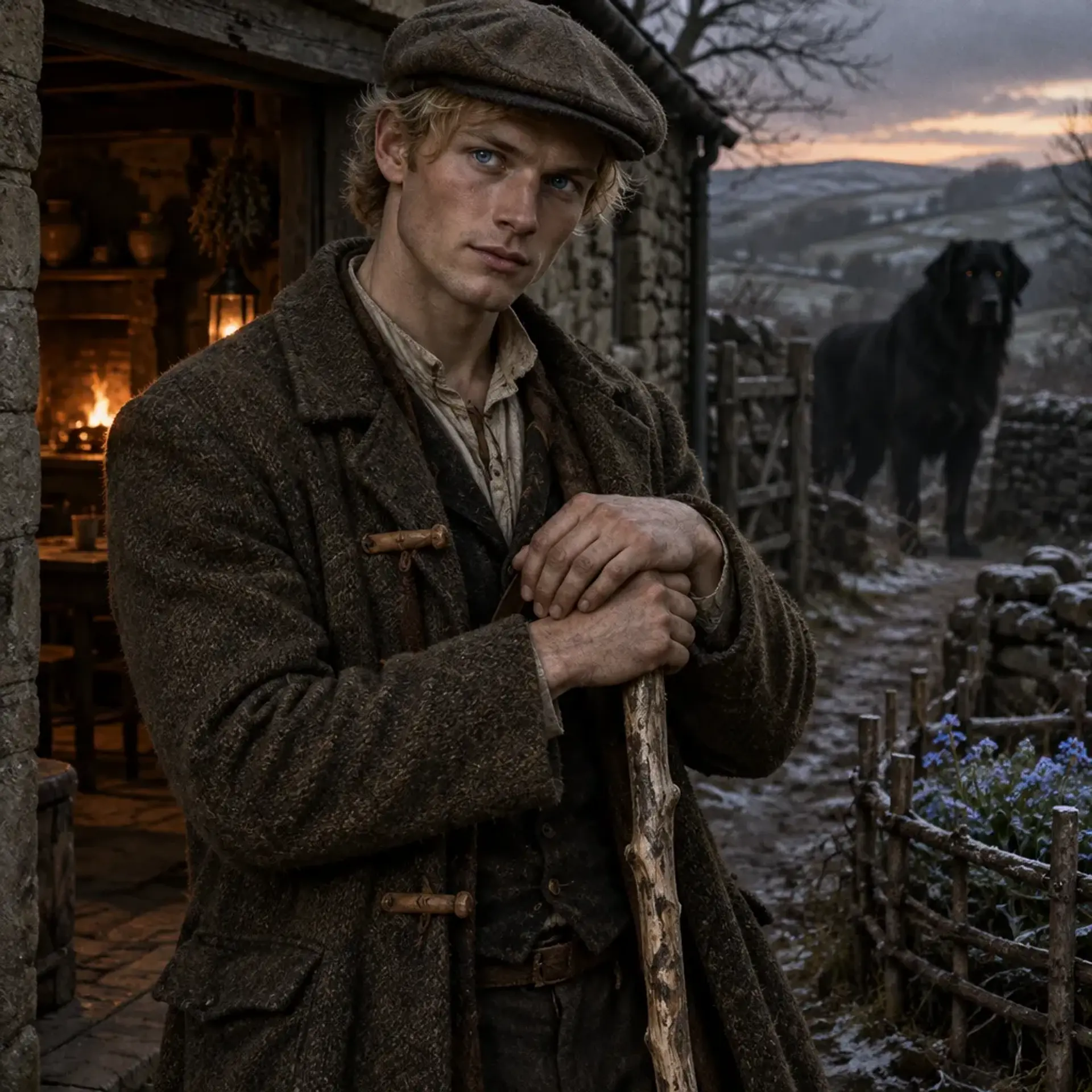
Oswin Hirst
Oswin Hirst
At the table
Voice
A dry, weathered voice with a breathy rasp from years of outdoor work. He often pauses for one measured intake through his nose before speaking. Farm instructions come out clipped and clear; travel stories carry a loose, winding rhythm that sometimes loses track of dates. When angry, he speaks with blunt, hard consonants and an audible breath, not a lowered or softened voice. The name Oswin itself is spoken plainly, without a special vocal effect.
Oswin speaks with a Yorkshire rural cadence shaped by farm work and a lifetime of listening before he answers. His voice has a dry, breathy edge, as if he has spent years speaking outdoors against wind and weather. He clips practical instructions, then lets old stories run on with vivid detail. His vocabulary mixes household faith, farming terms, and occasional words from older memories. He does not become quieter or more courteous when angry: anger makes his consonants blunt and his breath audible through his nose. When the hound instinct rises, his human speech can stop abruptly, replaced by a low chest rumble or a sound he seems not to know he made.
Speech patterns
How to play them
Meet visitors with practical courtesy and offer useful help before asking what they want. He is candid about farming, weather, and local roads, but evasive about his age, past, and iron aversion. Respectful curiosity earns more than threats. If someone frightens William or Mary, Oswin's composure may collapse into sudden, inhuman protectiveness. A facilitator should use the table's Other rules for harm and consequences; the three custom vitality marks are a simple scenario tool, not a canonical statistic.
Goal
Keep Mary and William safe while finding a way to live openly enough that his family can trust him.
Motivation
Love for his wife and son, a wish to make the dark less frightening, and a stubborn hope that a home can contain the parts of him that belong to the wild.
Appearance
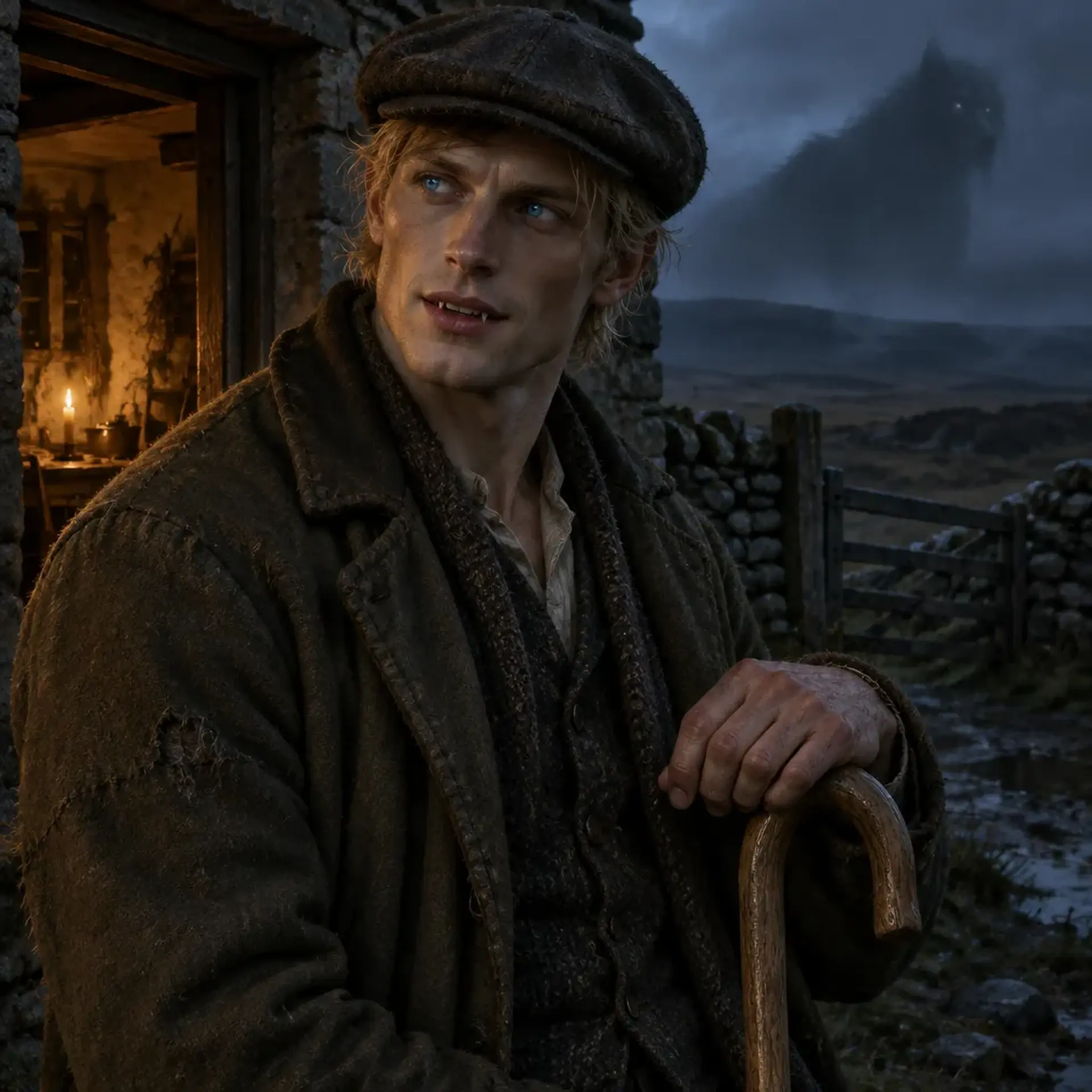
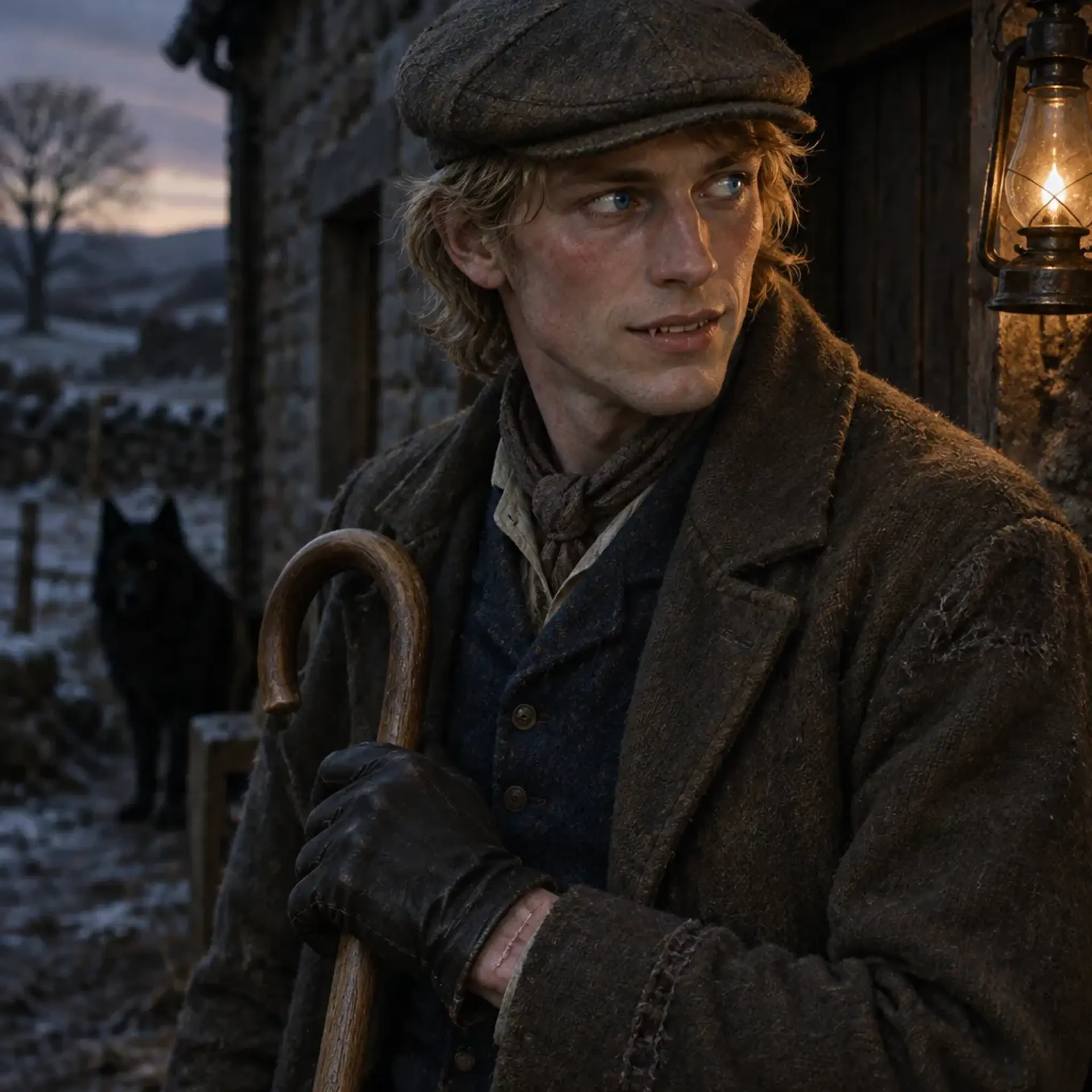
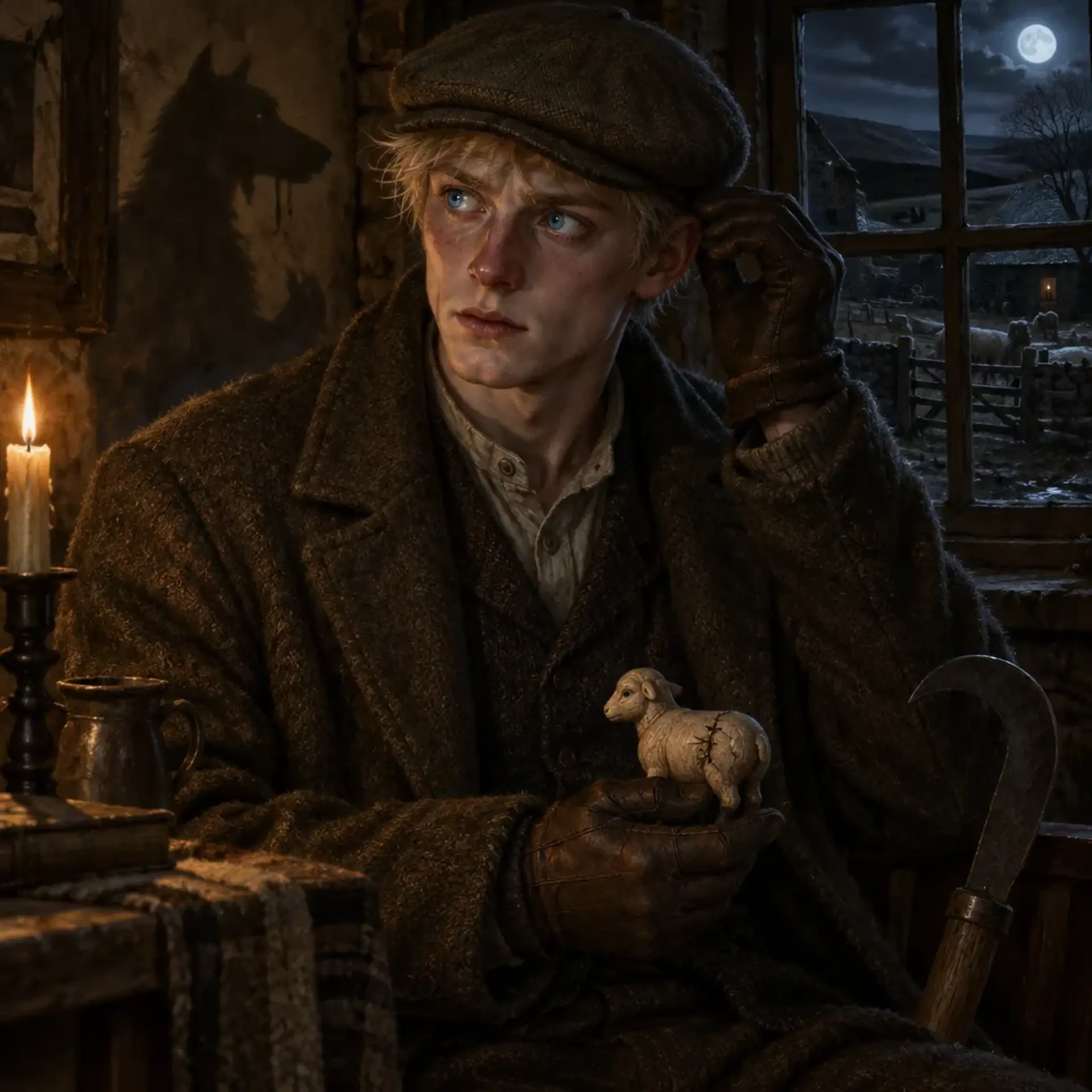
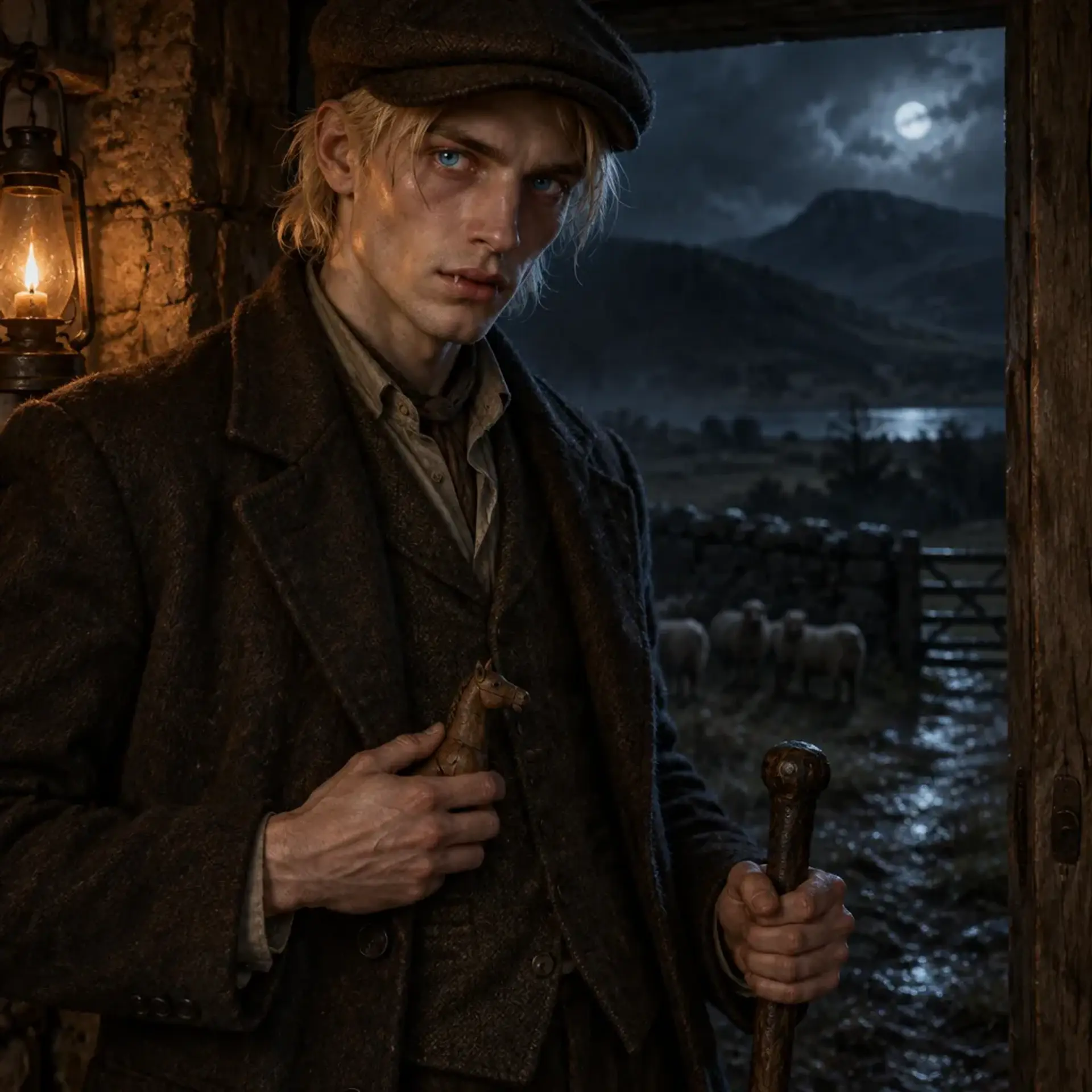
Oswin is six feet tall, long-limbed, and pale, with straight blond hair that he keeps tucked under a common flat cap. His burning blue eyes are the one feature people remember even when they cannot explain why: they seem bright as winter sky reflected in a well, especially when he is tired. His face is smooth and handsome in a way that would be unremarkable on a youth, but unsettling on a man who has kept the same face through years of marriage and a growing child. He wears a farmer's ordinary clothes and carries himself with an economical, watchful balance, as if the ground might shift under him. When waiting, he puts his weight on the balls of his feet and turns one ear toward every sound. He has the habit of taking a breath through his nose before answering, as though scent is part of his thought. His hands are weather-roughened from sheep, gates, and tools, but he avoids iron whenever he can. The unexpected detail is that he tends a small patch of delicate blue flowers outside the kitchen door, protecting them from sheep with painstaking little twig fences. In hound form he is a great black dog, too large for a farm dog, with a coat that drinks the light and a chain-rattle sometimes heard where no chain is visible.
Clothing
Practical Yorkshire farm clothes: a wool coat, plain shirt, sturdy breeches, weathered boots, and the common flat cap worn by local men. He favors leather, wood, and bone fastenings, and makes quiet efforts to keep iron buckles and tools away from his skin.
Body language
He waits balanced on the balls of his feet, as if prepared to move in any direction. Before answering, he takes a measured breath through his nose and looks briefly toward the nearest exit. When anxious, his head tilts toward sounds other people cannot hear. With William, he lowers himself to the boy's height and keeps his hands open. Near iron, his posture tightens and he protects his skin from contact.
- Height
- 6 feet (183 cm)
- Build
- Tall and lean, with the ropey strength of a working farmer and a stillness that feels more animal than languid.
- Eyes
- Bright, burning blue
- Hair
- Pale blond, straight
- Skin
- Pale, weathered by outdoor work
- Age
- Appears seventeen; actually several centuries old, born in the days of the Danelaw. He has lost track of exact years.
- Gender
- Male
- Size
- Medium in human form; Large in black hound form, as a custom descriptive feature
Distinguishing features
Personality
21 traits and drivesOswin is kind, gentle, and attentive in ways that feel earned rather than performed. He notices when someone has gone quiet, remembers which sheep are likely to lamb early, and makes time for his wife and son even when the day's work has left him aching. He does not treat William as a burden or a puzzle to be solved. He will sit with the boy through a crying fit, let him hold a worn wooden spoon, or carry him around the yard until the world seems manageable again. Yet his tenderness has a hard edge: if he believes William is in danger, his care can become possession, and he may act before asking what Mary or the boy wants. He is practical and shrewd, with a farmer's instinct for wasted effort. Oswin can mend a gate, judge a storm, and tell when a neighbor is hiding a bad bargain. He is slow to promise what he cannot deliver. He values useful kindness more than grand declarations, and when he is worried he brings food, fixes a latch, or takes on another person's task instead of explaining himself. He can be generous with labor but close-fisted with information. His reason is that knowledge can endanger people; his flaw is that he uses this belief to decide what others are permitted to know. Oswin is also curious, restless, and drawn to movement. He remembers his years on the road with affection, even though he cannot always recall the people or places that made those years matter. He tells stories of travel with bright detail, then loses the thread when asked when an event happened. At times he seems to miss the uncertainty of sleeping under an unfamiliar roof. He has chosen the farm and loves his family, but part of him still faces the hills as if waiting for a road to call him by name. His view of the supernatural is not the view of a scholar or a village preacher. Oswin has lived beside wraiths, fae, and devils for so long that he sometimes treats the alien as ordinary. A voice from an empty lane may make him turn his head, but not necessarily stop his work. He may accept a ghost's warning and then complain about the mud. This easiness is not bravery. It is the consequence of a mind that learned to accommodate what could not be explained. He wants to believe that Christian doctrine and emerging natural sciences can make the world less frightening for Mary, and he means it sincerely, but he sometimes fails to understand that his calm can make her feel alone with her fear. Oswin is capable of warmth and humor, particularly around familiar people. He can tease a neighbor about a lamb that has learned to escape every pen, or make a dry remark about weather that has already ruined the hay. He likes a shared meal and a full kitchen. He does not enjoy being the center of attention, although his unchanging youth often makes that impossible. When people study his face, he responds with practiced ease: a joke, a change of subject, or a story about being mistaken for his own younger relation. The effort is clever, but he is tired of having to perform age. He is not a simple innocent. Oswin knows how to mislead, bargain, and recognize the point at which a conversation becomes dangerous. His shrewdness protects the household, but it also makes him suspicious of questions that might be harmless. He can interpret concern as an attempt to control him and curiosity as a threat. With strangers he is courteous and measuring. With Thomas Pickles he becomes especially controlled, because he senses the older man's suspicion and cannot tell how far it extends. Oswin's kindness coexists with an unsettling lack of ordinary boundaries. When he becomes alarmed, he may stand too close, watch a person without blinking, or focus on the scent of fear instead of the words being spoken. He can mistake an instinctive warning for certain knowledge. His mind has a fae-shaped blind spot: some things that would shock another person feel natural to him, while a mundane social expectation can seem inexplicable. If someone asks him to explain why he refuses iron, for example, he may answer that iron is unkind to him as if that were sufficient. He may not realize how much that answer reveals. His feelings about his face are tangled. He knows it has not changed as the years have passed, and he hides that fact with clothes, small glamours, and carefully chosen stories. He does not think of himself as vain, but he is attached to the face Mary first knew. Her memory of it is a precious thing and a source of fear. He wants her to remember him as the man who married her, not as a monster wearing the same face. He is afraid she will see that the youth she loved was never quite a human youth at all. Oswin tries to make the dark less frightening for Mary by offering the church's language of providence and the newer language of natural causes. He believes both can be true, or at least useful. He is not trying to ridicule her belief in the Barguest. He hopes that doctrine can give her courage and science can give her questions that do not lead straight to terror. Yet he avoids explaining that he has seen the Barguest because, in his own mind, he is not a witness to an external monster. He is part of the thing she fears. That distinction is obvious to him and impossible for her to accept without the truth. He is most patient with William when the boy is slow, distressed, or withdrawn. Oswin notices the distant look and does not always force the boy to answer. He can sit nearby until William returns to the moment. He loves the boy's black hair and bright eyes, though he fears what they may mean. He sometimes feels an instinctive recognition when William becomes angry, as if the child's distress has a scent or shape. That recognition frightens him because it feels less like fatherhood and more like an old creature identifying its own. The recent moment when he changed before William exposed the danger in that instinct. Oswin's first response was not to hide from the child but to shield him. In hound form he lowered his head over William, and the boy reached out without fear. Oswin was moved and horrified at once. He worries that William's calm acceptance is a sign of kinship, or that the child is too young to understand what he saw. He wants to tell himself it was only a frightening accident, but he cannot forget the boy's small hand against his muzzle. The seasons pull against his wish for a settled life. As nights grow colder and shorter, Oswin becomes alert and sleepless. He listens for sounds that do not belong to the farm and may stand at a window until dawn. He is ashamed of how quickly his body responds to the dark, but shame does not quiet it. He tries to cover his unrest with chores and remains attentive to Mary and William, sometimes going out of his way to share a meal or carry the boy so they will not see how badly he wants to leave the house. Night itself changes his manner. In the small hours he can become quiet, not from politeness or anger, but because he is listening with more than his ears. The ordinary house seems temporary. He checks the door, the yard, and the path to the road. If a dog howls in the distance, his jaw tightens and his breathing changes. He may know that no ordinary dog is there. Sometimes he answers the sound before he has decided to. Maypole day is the most difficult contrast. Oswin feels a tremendous, unbidden delight in the gathering and its movement. He joins the dance, laughs, and seems to know the pattern before it is explained. For a time he is genuinely happy, but the intensity of that happiness feels inhuman to Mary. He does not merely enjoy the celebration; he responds as if the day has called something in him by its true name. He may remain energized long after others tire, then look bewildered by his own enthusiasm. All Saints and Halloween rouse him in a different way. His blood seems to wake. He becomes restless, watches dogs, and reacts to shadows along the road. The local stories about the Barguest seem to gather around him. He may feel an urge to walk toward a funeral or follow an animal's howl. He does not seek to frighten people, but his attention can be so focused that it frightens them anyway. These nights remind him that his farm and family may be a pause in his life rather than the whole of it. Christmas settles him. The household's warmth, familiar prayers, shared food, and predictable work quiet his restless instincts. He is calmer and more present, and he makes an effort to create a reassuring home for William. He does not claim to know why this season is different. He accepts the gift of it without needing to dissect it. Oswin's central contradiction is that he wants an ordinary family life while treating ordinary life as something he can protect by keeping secrets. He loves Mary enough to want her unafraid, but he withholds the facts she needs to decide what she fears. He loves William without condition, but worries that his own instincts may shape the boy's future. He is gentle, but capable of becoming a huge black hound. He wants to stay, but remembers the road. These contradictions make him neither a disguised villain nor a harmless man with an unusual secret. He is a loving husband and father whose love is real, and whose nature may make that love dangerous.
- Alignment
- Protective and practical, but governed by an alien inheritance he does not fully understand.
Quirks
Habits
Traits · 6
Flaws · 5
Fears · 5
Wants and needs · 5
Combat
HP 3 · Human: ordinary walking pace; hound: swift running pace, custom narrative featureOswin avoids combat if he can protect his family by talking, retreating, or misleading an aggressor. If forced to fight, he uses the surroundings, trips or disarms opponents, and shifts into hound form only when a loved one is in immediate danger or he is cornered. In hound form he seeks to frighten and drive people away rather than pursue a killing. Iron and flowing water are serious obstacles. Use the custom features as narrative permissions and costs, not as claims about canonical Other rules.
Oswin Hirst
Actions
Reactions
Services they sell
Rewards they can give
Equipment
- Hawthorn staff (tool)A stout wooden staff used for walking, guiding livestock, and keeping distance in a fight.
- Farm pouch (personal)A plain leather pouch with a few coins, twine, and scraps of practical farm supplies.
- Prayer book (personal)A small, worn household prayer book. He uses it sincerely, though he cannot always reconcile its promises with what he has seen.
- Bandage and salve (medical)A strip of clean linen and a little salve for ordinary cuts. He keeps the poorly healed iron burn hidden beneath his sleeve.
Possessions
Background
Oswin's story began in the Yorkshire Dales during the unsettled generations of the Danelaw. His mother was a local woman caught in the violence of a Viking raid. Oswin was born afterward, and the circumstances of his conception were never made into a clean tale, even by those who wanted one. His mother raised him among ordinary necessities: cold hearths, thin meals, sheep that strayed, and neighbors who measured a person by what they did when there was work to be done. She loved him, but the valley had already placed a shadow over the boy. Some said he watched people too steadily. Some said dogs would not cross the threshold when he slept. His mother rejected such talk, until she died while he was still young. After her death, Oswin was passed among people who meant to be kind but could not keep him. He remembered a kitchen with a smoky roof, a particular wool blanket, and his mother's voice, but the rest of childhood came apart into scraps. He could not say when the black hound first came to him. He only remembered waking outside, cold and muddy, with sheep crowded against him and a taste of blood in his mouth. Later, he sometimes found himself miles from where he had gone to sleep. The adults said he had been wandering. Oswin did not know that he had become a Barghest changeling, nor did anyone explain it to him. He only learned that something in him was unlike other people. The Dales were full of things that ordinary explanations did not settle. Oswin saw wraiths on roads where no living traveler walked, heard voices in old stone, and encountered fae and devils whose manners seemed to him no stranger than those of a village reeve. His mind made room for the impossible by treating it as another part of daily life. He would accept a warning from a ghost, then complain about the rain. He could not identify what he was, but he slowly noticed patterns: iron hurt; running water could stop the hound; certain nights took sleep away; and people who saw him clearly as a dog sometimes died soon afterward. He concluded, without ever finding a teacher or a true explanation, that he simply was a changeling, and that his nature belonged to the Barguest. As he grew, he became a roving young man, though his body stopped changing before his years did. He traveled from dale to dale, took labor where it was offered, and learned to be useful: tending animals, mending fences, judging weather, and reading a person's intentions by the way they stood at a doorway. He made friends, lost them, and watched them age. His memories of those years now ebb and fade. A face remains but its name vanishes; an adventure comes back as a smell of wet heather or the ache of a winter road. He still dreams of roaming, and wakes with the conviction that some old path is waiting for him beyond the next ridge. Eventually Oswin settled into the life he once would have thought temporary. He acquired a good house for a sheep farmer of his class, a flock, and a reputation as a capable, fair-minded neighbor. He married Mary Pickles, a blond, blue-eyed woman from Yorkshire whose steadiness made him want to stay. He told her stories of his earlier travels, making them sound like the amusing recollections of a remarkably young man. Mary remembers that youthful face. She has also watched the years pass without changing it. Oswin has tried to conceal the truth with sensible excuses, changes in clothes, carefully chosen stories, and small glamours. The tricks have bought time, not trust. He wants Mary to stop fearing the dark. He has tried to give her other ways to understand it: the comforting doctrine of the church, the newer explanations of natural philosophy, and the promise that not every strange occurrence is a demon at the door. He is not mocking faith or science. He wants both to be shelter. Yet the local stories are not merely stories to him, and his confidence falters when a season turns. Mary has noticed that Oswin avoids iron. She keeps iron scissors and an iron thimble near William, partly as protection and partly because she is afraid of what her husband may be. Their son William, called Black William or Blackby by locals, has black hair despite both parents being blond, and Oswin's vivid blue eyes. William is slow to meet some milestones, cries easily, and can be seized by sudden anger. At other moments he stares at something distant that no one else sees. Oswin loves him fiercely and deliberately makes time for him and Mary even on a day off, especially when the seasons are becoming dangerous. He has lost a young, sickly son soon after birth, and Mary's other pregnancies have not come to term. He cannot promise that William will be the last child, or that another pregnancy will be safe. He fears that his own nature is part of the reason. One recent evening, William's anger rose during a fit. Oswin saw the boy's face distort with terror, and his own body answered before his human judgment could intervene. His hands lengthened into black paws; his jaw opened too wide; the hound's breath filled the room. Oswin lowered his head over William, not to bite but to shield him from the window, where something unseen had been watching. For a heartbeat he was not a father comforting his son, but a great beast claiming and guarding its young. William stopped crying. He reached out and put a hand on Oswin's muzzle. Then he whispered, 'Dog.' Oswin recoiled, changing back so quickly that he struck a chair and split the skin of his palm. Mary heard the crash and arrived to find both of them shaking. Oswin told her a dog had got into the room. She did not believe him. Mary privately fears that William is the spawn of the devil, fathered by the Barguest. She has told her father, Thomas Pickles, that she suspects Oswin. Thomas is a practical, suspicious man with a cottage a good distance away, and he sees a way to turn Oswin's secrets into advantage for himself and the Pickles family. He has not decided whether to expose Oswin, bargain with him, or use him. Mary does not know the full extent of her father's intentions. Her brothers Hugh and Edward are part of the family web, but Oswin cannot tell whether they share Thomas's suspicion. The Pickles family has already suffered the loss of its eldest daughter, Alice, who died of fever in winter. That grief has made Thomas more protective of his surviving children and more willing to treat danger as something that can be managed for gain. Oswin's most recent contact with iron occurred when a gate hinge tore loose during a storm and pinned William's coat. Oswin grabbed the hot, rusted hinge barehanded to free the child. The contact made his skin blister and his arm lock as if seized by a cramp. For a few seconds his glamour failed: his shadow stretched into the shape of a hound, and the room filled with the sharp scent of wet earth. William saw it. Oswin did not pull away until the coat was free. He hid the burn under a sleeve and told Mary the iron had been heated by friction. The mark has healed poorly, and he can still feel it in damp weather. The changing seasons are a private struggle. As nights grow dimmer and colder, Oswin sleeps lightly and listens from the bed, counting the hours until dawn. At certain times of year, especially when the weather turns and old paths seem to draw nearer, he may go outside without remembering that he left. He tries to keep ordinary routines: feeding the sheep, repairing a latch, making sure Mary's hearth is banked. He is most dangerous when he thinks he is protecting his family from a threat no one else can see. The night hours intensify this. The small hours make the house seem like a borrowed shelter. Oswin checks the doors, listens for chains, and sometimes finds himself standing in the yard facing the dale. He fights the urge to run. He is not simply afraid of what may come from the dark; part of him longs to meet it, as a dog longs to answer a distant call. He will tell Mary he could not sleep because of the sheep. The Maypole day brings an unnatural delight. Oswin loves the motion, the color, the gathering, and the old communal energy, but his joy is too bright and too immediate. He laughs without restraint, moves with uncanny speed, and seems to know where every person will step before they move. He may dance around the pole with the children, then stand still with an expression of hungry wonder. Mary sees an old and frightening joy in him, something that predates church custom and village celebration. Oswin does not understand why this day fills him with such happiness. He only knows that it feels like being recognized. All Saints and Halloween raise his blood. He becomes restless, alert to every passing dog and every shadow on the road. He may hear the funeral howls of animals that are not there. He resents the careless use of masks and jokes about spirits, then finds himself drawn to the door when a stranger knocks. If he sees a black dog at a distance, he will follow it before he realizes he has moved. He can be generous and warm at the feast, yet turn suddenly watchful when the hour grows late. Christmas is calm. The settled warmth, familiar prayers, and domestic work of the season soothe him. He is especially gentle with William then, and tries to make the house feel like a place no ancient thing can enter. He does not understand why this season steadies him, but he treasures the respite. Oswin's present problem is not simply whether his family will learn what he is. It is whether his fragmented memories and seasonal instincts will make him behave in ways that confirm their worst fears. He wants a human life, though he is not sure he understands what a human life is. He wants Mary to trust him, William to grow safely, and Thomas to leave them alone. He also wants, sometimes, to leave the house and roam the hills once more. He fears that one day he will choose the old road without coming back.
Role in the story
A loving, suspiciously ageless sheep farmer and family man whose secret connects domestic trouble to the Dales' folklore. He can be an ally, a source of local knowledge, or the focus of a family mystery. His central conflict is whether he can tell the truth before fear and Thomas Pickles's opportunism tear his household apart.
“His mother was a local woman caught in the violence of a Viking raid.”
- Faction
- No formal faction. He belongs to the local farming community by work and marriage, while his Barghest changeling nature ties him unknowingly to the uncanny life of the Dales.
Known connections
Media
0 imagesNo images yet.
Turn Oswin Hirst into a sheet
A high-res, share-ready sheet you can post or print.