Oswin Hirst
Oswin Hirst
At the table
Voice
A weathered, breath-forward voice shaped by open fields and cold nights, with a rough edge that catches on certain consonants. He can call sheep across a hillside without shouting himself hoarse. When unsettled, he speaks more quickly and clips the ends of sentences; when comforting William, he slows down and leaves generous pauses.
His speech carries the plain, work-shaped rhythm of a Yorkshire farmer: short clauses, concrete comparisons, and few decorative words. Centuries of travel sometimes surface as an archaic turn of phrase or an oddly exact name for a place. His voice comes from a body accustomed to cold air, long walks, and calling across fields; it has a dry rasp at the edges, as if weather has rubbed it smooth. He does not sing his sentences. When disturbed, his words become blunt and the jaw beneath them tightens.
Speech patterns
How to play them
Treat Oswin as a practical, courteous farmer first. He responds to patience, useful help, and concern for his family. Do not begin by threatening Mary or William: he will become frighteningly direct. He may admit to old travels or unusual beliefs before admitting he is a Barghest changeling. If confronted with evidence, his first impulse is to protect his household, not to attack the questioner.
Goal
Keep Mary and William safe while finding a way to tell the truth without letting fear, Thomas's ambition, or the seasonal powers define his family.
Motivation
Love of his household contends with an ancient pull toward the dales and the uncanny life he once roamed. He wants to turn fear into understanding, but does not fully know whether his own ideas of safety are human ones.
Appearance
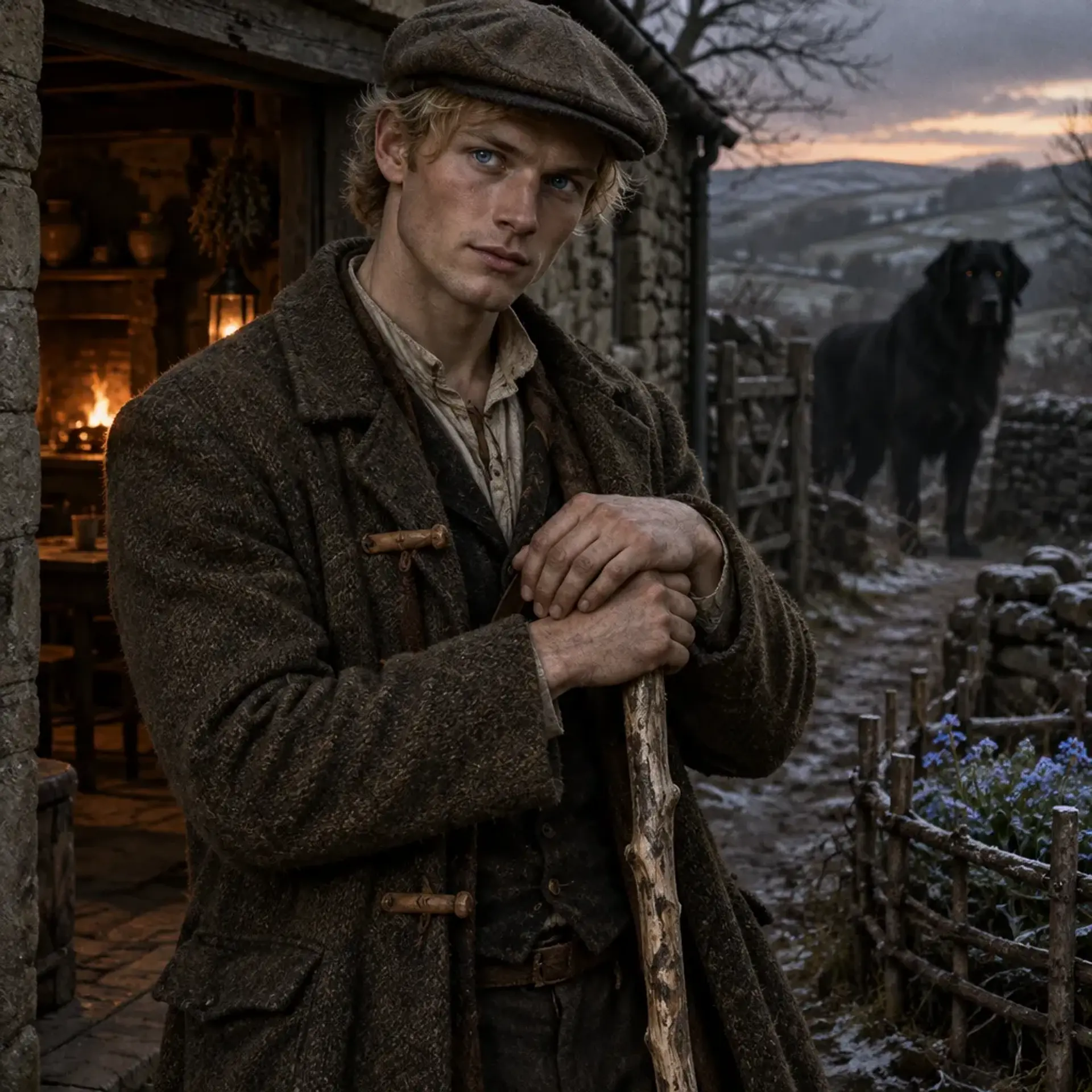
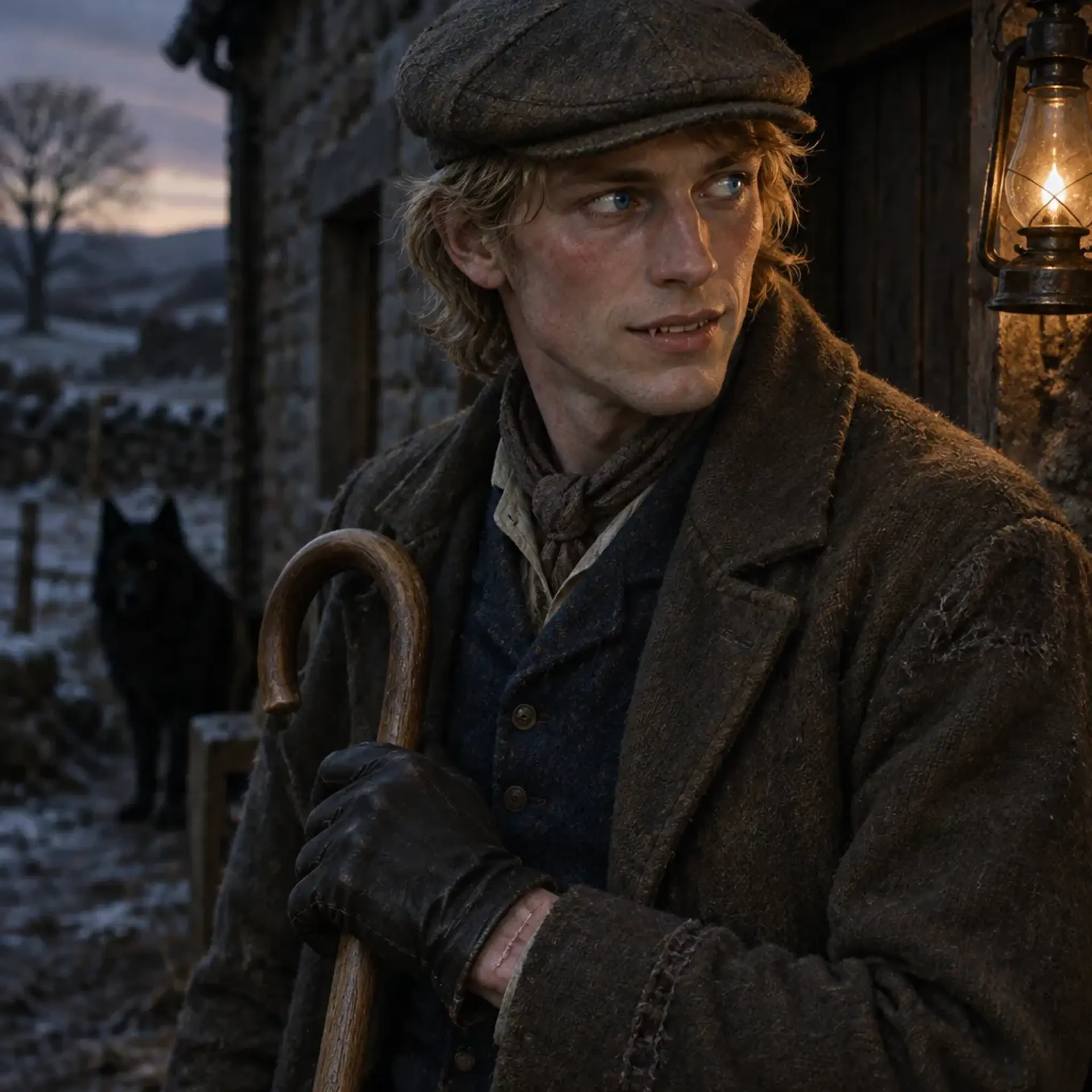
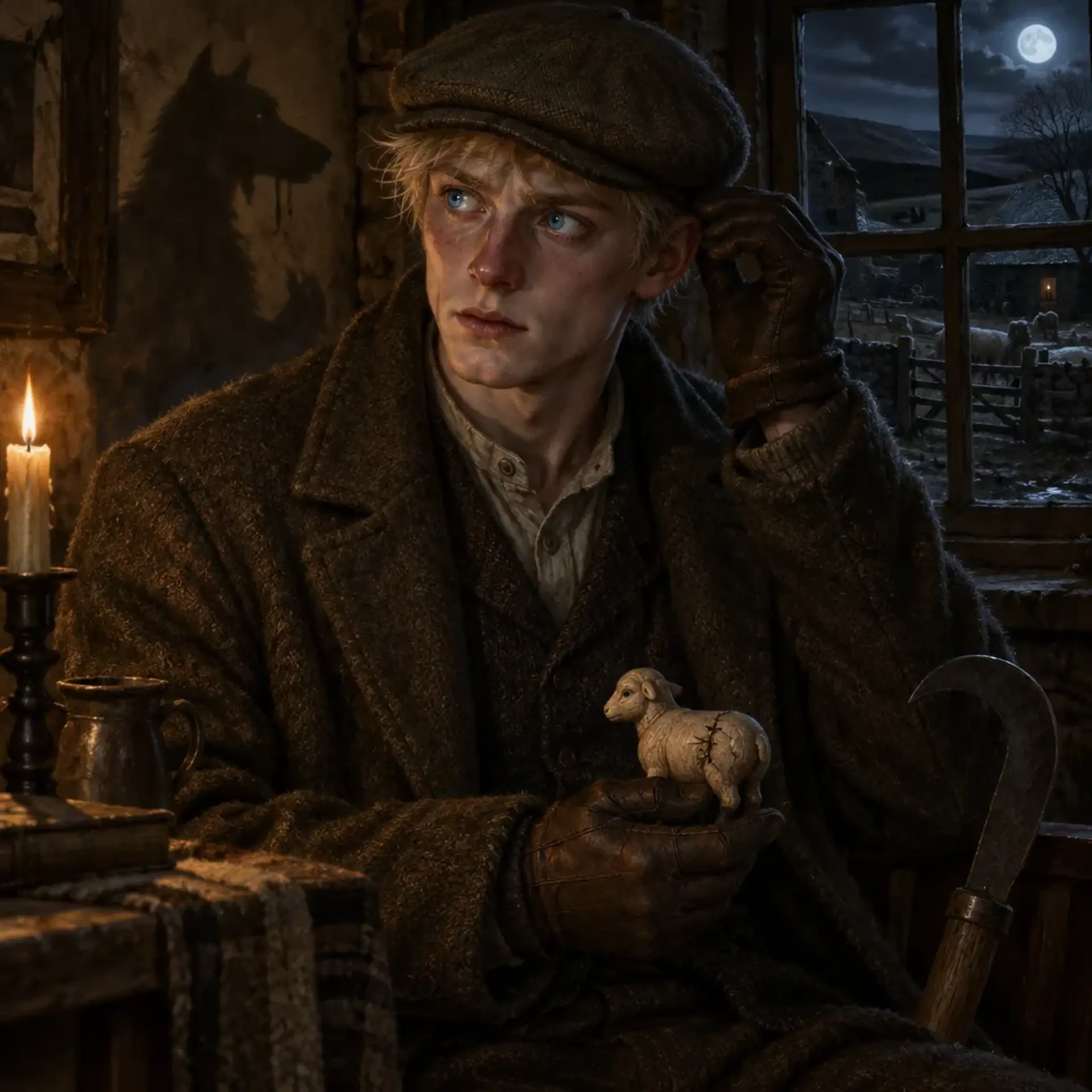
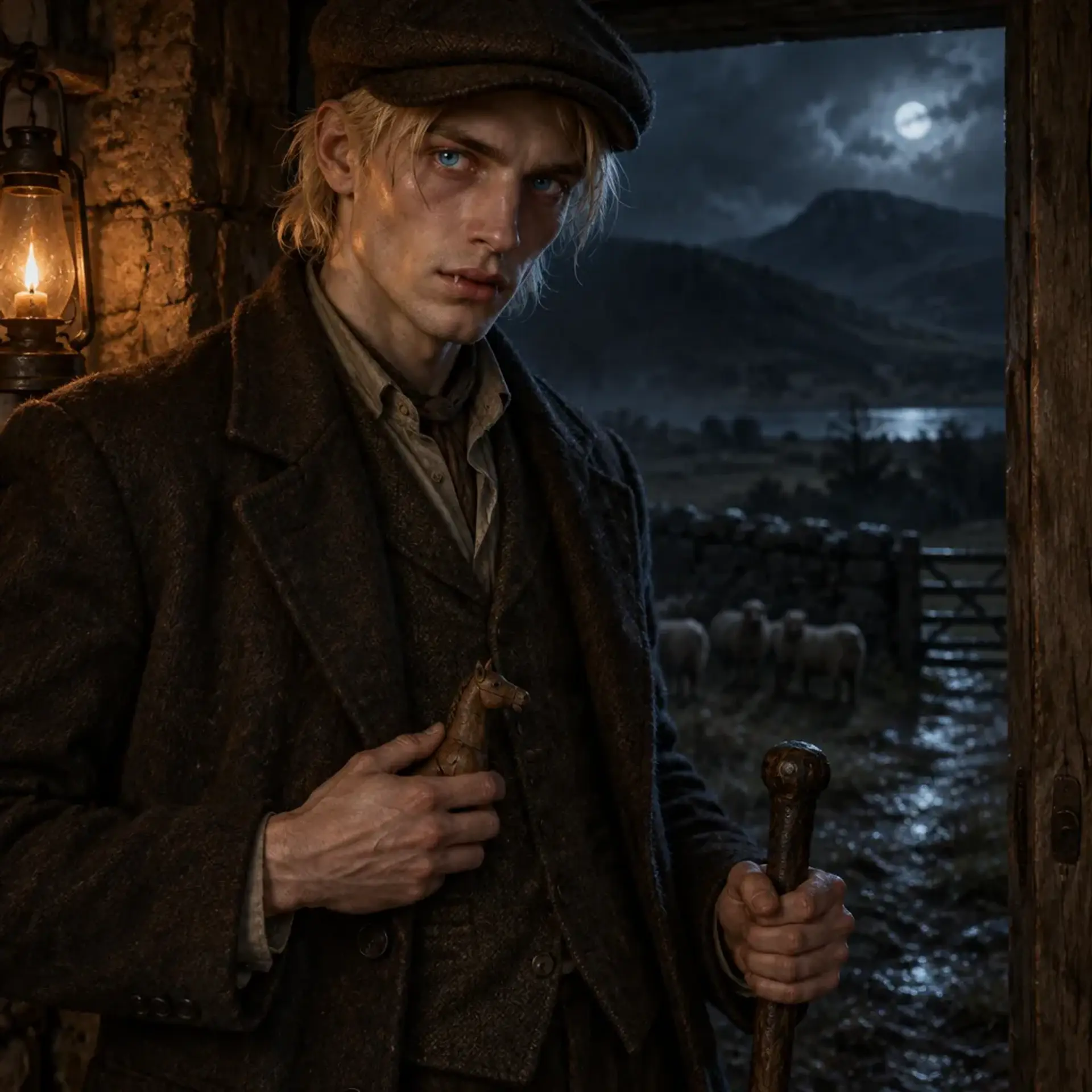
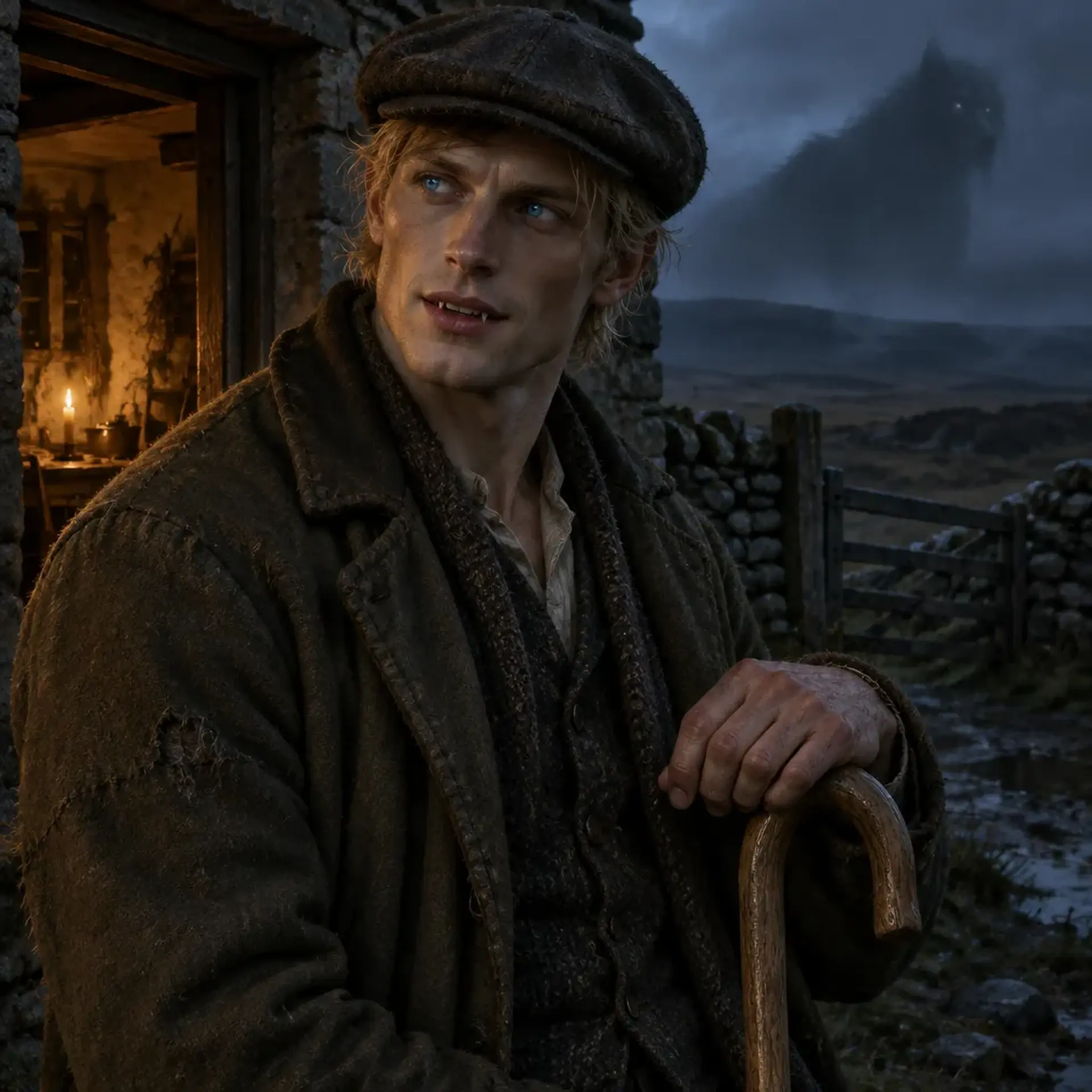
Oswin stands six feet tall, long-limbed and narrowly built, with pale skin that takes on a bluish cast in winter light. His straight blond hair lies flat beneath a common Yorkshire flat cap, though strands escape at his temples. His eyes are a startling, near-burning blue, fixed and reflective in darkness. His young, handsome face has scarcely changed since Mary first knew him; the smoothness looks less like good health than a portrait that has refused to age. His jaw is a little too broad at the hinge, and when he laughs his upper canines show long enough to make the expression seem briefly canine. He walks with a measured farmhand's stride, but turns without moving his shoulders first, as if his head has heard something his body has not. He is careful with tools and gentle with sheep, yet stands unnaturally still when listening to night sounds. Unexpectedly for a wary, half-legendary wanderer, he keeps a tiny, painstakingly tended kitchen garden of herbs and sweet peas, and knows how to coax a reluctant seedling into life.
Clothing
A well-kept, practical farmer's coat, wool waistcoat, sturdy boots, and a common flat cap. His clothes suit his station and are mended rather than showy. He favors leather, wood, horn, and wool over metal fittings, and carries iron tools only when necessity leaves no alternative.
Body language
He inclines his head before answering, as if hearing the question twice. His hands are competent and quick, but he keeps them away from iron. When tense, his jaw works and his upper teeth show. He turns his whole body toward unfamiliar sounds only after his eyes have already fixed on them. With William, he lowers himself to the child's height and leaves space for the boy to approach.
- Height
- 6 feet
- Build
- Tall and lean, with the wiry strength of a man accustomed to walking hills and handling sheep.
- Eyes
- Burning blue
- Hair
- Pale blond, straight
- Skin
- Pale, with a bluish cast in cold light
- Age
- Appears about seventeen; has lived for centuries, though his memories of the earliest years are incomplete.
- Gender
- Male
- Size
- Medium in human form; large hound in Barghest form, custom description
Distinguishing features
Personality
20 traits and drivesOswin is kind in ways that are practical rather than grand. He mends what is broken, brings food without being asked, and remembers which sheep startle at thunder. He likes people, but does not always understand what they need from one another. He may offer a sound solution to a grief that needs company, then sit in silence once he realizes advice has failed. His tenderness is real; so is the strangeness beneath it. He is shrewd about land, weather, animals, and the motives of people who bargain. He notices a bad fence, a concealed limp, or a lie told to avoid paying a fair price. Yet he can fail to recognize that a custom he considers harmless is frightening to someone else. His mind treats much of the uncanny as ordinary. A wraith at a ford may seem to him no more remarkable than a neighbor's dog, while Mary's fear of it appears, at first, to be the unusual reaction. He is both settled and restless. He takes pride in his house, flock, and family, and he is careful not to neglect them. He also dreams of the dales as they were during his wandering years: roads without fences, lonely heights, and nights when he had no need to explain himself. He does not want to return to that life in full, but resents that loving people means choosing a place and remaining there. When the longing grows strong, he goes out to check the flock or walks the boundary, telling himself that work is the reason. With strangers, Oswin is courteous, plain-spoken, and watchful. He answers questions in a way that is useful but rarely complete. He is not a natural liar; instead, he selects a true detail and allows it to stand in for the whole truth. If pressed, he may become stubborn rather than clever. He dislikes being treated as a child, particularly when his unaged face leads people to dismiss his judgment. His irritation shows in his jaw and teeth, not in a raised voice or formal insult. At home, he is more openly affectionate. He does small things for Mary: carries water, checks the roof, sets aside the best portion of food. He tries to reassure her through Christian doctrine and the new sciences as they evolve, not because he has become a confident theologian or scholar, but because he wants her to believe the world can be studied rather than feared. He knows that some things are real. He also knows that Mary has seen enough to be frightened. His kindness becomes controlling when he withholds information to manage her feelings. He thinks he is sparing her; in truth, he is taking away her chance to choose. Oswin's love for William is patient and attentive. He makes time for the boy even when tired or when a season has made the house feel unsafe. He does not demand that William speak quickly or behave as other children do. When William cries, Oswin tries to stay present rather than correct him. When anger comes, Oswin gives him room but does not abandon him. The boy's black hair and blue eyes unsettle Oswin because they look like evidence of a connection he cannot explain. He fears the inheritance, but he also fears that treating William as a portent will make him feel monstrous before he can understand himself. The recent iron accident exposed a contradiction in Oswin. He endured pain to save William, but his reaction was so inhuman that it frightened the child. Once William recoiled and struck at him, Oswin did not punish him. He backed away, held his hands where the boy could see them, and tried to become familiar again. The incident left him ashamed, and he now watches his own expressions around William as carefully as he watches the boy's moods. The changing year brings out parts of Oswin that ordinary farm life keeps folded away. When nights grow dimmer and colder, he sleeps poorly. He makes repeated checks of doors and livestock, walks the edge of the property, and listens with his head tilted toward the moor. He can spend the final hours before dawn standing still in a yard, alert to a sound that no human ear seems to catch. He tells Mary this is practical care. Sometimes it is. Sometimes he is answering a summons he cannot name. Mayday is the exception to his usual restraint. The maypole gives him an unnatural delight, a brightness that is not quite joy as people understand it. He may clap, circle, and laugh with too much energy, as he did while Hugh was with him. The celebration seems to reach back into his oldest nature. He does not experience it as danger in the moment; he experiences it as recognition. Later he is embarrassed by what Hugh saw and cannot explain why the pole seemed to call to him. All Saints and Halloween raise his blood in a different way. He becomes restless, alert to scents and movement, and more aware of the boundary between the living and the dead. He does not necessarily become cruel, but his impulse to pursue or answer a sound grows harder to restrain. The night he stayed with Edmund to mourn Alice was difficult precisely because he chose to remain with grief instead of following the call outside. He sat by the fire, kept watch, and gave Edmund company, though he could not offer easy words. That effort reveals his moral center: not that he lacks the wild pull, but that he will sometimes refuse it for another person. Christmas calms him. Familiar prayers, food, chores, and the shared warmth of his house make the world feel bounded in a way he can trust. He can sit with Mary and William without scanning every shadow. He participates without needing the celebration to become a ritual of the wild. At Christmas he seems most like the husband and father he wants to be, which makes the peace precious rather than ordinary. Oswin has a dry, slightly bewildered humor. He can make a blunt observation that sounds like a joke only after a moment. He is not easily shocked by strange appearances, but he can be deeply moved by human kindness. A person who sits beside him without demanding an explanation earns more trust than someone who boasts of courage. He respects competence and dislikes grand claims, including claims about his own nature. His greatest conflict is not whether he is good or evil. He is capable of tenderness and capable of terrifying behavior, and he does not know where the boundary lies until he reaches it. He wants Mary to be unafraid, yet he hides the evidence that might let her make an informed choice. He wants William to grow safely, yet fears the boy's nature before the boy can understand it. He wants to remember his past, yet some part of him finds the fading easier than facing what he may have done. Oswin is trying to make a home in a life that was never built for staying, and he is not certain whether the house is shelter, promise, or trap.
- Alignment
- Protective and compassionate in daily life, but governed by an alien, seasonal sense of obligation that can override human judgment.
Quirks
Habits
Traits · 5
Flaws · 5
Fears · 5
Wants and needs · 5
Combat
HP 12 · Custom: ordinary walking pace in human form; swift pursuit in hound form, with exact movement determined by the table's Other-system procedures.Oswin avoids a fight if he can end it with a warning, a shove, or a frightening glimpse of the hound. If his family is threatened, he uses speed and misdirection, striking to disable and retreating toward open ground. He will not cross flowing water in hound form. He is especially vulnerable to iron and knows it.
Oswin Hirst
Actions
Reactions
Services they sell
Rewards they can give
Equipment
- Shepherd's crook (tool)A plain wooden crook used for sheep and, if forced, to keep an attacker at a distance.
- Flat cap (clothing)A common flat cap that helps him look like an ordinary local and conceals how little his face has changed.
- Herb wrap (supplies)A small bundle of herbs and household remedies, more useful for ordinary farm and family troubles than supernatural ones.
Possessions
Background
Oswin's own account of his childhood is a ragged thing, assembled from a few memories, old village stories, and feelings that arrive without explanation. He was born in the Yorkshire dales during the age of the Danelaw, after his mother was assaulted by Viking raiders. He remembers her hands more clearly than her face: roughened by work, smelling of smoke and crushed herbs. She died while he was still a child. Afterward he was passed between people who fed him when they could, then left to fend for himself among ruined folds, sheep tracks, and abandoned places where the living did not linger after dark. He did not know he was a changeling. No fae court stole him from a cradle in a scene he can recall, and no elder explained his nature. He simply noticed, years later, that his responses were wrong in ways he could not mend. He did not tire when a human boy should. He heard dogs howling from valleys where there were no dogs. Iron made him flinch before he knew what it was. In the dark, his body sometimes seemed to remember another shape. He could not decide whether these facts meant he was cursed, blessed, or merely made badly. He learned to call himself a Barghest changeling only after long, troubled reflection and after hearing the name attached to the black hound feared in the dales. The moors and valleys raised him as much as people did. He spent years in the company of wraiths, fae, and devils, though the words he uses for them are not always the words a churchman would choose. He took their bargains as ordinary exchanges and their impossible appetites as simple manners. He remembers roaming from settlement to settlement, taking whatever work a young-looking stranger could get: herding, carrying, guiding, repairing fences, and sometimes helping people avoid a presence they had mistaken for a beast. He remembers less of the order of those years every decade. Some memories return as weather, a smell, or the shape of a road, not as a story with a beginning and end. He has been mistaken for a youth for so long that he made an art of explaining it. He claims a family resemblance, a fortunate constitution, or that he is younger than he looks only to people who do not know him. He changes his clothes, uses a little harmless magic to alter the impression of his face, and tells stories that suggest a different past. These tricks are clever enough for strangers and useless against anyone who has watched him across years. Oswin settled into a sheep farmer's life with a fine house for his station, a good flock, and a routine he both treasures and resents. He married Mary Pickles, a fair-haired, blue-eyed woman from Yorkshire. He gives her affection without making a performance of it, and works hard to be the husband she believes she married. He is present when he can be: tending the fire, mending a gate, or sitting with their son even when the season has made him sleepless. He longs for the dales of his wandering years, but the longing does not mean he wants to abandon his family. He wants both the open road and the warm room, and knows the two desires cannot always be reconciled. Their son William, whom neighbors call Black William or Blackby, has black hair despite both parents being blond and Oswin's same burning blue eyes. He is slow to learn some things, cries easily, and has anger that can flare with little warning. At other times he looks far away, as if listening to a place no one else can hear. Oswin recognizes something in the boy but cannot tell whether it is his own nature, a separate inheritance, or simply a child in need of patience. He spends time with William deliberately, even on days when the seasonal pull makes the household feel like a room with a door standing open to the night. Mary fears the boy may be the spawn of the devil or the Barguest. She watches both son and husband when the dangerous seasons approach, keeping iron scissors close and an iron thimble near William. She remembers Oswin's old adventures and sees that his face has not changed since they met. She has noticed his avoidance of iron and the failures of her pregnancies. A small son born sickly died soon after birth, and other pregnancies have not reached term. Her grief makes the fear sharper, though it has not erased her love for William or Oswin. She has told her father, Thomas Pickles, that she suspects something in Oswin. She has not told Oswin that she has done so. Thomas is suspicious and sees a possible advantage in what Oswin hides. He has a cottage a good distance away and intends, if he can learn the truth, to use Oswin's secret for his household's benefit. Whether he thinks that means protection, leverage, or a bargain has not yet become clear. Mary's brothers Hugh and Edward are part of the family orbit, though neither has the same certainty as Thomas. The Pickles family still carries the loss of Alice, Thomas's eldest daughter, who died of a winter fever. On Mayday, Oswin was with Hugh near the maypole. The bright ribbons, drums, and crowd should have been an ordinary village celebration. Instead the day struck some ancient chord in him. He was delighted with a terrible, unguarded intensity, clapping in time and circling the pole with a grace too quick for his apparent age. For a few moments he seemed to know a dance no one had taught him. Hugh saw his expression change and pulled him away before the villagers could decide whether to cheer or cross themselves. Oswin later remembered the event as a happy day, but could not explain why the pole had seemed to him like a boundary, a beacon, and an invitation all at once. On Halloween, after Alice's death, Oswin was left alone with Edmund to mourn her. The night raised his blood. He kept watch beside the grieving man, but every rustle outside drew his attention and every hour seemed to sharpen his senses. He did not leave Edmund alone, even when the call of the dark pressed at him. He found words of comfort awkward, so he sat close, kept the fire alive, and listened. The effort cost him more than he admitted. The night ended without violence, but he remembers its pressure more clearly than the words spoken in the room. Christmas is different. Its settled customs and familiar domestic labor calm him. One Christmas, he spent the day with Mary and William, helping with the meal, letting William sit against his knee, and listening to the familiar prayers without looking toward the door. He was content when the boy fell asleep near the fire. For once the dark outside felt like weather, not a summons. More recently, Oswin touched iron while trying to rescue William from a broken gate. The iron latch caught his palm. His hand convulsed, the smell of hot pennies filled the air, and he made a sound too deep and rough to be human. He dropped the latch but held onto William until the boy was clear. The skin reddened and blistered; the pain lasted for days. William saw the change in his father's face and began crying, then struck at Oswin's arm in frightened anger. Oswin immediately backed away, kept both hands visible, and spoke gently until the boy let Mary hold him. He has not forgotten the look William gave him. Oswin wants Mary to stop fearing the dark and to feel that the church's teachings and the new sciences can offer a safer account of the world. He hopes that knowledge can replace fear without asking her to deny what she has seen. He is not sure this hope is honest. His own mind belongs partly to a world where the strange is ordinary, and he sometimes cannot tell whether he is comforting Mary or asking her to overlook danger. His central problem is not simply whether to reveal his nature. It is whether he can be a trustworthy husband and father while continuing to hide the truth that shapes his instincts.
Role in the story
A loving but secretive farmer whose uncanny nature is becoming impossible for his family to ignore. He can be a guide to Yorkshire's supernatural history, a source of danger during seasonal nights, or the center of a family crisis in which truth, trust, and protection are competing needs.
“He was born in the Yorkshire dales during the age of the Danelaw, after his mother was assaulted by Viking raiders.”
- Faction
- No formal faction. He is tied to his household, the local sheep-farming community, and the uncanny inhabitants of the Yorkshire dales, though he has no clear allegiance to any fae court.
Known connections
Media
0 imagesNo images yet.
Turn Oswin Hirst into a sheet
A high-res, share-ready sheet you can post or print.