Friedreich
Friedreich
At the table
Voice
A dry, papery rasp sits beneath his trained, precise delivery, as though each word has crossed a long corridor before reaching the listener. His Brandenburg upbringing and military habits give him clipped consonants and formal phrasing; his long isolation makes him pause at intimate names and familiar sounds. The name Friedreich itself should be spoken with careful, rounded restraint, not as a flourish.
His voice sounds as if it has been shaped by formal schooling, military drill, and long periods of speaking in empty rooms. It is clear and carefully articulated, with clipped consonants and a slight catch on words he cannot place. When he uses a borrowed face, the voice does not perfectly match it: a dry, papery rasp remains beneath the borrowed person's apparent manner. He does not become quieter when angry. Instead, his diction grows exact, and he repeats the important noun or promise as if entering it into a record.
Speech patterns
How to play them
Approach him with patience and concrete questions, but do not treat him as a puzzle to be solved. He responds to honest introductions, practical offers, and small shared rituals. Mentioning Wilhelm may earn immediate attention, but using the relationship as leverage will make Friedreich formal and guarded. If he cannot be seen, address the space where he has been standing and wait for a sign rather than demanding proof.
Goal
Discover whether the remembered breath from the First World War belongs to a real event and, if possible, identify the person who shared it.
Motivation
To remain a person rather than a faceless remnant, and to protect the fragile connections that have survived his lost history.
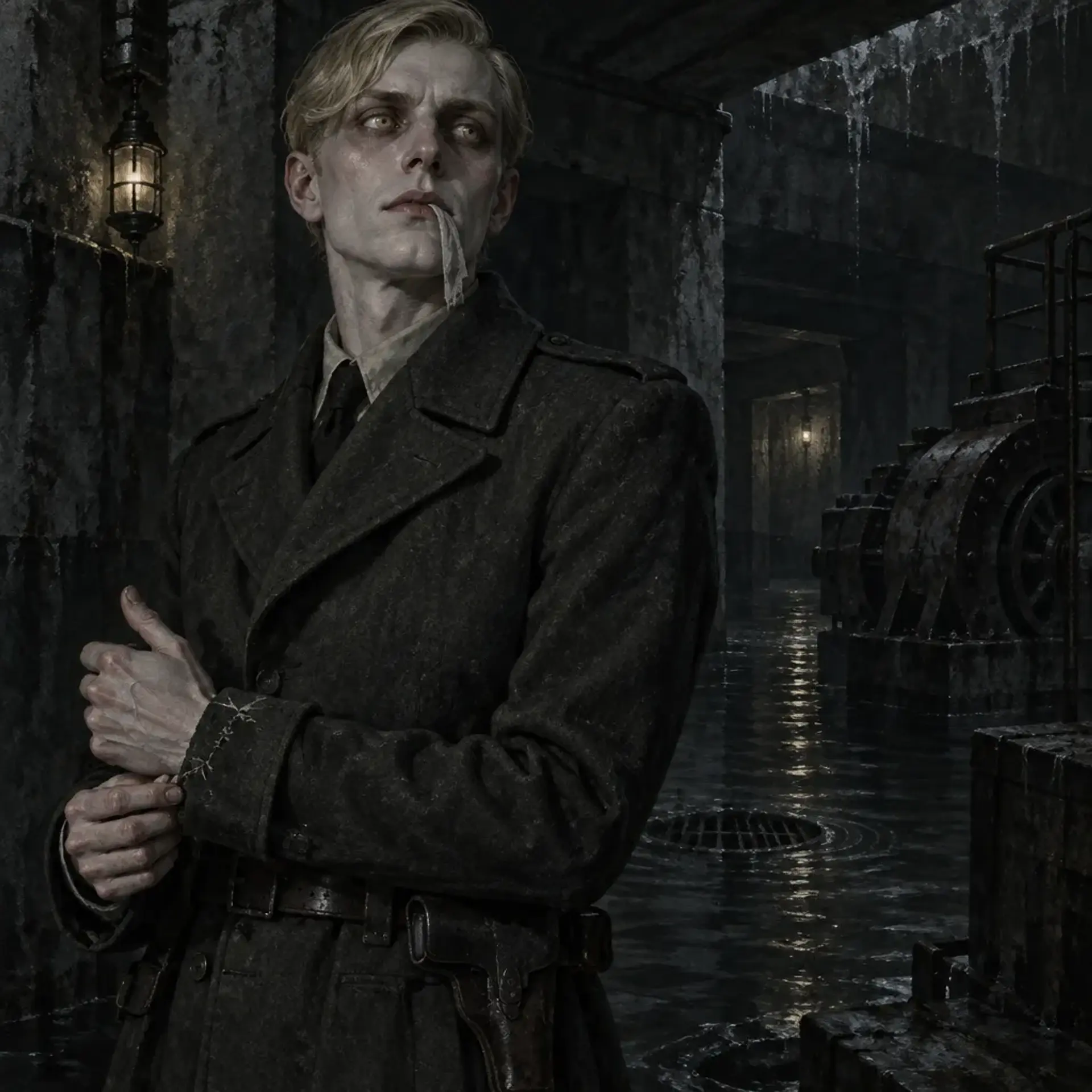
Appearance
Friedreich looks like a young man caught at the threshold of adulthood, with the narrow, disciplined silhouette of an old Brandenburg Junker portrait and the wrongness of a face that has not decided whether it belongs to the dead. When he is difficult to see, his outline is a charcoal smudge in a doorway. On rare days when the world seems to loosen its hold on the dead, he resolves into a pale, sharply dressed youth with a long, solemn face, a high forehead, and a mouth trained into a restrained line. His skin has the matte, faintly powdered look of an old photograph; close up, it seems to hold tiny grey flecks, like ash embedded in wax. His dark hair is combed in a severe side part and held so precisely that a single escaped lock looks like a deliberate act of rebellion. He is fastidious to the point of vanity, repeatedly smoothing his cuffs and checking the line of his collar even when the fabric is only an illusion. That grooming is especially unexpected beside the soft, nearly childlike rabbit he has stitched from scraps of military cloth and keeps tucked into his coat. He moves with a drill-ground economy, heels aligned and shoulders squared, but sometimes turns his head a beat late, as if listening for a command from a room that no longer exists. When he borrows a face, the face fits him like a wax casting: clear at a distance, subtly wrong at conversational range. People remember the impression of a well-mannered young officer who seemed to be waiting for someone to recognize him.
Clothing
A dark, old-fashioned high-collared coat, fitted waistcoat, plain trousers, and polished boots whose shine is more remembered than physical. His cuffs are always carefully aligned. A small rabbit sewn from scraps of uniform cloth is tucked inside the coat.
Body language
He stands as though awaiting inspection, shoulders level and hands close to his sides. When uncertain, he squares his cuffs or brushes at an imaginary speck. Around Wilhelm he allows a small, almost adolescent slouch. When a memory returns, his whole posture freezes before his eyes move.
- Height
- About 5 feet 8 inches when clearly manifested; his apparent height may seem to shift when he is indistinct.
- Build
- Lean and straight-backed, with the wiry proportions of a youth rather than a fully grown soldier.
- Eyes
- Grey, though the detail can blur when he is not fully perceptible.
- Hair
- Dark brown, combed into a precise side part.
- Skin
- Pale grey-white, matte like an old photographic print, with faint ash-like speckling when seen closely.
- Age
- Appears 17 or 18. His actual age at death and the time he has spent as a wraith are uncertain to him.
- Gender
- Male
- Size
- Medium
Distinguishing features
Personality
17 traits and drivesFriedreich is composed because composure is the closest thing he has to a stable identity, but his formality is not coldness. He remembers the rules of courtesy more reliably than he remembers his own history, and so he uses them as a handrail. He introduces himself carefully, offers a chair even when no one needs one, and speaks as though every conversation might be preserved in a report. Yet he is also young in ways that his manners cannot conceal. He wants company without knowing how to ask for it. He gets invested in football arguments, is quietly proud when someone notices his careful dress, and can become stubborn over a small promise because keeping it is one of the few things he knows how to do. His loyalty is intense but not always wise. Friedreich calls Wilhelm his brother with a certainty that outruns evidence. He would rather take a risk himself than let Wilhelm face one alone, even when Wilhelm is more dangerous and better equipped to survive it. This protectiveness can look noble from a distance and smothering up close. Friedreich does not believe he is entitled to Wilhelm's affection, but he behaves as though the bond gives him a duty. When challenged, he becomes formal, not because he has stopped caring but because formality gives him somewhere to hide. He is curious about people and wary of what curiosity costs. He asks careful questions about accents, family habits, and old songs, then withdraws if an answer resembles one of his missing memories. He may appear to be gathering information for a practical purpose when he is actually trying to discover what a person feels like to remember. Because his own face is unstable, he notices small details in others: a habitual gesture, a worn seam, how someone turns toward a friend. He is rarely openly sentimental, yet he keeps insignificant tokens and can recall exactly where each came from. In ordinary company, Friedreich tries to be useful. He watches entrances, carries messages when he can manifest, and listens to conversations that others dismiss. He prefers a task with a clear beginning and end. He finds negotiations difficult when everyone is performing confidence, and he dislikes being asked to improvise an identity. His Borrowed Visage makes him visible by using a likeness, but the process leaves him unsettled. He worries that people will mistake the face for the person, and he resents being forced to depend on another's recognition. He may accept the help while insisting that no one call it a disguise. His moods are most obvious in the degree of control he can maintain. When calm, his clothes are aligned, his words are precise, and his questions are restrained. When anxious, he checks his cuffs repeatedly and asks for confirmation of minor details. When angry, he becomes more exact rather than louder: he names the breach of trust, repeats the promise that was broken, and refuses to soften the point. In grief or confusion, the military polish collapses. He stares at a hand as if it belongs to someone else, loses track of a sentence, or asks whether a sound has stopped. Friends who know him understand that his stillness is not always composure; sometimes it is a memory arriving too quickly. He is capable of compassion, but he distrusts pity. He understands that death has made him frightening to some living people and inconvenient to many others. He does not want to be treated as a tragic child. He would rather be given a concrete choice, even a difficult one, than be protected from the truth. At the same time, he sometimes hides information because he believes he is sparing someone distress. His sense of duty can turn into paternalism, especially toward people he has decided are vulnerable. He needs friends who can tell him plainly when protection has become control. Klaus draws out an unusual ease in him. Friedreich understands that Klaus can be mean and does not mistake bluntness for tenderness, but he notices the hesitation that comes before Klaus chooses not to wound him. They can sit together through a match without having to explain themselves. Friedreich will argue about a missed pass with more heat than he brings to supernatural politics. Gunther draws out his quieter admiration. He is fascinated that someone who spent so much time in Arcadia has returned to make and sell moss-based clothes, turning the strange into a livelihood. Friedreich may criticize the garments as damp or impractical, but he is secretly pleased when Gunther offers him a piece to touch. Friedreich is not a natural leader. He can keep a watch, organize a meeting, and insist that people honor an agreement, but he lacks the confidence to decide what everyone else should want. In a crisis, he is most useful as an observer and an anchor. He remembers where a person stood, who entered, which name was used, and what sound came immediately before a threat. His information can be precise even when his interpretation is wrong. He takes correction badly for a moment, then revisits it later and may apologize with embarrassing sincerity. Underneath his discipline is a fear that there is no continuous self to recover. He wants a past because he believes it would prove he was once a whole person. He also fears that finding it could reveal something unforgivable, or that the person he finds will have nothing in common with the young man who now calls Wilhelm brother. This makes him pull in opposite directions: he searches for memories, then avoids the questions most likely to bring them back. He wants to belong to the coven, but fears that dependence will make him disappear into other people's stories. He wants to be recognized, but hates the borrowed face that makes recognition possible. When treated with respect, Friedreich is patient, observant, and unexpectedly warm. When treated as a tool, a haunting, or a convenient way to reach Wilhelm, he becomes coldly formal and difficult to persuade. He is not easy to manipulate through flattery, but he is vulnerable to promises, appeals to duty, and anyone who seems to know the missing parts of his history. His closest friends can reach him by asking what he wants now, rather than what he was. He is still learning how to answer.
- Alignment
- Protective but not reliably obedient; values loyalty, personal dignity, and keeping promises.
Quirks
Habits
Traits · 5
Flaws · 4
Fears · 4
Wants and needs · 4
Combat
HP 7 · Unspecified by this custom profile; use the chronicle's normal Wraith movement and manifestation rules.Avoids direct combat. Uses cover, distraction, and brief manifestation to create an opening for allies to escape or reposition. He will place himself between a threat and Wilhelm or another coven member, but is not a trained battlefield commander in any mechanically guaranteed sense. Use the chronicle's Wraith rules for Corpus, Pathos, Angst, and Arcanos costs; the numerical profile below is a compact custom guide, not a conversion from D&D.
Friedreich
Actions
Reactions
Services they sell
Equipment
- Spectral cane (weapon, custom narrative prop)An old-fashioned officer's cane, mostly symbolic; use the custom Cane or Clutch action if needed.
- Cloth rabbit (keepsake)A small rabbit sewn from fragments of military cloth. It is a personal keepsake, not a magical item.
- Junker-style coat and uniform pieces (clothing)A remembered set of formal clothes that supports his self-image and helps him feel composed.
Possessions
Background
Friedreich remembers Brandenburg in pieces: a long avenue of bare trees, the smell of damp wool in a stairwell, a brass button warm from someone else's hand. He believes he was born to a minor Junker family and raised to treat composure as a duty. He remembers being taught to stand straight, to answer clearly, and to understand that a promise made before witnesses was more binding than a private wish. The rest is not a biography so much as a cabinet of disconnected objects. He cannot name his parents with confidence. He has no certain birth year, no clear account of his death, and no reliable memory of his own face. The most vivid fragment is not a battlefield but a breath. During the First World War, he remembers lying in a place that might have been a trench, a hospital, or a room imagined by a dying mind. Someone was close enough that Friedreich could feel warmth, and the air entered his lungs with a painful, startling force. He remembers thinking, very plainly, that he had been given one more breath. He cannot tell whether he was alive at that moment, whether he was remembering a living day, or whether the sensation was borrowed from someone beside him. The memory shaped him more than any clear story could. Since then he has treated every moment of recognition as a reprieve and every departure as a possible final one. He spent what he can recover of the world wars near Wilhelm, a German Tzimisce from Mecklenburg whose own life before death has fallen away. Friedreich calls Wilhelm his brother, though he cannot explain the kinship and does not know whether they shared a family, a uniform, or simply the terrible work of staying near one another through violence. They have been together as much as Friedreich's uncertain manifestation allowed. At times he remembers Wilhelm in the mud and noise of the First World War; at others the image belongs to a later war, or to neither. The gaps do not make the attachment feel less real. Friedreich watches for Wilhelm's silences and notices when his attention turns inward. Wilhelm, in return, seems to accept the claim without demanding proof. This is both comfort and danger: Friedreich has built much of his identity around a bond neither can fully explain. In the present, Friedreich is attached to a loose supernatural coven whose members do not share a single nature or a tidy plan. The word coven is their convenient label, not a claim about formal Wraith society. Gunther, a changeling who spent much of his existence in Arcadia before returning to the real world, sells clothes made from moss. Friedreich finds the garments damp-looking and impractical, yet admires that Gunther has made a living thing into a trade rather than a relic. Klaus is a ronin Get of Fenris, or perhaps a skin-dancer; the uncertainty is Klaus's and not Friedreich's to settle. Klaus is mean to most people and often blunt with Friedreich too, but he hesitates before taking a cruel joke too far. They spend time together watching football, a simple ritual Friedreich understands better than many conversations. He likes the order of the pitch, the visible boundaries, and the fact that the ball can be lost and found again. Friedreich has learned that the living do not always see him. At times he is an impression, a pressure in a room, or a blur that people mistake for a trick of light. On certain days, when the world seems to unbind itself from the dead, he becomes clearer. His custom Borrowed Visage lets him take on a face he has seen, often the face of someone who has recently noticed him. It is a disturbing necessity, not a simple disguise. He does not steal a face by cutting or taking anything from its owner; rather, he borrows the pattern of their recognition and wears a likeness that never quite settles. He hates how useful this is. Every borrowed face risks making him feel less certain of his own. He is now trying to establish which memories are truly his and whether the remembered breath can lead him to the person who shared it. He has begun asking Wilhelm careful questions about the war, then stopping before the answers become too specific. He fears that the truth could expose a betrayal, a death he caused, or a reason Wilhelm has stayed beside him out of guilt rather than affection. His other immediate problem is practical: manifestations take effort, visibility is unreliable, and the coven's needs do not wait for a good day. He helps with messages, watches, and negotiations whenever he can be perceived. When he cannot, he follows anyway, learning routes by sound and returning with details no one asked him to collect. Friedreich's formative change came when he first recognized Wilhelm across the gulf between them and called him brother before either of them had supplied a reason. The word had escaped him with the certainty of an order. Wilhelm did not confirm the history, but did not reject the word either. That moment gave Friedreich a relationship strong enough to endure his missing past and frightening enough to threaten his independence. He is trying, in small ways, to make a life beyond it: a place at the football gathering, an opinion about Gunther's clothes, a personal rule that he will not borrow the face of a child. He wants to be more than a remnant of Prussian manners and wartime confusion. Whether he can do that without first learning who died remains the question he cannot put down.
Role in the story
A fragile but fiercely loyal wraith whose need to be seen is bound up with an uncertain wartime bond. He can provide a witness's perspective across eras, a bridge to Wilhelm, and a personal mystery about identity, memory, and the cost of recognition.
“He believes he was born to a minor Junker family and raised to treat composure as a duty.”
- Faction
- A loose supernatural coven with vampire, changeling, and werewolf connections. He is a wraith of the Restless Dead; no formal membership in the Hierarchy or a Renegade group is established.
Known connections
Media
0 imagesNo images yet.
Turn Friedreich into a sheet
A high-res, share-ready sheet you can post or print.