Wilhelm
Wilhelm
At the table
Voice
His speech seems to come from a dry, tightly controlled body: a faint rasp, crisp stops, and the occasional wet click when he shifts the hidden shroud fragment. His Mecklenburg vowels are plain and regionally marked, while his military diction lends ordinary statements the weight of an order. When excited by a theory, his pace accelerates and he piles qualifications onto sentences until he loses track of the original question.
Wilhelm speaks German with a Mecklenburg regional accent that he calls simply “local.” His consonants are firm and his phrasing carries the clipped, procedural habits of military service, but his sentences can wander into folklore and speculative theory. The voice sounds dry and slightly rough, as if his throat has been unused for a long time; when hungry, his words catch around the strip of shroud in his mouth. He does not become softer or more polite when angry. He becomes more explicit, more repetitive, and increasingly exact about what he believes another person has done.
Speech patterns
How to play them
Approach him as a person rather than a specimen. Respect the boundary around his dry chamber, avoid demanding a confession about the war, and offer concrete help with his technology. He responds to patient curiosity and candid disagreement better than flattery. If the conversation becomes friendly, expect an unfiltered lecture on soil, folklore, or the failures of Cainite history. Do not promise to mentor him unless prepared to follow through.
Goal
Find a trustworthy teacher who can explain his computer and game console, preserve his dry chamber, and learn whether his connection to Byelobog is real without surrendering his identity to the Tzimisce who claim authority over him.
Motivation
To make a life out of the scraps he remembers, prove that he is more than a curiosity of Byelobog’s bloodline, and find a place among his strange circle without admitting how badly he needs it.
Appearance
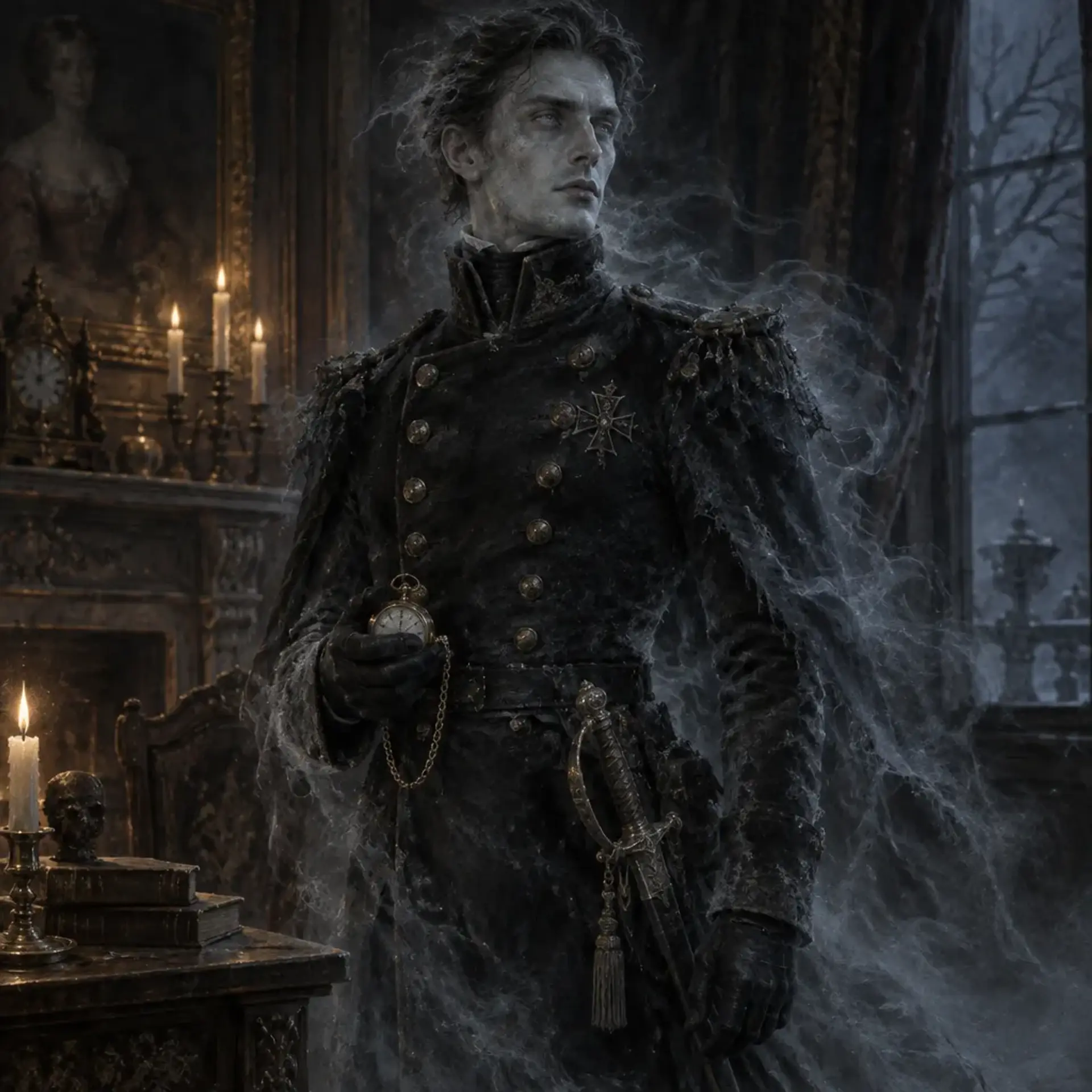
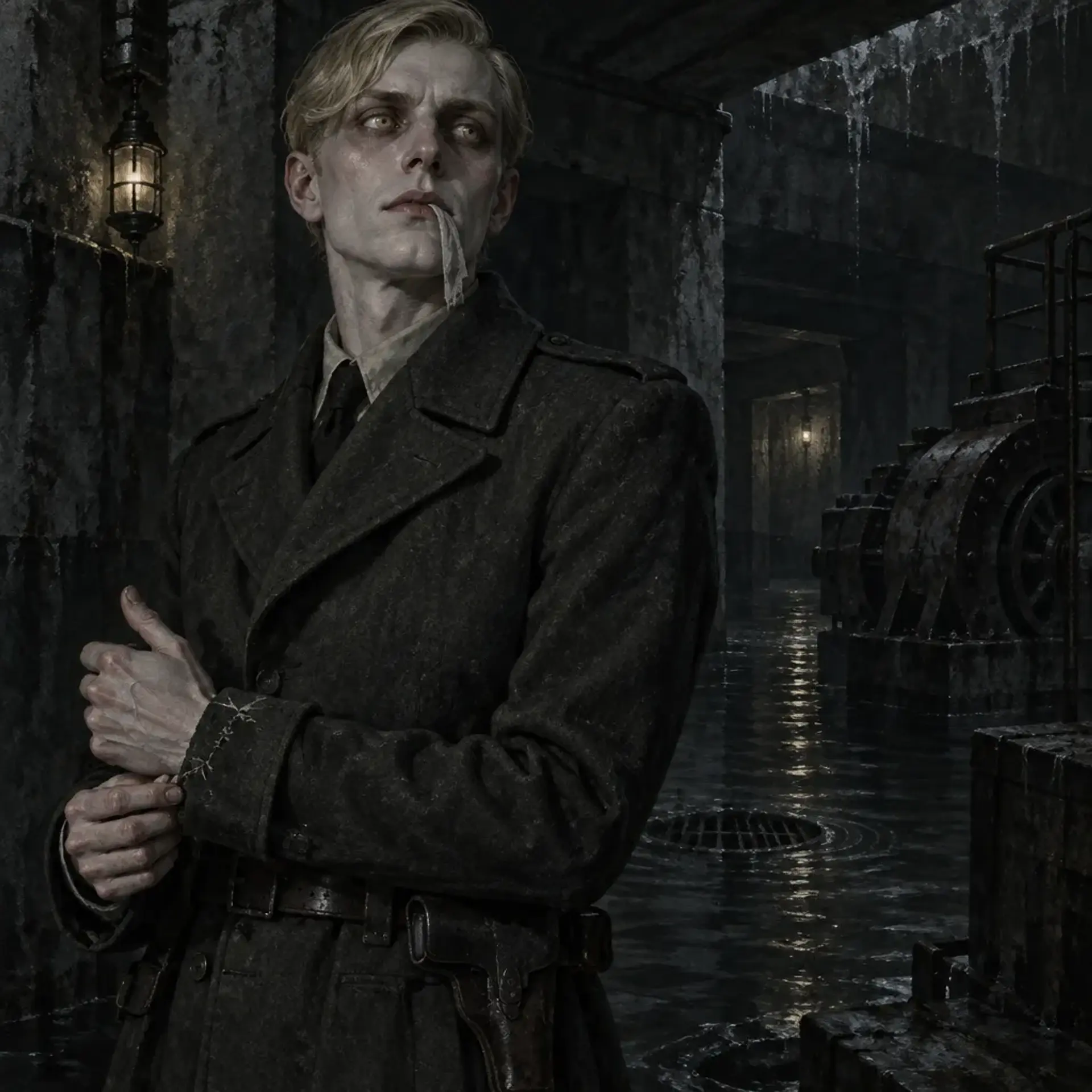
Wilhelm looks like a pale, carefully groomed young German man who has dressed himself from a half-remembered photograph of an older soldier. He keeps his pale-blond hair short, combed into a neat 1920s side part, but damp air makes it lift in thin, stiff wisps. Before feeding his skin has the grey-white cast of old candle wax; afterward it takes on a faint, unhealthy warmth that never quite reaches his eyes. His eyes shift from yellowish and cloudy-looking when hungry to a steely, washed blue after feeding. His cheeks are smooth and young, yet his mouth works constantly against something hidden inside it. He stands too straight until he thinks no one is watching, then folds at the shoulders like a man listening through the floor. His dark coat is military in cut but stripped of insignia, carefully brushed, and patched at the cuffs with thread that does not match. He smells faintly of wet stone, old wool, and iron. The unexpected detail is a child’s tidy, almost schoolmasterly habit of keeping his nails evenly filed and his collar squared, even when he has just crawled from a flooded bunker.
Clothing
A dark, well-brushed German military-style coat with all insignia removed, a plain shirt, narrow trousers, and practical black boots. The coat is carefully maintained but repeatedly repaired at the cuffs and hem. He favors a short, tidy 1920s hairstyle and dresses to look a few years older than his youthful face.
Body language
He keeps his shoulders squared and his chin slightly raised, like a young man imitating an officer. When attention turns away, his posture loosens and his head tilts as though he can hear movement below the floor. He presses his tongue against one cheek to feel the hidden shroud strip. Under stress he rubs his thumb over the seam of his coat cuff rather than gesturing.
- Height
- Approximately 170 cm (5 ft 7 in).
- Build
- Lean, narrow-shouldered, and wiry, with the compact strength of someone used to crawling through rubble rather than displaying muscle.
- Eyes
- Yellow when hungry, shifting to steely pale blue after feeding.
- Hair
- Pale blond, kept short and practically styled in a neat 1920s side part.
- Skin
- Deathly pale, with a clammy, candle-wax cast when hungry; marginally less corpse-like after feeding.
- Age
- Appears about sixteen; claims no reliable mortal age. A young vampire by the standards of his lineage, though his actual Embrace date is uncertain.
- Gender
- Male
- Size
- Medium
Distinguishing features
Personality
21 traits and drivesWilhelm is a young-seeming vampire trying to perform adulthood by copying its visible rituals. He keeps his coat brushed, his hair in order, his possessions arranged, and his speech ready with assertions. These habits are not signs of ease. They are scaffolding. He has little confidence that a self exists beneath the scraps of remembered identity, so he treats a clean collar and a guarded room as proof that he has chosen something for himself. He is curious, but not open-minded in the usual sense. He will ask a stranger how a computer works and listen with genuine attention, then reject a well-supported account of vampire origins because it does not fit his intuition. He loves explanations that leave room for bodies, soil, and weather to matter. He dislikes explanations that make the supernatural seem like a tidy family tree. His own alternative theories can be ridiculous, and he knows this sometimes; knowing does not stop him from arguing. When he trusts someone, his speculation becomes exuberant and associative. When he feels judged, he turns it into a contest of certainty and makes himself hard to reach. There is a real tenderness in him, but it is tangled with control. He wants to be Friedreich’s friend, not his keeper, yet he feels responsible for preserving the wraith’s changing identity and can become intrusive when Friedreich’s face or name shifts. He wants Johan to see him as harmless and ordinary, while withholding the most important facts that would let Johan make an informed choice. Wilhelm does not think of this as manipulation. He believes that a friendship is possible if he can behave correctly enough, and that the truth can wait until he understands it himself. This is a dangerous and very human mistake. His humor is dry, blunt, and often badly timed. Stealing the changeling Gunther’s name was a deliberate joke that Wilhelm still considers funny, although he recognizes that Gunther does not. He uses teasing to test whether a person will stay after being irritated. He is not especially good at reading the point where a test becomes cruelty. When someone answers him directly, however, he often respects them more than a person who offers careful reassurance. Wilhelm’s idea of honor is severe and inconsistent. He condemns his own desertion in the First World War, even though he can explain why he left and insists that the army had already failed. He sees the contradiction but cannot resolve it. He may forgive another person for fleeing a doomed situation while calling his own choice dishonorable. He tends to admire discipline, endurance, and bluntness, partly because those qualities give shape to a life he cannot remember. Yet he distrusts institutions and leaders, especially when they demand obedience without explaining why. He is capable of defying authority and then punishing himself for having done so. Around strangers he is guarded, formal, and faintly challenging. He watches hands, doors, and the ground, not because he has mastered social suspicion but because he does not know what else to watch. He answers personal questions with evasions or counterquestions. Around his supernatural circle he becomes noisier and more opinionated, interrupting to correct details and then apologizing in a stiff, awkward way. At gatherings he may sit apart, seemingly uninterested, while remembering every small change in his friends’ habits. He returns to the group even after announcing that he has no need of it. Hunger changes him in visible ways. His eyes yellow, his face loses what little warmth it had, and his attention narrows toward living bodies and the dead. He is ashamed of the way he feeds and tries to turn it into a matter of folklore, calling himself a Nachzehrer rather than admitting that the act frightens him. After feeding, the steel-blue clarity of his eyes returns, and he can become almost buoyant, as if the world has resumed having edges. He still struggles to understand ordinary human pleasures. Affection, eating together, and casual touch can strike him as theatrical or unpleasant, but he watches people who enjoy them with a fascination he cannot easily confess. He is not brave in a clean, heroic fashion. He is capable of crawling into a flooded tunnel to retrieve the shroud he has hidden there, but may avoid an honest conversation for years. He can stand his ground against a Tzimisce elder and then become consumed by doubts afterward. He is most courageous when protecting a person or place he has decided belongs within his small circle. That loyalty can be generous, but it can also become possessive. Wilhelm wants a family and rejects the word because he fears that calling it one will expose how much he depends on it.
- Alignment
- Not applicable as a Vampire: The Masquerade statistic. In ordinary terms, protective toward his chosen few and ruthlessly pragmatic toward perceived enemies.
Quirks
Habits
Traits · 5
Flaws · 6
Fears · 5
Wants and needs · 5
Combat
HP 5 · Standard human walking and running pace; use the chronicle's normal movement rules.Wilhelm avoids a fair fight. He uses the bunker’s cramped passages, darkness, mud, and exits to control where opponents can move. If threatened at range, he uses his pistol and withdraws; if cornered, he grapples, draws on Feral Weapons, and tries to drag a target into water or darkness. He is stubborn about protecting his dry chamber and may make poor tactical choices if it is threatened. He does not use his custom soil-work as a reliable combat power.
Wilhelm
Actions
Reactions
Services they sell
Rewards they can give
Equipment
- Military pistol (weapon)An old German military pistol with limited, irregularly sourced ammunition. Its model and reliability depend on the chronicle's period.
- Stripped service coat (clothing)A military-style German coat with insignia removed and worn cuffs repaired by hand.
- Burial shroud fragment (personal keepsake)A short, soil-stained piece of burial shroud hidden in his mouth; he sometimes soaks it in blood.
- Old computer (curiosity)An obsolete computer taken from a victim. Wilhelm does not know how to use it and wants a patient teacher.
- Game console (curiosity)A game console taken from a victim, kept beside the computer with cables he has not correctly connected.
Possessions
Background
Wilhelm says he woke in a grave with dirt in his mouth and a burial shroud caught between his teeth. That is the beginning of his remembered life. He cannot say who buried him, what name he once carried, or whether the body he clawed out of the earth had ever been alive in the way he understands life. A narrow strip of that shroud is still hidden inside his mouth. He chews it when frightened, and sometimes soaks it in blood. The remaining cloth is kept in a safe place he will not identify. He calls himself a Nachzehrer, borrowing the German folkloric word for a dead person believed to consume the living, because the label feels closer to his experience than Cainite genealogies do. Other Tzimisce have called him a childe of Byelobog, the legendary White God of the northern wetlands. Wilhelm has no memory of meeting Byelobog, receiving the Embrace, or being taught. The claim rests on rumor, odd signs, and the resemblance others see between Wilhelm’s clammy pallor and Byelobog’s corpse-white skin. His supposed sire is said to have marked territory through flakes of living skin carried by wind, soil, and animals, creating a mystical intimacy with his domain. Wilhelm has no demonstrated ability to do that. He sometimes finds pale flakes in flooded places and treats them as messages, but they may be ordinary fungus, peeling paint, or his own imagination. Some Fiends suggest he is Byelobog’s last childe and the runt of a vanished litter; others say he is a fraud, a revenant remnant, or something that merely wears a Tzimisce’s shape. Wilhelm listens to all of these explanations and rejects the certainty of each. He remembers a stretch of mortal life as a German shock trooper in the First World War, though the memories come like scenes from someone else’s account: mud in the seams of his uniform, a hand signal in smoke, a stretch of quiet before an order. Near the war’s end he deserted. He recalls the immediate relief of walking away from orders, followed by a shame that outlasted every excuse he made for it. He calls the retreat dishonorable and insists that the army’s repeated failures were proof that its ideals had failed, not that he had acted wisely. He cannot establish whether these are authentic memories, borrowed memories, or a story he built to give his first nights a shape. He was also involved in the Second World War, but evades questions about his work. If pressed, he says, “You wouldn’t understand,” and turns the conversation toward the questioner’s own complicity. He still owns a German military coat stripped of insignia and an old pistol. He has never explained where he was stationed, whom he served, or what he did. The silence is not theatrical; he appears to be guarding a sealed room in his mind. For much of his unlife he wandered Prussian lands and other German-speaking towns alone. He met Tzimisce who expected him to practice Vicissitude, and he disappointed or unnerved them by refusing it. He studies soil, water, weather, local folklore, and the sensations of places he sleeps in. He calls his resulting practices “soil-work.” He is fond of Norse pagan motifs and severe social ideas, partly because they make humans and the undead seem less separate to him. He disputes the Cainite origin story, offering theories that range from eccentric to absurd; when he thinks a listener is friendly, he can talk until dawn without noticing the approach of sunrise. His current home is a partly flooded Second World War bunker. One room is kept dry, swept, and scrupulously arranged. He calls it his chamber and defends it with an intensity that surprises visitors. He does not remember mortal pleasures and can react with bafflement or disgust to ordinary intimacy, shared meals, and casual touch. Two objects taken from victims fascinate him: an obsolete computer and a game console. He cannot operate either and hopes to find a teacher, but insists that the teacher must be “the right one.” Wilhelm belongs to an irregular circle of outsiders that includes Kindred, a werewolf, a changeling, a wraith, and others. They call themselves family when it suits them, then dismiss the phrase as sentimental when challenged. They sometimes gather for holidays and, rarely, football. The company irritates Wilhelm, but he returns to it. Friedreich, a wraith from Brandenburg who resembles a Prussian Junker and military officer, is his closest friend. Friedreich has his own gaps in memory and sometimes needs to borrow a living person’s face to be seen. Wilhelm takes this literally and respectfully, which is not always helpful. The changeling Gunther resents Wilhelm for stealing his name as a deliberate provocation. Klaus, a hostile Ronin Get of Fenris or perhaps a skin-dancer, warns Wilhelm away from Bavarian territory, yet has shown him hospitality when circumstances leave no choice. Wilhelm has also become attached to Johan, a mortal teenager from Berlin whom he describes as “chill.” He is trying to be Johan’s friend, but the imbalance of age, power, and secrecy makes the relationship dangerous. His immediate troubles are practical and intimate. The bunker floods more deeply each winter. His experiments in soil-work have begun attracting attention from local occultists. His circle does not trust his theories about Byelobog, and some Tzimisce would like to inspect him as a curiosity. He fears that the rumors are true in a way he cannot comprehend: that he is not Byelobog’s son but a piece of the White God’s territory, grown into a person. He keeps looking for a mentor, a dry room, and evidence that his memories belong to him.
Role in the story
A memorable, unreliable ally and potential source of occult information. Wilhelm can connect characters to a community of supernatural outcasts, but his contested lineage, missing memories, hidden shroud, and attachment to a mortal teenager create immediate risks. His story can explore identity, inherited legacy, wartime guilt, and the difference between found companionship and possession.
“A narrow strip of that shroud is still hidden inside his mouth.”
- Faction
- Tzimisce, though his standing and lineage are disputed. Member of an informal cross-supernatural circle of outcasts, not a formal sect or coven.
Known connections
Media
0 imagesNo images yet.
Turn Wilhelm into a sheet
A high-res, share-ready sheet you can post or print.