Wilhelm “Gunther”
Wilhelm “Gunther”
At the table
Voice
His voice has a dry, slightly rasped edge, as if each word passes a mouth accustomed to chewing grit. The Mecklenburg accent rounds some vowels and clips endings; his careful grooming and formal posture make the voice sound more composed than the damp bunker and hungry stare suggest. When he is excited by a theory, consonants come faster and military phrasing intrudes. Anger makes him precise and prosecutorial, not soft or hushed.
He speaks German with a regional Mecklenburg accent he calls “the local accent.” His English, if used, is functional but stiff and heavily shaped by German phrasing. He chooses formal, direct sentences when asserting authority, and piles up speculative clauses when comfortable. His work and war history leak into his vocabulary as tactical terms and orders. When he cannot answer a personal question, he uses a flat formula rather than improvising.
Speech patterns
How to play them
Meet him on practical ground first. A direct offer to teach him something, share information about the local dead, or help keep the bunker dry earns more trust than flattery. Do not mistake his theories for harmless eccentricity: he may use them to justify coercion. If asked about his past, let him choose what to disclose, but set firm limits around mortals and feeding. He responds well to someone who can disagree without humiliating him.
Goal
Find a trustworthy mentor who can teach him to use the computer and game console, while discovering whether Byelobog truly sired him and what, if anything, lives in his skin.
Motivation
To turn an unknowable beginning into a coherent identity, and to be regarded as a person rather than a failed childe, a monster, or a piece of an elder's skin.
Appearance
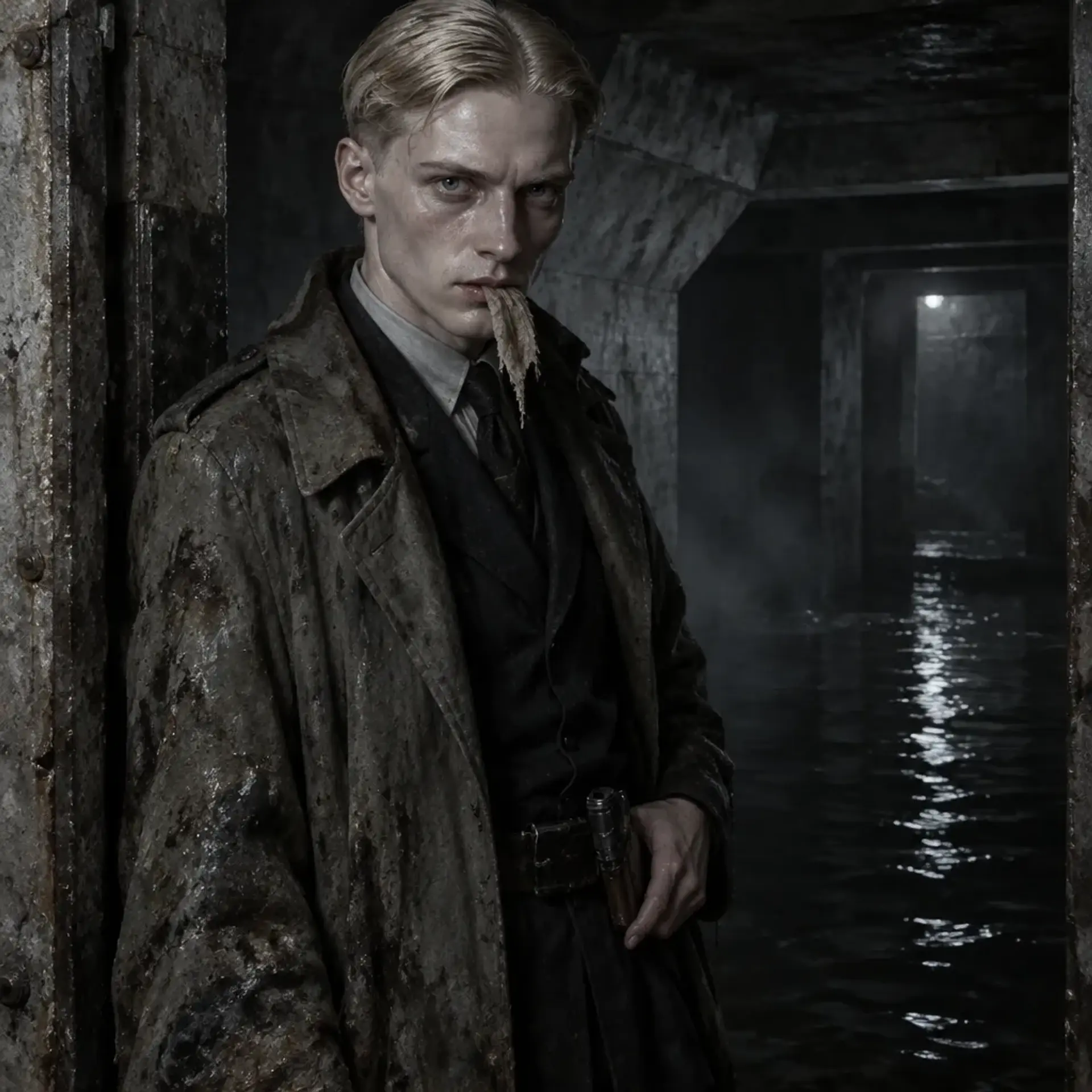
At first glance, Gunther looks like a carefully groomed young German man who has dressed for a photograph that never happened. His skin is corpse-pale when hungry, with a dry, waxy cast at the temples and a faintly damp sheen around the mouth; after feeding, warmth does not return, but his face seems less hollow and his eyes turn from yellow to steely pale blue. His short pale-blond hair is combed into a practical, fashionable 1920s cut, its neat part at odds with the dirt that sometimes clings beneath his nails. He wears his age as a performance: shoulders squared too deliberately, chin held at a studied angle, coat buttoned as if rank were still sewn inside it. He takes up more room than his slight build suggests, standing close and holding a doorway as if it were a position to defend. People notice the small, soil-stained piece of burial shroud tucked behind his lower lip; he worries it with his teeth and soaks it in blood when he can. Its frayed edge is polished dark by years of chewing. He moves in abrupt, economical starts, then becomes unnervingly still, like a man waiting for an order he has already decided to refuse.
Clothing
A well-groomed, practical 1920s German-inspired look layered beneath a stripped, old German military coat with no insignia. The coat is carefully maintained but water-stained at the hem from the bunker. He wears plain dark trousers and sturdy boots, avoiding visible symbols of rank.
Body language
Gunther plants his feet as though bracing against recoil or a trench wall, and he unconsciously leaves himself a line to the nearest exit. He makes formal gestures with an earnest, slightly theatrical precision, then ruins the effect by chewing the hidden shroud. He crowds people when he wants to establish authority and retreats a full step when someone asks about his mortal life. After feeding, he stands straighter but does not relax.
- Height
- About 170 cm (5 ft 7 in).
- Build
- Lean and narrow-shouldered, with the compact, wiry tension of someone accustomed to carrying equipment and moving under a load.
- Eyes
- Yellow when hungry; steely pale blue after feeding.
- Hair
- Pale blond.
- Skin
- Deathly pale, with a waxy, faintly damp texture; he remains pallid even after feeding.
- Age
- Looks about 16, though he presents himself as a young adult. His mortal age, Embrace date, and apparent chronology are uncertain.
- Gender
- Male
- Size
- Medium
Distinguishing features
Personality
20 traits and drivesWilhelm is both hungry for belonging and suspicious of anyone who offers it. He can be punctilious about small courtesies, insisting on proper introductions or a seat for a guest, while endorsing severe ideas that make ordinary compassion sound weak. His manners are not a mask he can simply remove; they are one of the few structures he trusts. The contradiction shows most clearly around his circle. He calls Friedreich a friend with no hesitation, defends the others when outsiders mock them, and turns up for holidays and occasional football. Yet when anyone calls this a found family, he rejects the phrase as sentimental nonsense. He wants the bond without wanting to admit that he needs it. Wilhelm changes sharply with the situation. With strangers, he performs a composed, older-young-man authority: clipped explanations, careful posture, and a readiness to declare what is proper. With Friedreich or someone who has earned his curiosity, he becomes an excitable theorist, stringing together ideas about the undead, folk belief, military discipline, and the nature of hunger. He is not always trying to persuade; sometimes he is testing whether the listener will remain present when his thinking becomes strange. When ashamed, he becomes formal and evasive. A question about desertion or his later wartime service can turn him from expansive to impenetrable in a sentence. Anger does not make him quieter or gentler. It makes him more exacting: he corrects a word, draws a hard distinction, and speaks as though the argument itself were a tribunal. If he is frightened, he may become needlessly confrontational, because a challenge feels more manageable than helplessness. His concern for people is real but poorly trained. He wants Johan's friendship and speaks of him as a person rather than a resource, yet he does not fully understand how threatening it is for an immortal predator to cultivate a teenager. He can be protective, then overbearing; generous, then offended when generosity is not repaid in the form he expected. His interest in harsh ideologies is not a simple love of violence. He believes that people and monsters are closer than polite society admits, and that strict rules reveal what a person truly values. He sees weakness in hypocrisy more readily than in cruelty, a blind spot that makes him dangerous. His odd confidence about his own identity is also fragile. He calls himself a Nachzehrer rather than accepting whatever category other vampires assign him, but he privately studies their reactions for clues about what he might be. He does not want to be told that Byelobog is his sire unless the speaker can explain why. He does not want the claim disproved either. Underneath his stubbornness is a frightened young man who woke under the soil with no name, no memories, and nobody to tell him what had happened. He has turned that blankness into a set of arguments, uniforms, habits, and chosen loyalties. Those structures can help him keep a promise or endure a threat; they can also prevent him from asking for help until the bunker is already flooding.
- Alignment
- Not applicable as a V5 rules category. Morally severe and self-justifying; he can show real loyalty while endorsing brutal ideas.
Quirks
Habits
Traits · 5
Flaws · 5
Fears · 5
Wants and needs · 5
Combat
HP 6 · V5 movement and chase rules apply; no separate fixed speed statistic is assigned.Gunther avoids a fair fight. He uses the bunker, mud, narrow passages, and darkness to control approach routes; he threatens with the pistol at range and uses his teeth only when cornered or certain he can feed. He is more likely to hinder pursuit with his custom earth-and-water practice than to stand and trade blows. He will retreat if the enemy is clearly stronger, but may endanger himself to protect a member of his circle. He does not fight like a trained modern soldier so much as a survivor whose old training returns under pressure.
Wilhelm “Gunther”
Actions
Reactions
Services they sell
Rewards they can give
Equipment
- Stripped service pistol (firearm)An old German service pistol retained from his military past. It has been maintained, but is not supernatural and has limited ammunition.
- Unmarked military coat (clothing)A German military coat with all insignia removed. The lining is worn smooth at the inside pocket and damp at the hem.
- Burial shroud fragment (personal relic)A small, soil-covered cut piece of burial shroud, usually hidden in his mouth. The rest of the shroud is concealed in a location he will not disclose.
- Unfamiliar electronics (technology)An old computer and a game console taken from victims. He does not know how to operate them and keeps them dry on a raised shelf in the bunker.
Possessions
Background
Gunther remembers no mortal childhood, no family, and no name before Wilhelm. His first memory is not a nursery or a deathbed but the pressure of earth: a shroud across his mouth, cold soil packed around his head, and the urgent animal act of chewing and clawing upward. He cannot say whether he was buried alive, buried after death, or placed there by someone who wanted him to wake. A cut piece of the shroud has stayed with him ever since. He keeps it hidden in his mouth, worrying it with his teeth; the rest is secreted in a safe place whose location he refuses to share. Its burial dirt has never been washed away. He calls himself a Nachzehrer, a German revenant who consumes the dead, because the word fits his beginning better than the vampire names other people give him. The Tzimisce who have encountered him call him a malformed childe, a curiosity, or a problem. Some insist he must be Byelobog's last childe and the runt of a terrible litter. Gunther repeats that claim when it suits him but has no proof. His supposed sire is a legend: a white-skinned ancient koldun associated with swamps, fog, and northern snows, whose fate is entangled with old clan stories and the Anarch Revolt. Gunther does not know whether Byelobog truly Embraced him, whether a remnant of the ancient's flesh took root in him, or whether the story was invented by vampires who needed an explanation for something they feared. His body offers no easy answer. He appears to have no normal fangs, does not practice Vicissitude, and claims to have no capacity to sire childer. His feeding is laborious and alarming: he chews at the dead, or at a living victim if desperation overcomes caution. Others whisper that he is less a proper vampire than a host for something like a fungus in an ant, a piece of Byelobog's skin using him as a place to travel. Gunther finds the rumor repulsive, then secretly wonders whether it is true. He served as a German shock trooper in the First World War. He remembers mud, shouted orders, and the brutal intimacy of moving through a position built to kill him. Near the war's end, after repeated failures of the German army, he deserted. He now calls that choice dishonorable, though he still cannot explain what loyalty would have accomplished other than another grave. The contradiction is one of his lasting injuries: he despises the collapse of discipline, but remembers that obedience had nearly killed him. Later, during the Second World War, he served again in some capacity. He never gives his exact assignment. If pressed, he says, “You wouldn’t understand,” and watches the questioner for signs of whether they will ask again. The coat he retained from that period has had every insignia stripped away. It is a practical garment, a concealment, and perhaps the only remaining evidence of a history he cannot bear to narrate plainly. After his first remembered emergence, Gunther wandered through Prussian lands and other German towns as a solitary night creature. He met other Tzimisce and, once, encountered what he understood to be other children of his supposed sire. The meeting gave him more questions than answers: they regarded him as a family embarrassment, but some also looked at him with the wary attention people reserve for a thing that might belong to an elder. He has never fitted well into vampire society. He dislikes courtly ownership, formal lineage claims, and the expectation that a childe should accept an elder's account of who they are. He also craves a place in a family, a need he disguises as contempt for the very idea. In the present, he occupies a partly flooded Second World War bunker. The damp suits his habits, and its concrete rooms provide privacy, but the water is rising and the structure is slowly becoming less defensible. He has acquired an old computer and a game console from victims and cannot operate either. He wants a mentor, but only the right mentor: someone who will teach him without demanding that he submit to a fashionable theory of history, vampire origins, or proper Tzimisce conduct. His search is complicated by his inability to explain what he wants from the devices beyond the insistence that they contain a new kind of human ritual. Gunther belongs to an irregular gathering of supernatural misfits that includes a wraith, a changeling, and a werewolf; its members call one another family when outsiders are listening and dismiss “found family” as a sentimental label when challenged. They meet for holidays and, rarely, football. Gunther is the loudest theorist and perhaps the least reliable host. Friedreich, a wraith from Brandenburg who must borrow or steal a living face to be seen, is his closest friend. They share gaps in memory and a fondness for old Prussian manners, although Friedreich has his own resentments. Gunther has taken the name of a changeling in their circle, also called Gunther, specifically to irritate him. Klaus, a hostile Ronin Get of Fenris or possibly a Skin Dancer, tells him to stay out of Bavarian lands forever. Klaus can be unexpectedly hospitable when cornered, a contradiction Gunther reads as proof that harsh codes reveal more than easy kindness. He is also trying to cultivate Johan, a mortal teenager from Berlin, as a friend. Gunther says Johan is “chill” and insists their friendship is not a recruitment, though he has not grasped how dangerous that distinction is. His immediate problems are practical and moral. The bunker is flooding; his supposed lineage is disputed; the group may be tired of his arguments; and he needs someone to teach him modern technology without turning him into a project. He is haunted by his desertion and evasive about his later service. He wants to believe that a harsh code can make humans and the undead honest with one another. He may instead be using ideology to give his loneliness a uniform.
Role in the story
A strange potential ally whose disputed lineage and anomalous feeding invite investigation. He can connect characters to a supernatural circle outside familiar vampire politics, provide shelter or occult clues, and create moral complications through his relationship with Johan and his attraction to uncompromising ideologies.
“He cannot say whether he was buried alive, buried after death, or placed there by someone who wanted him to wake.”
- Faction
- Tzimisce, though poorly integrated and treated as an oddity. Associated with an informal supernatural circle of misfits and outcasts that includes Friedreich, the changeling Gunther, and Klaus. Its members sometimes call themselves a family but reject sentimental explanations of the term.
Known connections
Media
0 imagesNo images yet.
Turn Wilhelm “Gunther” into a sheet
A high-res, share-ready sheet you can post or print.