Eber
Eber
At the table
Voice
A clear, slightly rasped voice with a dry edge, shaped by careful speech around an altered jaw and by years of listening to the clack and scrape of tools. His tone is practical and unhurried when discussing work, quick and defensive when the subject turns to his body, and unexpectedly warm when talking about childhood games with Ignatz.
Eber speaks with a measured, practical cadence shaped by workshop talk and a childhood spent listening before joining in. He clips sentences when embarrassed and becomes precise when discussing mechanisms or magic. His altered jaw gives some consonants a faintly rough edge, but his words remain clear. He does not grow soft-spoken when angry; his voice becomes blunt and tightly controlled, with each point stated as if it were a tool laid on a bench.
Speech patterns
How to play them
Treat Eber as an adult rather than a family problem. Give him time to answer, do not stare at his teeth while he eats, and offer practical help instead of unsolicited reassurance. He is more likely to open up while repairing something side by side than during a direct interrogation.
Goal
Learn to control his sorcery, help make the workshop and home livable for high-blooded family members, and uncover who is manipulating the village’s fear of its own history.
Motivation
He wants a place in his family that does not depend on pretending he is still the small child they remember.
Appearance
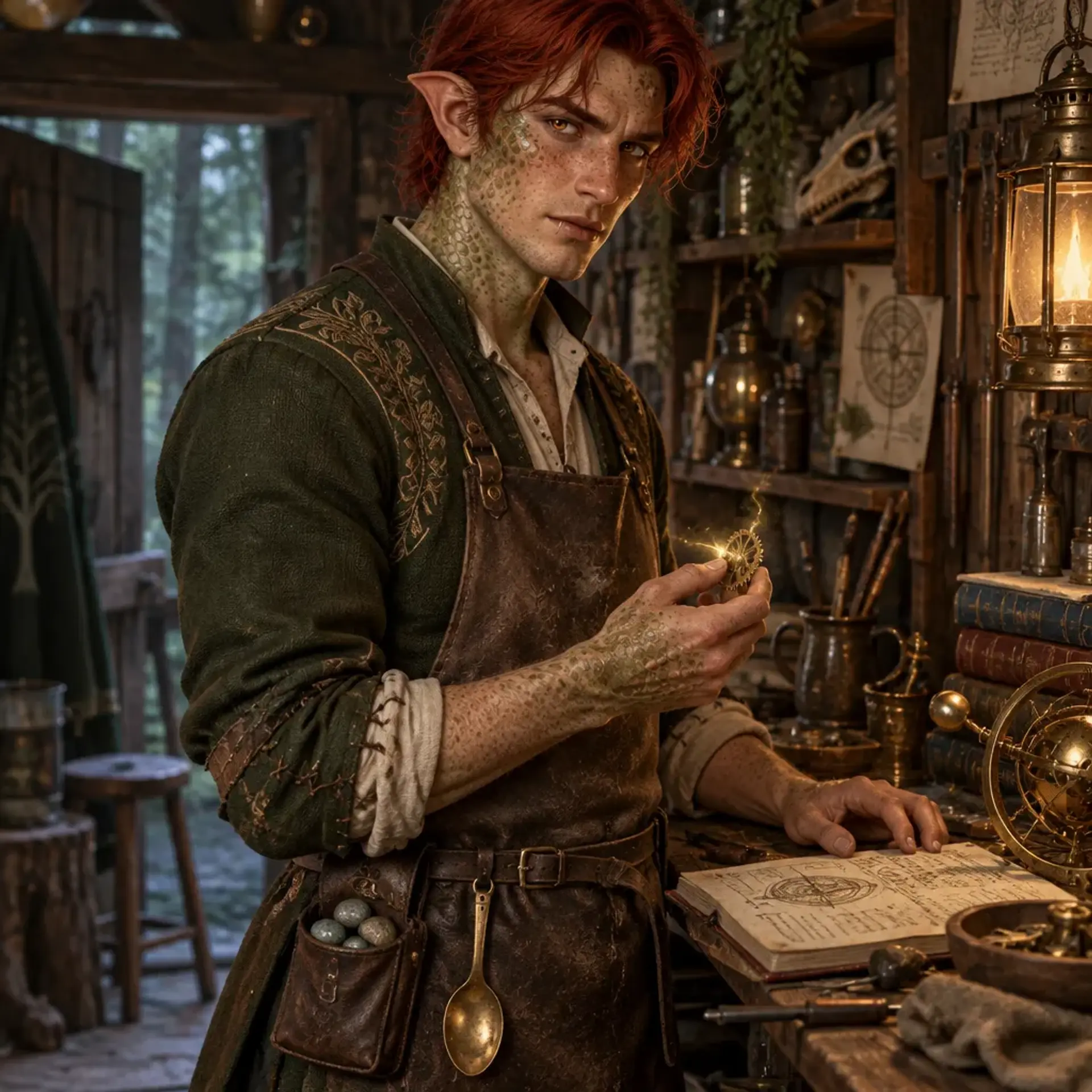
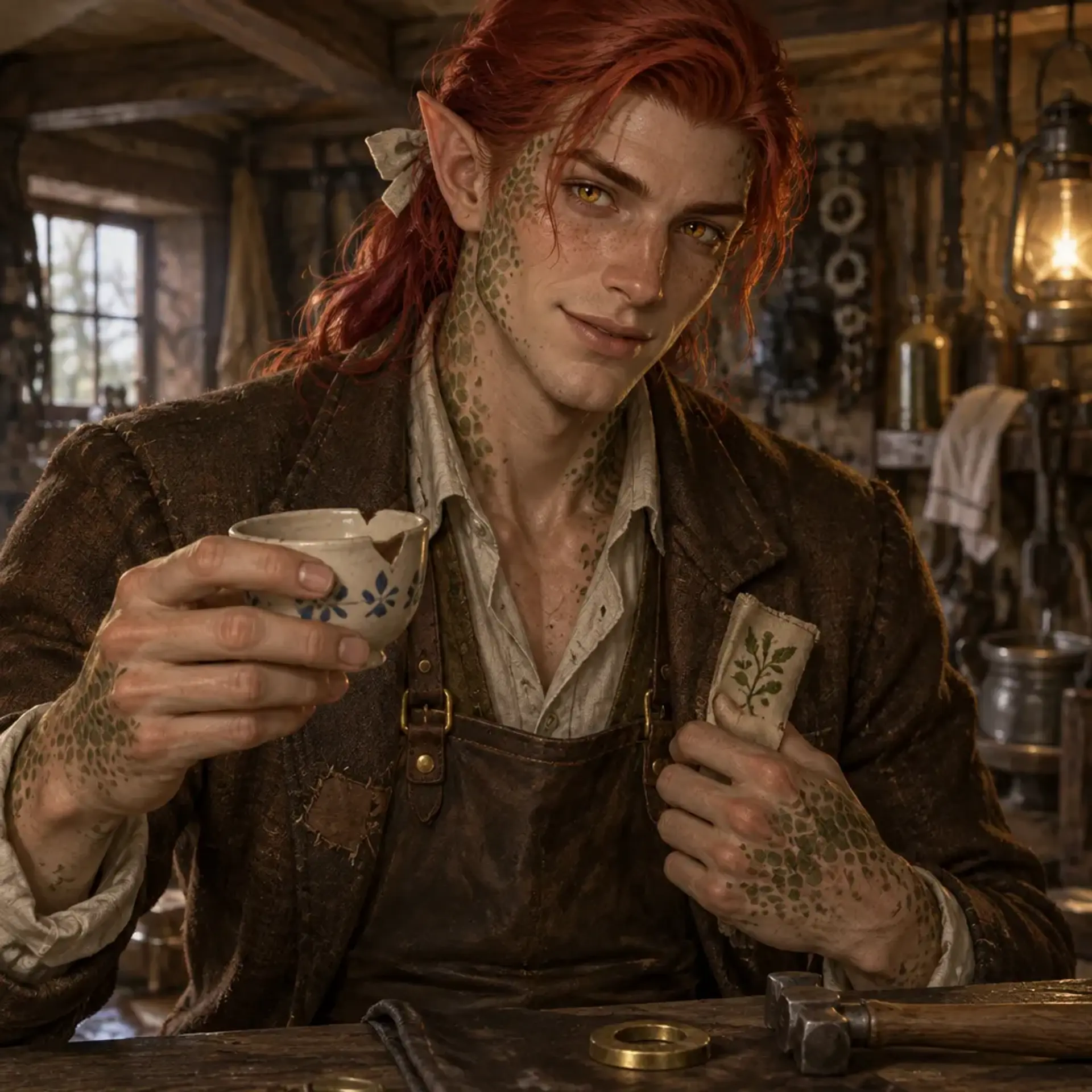
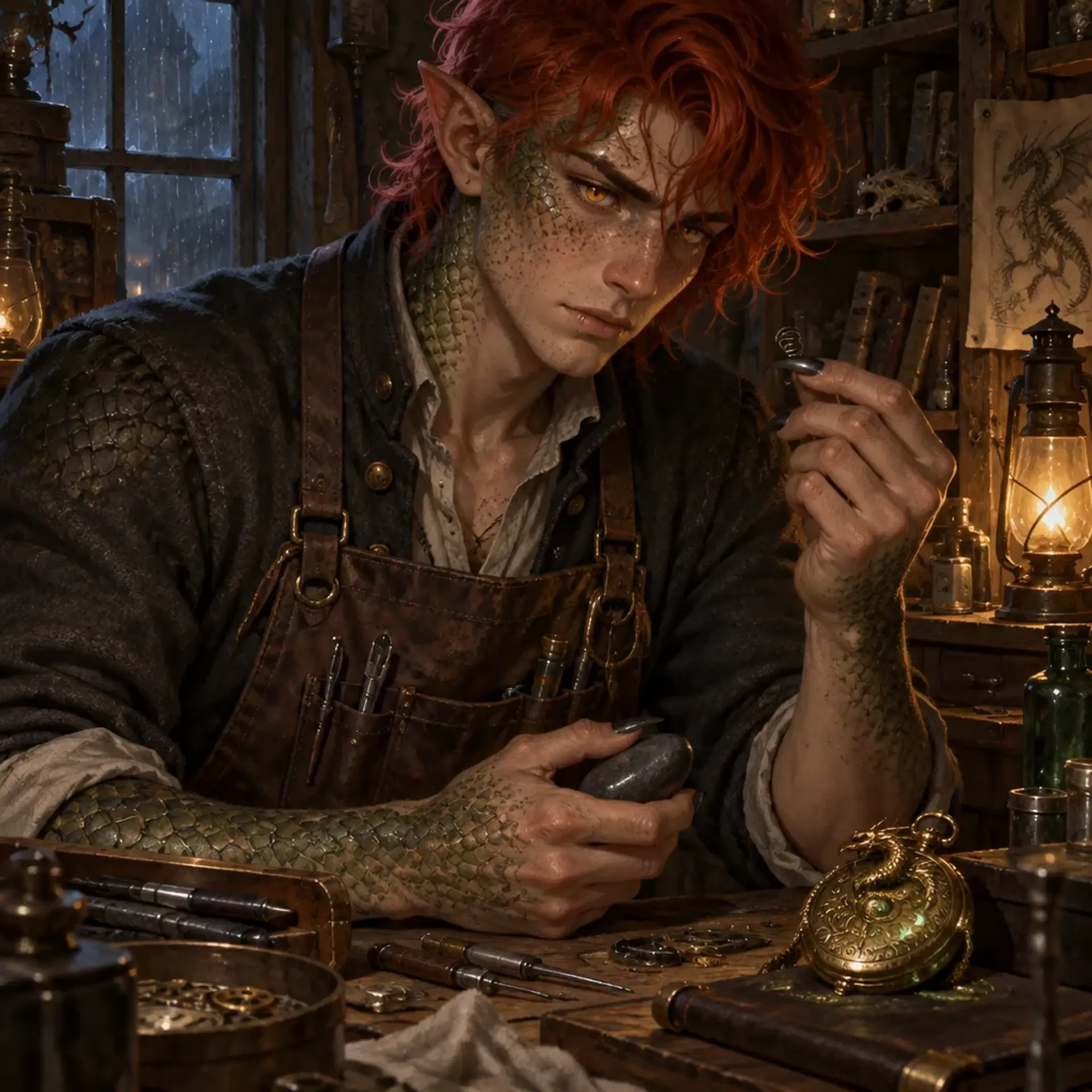
Eber is five feet ten inches tall, and in a room built around stout halflings he seems to occupy more space than his body alone should. Olive-green scales overlap his fair, freckled skin in fine, flexible plates, darkest along his shoulders and ribs and paler toward his hands. His vivid red hair, once auburn, falls in untidy waves around pointed ears. Amber eyes with narrow, draconic pupils track people with an unnerving stillness. His jaw is broad and subtly altered; when he speaks or smiles, the green-dragon teeth show, long and pointed, built to grip and tear rather than grind. He moves carefully through family rooms, turning sideways before anyone asks him to make room. Yet when he forgets himself, his long stride and easy strength can make a doorway feel suddenly narrow. The unexpected detail is the delicate, patient way he handles tiny watch springs, holding them between claw tips without crushing them.
Clothing
Fitted charcoal wool jacket with sturdy brass fastenings, a linen shirt, a leather work apron, and boots made by widening an old family pattern. His clothes keep the village’s German-influenced craft style, but the seams are repeatedly let out as he grows.
Body language
Eber folds his arms close to his ribs in the family home, trying to seem smaller than he is. Outdoors his posture loosens and his head turns in small, alert movements. He avoids smiling with his mouth open, but when amused he gives a brief, startled snort. His hands are steady over tiny mechanisms; when uneasy, he rolls a smooth stone across his knuckles.
- Height
- 5 feet 10 inches
- Build
- Tall and long-limbed beside his stout-halfling family, with wiry strength rather than bulky muscle.
- Eyes
- Molten amber with narrow draconic pupils
- Hair
- Vivid red, formerly auburn
- Skin
- Fair, freckled skin beneath flexible olive-green scales
- Age
- 19, a young adult by village custom
- Gender
- Male
- Size
- Medium
Distinguishing features
Personality
17 traits and drivesEber is clever, observant, and guarded, but not cold. He can spend an hour alone sorting gears, then linger in a doorway because he wants to hear his family laughing without having to join in. He dislikes being treated as fragile, yet he is quietly grateful when Wilma checks that he has food he can swallow. He resents the distance his new body has placed between him and his parents, but he knows their worry comes from love. When relaxed, he can be dryly funny and unexpectedly patient; when watched, pitied, or teased about eating, he becomes clipped and defensive. With children he is gentler than he is with adults, partly because they ask blunt questions without pretending not to stare. In the workshop he is precise and confident, even when the rest of his life feels unfamiliar. His cleverness can become suspicion: he notices small inconsistencies and sometimes assumes they conceal a threat. He wants the freedom to be solitary without being abandoned, and affection without being managed. His temper is not constant, but when it comes it is direct, especially if someone humiliates Ignatz or treats the younger children as specimens. He is learning that accepting help does not mean surrendering control, a lesson he understands in theory far better than in practice.
- Alignment
- Neutral Good, though his cautious habits can look selfish to people who expect open-hearted halfling sociability.
Quirks
Habits
Traits · 5
Flaws · 4
Fears · 4
Wants and needs · 4
Combat
AC 12 · HP 13 · 30 ft.Eber avoids a fair fight. He keeps distance, uses control and distraction spells, and places himself between danger and family members only when he must. He uses his bite as a last resort. If badly frightened, his magic may flare before he has fully chosen a spell.
Eber
Spells
Actions
Reactions
Services they sell
Rewards they can give
Equipment
- Brass spell focus (spellcasting focus)A small focus set into a brass watch casing, assembled from workshop scraps.
- Gizzard stone (personal item)A smooth, clean stone kept in a pocket for the digestive need caused by his altered body.
- Workshop apron (clothing)A sturdy apron with narrow pockets for springs, screws, and small tools.
- Light hammer (weapon)A compact hammer used for work and, if necessary, defense.
Possessions
Background
Eber was the eighth child of Trogi and Wilma, born into a family whose life revolved around a cramped workshop, a kitchen large enough for a dozen stools, and the gardens and chicken runs Wilma tended behind the house. His parents descended from stout halflings and kept the old village habits alive: work shared according to need, food placed in the middle of the table, and a name spoken aloud when remembering the dead. Trogi, black-haired and green-eyed, was the family’s quiet center, a craftsman who claimed he meant to retire while still reaching for the next tool. Wilma, white-blond and hazel-eyed, was warm, perceptive, and far more capable than she let the noisy workshop guess. They fished together at a nearby stream and worried that their children were inheriting more than scales. Eber grew up the baby, bundled among seven siblings who made the workshop seem like a world with its own weather. Windle, the eldest, was already steady and serious, with a future in management and a small family of his own: Otto and cheerful little Anika. Karl loved gears and tools, though his marriage to Leanora, a sailor descended from famous dragon hunters, was strained by long absences and old family tensions. Their household included Hansel and Ragni, a pale, white-haired child whose unusual coloring made village gossip linger. Yonda, the only sister, was beautiful, kind, and sociable, with five children and an instinct for coaxing Eber out among people. Her sons Hans and Birke had begun to show signs that made the adults exchange worried looks. Alder guarded the town when he remembered to be dependable, but merriment often won; his son, Black Alder, was a high-blooded cousin with amber serpent eyes and green scales. Kasper repaired watches and minded the garden and chickens, content with his small household and daughters Wonda and Ilse. For years Eber’s closest companions were Rodrick and Ignatz. They played in the woods or beside the river, making up contests and exploring places where the adults could not see them. Ignatz was careful and loyal; Rodrick was once kinder than he later remembered himself being. Eber assumed he would grow into an ordinary stout-halfling life: useful hands, a family place at the table, and a body that fit through the familiar doors. Then adolescence came like an illness without a name. His auburn hair turned startling red. His brown eyes became molten amber, his ears sharpened, and olive scales spread over his body. He grew far beyond his parents’ height. The worst change was his jaw. It reshaped painfully over weeks, and chewing became impossible. His new teeth could tear meat and fruit, but food had to be swallowed in pieces. His parents and siblings learned to keep smooth stones ready for him to swallow, as his draconic stomach needed them to grind what he ate. He hated the stones more than he admitted. Each one seemed to announce that the family meal was no longer a meal he could share in the same way. The first weeks were frightening for everyone. Trogi quietly altered benches and doorframes, then pretended the work was ordinary. Wilma searched for foods Eber could swallow safely, keeping a list beside her pantry. She could butcher chickens and fish, but the sight of Eber choking during his first attempts to eat made her go pale. Windle watched with a stoic fear that his own children might undergo the same change. Yonda brought company and encouragement, then gently urged him to be more social, not understanding that attention could feel like another physical burden. Karl tried to solve the problem with tools and recipes. Kasper measured small stones and kept them clean. The family’s care was real, but care could not make Eber feel at home in his own body. One night, not long after Ignatz’s own high-blood changes began, Eber woke to find him sitting beside the kitchen stove, unable to sleep. Ignatz had a new tail and claws, and the shame of an incident in which he had killed a chicken with his bare hands. Eber joined him on the floor. The next night Rodrick came too, pretending he was there because the kitchen was cooler. For a while, the three high-blood brothers slept together in the kitchen, too large for their old beds and too unsettled to admit they were afraid. The room smelled of ashes, flour, and damp wool. They learned to fold themselves around the table legs and wake one another when a nightmare turned into a snarl. Ignatz offered quiet company. Rodrick made jokes, sometimes cruel ones, but learned to stop when Eber’s anger sharpened. The shared nights became a family memory none of them discussed in front of the younger children. Rodrick’s later adolescence brought height, a predator’s build, reddish-tipped green scales, yellow eyes, and sorcerous power. He became blunt and arrogant, insisting he was only being honest. His teasing about Eber’s eating could cut deeply. He did not always understand why Eber shut him out, though he did stop when Eber became truly furious. Ignatz’s own changes were slower: grey-green scales growing more vivid, claws, sharp teeth, and a flexible tail. He withdrew from outdoor pursuits after the chicken incident and stayed close to the workshop. Eber remembered the boy who had once raced him by the river, and still trusts that boy more than Ignatz’s present silences. The village itself is changing. It began as a refuge for survivors who endured drowning, hunger, dangerous woods, and a volcanic eruption before settling near clear springs, fertile soil, and good fishing. Three generations later, the Greenwake Kin number roughly 447. Their timber houses, stone footings, steep roofs, and covered workyards still bear the marks of practical halfling life. Yet high-blooded descendants are now a majority. Some elders see them as a dangerous departure from communal ways; some youths see their strength and draconic heritage as proof that the old bargains made the people stronger. New displays of wealth, stricter gender expectations, and hunting prestige compete with household gratitude and shared meals. The old ritual that changed the families remains poorly understood. Some blame the green dragon whose blood altered them; others suspect one of her daughters or a rite left unfinished. Eber’s own magic appeared in small, unsettling ways: a flicker of green light when he was frightened, a breath that made leaves curl, and a whisper of draconic force that pushed objects across a workbench. Trogi urged him to learn control before the power frightened Wilma. Eber became a second-level sorcerer, studying through experiments, careful notes, and spells practiced alone in a covered yard. His magic has not made him eager to fight. Instead, it gives him a means of protecting a family that already worries about him. He has become quietly fascinated by bright, well-made objects. He collects polished gears, glass beads, brass fittings, and stones that catch the light. He tells himself they are useful; some are. He is also clever and watchful, able to spot which tool has been moved or which visitor has lied about a broken mechanism. Solitude suits him, but it is not the same as wanting to be abandoned. He still misses the warmth of his childhood and resents how much work it takes to fit inside it now. His current problems are practical and political. High-blood children need larger clothes and beds; the family has neither enough room nor money to meet every need. The workshop needs his labor, but Eber fears his strength and magic will make him a spectacle or a weapon. The village’s growing dragon worship alarms him. A secret circle is exploiting the people’s fear and divisions, while a returning green dragon patriarch treats the community as useful pawns. Eber does not know the circle’s full reach, but he has noticed that some visitors ask too many questions about his family’s changes and the old ritual. He wants to protect the workshop and his siblings without becoming the sort of creature who values power above kin. His work with small mechanisms, his observations of the village, and his reluctant magical training may make him one of the few people positioned to notice what the adults are missing.
Role in the story
A young family member whose bodily transformation makes the village’s larger conflict intimate. Eber can offer practical skills, an outsider’s view of family tensions, and clues to the secret circle, while giving the party a personal stake in the fate of the Greenwake Kin.
“Trogi, black-haired and green-eyed, was the family’s quiet center, a craftsman who claimed he meant to retire while still reaching for the next tool.”
- Faction
- The Greenwake Kin, especially the family workshop and the household network around his parents. He is wary of the growing dragon-worshiping circle and has no allegiance to it.
Known connections
Media
0 imagesNo images yet.
Turn Eber into a sheet
A high-res, share-ready sheet you can post or print.