William Windon
William Windon
At the table
Voice
His voice has a dry edge from country air and a slight catch from his habit of holding his breath. When rattled, he gulps air in short, audible pulls and his sentences break apart. The stranger's voice uses the same throat but seems to settle lower in the chest, with a dry consonant bite and the brisk confidence of someone correcting a badly kept room.
William speaks in a careful, locally rooted English, with a measured pace learned from trying to sound sensible. He often begins with a qualification such as 'I may have this wrong' before describing something he knows he saw. His breath catches at the start of a difficult confession. The reflection's voice comes through his own mouth in a lower, older-sounding register, with clipped phrasing and a dry, almost domestic disdain.
Speech patterns
How to play them
Begin with practical questions and a guarded account of the heart. William needs evidence that the listener will not dismiss him as ill or foolish. If treated patiently, he describes the hammer blow and the independent reflection. If pressed aggressively, he retreats into denials and watches the nearest glass. These statistics and harm notes are custom placeholders for this response, not verified Secret Histories rules.
Goal
Find Abraham Gorff and the returned heart, learn what the reflection is, and separate it from himself without endangering his family.
Motivation
William wants to regain ownership of his body and face, but he is also fascinated by the stranger's knowledge and fears that separation may erase the only witness to what happened.
Appearance
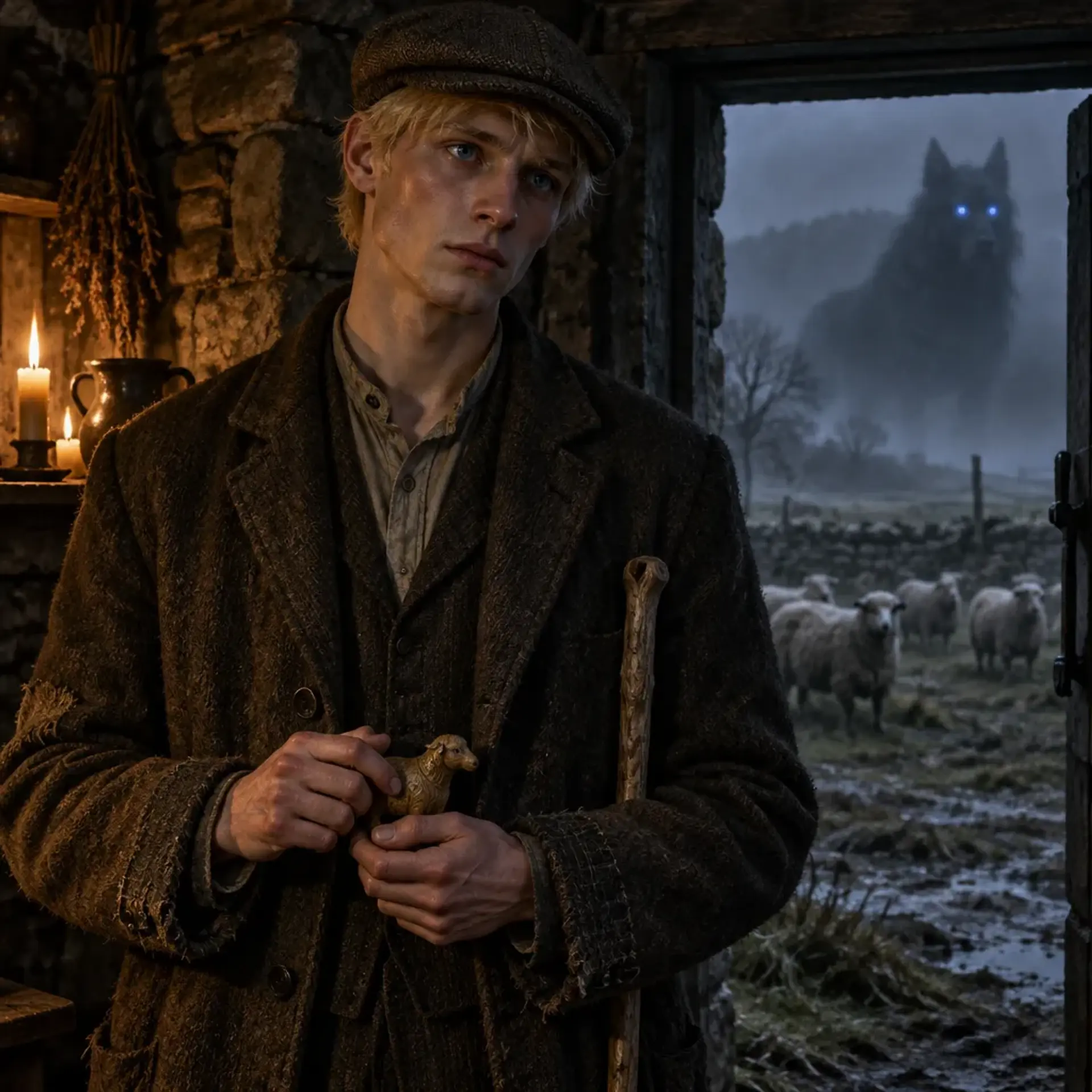
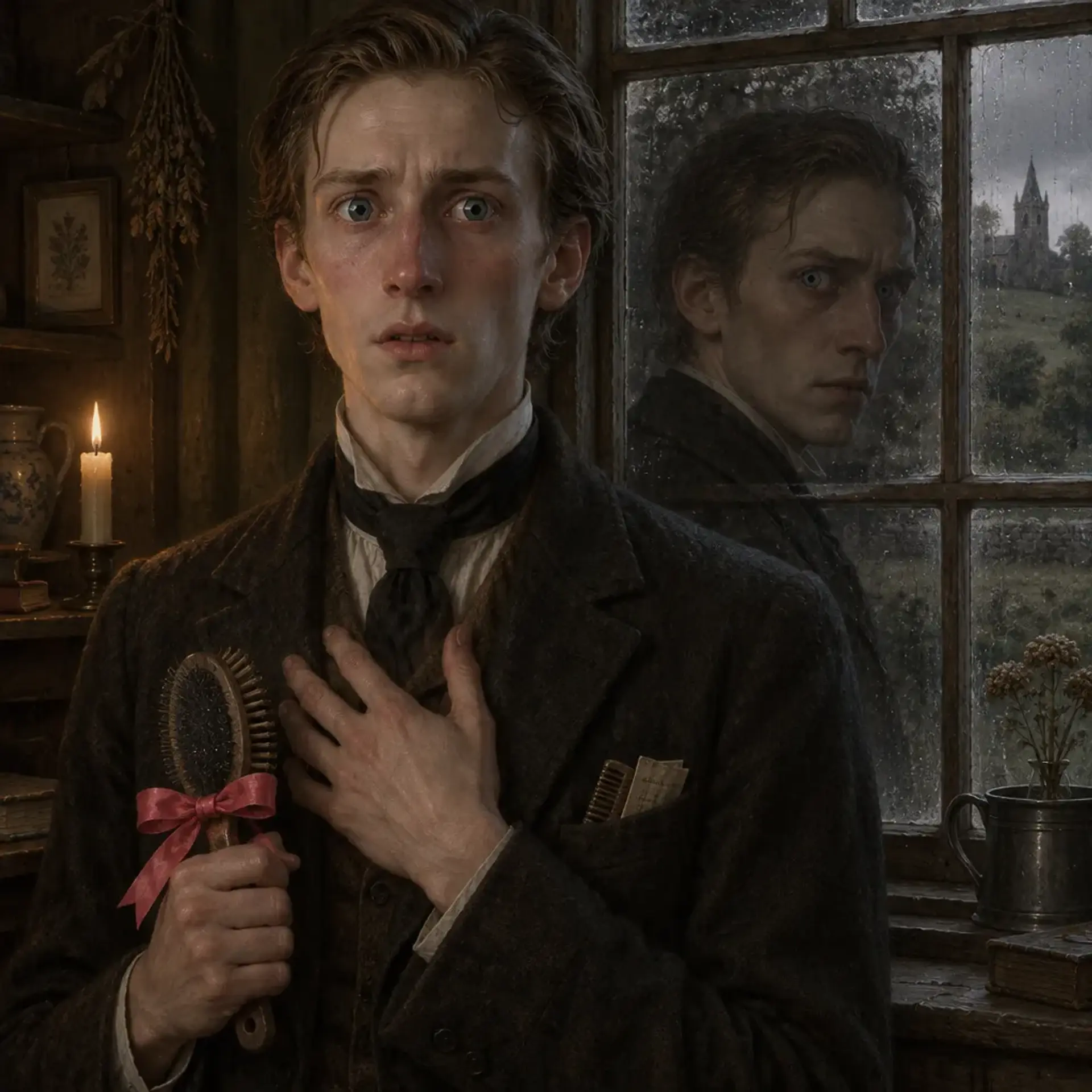
William Windon is long-faced and lanky, with the slightly unfinished look of someone who has only recently grown into his height. His skin is pale with a wind-reddened nose and small, ordinary blemishes; his face is not handsome so much as carefully arranged. He has unusual hexagonal pupils, a detail people often mistake for a trick of the light until they look twice. His dark blond hair is combed back with exacting care, every strand kept in place with water and a dab of pomade. He moves with the self-conscious stiffness of someone trying not to jostle a precious object in his pocket, though the pocket has long been empty. When startled, he holds his breath so completely that his lips blanch. He gives the impression of a tidy young man being slowly crowded out of his own reflection. Unexpectedly, he has an almost compulsive fondness for bright, childish ribbons, and has one tied around the handle of his hairbrush.
Clothing
A brushed, carefully maintained Sunday coat over a plain shirt, narrow trousers, and sturdy boots suited to muddy lanes. He favors a neat neckcloth and keeps a small comb in his pocket. A bright ribbon tied to his hairbrush is his incongruous private indulgence.
Body language
He stands very straight when trying to appear composed, shoulders drawn back and chin slightly lifted. When frightened, the pose collapses inward: elbows tight to his ribs, one palm pressed over his sternum, breath held until his face reddens. He smooths his hair whenever someone looks at him too closely.
- Height
- About 5 feet 10 inches
- Build
- Lanky and narrow-shouldered, with the recent, awkward length of a young man who has grown quickly
- Eyes
- Blue-grey, with distinctly hexagonal pupils
- Hair
- Dark blond
- Skin
- Pale, with a wind-reddened nose and cheeks
- Age
- Young adult, about nineteen
- Gender
- Male
- Size
- Human
Distinguishing features
Personality
17 traits and drivesWilliam is proud of being dependable and embarrassed by how badly he wants someone else to take charge. In company he is courteous, tidy, and eager to pass as sensible; alone, he speaks aloud to the reflection and sometimes argues with it as if they were brothers. He can be generous with practical help, but he resents pity and reacts badly to being treated as a child. When calm, he is observant and unexpectedly funny. When frightened, he becomes exacting, correcting small details because the larger truth is too large to hold. He is both repulsed by the stranger and drawn to its certainty. Its sarcasm can make him laugh before he remembers to be afraid. He wants to protect his family from the whole affair, yet his secrecy has already made them less safe. The reflection's comments expose the part of him that would rather be judged by a cruel voice than admit how lonely he is.
Quirks
Habits
Traits · 5
Flaws · 4
Fears · 4
Wants and needs · 4
Combat
HP 3 · Ordinary walking pace; no special movementWilliam is not a trained fighter. He avoids violence, tries to make space, and seeks an exit or a barrier. If cornered, he swings his iron poker once and retreats. The reflection may speak at a crucial moment, but it does not reliably improve his fighting ability.
William Windon
Actions
Reactions
Rewards they can give
Equipment
- Iron poker (tool)A sturdy iron poker he carries when traveling alone. It is a household tool, not a weapon he knows how to use well.
- Grooming kit (personal effects)A small comb and a glass bottle of pomade, carried as if meticulous grooming could keep the stranger in order.
- Ribboned brush (personal effect)A hairbrush with a bright ribbon knotted around its handle.
Possessions
Background
William Windon was born in Wiltshire, in a family that had stayed in the same scattered patch of country for generations. He grew up among ordinary inherited things: a kitchen table polished by elbows, a lane that turned to mud after rain, and relatives who regarded leaving as a kind of complaint. His mother, Bess, kept the household moving with practical warmth. His father was often away doing seasonal work, and William learned early that being useful was a safer way to be noticed than being difficult. He is not a farmer by temperament, though he knows the smell of wet earth and the difference between rain that will pass and rain that will soak through a coat. At seventeen, William met Abraham Gorff, a London visitor who had brought home a strange stone heart. The object was said to have been offered at the Hush House by an amateur visitor as payment for entry he was never permitted to make. Abraham had thrown it into the sea. It returned to shore, wet with salt water and black ooze, its surface changed from cliff-white to a faint red-pink beneath the stone. It resembled a human heart crudely shaped from Dover chalk, crusted with barnacles and strands of sea grass. Abraham found that it beat when kept near him, and that it fell still when shown to other people. He came to believe it disliked company. His house filled with footsteps, voices, and doors moving on their own. Eventually, frightened and exhausted, he sold it. William had been among the neighbors who saw the heart apparently die in company. He bought it partly out of curiosity and partly because he wanted to own one thing that was unmistakably his. At first he showed it off. Then he noticed its pulse answering his own, a small rhythmic pressure beneath his coat. After tasting seawater, blood, and dark soil in his mouth, he decided the stone was either a fraud or a threat. He took a hammer to it. The blow landed on the heart, but pain shot through his chest as if the hammer had struck him. He fell, choking and groaning in a voice that did not sound like his. For a fraction of a second he saw something inside the stone flex like living muscle. His mother found him collapsed and said his heart had stopped. William woke beneath her hands, with the hammer still on the floor. He hid the heart in a hollow log, intending to return once he had calmed down. Days later it looked cold and pristine, apparently unaffected by the hammer. Then it vanished. William has never decided whether it crawled away, was taken, or was never in the log at all. In the days after, he began seeing a stranger in reflective surfaces: a long-faced young man with short, well-kept dark hair and pond-blue eyes, wearing a stern expression. The stranger's movements lagged behind William's, then began to differ. It would turn its head when William did not, or watch him groom himself with open disapproval. One morning it spoke through William's mouth. Its voice had the weight and phrasing of an older generation, and it criticized his hair as if it had known him all his life. William started searching for Abraham Gorff, only to learn that Abraham had moved to Canada. He wrote letters, asked neighbors, and followed every rumor of the stone. He has not told his mother the full truth. He says the trouble is an illness and that he is looking for a doctor. Bess knows he is frightened and suspects he is keeping something from her, but she has not forced him to confess. William's younger cousin Tilly is the only person he has trusted with part of the story; she thinks his reflections are a prank until she sees the stranger move independently in a dark window. William is protective of her and furious with himself for involving her. The stranger's presence has grown more personal. William sometimes wakes to find his hairbrush set at a different angle, his clothes rearranged, or the ribbon he tied to the brush knotted differently. The reflection comments on his appearance and on people passing by, with dry, old-fashioned contempt. It has called a neighbor's hat 'a bucket that lost its argument with a scarecrow' and described William's Sunday coat as 'a funeral for a boy who has not yet had the decency to die.' William cannot tell whether the stranger is the heart, someone trapped inside it, or a memory that has mistaken him for its home. His current problem is immediate: the reflection is beginning to appear even when there is no glass. He has heard its voice come from a darkened room while he was alone, and once found damp, black grit on his pillow. He needs to find Abraham, recover the heart, and discover whether destroying it would free him or kill him. He also wants an ordinary life, though he is increasingly unsure what ordinary means when his own face is becoming a guest in his mirrors.
Role in the story
A frightened witness and possible living link to the heart. William can lead the players toward Abraham Gorff, reveal that the heart responds to water and company, and complicate any attempt to treat the object as a simple relic. His growing bond with the reflection makes him an ally, a danger, and a mystery at once.
“His mother, Bess, kept the household moving with practical warmth.”
Known connections
Media
0 imagesNo images yet.
Turn William Windon into a sheet
A high-res, share-ready sheet you can post or print.