William Groff
William Groff
At the table
Voice
William's voice is ordinary and youthful, with the slight breathlessness of someone still recovering from a serious illness. His gardening work has taught him to speak plainly and to wait before interrupting. Wilt uses the same throat but changes its placement: a firmer, older-sounding voice with a dry rasp, precise consonants, and an unmistakably local Wiltshire accent. When Wilt is frightened by the siblings, it can speak sharply and commandingly. William dislikes hearing the difference because he can feel it as well as hear it.
William speaks in a young, plain Wiltshire voice, shaped by garden work and local life. When anxious, he restarts a sentence or chooses a more careful word. Wilt's voice comes from the same mouth but sounds older and deeper, with a pronounced Wiltshire accent and the measured certainty of someone raised on stricter manners. Its texture is dry and slightly rough, like a voice unused to speaking aloud. In moments of fear, Wilt may become abruptly forceful rather than softening. It does not always speak aloud: sometimes William's lips move with Wilt's words before William understands what is being said.
Speech patterns
How to play them
Treat William as a frightened but thoughtful young man rather than a monster or a puzzle. Give him privacy and concrete choices. Wilt responds better to direct questions than to accusations, but will become cutting if someone mocks William or violates the household's manners. Mirrors, quiet rooms, and an invitation to discuss the landscape can help establish trust. Do not assume either has full control or understanding.
Goal
Keep his identity and family intact, learn what the coastal siblings want, and find out whether Wilt can exist without consuming William.
Motivation
William wants a life that belongs to him, built from plants, study, and ordinary affection. Wilt wants shelter from his siblings, access to the unfamiliar world of modern life, and a bond with William that he cannot yet explain.
Appearance
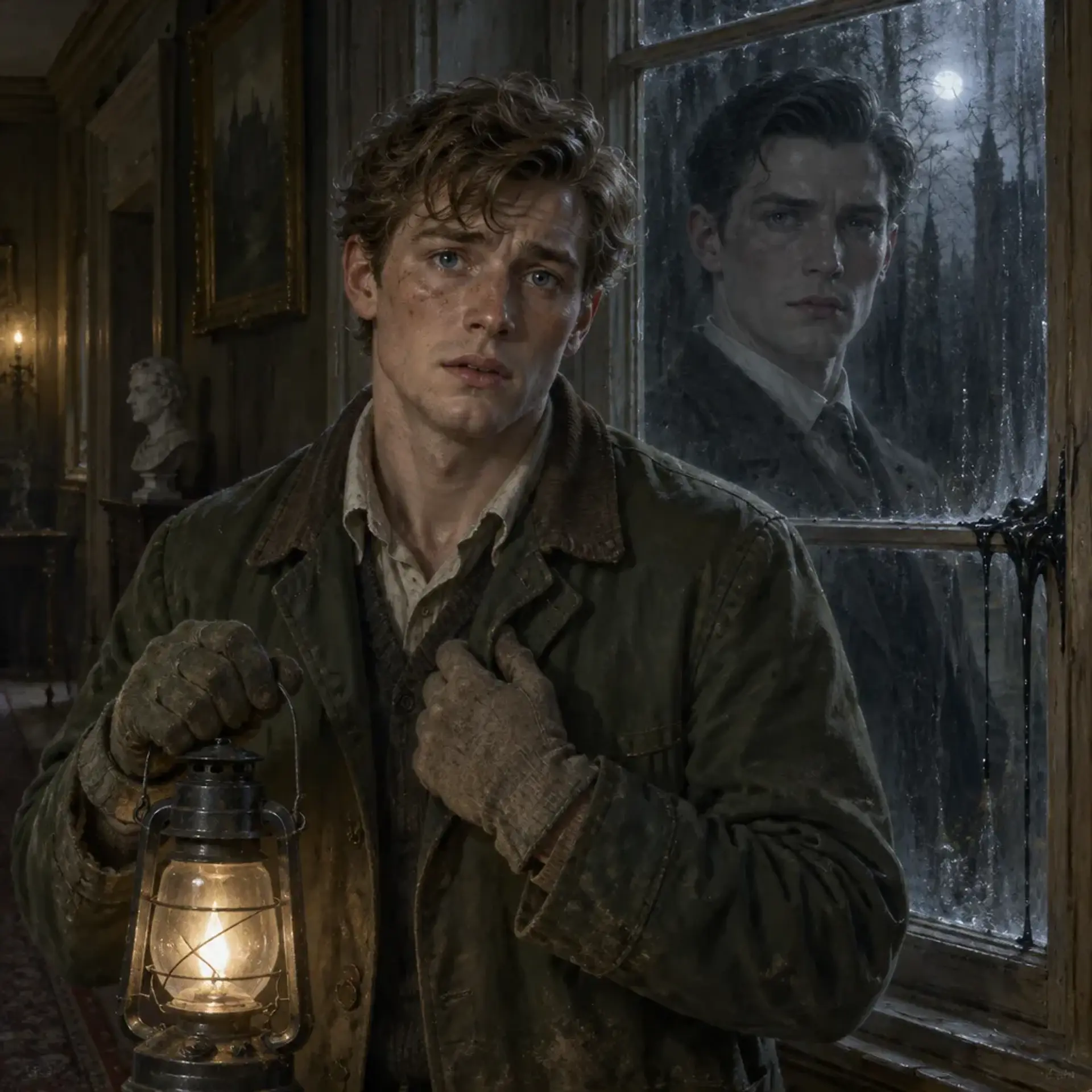
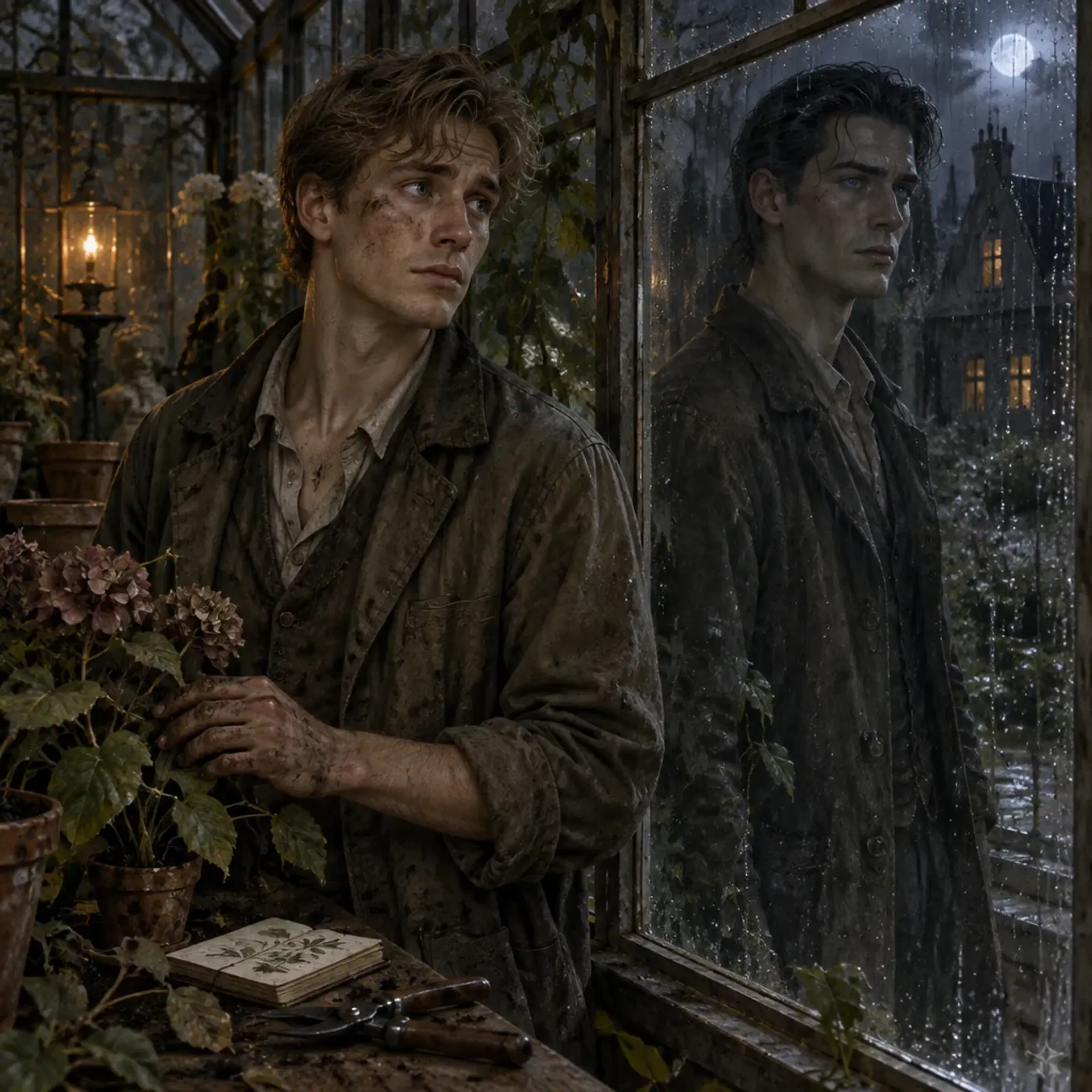
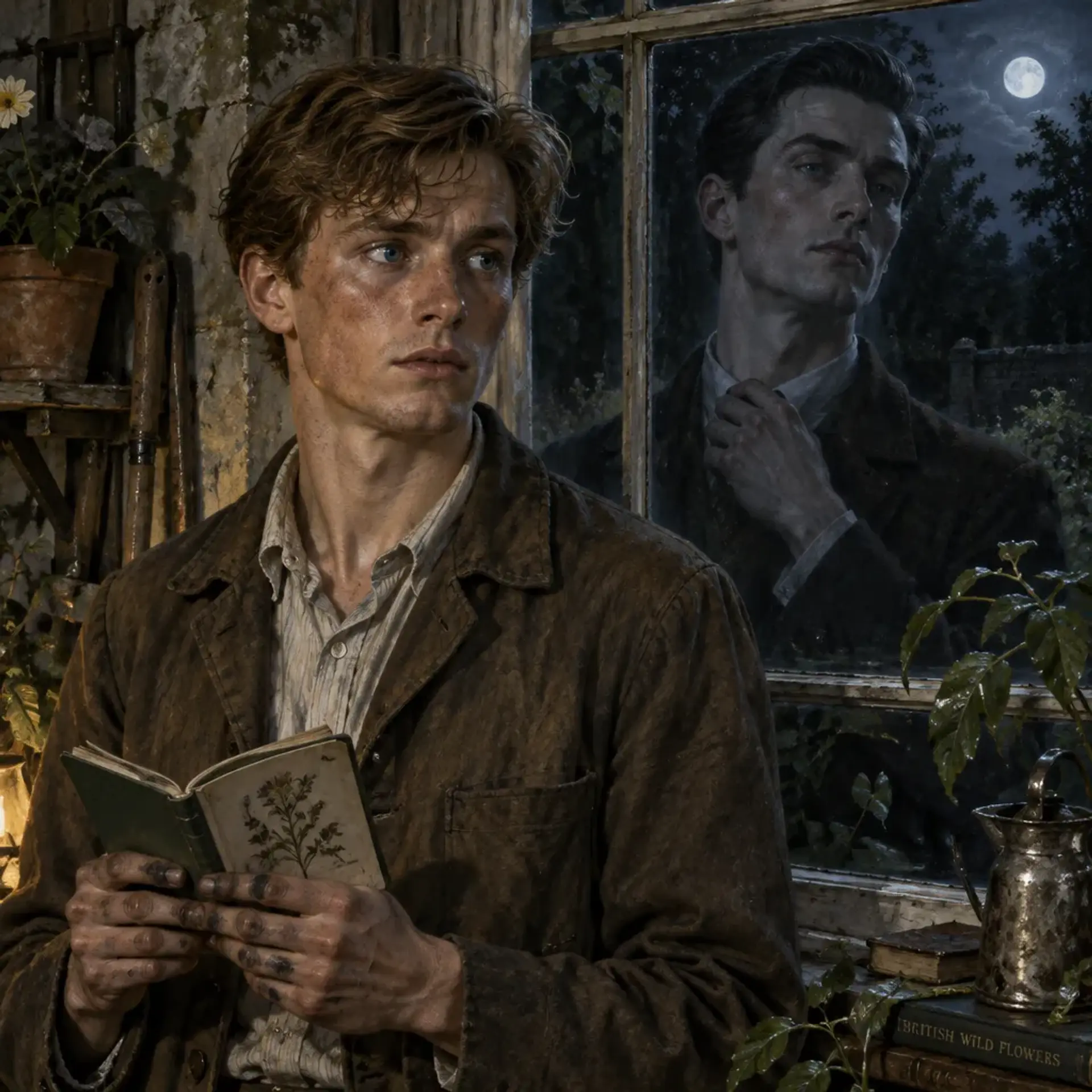
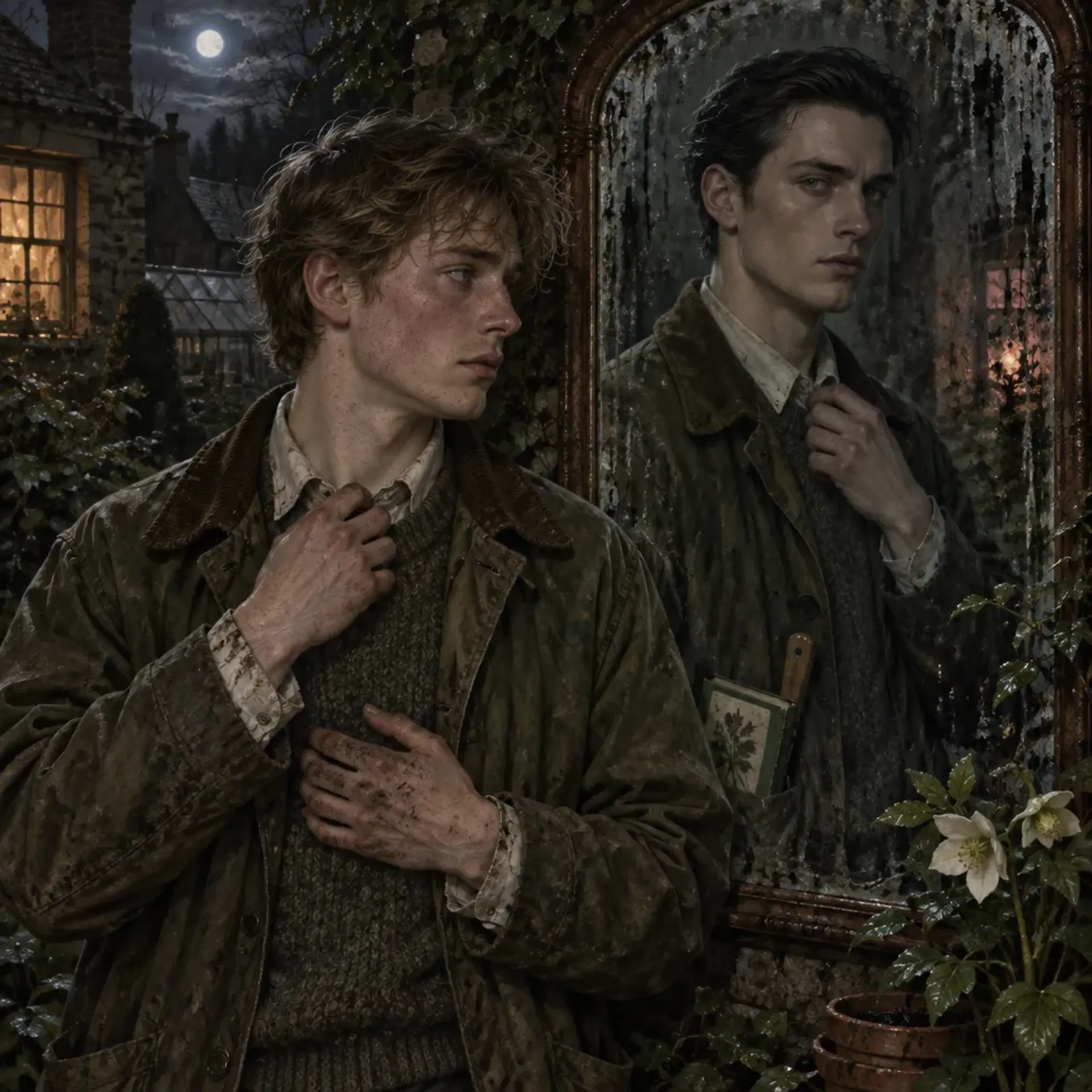
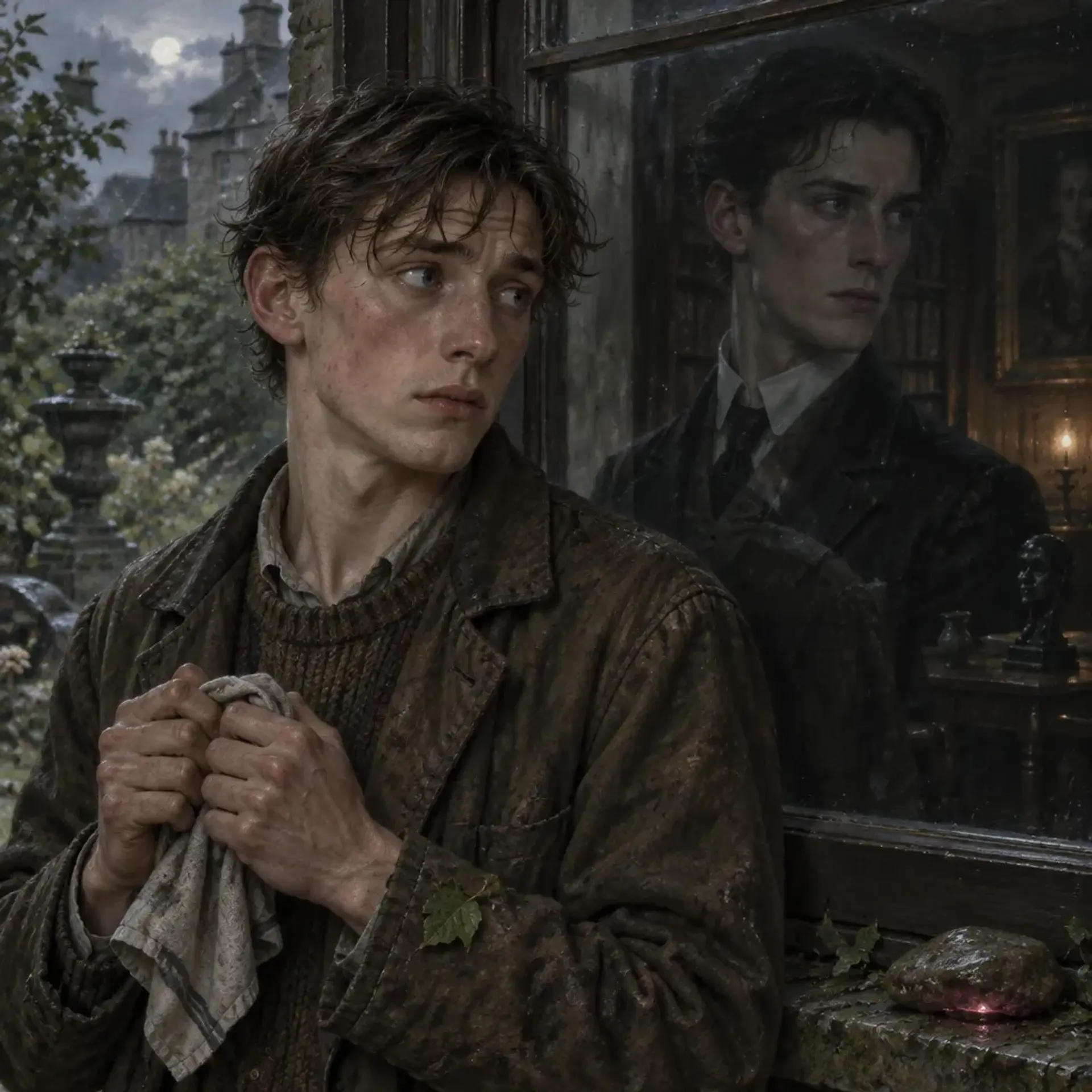
William Groff is an average-height young man for his Cold War era English setting, with a gardener's practical strength and a tendency to fold inward when scrutinized. His clothes usually carry a faint trace of cut stems, soil, and damp wool. He moves gently around plants, as if reluctant to bruise anything, but his hands become abruptly rigid when a reflection moves without him. Wilt appears in glass and water as a taller, more handsome young man with a long face, neatly combed short black hair, trimmed sides, and cool blue eyes. He wears whatever William wears, but holds it with a stiff, composed precision William cannot imitate. Wilt's eyes do not meet a person's gaze first. They inspect exits, door hinges, the corners of a room, then the person's hands. A worn pocket handkerchief, permanently rubbed thin at one folded corner, is the object people notice William worrying between his fingers. In a mirror, Wilt sometimes uses it with the solemnity of a ritual. The unexpected detail: despite his unnerving, almost courtly appearance, Wilt is avidly curious about television sets, cars, and household electronics, studying them with the absorbed wonder of a child at a tide pool.
Clothing
Work trousers, practical shirts, knitwear, and a gardening jacket that often carries bits of leaf and soil. Wilt appears in the same clothes but arranges them with old-fashioned precision. For tea, Wilt insists on proper dress and correct table manners, to Hector's irritation.
Body language
William tries to make himself unthreatening, shoulders rounded and hands busy. When frightened, he touches the thin corner of his handkerchief and checks the nearest glass. Wilt stands straighter, turns his head as if listening through walls, and makes small exacting adjustments to cuffs, collars, and hair. When hiding from his siblings, William's body curls tightly beneath furniture, though Wilt's stillness remains painfully alert.
- Height
- William is of average height for a young man in his Cold War era English setting. Wilt appears taller.
- Build
- Average, lightly wiry, with the practical strength of someone accustomed to gardening. Wilt's manifested form is noticeably taller and more composed.
- Eyes
- William has blue eyes. Wilt's reflection has blue eyes like moonlight over a freshwater pond.
- Hair
- William's hair is dark blond. Wilt's reflected and manifested hair is short, practical black, combed back and trimmed at the sides.
- Skin
- Fair, with a tendency to look pale after exertion or a cold night.
- Age
- William is 18. Wilt's reflection appears about 18, though its voice and manner suggest someone from an older generation.
- Gender
- Male
Distinguishing features
Personality
18 traits and drivesWilliam is tender without being meek: he notices when people are uncomfortable and tries to help, yet can stubbornly refuse to look away when fear tells him to hide. He longs for his father's approval but resents the way Hector treats his interests as small. Among friends he is warmer and more spontaneous; at home he has become watchful and evasive. When ill or exhausted he retreats into quiet routines. Wilt pulls against him in almost every way. Wilt is formal but curious, judgmental but capable of tenderness, and proud of old customs while delighted by television, cars, and electronics. He can be cruelly funny about Hector and William's clothes, then offer a memory in apology after causing genuine distress. He is possessive of William's body and jealous of Adaline, but also afraid of the sea-born siblings and dependent on William's companionship. Neither is a simple villain or a reliable narrator of the other.
- Alignment
- Not applicable as a canonical Secret Histories statistic. William is compassionate and protective; Wilt's ethics are old-fashioned, possessive, and still forming.
Quirks
Habits
Traits · 5
Flaws · 4
Fears · 5
Wants and needs · 4
Combat
HP 0William avoids fights and tries to escape, protect someone, or use the house and garden as cover. Wilt is not a trained combatant. If cornered, he uses sudden borrowed strength, an improvised tool, and confusing reflections to create an opening. His priority is avoiding the siblings and preventing a full manifestation, not winning a prolonged fight.
William Groff
Actions
Reactions
Services they sell
Rewards they can give
Equipment
- Worn handkerchief (personal item)A soft, ordinary handkerchief rubbed thin at one folded corner from nervous handling.
- Gardening tools (work equipment)Practical gardening tools used for estate work. Wilt may conceal or relocate a small tool without telling William.
- House key (utility)A household key William uses while checking doors and windows at night.
Possessions
Background
William Groff was born in Wiltshire into a family that had lived in the county for generations. He grew up in a house where the past was never quite settled. His father, Hector, is a historian, a man who can spend an evening dismantling a patriotic story and the next morning insist that his own son stop wasting time on plants. Hector dislikes inherited rank and rigid custom, calls himself modern, and is drawn to artists and political arguments. Yet he is secretly involved with an occult circle, a fact he has concealed from Clare, his wife, and from William. Hector's contradictions shaped William: he learned to distrust pomp, but also learned to crave approval from the man who taught him that old ways were foolish. Hector's own father, known as Bobby, had been a fierce veteran of the Second World War. Hector dismisses parts of the war's history, partly from conviction and partly because his father's shadow has never left him. He is proud of William's studiousness until William chooses gardening and botany over the more intellectual future Hector imagined. William's mother, Clare, is warm without being demonstrative. She makes time to garden with him, reads while he works, and brings him tea and snacks. Her kindness does not demand a performance. William's sister Elizabeth is sharp, curious, and more attentive than she lets on. She enjoys asking questions in ways that make William stumble into an unfamiliar voice, and has privately called his condition 'brain damage.' The joke began as teasing. It is becoming a way to name what scares her. William's friends Tommy DeHare, John Mollask, and Ryan O'Leary have seen enough odd moments to know something is wrong, but not enough to know what. His girlfriend, Adaline, has auburn hair and soft brown eyes. Wilt's interest in her has made William's private struggle humiliatingly personal: he has discovered that his most persistent rival can borrow his face and his voice. William works as a gardener on an estate and is training himself toward botany. He likes the visible consequences of patient work: a bed weeded, a cutting rooted, a sick plant given a second chance. He was once softer and more easily hurt than he wanted to admit. His father regarded that gentleness as a lack of ambition. William's life turned when he saw an odd object in the possession of a local lad, William Windon, and later heard of the object's history. The thing had once been offered at Hush House by the amateur alchemist Bartholomew Golden, who called it the Heart of England. Golden said it could bring servants from man's shadow, from chalk cliffs and borderlands, born to labor for a house. The object looked like a human heart carved from Dover chalk, crusted with barnacles and sea grass. It was wrapped in newspaper as payment for entry, and Golden was barred from Brancrug afterwards. The heart was thrown into the sea and returned to shore, wet with salt water and black ooze. Beneath the stone a red-pink hue seemed to return, like blood or a light waking under the rock. Abraham Groff, a young Londoner unrelated to the later William despite the shared surname, picked it up and took it home to Wiltshire. It beat beneath his coat after a train journey. Neighbors saw it go inert; near a Hampshire shore, water revived its color. Abraham became convinced it was special and his, not from greed but because he sensed it disliked company. Voices, footsteps, and moving doors followed. He sold it to William Windon, a seventeen-year-old local who had once seen the heart. Windon felt its pulse in his own chest, tasted ocean, blood, and soil, and struck it with a hammer. The pain transferred to his body. He collapsed, groaning in a voice unlike his own, and briefly saw muscle twitch under the stone before he himself seemed to die. His mother, Clare, revived him. He abandoned the heart in a hollow log. Days later the stone appeared cold and pristine, untouched by the hammer. William Groff did not possess the stone, and neither he nor his family knows its name or purpose. The heart's connection to Wilt remains unknown to them. William's first warning came through his reflection. He would find a long-faced young man in a mirror, black hair groomed carefully back, blue eyes like moonlight over a freshwater pond, and an expression of unearned sternness. At first it was only a nuisance. The image's movements jerked out of time. It disapproved of William's grooming, clothing, and manners. Then one evening the reflection spoke through William's moving mouth: 'Well, it's not often you use that one.' Its accent belonged to an older generation; its voice seemed deeper than William's. It could speak through his body when it thought itself alone, and sometimes stopped William from saying something it judged improper. It made cutting remarks about Hector and the neighbors, leading William to muck out a neighbor's stables after Wilt used a slur about a Welsh child who had accidentally knocked into him with a toy wagon. William never repeats the word. The first time William saw a war film on television, Wilt took control of his body. William experienced a panic like shell shock, screaming and cursing while his family struggled to hold him. Elizabeth changed the channel. Hector looked at him differently afterwards, and William feared that his father had seen not illness but something that confirmed his own hidden suspicions. When William recovered control, Wilt apologized in a low murmur and offered a memory as consolation. He began to explain himself in fragments: a father, siblings, a dark wood, a forge, salt, and the sea. He speaks of them not as people with ordinary lives, but as one might speak of weather or a sensation. Wilt loves books and films, sneaks through the house, and has hidden cigarettes, cigars, cheese, sweets, tinned fish, a knife, and even a bottle of alcohol under William's bed. He likes alcohol far too much. One night, after Hector left whisky and bourbon in the house for William's health, Wilt drank it and became riotously cheerful, teasing, arguing, singing, and nearly taking off William's shirt as an act of rebellion. When William asked if he was the stone, Wilt scoffed, 'Dad isn't here.' The following morning Clare found the empty bottle. Hector yelled, then abruptly stopped and offered William tasks around the house. The strange domestic bargain exposed Hector's fear: he was trying to keep his son occupied, or to test what would happen. Five months after William's heart stoppage, he has returned to gardening work. His mother remains warm and steady. Hector is increasingly suspicious. He watches William's pauses, asks why he avoids windows, and notices objects moved in the house. He has not told his family about his occult circle. He worries that he has brought something into his home, though he does not know what, and fears William's silence means his son hates him as Hector once resented Bobby. Elizabeth has become a quiet observer. Her boyfriend, Romy Brock, is an artist who plays rock and roll on guitar and remains blissfully unaware of the danger. William and Wilt have learned that the presence outside the house is not merely a haunting. On a cold moonlit night, William woke unable to move. The body that was his lay rigid under blankets while Wilt used William's mouth to whisper that his sister was outside looking for him. A voice seeped through the walls, calling a name that sounded like 'Wilt.' William tried to speak. Wilt clamped his mouth shut. William's body rolled silently to the floor and crawled under the bed, driven by a fear that felt older than his own. 'The bloody hell, your siblings?' William demanded in his mind. Wilt paused. A thick Wiltshire accent came through, unlike William's own. 'She is trying to draw me out.' Wilt told him that every word gave her a chance to find him, that they would talk in the morning. William resisted, but he could feel that Wilt was not merely wrestling for control. Wilt was hiding. In the darkness beneath the bed, moonlight shifted across the walls. A shape outside seemed to alter with the passing clouds. They stayed there for what felt like hours. William heard wet grass drag against the outside of the house and smelled salt, damp soil, and something like fresh blood. At some point he stopped fighting. He does not remember falling asleep. He woke beneath the bed in the grey morning, cramped, cold, and ashamed. He pushed himself out and went straight to the bathroom mirror. Wilt was still there, composed and fully dressed in William's clothes. William pressed his palm to his face. The features felt like his own again. Wilt gave him an oddly plaintive gesture and said, 'See? You're fine now.' The reassurance did not make William feel fine. He went outside to check the ground. The air smelled of salt water, damp grass, and black ooze. Something had been there. Wilt wanted to hide; William made himself look. He asked, calmly, whether Wilt's name was Wilt. After a long pause, Wilt said yes. Neither knows what the name means, or whether it is even a name in the usual sense. Since then, the siblings have appeared again at night. They seem able to wake Wilt into a tangible presence. William locks doors and windows, including the second-floor bedroom window. He avoids windows when the air smells of salt or meadow grass. He and Wilt found an old window in Hector's study, hidden behind a bookcase and sealed shut, and a bricked cellar that predates Hector's purchase of the house. A breeze sometimes reaches them anyway. William has started searching Hector's study for answers, carefully avoiding waking his family. There he finds evidence of his father's private occult work. Hector is growing more suspicious of William's nighttime absences and of the way the study seems disturbed. William has begun to haunt his own home in Wilt's face. During brief, unwanted manifestations, his appearance is replaced by Wilt's: taller, more handsome, black-haired, stern. He moves through the halls to inspect the sealed window, test the cellar, retrieve clues, and learn whether the outside presence can enter. When a family member catches sight of him, the result is not a clean revelation. Clare sees a stranger who wears her son's clothes and says William's name with William's mouth. Elizabeth is frightened but approaches rather than screams. Hector reaches for a lamp and demands to know what William has done. William fights to return to his own face. Wilt freezes, because the visitor outside may notice the moment he is fully present. They manage to make the sighting look like a confused, half-lit glimpse, but the family cannot forget it. Hector's questions become more precise; he begins checking doors, windows, and his study, and he treats William's explanations as possible lies. William is caught between protecting his family and concealing the very thing that makes their house unsafe. Wilt is no ordinary ghost. The hard truth, which neither of them understands in full, is that he is not human in the ordinary sense, nor quite a dead person. He is a glimmering of Wiltshire, something that might be mistaken for a ghost, summoned by a practitioner to serve a house. The heart may have made him, anchored him, or merely given him a way to appear. Wiltshire has finally found a human soul with which to mingle. William is that anchor. Wilt's appearance may replace William's over time, while William's separate self fades, leaving something that is, in a sense, Wiltshire. Neither William nor Wilt knows this. Wilt's fear of the siblings, his strange knowledge of history, his tenderness toward the land, and his erratic attachment to William are clues, not answers. The possible destination is left deliberately uncertain: perhaps William can keep his own life, perhaps Wilt can learn to be more than a servant, or perhaps a county's memory will slowly wear a human face.
Role in the story
A sympathetic, unstable ally whose body is shared with a land-born presence. William's home, family, and identity are all becoming contested territory. He can lead the characters toward the Heart of England, Hector's occult circle, and the siblings on the coast, while making clear that saving one person may endanger another.
“He grew up in a house where the past was never quite settled.”
- Faction
- No confirmed faction affiliation for William or Wilt. Hector secretly belongs to an unnamed occult circle; William does not yet know its full nature.
Known connections
Media
0 imagesNo images yet.
Turn William Groff into a sheet
A high-res, share-ready sheet you can post or print.