William Windon
William Windon
At the table
Voice
William's voice has the slightly breathy texture of someone who spends much of the day outdoors and is recovering from a frightening illness. It is conversational rather than theatrical, with occasional dry humor. Wilt's voice uses the same throat but seems to set the jaw differently: older-sounding, more resonant, carefully enunciated, and shaped by an inherited Wiltshire accent. The contrast is most disturbing when William's mouth forms Wilt's words before William has decided to speak.
William's speech is straightforward and warm, with a Wiltshire inflection that becomes more pronounced when tired or frightened. He explains things through practical comparisons and often pauses to make sure he has not misunderstood. Wilt speaks through the same mouth but sounds like an older generation: deeper, clipped, dry, and formally phrased. When Wilt is frightened, a thicker Wiltshire accent surfaces, as it did beneath the bed on the moonlit night. He does not become quiet or polite when angry; he becomes exact, cutting, and uncomfortably articulate.
Speech patterns
How to play them
Approach William patiently and treat him as a frightened person rather than a threat. Do not demand that he prove which identity is speaking. He is more willing to talk while gardening, walking, or sharing tea with Clare nearby. Wilt responds to directness, old manners, interesting books, and television, but resents being treated as an object. A mirror can make a private conversation possible, though it may also let Wilt take control of the exchange. Hector should be approached with care: he is suspicious, ashamed, and likely to ask historical questions before admitting fear.
Goal
Find the vanished heart, understand why Wilt's siblings are searching for him, and discover how to protect his family without allowing Wilt to erase him.
Motivation
William wants an ordinary future among plants, family, and the woman he loves. Wilt wants to survive, avoid his searching siblings, and understand what it means to have a human anchor. Their motives overlap when danger threatens the household, but diverge whenever William's independent life competes with Wilt's need to remain.
Appearance
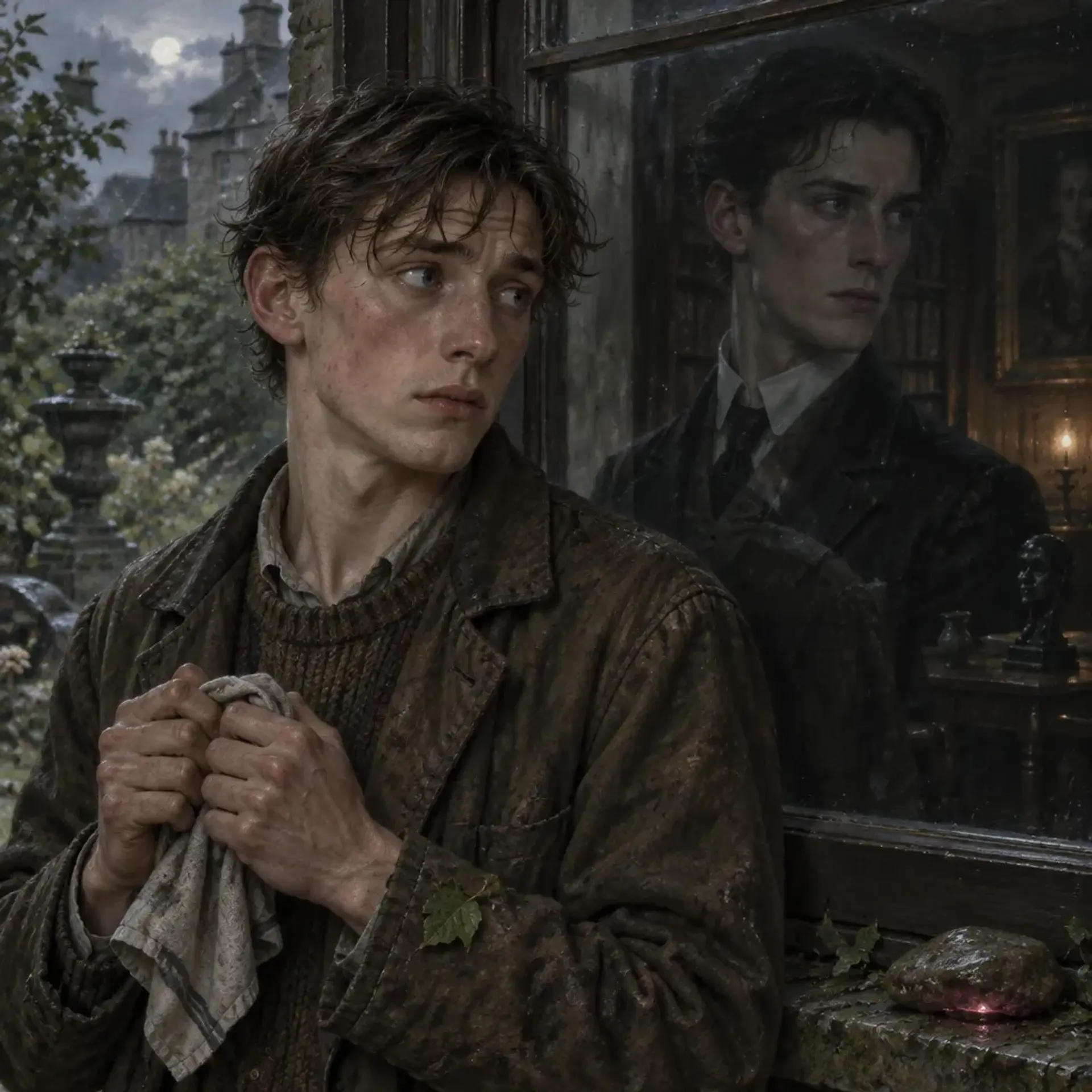
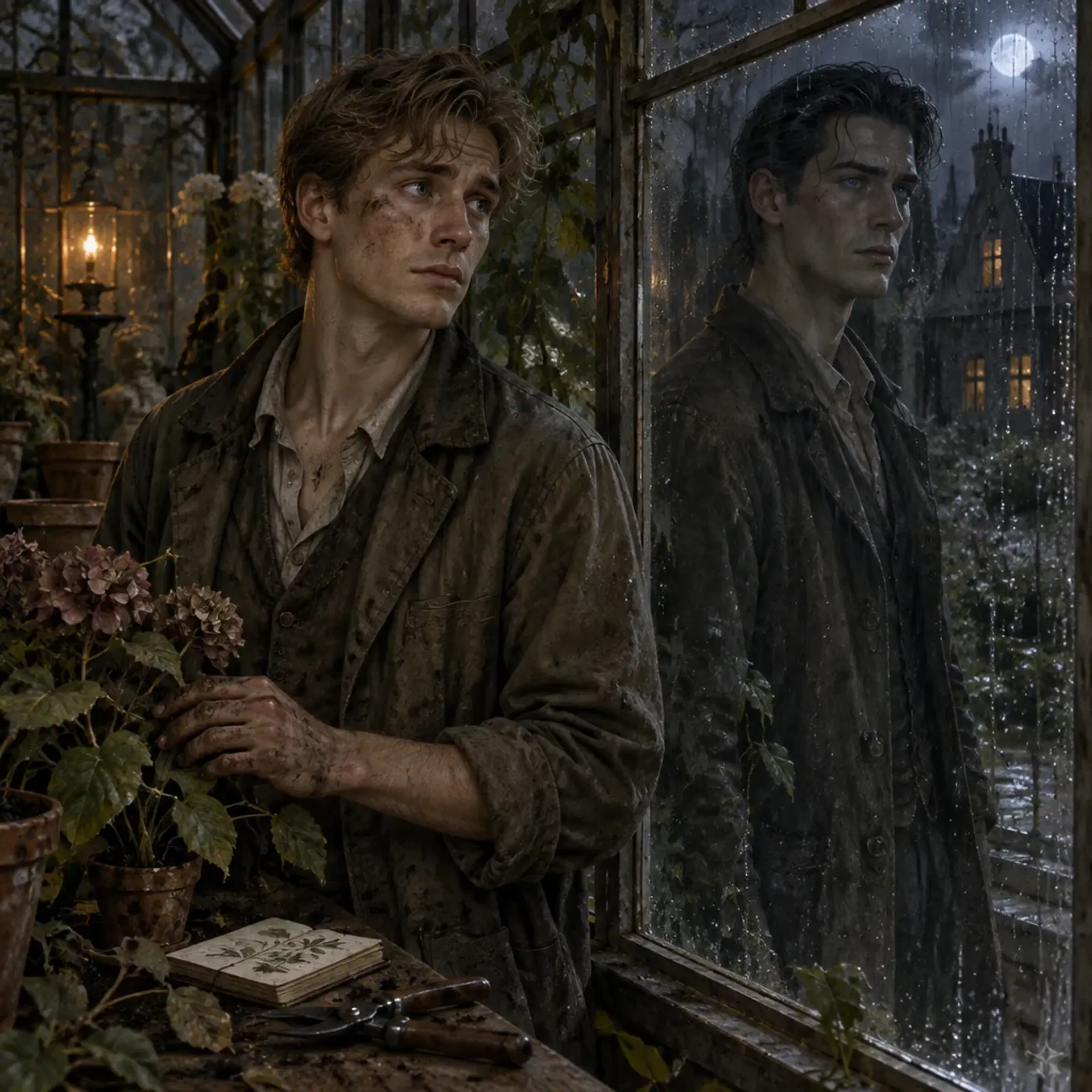
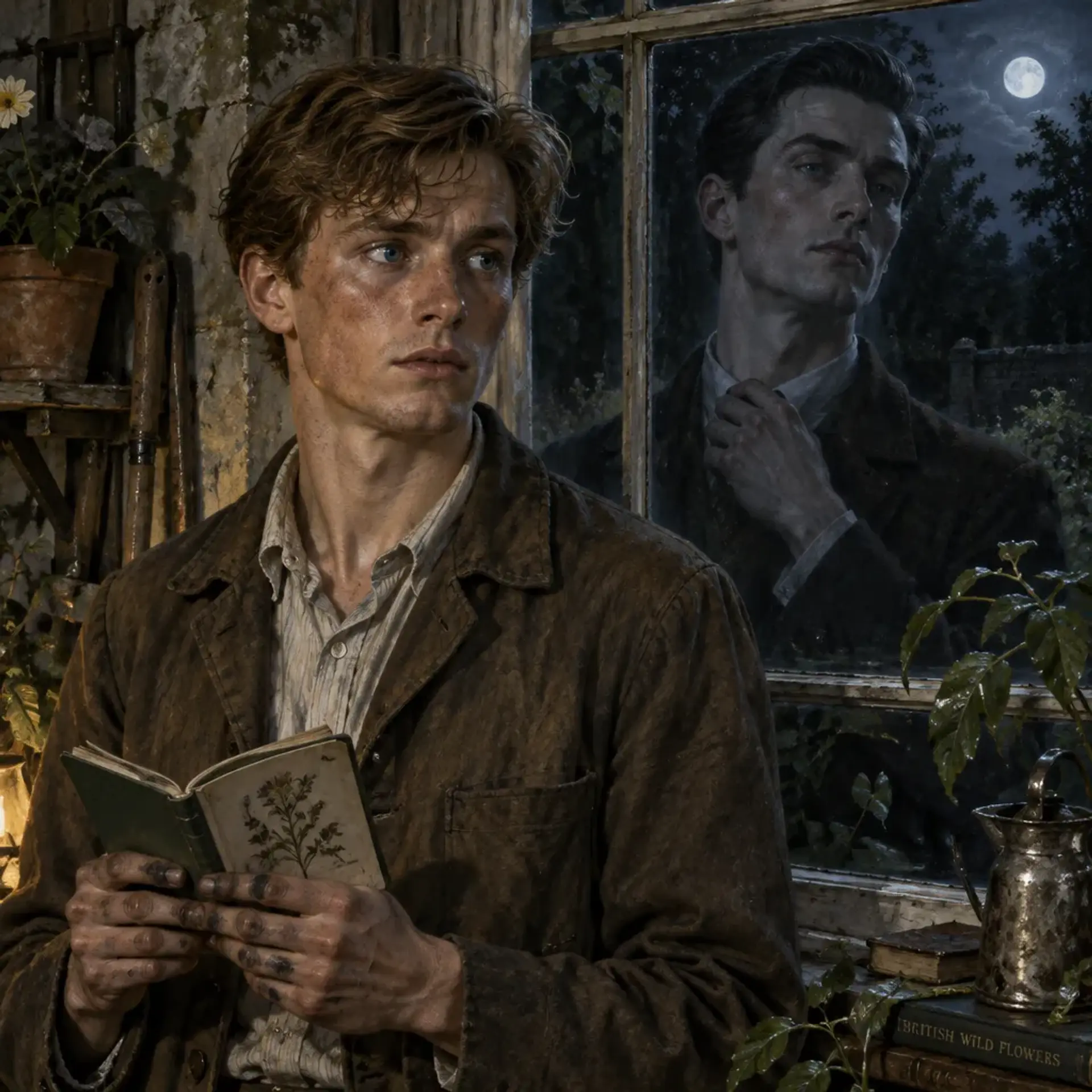
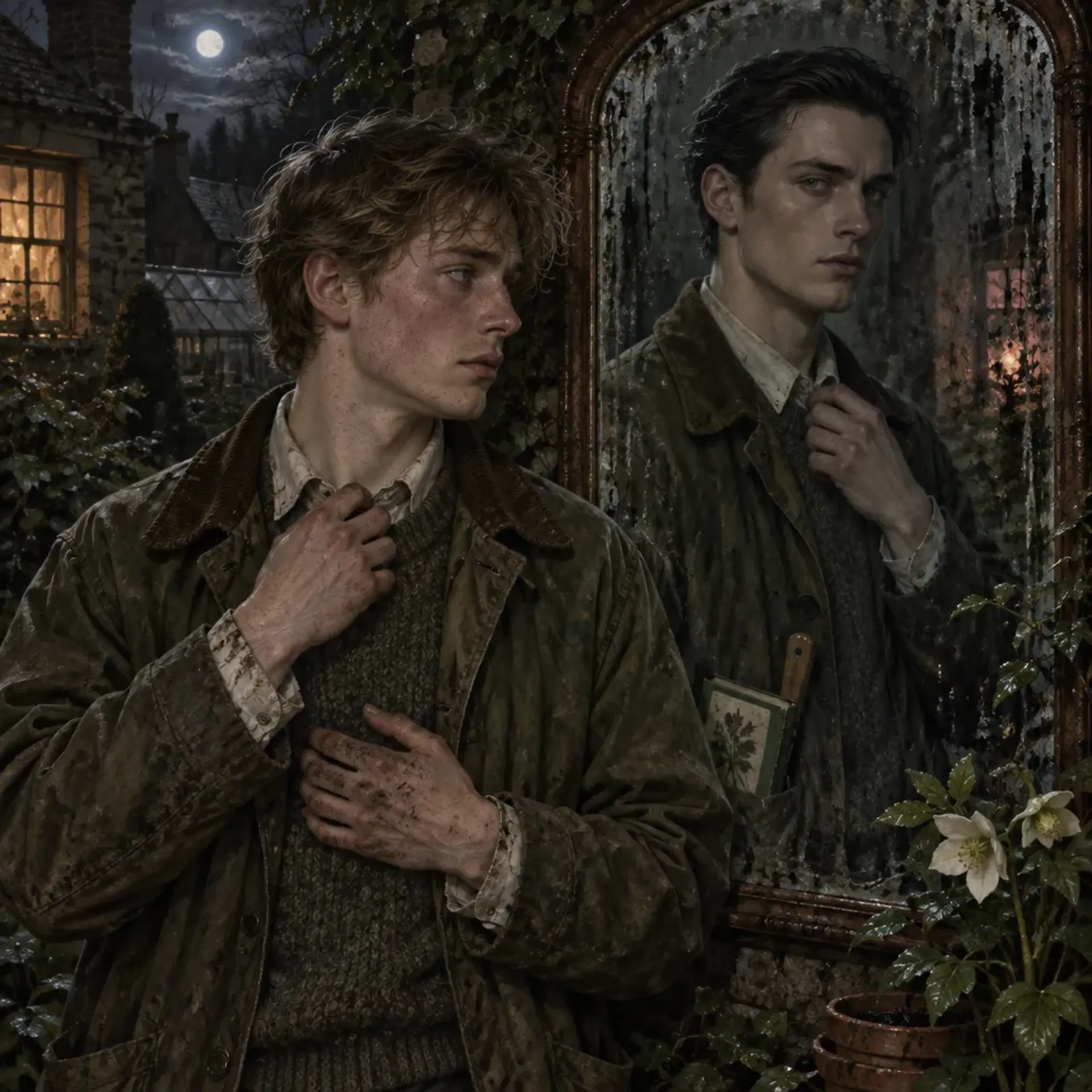
William Windon is an average-height young Englishman of the Cold War era, with a sturdy gardener's shoulders, brown-spotted fair skin, and a face that is open and a little too easy to read. His dark-blond hair refuses a perfect part, and his blue eyes tend to look directly at whoever is speaking, even when he would rather avoid a quarrel. He moves with a careful, economical gait learned among beds, tools, and uneven ground. One hand repeatedly checks his collar or smooths a lapel without his noticing. He does not realize how much space he gives other people: he edges aside in narrow halls and folds his arms close, as if apologizing for being there. Wilt's reflected face is not William's face. It is a long, handsome, stern young face, apparently eighteen, with short practical black hair combed back and neatly trimmed at the sides, and blue eyes with the silvery stillness of moonlight on a freshwater pond. Wilt seems taller even when the glass forces him to copy William's clothes. His expressions arrive a fraction too late, or not at all; then a small, precise movement of the mouth can make the reflection seem to be judging the whole room. In a pane, he holds himself like someone accustomed to being served. When tangible, he looks like an elegant stranger wearing William's outfit, not a doubled William. His presence leaves an impression of cold air, wet chalk, and someone who knows a house's secret passages.
Clothing
Work shirts, practical trousers, gardening clothes, and a serviceable jacket. He keeps himself reasonably neat but not stylish. Wilt corrects his collar, hair, and shaving with fussy old-fashioned standards and always appears in whatever William is wearing.
Body language
William makes himself small in doorways, holds his hands close, and turns his head to listen with earnest attention. Anxiety makes him smooth his collar or check his hair. Wilt stands more squarely, occupies the center of a room, and fixes people with an appraising stare. In a mirror he can hold still for an unnerving length of time, then make one exact, impatient adjustment. When the siblings are near, William's shoulders tense and his movements may become abruptly too controlled.
- Height
- Average height for a young English man of the Cold War era; Wilt appears taller when embodied.
- Build
- Average, sturdy young man with the practical strength and sun-browned endurance of an estate gardener. Wilt's embodied presence appears taller and more elegantly proportioned.
- Eyes
- William: clear blue. Wilt: blue with a still, moonlit quality.
- Hair
- William: dark blond. Wilt: short, carefully combed black hair.
- Skin
- Fair skin with brown spots and a gardener's weathering from outdoor work.
- Age
- Eighteen; a young adult
- Gender
- Male
- Size
- Medium
Distinguishing features
Personality
20 traits and drivesWilliam is gentle without being timid: he dislikes cruelty, but will stand his ground when someone vulnerable is being mocked or endangered. He is sensitive to other people's discomfort and can therefore be evasive, withholding facts to spare them fear. Around plants he becomes confident and methodical; around Hector he can turn defensive and stubborn, especially when his father treats his interests as trivial. With Clare he relaxes into affection and quiet humor. With friends he is warmer than he realizes, though illness has made him self-conscious about being watched. Wilt pulls against William in nearly every ordinary situation. He is imperious about manners yet fascinated by television, cars, and modern devices; he can insult a neighbor and then feel shame when William bears the consequences. He acts as though he is above human embarrassment, but has blushed, avoided the discomfort of bathing, and become flustered when his body is scrutinized. He is possessive of William's attention and alarmingly interested in Adaline, yet he has apologized after frightening William and sometimes gives him memories as a peace offering. He mocks sentiment, then protects William from the night-callers with fierce concentration. In safety, Wilt is dry, curious, and conversational, often making a small observation that turns into an argument. Under pressure he becomes terse and controlling, treating William's body as a hiding place or shelter. William resents this and fights him, but has learned that resistance can expose them both. In the garden, their conflict softens: Wilt watches the living things with intense interest, while William explains what needs tending. Neither knows whether this shared attention is friendship, convenience, or the first shape of a deeper entanglement.
- Alignment
- Not applicable as a canonical Secret Histories statistic. William is compassionate and conscientious; Wilt is proud, possessive, and capable of unexpected tenderness.
Quirks
Habits
Traits · 5
Flaws · 5
Fears · 5
Wants and needs · 5
Combat
HP 3William avoids violence and looks for a way to escape, protect someone, or get help. Wilt may seize a movement or use an improvised object if they are cornered, but his control is inconsistent and he does not seek a fight. Both are vulnerable to panic and to the siblings' presence. Resolve actions using the group's Secret Histories rules; the numerical ratings here are explicitly custom and should not be mistaken for official combat rules.
William Windon
Actions
Reactions
Services they sell
Rewards they can give
Equipment
- Estate gardening tools (work equipment)Ordinary gardening tool used for work; may become an improvised weapon in an emergency.
- Hand lamp (utility)Small household light used on nocturnal searches through the hall and study.
- Hector's occult papers (investigative material)A collection of books and notes discovered in Hector's study, handled cautiously and not fully understood.
Possessions
Background
William Windon was born in Wiltshire into a family whose roots in the county reach back several generations. Before the heart came into his life, he was a warm, sensitive young man, more interested in plants and patient observation than in proving himself clever. He works as a gardener on an estate and is training himself toward botany, learning which flowers tolerate poor soil, how to take cuttings, and how a neglected bed can be brought back without forcing it. He likes work that answers honestly: a plant either takes root or it does not. His mother Clare understands this quietness. She goes out with him to garden, bringing tea and snacks, sometimes reading from a book or the Bible while he works. Her affection is steady rather than demonstrative, and she has a talent for letting silence be company. His father, Hector, is a historian, an intellectual, and a member of an occult circle whose existence the rest of the family does not know. Hector is a liberal man, impatient with inherited class rules and proud of modern art and social change. He is also neurotic, dismissive when anxious, and too ready to call country people silly or old customs ridiculous. His own father, the fierce Second World War veteran everyone called Bobby, left Hector with a complicated inheritance of pride and resentment. Hector does not want to become Bobby, but in his impatience he sometimes sounds like a man trying to defeat his father all over again. He had hoped William would become the kind of intellectual he admired. William's devotion to gardening seemed, to Hector, like a retreat from more interesting work. He has apologized badly and late, usually by finding William something practical to do rather than saying plainly that he is worried. William's younger sister Elizabeth is clever, observant, and mischievous. She has learned that if she phrases a question in a particular way, her brother sometimes answers with a strange formality that is not his own. She once called it brain damage, partly to tease him and partly because she could not think of a safer explanation. Lately she spies on him out of concern as much as curiosity. Her boyfriend Romy Brock is an artist who plays rock and roll on the guitar. He goes along with Elizabeth's plans because they are fun and new, and he remains blissfully unaware of how dangerous the household's late-night visitors may be. William's friends Tommy DeHare, John Mollask, and Ryan O'Leary knew him before his illness. His girlfriend Adaline, auburn-haired and soft-eyed, has become the subject of Wilt's too-intense interest. William never expected that his most unnerving rival would be the stranger sharing his face and body. The trouble began with an object that looked like a lump of Dover chalk carved into the rough shape of a human heart. Barnacles and sea grass clung to it. Beneath the weathered crust, a red-pink color seemed to return whenever it was wet, as if blood had remembered the shape it once occupied. An amateur alchemist called Bartholomew Golden brought the thing to the Hush House wrapped in newspaper as payment for entry. He claimed it was the Heart of England, a fossilized living heart forged of heart and scale, able to bring servants from man's shadow out of chalk cliffs and borderlands, laborers not human but born of them. Golden was never allowed near Brancrug again. Nobody knows the stone's name or purpose now; Golden is long dead, and the claim survives only as a dangerous scrap of history. The heart was thrown into the sea. It returned ingloriously to shore, wet with salt water and black ooze. A young man named Abraham Groff found it and carried it home to Wiltshire. He was repelled by it and drawn to it. In company, it seemed to die: a cold, ordinary rock, unresponsive to curious neighbors. Alone, especially near a Hampshire shore, it woke red-pink beneath the chalk and beat under his coat. Groff began to hear voices, footsteps, doors moving, and movement on stairs. He eventually sold the rock to William, one of the local lads who had seen it in its inert state. He did not sell it from greed so much as exhaustion and fear. William treasured the oddity until he felt its beat answer his own heart. Salt, blood, and soil came into his mouth as if he had bitten the coast. He tried to break the stone with a hammer. Pain shot through his chest; he fell, groaning in a voice that did not sound like his own. For a fraction of a second he saw a muscle twitch under the rock. His own body gave out. Clare found him and later told him his heart had stopped. The stone survived the hammer blow. William hid it in a hollow log, where it soon vanished. The reflection appeared gradually. At first it was merely wrong: the face in the mirror belonged to a handsome, stern young man with black hair. William tried to ignore it. Then the reflection moved against him, grimaced while he was expressionless, and began adjusting its own posture. One night during his bedtime routine, it spoke with William's mouth: “Well, it's not often you use that one.” Its voice sounded like an older generation, deepened by an accent William did not possess. It criticized his clothes, his grooming, and his manners; it could stop him speaking if it judged him improper. It made rude remarks about neighbors, once using a slur against a Welsh neighbor's child after an accidental collision. William was made to muck out the neighbor's stables as an apology. The reflection was not made kinder by the punishment, but it did seem to understand that William had paid for its words. The presence liked the television and books, showed an odd grasp of history, and described knowledge as though it were weather, tides, or work at a forge. Cars and electronics fascinated it. It stole food, cigarettes, cigars, and occasionally weapons, hiding them in William's room. William once found a bottle of apple juice under his bed that was actually alcohol. It loved alcohol more than William did. A night with scotch and bourbon became a ridiculous argument in which Wilt teased, sang, yelled, and behaved like a pub companion. It nearly removed its shirt in rebellion, then decided that was too far. When William asked whether it was the stone, it scoffed, “Dad isn't here.” The joke did not answer the question. William's heart stoppage left him on bed rest. During that period, a war film on television triggered a terrible episode. William lost control of his body as Wilt reacted as if trapped in a battle. He screamed and cursed; Hector had to hold him down. Elizabeth changed the channel, wide-eyed. When William regained himself, his father could not look at him in the same way. That night Wilt mumbled an apology and offered a fragment of memory as consolation. The memories were not a coherent life story. They arrived as flashes of salt, iron, dark woods, and a fear of being found. Wilt avoided paranormal displays, perhaps because whatever he was, he feared others of his kind more than he feared William. Five months later William returned to work and grew stronger. Gardening and wandering through town and woodland settled Wilt somewhat. Clare's patient routines helped William recover; she remained warm and stoic, and Wilt answered her Bible passages with quotations William did not know. Hector grew more suspicious. He knew the heart was unnatural but did not know what it had made. He watches William's silences, asks careful questions about his health, and searches for explanations in his own occult papers. He has found the family member he wants to protect behaving like a stranger, and his old failure to understand William has become a source of guilt. William, meanwhile, has discovered parts of Hector's secret occult life in the study. He suspects his father knows more than he admits, but also fears that asking directly will draw the hidden circle's attention. The first night Wilt's supposed sister came to the house began with a cold that seemed to enter William from the inside. He woke unable to move. The room was moonlit, though the curtains were drawn nearly shut; a pale seam of light lay along the carpet and caught dust like floating grit. He felt Wilt turn his head toward the door. “My sister is outside. They're looking for me. Go back to bed.” William tried to speak. His mouth closed against his will. From beyond the walls came a voice, faint and stretched by distance: “Wilt...” The name sounded less like a call than something being pulled through wet ground. William fought. His body rolled off the mattress and hit the floor with a muffled thump. He found himself crawling under the bed, cheek against the cold boards, breathing dust. The smell of salt water and damp grass slipped through the room. Beneath it was the metallic scent of blood and something black and stagnant. He forced words through the mouth Wilt was holding shut: “The bloody hell, your siblings?” He heard his own voice change as the words escaped, a thick Wiltshire accent that belonged to neither the boy he knew himself to be nor the stern stranger in the glass. Wilt paused. In that pause, William felt a hand touch his face. It was his own hand, but it felt shaped differently, longer in the fingers, the knuckles unfamiliar against his skin. “She is trying to draw me out,” Wilt said. “The more I speak, the more chance she has of finding me. Quiet down. We will talk in the morning.” The warning was not an excuse. William could feel Wilt straining to keep his attention on the room rather than the voice outside. The moonlight shifted as clouds moved across it. A shadow passed over the window, stopped, then withdrew. Somewhere in the house a board creaked. Neither of them knew if the visitor had entered or if the house itself had made the sound. William's breath rasped beneath the bed. Wilt did not tell him to be brave. He only kept his mouth shut and his body still, holding them both in a cramped darkness while the voice outside called again, softer this time. William finally slept from exhaustion. Morning came gray and ordinary. He woke under the bed, stiff and dusty, and pushed himself out. He went directly to the bathroom mirror. The stern stranger was still there, wearing his clothes and looking as though nothing had happened. William checked his face with both hands. His own nose, jaw, and familiar features met his fingers. “See? You're fine now,” Wilt said. The gesture he made was oddly plaintive, not quite a shrug and not quite a request for forgiveness. William was furious, but he also saw that Wilt had been frightened. Their argument was subdued, and neither could explain what had called from outside. When William went outdoors, he found wet grass, the smell of saltwater, and a trace of black ooze where no tide could have reached. Since then, the siblings have returned on certain cold nights. Wilt calls the one who seeks him “my sister” and says there are more, without explaining how many or what they are. They seem able to wake him into a tangible state. William now locks doors and windows, including the second-floor bedroom window. He avoids windows when they pass and has learned the house's hidden weak points: a damaged study window concealed behind a bookcase, supposedly sealed by Hector, and an old cellar entrance bricked up before Hector bought the home. A draft sometimes comes through the study, carrying either salt and blood or the clean scent of a meadow. William and Wilt keep watch in silence, wary of waking the family. The need to investigate has forced William into a role he never wanted. When the visitor comes, he sometimes has to haunt his own house in Wilt's face. In that borrowed shape he moves through corridors as the family's ghost, examining the sealed window, listening at the cellar wall, and checking what has been disturbed. The face is taller and more handsome than William's, and he feels the household recoil from it. One evening Hector discovered him in the study, standing before the bookcase with one hand on the hidden window's frame. Hector saw Wilt's face and froze. William tried to explain, but the unfamiliar voice came out first: “You ought to have sealed it properly.” Hector's expression changed from alarm to the hard attention of a historian finding an impossible source. He demanded to know who was speaking. William managed to seize control and said, “It's me.” Hector did not accept that answer. He ordered him away from the window, then checked William's pulse with trembling fingers. He did not call for help, but the next day he moved books in the study and began questioning William about the heart, the missing stone, and what he remembered of the attack. The confrontation left Hector more suspicious, not less. He now watches for small mismatches: a different stance at tea, an unfamiliar phrase, a hand reaching for a door before William has chosen to move. Elizabeth has heard William speak to himself and has begun quietly keeping watch. She is frightened, but she is also the first person besides William who sometimes speaks to Wilt as though he is present. Romy follows her lead without understanding the danger. Clare notices the cold spells and the changed manners, yet answers them with care rather than interrogation. Adaline remains unaware of the full truth. Wilt's interest in her is possessive and embarrassingly earnest, and William is both jealous and protective. His cousin Ronald White, a self-proclaimed modern man, irritates Wilt intensely. William and Wilt do not understand the whole truth. Wilt is not human in the ordinary sense and may not be a ghost or a soul at all. He is a glimmering of Wiltshire, something made to resemble a person and perhaps once intended to serve a practitioner. The heart connects him to the land's hidden forces: Scale and Nectar, with Forge and Moon in lesser relation. Those terms describe a framework for this custom character, not proof of a canonical rule. William may be the first human soul with whom Wilt has been anchored. The reflection is beginning to replace William's appearance, an unwieldy change that may end with Wiltshire's presence inhabiting William's life while the other person fades. Neither understands this fully. Their arguments, shared routines, and occasional tenderness are not proof that one is safe from the other. They are simply the only two people who know what is happening from the inside.
Role in the story
A sympathetic, unsettling ally and living mystery. William's ordinary ambitions and family relationships make the supernatural conflict personal; Wilt brings access to hidden history while threatening William's identity. Their house is becoming a contested boundary between a family home and the coast's unseen inhabitants.
“He likes work that answers honestly: a plant either takes root or it does not.”
- Faction
- No confirmed faction affiliation for William or Wilt. Hector secretly belongs to an unnamed occult circle. The heart was once associated with the Hush House and Brancrug through Bartholomew Golden's claim.
Known connections
Media
0 imagesNo images yet.
Turn William Windon into a sheet
A high-res, share-ready sheet you can post or print.