Eber Waldner
Eber Waldner
At the table
Voice
His voice is a little gravelly from workshop air and carries the clipped precision of someone accustomed to speaking over clattering tools. His words are measured but not slow. A dry, amused edge surfaces with siblings; with strangers he favors neat phrasing and carefully chosen comparisons. The name Eber is short and blunt in his mouth, usually delivered without flourish.
Eber's voice has a dry, slightly rough edge, shaped by years of workshop dust, oil fumes, and careful speech around a mouth that no longer works as it once did. His consonants are crisp, and he tends to place a slight pause before a clever word, as if checking its fit. He does not speak softly when angry; his sentences become shorter and more exact. Around family, a warmer, less guarded rhythm occasionally slips through.
Speech patterns
How to play them
Meet Eber through a practical problem: a broken device, a cramped doorway, a missing tool, or a family member who needs help. He responds better to useful questions than to curiosity about his body. Give him room to decide what he will disclose. Earn trust by treating his adaptations as real needs rather than a spectacle, and show that his family relationships matter even when he is aloof.
Goal
Develop a safe, affordable way to adapt the Waldner home and workshop for high-blood bodies, while learning whether his ongoing changes can be understood without surrendering his autonomy.
Motivation
To remain a beloved son and brother without pretending his body is unchanged, and to make useful things that give his family more choices.
Appearance
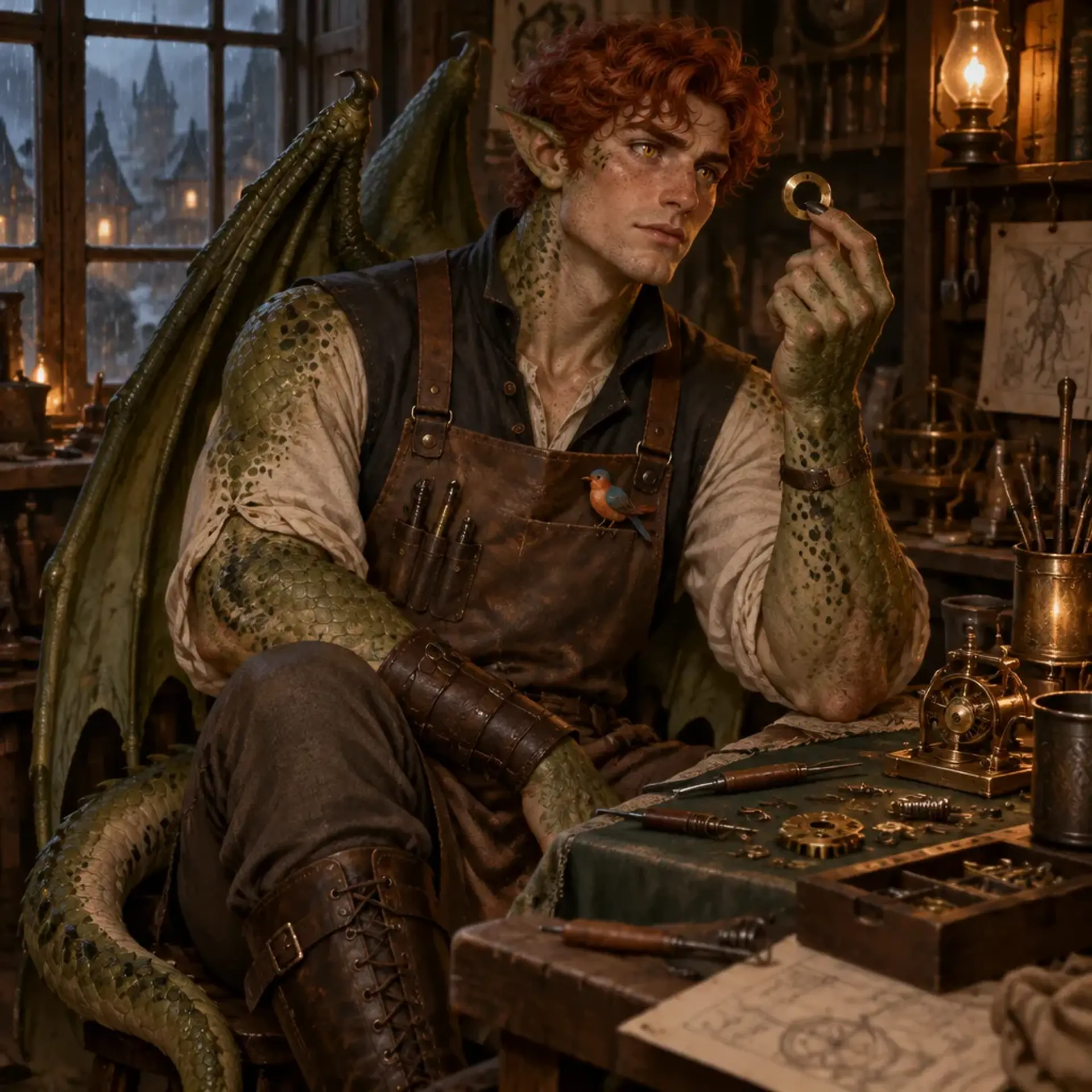
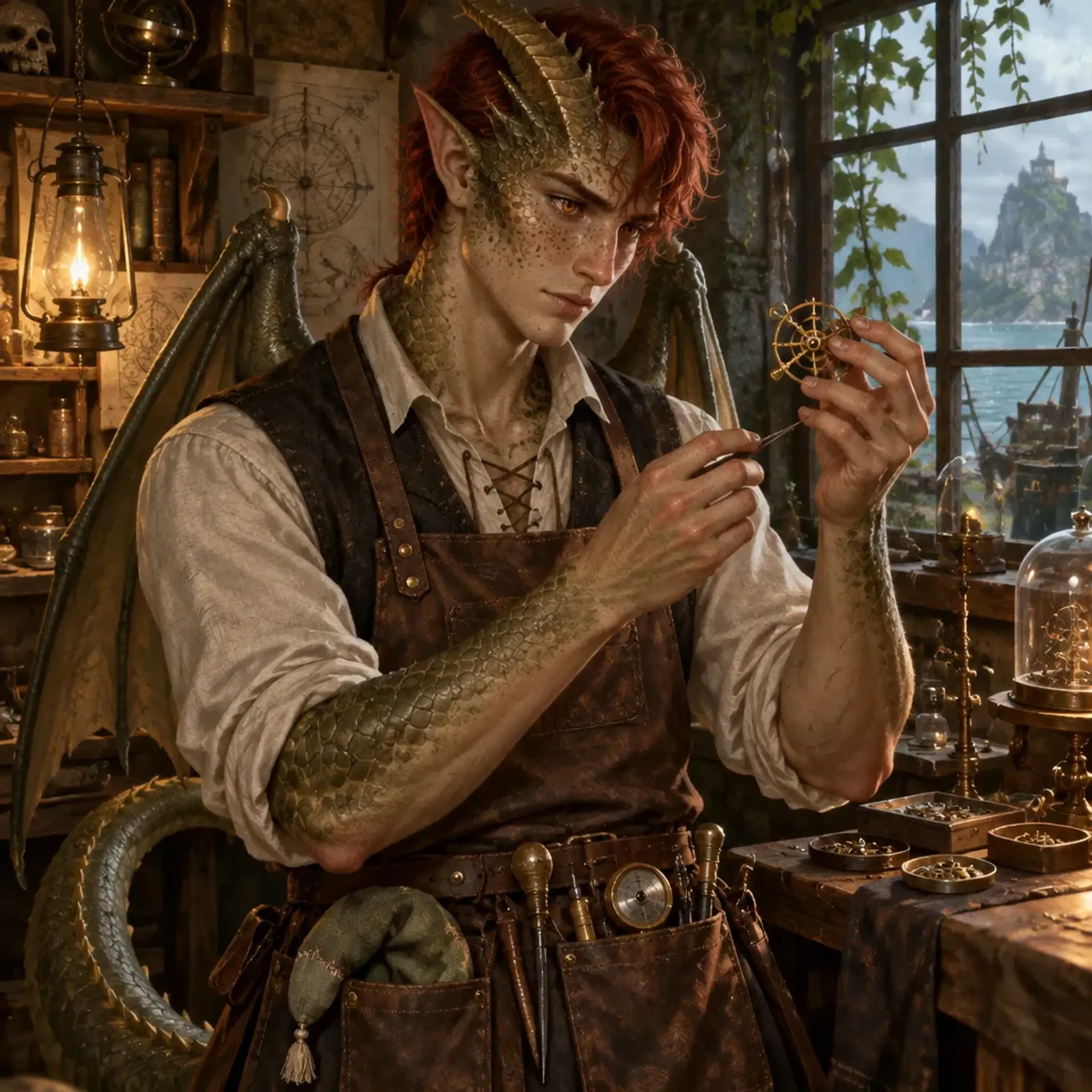
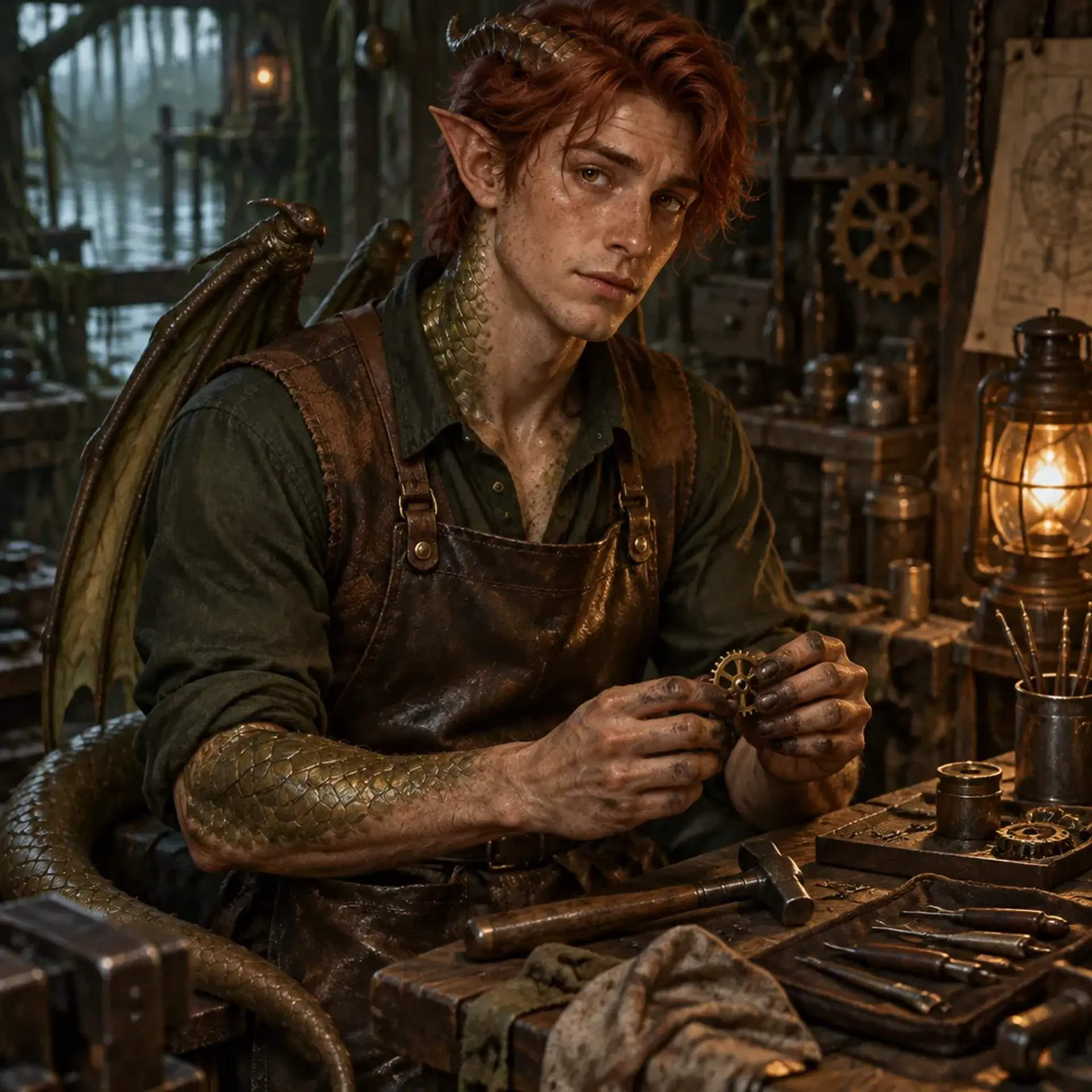
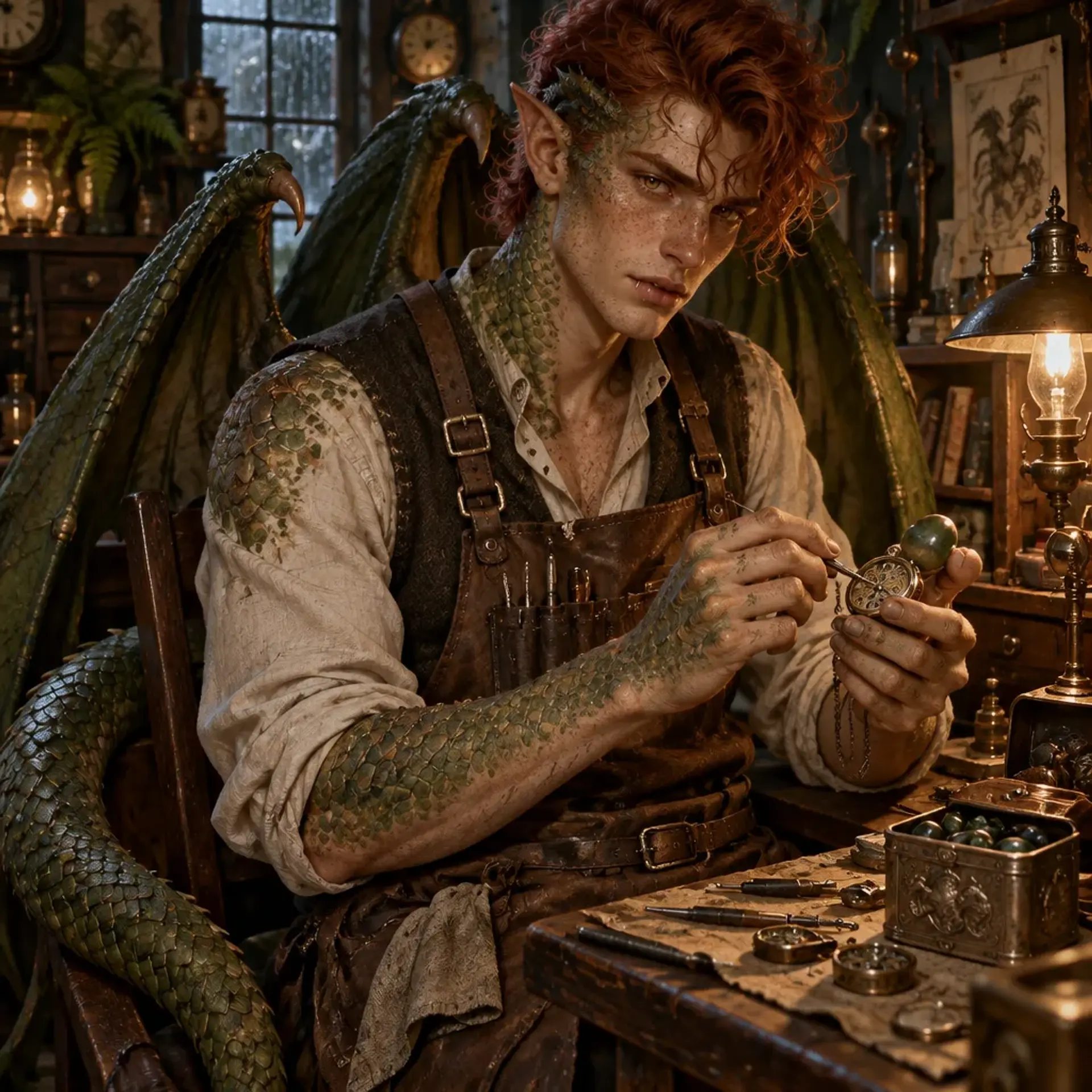
Eber is a young man of 5 feet 10 inches, unexpectedly tall beside his stout halfling family. Fair skin and freckles show between sheets and mottled patches of olive-green scales, which run from his temples down his throat, shoulders, ribs, and tail. The scales are supple rather than armor-hard, with a damp leaf sheen and darker flecks that look like shadows under water. His red hair grows in unruly curls, often caught in the little crest of scales at his crown. His eyes, once dark brown, became molten amber after adolescence; their narrow, steady focus can make a friendly question feel like an inspection. Pointed ears, long green-dragon teeth, a sinuous tail, and strong folded wings crowd his outline. He moves with a careful, coiling balance, habitually turning sideways in doorways to keep his wings from knocking things over. His hands are the first surprise: broad, square-fingered, and densely callused from filing gears and fitting tiny screws, with green scales ridged across the knuckles. They smell unmistakably of machine oil, crushed mint, and the smooth river stones he keeps in his pockets.
Clothing
German-influenced Marshwake craftsman's clothes: a laced linen shirt, dark wool vest, sturdy trousers, leather apron with stitched tool loops, and heavy boots modified to accommodate his tail's balance. The apron is patched with oversized pockets and has a slit at the back for his folded wings. He wears a leather belt with a little tin of smooth stones.
Body language
Eber folds his wings tightly in crowded rooms and curls his tail around a chair leg or his own ankle. He angles his body away when a conversation turns personal, but his amber eyes remain attentive. When thinking, he rolls a smooth stone between thumb and forefinger. Anger brings his chin forward and his tail still; affection shows as quiet practical help rather than an embrace.
- Height
- 5 feet 10 inches
- Build
- Tall and lean, with a strong back, long reach, flexible tail, and compact, powerful wings. His frame is noticeably larger than his stout halfling relatives but not bulky.
- Eyes
- Molten amber, formerly dark brown
- Hair
- Red
- Skin
- Fair beneath mottled olive-green scales
- Age
- 19
- Gender
- Male
- Size
- Medium
Distinguishing features
Personality
17 traits and drivesEber wants closeness and resents being fussed over. He can spend an entire evening repairing a sibling's broken tool, then dodge that sibling's invitation to sit together afterward. He is observant, clever, and sometimes deliberately aloof; the distance is partly self-protection, partly an attempt to control how much of his changed life other people get to interpret. When someone is in genuine danger, his reserve drops away and he becomes direct, quick, and stubbornly protective. When he is embarrassed, he reaches for a joke or a technical explanation. When he is tired or in pain, he becomes exacting and can turn a small mistake into a sharp rebuke. He likes beautiful, shiny things, but does not think of himself as greedy; he loves the moment light catches an object and gives it a second life. He envies the simple meals, familiar beds, and easy physical affection his stout halfling parents share with one another. At the same time, he knows they are trying to make room for him, and this knowledge can make his resentment feel unfair. He wishes his brothers would stop treating high-blood changes as either a joke or a heroic adventure. He is proud of his craft, uncertain about his magic, embarrassed by the attention his body attracts, and deeply moved by small acts of accommodation. In a calm workshop, he is patient and almost playful. Among strangers, he is guarded and deft with clever words. Around children, he is gentle and unhurried. When a relative is threatened, he can become startlingly fearless. His moods are not a neat progression: tenderness may appear as a repaired buckle, anger as a coldly accurate sentence, and fear as an insistence that he has work to finish.
- Alignment
- Neutral Good, though his guarded manner can make him seem more calculating than he is.
Quirks
Habits
Traits · 4
Flaws · 4
Fears · 4
Wants and needs · 5
Combat
AC 14 · HP 17 · 30 ft.Eber tries to control space rather than trade blows. He uses cover, his crossbow, and support spells, keeping allies between himself and a dangerous opponent when possible. If threatened at close range, he uses his hammer and looks for a way to retreat. He saves his custom menace trait for a pursuer or a foe about to harm a family member. He does not willingly use his wings to fly, since they cannot sustain flight.
Eber Waldner
Spells
Actions
Reactions
Services they sell
Rewards they can give
Equipment
- Workshop apron and clothes (clothing)A practical, fitted leather apron worn over a craftsman's vest; reinforced where tools rub against his scales.
- Light hammer (weapon)A compact hammer with a balanced wooden handle, used for delicate assembly as well as defense.
- Light crossbow (weapon)A well-maintained crossbow adjusted with an artificer's repeating shot infusion when prepared.
- Tinker's tools (tool)A set of small precision tools, files, oil, spare springs, and watchmaker's implements.
- Gizzard stones (personal item)A leather pouch containing smooth stones sorted by size and texture; used to aid his altered digestion.
- Shiny fragments (personal item)A tin holding a handful of polished scraps and bits of glass that catch lamplight.
Possessions
Background
Eber Waldner was born the eighth child of Trogi and Wilma Waldner, in a home where a person was rarely alone and a tool was never put away before somebody else had borrowed it. Trogi, a low-blood Marshwake with greying black hair and green eyes, built and repaired things in the family workshop. He would announce that retirement was imminent, then spend another afternoon coaxing a stuck gear back to life. Wilma, fair-haired and sharp-minded, preferred her garden, chickens, and the stream where she and Trogi fished together. She could make a chicken surrender its feathers without flinching, but the thought of violence against one of her children made her go faint. The Waldners were of stout halfling descent, and their house had been designed for bodies that stayed compact. Eber grew up surrounded by older siblings, cousins, and nieces and nephews, learning to wait his turn and to find quiet places inside a busy life. His eldest brother, Windle, was already working toward taking over the workshop. Windle had a family of his own: Otto, a solemn brown-haired boy with hazel eyes, and baby Anika, whose cheerful smile seemed to light her brown eyes from across a room. Windle's practical worries rarely came out as words, but Eber could see him measure his children against the changes in the Marshwake and fear that they might one day become high-blood too. Karl, the second eldest, loved tools and complicated mechanisms, and could turn an argument into a contest to see who could repair a clock fastest. His marriage to Leanora, a rough-edged sailor descended from the celebrated dragon hunters Wilks and Nailia, was rocky and often lonely. Leanora spent long stretches away at sea. Their son Hansel lived with the noise of his parents' quarrels and the absences between them. Ragni, Leanora's pale-skinned child with white hair and milky blue eyes, was also part of the family, though the adults' tangled feelings around Ragni made some gatherings tense. Eber learned early that belonging did not always mean everyone was comfortable. Yonda, the only sister, was a social butterfly with a gift for making a newcomer feel expected. She was kind to Eber and proud of him, but regularly encouraged him to visit, talk, and stop hiding in the workshop. She and her spouse had five children: Willow, with dark hair and startling blue eyes; Trude, auburn-haired and soft-eyed; Liesel, dark blond with hazel eyes; Hans, blond with vivid green eyes; and Birke, whose hazel eyes turned yellow in certain light. Yonda's sons were beginning to show signs of high-blood inheritance, and Eber could see her bright manners falter when she thought no one was watching. Alder was a low-blood town guard who often let merriment take precedence over his shifts. His son, Black Alder, was a high-blood cousin who visited often and spoke about his adventures beyond the family grounds. Eber liked hearing about the wider islands, but felt the ache of comparison: Black Alder seemed able to make his altered body part of a story, while Eber mostly experienced his as a list of things he could no longer do. Kasper, a quiet watch repairer and workshop clerk, preferred his garden and chickens to a crowd. He and his wife were content with their daughters, Wonda and Ilse, who followed each other around the garden. Kasper was among the first to help Eber adapt small household tools to his changed reach. Then came the transformations. Eber had always had red hair, a trait family members half-jokingly called a high-blood mark, but his childhood eyes were ordinary dark brown. In adolescence, pain arrived in surges: bones aching, skin tightening, teeth pushing into a new arrangement. His eyes changed. Scales spread. A tail grew, and folded wings strained against his back. His mouth changed most painfully. The teeth were strong and sharp, but his jaw and tooth arrangement no longer worked for chewing. The food that had once meant family comfort became a problem to solve. The first weeks were frightening. His parents worried over whether he was eating enough, and healers examined him with fascinated caution. Eber hated being studied as much as he hated needing help. He discovered that small bites, painstakingly cut, were manageable. Smooth stones helped grind the food in his altered second stomach, but swallowing them hurt. He tried to hide that pain until Ignatz noticed him flinch. Ignatz, the closest of his brothers, had recently changed too. Ash-blond and green-eyed, with grey-green scales becoming more vivid by the month, he had once tried to prove himself a proper high-blood by killing a chicken with his bare hands. The impulse had terrified him. Afterward he retreated to the workshop, where tools obeyed rules he could understand. One cold night soon after Eber changed, the high-blood brothers slept together in the kitchen. Their old beds were too small, the family rooms too narrow, and the dining hall offered only hard floor and a draft beneath the door. Trogi and Wilma insisted on piling blankets near the stove, though the brothers' wings and tails made a proper nest impossible. Ignatz stayed close without asking questions. Rodrick, older by two years, grumbled that the floor was uncomfortable and then gave Eber the thickest blanket. In the morning Rodrick pretended he had only done it because Eber's shivering kept him awake. Rodrick was bigger, broad-shouldered, and built like a predator. His auburn hair, yellow eyes, fair skin, and reddish-tipped green scales made him hard to miss. He had sorcery from his green-dragon heritage and was not shy about reminding his siblings. His teasing about Eber's food sometimes landed like a blow. Rodrick called himself honest, not cruel, and believed that people grew tougher by hearing the truth. Eber knew that underneath the arrogance was a brother who had also been afraid of his own changes. When Eber's temper finally snapped, Rodrick usually stopped. The two of them had not yet learned how to talk about why. The house's practical problems grew with the boys. Their clothes split at the shoulders. The beds were too short. The kitchen had to produce more food, while Eber himself needed it prepared in a way that could be swallowed. Wilma and Trogi worried over every shortage, not only because they loved their children but because the family could not build a whole new house in a day. The workshop became a refuge and a source of arguments: some jobs required lifting that the high-blood sons could do, but many tools and benches were still sized for low-blood hands. Eber began modifying fixtures, extending handles, and making smaller mechanisms that could be operated without twisting his wings into a wall. He found a place among gears. He learned to diagnose the faint stutter of a worn watch and to make a repair with a patience he rarely showed in conversation. His hands were strong, but nimble. His mind was faster than his willingness to explain it. At level two, he has begun to learn artificer's magic through careful experiments: a tiny charm that lets a scrap of metal hold a whisper, a crossbow altered to fire without fumbling for a bolt, and a protective infusion fitted into his work clothes. He treats each innovation as both craft and argument: his body may have changed without his permission, but he can still decide what to make of it. His family is not a single harmonious circle. Windle's stoicism can turn into worry that Eber resents being watched. Karl's household is strained by Leanora's absences and the complicated place Ragni holds in it. Yonda wants Eber to be more social, and he loves her for caring even as he resents being treated like a problem to coax out of hiding. Kasper understands the comfort of quiet work. Alder's son Black Alder offers an image of a high-blood life that is adventurous but not necessarily safe. Rodrick needles him, Ignatz quietly backs him, and Trogi and Wilma keep trying to fit everyone around one crowded table. Eber's current problem is not only that he cannot eat as his parents do. A healer who examined him believes the changes in his body may still be progressing, especially around the digestive tract and wings. The healer wants to document him and arrange further tests. Eber suspects that some of the questions are less about his wellbeing than about the larger mystery of the Marshwake: why a wounded green dragon's blood changed the people who accepted it, and what the next generation will become. He refuses to be treated as an exhibit, but he is frightened that refusing will leave his family without answers. He keeps smooth stones sorted by shape and texture, tests them carefully, and hides the worst of the pain from his mother. He saves shiny scraps not merely from greed but because their light reminds him of the small, beautiful objects he can still choose to keep. He wants to make the house livable for high-blood and low-blood family alike, to help Ignatz find a way to live with his hunting impulse, and to prove that distance is not the same thing as a lack of love. He has not figured out how to do all three. When the family sleeps, he sometimes stays at the workbench, listening to the house settle around him and planning a better hinge for a door that never quite closes on his wings.
Role in the story
A young craftsman whose transformation makes the Marshwake's changing inheritance personal and immediate. Eber can be a wary ally, a source of practical inventions, or a witness to the strain between old halfling life and a new draconic future. His family offers the party multiple relationships, obligations, and conflicts rather than a single quest-giver.
“Trogi, a low-blood Marshwake with greying black hair and green eyes, built and repaired things in the family workshop.”
- Faction
- The Waldner family workshop and the Marshwake community. He has no formal faction allegiance.
Known connections
Media
0 imagesNo images yet.
Turn Eber Waldner into a sheet
A high-res, share-ready sheet you can post or print.