Friedreich
Friedreich
At the table
Voice
His voice sounds like a young man's speech preserved in a formal drill: clean consonants, a firm pace, and a slight rasp when he has been straining to make the living hear him. The Prussian German accent is strongest on his own name and on words for duty, family, and command. Borrowing a face changes the sound of his body only imperfectly; attentive listeners may hear his old cadence beneath another person's voice.
Friedreich speaks German with a strong Prussian accent and careful consonants. His words have the clipped formality of a young man trained to answer promptly, but his phrasing occasionally slips into old-fashioned military courtesy. In English he pauses over idioms and sometimes chooses the most literal translation. He does not become quieter when angry: he becomes more exact, naming the offense and the person responsible. When he is tired or disoriented, he loses the thread of a sentence and repeats the last word as if trying to recover the order of his thoughts.
Speech patterns
How to play them
Treat Friedreich as a person rather than a haunting or a tool. He responds to practical inclusion, shared routines, and honest limits. Do not promise that he can safely possess someone or keep a borrowed face forever. If the subject of Wilhelm's wartime past arises, ask what Friedreich remembers before demanding a verdict.
Goal
Find a way to be seen and live among his friends without relying on a stolen or borrowed face, while discovering what opened his Caul and what Klaus is withholding.
Motivation
To belong to his chosen family as himself, and to protect them without becoming the kind of predator he fears.
Appearance
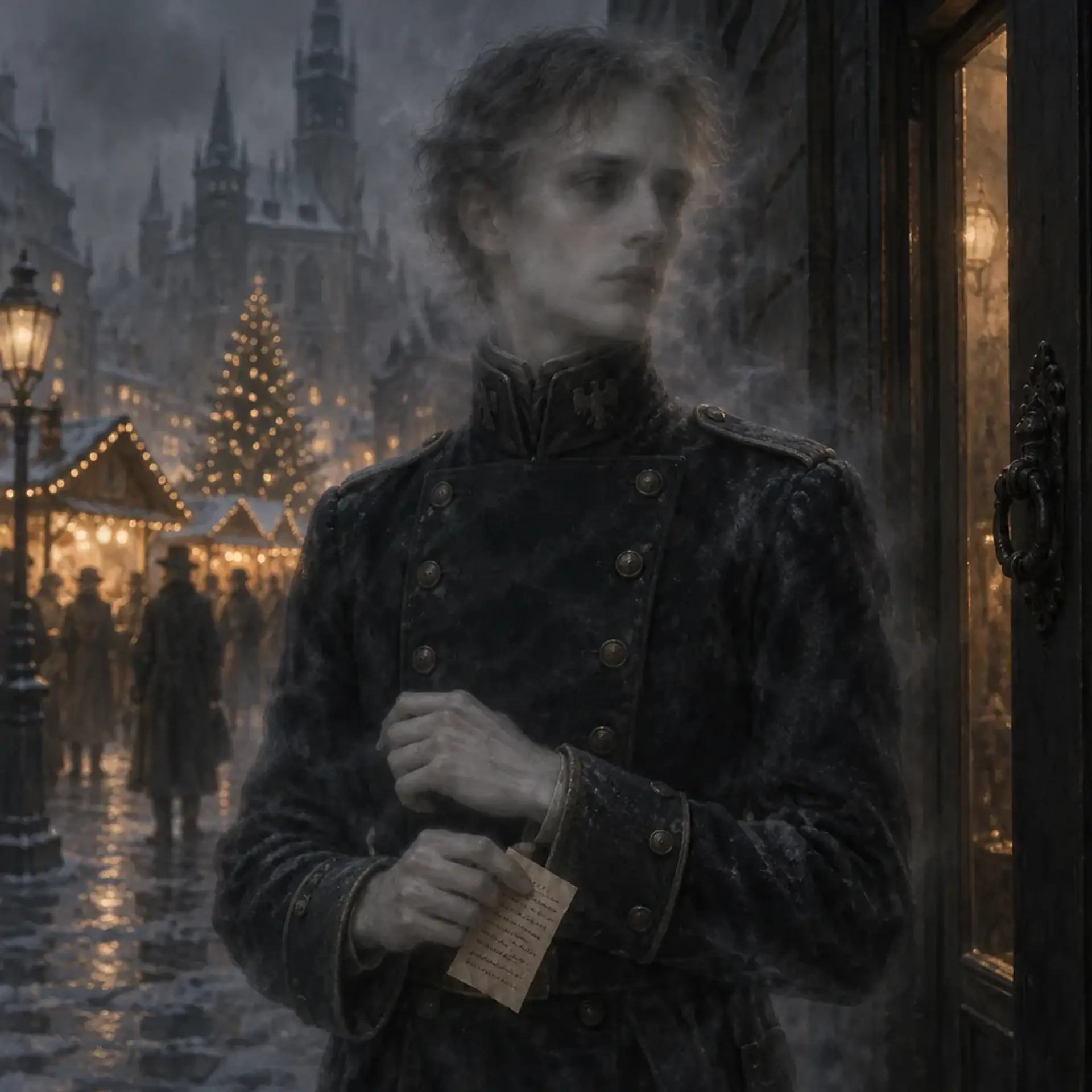
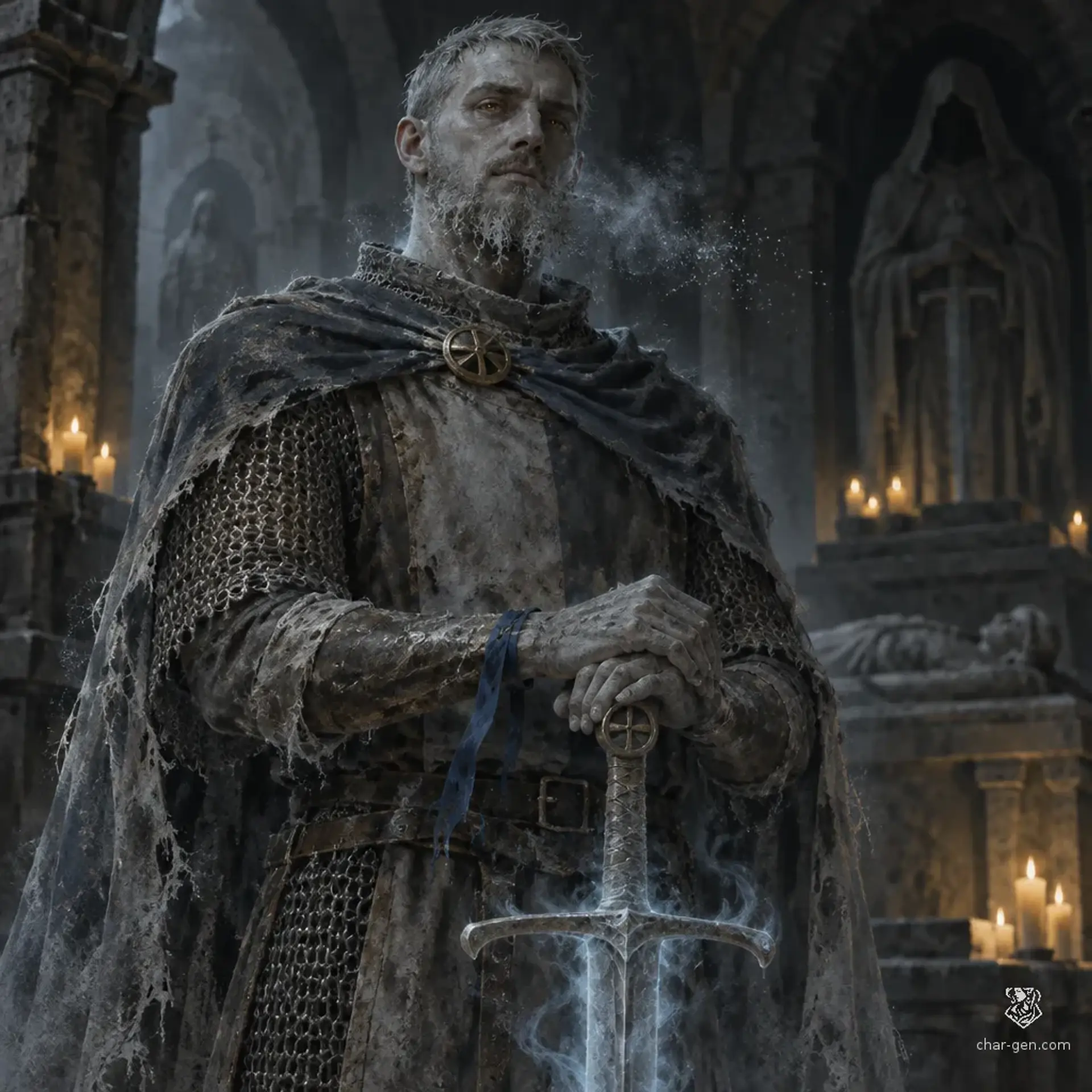
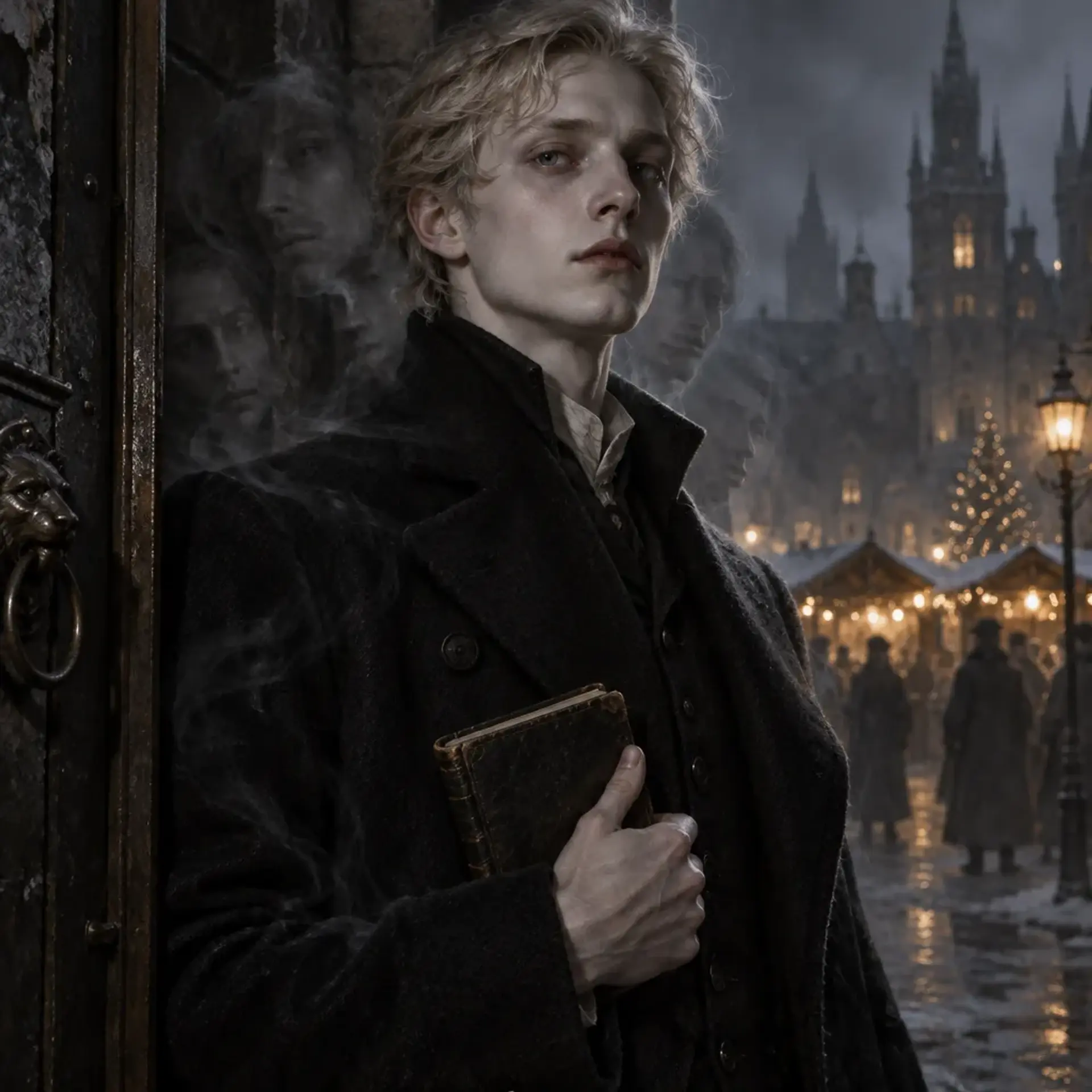
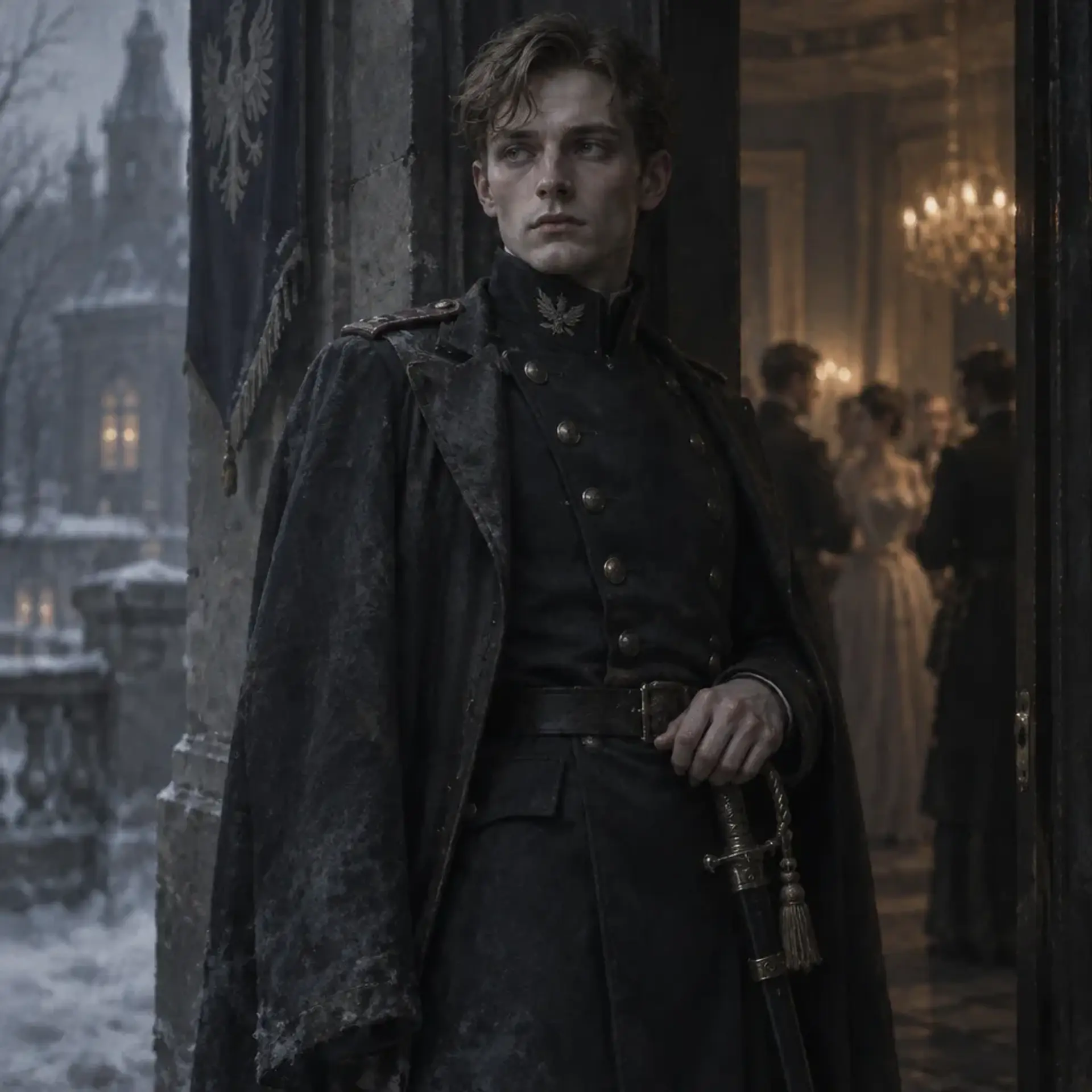
Friedreich usually looks like a young Prussian officer whose portrait has been left too long in a damp house. His borrowed faces retain a faint, waxy softness around the mouth, and their expressions seem to arrive a fraction of a second after the feeling that should cause them. When he is visible without a face, his outline is thin and smoke-blurred, with the rigid posture of a boy drilled to stand at attention. He occupies more room than his slight build suggests: he plants himself squarely in a doorway, then seems honestly surprised when people have to go around him. His most noticeable possession is a narrow officer's sword whose leather grip is polished smooth at exactly the spot where a thumb would rest. On certain days when the boundary between worlds loosens, he appears sharply enough for people to see the small, stubborn crease between his brows.
Clothing
Favors a sober, old-fashioned officer's coat when he can manifest it, but will wear contemporary clothes when borrowing a modern face. His garments often look slightly damp at the seams. He keeps his officer's sword close even when it is impractical.
Body language
He stands as if a superior officer might inspect him, shoulders squared and chin level. When anxious, one thumb rubs the polished place on his sword grip. In company he takes up the threshold or the end of a table, often unaware that others must negotiate around him. A borrowed face lets his body relax, but when his sense of self slips he presses two fingers to his own jaw as if checking that the face is still attached.
- Height
- About 173 cm when clearly manifested; apparent height follows the borrowed face.
- Build
- Slim and narrow-shouldered, with the stiff economy of someone trained to march rather than lounge.
- Eyes
- In his unborrowed appearance, a muted grey-blue that becomes difficult to focus on. Borrowed eyes match the chosen face.
- Hair
- Pale brown in his unborrowed appearance; copied from the face when embodied.
- Skin
- Pale, greyed as if seen through winter fog when unembodied; borrowed faces carry their own complexion.
- Age
- Appears 17 or 18; the exact age and date of death are uncertain to him.
- Gender
- Male
- Size
- Medium
Distinguishing features
Personality
20 traits and drivesFriedreich wants discipline because it gives shape to a life he cannot fully remember, but resents being treated as a subordinate or a relic. He can be courteous, even charming, when he is helping someone choose a Christmas-market bargain or explaining the rules of a card game. When the conversation turns to Wilhelm's past, that courtesy tightens into accusation. He loves Wilhelm with the unexamined certainty of a brother and distrusts him with the suspicion of someone who believes he has been lied to for years. He is protective without being naturally gentle. His first response to danger is often to put himself between the threat and a friend; his second is to decide what violence is necessary. He has killed to protect the coven, and that history gives his loyalty weight, but it also frightens him. He can be stubbornly formal when anxious, acting like an officer because orders and posture are easier than saying he is afraid. When he feels ignored, frustration can rise quickly. It no longer burns as hot as it once did, though; sometimes it drains into a bleak quiet that is harder to reach than anger. Face-taking gives him a glimpse of ordinary life and tempts him to mistake access for belonging. He likes being able to eat, touch, sleep, and talk with his friends, but knows that a borrowed identity can begin to replace his own. His curiosity about possession comes from affection and a wish to share what he cannot explain, not from a desire to dominate. Still, he has learned that good intentions do not make an invasion harmless. After the failed attempts with Wilhelm and Gunther, he is more cautious, but the wish to be understood has not disappeared. With Mila he is more openly delighted, because she can see and touch him without a face. With Klaus he is watchful: he notices Klaus's hesitation and suspects it conceals a debt, a fear, or knowledge of the spirit that opened his Caul. With Gunther he is curious and sometimes overwhelmed by the changeling's questions. Among the whole coven he tries to pass as merely another friend, but he watches the living eat, cheer at football, and handle ordinary objects with a longing he rarely admits. He can be generous with what he cannot have and sharp with anyone who treats that generosity as proof he does not want it.
- Alignment
- Not applicable as a Wraith game statistic; protective, bitter, and capable of frightening violence.
Quirks
Habits
Traits · 5
Flaws · 5
Fears · 5
Wants and needs · 5
Combat
HP 7 · Use the movement and manifestation rules of the chosen Wraith edition; no D&D speed statistic applies.Prefers surprise, a prepared face, and an exit route. He fights to protect the coven, not for glory. He uses a borrowed identity to approach, distract, or be recognized by a target, then resorts to his blade or a manifested strike. He avoids prolonged fights because his Corpus is limited and his Shadow thrives on fear and resentment.
Friedreich
Actions
Reactions
Services they sell
Rewards they can give
Equipment
- Officer's blade (weapon)A worn officer's sword with a thumb-polished leather grip. It has no universal supernatural bonus; resolve its use under the Storyteller's rules.
- Face list (personal record)A private, changing record of faces, names, dates, and uses. Some entries refer to people confirmed dead or no longer nearby.
Possessions
Background
Friedreich remembers Brandenburg as fragments rather than a home: flat winter light, a parade-ground rhythm under his feet, and the expectation that a young man of his station should know where to stand before anyone tells him. He believes he died at seventeen or eighteen, but cannot recover a reliable date or a complete account of his life. His memories of the living world have been worn down by time in the Shadowlands and by periods of wearing other people's faces. He remembers marching more clearly than he remembers his family. His Caul was not opened by a wraith, mage, or occultist. Klaus told him that a spirit of the land, a being marked by the Wyld and born among the Weaver's adopted children, had been given spoils of the Wyrm and carried a trace of Luna. That account sounds like a Garou's attempt to describe something no one could comfortably name. Friedreich suspects Klaus knows more than he says. What he personally remembers is waking into the Shadowlands after a repetitive, hollow existence of marching. A willow-wisp remained where the old routine had been, and for a moment he saw a vague image of a blond young man with clear blue eyes speaking to him. He cannot say whether that image was a memory, a guide, or a lure. The Shadowlands became a country of failed recognition. Friedreich could see the living world but could not reliably be seen or heard by it. When he discovered he could take on a face, the change was intoxicating. He could speak without shouting into a silence, touch a glass, taste food, sit at a table, and be included in an ordinary evening. He began keeping a private list of faces, noting where each came from and what he had used it for. He favors young German men, especially those with military or police associations, and faces that feel close to the one he thinks he once had. Junker nobles draw him for reasons he cannot separate from old class habits and grief. To reduce the chance of recognition, he changes names and tends to use people he has confirmed are dead or far from the area. He is currently testing faces against ordinary life, even considering a part-time job or a hobby group. The borrowed faces have a cost. The longer he wears one, the more he feels its habits pulling at him. His own memories blur; a borrowed face can seem like a better claim to life than his own. Envy follows, then anger at the living for possessing what he can only counterfeit. His Shadow has learned to whisper that the face is not a disguise but an inheritance. Friedreich knows the thought is dangerous, but knowledge does not always stop him from wanting. His closest bond is with Wilhelm, a German Tzimisce vampire from Mecklenburg who also cannot recall his life before death. Friedreich calls him brother without knowing why. They were together through both world wars as much as Friedreich could manage, and Friedreich sometimes remembers a breath during the First World War, a strange sensation for a dead boy. He is furious with Wilhelm for what he did in the Second World War and for deserting in the First. Wilhelm will not explain the former, and his shame about the latter is one of the few things he will admit. He has told Friedreich, bluntly once, that Friedreich had blond hair and grey eyes. Friedreich doubts the claim: Wilhelm is an ideologue in Friedreich's judgment, and memory is too easily turned into a story. Yet the detail has stayed with him. Their most disastrous experiment in possession began as an act of affection. Friedreich wanted to give Wilhelm the emotions he seemed unable to reach, and hoped that sharing a body might bring back a memory for either of them. Wilhelm agreed. While the coven was together, Friedreich used Puppetry to press into him. Wilhelm's undead body did not welcome a passenger. Friedreich felt the force of Wilhelm's will as a hard, airless resistance, and Wilhelm experienced the intrusion as a second awareness forcing itself against the borders of his own. For moments they pushed past each other: Friedreich felt the vampire's hunger, discipline, and buried panic; Wilhelm felt the ghost's cold yearning and the ache of memories that would not resolve. Neither received the other's life as a clean story. Their overlapping impulses made movement and speech falter, and the attempt became a struggle rather than communion. Klaus was alarmed and ready to intervene. Gunther, a changeling who sells clothes made from moss, responded with an increasingly bewildered stream of questions. They stopped before either could establish control. Wilhelm was shaken and furious, Friedreich felt ashamed of having treated love as a key, and neither recovered a lost memory. Later, Gunther wondered aloud what separated their kinds and whether shared memories could make them less alien to one another. Friedreich tried possessing him. The experience was wrong in a different way: Gunther's living, fae-touched nature made the inner world vivid and unstable, crowded with sensation and meanings that did not arrange themselves like human recollection. Friedreich could not find a simple boundary to cross. Gunther felt the intrusion as an unwelcome presence among intimate, shifting parts of himself, while Friedreich felt his own certainty about what a person was begin to come apart. They ended the attempt quickly. Friedreich said, 'Never again.' Gunther asked more questions anyway, though more carefully. Friedreich and Wilhelm later made one last agreement to try possession again, believing they could approach it with more discipline. It did not produce the hoped-for memory or emotional gift. Their old conflict returned under pressure: Friedreich pushed for closeness, Wilhelm defended himself with control and silence, and both found that willpower did not make their needs compatible. The second attempt left them with a clearer boundary but less confidence that they could ever share what they wanted. They have not tried again. The coven keeps Friedreich connected to the present. Its members play cards, hunt, fish, drink, watch football, and make holidays matter. Klaus is a ronin Get of Fenris, or perhaps a Skin-dancer; he refuses to settle the question and treats most people with passive-aggressive contempt. With Friedreich, that contempt thins into hesitation and concern. Mila, a mage from Bremen, can see and touch him without his needing a borrowed face. This delights him. He accompanies her to Christmas markets, advises her on bargains, and sometimes urges her to buy what he cannot have. At other times he wants to attend church services simply to stand among people without having to steal their features. Friedreich has killed to protect this chosen family. He surprised a Get of Fenris who was trying to kill Klaus and pierced the werewolf with his officer's blade, using silver in the fight. He has also killed three Hunters seeking Gunther or the others, and has defended Wilhelm from rival vampires and Gunther from hostile changelings. He does not tell these stories as triumphs. He remembers the moment of decision, the ugliness afterward, and the frightening ease with which love can justify violence. His relations with Stygia are uncertain. He knows the Shadowlands as a place of spiritual weather, danger, and transit, but no reliable record establishes that he has been formally received, judged, or enlisted by Stygia. Spectres are a terror he recognizes through their appetite and the way their presence makes hope feel foolish. He suspects his own Shadow could make him resemble them if he surrendered to its logic. His present problem is smaller and harder: he wants a life among his friends that does not depend on borrowing someone else's.
Role in the story
A friend, protector, and uneasy source of information whose longing for recognition can draw the coterie into questions of identity, consent, wartime guilt, and the nature of his Caul.
“He believes he died at seventeen or eighteen, but cannot recover a reliable date or a complete account of his life.”
- Faction
- A close-knit supernatural coven of personal friends, not a formal Wraith faction. No confirmed Stygian allegiance.
Known connections
Media
0 imagesNo images yet.
Turn Friedreich into a sheet
A high-res, share-ready sheet you can post or print.