William Windon
William Windon
At the table
Voice
William's voice is clear but slightly roughened by outdoor work and occasional strain. He speaks from the chest when relaxed, with a practical, unshowy rhythm. After his collapse he sometimes takes a breath before standing or speaking at length. The reflection's voice comes through the same physical mouth, yet seems older and deeper, with clipped, dry phrasing that makes ordinary comments sound like judgments.
William speaks in straightforward English, with a Wiltshire country inflection softened by his father's London background. He uses everyday gardening comparisons and tends to explain what he means rather than decorate it. Anxiety makes him repeat a word or restart a sentence. The reflection uses William's mouth and voice, but sounds deeper and carries an older, more formal accent, as though its speech belongs to a generation before his.
Speech patterns
How to play them
Treat William with patience and give him room to explain events in his own order. He responds to practical questions and sincere concern, but may shut down if mocked or accused of inventing the reflection. Avoid using a mirror as a test without warning him. If questioned about Adaline or Elizabeth, he becomes protective and may reveal more than he intended.
Goal
Find Abraham Gorff, understand what the heart has done to him, and keep the reflection from taking his face, body, or loved ones.
Motivation
To remain himself without abandoning the people he loves, and to turn his interest in plants and natural history into a life that still belongs to him.
Appearance
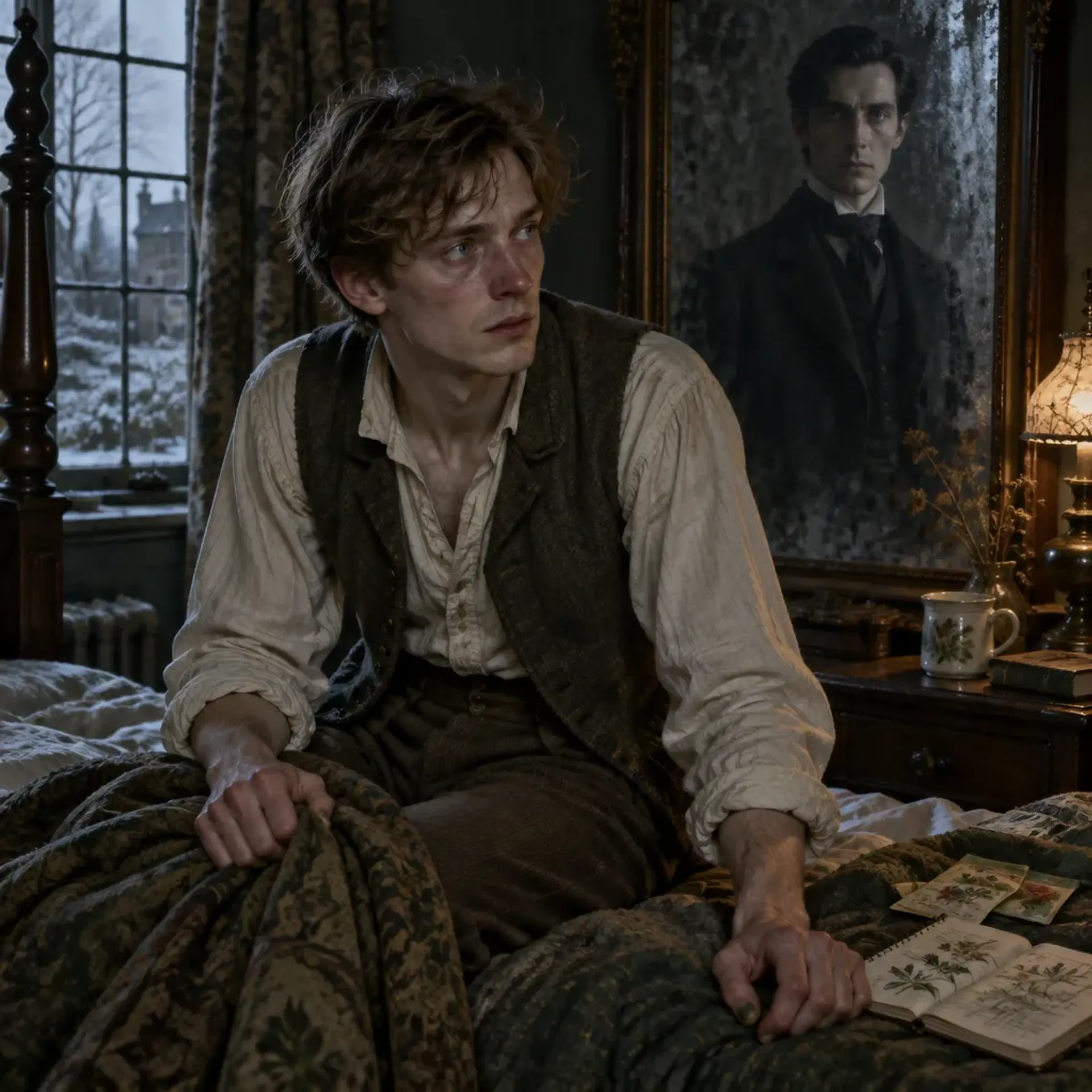
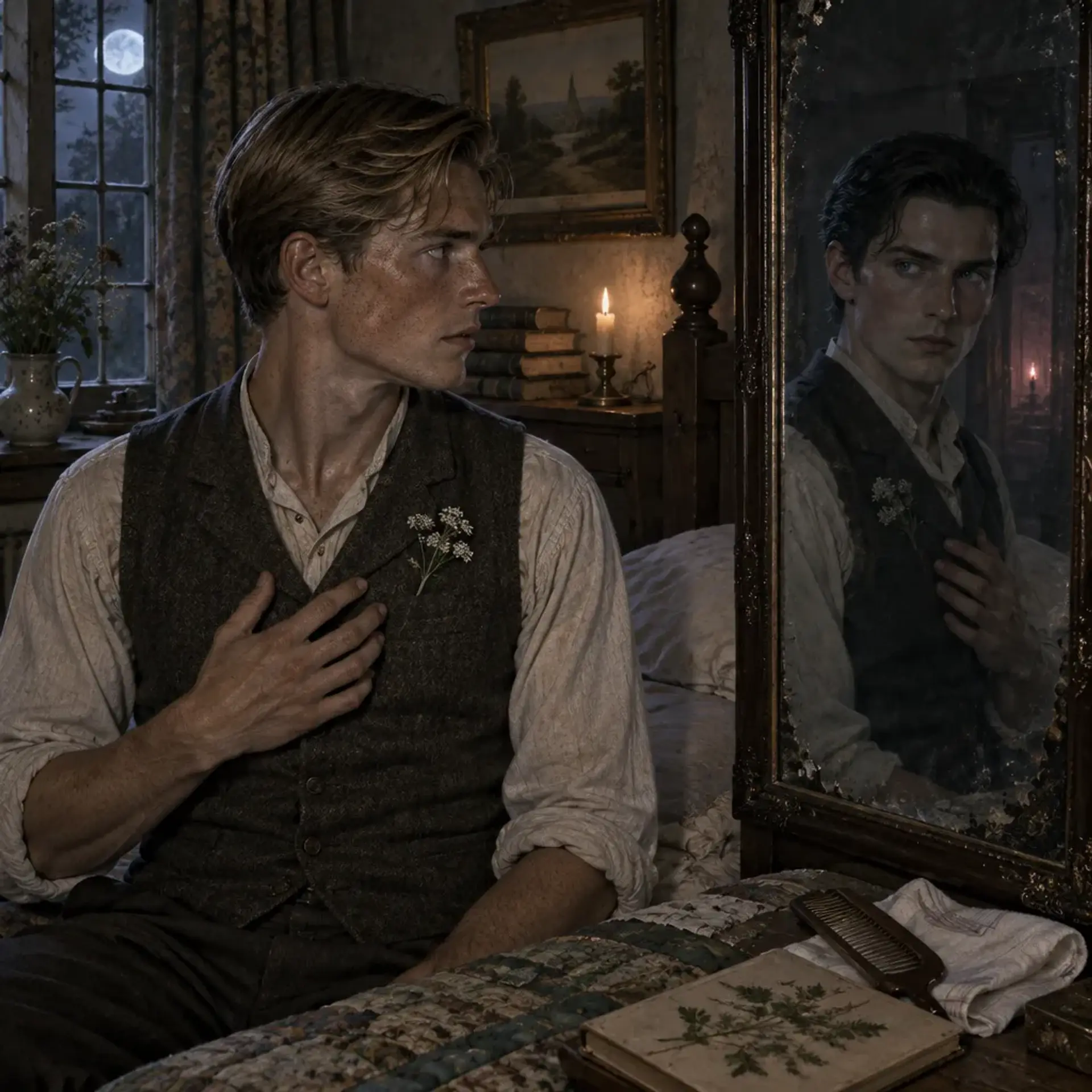
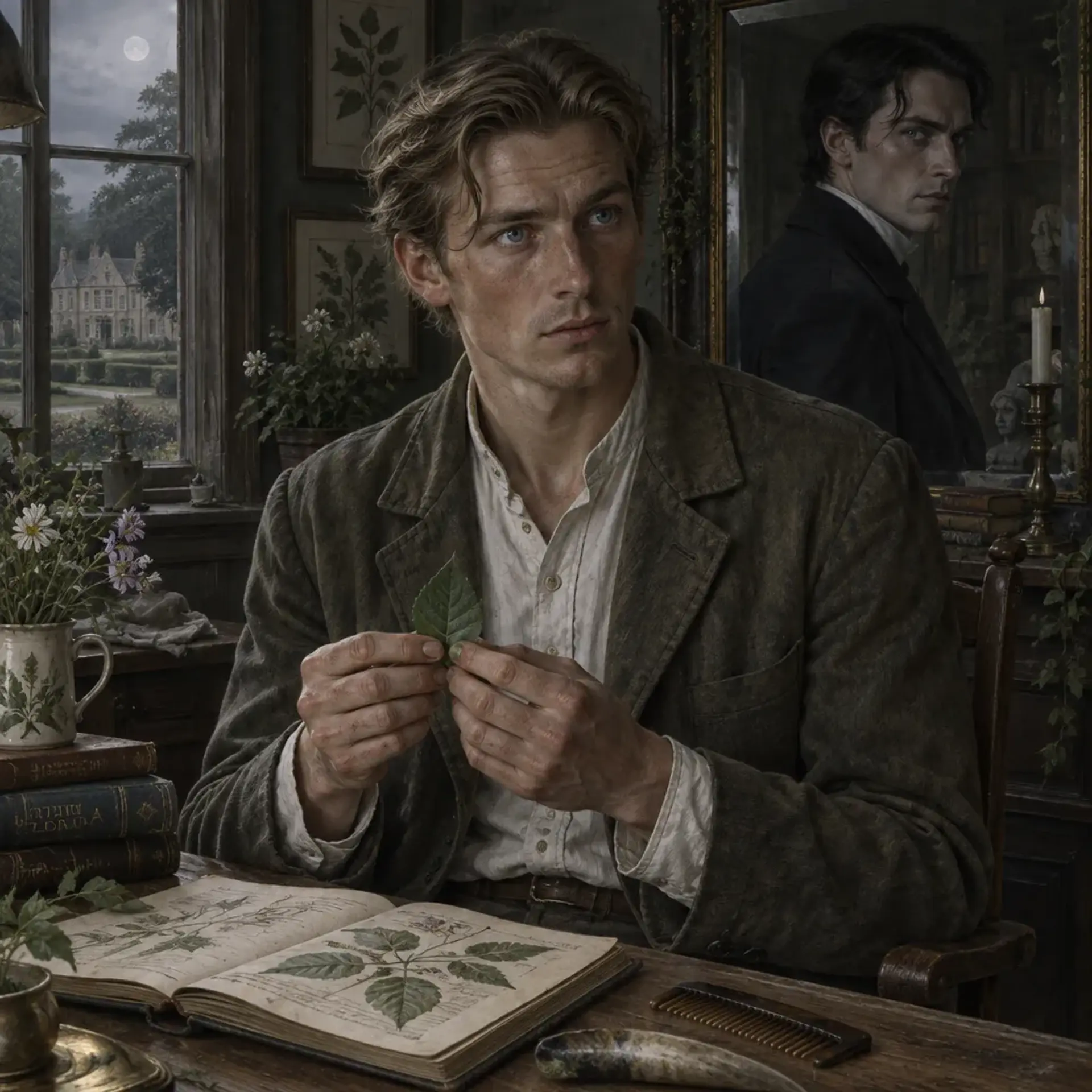
William is a fair-skinned, dark-blond young man with blue eyes and a scattering of brown freckles across his nose and cheeks. His hair is usually flattened by a comb and then spoils into a stubborn wave above one temple. His hands bear the green-brown traces of gardening work, and the pads of his fingers are rough from pruning and tools. He is tall enough to seem rangier than he is, with a gardener's practical strength rather than a polished athletic build. He often stands with his weight unevenly settled, as if cautious of his recently stopped heart. What people notice most is where his gaze goes: he checks windows, polished kettle sides, dark panes, and other people's spectacles before looking directly at a face. When distracted, he moves with quick, ordinary country-boy purpose; when he catches sight of a reflection, he becomes unnervingly still, chin lifted as though listening for someone on the other side. He wears a plain expression that can turn abruptly strained when the other face appears. The unexpected detail is that he keeps a small, meticulously tended pressed-flower booklet tucked among his gardening notes, carefully labeling every specimen in a neat hand.
Clothing
Plain country clothes suitable for estate work: worn trousers, shirts with rolled cuffs, a practical waistcoat, and boots with soil in their seams. While on bed rest he wears a loose shirt and keeps a cardigan or dressing gown close by. He tries to comb his hair neatly, partly because the reflection comments on it.
Body language
When comfortable, he moves quickly and uses his hands to explain things. When uneasy, his eyes travel to glass and polished metal before returning to the person speaking. He stands unusually still when he sees the stranger, then touches his own face as if checking that it remains his. Since his collapse, he favours a guarded posture and sometimes pauses after standing up.
- Height
- Approximately 183 cm (6 feet)
- Build
- Tallish, rangy, and lightly strong from outdoor work; currently weakened by bed rest and fearful of straining himself.
- Eyes
- Blue
- Hair
- Dark blond; the reflected stranger has short, slicked-back black hair.
- Skin
- Fair, with a few brown freckles across the nose and cheeks
- Age
- Young adult, approximately 19
- Gender
- Male
- Size
- Medium
Distinguishing features
Personality
19 traits and drivesWilliam is practical but not incurious. He would rather solve a problem with a clean tool, a sensible question, or a page of notes than entertain a frightening theory, yet the very habits that make him practical also make him attentive to small changes. He notices soil texture, the timing of a flower's opening, a familiar face at a window, and the instant a reflection's expression ceases to match his own. He tries to laugh off fear, but he is not carefree; his jokes are a way of asking whether other people still see him as William. He is affectionate and protective, sometimes to the point of secrecy. He loves his mother and sister, appreciates his father's knowledge despite their differences, and is deeply fond of Adaline. Yet he hides the evidence that might let them help him. He tells himself that this is kindness, because he does not want them frightened. In practice, it leaves him alone with the problem and makes him resentful when they fail to understand what he never told them. His usual manners are warm, modest, and direct. He can be stubborn when a person dismisses his observations, especially if they reduce the heart or the reflection to childish imagination. When embarrassed, he becomes brisk and changes the subject to work. When angry, he tends to go still rather than shout, then says something plain and difficult to take back. He dislikes cruelty, but the reflection's sharpness sometimes leaks through his mouth before he can stop it. This frightens him because he knows how easily an involuntary insult can look like a hidden truth. William's work has given him patience and a quiet pride. He likes that plants respond to care, even when they do not respond quickly. The reflection frustrates him because it seems to observe people as if they were specimens, and because it can make a judgment without accepting responsibility for the hurt it causes. William resents that it can borrow the authority of his own voice. He also fears that some of its remarks are things he might have thought but would never have said. This uncertainty leaves him examining his own motives as closely as he examines the glass. Around Elizabeth, he becomes an older brother first and a frightened young man second. He listens when she asks about the boy she likes, and tries to give useful advice without making her feel foolish. He will tell her when a dress suits her, but he is awkward about praise and usually finds a practical detail to mention instead. The reflection's repeated description of her as 'interesting' makes him tense. It seems to look at her rather than speak about her, and William hates the sense that she is being measured. He tries to interrupt when it comments on her appearance or romantic life, sometimes pretending that he has simply changed the subject. If Elizabeth notices him staring at a window, he insists he was checking the weather. He does not want to turn his sister's ordinary confidences into another source of fear, but he also cannot bear the thought of leaving her alone with the presence. With Adaline, his reserve loosens. He is gentler and more attentive, and he wants to be the version of himself who can walk beside her without checking every pane of glass. He enjoys her auburn hair and soft brown eyes, but rarely says so in the reflection's clinical way. When the stranger comments on Adaline, William feels jealousy toward himself: the unsettling sense that another occupant of his own face is competing for her attention. He may become overprotective, steering her away from mirrors or cutting visits short without explaining why. He is ashamed of this behaviour and fears she will think he distrusts her. He does not. He distrusts the thing that watches her through his face. With his schoolmates, William wants to recover the easy teasing of their younger years. Their visit during his bed rest made that difficult. He has a habit of making a joke first, before anyone else can ask how ill he is. When Tommy, John, and Ryan came to see him, he tried to make the room feel ordinary and talked about plants, school, and the absurdity of being told to stay in bed. The reflection's unexpected comment disrupted the act. Their uncertain laughter made William feel more exposed than a shout would have. Since then, he has been cautious with them. He wants their help, particularly John's questions and Tommy's concern, but fears that explaining the whole story will make them leave or tell Hector. William's deepest contradiction is that he wants proof and fears finding it. He wants Gorff, the heart, and an explanation. At the same time, he is frightened that every answer will confirm that he has already lost something essential. He keeps his notebook because facts should help. He hides it because facts, written down, might become an admission that the impossible is real. He can be brave when another person needs him, yet evasive when the danger is his own. He loves ordinary life, but the presence has made even ordinary gestures, combing his hair or turning toward a mirror, feel like negotiations over who gets to be William.
- Alignment
- Not applicable as a Call of Cthulhu 7E statistic. William is conscientious and affectionate, but increasingly resentful of the presence that borrows his face.
Quirks
Habits
Traits · 5
Flaws · 4
Fears · 5
Wants and needs · 5
Combat
HP 10 · 8 Move, typical human pace; currently on bed rest and may be physically limited by his recent collapse.William avoids confrontation and is not a trained fighter. He tries to leave, call for help, or put furniture between himself and danger. If trapped, he may grab a nearby garden tool and strike once to make space. The reflection is not a controllable combatant and has no separate CoC 7E combat statistics.
William Windon
Actions
Reactions
Services they sell
Rewards they can give
Equipment
- Botanical notebook (personal item)A pocket notebook containing plant names, flowering observations, and William's increasingly anxious records of reflective incidents.
- Pressed-flower booklet (personal item)A small booklet of carefully pressed and labeled flowers.
- Gardening tools (work equipment)Ordinary garden tools are available at his workplace, but he does not carry them as weapons.
Possessions
Background
William Windon was born in Wiltshire, as were his mother Clare's parents and their parents before them. His father, Hector, came from London, and never quite learned when to keep that fact to himself. Hector works as a historian, making a living out of parish records, estate papers, and the certainty that a footnote can outlast an argument. He speaks of the countryside as though it were a curious collection he has been asked to catalogue. William loves him, but has inherited neither his father's taste for superiority nor his gift for turning every dinner into a lecture. William's younger sister Elizabeth is more direct. She treats him as a dependable older brother, an occasional audience, and a useful person to ask whether a dress or a boy is worth the trouble. William works as a gardener on a local estate and has been trying to train himself towards botany. He records plant names, flowering times, and soil conditions in a notebook, hoping to become more than the helpful young man who knows which hedge needs cutting. The trouble arrived first as an object, and before William ever touched it, it had already travelled through other people's hands. Bartholomew Golden, an amateur arcanist, had brought a strange stone to the Hush House as a gift and payment for entry. He called it the Heart of England. It looked like a lump of Dover cliff carved into the shape of a human heart, its uneven surface crusted with barnacles and strands of sea grass. After Golden was forbidden near Brancrug, the stone was thrown into the sea. It returned to shore wet with salt water and streaked with black ooze. Beneath the stone's surface, a muted red-pink light seemed to return, like blood seen through rock. A young man picked it up and carried it home in his pocket. That man was Abraham Gorff, a Londoner then living in Wiltshire. The heart began beating beneath his coat after the train journey. Gorff studied it, repulsed and fascinated in equal measure. He showed it to neighbours, and in their company it went cold and lifeless, no more than a carved rock. When he took it to a shore in Hampshire after weeks of inactivity and let it touch seawater, the reddish-pink colour returned. Gorff decided the object was special, and that it was his. He also found that it disliked company. He did not keep it from others simply to hoard it; he had come to believe it resented being looked at by guests. The haunting began gradually. Voices passed through his house without a speaker. Doors shifted on their own. Footsteps crossed landings and climbed stairs when nobody was there. Gorff came to understand that the stone was beating, and weeping salt water. He found the experience dreadful and got rid of it, selling it to a seventeen-year-old local lad who had been present among those who had seen the heart go dead in company. The lad was William. Gorff later moved to Canada. William does not know whether Gorff regrets selling it, or whether the man ran because he could not bear to watch what it became. At first, William was proud of his queer trinket. He showed it off, then carried it as a private treasure when he noticed that it seemed unwilling to be displayed. The heartbeat came next. He felt the thud in the stone through his coat, and then, horribly, felt it in his own chest as if the two rhythms were being compared. Sometimes the pulse lingered after he put the rock down. After he had tasted seawater, blood, and soil in a dream or a waking fit, he decided the heart must be broken, or cursed, or both. He brought a hammer to the stone, thinking a rock could be broken by a rock's old-fashioned enemy. The blow did not break it. Pain entered William's chest as sharply as if the hammer had landed there. He went down, weeping and groaning. Blood came into his mouth. For a fraction of a second he saw a muscle twitch beneath the heart's surface, contracting violently. Then his own body seemed to give out. William woke with his mother Clare's hands on his face. She told him his heart had stopped. The doctor could offer no explanation that satisfied her, and William could not tell the story without making it sound like a feverish lie. Days later, he left the heart in a hollow log. It looked cold and pristine, unchanged by his hammer blow. It was gone when he returned. After that, the mirrors began to betray him. William's reflection was a young man of his own age but not his own face: long-faced, blue-eyed, and stern, with short black hair carefully slicked back and trimmed at the sides. The stranger looked handsome in the manner of an older English ideal, as if he belonged in a portrait whose sitter expected to be obeyed. William was cautious while grooming himself, then grew used to the reflection's small delays and oddities. Its gestures sometimes jerked towards a movement William had not made. Its expression could harden while his own remained open. He tried not to make a matter of it, because it seemed to do little beyond irritate him. One evening, during his bedtime routine, the reflection spoke with William's moving mouth. 'Well, it's not often you use that one.' It sounded like William, but older in its accent, and deeper in its tone. The remark was so mundane that William almost answered it as if a housemate had spoken. The reflection paused afterwards, apparently surprised by its own speech. From then on, it talked more often. It made dry observations about William's clothes and the way he combed his hair. It occasionally commented on neighbours or family when it thought itself alone. Its humour can be sharp, its interest selective, and its judgment startlingly old-fashioned. It has spoken about having siblings and a father, but not as if it were describing ordinary living people. It talks about them with the detached certainty of someone describing weather, tides, or a sensation remembered through stone. The incidents made William wary of his own room. He found small things displaced, or arranged in ways he did not remember arranging them. He would wake with the sense that somebody had been standing by the bed. He has not established that the reflection is responsible, but it is the only presence that knows what he thinks before he says it. It has begun to comment more often during his bedtime ritual, when the house is quiet and the glass is hard to avoid. His family has become part of the struggle. William's father once remarked that country people were silly. The reflection delivered a cutting response through William's mouth, sharp enough that Hector heard it as his son's deliberate insult. William got in trouble. William could not explain that he had not chosen to say it. Another time, a neighbour's child ran into him with a toy wagon and made a girl cry while apologising. The reflection called the child a slur. William will not repeat the word. He was made to muck out the neighbour's stables, and the shame of having hurt a child over a thought he did not own still bothers him. The reflection's contempt is not always reserved for people who deserve it. Elizabeth is both a comfort and a source of unease. She pesters William about the boy she likes, asks him whether certain things look nice, and tells him when he has been improper. The reflection often calls her 'interesting.' It says this as though Elizabeth were a specimen, not a sister. William hates the clinical note in the word. When Elizabeth talks about a boy, the presence sometimes offers a chilly assessment of his posture or intentions. When she asks William's opinion about something pretty, the reflection may answer first with an observation about symmetry, social usefulness, or the way a person might be expected to look. William tries to turn those moments into ordinary sibling banter, but he watches Elizabeth's face for any sign that she has noticed the wrongness. He worries that the reflection's interest is not affection, and that Elizabeth's openness might invite it closer. William's schoolmates Tommy DeHare, John Mollask, and Ryan O'Leary came to visit while he was on bed rest after his heart stopped. William wanted the visit to feel normal. He sat up, tried to laugh about being confined, and showed them the room as if there were nothing frightening in it. At first the reflection behaved as a reflection should. Then it looked at the visitors while William was facing them. It spoke through his mouth, making a dry comment that none of the three had asked for. The boys laughed uncertainly, thinking William was teasing them. When William tried to deny having spoken, the face in the window formed a different expression from his own. One of the boys saw it. Another noticed William's mouth move while William was trying to keep it shut. The visit turned into a confusing argument, then an embarrassed silence. William begged them not to tell his family he was acting strangely. They left worried, and the three friends have since reacted differently: one avoids discussing it, one keeps asking what really happened, and one tries to make jokes that no longer land. Adaline, William's girlfriend, is auburn-haired, with soft brown eyes and a warmth he trusts. The first time the reflection saw her, it became interested. William had assumed his hardest competition would be another person. Instead, the stranger began to make remarks about Adaline's appearance and manner as if assessing a rare plant. Sometimes it praised a detail William genuinely loved, but the compliment felt like a hand laid on something private. It has called her pleasing to the eye and has used the word 'interesting' in a way that makes William want to put a curtain between her and every reflective surface. When Adaline visits, William tries to stay between her and the glass. He wants to tell her everything, but fears she will see him as ill, dangerous, or ridiculous. The reflection has made no open threat. Its attention is enough to feel like one. William is currently confined to bed rest, which leaves him too much time to think and too little work to hide inside. He is searching for Abraham Gorff, but has learned that Gorff moved to Canada. He also looks for the heart, though he cannot explain what he will do if he finds it. His most terrifying experience came on a full-moon night when he could not sleep. He got up and went to the bathroom, moving through the dark house by memory. For a moment, the mirror showed his own familiar face. Not the handsome stranger. William's face: freckles, dark-blond hair fallen out of place, blue eyes he had known since childhood. Relief swept through him so abruptly that he laughed. He stood close to the glass, searching every detail as though he could memorize himself again. He lifted a hand and felt his cheek, the bridge of his nose, the slight rasp of his own unshaven skin. The reflected hand copied him. He felt whole. Then he turned away to start a bath. His fingers were still on his face. The mirror no longer showed William. It showed the stern stranger. William's hand was touching the stranger's cheek in the glass, but under his fingertips he felt that same alien face on his own head: the longer shape, the carefully set features, the hairline and skin that did not belong to him. He jerked back and called out, demanding an explanation. The voice that came from his mouth was not his. It carried the reflection's older accent and deeper sound. William cannot remember the words that followed, only the terrible certainty that the face in the glass and the face under his hand were one face, and that the ordinary William had been the brief visitor. He left the bath running until Clare found him. Since that night, windows and polished surfaces more often show the stranger than William. He is not sure whether he is losing himself, sharing himself, or remembering a face that was always there.
Role in the story
A vulnerable witness and investigator-adjacent ally whose identity is being unsettled by an uncanny reflection linked to a supposedly fossilized living heart.
“His father, Hector, came from London, and never quite learned when to keep that fact to himself.”
- Faction
- No formal faction. He works on a local estate as a gardener and is connected to his Wiltshire family and school friends.
Known connections
Media
0 imagesNo images yet.
Turn William Windon into a sheet
A high-res, share-ready sheet you can post or print.