William Windon
William Windon
At the table
Voice
William's ordinary voice is clear and youthful, with a country inflection and a slight breathlessness since his collapse. He often draws breath through his nose before speaking, as if preparing to make a careful point. The reflection's voice comes through his throat with a more settled, older cadence; the consonants seem clipped and its dry pauses make even simple remarks sound like judgments.
William speaks in straightforward, rural English, with practical vocabulary from gardening and estate work. He tends to explain observations literally and correct himself when he has overstated something. His voice catches slightly when he is tired after the cardiac episode. The reflection uses William's mouth but sounds older and more deliberate, with a deeper placement and an accent that seems to belong to an earlier generation. Its remarks are dry, exact, and often more personal than the setting warrants.
Speech patterns
How to play them
Approach William gently and give him room to answer in his own words. He is more forthcoming with someone who takes his physical recovery seriously and does not mock his fear. Ask about the heart through concrete details such as where it was kept or what it smelled like. Do not assume the voice is always his: watch his reflection and ask him to confirm what he meant. He will resist involving his family, but a direct threat to Elizabeth or Adaline may make him take reckless action.
Goal
Find Abraham Gorff or the missing Heart of England, understand the reflection's connection to it, and regain control of his voice and face without endangering his family.
Motivation
To keep the people he loves safe while proving to himself that he remains the person making his choices.
Appearance
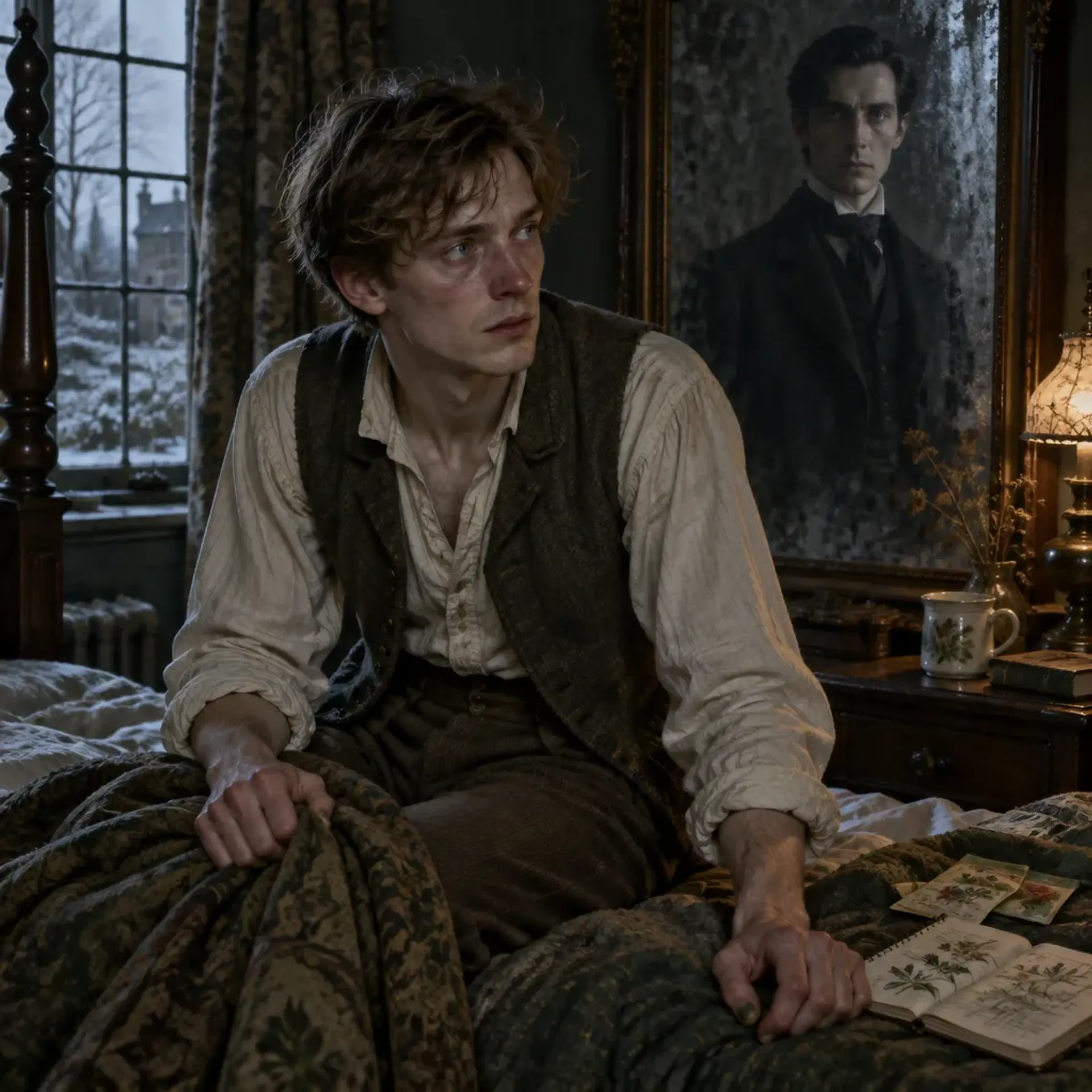
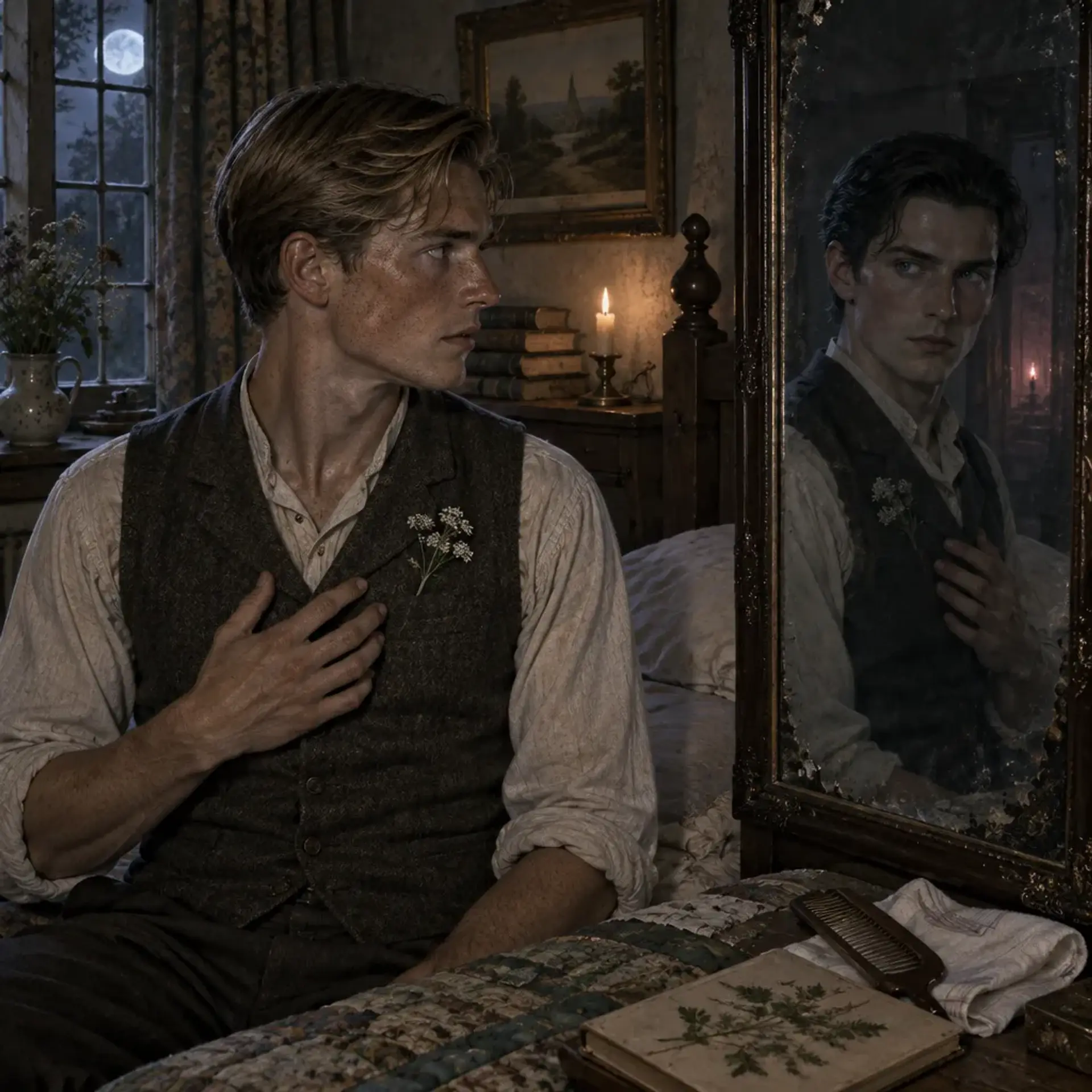
William Windon is a country-bred young man with a long, open face, a sun-browned complexion, and brown freckles scattered across his nose and cheeks. His dark-blond hair is usually combed neatly, though the effort shows: he checks the part, smooths the sides, then checks again as if the arrangement might betray him. His blue eyes are alert and candid until he catches a reflection; then they fix on it with a stillness that does not suit his age. His build is lean and growing into its height, with the wiry strength of someone accustomed to garden work rather than a soldier's bulk. He moves carefully now, pausing on stairs and placing a hand to his sternum after even modest exertion. His hands are roughened by soil and pruning, nails often shadowed with earth despite repeated washing. The unexpected detail is his fastidious grooming: he keeps a small comb and a clean handkerchief beside his bed, and is privately mortified by a muddy cuff or a crooked collar. People remember the contrast between his practical, earth-stained hands and his anxious care over his appearance, and the way his gaze checks every pane of glass in a room.
Clothing
Practical country clothes: a clean shirt, waistcoat or work jacket, sturdy trousers, and boots that tend to carry traces of garden soil. On bed rest he wears a dressing gown over a shirt and keeps his collar straight. He cares more than he admits about looking presentable, especially when Adaline visits.
Body language
When comfortable, William leans forward and speaks with his hands, palms open and often faintly stained with soil. Since his collapse, he guards his chest with an unconscious hand and turns slowly when standing. Around reflective surfaces his posture becomes rigid; he angles himself away while stealing glances. When the reflection speaks, his jaw tenses and his lips press together as though he is trying to hold a door shut.
- Height
- Approximately 5 ft 10 in (178 cm)
- Build
- Lean, wiry, and moderately tall, with the practical strength of an estate gardener, currently weakened by recovery from cardiac arrest.
- Eyes
- Blue
- Hair
- Dark blond
- Skin
- Fair, weathered and lightly sun-browned, with brown freckles across his face
- Age
- Young adult, approximately 19
- Gender
- Male
- Size
- Medium human
Distinguishing features
Personality
19 traits and drivesWilliam is curious enough to study a strange plant for an hour and cautious enough to refuse to touch the same plant once he learns it may be poisonous. He wants independence, yet he leans on his family more than he likes to admit, especially since his heart stopped. He is practical about work and plants, but becomes uncertain when forced to explain an experience no one else believes. With friends he tries to be easygoing and funny; when frightened, he grows precise, recounting small details as if accuracy might keep terror from becoming real. He is proud of being useful, but embarrassed by his present weakness. He cares deeply for Adaline, yet the reflection's attention to her has made him jealous of his own face. He wants to protect Elizabeth from danger and also resents her habit of treating him as a convenient adviser. He is patient with seedlings, impatient with condescension, and anxious about manners in a way that conflicts with his earthy, work-worn life. When he is alone, he can speak to the reflection with bitter familiarity. When someone else is present, he denies everything until the denial becomes impossible.
Quirks
Habits
Traits · 5
Flaws · 4
Fears · 5
Wants and needs · 5
Combat
HP 10 · Standard human movement; currently restricted by bed rest and recovery. Use the Keeper's judgment for ordinary movement rather than treating him as combat-ready.Avoids combat. William seeks a door, calls for help, or tries to calm an aggressor. If cornered, he may use a shove or improvised object, but his recent cardiac arrest makes exertion dangerous. The reflection's occasional interference is a scenario-specific complication, not a reliable combat power.
William Windon
Actions
Reactions
Equipment
- Pocket comb (personal item)A pocket comb he uses compulsively when anxious and keeps close to his bed.
- Observation notebook (evidence)A small notebook recording when the reflection appears and what it says. Several pages are deliberately left blank.
- Handkerchief (personal item)A clean handkerchief, often folded precisely and used to wipe soil from his hands or sweat from his brow.
- Work hammer (tool)The hammer used against the heart. William avoids handling it and cannot explain why the stone showed no damage.
Possessions
Background
William Windon was born in Wiltshire, into a family that had lived among its lanes and fields for generations. He grew up knowing the practical names of plants before he knew what he wanted to do with them: which weeds marked poor soil, which hedges flowered early, where frost settled first. His father, Hector, is a historian, and William learned from him that the past could be approached through patient looking. He did not inherit Hector's taste for argument or his confidence in the importance of old records. William would rather put his hands in a bed of damp earth and see what survived. He found work as a gardener on a nearby estate and hoped to train as a botanist. The job suited his curiosity and gave him a small measure of independence. It also gave him a reason to imagine that his life would widen beyond the familiar village. His mother, Clare, has always been the one who notices when he is tired before he admits it. His younger sister, Elizabeth, treats him as a mixture of brother, confidant, and unwilling audience for her romantic troubles. William complains about her interruptions, but he listens. He is still learning how to be kind without sounding as though he is correcting her. The strange object entered his life through Abraham Gorff, a London man who had come to the region and acquired a thing he called the Heart of England. Gorff said an amateur arcanist named Bartholomew Golden had left it at the Hush House as payment for entry, wrapped in newspaper. Golden was never allowed near Brancrug again. The object looked less like a relic than a piece of the cliffs of Dover crudely carved into the shape of a human heart. Barnacles and sea grass clung to its uneven surface. It was cold, unlovely, and apparently dead. It had also been thrown back into the sea and returned to shore, weeping seawater, salt, and a black ooze from its seams. Beneath the stone, a reddish-pink color seemed to show through, like blood or a light seen under a closed door. A young man picked it up and carried it home in his pocket. That man was Abraham Gorff. On the train inland, the stone beat beneath his coat. It had come with him to Wiltshire from London, and he became convinced it was special. Showing it to neighbors seemed at first a harmless way to prove the point. But in company the heart stopped. It was merely a queer rock, and Gorff's claims sounded ridiculous. When he brought it to a shore in Hampshire after weeks of inactivity and immersed it, the stone flushed red-pink again. Gorff concluded that it disliked an audience. He stopped letting people see it, not simply from greed but from the eerie sense that it had preferences of its own. As time passed, Gorff's house filled with unexplained sounds: voices without a speaker, footsteps in empty corridors, doors opening and closing. He came to understand that the object was beating and weeping salt water. The experience frightened him enough to get rid of it. He sold it to a seventeen-year-old local boy, William, one of the people who had seen the stone when it seemed dead. Gorff has since moved to Canada. William does not know where, or whether Gorff is hiding from the heart or merely trying to forget it. William was proud of his strange purchase until he began to feel its beat inside his chest. The rhythm sometimes matched his own and sometimes seemed to correct it. After tasting the ocean in his mouth, then blood and soil, he decided the stone was dangerous. He brought a hammer to break it. The first blow did not leave a visible mark on the stone, but pain struck through William's chest as sharply as if he had hit himself. He collapsed, groaning, with blood in his mouth. For a fraction of a moment he saw muscle twitching beneath the rock's surface. Then his own body seemed to fail. He woke with Clare's hands on his face and heard that his heart had stopped. The family and local doctor treated the episode as a medical emergency; none of them could account for the timing of the blow or the strange object. A few days later, William hid the heart in a hollow log. When he checked, it looked cold and pristine, apparently untouched by the hammer. He could not bring himself to take it home. He also could not bring himself to tell his family the whole story. He kept the discovery to himself and tried to return to ordinary routines, though the heart had already followed him somewhere more intimate than a pocket. His reflection was not his own. At first, the glass showed a young man of roughly William's age, long-faced, handsome by the tidy English standards William had been taught to admire, with short black hair combed slickly back and trimmed at the sides. The stranger's eyes were a clear blue, like moonlight on a still freshwater pond. Its expression was stern, and it held itself with a confidence William did not recognize. William became cautious while grooming, afraid that a careless movement might invite some exchange. For a while the reflection only irritated him. It would jerk toward a different angle, or stand too stiffly while William tried to shave or arrange his hair. He tried to ignore it, telling himself the episode and the heart had left him overwrought. One evening during his bedtime routine, William watched the reflected mouth move when his did not. In William's own voice, but with an older generation's accent and a deeper, more deliberate sound, the stranger said, “Well, it's not often you use that one.” The remark concerned William's comb, which he had taken up with his left hand. The reflection paused afterwards, apparently as surprised by having spoken as William was. The line was small and almost funny, which made the terror worse. A voice had come from his face without his intention. After that, the reflection grew bolder. It commented on his clothes, his hair, and his manners. It observed that his jacket sat badly at the shoulder, that he had chosen a dull tie, or that he was polishing his shoes for someone who would not notice. It sometimes interrupted him when it judged what he was about to say improper. The correction could be more embarrassing than the original remark. When William passed a window, a dark screen, or a polished kettle, the stranger increasingly appeared where William expected himself. It also began to move objects in his room during the night. William would wake to find a comb turned at right angles, a book shifted to the far side of the table, or his clothes set out in a different order. He could not prove the reflection was responsible, but the arrangement always seemed to express an opinion. The first time William's schoolmates Tommy DeHare, John Mollask, and Ryan O'Leary visited, he hoped their presence would make the house feel normal. At first the reflection stayed quiet. The boys crowded into William's room, joking about his enforced bed rest and asking after the heart. William did not tell them where he had hidden it. When Tommy leaned toward the mirror to inspect his own hair, the stranger in the glass turned its head to watch him while William remained still. John noticed and asked why William had not moved. William tried to laugh it off. The reflected man then lifted one hand and tapped the glass from the other side. The sound came from the mirror, though no hand touched its surface. Ryan backed away. Tommy swore that William had been standing perfectly still. John tried to inspect the frame and the wall behind it. William, flushed with shame and fear, told them it was a trick of light. Then the reflection spoke through William's mouth while William was trying to deny it. It made a dry, cutting observation about the boys' muddy boots and asked whether they had come to see an invalid or a sideshow. William felt his jaw move without his consent. The boys heard the words come from him, but saw the stranger's expression in the mirror. Their laughter died. Tommy demanded that William stop; Ryan went to fetch Clare. John stayed, pale and watchful, insisting later that William's mouth had shaped every syllable. Clare found them arguing and the reflection was once again still. The visit ended with three friends leaving uncertain whether William was ill, joking, or possessed. They have not agreed on what they saw, and William has not asked them to return together. The event cost him more than privacy. William now fears that his friends may treat him as a danger, but he also resents the reflection for using his mouth to drive them away. His father, Hector, has been skeptical of rural superstition and once remarked that country people could be silly about old stories. The reflection answered with a cutting remark about Hector's certainty and his habit of mistaking a footnote for wisdom. William was punished for the outburst, and the argument at home became another thing the stranger could use to divide him from his family. It has been no kinder to the neighbors. After a neighbor's child ran into William with a toy wagon and accidentally made a girl cry while apologizing, the reflection used a slur against the Welsh child. William did not choose the word and will not repeat it. The neighbor heard it, and William had to muck out the neighbor's stables as an apology. He did the work without complaint, ashamed both of the insult and of the fact that his family could not prove he had not meant it. The incident sharpened his fear that the reflection's voice could make his worst possible impression of himself into public fact. Elizabeth has become a particular fascination. She pesters William about the boy she likes, asks his opinion on clothes, and scolds him for poor manners. He pretends to be exasperated, but enjoys being trusted with her confidences. The reflection listens with an attention that makes William's skin tighten. When Elizabeth asks what suits her, it may say, “That one is less likely to make you look as though you are asking permission,” or, “You should wear the green. It makes people think you have already decided.” Sometimes the advice is unexpectedly useful. Sometimes it is too intimate, as if it knows the shape of Elizabeth's hopes before she has admitted them. Its most frequent response to talk of her is a thoughtful, “Interesting.” William cannot tell whether that is admiration, appetite, or a warning. He tries to keep Elizabeth away from mirrors without making her suspicious, and this makes her think he is being needlessly controlling. Adaline, William's girlfriend, has auburn hair and soft brown eyes. The reflection noticed her immediately. William had imagined that the greatest challenge to his relationship would be his awkwardness; instead, he found himself competing with the face he could not leave at home. The stranger watches Adaline through windows and mirrors, studying what makes her smile. When she visits, it may criticize William's collar or his clumsy greeting, then offer a wry aside about how much effort people expend pretending not to want what they want. It has called her pleasing to the eye, a phrase that made William feel as though she had been appraised rather than greeted. It has also asked, through William's mouth, whether she likes the sound of his voice or merely the face attached to it. William has tried to apologize to Adaline for every cruel or unsettling remark. She can see when he is frightened, but she cannot be sure when he is speaking for himself. On one visit, she reached to straighten his collar and the reflection leaned toward her before William did. Adaline pulled her hand back. William was left explaining that he had not moved. The stranger's attention to her has become a source of jealousy as well as fear. It wants her attention, though William cannot tell whether it wants affection, possession, or simply to test the limits of its influence. The reflection's comments about Adaline vary from sharp teasing to disconcerting scrutiny: “She watches your hands when you speak,” it once said. “You should decide whether that comforts you.” William hates that the observation was true. William is now on bed rest following the cardiac arrest. The restriction leaves him with time to worry, study the reflection, and search for Abraham Gorff, whom he has learned moved to Canada. He wants to find the heart or the man who sold it, but the heart has disappeared from the hollow log. He does not know whether someone took it, whether it returned to the sea, or whether it is somewhere in the house. He has begun recording the reflection's remarks and the times they occur, hoping to find a pattern. He does not write down everything. Some of the stranger's comments about its father and siblings feel less like memories of living people than descriptions of the ocean, a pressure, or a sensation. William has not shown those notes to anyone. One full-moon night, the reflection changed. William woke and went through his familiar bedtime routine, moving slowly because of his chest. In the mirror, for the first time in weeks, he saw his own face. His own dark-blond hair, his own freckles, his own blue eyes. Relief came so quickly that he almost laughed. He raised his hand to touch his cheek and felt the ordinary warmth of his skin. Then he put his fingertips against the reflected face through the glass. The face beneath his hand was not his. It had the stranger's long jaw, cool smooth skin, and short black hair. His fingers met the mirror, but sensation told him he was touching a living face on the other side. William called out, asking what it had done and whether it was going to leave. The answer came in a voice that was not his: his own voice was gone, replaced by the reflection's deeper, older cadence. The face in the glass remained William's for one unbearable instant, then its mouth formed the stranger's expression. William could not tell whether he had been given his appearance back as a gift, a trick, or a demonstration. He stumbled away from the mirror and called for Clare. By the time she arrived, the stranger was back in the glass. William has never told anyone the entire sequence. He is afraid that describing the joy will sound foolish and describing the touch will make the thing more real. His life is now a narrow room between two possible explanations. He may be a sick young man whose terror has become a story he cannot control. Or the stone has joined its heartbeat to his, and something old is learning to speak through him. He still wants to study plants, still wants Adaline to trust him, and still feels responsible for Elizabeth. Those ordinary ambitions keep him anchored. They also give the reflection more people to study.
Role in the story
A recovering young gardener caught between ordinary family life and an intrusive supernatural presence. William can lead investigators toward Abraham Gorff, Bartholomew Golden, the Hush House, the missing Heart of England, and the question of whether the reflection is an entity, a symptom, or both.
“His father, Hector, is a historian, and William learned from him that the past could be approached through patient looking.”
- Faction
- No formal faction. He is attached to his family, his gardening work at a local estate, and his village community.
Known connections
Media
0 imagesNo images yet.
Turn William Windon into a sheet
A high-res, share-ready sheet you can post or print.