Friedreich
Friedreich
At the table
Voice
A dry, breathy rasp with crisp, disciplined German consonants and a slight hollow catch, as though speech must cross a damp threshold before reaching the listener. The formal cadence comes from his remembered cadet bearing; around the coven, it breaks into hesitant, ordinary phrasing.
His voice sounds as if it has passed through a narrow throat and a room full of damp wool: dry consonants, a faint breathy rasp, and an occasional hollow catch on names. He learned a formal, clipped cadence from the officer-like role he remembers, but scraps of ordinary Brandenburg speech emerge when he is tired. The name Friedreich itself comes out with a careful initial breath and a little friction on the final consonants. He does not sing or boom. Anger makes his consonants sharper and his sentences more blunt, while fear makes him over-explain procedures.
Speech patterns
How to play them
Treat Friedreich as someone testing whether a relationship can survive without performance. Give him direct, specific kindness rather than grand promises. He responds best to invitations that include a practical role, such as choosing a team or keeping watch, and dislikes being treated as a puzzle or a servant. If a character recognizes his borrowed face, let him ask what they remember before he reveals what he wants. Respect that his attachment to Wilhelm is genuine even if its origin is unknown.
Goal
Find evidence of his living identity without sacrificing the unforced bond he has with Wilhelm and the coven.
Motivation
To be recognized without stealing recognition from someone else, and to keep the people he loves from vanishing into the gaps in his memory.
Appearance
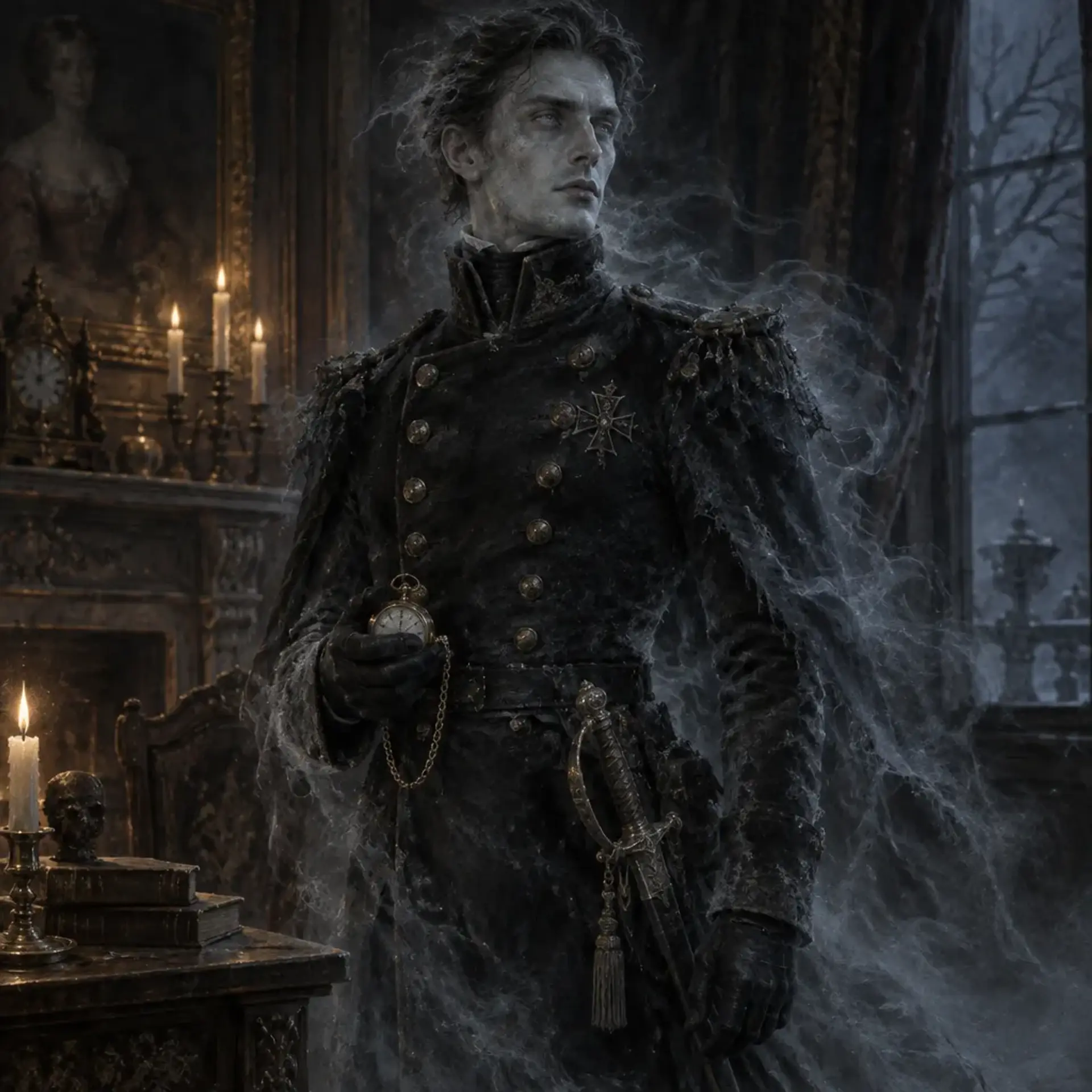
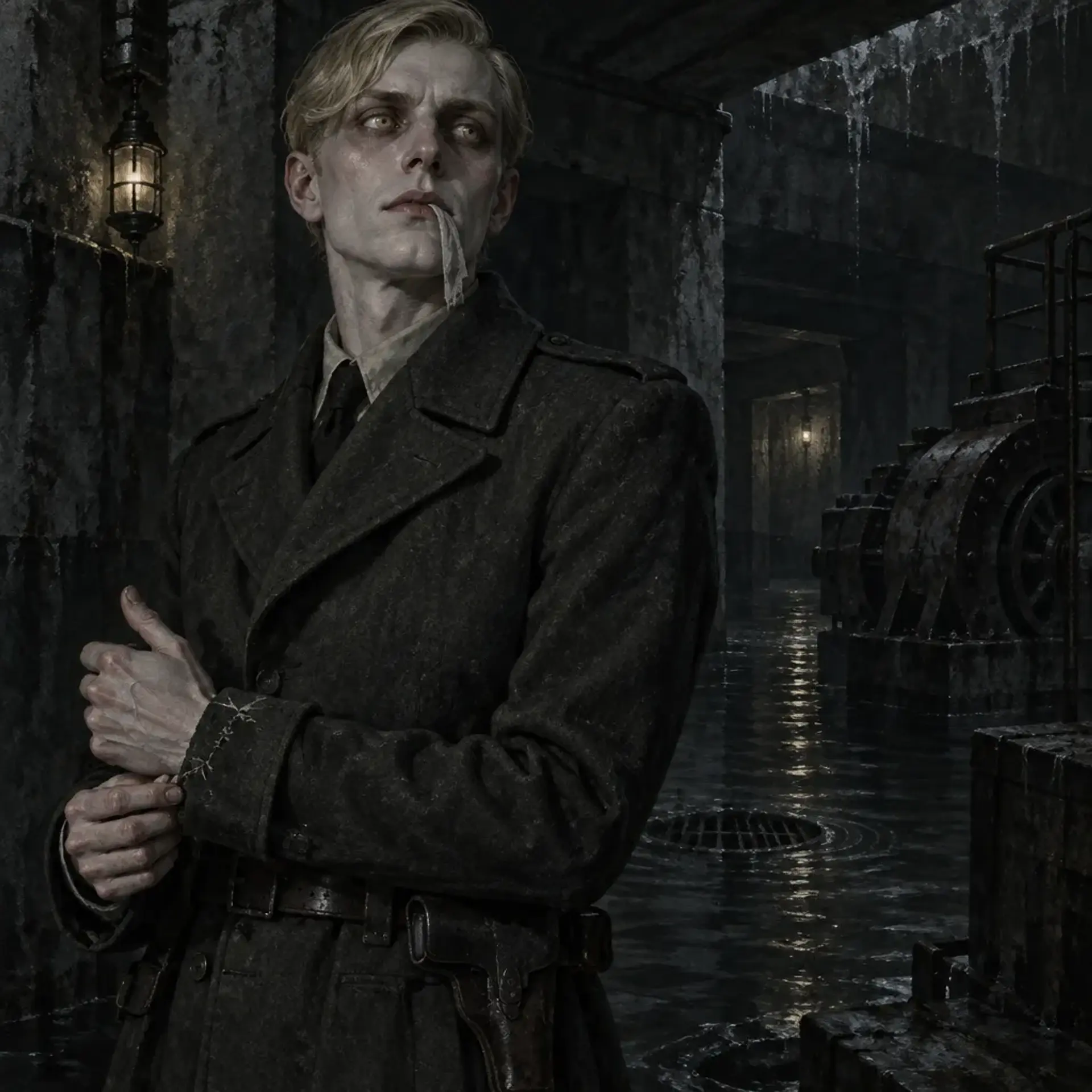
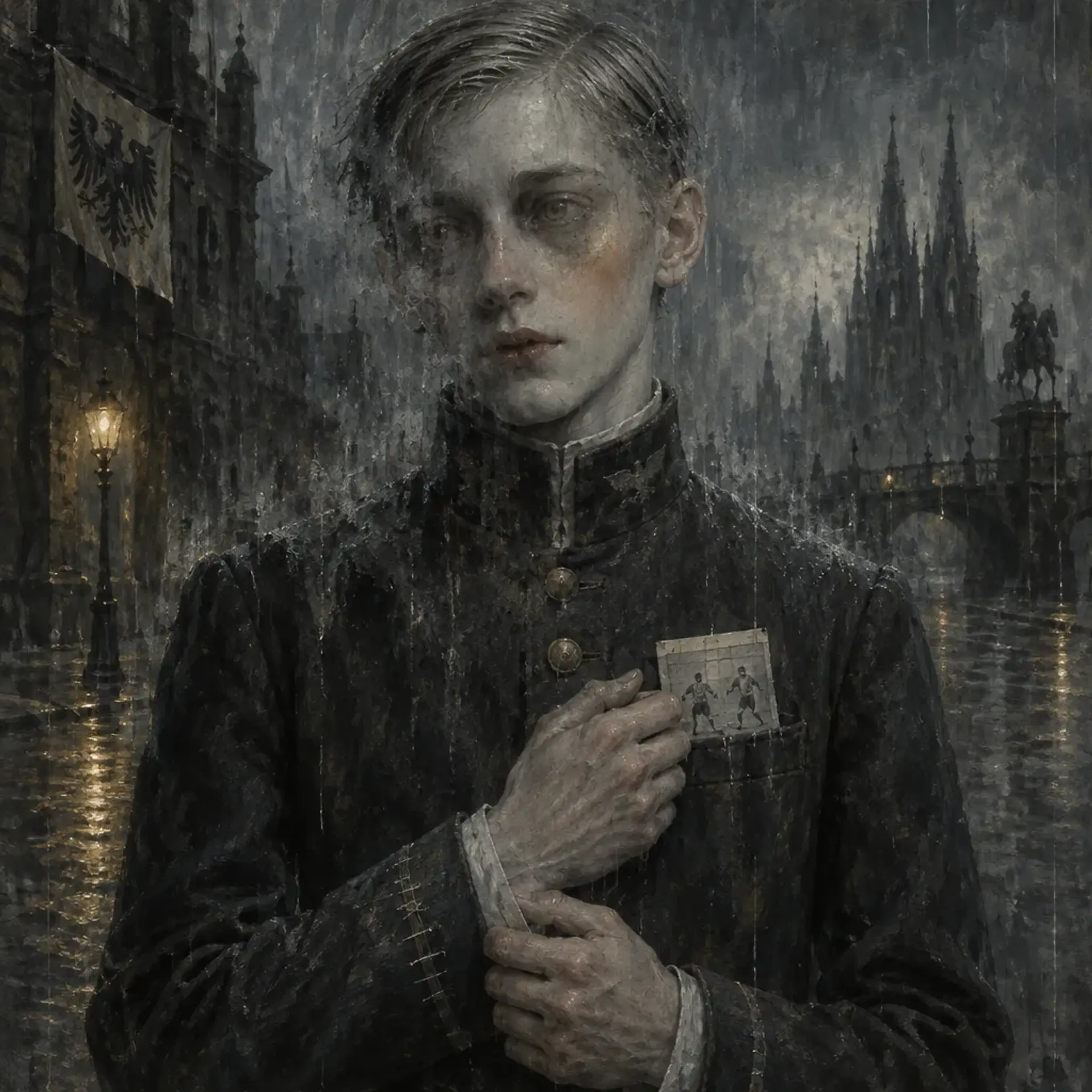
Friedreich looks like a young Prussian Junker cadet left out in a long Brandenburg rain: narrow-shouldered, upright, and too carefully arranged to seem relaxed. His skin has the grey, waterlogged cast of old paper, with fine dark stippling at the temples like soot worked into damp plaster. When the world loosens its grip on the dead, the skin briefly gains warmth and the shallow crease beside his mouth becomes visible; at other times his face is a blurred absence, as if a portrait had been scraped away. He moves in clipped, economical steps, stops with military precision, and sometimes turns his whole body toward a speaker rather than just his head. His borrowed faces sit almost correctly, but their expressions arrive a fraction late. He wears an old, over-cared-for pair of polished riding boots beneath a coat whose cuffs have been repeatedly darned in thread too pale for the cloth. Unexpectedly, he keeps a tiny paper football-table fixture tucked into his breast pocket and handles it with the tenderness of a child guarding a keepsake.
Clothing
A faded, high-collared Prussian-style coat with repaired cuffs, plain dark trousers, and immaculate old riding boots. The uniform is an impression assembled from memory rather than a historically exact garment. A folded paper football fixture sits in the breast pocket.
Body language
He stands as if a superior might inspect him at any moment: heels close, shoulders squared, hands held behind his back. When uncertain, one thumb rubs the seam of his cuff. With Wilhelm he sometimes forgets the pose and leans forward like a boy trying to hear a story. If threatened, he turns sideways, placing himself between danger and a companion without announcing the choice.
- Height
- About 170 cm when clearly manifested; his outline fluctuates when he is unseen.
- Build
- Lean and narrow, with the rigid bearing of a cadet and the weightless stillness of a ghost.
- Eyes
- Usually indistinct; when his face resolves, the eyes are a washed-out hazel that seems borrowed along with the face.
- Hair
- Ash-blond, close-cropped and combed with an old-fashioned side part; at times it blurs into the darkness around his head.
- Skin
- Grey-white like waterlogged paper, with soot-dark stippling near the temples; becomes briefly warmer in appearance when the boundary loosens.
- Age
- Appears seventeen or eighteen; his actual age and death date are uncertain to him.
- Gender
- Male
- Size
- Medium
Distinguishing features
Personality
15 traits and drivesFriedreich is courteous because courtesy is one of the few structures his memory has not lost, but he is not naturally gentle in every circumstance. He can be patient with fear and grief, having watched people endure both at close range, yet become rigidly intolerant when someone wastes another person's life through arrogance. He believes in duty and distrusts authority. The contradiction is not a performance: the old officer's posture is still in his body, while the dead man's experience has made him suspicious of every order that calls itself necessary. Among strangers, he is formal, watchful, and almost solicitous. He offers directions, remembers where people left their coats, and asks whether a person has eaten. These gestures are less an instinct for domestic kindness than a way of making himself useful before anyone can decide he is frightening. If a stranger treats him as a person without demanding a name, his courtesy warms into awkward humor. If they treat him as a tool, a ghost story, or an obedient servant, he becomes stiff and exacting. He will correct their manners with the disapproval of a small officer, then regret the correction when he sees that it has hurt them. With Wilhelm, the discipline loosens. Friedreich sometimes addresses him as a brother with startling certainty, then grows embarrassed and pretends he meant it as a joke. He is protective of Wilhelm, but the protectiveness has an uncomfortable edge. Friedreich may place himself between Wilhelm and a perceived threat without consulting him, and afterward insist that it was simply the correct position. He wants Wilhelm to remember him, while fearing that a recovered memory could make their present bond feel false. In moments of confusion, he watches Wilhelm's face for a clue about who Friedreich is supposed to be. Gunther's moss clothing puzzles and comforts him. He asks practical questions about seams, weight, and rainproofing, then quietly touches the fabric as if it might retain the warmth of a living forest. He respects Gunther's experience of Arcadia but is wary of stories that make a frightening place sound beautiful. He has learned not to demand explanations from Gunther about what happened there. Klaus receives a different kind of attention: Friedreich notices the insult hidden in a joke and often responds with a level, dry counterpoint. Yet when Klaus turns the same sharpness on him, Friedreich is more likely to wait than to retaliate. He interprets Klaus's hesitation as evidence of trust and does not see how much pressure that interpretation can place on him. At football gatherings, Friedreich is the closest he comes to being carefree. He takes the match seriously, even when he cannot see the pitch clearly, and will debate a referee's decision based on a whistle and the reaction of the room. He enjoys the ritual more than the result: people arriving, choosing seats, arguing, sharing food, and staying after the match. These ordinary repetitions feel like a life continuing beyond the moment anyone looks at him. If the coven is relaxed, he lets his humor show. It is dry, unexpectedly boyish, and often aimed at his own stiffness. If the room grows tense, he reverts to counting exits and assigning people places. Anger makes him more direct, not quieter or more polite. His voice becomes hard-edged, his borrowed face can slip, and he says exactly which behavior he considers cowardly or dishonorable. He is particularly angered by people who use another's grief to secure obedience. But he is not fearless or selfless. He may lie by omission, especially about his own memories, and he sometimes chooses the safety of a familiar role over the discomfort of being honestly unknown. He wants to be loved as Friedreich, yet he keeps offering people faces they might find easier to love. His deepest emotional conflict is between belonging and possession. The Shadow's temptation tells him that if a person recognizes him, he should make that recognition permanent by keeping them close, shaping their choices, and becoming indispensable. Friedreich resists this by making himself leave a room before he is asked, but that too can become a performance designed to earn reassurance. On a good day, he can admit that people are allowed to misunderstand him, leave him, or love him without explaining why. On a bad day, he treats those freedoms as a threat and hides behind the old dignity of the Junker boy he may never have been.
- Alignment
- Protective but possessive; duty-bound, though no longer sure who gave the orders.
Quirks
Habits
Traits · 4
Flaws · 4
Fears · 4
Wants and needs · 3
Combat
HP 7 · Ordinary walking pace when manifested; can pass through ordinary solid barriers as a wraith, subject to Wraith rules.Avoids a fair fight. He uses cover, borrowed appearance, and fear to create openings, then strikes once or withdraws. He positions himself between danger and a companion, especially Wilhelm, but does not charge blindly. He cannot use ordinary physical equipment as a living person would. Apply the chronicle's Wraith rules for Corpus damage, Pathos, and any Arcanoi in use.
Friedreich
Actions
Reactions
Services they sell
Rewards they can give
Equipment
- Cadet's coat and boots (apparel)A spectral impression of a Prussian-style coat and riding boots. They are part of his self-image, not ordinary protective gear.
- Folded football fixture (keepsake)A fragile paper football fixture he cannot remember making. It becomes crisp and tangible only when the boundary between worlds weakens.
Possessions
Background
Friedreich says he is from Brandenburg because the word still fits in his mouth. He cannot name a town, a family estate, or a year. He remembers a gravel drive, the smell of wet wool, and a gloved hand correcting the angle of his shoulders. He remembers being told that a young man of his station must be useful before he is liked. The memories have the thinness of a damaged photograph: when he reaches for a face, the features wash out, and he is left with the conviction that he was once expected to inherit something. He looks seventeen or eighteen when he is visible, though the dead do not age in the way he remembers, and no calendar has settled the question. His first clear memory after death is not his own death. It is standing beside a road while a column of soldiers went past, unable to make them see him. A boy in a muddy uniform dropped a small paper football fixture, and Friedreich tried to return it. His hand passed through the boy's shoulder. That failure became a pattern. He learned that when a living person expected to see someone familiar, he could sometimes borrow the shape of that expectation. The first face he wore belonged to a dead sentry; the man who saw it called Friedreich by a name he has since lost. The face held for only a few minutes, but the shock of being recognized was more powerful than any memory he had kept. Across the world wars, Friedreich found Wilhelm. Their histories are tangled in gaps. Wilhelm is a Tzimisce vampire from Mecklenburg, himself unable to recall his life before death. Friedreich has been near him as much as he could manage, sometimes as a stranger in a borrowed face, sometimes as a smear of cold air at the edge of a room. He remembers the first time Wilhelm looked directly at him and did not mistake him for anyone else. The recognition felt like finding a brother in a crowd after a lifetime of being sent to the wrong family. Friedreich cannot explain why he trusts Wilhelm, and Wilhelm cannot supply the missing reason. In the First World War, Friedreich sometimes remembers a breath: a chest expanding under a uniform, the sharp bite of winter air, and the humiliating relief of being alive. He does not know whether it is his memory or a memory he stole from a face. The wars taught him that uniforms can preserve a posture long after the cause has rotted away. He still thinks in terms of rank, duty, and formation, but the old certainty has failed him. He has seen orders lead men into mud and fire. He has watched people who called themselves enemies share cigarettes and bandages. In one formative episode, he borrowed the face of a young officer to reach Wilhelm during a bombardment. The officer's exhausted sister recognized the likeness and clung to Friedreich, believing her brother had returned. Friedreich stayed long enough to comfort her, then fled when she asked him to remember their mother's name. He has never forgiven himself for the relief he felt when she stopped asking. In the present, he belongs to an improbable coven of supernatural people who meet to spend time together and watch football. The word coven is casual, not a formal Wraith faction. Gunther, a changeling who spent much of his existence in Arcadia before returning to the ordinary world, sells clothes made from moss. Friedreich finds the garments impractical, damp, and oddly reassuring. Klaus is a ronin Get of Fenris, or perhaps a Skin-Dancer; even Klaus's account of himself changes depending on the company. He is passively aggressive with almost everyone, but his barbs falter around Friedreich. Friedreich treats this as evidence of a private bond, though he has never asked whether Klaus agrees. The coven's football nights give Friedreich a place to sit without having to perform a dead person's identity. He cannot always be seen, so Wilhelm or Gunther sometimes keeps an empty place for him, and someone explains the match aloud. Friedreich has developed fierce loyalties to teams he cannot reliably name and argues about fouls from memory. His current problem is that one of his borrowed faces has begun appearing in dreams and reflections before he calls it up. He fears it belongs to the person he was in life, but the face looks older than the boy he sees when the world unbinds. He is quietly searching for a living record of his death, while avoiding the possibility that his former family may still exist and would recognize him for the wrong reasons.
Role in the story
A recurring supernatural companion whose apparent identity is less stable than his loyalties. Friedreich can be an ally, a source of uncertain historical clues, or the emotional center of a story about memory, recognition, and the dangers of confusing care with possession.
“He cannot name a town, a family estate, or a year.”
- Faction
- An informal supernatural coven of friends. Friedreich has no confirmed membership in a canonical Wraith faction such as the Hierarchy, Renegades, or Heretics.
Known connections
Media
0 imagesNo images yet.
Turn Friedreich into a sheet
A high-res, share-ready sheet you can post or print.